Apac Asset Light Hospital Services Market Report Size, Share, Growth Drivers, Trends, Opportunities & Forecast 2025–2030

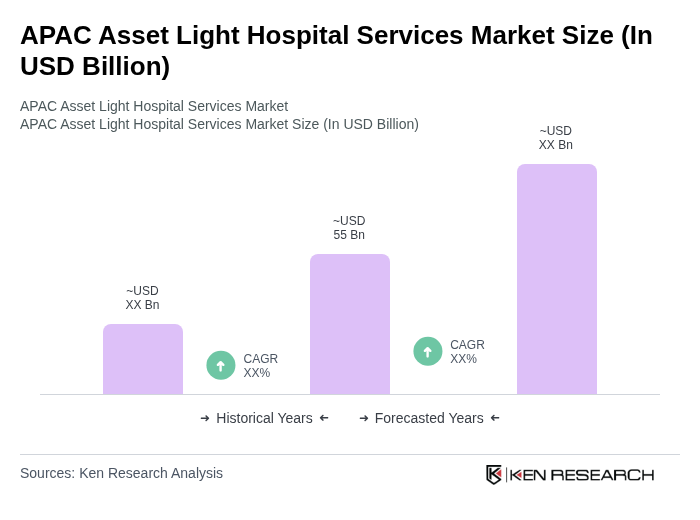
APAC Asset Light Hospital Services Market, worth USD 55 Bn in 2024, grows via demand for virtual care, chronic disease management, and aging populations in India, China, Singapore.

Region:Asia

Author(s):Rebecca

Product Code:KRAD5006

Pages:81

Published On:December 2025
About the Report

Base Year 2024

APAC Asset Light Hospital Services Market Overview

  • The APAC Asset Light Hospital Services Market is valued at USD 55 billion, based on a five-year historical analysis of asset-light and outpatient-focused delivery models as a subset of the broader Asia Pacific hospital services market, which generated revenue of about USD 1.44 trillion in 2024. This growth is primarily driven by the increasing demand for cost-effective healthcare solutions, the rise of outpatient and ambulatory services, and the expansion of telemedicine and virtual care across APAC. The market is also supported by technological advancements such as electronic health records, AI-enabled diagnostics, and remote monitoring tools that enhance service delivery, operational efficiency, and patient engagement.
  • Countries such as India, China, and Singapore dominate the APAC Asset Light Hospital Services Market due to their large and ageing populations, growing burden of chronic diseases, and sustained government initiatives aimed at improving healthcare access and digital connectivity. These nations have seen significant investments in hospital services, outpatient networks, and health IT infrastructure, including telemedicine platforms and diagnostic outsourcing, making them key contributors to asset-light service expansion and medical tourism in the region.
  • In 2023, the Indian government continued implementation of the National Digital Health Mission (now integrated under the Ayushman Bharat Digital Mission) launched by the Ministry of Health and Family Welfare, which aims to create a nationwide digital health ecosystem. This initiative, backed by the National Digital Health Mission Strategy Overview, includes creation of a unique digital health ID for citizens, registries of healthcare professionals and facilities, and standards for telemedicine, thereby promoting digital health services and teleconsultations and enhancing accessibility, continuity of care, and efficiency in healthcare delivery.
APAC Asset Light Hospital Services Market Size

APAC Asset Light Hospital Services Market Segmentation

By Service Type:The service type segmentation includes various subsegments such as Outpatient & Ambulatory Care Services, Day Surgery / Ambulatory Surgery Centers (ASCs), Telemedicine & Virtual Care Services, Diagnostic & Imaging Services (Asset-Light / Outsourced), Home Health & Hospital-at-Home Services, Rehabilitation & Post-Acute Care Services, and Outsourced Ancillary & Support Services. Among these, Telemedicine & Virtual Care Services is currently one of the fastest-growing components in the asset-light mix, supported by strong adoption of digital health solutions, high smartphone penetration, and expanding broadband coverage across APAC. The COVID-19 pandemic accelerated this trend by catalyzing regulatory support for remote consultations and reimbursement and by normalizing virtual visits as an integral part of healthcare delivery, particularly for follow-ups and chronic disease management.
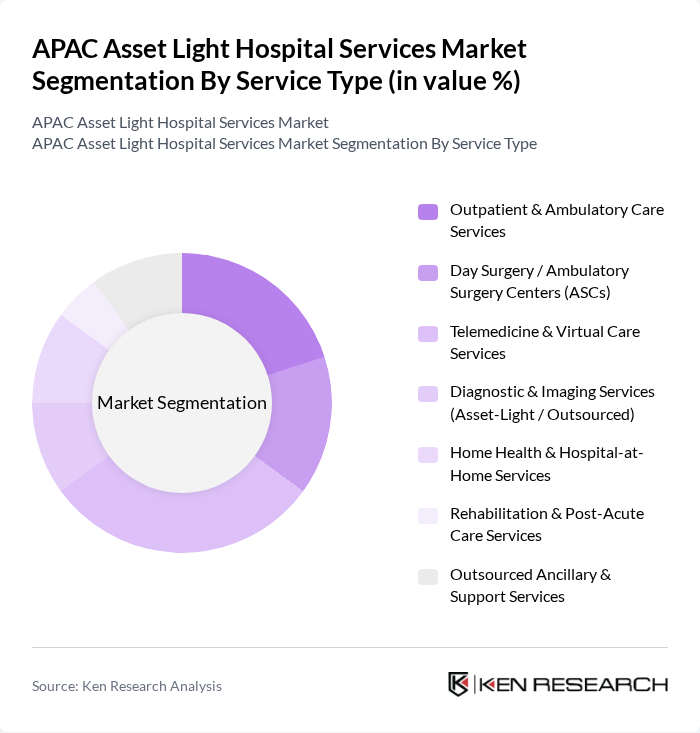
APAC Asset Light Hospital Services Market segmentation by Service Type.

By Patient Demographics:This segmentation includes Pediatric Patients, Adult Patients, Geriatric Patients, and Medical Tourists. The Adult Patients segment is currently the largest within hospital and outpatient services in APAC, reflecting the high prevalence of lifestyle-related and chronic diseases such as diabetes, cardiovascular conditions, and cancer in the working-age population, as well as rising insurance coverage and demand for convenient outpatient care. The growing awareness of preventive healthcare, increased use of health check-up packages, and employer-supported health programmes further drive this segment's utilization of asset-light and digitally enabled services.
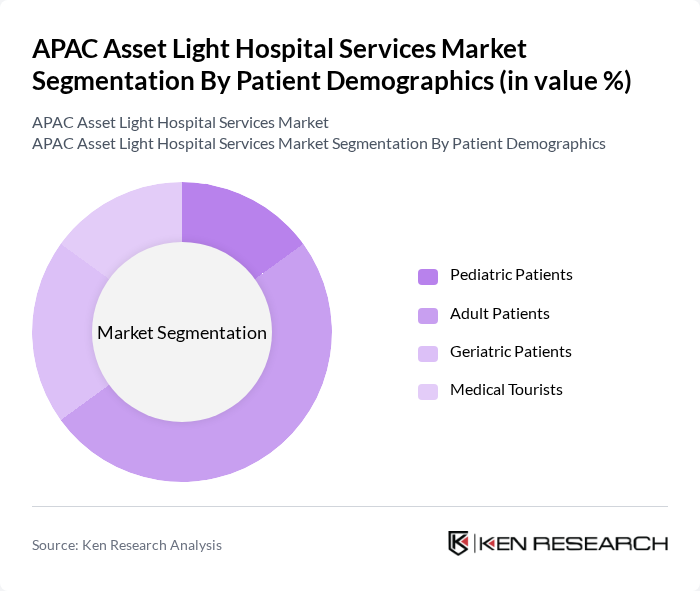
APAC Asset Light Hospital Services Market segmentation by Patient Demographics.

APAC Asset Light Hospital Services Market Competitive Landscape

The APAC Asset Light Hospital Services Market is characterized by a dynamic mix of regional and international players. Leading participants such as IHH Healthcare Berhad, Apollo Hospitals Enterprise Limited, Fortis Healthcare Limited, Narayana Hrudayalaya Limited (Narayana Health), Manipal Health Enterprises Limited, Max Healthcare Institute Limited, Bangkok Dusit Medical Services Public Company Limited (BDMS), Bumrungrad International Hospital Public Company Limited, Raffles Medical Group Limited, Parkway Pantai (IHH Healthcare Subsidiary), KPJ Healthcare Berhad, Ramsay Sime Darby Health Care, Healthway Medical Corporation Limited, Zuellig Health Solutions (APAC Health Services & Networks), Halodoc (Indonesia) contribute to innovation, geographic expansion, and service delivery in this space through models such as ambulatory centres, satellite clinics, diagnostic partnerships, digital platforms, and hospital-at-home offerings.

IHH Healthcare Berhad

1990

Malaysia

Apollo Hospitals Enterprise Limited

1979

India

Fortis Healthcare Limited

1996

India

Narayana Hrudayalaya Limited

2000

India

Max Healthcare Institute Limited

2001

India

Company

Establishment Year

Headquarters

Group Size (Unicorn / Large / Mid-Sized / Emerging)

APAC Revenue from Asset-Light Hospital Services

3-Year Revenue CAGR in Asset-Light Segments

Number of Asset-Light Facilities / Network Locations

Number of Active Digital Users / Teleconsultations per Year

Patient Acquisition Cost per New Patient

APAC Asset Light Hospital Services Market Industry Analysis

Growth Drivers

  • Increasing Demand for Cost-Effective Healthcare Solutions:The APAC region is witnessing a significant shift towards cost-effective healthcare solutions, driven by rising healthcare expenditures, which reached approximately $1.3 trillion in total health spending for East Asia and Pacific and South Asia combined in recent available data. With healthcare costs projected to increase in future, asset light hospital services are becoming essential. This model allows for reduced operational costs, enabling healthcare providers to offer affordable services, thus meeting the needs of a growing middle-class population seeking quality care without financial strain.
  • Rise in Chronic Diseases and Aging Population:The World Health Organization reported that chronic diseases account for 60% of all deaths in the APAC region, with projections indicating that in future, over 1 billion people will be aged 60 and above. This demographic shift is increasing the demand for healthcare services tailored to chronic conditions, driving the need for asset light hospital services that can efficiently manage patient care while minimizing hospital stays and associated costs.
  • Technological Advancements in Healthcare Delivery:The integration of advanced technologies in healthcare delivery is transforming the APAC asset light hospital services market. In future, investments in health technology reached tens of billions of USD, with telemedicine and AI-driven solutions leading the way. These innovations enhance patient care, streamline operations, and reduce costs, making asset light models more attractive to healthcare providers aiming to improve service delivery and patient outcomes in a competitive landscape.

Market Challenges

  • Regulatory Compliance and Licensing Issues:Navigating the complex regulatory landscape poses a significant challenge for asset light hospital services in the APAC region. In future, over 40% of healthcare providers reported difficulties in meeting local licensing requirements, which vary significantly across countries. This inconsistency can lead to delays in service delivery and increased operational costs, hindering the growth of asset light models that rely on streamlined processes and compliance.
  • Competition from Traditional Hospital Models:Traditional hospital models continue to dominate the healthcare landscape in APAC, with over 70% of patients still preferring established hospitals for their healthcare needs. This preference is driven by perceived quality and trust in traditional institutions. As a result, asset light hospital services face intense competition, requiring innovative strategies to attract patients and demonstrate the value of their cost-effective and flexible care options.

APAC Asset Light Hospital Services Market Future Outlook

The future of the APAC asset light hospital services market appears promising, driven by ongoing technological advancements and a growing emphasis on patient-centric care. As healthcare providers increasingly adopt telemedicine and AI solutions, the efficiency and accessibility of services are expected to improve significantly. Additionally, the rising focus on preventive healthcare will likely encourage more patients to seek early interventions, further expanding the market's potential. Stakeholders must remain agile to adapt to evolving patient needs and regulatory landscapes.

Market Opportunities

  • Expansion of Telemedicine Services:The telemedicine market in APAC is projected to reach $10 billion in future, driven by increased smartphone penetration and internet access. This growth presents a significant opportunity for asset light hospital services to enhance their offerings, providing remote consultations and follow-ups that cater to patient convenience and reduce the burden on physical facilities.
  • Partnerships with Local Healthcare Providers:Collaborating with local healthcare providers can enhance service delivery and expand patient reach. In future, over 30% of asset light hospital services reported successful partnerships that improved patient outcomes and operational efficiency. Such collaborations can leverage local knowledge and resources, creating a more integrated healthcare ecosystem that benefits all stakeholders.

Scope of the Report

SegmentSub-Segments
By Service Type

Outpatient & Ambulatory Care Services

Day Surgery / Ambulatory Surgery Centers (ASCs)

Telemedicine & Virtual Care Services

Diagnostic & Imaging Services (Asset-Light / Outsourced)

Home Health & Hospital-at-Home Services

Rehabilitation & Post?Acute Care Services

Outsourced Ancillary & Support Services

By Patient Demographics

Pediatric Patients

Adult Patients

Geriatric Patients

Medical Tourists

By Payment Model

Fee-for-Service

Subscription & Membership-Based Models

Bundled Payments & Episode-Based Care

Value-Based & Outcome-Linked Contracts

By Technology Utilization

Telehealth & Remote Monitoring Platforms

Mobile Health (mHealth) & Super-App Ecosystems

Cloud-Based Electronic Health Records & Practice Management

AI-Enabled Clinical Decision Support & Workflow Automation

Others

By Geographic Coverage

Tier?1 Cities & Metropolitan Areas

Tier?2 & Tier?3 Cities

Rural & Remote Areas

Cross?Border / Regional Networks

By Service Delivery Model

Home-Based & Remote Care

Standalone Clinics & Diagnostic Centers

Franchise & Network Clinic Models

Mobile Clinics & Pop-Up Facilities

Platform-Based Aggregators & Marketplaces

By Partnership Model

Public-Private Partnerships (PPP)

Managed Services & Outsourcing Contracts with Hospitals

Collaborations with Insurers & Corporates

Joint Ventures with Local Providers & Startups

Others

Key Target Audience

Investors and Venture Capitalist Firms

Government and Regulatory Bodies (e.g., Ministry of Health, National Health Service)

Healthcare Providers and Operators

Insurance Companies and Payers

Medical Equipment Suppliers

Pharmaceutical Companies

Health Technology Startups

Private Equity Firms

Players Mentioned in the Report:

IHH Healthcare Berhad

Apollo Hospitals Enterprise Limited

Fortis Healthcare Limited

Narayana Hrudayalaya Limited (Narayana Health)

Manipal Health Enterprises Limited

Max Healthcare Institute Limited

Bangkok Dusit Medical Services Public Company Limited (BDMS)

Bumrungrad International Hospital Public Company Limited

Raffles Medical Group Limited

Parkway Pantai (IHH Healthcare Subsidiary)

KPJ Healthcare Berhad

Ramsay Sime Darby Health Care

Healthway Medical Corporation Limited

Zuellig Health Solutions (APAC Health Services & Networks)

Halodoc (Indonesia)

Table of Contents

Market Assessment Phase

1. Executive Summary and Approach


2. APAC Asset Light Hospital Services Market Overview

2.1 Key Insights and Strategic Recommendations

2.2 APAC Asset Light Hospital Services Market Overview

2.3 Definition and Scope

2.4 Evolution of Market Ecosystem

2.5 Timeline of Key Regulatory Milestones

2.6 Value Chain & Stakeholder Mapping

2.7 Business Cycle Analysis

2.8 Policy & Incentive Landscape


3. APAC Asset Light Hospital Services Market Analysis

3.1 Growth Drivers

3.1.1 Increasing Demand for Cost-Effective Healthcare Solutions
3.1.2 Rise in Chronic Diseases and Aging Population
3.1.3 Technological Advancements in Healthcare Delivery
3.1.4 Government Initiatives to Promote Healthcare Accessibility

3.2 Market Challenges

3.2.1 Regulatory Compliance and Licensing Issues
3.2.2 Competition from Traditional Hospital Models
3.2.3 Limited Awareness Among Patients
3.2.4 Infrastructure Limitations in Rural Areas

3.3 Market Opportunities

3.3.1 Expansion of Telemedicine Services
3.3.2 Partnerships with Local Healthcare Providers
3.3.3 Investment in Health Technology Startups
3.3.4 Increasing Focus on Preventive Healthcare

3.4 Market Trends

3.4.1 Shift Towards Patient-Centric Care Models
3.4.2 Integration of AI and Big Data in Healthcare
3.4.3 Growth of Home Healthcare Services
3.4.4 Emphasis on Sustainability in Healthcare Practices

3.5 Government Regulation

3.5.1 Licensing Requirements for Asset Light Models
3.5.2 Health Insurance Reforms
3.5.3 Quality Standards for Healthcare Services
3.5.4 Incentives for Telehealth Services

4. SWOT Analysis


5. Stakeholder Analysis


6. Porter's Five Forces Analysis


7. APAC Asset Light Hospital Services Market Size, 2019-2024

7.1 By Value

7.2 By Volume

7.3 By Average Selling Price


8. APAC Asset Light Hospital Services Market Segmentation

8.1 By Service Type

8.1.1 Outpatient & Ambulatory Care Services
8.1.2 Day Surgery / Ambulatory Surgery Centers (ASCs)
8.1.3 Telemedicine & Virtual Care Services
8.1.4 Diagnostic & Imaging Services (Asset-Light / Outsourced)
8.1.5 Home Health & Hospital-at-Home Services
8.1.6 Rehabilitation & Post?Acute Care Services
8.1.7 Outsourced Ancillary & Support Services

8.2 By Patient Demographics

8.2.1 Pediatric Patients
8.2.2 Adult Patients
8.2.3 Geriatric Patients
8.2.4 Medical Tourists

8.3 By Payment Model

8.3.1 Fee-for-Service
8.3.2 Subscription & Membership-Based Models
8.3.3 Bundled Payments & Episode-Based Care
8.3.4 Value-Based & Outcome-Linked Contracts

8.4 By Technology Utilization

8.4.1 Telehealth & Remote Monitoring Platforms
8.4.2 Mobile Health (mHealth) & Super-App Ecosystems
8.4.3 Cloud-Based Electronic Health Records & Practice Management
8.4.4 AI-Enabled Clinical Decision Support & Workflow Automation
8.4.5 Others

8.5 By Geographic Coverage

8.5.1 Tier?1 Cities & Metropolitan Areas
8.5.2 Tier?2 & Tier?3 Cities
8.5.3 Rural & Remote Areas
8.5.4 Cross?Border / Regional Networks

8.6 By Service Delivery Model

8.6.1 Home-Based & Remote Care
8.6.2 Standalone Clinics & Diagnostic Centers
8.6.3 Franchise & Network Clinic Models
8.6.4 Mobile Clinics & Pop-Up Facilities
8.6.5 Platform-Based Aggregators & Marketplaces

8.7 By Partnership Model

8.7.1 Public-Private Partnerships (PPP)
8.7.2 Managed Services & Outsourcing Contracts with Hospitals
8.7.3 Collaborations with Insurers & Corporates
8.7.4 Joint Ventures with Local Providers & Startups
8.7.5 Others

9. APAC Asset Light Hospital Services Market Competitive Analysis

9.1 Market Share of Key Players

9.2 Cross Comparison of Key Players

9.2.1 Company Name
9.2.2 Group Size (Unicorn / Large / Mid-Sized / Emerging)
9.2.3 APAC Revenue from Asset-Light Hospital Services
9.2.4 3-Year Revenue CAGR in Asset-Light Segments
9.2.5 Number of Asset-Light Facilities / Network Locations
9.2.6 Number of Active Digital Users / Teleconsultations per Year
9.2.7 Patient Acquisition Cost per New Patient
9.2.8 Patient Retention / Repeat Visit Rate
9.2.9 Average Revenue per Patient Episode
9.2.10 EBITDA Margin for Asset-Light Operations
9.2.11 Capex-to-Revenue Ratio
9.2.12 Occupancy / Utilization Rate of Network Facilities
9.2.13 Net Promoter Score (NPS) / Patient Satisfaction Index
9.2.14 Geographic Footprint (Number of APAC Countries Covered)
9.2.15 Share of Digital / Virtual Care in Total Consultations

9.3 SWOT Analysis of Top Players

9.4 Pricing Analysis

9.5 Detailed Profile of Major Companies

9.5.1 IHH Healthcare Berhad
9.5.2 Apollo Hospitals Enterprise Limited
9.5.3 Fortis Healthcare Limited
9.5.4 Narayana Hrudayalaya Limited (Narayana Health)
9.5.5 Manipal Health Enterprises Limited
9.5.6 Max Healthcare Institute Limited
9.5.7 Bangkok Dusit Medical Services Public Company Limited (BDMS)
9.5.8 Bumrungrad International Hospital Public Company Limited
9.5.9 Raffles Medical Group Limited
9.5.10 Parkway Pantai (IHH Healthcare Subsidiary)
9.5.11 KPJ Healthcare Berhad
9.5.12 Ramsay Sime Darby Health Care
9.5.13 Healthway Medical Corporation Limited
9.5.14 Zuellig Health Solutions (APAC Health Services & Networks)
9.5.15 Halodoc (Indonesia)

10. APAC Asset Light Hospital Services Market End-User Analysis

10.1 Procurement Behavior of Key Ministries

10.1.1 Budget Allocation Trends
10.1.2 Decision-Making Processes
10.1.3 Preferred Service Providers
10.1.4 Contracting Practices

10.2 Corporate Spend on Infrastructure & Energy

10.2.1 Investment Priorities
10.2.2 Spending Patterns
10.2.3 Infrastructure Development Needs
10.2.4 Energy Efficiency Initiatives

10.3 Pain Point Analysis by End-User Category

10.3.1 Access to Services
10.3.2 Quality of Care
10.3.3 Affordability Issues
10.3.4 Availability of Specialists

10.4 User Readiness for Adoption

10.4.1 Awareness Levels
10.4.2 Training and Support Needs
10.4.3 Technology Acceptance
10.4.4 Feedback Mechanisms

10.5 Post-Deployment ROI and Use Case Expansion

10.5.1 Measurement of Success
10.5.2 Scalability of Solutions
10.5.3 Long-Term Partnerships
10.5.4 Future Investment Opportunities

11. APAC Asset Light Hospital Services Market Future Size, 2025-2030

11.1 By Value

11.2 By Volume

11.3 By Average Selling Price


Go-To-Market Strategy Phase

1. Whitespace Analysis + Business Model Canvas

1.1 Market Gaps Identification

1.2 Value Proposition Development

1.3 Revenue Model Structuring

1.4 Key Partnerships Identification

1.5 Customer Segmentation Analysis

1.6 Competitive Landscape Overview

1.7 Risk Assessment


2. Marketing and Positioning Recommendations

2.1 Branding Strategies

2.2 Product USPs

2.3 Target Audience Identification

2.4 Communication Strategy

2.5 Digital Marketing Approaches

2.6 Offline Marketing Strategies

2.7 Performance Metrics


3. Distribution Plan

3.1 Urban Retail Strategies

3.2 Rural NGO Tie-Ups

3.3 Online Distribution Channels

3.4 Partnerships with Local Distributors

3.5 Logistics and Supply Chain Management

3.6 Inventory Management Practices

3.7 Customer Service Framework


4. Channel & Pricing Gaps

4.1 Underserved Routes

4.2 Pricing Bands Analysis

4.3 Competitor Pricing Strategies

4.4 Customer Willingness to Pay

4.5 Price Sensitivity Analysis

4.6 Discounting Strategies

4.7 Value-Based Pricing Models


5. Unmet Demand & Latent Needs

5.1 Category Gaps

5.2 Consumer Segments Analysis

5.3 Emerging Trends Identification

5.4 Future Needs Forecasting

5.5 Product Development Opportunities

5.6 Service Enhancement Areas

5.7 Market Entry Opportunities


6. Customer Relationship

6.1 Loyalty Programs

6.2 After-Sales Service

6.3 Customer Feedback Mechanisms

6.4 Engagement Strategies

6.5 Retention Strategies

6.6 Relationship Management Tools

6.7 Community Building Initiatives


7. Value Proposition

7.1 Sustainability Initiatives

7.2 Integrated Supply Chains

7.3 Cost-Effectiveness

7.4 Quality of Care

7.5 Accessibility Enhancements

7.6 Innovation in Service Delivery

7.7 Patient-Centric Approaches


8. Key Activities

8.1 Regulatory Compliance

8.2 Branding Initiatives

8.3 Distribution Setup

8.4 Training and Development

8.5 Marketing Campaigns

8.6 Partnership Development

8.7 Performance Monitoring


9. Entry Strategy Evaluation

9.1 Domestic Market Entry Strategy

9.1.1 Product Mix Considerations
9.1.2 Pricing Band Analysis
9.1.3 Packaging Strategies

9.2 Export Entry Strategy

9.2.1 Target Countries Identification
9.2.2 Compliance Roadmap Development

10. Entry Mode Assessment

10.1 Joint Ventures

10.2 Greenfield Investments

10.3 Mergers & Acquisitions

10.4 Distributor Model Evaluation

10.5 Risk Assessment

10.6 Strategic Fit Analysis

10.7 Long-Term Viability


11. Capital and Timeline Estimation

11.1 Capital Requirements

11.2 Timelines for Implementation

11.3 Funding Sources

11.4 Financial Projections

11.5 Budget Allocation

11.6 Cost-Benefit Analysis

11.7 Risk Mitigation Strategies


12. Control vs Risk Trade-Off

12.1 Ownership vs Partnerships

12.2 Risk Assessment Framework

12.3 Control Mechanisms

12.4 Partnership Evaluation

12.5 Long-Term Strategy Alignment

12.6 Exit Strategies

12.7 Performance Metrics


13. Profitability Outlook

13.1 Breakeven Analysis

13.2 Long-Term Sustainability

13.3 Revenue Growth Projections

13.4 Cost Management Strategies

13.5 Profit Margin Analysis

13.6 Financial Health Indicators

13.7 Marke


Research Methodology

ApproachModellingSample

Phase 1: Approach1

Desk Research

  • Analysis of industry reports from healthcare associations and market research firms
  • Review of government publications and healthcare policy documents across APAC countries
  • Examination of financial reports and press releases from leading asset light hospital service providers

Primary Research

  • Interviews with hospital administrators and healthcare executives in the APAC region
  • Surveys targeting healthcare consultants and industry analysts specializing in asset light models
  • Field interviews with operational managers at asset light hospital facilities

Validation & Triangulation

  • Cross-validation of findings through multiple data sources including market trends and expert opinions
  • Triangulation of qualitative insights from interviews with quantitative data from market reports
  • Sanity checks conducted through expert panel reviews and feedback sessions

Phase 2: Market Size Estimation1

Top-down Assessment

  • Estimation of market size based on national healthcare expenditure and asset light service adoption rates
  • Segmentation of the market by service type, including outpatient services, telemedicine, and diagnostic services
  • Incorporation of demographic trends and healthcare access improvements across APAC countries

Bottom-up Modeling

  • Collection of data on service volumes from leading asset light hospital providers
  • Operational cost analysis based on service pricing and reimbursement rates in different APAC markets
  • Volume x cost calculations to derive revenue estimates for various service segments

Forecasting & Scenario Analysis

  • Multi-factor regression analysis incorporating factors such as population aging, urbanization, and healthcare policy changes
  • Scenario modeling based on potential regulatory changes and shifts in consumer behavior towards healthcare services
  • Development of baseline, optimistic, and pessimistic forecasts through 2030

Phase 3: CATI Sample Composition1

Scope Item/SegmentSample SizeTarget Respondent Profiles
Outpatient Services120Healthcare Administrators, Service Line Directors
Telemedicine Adoption100Telehealth Coordinators, IT Managers
Diagnostic Services80Laboratory Managers, Radiology Directors
Healthcare Policy Impact70Healthcare Policy Analysts, Regulatory Affairs Managers
Patient Experience and Satisfaction90Patient Experience Officers, Quality Assurance Managers

Frequently Asked Questions

What is the current value of the APAC Asset Light Hospital Services Market?

The APAC Asset Light Hospital Services Market is valued at approximately USD 55 billion, based on a five-year historical analysis of asset-light and outpatient-focused delivery models within the broader Asia Pacific hospital services market.

What factors are driving the growth of the APAC Asset Light Hospital Services Market?

Which countries dominate the APAC Asset Light Hospital Services Market?

How has the COVID-19 pandemic impacted the APAC Asset Light Hospital Services Market?

Other Regional/Country Reports

Indonesia Asset Light Hospital Services Market

Malaysia Asset Light Hospital Services Market

KSA Asset Light Hospital Services Market

SEA Asset Light Hospital Services Market

Vietnam Asset Light Hospital Services Market

Thailand Asset Light Hospital Services Market

Why Buy From Us?

Refine Robust Result (RRR) Framework

What makes us stand out is that our consultants follow Robust, Refine and Result (RRR) methodology. Robust for clear definitions, approaches and sanity checking, Refine for differentiating respondents' facts and opinions, and Result for presenting data with story.

Our Reach Is Unmatched

We have set a benchmark in the industry by offering our clients with syndicated and customized market research reports featuring coverage of entire market as well as meticulous research and analyst insights.

Shifting the Research Paradigm

While we don't replace traditional research, we flip the method upside down. Our dual approach of Top Bottom & Bottom Top ensures quality deliverable by not just verifying company fundamentals but also looking at the sector and macroeconomic factors.

More Insights-Better Decisions

With one step in the future, our research team constantly tries to show you the bigger picture. We help with some of the tough questions you may encounter along the way: How is the industry positioned? Best marketing channel? KPI's of competitors? By aligning every element, we help maximize success.

Transparency and Trust

Our report gives you instant access to the answers and sources that other companies might choose to hide. We elaborate each steps of research methodology we have used and showcase you the sample size to earn your trust.

Round the Clock Support

If you need any support, we are here! We pride ourselves on universe strength, data quality, and quick, friendly, and professional service.

Why Clients Choose Us?

400000+
Reports in repository
150+
Consulting projects a year
100+
Analysts
8000+
Client Queries in 2022








