About the Report
Base Year 2024Listen to the audio summary
APAC Manga Market Overview
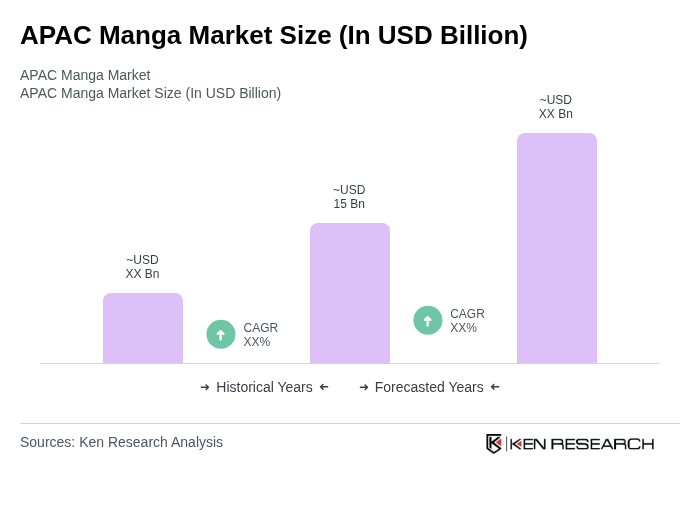
- The APAC Manga Market is valued at USD 15 billion, based on a five-year historical analysis. This growth is primarily driven by the increasing popularity of manga among diverse demographics, fueled by the rise of digital platforms, the global expansion of anime culture, and the widespread adoption of smartphones and e-commerce services. The accessibility of manga through various formats, including print and digital, has significantly contributed to its market size.
- Japan remains the dominant country in the APAC Manga Market due to its rich cultural heritage in manga creation and consumption. Other notable markets include South Korea and China, where local adaptations and original content have gained immense popularity. The strong fanbase and established distribution networks in these regions further solidify their market dominance.
- The Act on Promotion of Publication Industry, 2022 issued by the Ministry of Economy, Trade and Industry (METI) supports the manga industry through subsidies and incentives for digital transformation and international promotion, requiring publishers to meet content production and export thresholds for eligibility. This initiative aims to promote local content production and enhance the global competitiveness of Japanese manga, ensuring sustainable growth in the sector.
APAC Manga Market Segmentation
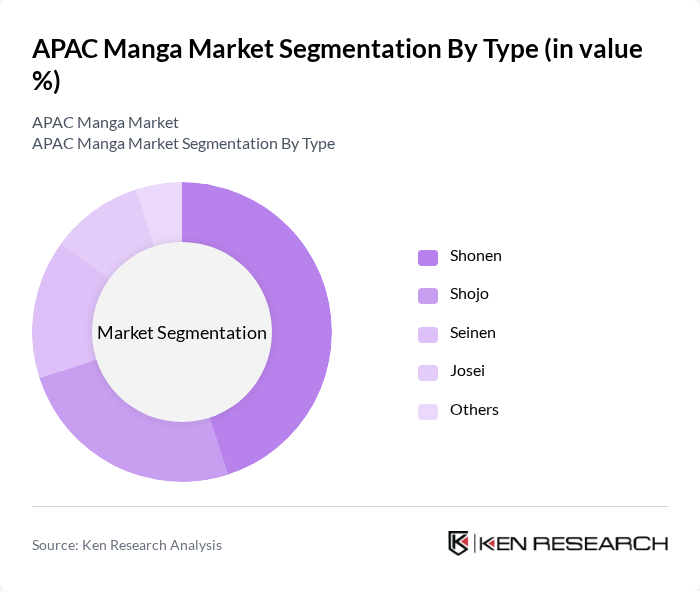
By Type:The market is segmented into various types, including Shonen, Shojo, Seinen, Josei, and Others. Shonen, which targets young male audiences, is particularly popular due to its action-oriented narratives and relatable characters. Shojo, aimed at young female readers, focuses on romance and relationships, while Seinen and Josei cater to adult audiences with more mature themes. The "Others" category includes niche genres that appeal to specific demographics.
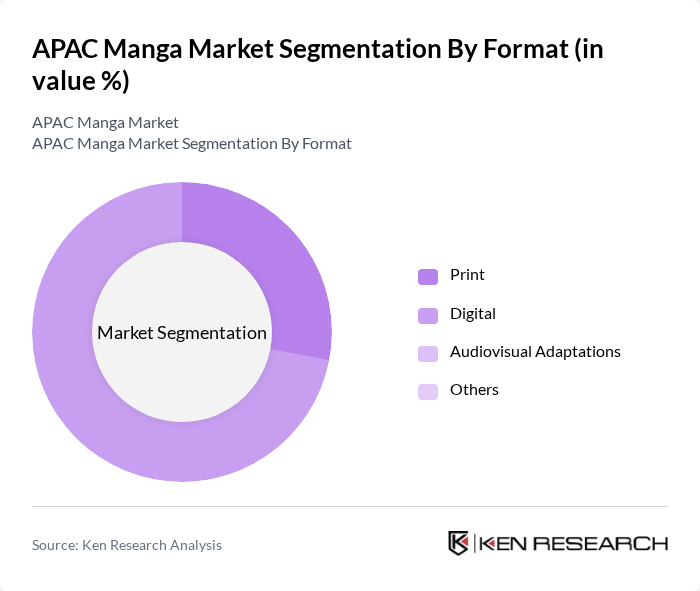
By Format:The market is divided into Print, Digital, Audiovisual Adaptations, and Others. Print remains a traditional format that appeals to collectors and purists, while digital formats have surged in popularity due to convenience and accessibility. Audiovisual adaptations, including anime and live-action series, have also contributed significantly to the market by attracting new audiences. The "Others" category encompasses various experimental formats.
APAC Manga Market Competitive Landscape
The APAC Manga Market is characterized by a dynamic mix of regional and international players. Leading participants such as Shueisha, Kodansha, VIZ Media, Yen Press, Seven Seas Entertainment, Tokyopop, Dark Horse Comics, Vertical, Inc., Manga Entertainment, ComiXology, Crunchyroll, BookWalker, Manga Plus, Tapas Media, Webtoon contribute to innovation, geographic expansion, and service delivery in this space.
APAC Manga Market Industry Analysis
Growth Drivers
- Increasing Popularity of Manga Among Youth:The youth demographic in APAC, particularly those aged 15-24, represents over 30% of the total population, approximately 1.1 billion individuals. This age group shows a significant inclination towards manga, with 60% of them engaging with manga content regularly. The rise of social media platforms has further amplified this trend, as 70% of young users share manga-related content, fostering a vibrant community that drives demand and consumption.
- Expansion of Digital Platforms for Manga Distribution:The digital manga market in APAC has seen a surge, with over 200 million downloads of manga apps in future alone. Major platforms like LINE Manga and ComiXology report annual growth rates exceeding 25%. This digital shift is supported by the increasing smartphone penetration, which reached 80% in urban areas, allowing easy access to manga content and enhancing reader engagement through interactive features.
- Rising Disposable Income in APAC Countries:The average disposable income in APAC countries is projected to reach $4,500 per capita in future, up from $4,200 previously. This increase enables consumers to spend more on entertainment, including manga. Countries like South Korea and Japan, with disposable incomes exceeding $5,000, are leading this trend, contributing to a robust market for manga purchases and subscriptions, thereby driving overall market growth.
Market Challenges
- Piracy and Copyright Issues:The APAC manga market faces significant challenges from piracy, with estimates indicating that over 40% of manga content is accessed illegally. This not only undermines revenue for creators but also complicates copyright enforcement. Countries like China, where piracy rates are particularly high, have seen a 20% decline in legitimate sales, prompting concerns about the sustainability of the manga industry in the region.
- Competition from Other Entertainment Forms:The manga market is increasingly competing with other entertainment mediums, such as video games and streaming services. In future, the gaming industry in APAC generated $78 billion, overshadowing the manga market, which was valued at $5 billion. This competition for consumer attention poses a challenge for manga publishers to innovate and retain their audience amidst diverse entertainment options.
APAC Manga Market Future Outlook
The APAC manga market is poised for transformative growth, driven by technological advancements and evolving consumer preferences. The integration of augmented reality and interactive storytelling is expected to enhance reader engagement, while collaborations with streaming services will broaden audience reach. Additionally, the increasing focus on diverse narratives will cater to a wider demographic, ensuring that manga remains relevant and appealing in a rapidly changing entertainment landscape.
Market Opportunities
- Collaborations with Streaming Services:Partnerships with platforms like Netflix and Crunchyroll can significantly enhance manga visibility. With over 200 million subscribers across these services in APAC, integrating manga adaptations into their offerings can attract new audiences and drive sales, creating a symbiotic relationship that benefits both manga creators and streaming platforms.
- Expansion into Emerging Markets:Emerging markets in Southeast Asia, such as Vietnam and Indonesia, present untapped potential for manga growth. With internet penetration rates exceeding 60% and a youthful population, these regions are ripe for manga expansion. Targeted marketing strategies can capitalize on this demographic, fostering a new generation of manga readers and increasing overall market share.
Scope of the Report
| Segment | Sub-Segments |
|---|---|
| By Type | Shonen Shojo Seinen Josei Others |
| By Format | Digital Audiovisual Adaptations Others |
| By Distribution Channel | Online Retail Brick-and-Mortar Stores Subscription Services Others |
| By Genre | Action Romance Fantasy Horror Others |
| By Target Audience | Children Teenagers Adults Others |
| By Language | Japanese English Local Languages Others |
| By Region | East Asia Southeast Asia South Asia Others |
Key Target Audience
Investors and Venture Capitalist Firms
Government and Regulatory Bodies (e.g., Ministry of Culture, Government of Japan)
Publishers and Manga Production Companies
Distributors and Retailers
Digital Platform Providers
Content Creators and Artists
Industry Associations (e.g., Japan Cartoonists Association)
Advertising Agencies and Marketers
Players Mentioned in the Report:
Shueisha
Kodansha
VIZ Media
Yen Press
Seven Seas Entertainment
Tokyopop
Dark Horse Comics
Vertical, Inc.
Manga Entertainment
ComiXology
Crunchyroll
BookWalker
Manga Plus
Tapas Media
Webtoon
Table of Contents
Market Assessment Phase
1. Executive Summary and Approach
2. APAC Manga Market Overview
2.1 Key Insights and Strategic Recommendations
2.2 APAC Manga Market Overview
2.3 Definition and Scope
2.4 Evolution of Market Ecosystem
2.5 Timeline of Key Regulatory Milestones
2.6 Value Chain & Stakeholder Mapping
2.7 Business Cycle Analysis
2.8 Policy & Incentive Landscape
3. APAC Manga Market Analysis
3.1 Growth Drivers
3.1.1 Increasing Popularity of Manga Among Youth
3.1.2 Expansion of Digital Platforms for Manga Distribution
3.1.3 Rising Disposable Income in APAC Countries
3.1.4 Globalization of Manga Culture
3.2 Market Challenges
3.2.1 Piracy and Copyright Issues
3.2.2 Competition from Other Entertainment Forms
3.2.3 Limited Awareness in Non-Traditional Markets
3.2.4 Fluctuating Consumer Preferences
3.3 Market Opportunities
3.3.1 Collaborations with Streaming Services
3.3.2 Growth of Merchandise and Adaptations
3.3.3 Expansion into Emerging Markets
3.3.4 Development of Interactive Manga Experiences
3.4 Market Trends
3.4.1 Rise of Webtoons and Digital Manga
3.4.2 Increased Focus on Diverse Storytelling
3.4.3 Integration of Augmented Reality in Manga
3.4.4 Growth of Manga Conventions and Events
3.5 Government Regulation
3.5.1 Copyright Protection Laws
3.5.2 Content Rating Systems
3.5.3 Support for Local Creators
3.5.4 Trade Agreements Affecting Manga Distribution
4. SWOT Analysis
5. Stakeholder Analysis
6. Porter's Five Forces Analysis
7. APAC Manga Market Market Size, 2019-2024
7.1 By Value
7.2 By Volume
7.3 By Average Selling Price
8. APAC Manga Market Segmentation
8.1 By Type
8.1.1 Shonen
8.1.2 Shojo
8.1.3 Seinen
8.1.4 Josei
8.1.5 Others
8.2 By Format
8.2.1 Print
8.2.2 Digital
8.2.3 Audiovisual Adaptations
8.2.4 Others
8.3 By Distribution Channel
8.3.1 Online Retail
8.3.2 Brick-and-Mortar Stores
8.3.3 Subscription Services
8.3.4 Others
8.4 By Genre
8.4.1 Action
8.4.2 Romance
8.4.3 Fantasy
8.4.4 Horror
8.4.5 Others
8.5 By Target Audience
8.5.1 Children
8.5.2 Teenagers
8.5.3 Adults
8.5.4 Others
8.6 By Language
8.6.1 Japanese
8.6.2 English
8.6.3 Local Languages
8.6.4 Others
8.7 By Region
8.7.1 East Asia
8.7.2 Southeast Asia
8.7.3 South Asia
8.7.4 Others
9. APAC Manga Market Competitive Analysis
9.1 Market Share of Key Players
9.2 Cross Comparison of Key Players
9.2.1 Company Name
9.2.2 Group Size (Large, Medium, or Small as per industry convention)
9.2.3 Revenue Growth Rate
9.2.4 Market Penetration Rate
9.2.5 Customer Retention Rate
9.2.6 Pricing Strategy
9.2.7 Product Diversification Index
9.2.8 Brand Recognition Score
9.2.9 Digital Engagement Metrics
9.2.10 Distribution Network Efficiency
9.3 SWOT Analysis of Top Players
9.4 Pricing Analysis
9.5 Detailed Profile of Major Companies
9.5.1 Shueisha
9.5.2 Kodansha
9.5.3 VIZ Media
9.5.4 Yen Press
9.5.5 Seven Seas Entertainment
9.5.6 Tokyopop
9.5.7 Dark Horse Comics
9.5.8 Vertical, Inc.
9.5.9 Manga Entertainment
9.5.10 ComiXology
9.5.11 Crunchyroll
9.5.12 BookWalker
9.5.13 Manga Plus
9.5.14 Tapas Media
9.5.15 Webtoon
10. APAC Manga Market End-User Analysis
10.1 Procurement Behavior of Key Ministries
10.1.1 Engagement with Local Publishers
10.1.2 Support for Cultural Initiatives
10.1.3 Funding for Educational Programs
10.1.4 Promotion of Local Artists
10.2 Corporate Spend on Infrastructure & Energy
10.2.1 Investment in Digital Platforms
10.2.2 Funding for Manga Events
10.2.3 Sponsorship of Competitions
10.2.4 Partnerships with Educational Institutions
10.3 Pain Point Analysis by End-User Category
10.3.1 Accessibility of Content
10.3.2 Quality of Translations
10.3.3 Pricing of Manga Products
10.3.4 Availability of Diverse Genres
10.4 User Readiness for Adoption
10.4.1 Familiarity with Digital Formats
10.4.2 Interest in Interactive Content
10.4.3 Engagement with Social Media Platforms
10.4.4 Willingness to Pay for Quality Content
10.5 Post-Deployment ROI and Use Case Expansion
10.5.1 Increased Sales from Digital Platforms
10.5.2 Growth in Merchandise Sales
10.5.3 Expansion into New Markets
10.5.4 Enhanced Brand Loyalty
11. APAC Manga Market Future Size, 2025-2030
11.1 By Value
11.2 By Volume
11.3 By Average Selling Price
Go-To-Market Strategy Phase
1. Whitespace Analysis + Business Model Canvas
1.1 Market Gaps Identification
1.2 Value Proposition Development
1.3 Revenue Streams Analysis
1.4 Customer Segmentation
1.5 Key Partnerships
1.6 Cost Structure Evaluation
1.7 Channels of Distribution
2. Marketing and Positioning Recommendations
2.1 Branding Strategies
2.2 Product USPs
3. Distribution Plan
3.1 Urban Retail vs Rural NGO Tie-ups
4. Channel & Pricing Gaps
4.1 Underserved Routes
4.2 Pricing Bands
5. Unmet Demand & Latent Needs
5.1 Category Gaps
5.2 Consumer Segments
6. Customer Relationship
6.1 Loyalty Programs
6.2 After-sales Service
7. Value Proposition
7.1 Sustainability
7.2 Integrated Supply Chains
8. Key Activities
8.1 Regulatory Compliance
8.2 Branding
8.3 Distribution Setup
9. Entry Strategy Evaluation
9.1 Domestic Market Entry Strategy
9.1.1 Product Mix
9.1.2 Pricing Band
9.1.3 Packaging
9.2 Export Entry Strategy
9.2.1 Target Countries
9.2.2 Compliance Roadmap
10. Entry Mode Assessment
10.1 JV
10.2 Greenfield
10.3 M&A
10.4 Distributor Model
11. Capital and Timeline Estimation
11.1 Capital Requirements
11.2 Timelines
12. Control vs Risk Trade-Off
12.1 Ownership vs Partnerships
13. Profitability Outlook
13.1 Breakeven Analysis
13.2 Long-term Sustainability
14. Potential Partner List
14.1 Distributors
14.2 JVs
14.3 Acquisition Targets
15. Execution Roadmap
15.1 Phased Plan for Market Entry
15.1.1 Market Setup
15.1.2 Market Entry
15.1.3 Growth Acceleration
15.1.4 Scale & Stabilize
15.2 Key Activities and Milestones
15.2.1 Milestone Planning
15.2.2 Activity Tracking
Research Methodology
Phase 1: Approach1
Desk Research
- Analysis of market reports from industry associations such as the Japan Animation Association
- Review of sales data from major manga publishers and distributors across the APAC region
- Examination of consumer behavior studies and trends published in academic journals
Primary Research
- Interviews with key stakeholders including manga artists, publishers, and distributors
- Surveys targeting manga readers to gather insights on preferences and purchasing habits
- Focus groups with fans to discuss trends, genres, and future expectations in the manga market
Validation & Triangulation
- Cross-validation of findings through multiple data sources including sales figures and consumer surveys
- Triangulation of qualitative insights from interviews with quantitative data from surveys
- Sanity checks conducted through expert panel reviews comprising industry veterans
Phase 2: Market Size Estimation1
Top-down Assessment
- Estimation of total market size based on regional sales data and growth rates
- Segmentation of the market by genre, format (digital vs. print), and demographic factors
- Incorporation of macroeconomic indicators such as GDP growth and disposable income trends
Bottom-up Modeling
- Collection of sales data from leading manga publishers to establish baseline figures
- Estimation of average price points for various manga formats and genres
- Volume estimates based on readership surveys and distribution channel analysis
Forecasting & Scenario Analysis
- Multi-factor regression analysis incorporating digital adoption rates and demographic shifts
- Scenario modeling based on potential impacts of new media adaptations and global trends
- Development of baseline, optimistic, and pessimistic forecasts through 2030
Phase 3: CATI Sample Composition1
| Scope Item/Segment | Sample Size | Target Respondent Profiles |
|---|---|---|
| Manga Reader Demographics | 120 | Young Adults, College Students, Working Professionals |
| Publisher Insights | 60 | Editorial Managers, Marketing Directors, Sales Executives |
| Retail Distribution Channels | 50 | Retail Managers, E-commerce Specialists, Supply Chain Coordinators |
| Digital Manga Platforms | 45 | Product Managers, UX Designers, Content Strategists |
| Fan Community Engagement | 55 | Community Managers, Social Media Influencers, Event Organizers |
Frequently Asked Questions
What is the current value of the APAC Manga Market?
The APAC Manga Market is valued at approximately USD 15 billion, driven by the increasing popularity of manga across diverse demographics, the rise of digital platforms, and the global expansion of anime culture.
Which countries dominate the APAC Manga Market?
What are the main types of manga in the APAC market?
How has digital transformation impacted the APAC Manga Market?
Other Regional/Country Reports
Other Adjacent Reports
Philippines Webtoon Market
Europe Comic Book Market Size, Share & Forecast, By Format, Genre & Distribution Channel, 2026-2032Japan Graphic Novel Market
Bahrain Digital Publishing Market
South Africa Streaming Services Market
Indonesia Video Game Market Size, Share & Forecast, By Platform, Game Type & Revenue Model, 2026-2032India Animation Market Size, Share & Forecast, By Animation Type, Application & Customer Type, 2026-2031South Korea E-book Market
UAE Entertainment Merchandise Market
Why Buy From Us?

What makes us stand out is that our consultants follow Robust, Refine and Result (RRR) methodology. Robust for clear definitions, approaches and sanity checking, Refine for differentiating respondents' facts and opinions, and Result for presenting data with story.

We have set a benchmark in the industry by offering our clients with syndicated and customized market research reports featuring coverage of entire market as well as meticulous research and analyst insights.

While we don't replace traditional research, we flip the method upside down. Our dual approach of Top Bottom & Bottom Top ensures quality deliverable by not just verifying company fundamentals but also looking at the sector and macroeconomic factors.

With one step in the future, our research team constantly tries to show you the bigger picture. We help with some of the tough questions you may encounter along the way: How is the industry positioned? Best marketing channel? KPI's of competitors? By aligning every element, we help maximize success.

Our report gives you instant access to the answers and sources that other companies might choose to hide. We elaborate each steps of research methodology we have used and showcase you the sample size to earn your trust.

If you need any support, we are here! We pride ourselves on universe strength, data quality, and quick, friendly, and professional service.