About the Report
Base Year 2024Australia Hospital Emergency Department Market Overview
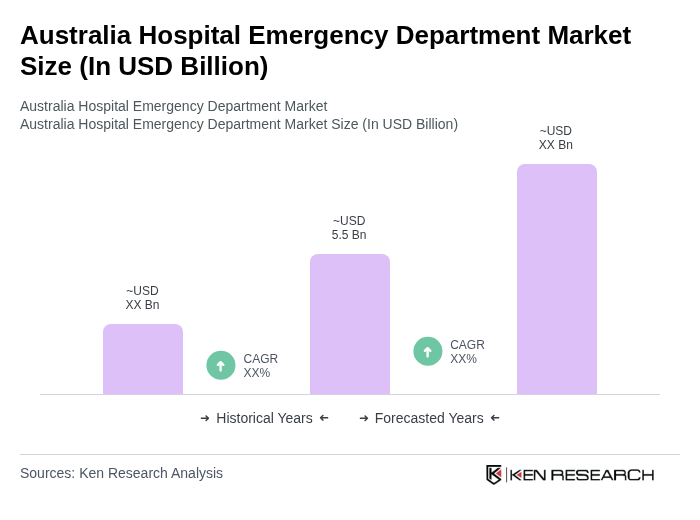
- The Australia Hospital Emergency Department Market is valued at USD 5.5 billion, based on a five-year historical analysis of the acute hospital care and broader hospital services market in Australia. This growth is primarily driven by increasing patient volumes, advancements in diagnostic and monitoring technologies, and a growing emphasis on timely emergency care services. The rising prevalence of chronic diseases, higher rates of mental health presentations, and an aging population with complex comorbidities further contribute to the demand for emergency services across the country.
- Key cities dominating the market include Sydney, Melbourne, and Brisbane. These urban centers have a high population density and larger catchment areas, leading to increased emergency department visits. Additionally, the presence of tertiary and quaternary referral hospitals, advanced diagnostic and intensive care capabilities, and a high concentration of specialist clinicians and emergency physicians in these cities enhances their market dominance.
- The operation of emergency departments in Australia is guided by performance and access frameworks such as the National Emergency Access Target (NEAT) introduced under the National Partnership Agreement on Improving Public Hospital Services, which aimed for 90% of patients to physically leave the emergency department for admission, transfer, or discharge within four hours. In addition, clinical urgency is regulated through the Australasian Triage Scale (ATS), issued by the Australasian College for Emergency Medicine and adopted nationally, which specifies maximum waiting times for five triage categories and requires hospitals to monitor and report the percentage of patients seen within these targets.
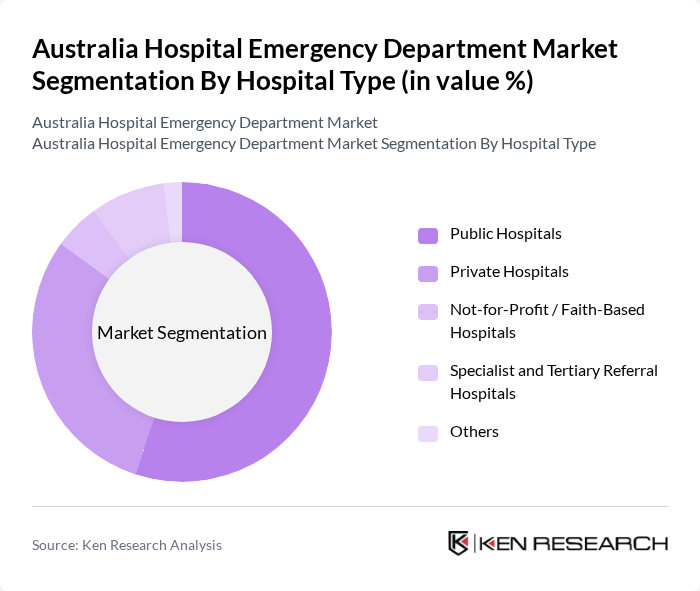
Australia Hospital Emergency Department Market Segmentation
By Hospital Type:The market is segmented into various hospital types, including Public Hospitals, Private Hospitals, Not-for-Profit / Faith-Based Hospitals, Specialist and Tertiary Referral Hospitals, and Others. Public hospitals dominate the market due to their accessibility, universal coverage under Medicare, and substantial government funding, which allows them to cater to a larger and more complex patient base, including time-critical emergencies. Private hospitals are also significant players, particularly in urban areas, offering selected emergency services, faster access for insured patients, and specialized services such as cardiac, orthopaedic, and surgical emergencies, appealing to patients seeking immediate and more personalised care.
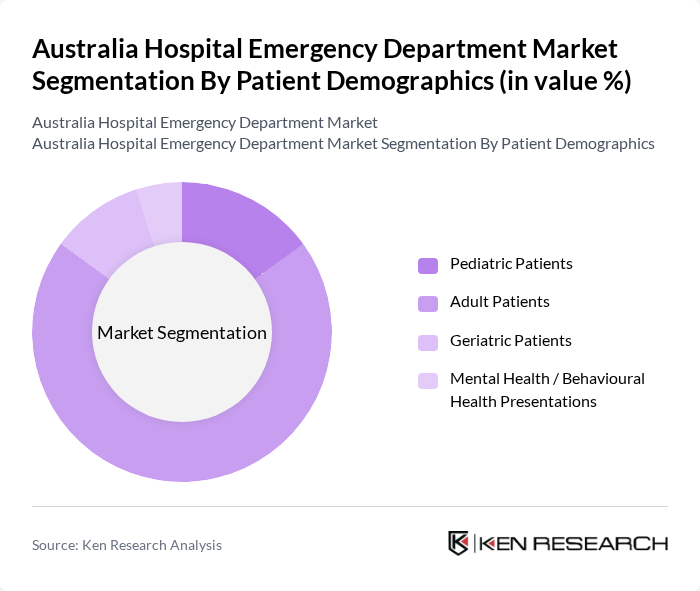
By Patient Demographics:The patient demographics segment includes Pediatric Patients, Adult Patients, Geriatric Patients, and Mental Health / Behavioural Health Presentations. Adult patients represent the largest demographic, driven by the high incidence of chronic diseases such as cardiovascular disease, diabetes, respiratory conditions, and injuries, as well as lifestyle-related health issues that frequently present to emergency departments. The increasing awareness and recognition of mental health conditions, combined with service gaps in community-based care, has also led to a sustained rise in mental health and behavioural presentations in emergency departments, particularly among adolescents and young adults.
Australia Hospital Emergency Department Market Competitive Landscape
The Australia Hospital Emergency Department Market is characterized by a dynamic mix of regional and international players. Leading participants such as St Vincent's Health Australia, Ramsay Health Care, Healthscope, Mater Misericordiae Limited (Mater Group), Queensland Health, NSW Health – Western Sydney Local Health District, Alfred Health, NSW Health – Sydney Local Health District, Northern Health (Victoria), NSW Health – South Eastern Sydney Local Health District, NSW Health – Central Coast Local Health District, Barwon Health, SA Health (Government of South Australia), Tasmanian Health Service, ACT Health Directorate contribute to innovation, geographic expansion, and service delivery in this space.
Australia Hospital Emergency Department Market Industry Analysis
Growth Drivers
- Increasing Patient Volume:The Australian population aged 65 and over is projected to reach 4.6 million in future, significantly increasing demand for emergency services. This demographic shift is expected to contribute to a rise in emergency department visits, as older adults typically require more medical attention. Additionally, the Australian Institute of Health and Welfare reported that there were over 8 million emergency department presentations nationally, highlighting the growing need for accessible healthcare services.
- Rising Prevalence of Chronic Diseases:Chronic diseases such as diabetes and cardiovascular conditions are on the rise in Australia, with around 1.3 million Australians living with diabetes. This trend is expected to increase emergency department visits, as patients with chronic conditions often experience acute episodes requiring immediate care. The Australian Institute of Health and Welfare indicates that chronic diseases account for about half of the total burden of disease, emphasizing the need for robust emergency services.
- Advancements in Emergency Medical Technology:The integration of advanced medical technologies, such as telemedicine and AI diagnostics, is transforming emergency care delivery. In future, it is anticipated that a significant percentage of emergency departments will adopt telehealth solutions, improving patient access and reducing wait times. Furthermore, investments in AI-driven tools are projected to enhance diagnostic accuracy, leading to better patient outcomes. The Australian government allocated a substantial amount for health technology advancements, supporting this growth driver.
Market Challenges
- High Operational Costs:The operational costs for Australian emergency departments are escalating, with average annual expenditures exceeding a significant amount per facility. Factors contributing to these costs include staffing, equipment maintenance, and facility upgrades. The rising costs are compounded by the need for compliance with stringent health regulations, which can further strain budgets. As a result, many hospitals face financial pressures that hinder their ability to expand services or invest in new technologies.
- Staff Shortages and High Turnover Rates:The healthcare sector in Australia is grappling with significant staff shortages, particularly in emergency departments. There was a reported shortfall of approximately 10,000 emergency physicians and nurses. High turnover rates, averaging around 20% annually, exacerbate this issue, leading to increased workloads for existing staff and potential declines in patient care quality. The Australian Health Workforce Strategy aims to address these challenges, but immediate solutions are necessary to stabilize the workforce.
Australia Hospital Emergency Department Market Future Outlook
The future of the Australia Hospital Emergency Department market is poised for transformation, driven by technological advancements and evolving patient needs. The integration of telemedicine and AI is expected to streamline operations, enhance patient care, and reduce wait times. Additionally, a growing emphasis on mental health services will likely reshape emergency care protocols, ensuring comprehensive treatment. As the healthcare landscape evolves, emergency departments must adapt to these trends to meet the increasing demands of the population effectively.
Market Opportunities
- Expansion of Telemedicine Services:The rise of telemedicine presents a significant opportunity for emergency departments to enhance patient access and reduce congestion. In future, it is projected that telehealth consultations will account for a notable percentage of all emergency visits, allowing for timely interventions and follow-ups. This shift can lead to improved patient satisfaction and optimized resource allocation within emergency departments.
- Integration of AI and Data Analytics:The adoption of AI and data analytics in emergency departments can revolutionize patient care. By leveraging predictive analytics, hospitals can anticipate patient influx and optimize staffing accordingly. It is estimated that AI-driven solutions could reduce patient wait times by a significant percentage, significantly enhancing operational efficiency and patient outcomes in emergency care settings.
Scope of the Report
| Segment | Sub-Segments |
|---|---|
| By Hospital Type | Public Hospitals Private Hospitals Not-for-Profit / Faith-Based Hospitals Specialist and Tertiary Referral Hospitals Others |
| By Patient Demographics | Pediatric Patients Adult Patients Geriatric Patients Mental Health / Behavioural Health Presentations |
| By Triage Acuity (ATS Category) | Category 1 – Resuscitation Category 2 – Emergency Category 3 – Urgent Category 4 – Semi-urgent Category 5 – Non-urgent |
| By Clinical Presentation / Case Type | Trauma & Injury Cardiovascular & Stroke Respiratory & Infectious Diseases Gastrointestinal & Abdominal Psychiatric & Substance Use Others |
| By Care Pathway Outcome | Discharged from ED Admitted to Inpatient Ward Transferred to Another Facility Left Without Being Seen / Left at Own Risk |
| By Geography | New South Wales Victoria Queensland Western Australia South Australia Tasmania Australian Capital Territory Northern Territory |
| By Technology & Digital Maturity | Basic ED Information Systems Integrated EMR / EHR-Enabled EDs Telehealth-Enabled Emergency Care Advanced Analytics / Decision Support-Enabled EDs |
Key Target Audience
Investors and Venture Capitalist Firms
Government and Regulatory Bodies (e.g., Australian Department of Health, Therapeutic Goods Administration)
Healthcare Providers and Hospital Administrators
Medical Equipment Manufacturers
Pharmaceutical Companies
Health Insurance Companies
Emergency Medical Services (EMS) Organizations
Health Technology Startups
Players Mentioned in the Report:
St Vincent's Health Australia
Ramsay Health Care
Healthscope
Mater Misericordiae Limited (Mater Group)
Queensland Health
NSW Health Western Sydney Local Health District
Alfred Health
NSW Health Sydney Local Health District
Northern Health (Victoria)
NSW Health South Eastern Sydney Local Health District
NSW Health Central Coast Local Health District
Barwon Health
SA Health (Government of South Australia)
Tasmanian Health Service
ACT Health Directorate
Table of Contents
Market Assessment Phase
1. Executive Summary and Approach
2. Australia Hospital Emergency Department Market Overview
2.1 Key Insights and Strategic Recommendations
2.2 Australia Hospital Emergency Department Market Overview
2.3 Definition and Scope
2.4 Evolution of Market Ecosystem
2.5 Timeline of Key Regulatory Milestones
2.6 Value Chain & Stakeholder Mapping
2.7 Business Cycle Analysis
2.8 Policy & Incentive Landscape
3. Australia Hospital Emergency Department Market Analysis
3.1 Growth Drivers
3.1.1 Increasing patient volume due to aging population
3.1.2 Rising prevalence of chronic diseases
3.1.3 Advancements in emergency medical technology
3.1.4 Government funding and support for healthcare services
3.2 Market Challenges
3.2.1 High operational costs
3.2.2 Staff shortages and high turnover rates
3.2.3 Increasing patient wait times
3.2.4 Regulatory compliance complexities
3.3 Market Opportunities
3.3.1 Expansion of telemedicine services
3.3.2 Integration of AI and data analytics
3.3.3 Development of specialized emergency care units
3.3.4 Partnerships with private healthcare providers
3.4 Market Trends
3.4.1 Shift towards patient-centered care
3.4.2 Increased focus on mental health services
3.4.3 Adoption of electronic health records
3.4.4 Growth in mobile emergency services
3.5 Government Regulation
3.5.1 National Health Reform Agreement
3.5.2 Emergency Care Framework
3.5.3 Health Practitioner Regulation National Law
3.5.4 Australian Commission on Safety and Quality in Health Care standards
4. SWOT Analysis
5. Stakeholder Analysis
6. Porter's Five Forces Analysis
7. Australia Hospital Emergency Department Market Market Size, 2019-2024
7.1 By Value
7.2 By Volume
7.3 By Average Selling Price
8. Australia Hospital Emergency Department Market Segmentation
8.1 By Hospital Type
8.1.1 Public Hospitals
8.1.2 Private Hospitals
8.1.3 Not-for-Profit / Faith-Based Hospitals
8.1.4 Specialist and Tertiary Referral Hospitals
8.1.5 Others
8.2 By Patient Demographics
8.2.1 Pediatric Patients
8.2.2 Adult Patients
8.2.3 Geriatric Patients
8.2.4 Mental Health / Behavioural Health Presentations
8.3 By Triage Acuity (ATS Category)
8.3.1 Category 1 – Resuscitation
8.3.2 Category 2 – Emergency
8.3.3 Category 3 – Urgent
8.3.4 Category 4 – Semi-urgent
8.3.5 Category 5 – Non-urgent
8.4 By Clinical Presentation / Case Type
8.4.1 Trauma & Injury
8.4.2 Cardiovascular & Stroke
8.4.3 Respiratory & Infectious Diseases
8.4.4 Gastrointestinal & Abdominal
8.4.5 Psychiatric & Substance Use
8.4.6 Others
8.5 By Care Pathway Outcome
8.5.1 Discharged from ED
8.5.2 Admitted to Inpatient Ward
8.5.3 Transferred to Another Facility
8.5.4 Left Without Being Seen / Left at Own Risk
8.6 By Geography
8.6.1 New South Wales
8.6.2 Victoria
8.6.3 Queensland
8.6.4 Western Australia
8.6.5 South Australia
8.6.6 Tasmania
8.6.7 Australian Capital Territory
8.6.8 Northern Territory
8.7 By Technology & Digital Maturity
8.7.1 Basic ED Information Systems
8.7.2 Integrated EMR / EHR-Enabled EDs
8.7.3 Telehealth-Enabled Emergency Care
8.7.4 Advanced Analytics / Decision Support-Enabled EDs
9. Australia Hospital Emergency Department Market Competitive Analysis
9.1 Market Share of Key Players
9.2 Cross Comparison of Key Players
9.2.1 Company Name
9.2.2 Ownership & Group Size (Public Network, Private Group, Standalone)
9.2.3 Annual ED Visit Volume
9.2.4 Average Length of Stay in ED
9.2.5 Median Door-to-Doctor Time
9.2.6 Percentage of Patients Seen Within ATS Target Time
9.2.7 ED Admission Rate to Inpatient Wards
9.2.8 Percentage of Patients Leaving Without Being Seen
9.2.9 Revenue from Emergency Services
9.2.10 Operating Margin from Emergency Services
9.2.11 Capital Expenditure on ED Infrastructure & Digital Systems
9.2.12 Patient Experience / Satisfaction Index
9.3 SWOT Analysis of Top Players
9.4 Pricing Analysis
9.5 Detailed Profile of Major Companies
9.5.1 St Vincent's Health Australia
9.5.2 Ramsay Health Care
9.5.3 Healthscope
9.5.4 Mater Misericordiae Limited (Mater Group)
9.5.5 Queensland Health
9.5.6 NSW Health – Western Sydney Local Health District
9.5.7 Alfred Health
9.5.8 NSW Health – Sydney Local Health District
9.5.9 Northern Health (Victoria)
9.5.10 NSW Health – South Eastern Sydney Local Health District
9.5.11 NSW Health – Central Coast Local Health District
9.5.12 Barwon Health
9.5.13 SA Health (Government of South Australia)
9.5.14 Tasmanian Health Service
9.5.15 ACT Health Directorate
10. Australia Hospital Emergency Department Market End-User Analysis
10.1 Procurement Behavior of Key Ministries
10.1.1 Ministry of Health
10.1.2 State Health Departments
10.1.3 Local Government Health Services
10.1.4 Others
10.2 Corporate Spend on Infrastructure & Energy
10.2.1 Hospital Infrastructure Investments
10.2.2 Emergency Equipment Procurement
10.2.3 Energy Efficiency Initiatives
10.2.4 Others
10.3 Pain Point Analysis by End-User Category
10.3.1 Emergency Physicians
10.3.2 Nursing Staff
10.3.3 Hospital Administrators
10.3.4 Patients
10.4 User Readiness for Adoption
10.4.1 Technology Adoption Rates
10.4.2 Training and Support Needs
10.4.3 Infrastructure Readiness
10.4.4 Others
10.5 Post-Deployment ROI and Use Case Expansion
10.5.1 Cost Savings Analysis
10.5.2 Patient Outcome Improvements
10.5.3 Service Expansion Opportunities
10.5.4 Others
11. Australia Hospital Emergency Department Market Future Size, 2025-2030
11.1 By Value
11.2 By Volume
11.3 By Average Selling Price
Go-To-Market Strategy Phase
1. Whitespace Analysis + Business Model Canvas
1.1 Market Gaps Identification
1.2 Value Proposition Development
1.3 Revenue Streams Analysis
1.4 Cost Structure Evaluation
1.5 Key Partnerships Exploration
1.6 Customer Segments Definition
1.7 Channels Strategy
2. Marketing and Positioning Recommendations
2.1 Branding Strategies
2.2 Product USPs
3. Distribution Plan
3.1 Urban retail vs rural NGO tie-ups
4. Channel & Pricing Gaps
4.1 Underserved routes
4.2 Pricing bands
5. Unmet Demand & Latent Needs
5.1 Category gaps
5.2 Consumer segments
6. Customer Relationship
6.1 Loyalty programs
6.2 After-sales service
7. Value Proposition
7.1 Sustainability
7.2 Integrated supply chains
8. Key Activities
8.1 Regulatory compliance
8.2 Branding
8.3 Distribution setup
9. Entry Strategy Evaluation
9.1 Domestic Market Entry Strategy
9.1.1 Product mix
9.1.2 Pricing band
9.1.3 Packaging
9.2 Export Entry Strategy
9.2.1 Target countries
9.2.2 Compliance roadmap
10. Entry Mode Assessment
10.1 JV
10.2 Greenfield
10.3 M&A
10.4 Distributor Model
11. Capital and Timeline Estimation
11.1 Capital requirements
11.2 Timelines
12. Control vs Risk Trade-Off
12.1 Ownership vs Partnerships
13. Profitability Outlook
13.1 Breakeven analysis
13.2 Long-term sustainability
14. Potential Partner List
14.1 Distributors
14.2 JVs
14.3 Acquisition targets
15. Execution Roadmap
15.1 Phased Plan for Market Entry
15.1.1 Market Setup
15.1.2 Market Entry
15.1.3 Growth Acceleration
15.1.4 Scale & Stabilize
15.2 Key Activities and Milestones
15.2.1 Milestone Planning
15.2.2 Activity Tracking
Research Methodology
Phase 1: Approach1
Desk Research
- Analysis of government health statistics and reports from the Australian Institute of Health and Welfare
- Review of published studies and white papers on emergency department trends and patient demographics
- Examination of hospital accreditation reports and guidelines from the Australian Commission on Safety and Quality in Health Care
Primary Research
- Interviews with emergency department heads and hospital administrators across major Australian cities
- Surveys conducted with healthcare professionals, including nurses and paramedics, to gather insights on operational challenges
- Focus groups with patients to understand their experiences and expectations from emergency services
Validation & Triangulation
- Cross-validation of findings through comparison with national health expenditure data and emergency department utilization rates
- Triangulation of qualitative insights from interviews with quantitative data from surveys
- Sanity checks through expert panel reviews involving healthcare economists and policy analysts
Phase 2: Market Size Estimation1
Top-down Assessment
- Estimation of total healthcare expenditure in Australia and allocation to emergency services
- Analysis of patient visit trends to emergency departments segmented by demographics and geographic regions
- Incorporation of government funding initiatives and reforms impacting emergency healthcare services
Bottom-up Modeling
- Collection of operational data from a sample of hospitals regarding patient throughput and service costs
- Estimation of average cost per patient visit based on service type and treatment provided
- Volume x cost analysis to derive total market size for emergency department services
Forecasting & Scenario Analysis
- Multi-factor regression analysis incorporating population growth, aging demographics, and urbanization trends
- Scenario modeling based on potential changes in healthcare policy and funding levels
- Baseline, optimistic, and pessimistic projections for emergency department market growth through 2030
Phase 3: CATI Sample Composition1
| Scope Item/Segment | Sample Size | Target Respondent Profiles |
|---|---|---|
| Urban Emergency Departments | 120 | Emergency Department Heads, Hospital Administrators |
| Rural Emergency Services | 90 | Healthcare Managers, Community Health Workers |
| Patient Experience in EDs | 140 | Patients, Caregivers, Patient Advocacy Groups |
| Emergency Medical Services (EMS) Operations | 80 | Paramedics, EMS Directors, Operations Managers |
| Healthcare Policy Impact on EDs | 70 | Healthcare Policy Analysts, Economists, Government Officials |
Frequently Asked Questions
What is the current value of the Australia Hospital Emergency Department Market?
The Australia Hospital Emergency Department Market is valued at approximately USD 5.5 billion. This valuation is based on a five-year historical analysis of acute hospital care and broader hospital services in Australia, reflecting significant growth driven by various factors.
What factors are driving the growth of the Australia Hospital Emergency Department Market?
Which cities are the major players in the Australia Hospital Emergency Department Market?
How does the National Emergency Access Target (NEAT) impact emergency departments in Australia?
Other Regional/Country Reports
Other Adjacent Reports
Thailand Healthcare AI Market
Saudi Arabia Mental Health Services Market Size, Share, Growth Drivers, Trends, Opportunities & Forecast 2025–2030Middle East Chronic Disease Management Market Size, Share, Growth Drivers, Trends, Opportunities & Forecast 2025–2030Brazil Diagnostic Technology Market
Emergency Medical Services MarketPhilippines Intensive Care Market
UAE healthcare staffing market size, share, growth drivers, trends, opportunities & forecast 2025–2030Oman Medical Device Market Size Share Growth Drivers Trends Opportunities & Forecast 2025–2030Why Buy From Us?

What makes us stand out is that our consultants follow Robust, Refine and Result (RRR) methodology. Robust for clear definitions, approaches and sanity checking, Refine for differentiating respondents' facts and opinions, and Result for presenting data with story.

We have set a benchmark in the industry by offering our clients with syndicated and customized market research reports featuring coverage of entire market as well as meticulous research and analyst insights.

While we don't replace traditional research, we flip the method upside down. Our dual approach of Top Bottom & Bottom Top ensures quality deliverable by not just verifying company fundamentals but also looking at the sector and macroeconomic factors.

With one step in the future, our research team constantly tries to show you the bigger picture. We help with some of the tough questions you may encounter along the way: How is the industry positioned? Best marketing channel? KPI's of competitors? By aligning every element, we help maximize success.

Our report gives you instant access to the answers and sources that other companies might choose to hide. We elaborate each steps of research methodology we have used and showcase you the sample size to earn your trust.

If you need any support, we are here! We pride ourselves on universe strength, data quality, and quick, friendly, and professional service.