About the Report
Base Year 2024Middle East Hospital Emergency Department Market Overview
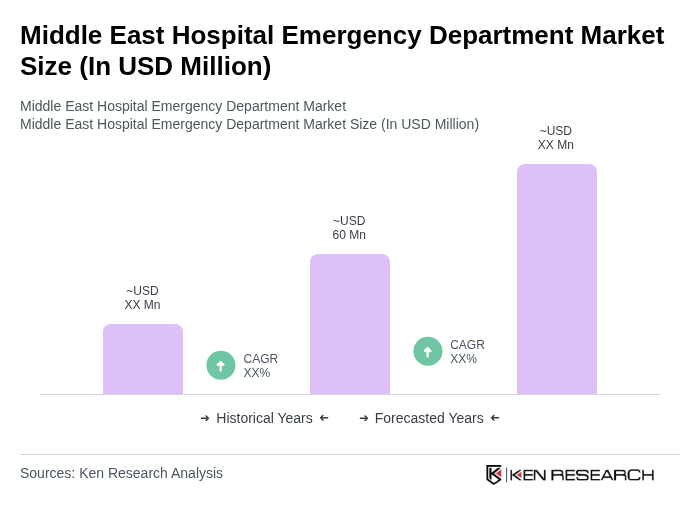
- The Middle East Hospital Emergency Department Market is valued at USD 60 million, based on a five-year historical analysis of the regional emergency department solutions and services market, including digital and information system components. This growth is primarily driven by increasing population density in Gulf Cooperation Council (GCC) countries, rising incidences of chronic diseases such as cardiovascular disease and diabetes, and the growing demand for immediate medical care in urban centers. The expansion of healthcare infrastructure, particularly in Saudi Arabia, the United Arab Emirates, and Qatar, and advancements in emergency medical technologies, including emergency department information systems and tele-emergency care, have also significantly contributed to the market's growth.
- Key players in this market include the United Arab Emirates, Saudi Arabia, and Qatar. These countries dominate the market due to their substantial investments in healthcare infrastructure, high per capita healthcare spending, and a growing expatriate population that increases the demand for emergency services. Additionally, the presence of advanced medical facilities, national strategies focused on improving emergency care capacity, and a strong focus on healthcare quality accreditation and digitalization further solidify their market leadership.
- In the United Arab Emirates, hospital emergency departments are governed by federal and emirate-level regulations that require hospitals to provide 24/7 emergency care with appropriate equipment and staffing, including advanced life support capabilities. For example, the Federal Law No. 4 of 2016 on Medical Liability and subsequent implementing regulations issued by the UAE Ministry of Health and Prevention, together with licensing standards from authorities such as the Dubai Health Authority and the Department of Health – Abu Dhabi, mandate emergency readiness, triage protocols, and the availability of emergency services as a core requirement for hospital licensing.
Middle East Hospital Emergency Department Market Segmentation
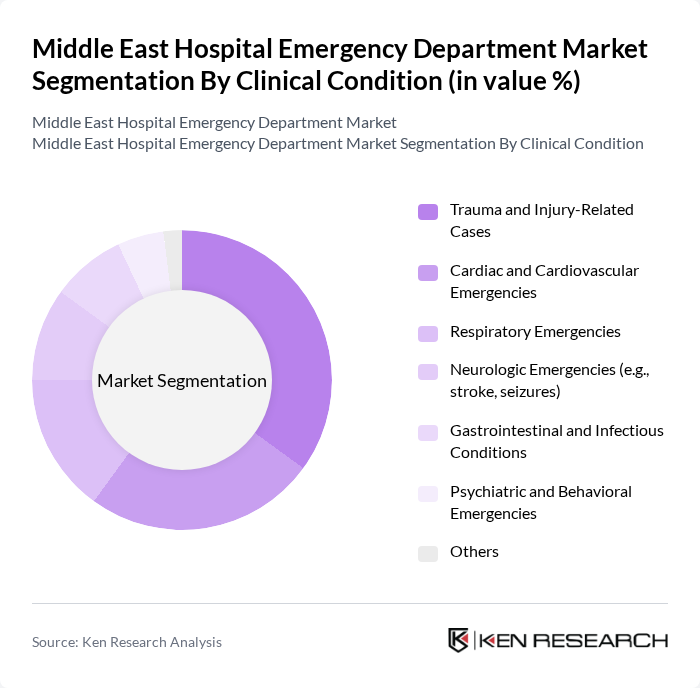
By Clinical Condition:The clinical conditions treated in emergency departments encompass a wide range of medical issues. The subsegments include Trauma and Injury-Related Cases, Cardiac and Cardiovascular Emergencies, Respiratory Emergencies, Neurologic Emergencies (e.g., stroke, seizures), Gastrointestinal and Infectious Conditions, Psychiatric and Behavioral Emergencies, and Others. Trauma and Injury-Related Cases dominate the market due to the high incidence of road traffic accidents and occupational injuries in rapidly urbanizing and industrializing areas, coupled with increasing awareness of the need for immediate medical attention and the expansion of trauma centers in major cities across the region.
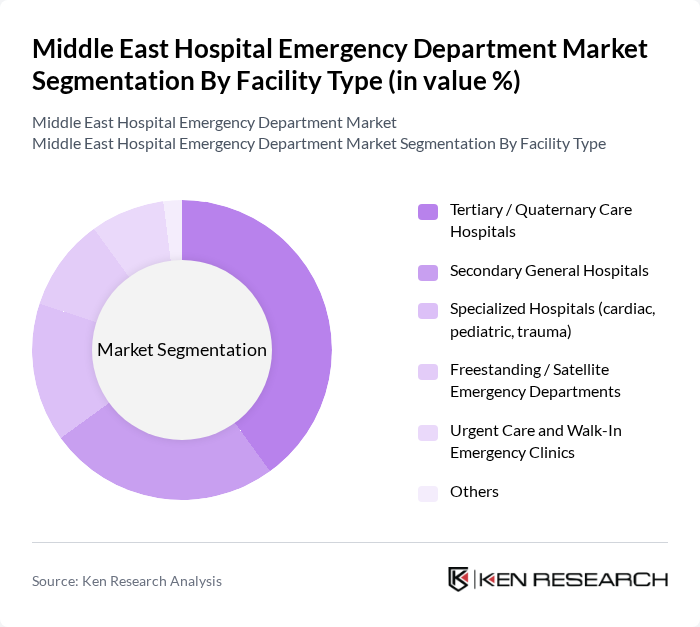
By Facility Type:The facility types in the emergency department market include Tertiary / Quaternary Care Hospitals, Secondary General Hospitals, Specialized Hospitals (cardiac, pediatric, trauma), Freestanding / Satellite Emergency Departments, Urgent Care and Walk-In Emergency Clinics, and Others. Tertiary / Quaternary Care Hospitals lead the market due to their comprehensive services, advanced diagnostic and interventional technology, subspecialty coverage, and ability to handle complex and multi-trauma cases, making them the preferred choice for emergency care referrals in the region. The growing presence of urgent care centers and freestanding emergency facilities, particularly in urban hubs, is also supporting greater access and reducing congestion in large public hospitals.
Middle East Hospital Emergency Department Market Competitive Landscape
The Middle East Hospital Emergency Department Market is characterized by a dynamic mix of regional and international players. Leading participants such as Cleveland Clinic Abu Dhabi, King Faisal Specialist Hospital & Research Centre, Hamad Medical Corporation, Mediclinic Middle East, Saudi German Hospitals Group, Al Zahra Hospital Dubai, Rashid Hospital, Emirates Specialty Hospital, NMC Health, Abu Dhabi Health Services Company (SEHA), Qatar Healthcare Services, Dubai Health Authority, Supreme Council of Health – Kingdom of Bahrain, Ministry of Health and Prevention, UAE, Al Ain Hospital contribute to innovation, geographic expansion, and service delivery in this space.
Middle East Hospital Emergency Department Market Industry Analysis
Growth Drivers
- Increasing Patient Population Due to Urbanization:The Middle East is experiencing rapid urbanization, with urban populations projected to reach 75% in future, up from 70% in 2020. This shift is driving demand for emergency services, as urban areas typically have higher incidences of accidents and health emergencies. The World Bank estimates that urbanization contributes to a 15% increase in healthcare service utilization, necessitating expanded emergency department capacities to meet the growing needs of urban residents.
- Rising Prevalence of Chronic Diseases:Chronic diseases such as diabetes and cardiovascular conditions are on the rise in the Middle East, with the World Health Organization reporting that these diseases account for approximately 70% of deaths in the region. By future, it is estimated that over 30 million people in the Middle East will be living with diabetes alone. This increase in chronic conditions leads to more frequent emergency department visits, necessitating enhanced emergency care capabilities to manage these complex health issues effectively.
- Advancements in Emergency Medical Technology:The integration of advanced medical technologies, such as telemedicine and AI-driven diagnostics, is transforming emergency care in the Middle East. The market for health technology is expected to grow by $2 billion in future, driven by innovations that improve patient outcomes and operational efficiency. These advancements enable quicker response times and better resource allocation in emergency departments, ultimately enhancing the quality of care provided to patients in critical situations.
Market Challenges
- Limited Access to Emergency Services in Rural Areas:Approximately 30% of the Middle East's population resides in rural areas, where access to emergency services is severely limited. The World Health Organization indicates that rural regions often have only one emergency facility per 100,000 people, compared to urban areas that have multiple facilities. This disparity results in delayed treatment for critical conditions, leading to higher morbidity and mortality rates in these underserved populations.
- High Operational Costs for Hospitals:The operational costs for hospitals in the Middle East are rising, with an average increase of 5% annually due to inflation and rising salaries. According to the International Monetary Fund, healthcare spending in the region is projected to reach $200 billion in future. These high costs can strain hospital budgets, limiting their ability to invest in necessary emergency department resources and technologies, ultimately affecting patient care quality and accessibility.
Middle East Hospital Emergency Department Market Future Outlook
The future of the Middle East hospital emergency department market is poised for significant transformation, driven by technological advancements and evolving patient needs. As urbanization continues, emergency departments will increasingly adopt telemedicine and AI solutions to enhance service delivery. Additionally, the focus on preventive care and health education will likely reshape emergency services, emphasizing early intervention and community health initiatives. These trends will create a more responsive and efficient emergency care system, ultimately improving patient outcomes across the region.
Market Opportunities
- Expansion of Telemedicine Services:The telemedicine market in the Middle East is expected to grow to $1.5 billion in future, providing a significant opportunity for emergency departments to enhance patient access. By integrating telemedicine, hospitals can offer remote consultations, reducing the burden on physical emergency facilities and improving patient triage processes, ultimately leading to better health outcomes.
- Development of Private Emergency Care Facilities:The rise of private healthcare in the Middle East presents an opportunity for the establishment of specialized emergency care facilities. With private healthcare spending projected to reach $100 billion in future, investing in private emergency services can alleviate pressure on public hospitals, offering faster and more efficient care to patients while improving overall healthcare system resilience.
Scope of the Report
| Segment | Sub-Segments |
|---|---|
| By Clinical Condition | Trauma and Injury-Related Cases Cardiac and Cardiovascular Emergencies Respiratory Emergencies Neurologic Emergencies (e.g., stroke, seizures) Gastrointestinal and Infectious Conditions Psychiatric and Behavioral Emergencies Others |
| By Facility Type | Tertiary / Quaternary Care Hospitals Secondary General Hospitals Specialized Hospitals (cardiac, pediatric, trauma) Freestanding / Satellite Emergency Departments Urgent Care and Walk-In Emergency Clinics Others |
| By Patient Demographics | Adult Patients Pediatric Patients Geriatric Patients Others |
| By Service Type | Inpatient Emergency Admissions Outpatient / Short-Stay Emergency Visits Emergency Transport and Pre-Hospital Care Observation Unit and Fast-Track Services Others |
| By Geographic Coverage | Urban Emergency Departments Suburban Emergency Departments Rural and Remote Emergency Services Others |
| By Technology Utilization | Traditional / Low-Digital Emergency Departments Advanced Diagnostic and Imaging-Enabled EDs Telemedicine-Enabled EDs and Virtual Triage Emergency Department Information Systems (EDIS)–Enabled EDs Others |
| By Funding and Payer Type | Government-Funded Public EDs Privately Funded Hospitals Insurance-Reimbursed Emergency Services Self-Pay / Out-of-Pocket Others |
Key Target Audience
Investors and Venture Capitalist Firms
Government and Regulatory Bodies (e.g., Ministry of Health, Health Authority Abu Dhabi)
Healthcare Providers and Hospital Administrators
Medical Equipment Manufacturers
Pharmaceutical Companies
Health Insurance Companies
Emergency Medical Services (EMS) Organizations
Healthcare Technology Solution Providers
Players Mentioned in the Report:
Cleveland Clinic Abu Dhabi
King Faisal Specialist Hospital & Research Centre
Hamad Medical Corporation
Mediclinic Middle East
Saudi German Hospitals Group
Al Zahra Hospital Dubai
Rashid Hospital
Emirates Specialty Hospital
NMC Health
Abu Dhabi Health Services Company (SEHA)
Qatar Healthcare Services
Dubai Health Authority
Supreme Council of Health Kingdom of Bahrain
Ministry of Health and Prevention, UAE
Al Ain Hospital
Table of Contents
Market Assessment Phase
1. Executive Summary and Approach
2. Middle East Hospital Emergency Department Market Overview
2.1 Key Insights and Strategic Recommendations
2.2 Middle East Hospital Emergency Department Market Overview
2.3 Definition and Scope
2.4 Evolution of Market Ecosystem
2.5 Timeline of Key Regulatory Milestones
2.6 Value Chain & Stakeholder Mapping
2.7 Business Cycle Analysis
2.8 Policy & Incentive Landscape
3. Middle East Hospital Emergency Department Market Analysis
3.1 Growth Drivers
3.1.1 Increasing patient population due to urbanization
3.1.2 Rising prevalence of chronic diseases
3.1.3 Advancements in emergency medical technology
3.1.4 Government investments in healthcare infrastructure
3.2 Market Challenges
3.2.1 Limited access to emergency services in rural areas
3.2.2 High operational costs for hospitals
3.2.3 Shortage of trained emergency medical personnel
3.2.4 Regulatory compliance complexities
3.3 Market Opportunities
3.3.1 Expansion of telemedicine services
3.3.2 Development of private emergency care facilities
3.3.3 Integration of AI in emergency response systems
3.3.4 Partnerships with international healthcare organizations
3.4 Market Trends
3.4.1 Increasing focus on patient-centered care
3.4.2 Growth of mobile emergency units
3.4.3 Adoption of electronic health records (EHR)
3.4.4 Emphasis on preventive care and health education
3.5 Government Regulation
3.5.1 Licensing requirements for emergency medical services
3.5.2 Standards for emergency department operations
3.5.3 Regulations on patient data privacy
3.5.4 Compliance with international healthcare standards
4. SWOT Analysis
5. Stakeholder Analysis
6. Porter's Five Forces Analysis
7. Middle East Hospital Emergency Department Market Market Size, 2019-2024
7.1 By Value
7.2 By Volume
7.3 By Average Selling Price
8. Middle East Hospital Emergency Department Market Segmentation
8.1 By Clinical Condition
8.1.1 Trauma and Injury-Related Cases
8.1.2 Cardiac and Cardiovascular Emergencies
8.1.3 Respiratory Emergencies
8.1.4 Neurologic Emergencies (e.g., stroke, seizures)
8.1.5 Gastrointestinal and Infectious Conditions
8.1.6 Psychiatric and Behavioral Emergencies
8.1.7 Others
8.2 By Facility Type
8.2.1 Tertiary / Quaternary Care Hospitals
8.2.2 Secondary General Hospitals
8.2.3 Specialized Hospitals (cardiac, pediatric, trauma)
8.2.4 Freestanding / Satellite Emergency Departments
8.2.5 Urgent Care and Walk-In Emergency Clinics
8.2.6 Others
8.3 By Patient Demographics
8.3.1 Adult Patients
8.3.2 Pediatric Patients
8.3.3 Geriatric Patients
8.3.4 Others
8.4 By Service Type
8.4.1 Inpatient Emergency Admissions
8.4.2 Outpatient / Short-Stay Emergency Visits
8.4.3 Emergency Transport and Pre-Hospital Care
8.4.4 Observation Unit and Fast-Track Services
8.4.5 Others
8.5 By Geographic Coverage
8.5.1 Urban Emergency Departments
8.5.2 Suburban Emergency Departments
8.5.3 Rural and Remote Emergency Services
8.5.4 Others
8.6 By Technology Utilization
8.6.1 Traditional / Low-Digital Emergency Departments
8.6.2 Advanced Diagnostic and Imaging-Enabled EDs
8.6.3 Telemedicine-Enabled EDs and Virtual Triage
8.6.4 Emergency Department Information Systems (EDIS)–Enabled EDs
8.6.5 Others
8.7 By Funding and Payer Type
8.7.1 Government-Funded Public EDs
8.7.2 Privately Funded Hospitals
8.7.3 Insurance-Reimbursed Emergency Services
8.7.4 Self-Pay / Out-of-Pocket
8.7.5 Others
9. Middle East Hospital Emergency Department Market Competitive Analysis
9.1 Market Share of Key Players
9.2 Cross Comparison of Key Players
9.2.1 Company Name
9.2.2 Group Size (Large, Medium, or Small as per industry convention)
9.2.3 Annual Emergency Department Visit Volume
9.2.4 Emergency Department Revenue and Revenue Growth Rate
9.2.5 Average Waiting Time to Initial Clinical Assessment
9.2.6 Door-to-Doctor Time / Door-to-Needle Time (for critical cases)
9.2.7 Percentage of Patients Seen Within Target Time (e.g., 4-hour target)
9.2.8 Left-Without-Being-Seen (LWBS) Rate
9.2.9 Average Length of Stay in ED
9.2.10 Bed Occupancy Rate in Emergency Department
9.2.11 Readmission Rate Within 72 Hours of ED Discharge
9.2.12 Patient Satisfaction / Net Promoter Score (ED-specific)
9.2.13 Staff-to-Patient Ratio in ED
9.2.14 Technology Adoption Level (EDIS, telemedicine, advanced diagnostics)
9.3 SWOT Analysis of Top Players
9.4 Pricing Analysis
9.5 Detailed Profile of Major Companies
9.5.1 Cleveland Clinic Abu Dhabi
9.5.2 King Faisal Specialist Hospital & Research Centre
9.5.3 Hamad Medical Corporation
9.5.4 Mediclinic Middle East
9.5.5 Saudi German Hospitals Group
9.5.6 Al Zahra Hospital Dubai
9.5.7 Rashid Hospital
9.5.8 Emirates Specialty Hospital
9.5.9 NMC Health
9.5.10 Abu Dhabi Health Services Company (SEHA)
9.5.11 Qatar Healthcare Services
9.5.12 Dubai Health Authority
9.5.13 Supreme Council of Health – Kingdom of Bahrain
9.5.14 Ministry of Health and Prevention, UAE
9.5.15 Al Ain Hospital
10. Middle East Hospital Emergency Department Market End-User Analysis
10.1 Procurement Behavior of Key Ministries
10.1.1 Ministry of Health, UAE
10.1.3 Ministry of Health, Qatar
10.1.4 Others
10.2 Corporate Spend on Infrastructure & Energy
10.2.1 Hospital Infrastructure Development
10.2.2 Emergency Equipment Procurement
10.2.3 Staff Training Programs
10.2.4 Others
10.3 Pain Point Analysis by End-User Category
10.3.1 Long Wait Times
10.3.2 Limited Access to Specialists
10.3.3 High Costs of Emergency Care
10.3.4 Others
10.4 User Readiness for Adoption
10.4.1 Awareness of Emergency Services
10.4.2 Acceptance of Telemedicine
10.4.3 Training for Emergency Personnel
10.4.4 Others
10.5 Post-Deployment ROI and Use Case Expansion
10.5.1 Cost Savings from Efficient Operations
10.5.2 Improved Patient Outcomes
10.5.3 Expansion of Service Offerings
10.5.4 Others
11. Middle East Hospital Emergency Department Market Future Size, 2025-2030
11.1 By Value
11.2 By Volume
11.3 By Average Selling Price
Go-To-Market Strategy Phase
1. Whitespace Analysis + Business Model Canvas
1.1 Market Gaps Identification
2. Marketing and Positioning Recommendations
2.1 Branding Strategies
2.2 Product USPs
3. Distribution Plan
3.1 Urban Retail vs Rural NGO Tie-ups
4. Channel & Pricing Gaps
4.1 Underserved Routes
4.2 Pricing Bands
5. Unmet Demand & Latent Needs
5.1 Category Gaps
5.2 Consumer Segments
6. Customer Relationship
6.1 Loyalty Programs
6.2 After-Sales Service
7. Value Proposition
7.1 Sustainability
7.2 Integrated Supply Chains
8. Key Activities
8.1 Regulatory Compliance
8.2 Branding
8.3 Distribution Setup
9. Entry Strategy Evaluation
9.1 Domestic Market Entry Strategy
9.1.1 Product Mix
9.1.2 Pricing Band
9.1.3 Packaging
9.2 Export Entry Strategy
9.2.1 Target Countries
9.2.2 Compliance Roadmap
10. Entry Mode Assessment
10.1 JV
10.2 Greenfield
10.3 M&A
10.4 Distributor Model
11. Capital and Timeline Estimation
11.1 Capital Requirements
11.2 Timelines
12. Control vs Risk Trade-Off
12.1 Ownership vs Partnerships
13. Profitability Outlook
13.1 Breakeven Analysis
13.2 Long-Term Sustainability
14. Potential Partner List
14.1 Distributors
14.2 JVs
14.3 Acquisition Targets
15. Execution Roadmap
15.1 Phased Plan for Market Entry
15.1.1 Market Setup
15.1.2 Market Entry
15.1.3 Growth Acceleration
15.1.4 Scale & Stabilize
15.2 Key Activities and Milestones
15.2.1 Milestone Planning
Research Methodology
Phase 1: Approach1
Desk Research
- Analysis of healthcare expenditure reports from regional health ministries
- Review of published studies and white papers on emergency department trends in the Middle East
- Examination of demographic and health statistics from WHO and local health authorities
Primary Research
- Interviews with emergency department heads and hospital administrators across key markets
- Surveys targeting healthcare professionals, including doctors and nurses in emergency settings
- Focus groups with patients to understand their experiences and expectations in emergency care
Validation & Triangulation
- Cross-validation of findings with regional healthcare market reports and forecasts
- Triangulation of data from interviews, surveys, and secondary research sources
- Sanity checks through expert panel discussions with healthcare analysts and practitioners
Phase 2: Market Size Estimation1
Top-down Assessment
- Estimation of total healthcare spending in the Middle East and allocation to emergency services
- Analysis of patient flow data from hospitals to determine emergency department utilization rates
- Incorporation of government health initiatives aimed at improving emergency care access
Bottom-up Modeling
- Collection of operational data from leading hospitals regarding patient volumes and service costs
- Estimation of average treatment costs per patient visit in emergency departments
- Volume x cost analysis to derive total market size for emergency services
Forecasting & Scenario Analysis
- Multi-factor regression analysis incorporating population growth, urbanization, and health trends
- Scenario modeling based on potential changes in healthcare policy and funding
- Baseline, optimistic, and pessimistic forecasts for emergency department market growth through 2030
Phase 3: CATI Sample Composition1
| Scope Item/Segment | Sample Size | Target Respondent Profiles |
|---|---|---|
| Emergency Department Utilization | 120 | Emergency Physicians, Hospital Administrators |
| Patient Experience in Emergency Care | 110 | Patients, Caregivers |
| Healthcare Policy Impact on Emergency Services | 75 | Health Policy Makers, Regulatory Officials |
| Emergency Care Technology Adoption | 60 | IT Managers, Clinical Technology Specialists |
| Emergency Response Systems | 85 | Paramedics, Emergency Medical Technicians |
Frequently Asked Questions
What is the current value of the Middle East Hospital Emergency Department Market?
The Middle East Hospital Emergency Department Market is valued at approximately USD 60 million, reflecting a five-year historical analysis of emergency department solutions and services, including digital and information system components.
What factors are driving the growth of the emergency department market in the Middle East?
Which countries are the leading players in the Middle East Hospital Emergency Department Market?
What are the main clinical conditions treated in emergency departments?
Other Regional/Country Reports
Other Adjacent Reports
Bahrain Healthcare IT Systems Market
Bahrain Trauma Equipment Market
Kuwait cardiovascular devices market report size, share, growth drivers, trends, opportunities & forecast 2025–2030KSA Respiratory Care Market
South Korea Urgent Care Clinics Market
New Zealand Medical Imaging Market Report Size Share Growth Drivers Trends Opportunities & Forecast 2025–2030Egypt Critical Care Equipment Market
Philippines Hospital Infrastructure Market
Why Buy From Us?

What makes us stand out is that our consultants follow Robust, Refine and Result (RRR) methodology. Robust for clear definitions, approaches and sanity checking, Refine for differentiating respondents' facts and opinions, and Result for presenting data with story.

We have set a benchmark in the industry by offering our clients with syndicated and customized market research reports featuring coverage of entire market as well as meticulous research and analyst insights.

While we don't replace traditional research, we flip the method upside down. Our dual approach of Top Bottom & Bottom Top ensures quality deliverable by not just verifying company fundamentals but also looking at the sector and macroeconomic factors.

With one step in the future, our research team constantly tries to show you the bigger picture. We help with some of the tough questions you may encounter along the way: How is the industry positioned? Best marketing channel? KPI's of competitors? By aligning every element, we help maximize success.

Our report gives you instant access to the answers and sources that other companies might choose to hide. We elaborate each steps of research methodology we have used and showcase you the sample size to earn your trust.

If you need any support, we are here! We pride ourselves on universe strength, data quality, and quick, friendly, and professional service.