About the Report
Base Year 2024Bahrain Hospital Emergency Department Market Overview
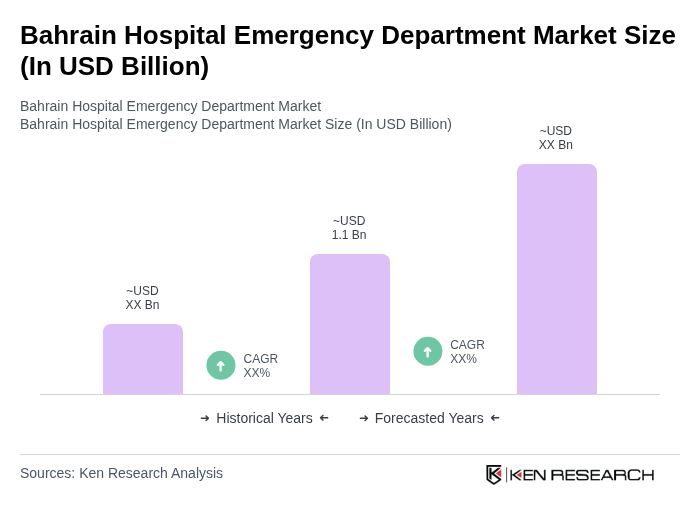
- The Bahrain Hospital Emergency Department market is valued at USD 1.1 billion, based on a five-year historical analysis, as a subsegment of the wider Bahrain hospital and healthcare services market. This growth is primarily driven by increasing healthcare expenditure, a rising population, and a growing prevalence of chronic diseases that necessitate emergency care services. The demand for efficient emergency services has surged, leading to investments in infrastructure, digital health solutions (such as tele-triage and electronic health records), and advanced diagnostic capabilities to enhance patient care and operational efficiency.
- Key cities such as Manama and Muharraq dominate the market due to their high population density and concentration of healthcare facilities, including major tertiary hospitals and specialized centers. The presence of Salmaniya Medical Complex, Bahrain Defence Force Royal Medical Services Hospital, King Hamad University Hospital, and leading private hospitals in these urban areas facilitates quick access to emergency services, making them critical hubs for healthcare delivery in Bahrain.
- In 2023, the Bahraini government implemented the National Health Regulatory Authority’s updated licensing and quality standards for emergency and critical care services under the Health Facilities Regulation, issued by the National Health Regulatory Authority (NHRA) and the Supreme Council of Health, which mandate time-bound triage, staffing, and clinical response parameters for hospital emergency departments. These requirements aim to ensure that emergency departments meet defined response and patient-flow standards, improve patient outcomes, and standardize emergency services across public and private hospitals, thereby enhancing overall system efficiency.
Bahrain Hospital Emergency Department Market Segmentation
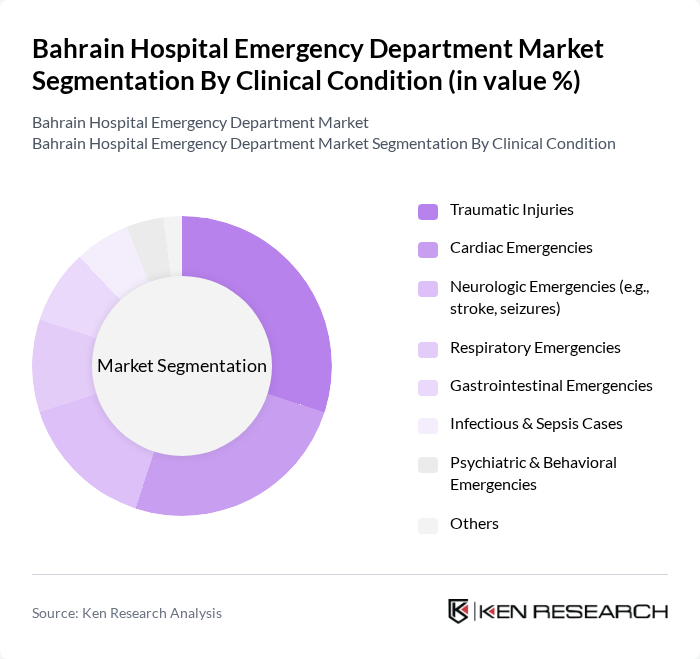
By Clinical Condition:This segmentation includes various clinical conditions that emergency departments address. The subsegments are Traumatic Injuries, Cardiac Emergencies, Neurologic Emergencies (e.g., stroke, seizures), Respiratory Emergencies, Gastrointestinal Emergencies, Infectious & Sepsis Cases, Psychiatric & Behavioral Emergencies, and Others. Among these, Traumatic Injuries and Cardiac Emergencies are the most prevalent categories in emergency utilization, supported by a relatively high incidence of road traffic injuries and the burden of cardiovascular disease risk factors such as diabetes, obesity, and hypertension in Bahrain’s population. The increasing awareness of acute symptoms (such as chest pain and stroke warning signs), national campaigns on non-communicable diseases, and the need for immediate care have led to a higher volume of visits in these categories.
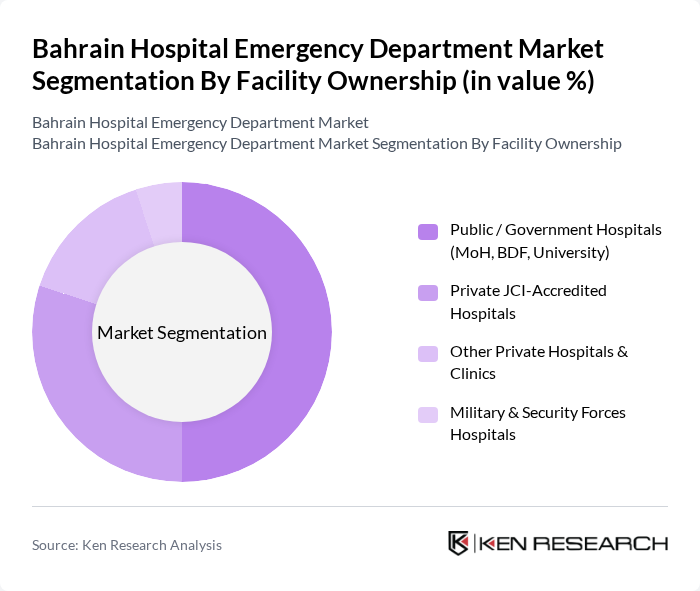
By Facility Ownership:This segmentation categorizes emergency departments based on their ownership structure, including Public / Government Hospitals (MoH, BDF, University), Private JCI-Accredited Hospitals, Other Private Hospitals & Clinics, and Military & Security Forces Hospitals. Public hospitals dominate this segment due to their extensive reach, role as primary referral centers, and funding from the government, which allows them to provide emergency services to a larger segment of the population and handle complex tertiary and trauma cases. Private hospitals are also significant players, offering specialized services, shorter perceived wait times, and enhanced amenities, and increasingly investing in accreditation and advanced emergency care capabilities to attract both insured residents and medical travelers.
Bahrain Hospital Emergency Department Market Competitive Landscape
The Bahrain Hospital Emergency Department Market is characterized by a dynamic mix of regional and international players. Leading participants such as Salmaniya Medical Complex (Ministry of Health), Bahrain Defence Force (BDF) Royal Medical Services Hospital, King Hamad University Hospital, Bahrain Specialist Hospital, Royal Bahrain Hospital, American Mission Hospital, Ibn Al-Nafees Hospital, KIMSHEALTH Hospital Bahrain, Al Hilal Hospital & Medical Centers, Aster Medical Centre Bahrain, Middle East Hospital, Noor Specialist Hospital, Al Kindi Specialized Hospital, Al Salam Specialist Hospital, and other emerging private hospitals and ED providers contribute to innovation, geographic expansion, and service delivery in this space.
Bahrain Hospital Emergency Department Market Industry Analysis
Growth Drivers
- Increasing Population and Urbanization:Bahrain's population is projected to reach approximately 1.7 million in future, driven by urbanization trends. The urban population is expected to account for over 90% of this figure, leading to increased demand for emergency healthcare services. As urban areas expand, the need for accessible emergency departments becomes critical, necessitating investment in healthcare infrastructure to accommodate the growing population's needs and ensure timely medical interventions.
- Rising Incidence of Emergencies and Accidents:The World Health Organization reported that road traffic accidents in Bahrain resulted in over 1,200 injuries annually. This statistic highlights the urgent need for efficient emergency services. Additionally, the increasing prevalence of chronic diseases, such as diabetes and cardiovascular conditions, contributes to a higher incidence of medical emergencies, further stressing the importance of well-equipped emergency departments to manage these situations effectively.
- Advancements in Medical Technology:The healthcare sector in Bahrain is witnessing significant technological advancements, with investments exceeding $200 million in medical technology in future. Innovations such as telemedicine, AI diagnostics, and advanced imaging techniques are enhancing emergency care delivery. These technologies not only improve patient outcomes but also streamline operations within emergency departments, allowing for quicker response times and more accurate treatment protocols, ultimately benefiting the healthcare system.
Market Challenges
- Limited Resources and Infrastructure:Despite the growing demand for emergency services, Bahrain faces challenges related to limited healthcare resources. The country has around 2.0 hospital beds per 1,000 people, which is slightly below the average for high-income countries. This shortage strains emergency departments, leading to overcrowding and longer wait times, which can adversely affect patient outcomes and overall satisfaction with healthcare services.
- High Operational Costs:Operating an emergency department in Bahrain incurs significant costs, with estimates suggesting that annual operational expenses can exceed $1 million per facility. These costs stem from staffing, equipment maintenance, and compliance with regulatory standards. High operational costs can limit the ability of hospitals to invest in necessary upgrades and expansions, ultimately impacting the quality of emergency care provided to patients.
Bahrain Hospital Emergency Department Market Future Outlook
The future of Bahrain's hospital emergency department market appears promising, driven by ongoing investments in healthcare infrastructure and technology. As the population continues to grow, the demand for emergency services will likely increase, prompting hospitals to enhance their capabilities. Additionally, the integration of telemedicine and AI technologies is expected to revolutionize patient care, improving efficiency and outcomes. With government support and private sector involvement, the market is poised for significant advancements in service delivery and patient satisfaction.
Market Opportunities
- Expansion of Private Healthcare Facilities:The private healthcare sector in Bahrain is projected to grow, with investments expected to reach $150 million in future. This expansion presents opportunities for developing new emergency departments that can alleviate pressure on public facilities, providing faster and more efficient care to patients while enhancing overall healthcare access.
- Telemedicine and Remote Care Solutions:The telemedicine market in Bahrain is anticipated to grow significantly, with an estimated value of $30 million in future. This growth offers opportunities for emergency departments to implement remote care solutions, allowing for timely consultations and triage, which can reduce the burden on physical facilities and improve patient outcomes through quicker access to care.
Scope of the Report
| Segment | Sub-Segments |
|---|---|
| By Clinical Condition | Traumatic Injuries Cardiac Emergencies Neurologic Emergencies (e.g., stroke, seizures) Respiratory Emergencies Gastrointestinal Emergencies Infectious & Sepsis Cases Psychiatric & Behavioral Emergencies Others |
| By Facility Ownership | Public / Government Hospitals (MoH, BDF, University) Private JCI-Accredited Hospitals Other Private Hospitals & Clinics Military & Security Forces Hospitals |
| By Patient Demographics | Adult (18–64 years) Pediatric (0–17 years) Geriatric (65+ years) Others |
| By Acuity Level (Triage Category) | Critical / Life-Threatening (e.g., CTAS 1–2, ESI 1–2) Urgent Non-Urgent Observation & Short-Stay Cases |
| By Visit Disposition | Admitted to Inpatient Ward / ICU Discharged Home Transferred to Another Facility Left Without Being Seen (LWBS) |
| By Payer / Insurance Type | Government-Funded Schemes / Public Coverage Private Insurance Self-Pay (Out-of-Pocket) Employer-Sponsored / Corporate Plans |
| By Care Delivery Model & Technology Utilization | Conventional In-Person ED Care Tele-Triage & Virtual Emergency Consults Fast-Track / Minor Emergency Units Observation Units & Short-Stay Wards |
Key Target Audience
Investors and Venture Capitalist Firms
Government and Regulatory Bodies (e.g., Ministry of Health, Bahrain National Health Regulatory Authority)
Healthcare Providers and Hospital Administrators
Medical Equipment Manufacturers
Pharmaceutical Companies
Health Insurance Companies
Emergency Medical Services (EMS) Providers
Healthcare Technology Solution Providers
Players Mentioned in the Report:
Salmaniya Medical Complex (Ministry of Health)
Bahrain Defence Force (BDF) Royal Medical Services Hospital
King Hamad University Hospital
Bahrain Specialist Hospital
Royal Bahrain Hospital
American Mission Hospital
Ibn Al-Nafees Hospital
KIMSHEALTH Hospital Bahrain
Al Hilal Hospital & Medical Centers
Aster Medical Centre Bahrain
Middle East Hospital
Noor Specialist Hospital
Al Kindi Specialized Hospital
Al Salam Specialist Hospital
Other Emerging Private Hospitals & ED Providers
Table of Contents
Market Assessment Phase
1. Executive Summary and Approach
2. Bahrain Hospital Emergency Department Market Overview
2.1 Key Insights and Strategic Recommendations
2.2 Bahrain Hospital Emergency Department Market Overview
2.3 Definition and Scope
2.4 Evolution of Market Ecosystem
2.5 Timeline of Key Regulatory Milestones
2.6 Value Chain & Stakeholder Mapping
2.7 Business Cycle Analysis
2.8 Policy & Incentive Landscape
3. Bahrain Hospital Emergency Department Market Analysis
3.1 Growth Drivers
3.1.1 Increasing Population and Urbanization
3.1.2 Rising Incidence of Emergencies and Accidents
3.1.3 Advancements in Medical Technology
3.1.4 Government Initiatives to Improve Healthcare Access
3.2 Market Challenges
3.2.1 Limited Resources and Infrastructure
3.2.2 High Operational Costs
3.2.3 Regulatory Compliance Issues
3.2.4 Shortage of Skilled Medical Personnel
3.3 Market Opportunities
3.3.1 Expansion of Private Healthcare Facilities
3.3.2 Telemedicine and Remote Care Solutions
3.3.3 Partnerships with International Healthcare Providers
3.3.4 Investment in Emergency Response Training Programs
3.4 Market Trends
3.4.1 Integration of AI and Machine Learning in Emergency Care
3.4.2 Focus on Patient-Centric Care Models
3.4.3 Increased Use of Mobile Health Applications
3.4.4 Shift Towards Preventive Healthcare Services
3.5 Government Regulation
3.5.1 Licensing and Accreditation Requirements
3.5.2 Emergency Medical Services Regulations
3.5.3 Patient Privacy and Data Protection Laws
3.5.4 Quality Assurance Standards in Healthcare
4. SWOT Analysis
5. Stakeholder Analysis
6. Porter's Five Forces Analysis
7. Bahrain Hospital Emergency Department Market Market Size, 2019-2024
7.1 By Value
7.2 By Volume
7.3 By Average Selling Price
8. Bahrain Hospital Emergency Department Market Segmentation
8.1 By Clinical Condition
8.1.1 Traumatic Injuries
8.1.2 Cardiac Emergencies
8.1.3 Neurologic Emergencies (e.g., stroke, seizures)
8.1.4 Respiratory Emergencies
8.1.5 Gastrointestinal Emergencies
8.1.6 Infectious & Sepsis Cases
8.1.7 Psychiatric & Behavioral Emergencies
8.1.8 Others
8.2 By Facility Ownership
8.2.1 Public / Government Hospitals (MoH, BDF, University)
8.2.2 Private JCI-Accredited Hospitals
8.2.3 Other Private Hospitals & Clinics
8.2.4 Military & Security Forces Hospitals
8.3 By Patient Demographics
8.3.1 Adult (18–64 years)
8.3.2 Pediatric (0–17 years)
8.3.3 Geriatric (65+ years)
8.3.4 Others
8.4 By Acuity Level (Triage Category)
8.4.1 Critical / Life-Threatening (e.g., CTAS 1–2, ESI 1–2)
8.4.2 Urgent
8.4.3 Non-Urgent
8.4.4 Observation & Short-Stay Cases
8.5 By Visit Disposition
8.5.1 Admitted to Inpatient Ward / ICU
8.5.2 Discharged Home
8.5.3 Transferred to Another Facility
8.5.4 Left Without Being Seen (LWBS)
8.6 By Payer / Insurance Type
8.6.1 Government-Funded Schemes / Public Coverage
8.6.2 Private Insurance
8.6.3 Self-Pay (Out-of-Pocket)
8.6.4 Employer-Sponsored / Corporate Plans
8.7 By Care Delivery Model & Technology Utilization
8.7.1 Conventional In-Person ED Care
8.7.2 Tele-Triage & Virtual Emergency Consults
8.7.3 Fast-Track / Minor Emergency Units
8.7.4 Observation Units & Short-Stay Wards
9. Bahrain Hospital Emergency Department Market Competitive Analysis
9.1 Market Share of Key Players
9.2 Cross Comparison of Key Players
9.2.1 Company Name
9.2.2 Ownership Type (Public, Private, Military, University)
9.2.3 Annual ED Visit Volume
9.2.4 Market Share by ED Visits (%)
9.2.5 Average ED Revenue per Visit
9.2.6 ED Revenue CAGR (Historical & Forecast)
9.2.7 Average Door-to-Doctor Time
9.2.8 Average Length of Stay in ED
9.2.9 Left Without Being Seen (LWBS) Rate
9.2.10 4-Hour / Target Throughput Compliance Rate
9.2.11 Bed Occupancy Rate (ED Beds)
9.2.12 Staff-to-Patient Ratio (Peak Hours)
9.2.13 ED Readmission / 72-Hour Return Rate
9.2.14 Clinical Outcome Metrics (e.g., mortality, complication rates)
9.2.15 Patient Experience / Satisfaction Score (e.g., PREMs/NPS)
9.2.16 Digital Maturity (EHR, PACS, Telehealth, AI Triage) Index
9.3 SWOT Analysis of Top Players
9.4 Pricing Analysis
9.5 Detailed Profile of Major Companies
9.5.1 Salmaniya Medical Complex (Ministry of Health)
9.5.2 Bahrain Defence Force (BDF) Royal Medical Services Hospital
9.5.3 King Hamad University Hospital
9.5.4 Bahrain Specialist Hospital
9.5.5 Royal Bahrain Hospital
9.5.6 American Mission Hospital
9.5.7 Ibn Al-Nafees Hospital
9.5.8 KIMSHEALTH Hospital Bahrain
9.5.9 Al Hilal Hospital & Medical Centers
9.5.10 Aster Medical Centre Bahrain
9.5.11 Middle East Hospital
9.5.12 Noor Specialist Hospital
9.5.13 Al Kindi Specialized Hospital
9.5.14 Al Salam Specialist Hospital
9.5.15 Other Emerging Private Hospitals & ED Providers
10. Bahrain Hospital Emergency Department Market End-User Analysis
10.1 Procurement Behavior of Key Ministries
10.1.1 Ministry of Health
10.1.2 Ministry of Interior
10.1.3 Ministry of Defence
10.1.4 Others
10.2 Corporate Spend on Infrastructure & Energy
10.2.1 Healthcare Infrastructure Investments
10.2.2 Emergency Services Funding
10.2.3 Technology Upgrades
10.2.4 Others
10.3 Pain Point Analysis by End-User Category
10.3.1 Delays in Emergency Response
10.3.2 Accessibility Issues
10.3.3 Quality of Care Concerns
10.3.4 Others
10.4 User Readiness for Adoption
10.4.1 Awareness of Emergency Services
10.4.2 Training and Preparedness
10.4.3 Technology Acceptance
10.4.4 Others
10.5 Post-Deployment ROI and Use Case Expansion
10.5.1 Cost Savings from Efficient Operations
10.5.2 Improved Patient Outcomes
10.5.3 Expansion of Service Offerings
10.5.4 Others
11. Bahrain Hospital Emergency Department Market Future Size, 2025-2030
11.1 By Value
11.2 By Volume
11.3 By Average Selling Price
Go-To-Market Strategy Phase
1. Whitespace Analysis + Business Model Canvas
1.1 Market Gaps Identification
1.2 Business Model Development
2. Marketing and Positioning Recommendations
2.1 Branding Strategies
2.2 Product USPs
3. Distribution Plan
3.1 Urban Retail vs Rural NGO Tie-ups
4. Channel & Pricing Gaps
4.1 Underserved Routes
4.2 Pricing Bands
5. Unmet Demand & Latent Needs
5.1 Category Gaps
5.2 Consumer Segments
6. Customer Relationship
6.1 Loyalty Programs
6.2 After-sales Service
7. Value Proposition
7.1 Sustainability
7.2 Integrated Supply Chains
8. Key Activities
8.1 Regulatory Compliance
8.2 Branding
8.3 Distribution Setup
9. Entry Strategy Evaluation
9.1 Domestic Market Entry Strategy
9.1.1 Product Mix
9.1.2 Pricing Band
9.1.3 Packaging
9.2 Export Entry Strategy
9.2.1 Target Countries
9.2.2 Compliance Roadmap
10. Entry Mode Assessment
10.1 JV
10.2 Greenfield
10.3 M&A
10.4 Distributor Model
11. Capital and Timeline Estimation
11.1 Capital Requirements
11.2 Timelines
12. Control vs Risk Trade-Off
12.1 Ownership vs Partnerships
13. Profitability Outlook
13.1 Breakeven Analysis
13.2 Long-term Sustainability
14. Potential Partner List
14.1 Distributors
14.2 JVs
14.3 Acquisition Targets
15. Execution Roadmap
15.1 Phased Plan for Market Entry
15.1.1 Market Setup
15.1.2 Market Entry
15.1.3 Growth Acceleration
15.1.4 Scale & Stabilize
15.2 Key Activities and Milestones
15.2.1 Milestone Planning
15.2.2 Activity Tracking
Research Methodology
Phase 1: Approach1
Desk Research
- Analysis of healthcare expenditure reports from the Bahrain Ministry of Health
- Review of published studies and white papers on emergency department trends in the Gulf region
- Examination of demographic and health statistics from the World Health Organization and local health authorities
Primary Research
- Interviews with emergency department heads and hospital administrators in Bahrain
- Surveys conducted with healthcare professionals working in emergency services
- Focus groups with patients who have utilized emergency services in the past year
Validation & Triangulation
- Cross-validation of findings with regional healthcare market reports and forecasts
- Triangulation of data from interviews, surveys, and secondary research sources
- Sanity checks through expert panel discussions with healthcare analysts and practitioners
Phase 2: Market Size Estimation1
Top-down Assessment
- Estimation of total healthcare spending in Bahrain and allocation to emergency services
- Analysis of patient volume trends in emergency departments over the past five years
- Incorporation of government health initiatives aimed at improving emergency care access
Bottom-up Modeling
- Collection of data on average costs per emergency visit from local hospitals
- Estimation of service utilization rates based on demographic data and health trends
- Volume x cost analysis to derive total market size for emergency services
Forecasting & Scenario Analysis
- Multi-factor regression analysis incorporating population growth and urbanization rates
- Scenario modeling based on potential changes in healthcare policy and funding
- Baseline, optimistic, and pessimistic projections for emergency department growth through 2030
Phase 3: CATI Sample Composition1
| Scope Item/Segment | Sample Size | Target Respondent Profiles |
|---|---|---|
| Emergency Department Utilization | 120 | Emergency Physicians, Hospital Administrators |
| Patient Experience in Emergency Services | 110 | Patients, Caregivers |
| Healthcare Policy Impact on Emergency Services | 90 | Health Policy Makers, Regulatory Officials |
| Emergency Care Staffing and Resources | 80 | Nurse Managers, Emergency Service Coordinators |
| Technological Integration in Emergency Departments | 70 | IT Managers, Healthcare Technology Specialists |
Frequently Asked Questions
What is the current value of the Bahrain Hospital Emergency Department market?
The Bahrain Hospital Emergency Department market is valued at approximately USD 1.1 billion, reflecting a significant growth driven by increasing healthcare expenditure, a rising population, and a higher prevalence of chronic diseases requiring emergency care services.
Which cities in Bahrain dominate the Emergency Department market?
What are the main clinical conditions treated in Bahrain's Emergency Departments?
How has the Bahraini government improved emergency care standards?
Other Regional/Country Reports
Other Adjacent Reports
Qatar Diagnostic Equipment Market
New Zealand Medical Imaging Market Report Size Share Growth Drivers Trends Opportunities & Forecast 2025–2030Kuwait cardiovascular devices market report size, share, growth drivers, trends, opportunities & forecast 2025–2030Mexico Trauma Care Market
KSA healthcare it market size, share, growth drivers, trends, opportunities & forecast 2025–2030Global electronic health records market report size, share, growth drivers, trends, opportunities & forecast 2025–2030Why Buy From Us?

What makes us stand out is that our consultants follow Robust, Refine and Result (RRR) methodology. Robust for clear definitions, approaches and sanity checking, Refine for differentiating respondents' facts and opinions, and Result for presenting data with story.

We have set a benchmark in the industry by offering our clients with syndicated and customized market research reports featuring coverage of entire market as well as meticulous research and analyst insights.

While we don't replace traditional research, we flip the method upside down. Our dual approach of Top Bottom & Bottom Top ensures quality deliverable by not just verifying company fundamentals but also looking at the sector and macroeconomic factors.

With one step in the future, our research team constantly tries to show you the bigger picture. We help with some of the tough questions you may encounter along the way: How is the industry positioned? Best marketing channel? KPI's of competitors? By aligning every element, we help maximize success.

Our report gives you instant access to the answers and sources that other companies might choose to hide. We elaborate each steps of research methodology we have used and showcase you the sample size to earn your trust.

If you need any support, we are here! We pride ourselves on universe strength, data quality, and quick, friendly, and professional service.