About the Report
Base Year 2024Australia Reusable Corrugated Boxes Market Overview
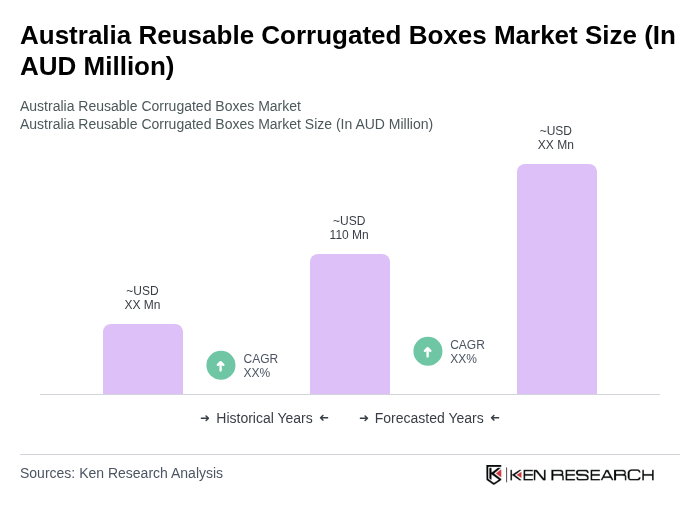
- The Australia Reusable Corrugated Boxes Market is valued at approximately AUD 110 million, based on a five-year historical analysis and aligned with the broader reusable transit and corrugated packaging trends in the country. This growth is primarily driven by the increasing demand for sustainable packaging solutions, as businesses seek to reduce their environmental footprint and improve supply chain efficiency. The shift towards e-commerce and the need for efficient logistics have further propelled the adoption of reusable corrugated boxes across various industries, particularly in food and beverage, agriculture, and online retail distribution.
- Key demand clusters in this market include major cities such as Sydney, Melbourne, and Brisbane, which dominate due to their robust industrial base, significant consumer markets, and concentration of logistics hubs and distribution centres. The presence of large e-commerce fulfilment centres, food processing facilities, and retail distribution platforms in these urban areas facilitates the efficient use of reusable packaging solutions, making them essential for businesses aiming to optimize their operations, reduce damage rates, and lower total packaging costs over multiple trips.
- Australian packaging policy frameworks have strengthened the shift towards sustainable, recyclable, and reusable packaging formats, including corrugated solutions. The 2025 National Packaging Targets, endorsed by environment ministers and implemented through the Australian Packaging Covenant Organisation (APCO), require that 100% of packaging be reusable, recyclable or compostable by 2025, with problematic single?use plastics phased out and higher recycled content across materials. In 2024, APCO’s 2030 Strategic Plan further operationalised these objectives by strengthening design guidelines, recycled-content expectations, and investment in collection and recycling systems, incentivising businesses in retail, food service, and fast?moving consumer goods to adopt fibre-based, returnable and reusable corrugated packaging formats.
Australia Reusable Corrugated Boxes Market Segmentation
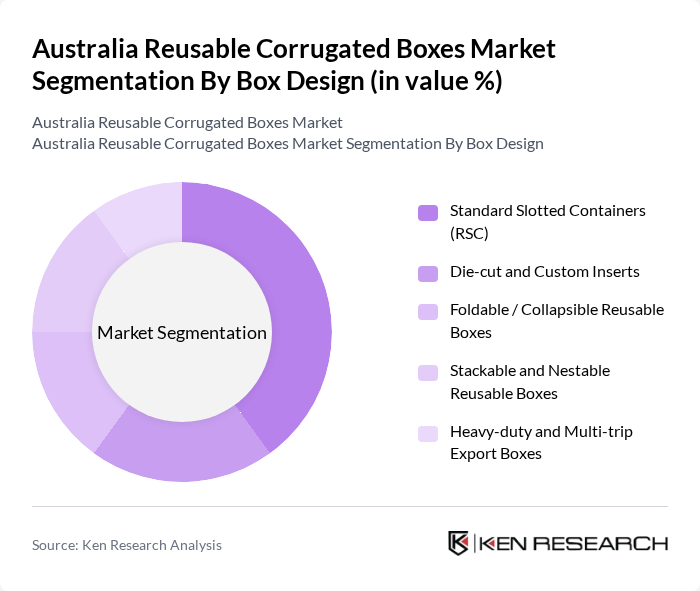
By Box Design:The box design segment includes various types of reusable corrugated boxes tailored for specific applications. The subsegments are Standard Slotted Containers (RSC), Die-cut and Custom Inserts, Foldable / Collapsible Reusable Boxes, Stackable and Nestable Reusable Boxes, and Heavy-duty and Multi-trip Export Boxes. Among these, Standard Slotted Containers (RSC) dominate the market due to their versatility, compatibility with automated packing lines, and cost-effectiveness across e-commerce, food, and industrial supply chains, which aligns with the broader dominance of corrugated shippers in Australia’s paper and paperboard packaging mix.
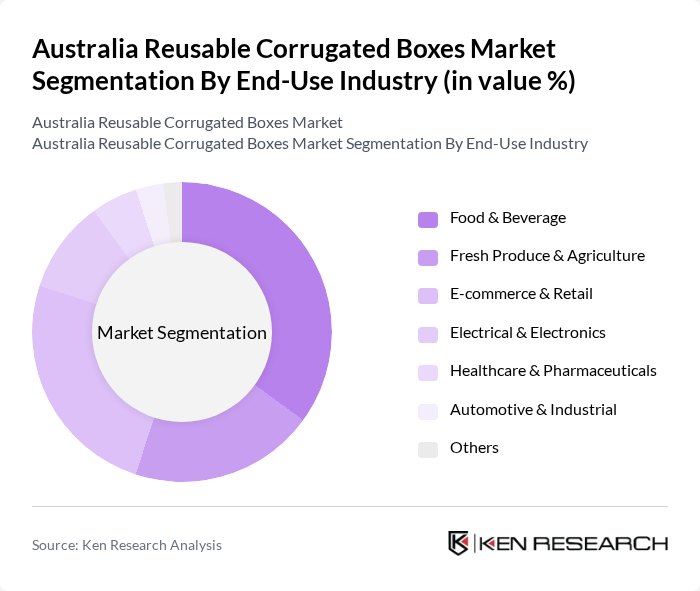
By End-Use Industry:This segment encompasses various industries utilizing reusable corrugated boxes, including Food & Beverage, Fresh Produce & Agriculture, E-commerce & Retail, Electrical & Electronics, Healthcare & Pharmaceuticals, Automotive & Industrial, and Others. The Food & Beverage sector leads the market, supported by strong corrugated usage in beverage multipacks, shelf-ready packaging, and secondary transit packaging for groceries and beverages, where fibre-based solutions increasingly replace rigid plastics. Fresh produce and agriculture make extensive use of reusable and recyclable corrugated crates and shippers for fruits and vegetables, while E-commerce & Retail rely on corrugated shippers, returnable mailers, and subscription boxes to balance product protection and sustainability in parcel delivery.
Australia Reusable Corrugated Boxes Market Competitive Landscape
The Australia Reusable Corrugated Boxes Market is characterized by a dynamic mix of regional and international players. Leading participants such as Visy Industries, Orora Limited, Smurfit Kappa Group, Pact Group Holdings Ltd, Amcor plc, Detmold Group, Oji Fibre Solutions (Australia), Nefab Packaging Australia, Visy Recycling, Opal Packaging Australia, Custom Cartons, Cardboard Cartons Pty Ltd, Austcor Packaging, EcoPack Solutions, and other emerging local players contribute to innovation, geographic expansion, and service delivery in this space.
Australia Reusable Corrugated Boxes Market Industry Analysis
Growth Drivers
- Increasing Demand for Sustainable Packaging Solutions:The Australian packaging industry is witnessing a significant shift towards sustainability, with the market for eco-friendly packaging projected to reach AUD 2.7 billion in future. This growth is driven by consumer preferences for environmentally responsible products, as 75% of Australians express a willingness to pay more for sustainable packaging. The emphasis on reducing plastic waste aligns with global sustainability goals, further propelling the demand for reusable corrugated boxes.
- Rising E-commerce Activities:E-commerce in Australia is expected to grow to AUD 55 billion in future, driven by increased online shopping habits. This surge in e-commerce is creating a higher demand for efficient and sustainable packaging solutions, including reusable corrugated boxes. With over 85% of Australians shopping online at least once a month, businesses are increasingly adopting reusable packaging to enhance their logistics and reduce costs associated with single-use materials.
- Cost-Effectiveness of Reusable Packaging:The total cost of ownership for reusable packaging is estimated to be 28% lower than that of single-use alternatives over a five-year period. This cost advantage is particularly appealing to businesses looking to optimize their supply chains. As companies face rising operational costs, the adoption of reusable corrugated boxes not only reduces waste but also leads to significant savings in packaging expenses, making it a financially attractive option.
Market Challenges
- High Initial Investment Costs:The transition to reusable corrugated boxes often requires substantial upfront investment, estimated at around AUD 1.2 million for mid-sized companies. This financial barrier can deter businesses from adopting sustainable packaging solutions, especially in a competitive market where profit margins are tight. Companies must weigh the long-term savings against the initial costs, which can be a significant challenge for many.
- Competition from Single-Use Packaging:The single-use packaging market in Australia is valued at approximately AUD 3.5 billion, presenting a formidable challenge to reusable packaging solutions. Many businesses continue to rely on single-use options due to their lower upfront costs and established supply chains. This entrenched preference for single-use materials complicates the market entry for reusable corrugated boxes, as companies may be hesitant to change their packaging strategies.
Australia Reusable Corrugated Boxes Market Future Outlook
The future of the reusable corrugated boxes market in Australia appears promising, driven by increasing consumer awareness and regulatory support for sustainable practices. As businesses adapt to the circular economy, innovations in materials and design are expected to enhance the functionality and appeal of reusable packaging. Additionally, partnerships with logistics companies will facilitate broader adoption, ensuring that reusable solutions become integral to supply chains, ultimately contributing to a more sustainable packaging landscape.
Market Opportunities
- Expansion in the Food and Beverage Sector:The food and beverage industry is projected to grow by AUD 6 billion in future, creating significant opportunities for reusable corrugated boxes. As companies seek to reduce waste and improve sustainability, the demand for reusable packaging solutions in this sector is expected to rise, providing a lucrative market for manufacturers.
- Innovations in Materials and Design:Advances in packaging technology are paving the way for innovative materials that enhance the durability and functionality of reusable boxes. With an estimated investment of AUD 250 million in R&D for sustainable packaging solutions, companies can capitalize on these innovations to meet evolving consumer demands and differentiate themselves in a competitive market.
Scope of the Report
| Segment | Sub-Segments |
|---|---|
| By Box Design | Standard Slotted Containers (RSC) Die-cut and Custom Inserts Foldable / Collapsible Reusable Boxes Stackable and Nestable Reusable Boxes Heavy-duty and Multi-trip Export Boxes |
| By End-Use Industry | Food & Beverage Fresh Produce & Agriculture E-commerce & Retail Electrical & Electronics Healthcare & Pharmaceuticals Automotive & Industrial Others |
| By Material Type | Recycled Corrugated Board Virgin Corrugated Board Hybrid / Reinforced Corrugated Structures |
| By Load Capacity | Up to 10 kg –25 kg –50 kg Above 50 kg |
| By Reuse Cycle | Short-cycle (up to 10 trips) Medium-cycle (11–30 trips) Long-cycle (above 30 trips) |
| By Region | Australian Capital Territory & New South Wales Victoria & Tasmania Queensland Northern Territory & South Australia Western Australia |
| By Application | Distribution & Shipping Intra-facility Material Handling Storage & Warehousing Display-Ready & Retail-ready Packaging Reverse Logistics & Returns Management |
Key Target Audience
Investors and Venture Capitalist Firms
Government and Regulatory Bodies (e.g., Australian Competition and Consumer Commission, Department of Agriculture, Water and the Environment)
Manufacturers and Producers
Distributors and Retailers
Logistics and Supply Chain Companies
Packaging Technology Providers
Industry Associations (e.g., Australian Packaging Covenant Organisation)
Financial Institutions
Players Mentioned in the Report:
Visy Industries
Orora Limited
Smurfit Kappa Group
Pact Group Holdings Ltd
Amcor plc
Detmold Group
Oji Fibre Solutions (Australia)
Nefab Packaging Australia
Visy Recycling
Opal Packaging Australia
Custom Cartons
Cardboard Cartons Pty Ltd
Austcor Packaging
EcoPack Solutions
Other Emerging Local Players
Table of Contents
Market Assessment Phase
1. Executive Summary and Approach
2. Australia Reusable Corrugated Boxes Market Overview
2.1 Key Insights and Strategic Recommendations
2.2 Australia Reusable Corrugated Boxes Market Overview
2.3 Definition and Scope
2.4 Evolution of Market Ecosystem
2.5 Timeline of Key Regulatory Milestones
2.6 Value Chain & Stakeholder Mapping
2.7 Business Cycle Analysis
2.8 Policy & Incentive Landscape
3. Australia Reusable Corrugated Boxes Market Analysis
3.1 Growth Drivers
3.1.1 Increasing demand for sustainable packaging solutions
3.1.2 Rising e-commerce activities
3.1.3 Cost-effectiveness of reusable packaging
3.1.4 Government initiatives promoting recycling
3.2 Market Challenges
3.2.1 High initial investment costs
3.2.2 Competition from single-use packaging
3.2.3 Limited consumer awareness
3.2.4 Supply chain complexities
3.3 Market Opportunities
3.3.1 Expansion in the food and beverage sector
3.3.2 Innovations in materials and design
3.3.3 Partnerships with logistics companies
3.3.4 Growth in export markets
3.4 Market Trends
3.4.1 Shift towards circular economy practices
3.4.2 Adoption of smart packaging technologies
3.4.3 Increased focus on brand sustainability
3.4.4 Customization and personalization in packaging
3.5 Government Regulation
3.5.1 Packaging waste reduction policies
3.5.2 Standards for reusable packaging
3.5.3 Incentives for sustainable practices
3.5.4 Compliance with environmental regulations
4. SWOT Analysis
5. Stakeholder Analysis
6. Porter's Five Forces Analysis
7. Australia Reusable Corrugated Boxes Market Market Size, 2019-2024
7.1 By Value
7.2 By Volume
7.3 By Average Selling Price
8. Australia Reusable Corrugated Boxes Market Segmentation
8.1 By Box Design
8.1.1 Standard Slotted Containers (RSC)
8.1.2 Die-cut and Custom Inserts
8.1.3 Foldable / Collapsible Reusable Boxes
8.1.4 Stackable and Nestable Reusable Boxes
8.1.5 Heavy-duty and Multi-trip Export Boxes
8.2 By End-Use Industry
8.2.1 Food & Beverage
8.2.2 Fresh Produce & Agriculture
8.2.3 E-commerce & Retail
8.2.4 Electrical & Electronics
8.2.5 Healthcare & Pharmaceuticals
8.2.6 Automotive & Industrial
8.2.7 Others
8.3 By Material Type
8.3.1 Recycled Corrugated Board
8.3.2 Virgin Corrugated Board
8.3.3 Hybrid / Reinforced Corrugated Structures
8.4 By Load Capacity
8.4.1 Up to 10 kg
8.4.2 10–25 kg
8.4.3 25–50 kg
8.4.4 Above 50 kg
8.5 By Reuse Cycle
8.5.1 Short-cycle (up to 10 trips)
8.5.2 Medium-cycle (11–30 trips)
8.5.3 Long-cycle (above 30 trips)
8.6 By Region
8.6.1 Australian Capital Territory & New South Wales
8.6.2 Victoria & Tasmania
8.6.3 Queensland
8.6.4 Northern Territory & South Australia
8.6.5 Western Australia
8.7 By Application
8.7.1 Distribution & Shipping
8.7.2 Intra-facility Material Handling
8.7.3 Storage & Warehousing
8.7.4 Display-Ready & Retail-ready Packaging
8.7.5 Reverse Logistics & Returns Management
9. Australia Reusable Corrugated Boxes Market Competitive Analysis
9.1 Market Share of Key Players
9.2 Cross Comparison of Key Players
9.2.1 Company Name
9.2.2 Group Size (Large, Medium, or Small as per industry convention)
9.2.3 Australia Reusable Corrugated Box Revenue (AUD million)
9.2.4 3-year CAGR in Reusable Corrugated Box Revenue (%)
9.2.5 EBITDA Margin from Reusable Packaging (%)
9.2.6 Market Share in Australia Reusable Corrugated Boxes (%)
9.2.7 Volume of Reusable Boxes Supplied (million units per year)
9.2.8 Average Price per Reusable Box (AUD/unit)
9.2.9 Contracted Customer Count (Number of Active B2B Accounts)
9.2.10 Customer Retention Rate (%)
9.2.11 Capex Intensity (Capex as % of Segment Revenue)
9.2.12 Sustainability Performance (Reuse Cycles per Box / % Recycled Content)
9.3 SWOT Analysis of Top Players
9.4 Pricing Analysis
9.5 Detailed Profile of Major Companies
9.5.1 Visy Industries
9.5.2 Orora Limited
9.5.3 Smurfit Kappa Group
9.5.4 Pact Group Holdings Ltd
9.5.5 Amcor plc
9.5.6 Detmold Group
9.5.7 Oji Fibre Solutions (Australia)
9.5.8 Nefab Packaging Australia
9.5.9 Visy Recycling
9.5.10 Opal Packaging Australia
9.5.11 Custom Cartons
9.5.12 Cardboard Cartons Pty Ltd
9.5.13 Austcor Packaging
9.5.14 EcoPack Solutions
9.5.15 Other Emerging Local Players
10. Australia Reusable Corrugated Boxes Market End-User Analysis
10.1 Procurement Behavior of Key Ministries
10.1.1 Government procurement policies
10.1.2 Budget allocation for sustainable packaging
10.1.3 Supplier selection criteria
10.1.4 Contract management practices
10.2 Corporate Spend on Infrastructure & Energy
10.2.1 Investment trends in packaging
10.2.2 Budgeting for sustainability initiatives
10.2.3 Cost-benefit analysis of reusable packaging
10.2.4 Long-term financial commitments
10.3 Pain Point Analysis by End-User Category
10.3.1 Supply chain disruptions
10.3.2 Cost management challenges
10.3.3 Quality assurance issues
10.3.4 Regulatory compliance hurdles
10.4 User Readiness for Adoption
10.4.1 Awareness of reusable packaging benefits
10.4.2 Training and education needs
10.4.3 Infrastructure readiness
10.4.4 Adoption barriers
10.5 Post-Deployment ROI and Use Case Expansion
10.5.1 Measurement of cost savings
10.5.2 Expansion into new markets
10.5.3 Long-term sustainability benefits
10.5.4 Customer feedback and improvement
11. Australia Reusable Corrugated Boxes Market Future Size, 2025-2030
11.1 By Value
11.2 By Volume
11.3 By Average Selling Price
Go-To-Market Strategy Phase
1. Whitespace Analysis + Business Model Canvas
1.1 Market gaps identification
1.2 Value proposition development
1.3 Revenue model exploration
1.4 Customer segmentation analysis
1.5 Competitive landscape overview
1.6 Key partnerships identification
1.7 Risk assessment
2. Marketing and Positioning Recommendations
2.1 Branding strategies
2.2 Product USPs
2.3 Target audience definition
2.4 Marketing channels selection
2.5 Messaging and communication strategy
3. Distribution Plan
3.1 Urban retail strategies
3.2 Rural NGO tie-ups
3.3 Logistics and supply chain management
3.4 Distribution partnerships
4. Channel & Pricing Gaps
4.1 Underserved routes
4.2 Pricing bands analysis
4.3 Competitor pricing strategies
4.4 Customer willingness to pay
5. Unmet Demand & Latent Needs
5.1 Category gaps identification
5.2 Consumer segments analysis
5.3 Product development opportunities
5.4 Market entry barriers
6. Customer Relationship
6.1 Loyalty programs design
6.2 After-sales service strategies
6.3 Customer feedback mechanisms
6.4 Relationship management tools
7. Value Proposition
7.1 Sustainability benefits
7.2 Integrated supply chains
7.3 Cost savings for customers
7.4 Enhanced customer experience
8. Key Activities
8.1 Regulatory compliance
8.2 Branding initiatives
8.3 Distribution setup
8.4 Market research activities
9. Entry Strategy Evaluation
9.1 Domestic Market Entry Strategy
9.1.1 Product mix considerations
9.1.2 Pricing band analysis
9.1.3 Packaging strategies
9.2 Export Entry Strategy
9.2.1 Target countries selection
9.2.2 Compliance roadmap development
10. Entry Mode Assessment
10.1 Joint Ventures
10.2 Greenfield investments
10.3 Mergers & Acquisitions
10.4 Distributor Model evaluation
11. Capital and Timeline Estimation
11.1 Capital requirements analysis
11.2 Timelines for market entry
12. Control vs Risk Trade-Off
12.1 Ownership considerations
12.2 Partnerships evaluation
13. Profitability Outlook
13.1 Breakeven analysis
13.2 Long-term sustainability strategies
14. Potential Partner List
14.1 Distributors identification
14.2 Joint Ventures opportunities
14.3 Acquisition targets
15. Execution Roadmap
15.1 Phased Plan for Market Entry
15.1.1 Market Setup
15.1.2 Market Entry
15.1.3 Growth Acceleration
15.1.4 Scale & Stabilize
15.2 Key Activities and Milestones
15.2.1 Activity timelines
15.2.2 Milestone tracking
Research Methodology
Phase 1: Approach1
Desk Research
- Industry reports from Australian packaging associations and market research firms
- Government publications on sustainability initiatives and recycling regulations
- Trade statistics from the Australian Bureau of Statistics related to corrugated box production and usage
Primary Research
- Interviews with key stakeholders in the packaging industry, including manufacturers and suppliers
- Surveys targeting logistics and supply chain managers in various sectors utilizing reusable corrugated boxes
- Field interviews with end-users in retail and e-commerce to understand their packaging needs and preferences
Validation & Triangulation
- Cross-validation of findings through multiple data sources, including trade publications and expert insights
- Triangulation of market data with insights from industry experts and academic research
- Sanity checks through feedback from a panel of industry experts to ensure data accuracy
Phase 2: Market Size Estimation1
Top-down Assessment
- Analysis of the overall packaging market size in Australia, focusing on the segment of reusable corrugated boxes
- Segmentation of the market by end-user industries such as food and beverage, retail, and e-commerce
- Incorporation of trends in sustainability and circular economy practices influencing market growth
Bottom-up Modeling
- Collection of production and sales data from leading manufacturers of reusable corrugated boxes
- Estimation of market size based on unit sales and average selling prices across different sectors
- Analysis of growth rates based on historical data and projected demand from key industries
Forecasting & Scenario Analysis
- Development of forecasting models using historical growth trends and market drivers
- Scenario analysis based on potential regulatory changes and shifts in consumer behavior towards sustainability
- Creation of multiple growth scenarios (baseline, optimistic, and pessimistic) through 2030
Phase 3: CATI Sample Composition1
| Scope Item/Segment | Sample Size | Target Respondent Profiles |
|---|---|---|
| Food & Beverage Packaging | 100 | Packaging Managers, Supply Chain Coordinators |
| Retail Sector Usage | 80 | Logistics Managers, Store Operations Managers |
| E-commerce Fulfillment | 90 | E-commerce Operations Managers, Warehouse Supervisors |
| Pharmaceutical Packaging Solutions | 70 | Quality Assurance Managers, Procurement Specialists |
| Industrial Applications | 60 | Production Managers, Supply Chain Analysts |
Frequently Asked Questions
What is the current value of the Australia Reusable Corrugated Boxes Market?
The Australia Reusable Corrugated Boxes Market is valued at approximately AUD 110 million, reflecting a growing trend towards sustainable packaging solutions and efficient logistics across various industries, particularly in e-commerce and food and beverage sectors.
What are the main drivers of growth in the Australia Reusable Corrugated Boxes Market?
Which cities in Australia are the largest markets for reusable corrugated boxes?
What are the different types of reusable corrugated boxes available in the market?
Other Regional/Country Reports
Other Adjacent Reports
Brazil E-commerce Packaging Market
Japan Food and Beverage Packaging Market
APAC Agricultural Packaging Market Size, Share & Forecast, By Material, Product Type, Application & Geography, 2026-2031US Paperboard Packaging Market Outlook to 2020 - Expanding E-tail industry and Usage of Recycled Paper to Fuel the Demand for Paper ProductsOman recyclable packaging market report size, share, growth drivers, trends, opportunities & forecast 2025–2030UAE Industrial Packaging Market Report Size Share Growth Drivers Trends Opportunities & Forecast 2025–2030Malaysia Logistics Packaging Market
Why Buy From Us?

What makes us stand out is that our consultants follow Robust, Refine and Result (RRR) methodology. Robust for clear definitions, approaches and sanity checking, Refine for differentiating respondents' facts and opinions, and Result for presenting data with story.

We have set a benchmark in the industry by offering our clients with syndicated and customized market research reports featuring coverage of entire market as well as meticulous research and analyst insights.

While we don't replace traditional research, we flip the method upside down. Our dual approach of Top Bottom & Bottom Top ensures quality deliverable by not just verifying company fundamentals but also looking at the sector and macroeconomic factors.

With one step in the future, our research team constantly tries to show you the bigger picture. We help with some of the tough questions you may encounter along the way: How is the industry positioned? Best marketing channel? KPI's of competitors? By aligning every element, we help maximize success.

Our report gives you instant access to the answers and sources that other companies might choose to hide. We elaborate each steps of research methodology we have used and showcase you the sample size to earn your trust.

If you need any support, we are here! We pride ourselves on universe strength, data quality, and quick, friendly, and professional service.