Australia Zinc Air Battery Market Report Size Share Growth Drivers Trends Opportunities & Forecast 2025–2030

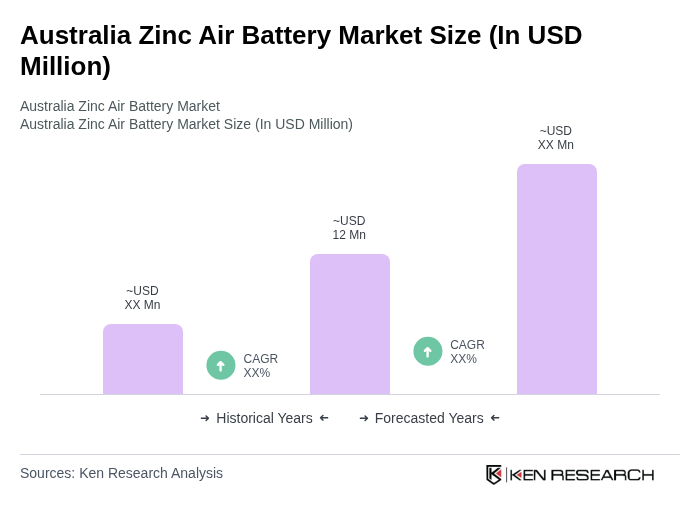
Australia Zinc Air Battery market, valued at USD 12 million, grows due to renewable energy needs, tech innovations, and applications in energy storage and consumer electronics.

Region:Asia

Author(s):Dev

Product Code:KRAA6761

Pages:89

Published On:January 2026
About the Report

Base Year 2024

Australia Zinc Air Battery Market Overview

  • The Australia Zinc Air Battery market is valued at USD 12 million, based on a five-year historical analysis. This growth is primarily driven by the increasing demand for renewable energy storage solutions, coupled with advancements in battery technology that enhance efficiency and longevity, alongside rising adoption in hearing aids, medical devices, and energy storage systems. The rising focus on sustainable energy sources and the need for efficient energy storage systems are significant factors contributing to this market's expansion.
  • Key players in this market include New South Wales, Victoria, and Queensland, which dominate due to their robust industrial infrastructure and supportive government policies promoting renewable energy initiatives. These regions have seen significant investments in energy storage technologies, making them pivotal in the growth of the zinc air battery market.
  • The Renewable Energy (Electricity) Act 2000, issued by the Australian Government, establishes the Renewable Energy Target scheme requiring liable entities to meet specified renewable energy percentages through Large-scale Generation Certificates and Small-scale Technology Certificates. This regulation mandates compliance for electricity retailers and wholesalers, with thresholds based on annual acquisition targets to promote renewable technologies including advanced batteries for grid integration and storage.
Australia Zinc Air Battery Market Size

Australia Zinc Air Battery Market Segmentation

By Type:The market is segmented into three types: Primary Zinc Air Batteries, Rechargeable Zinc Air Batteries, and Others. Primary Zinc Air Batteries are widely used in hearing aids and other small electronic devices due to their high energy density and lightweight characteristics. Rechargeable Zinc Air Batteries are gaining traction in applications requiring longer life cycles and sustainability. The "Others" category includes specialized applications that do not fit into the primary or rechargeable classifications.
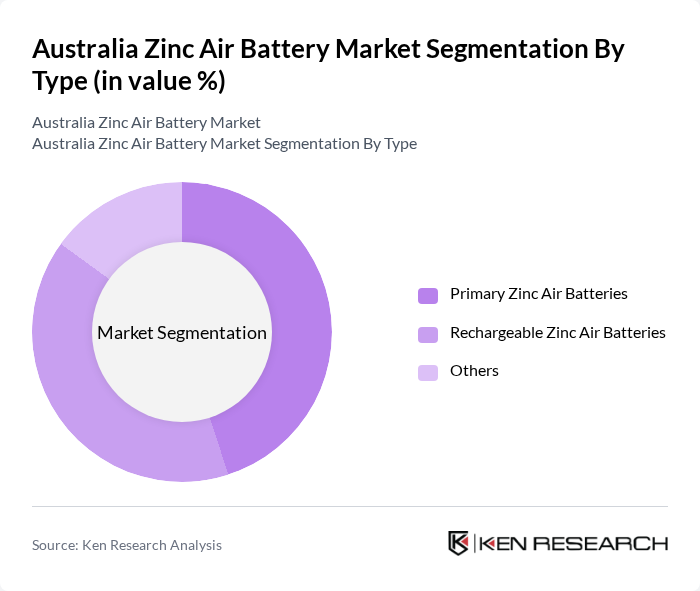
Australia Zinc Air Battery Market segmentation by Type.

The Primary Zinc Air Batteries segment is currently leading the market due to their extensive use in consumer electronics, particularly in hearing aids, where their lightweight and high energy density are critical. The growing trend towards miniaturization in electronic devices has further propelled the demand for these batteries. Rechargeable Zinc Air Batteries are also witnessing increased adoption, especially in applications that require sustainable energy solutions, but they still lag behind in market share compared to primary batteries.

By End-User:The market is segmented into Residential, Commercial, Industrial, Government & Utilities, and Others. The Residential segment is driven by the increasing adoption of home energy storage systems, while the Commercial and Industrial segments are expanding due to the need for reliable energy solutions in business operations. Government & Utilities are also significant users, focusing on large-scale energy storage projects.
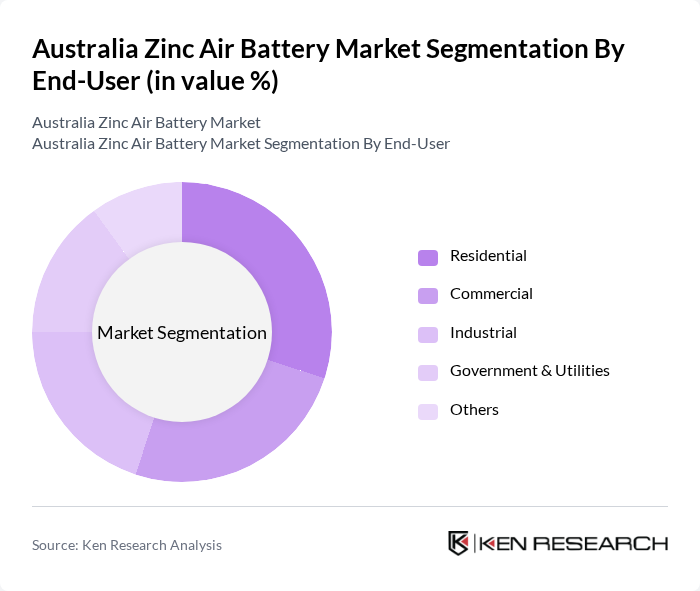
Australia Zinc Air Battery Market segmentation by End-User.

The Residential segment is currently the dominant end-user category, driven by the increasing trend of energy independence among homeowners and the growing popularity of solar energy systems. The Commercial segment follows closely, as businesses seek efficient energy storage solutions to manage operational costs. Industrial applications are also significant, particularly in sectors that require uninterrupted power supply, while Government & Utilities are investing in large-scale projects to enhance grid stability.

Australia Zinc Air Battery Market Competitive Landscape

The Australia Zinc Air Battery Market is characterized by a dynamic mix of regional and international players. Leading participants such as Redflow Limited, Zinc8 Energy Solutions, Powertech Systems, EnerSys, Axiom Energy, Australian Battery Technologies, EcoGraf Limited, Battery Energy Solutions, Zinc Power Holdings, Clean Energy Innovations, Altech Chemicals, Lithium Australia, Redflow Energy, Green Lithium, Australian Renewable Energy Agency (ARENA) contribute to innovation, geographic expansion, and service delivery in this space.

Redflow Limited

2005

Brisbane, Australia

Zinc8 Energy Solutions

2016

Vancouver, Canada

Powertech Systems

1995

Melbourne, Australia

EnerSys

2000

Reading, Pennsylvania, USA

Axiom Energy

2015

Sydney, Australia

Company

Establishment Year

Headquarters

Group Size (Large, Medium, or Small as per industry convention)

Revenue Growth Rate

Market Penetration Rate

Customer Retention Rate

Pricing Strategy

Product Innovation Rate

Australia Zinc Air Battery Market Industry Analysis

Growth Drivers

  • Increasing Demand for Renewable Energy Storage Solutions:The Australian energy sector is witnessing a significant shift towards renewable sources, with solar energy capacity reaching 20.5 GW in the future. This transition is driving the demand for efficient energy storage solutions, such as zinc air batteries, which can store excess energy generated during peak solar production. The Australian Renewable Energy Agency (ARENA) reported that energy storage installations are expected to exceed 2.0 GW in the future, highlighting the growing need for reliable storage technologies.
  • Government Incentives for Clean Energy Technologies:The Australian government has committed AUD 25 billion to support clean energy initiatives through various programs, including the Clean Energy Finance Corporation (CEFC). These incentives are designed to promote the adoption of innovative technologies, including zinc air batteries, which are seen as crucial for achieving the country’s renewable energy targets. With the Renewable Energy Target (RET) aiming for 40,000 GWh in the future, the financial backing is expected to accelerate market growth.
  • Advancements in Battery Technology:Recent technological advancements have significantly improved the performance and efficiency of zinc air batteries. Research from the University of Sydney indicates that new materials and designs can enhance energy density to over 350 Wh/kg, making them competitive with lithium-ion batteries. As these innovations continue to emerge, the market is likely to see increased adoption, particularly in sectors requiring high-capacity storage solutions, such as electric vehicles and grid applications.

Market Challenges

  • High Initial Investment Costs:The upfront costs associated with zinc air battery systems remain a significant barrier to widespread adoption. Current estimates suggest that the installation of a zinc air battery system can range from AUD 1,300 to AUD 1,900 per kWh. This high initial investment can deter potential consumers and businesses, particularly in a market where cheaper alternatives, such as lithium-ion batteries, are readily available and well-established.
  • Limited Consumer Awareness and Education:Despite the potential benefits of zinc air batteries, consumer awareness remains low. A survey conducted by the Clean Energy Council in the future revealed that only 30% of Australians are familiar with zinc air technology. This lack of knowledge can hinder market growth, as consumers may be reluctant to invest in unfamiliar technologies. Increased educational efforts are essential to inform potential users about the advantages and applications of zinc air batteries.

Australia Zinc Air Battery Market Future Outlook

The future of the Australia zinc air battery market appears promising, driven by the increasing integration of renewable energy sources and supportive government policies. As the demand for energy storage solutions continues to rise, innovations in battery technology are expected to enhance performance and reduce costs. Additionally, the growing focus on sustainability and environmental responsibility will likely propel the adoption of zinc air batteries, positioning them as a viable alternative in the energy storage landscape.

Market Opportunities

  • Expansion into Commercial and Industrial Sectors:The commercial and industrial sectors present significant opportunities for zinc air batteries, particularly in energy-intensive industries. With energy costs projected to rise by 20% in the future, businesses are increasingly seeking efficient storage solutions to manage energy consumption and costs effectively, making zinc air batteries an attractive option.
  • Development of Hybrid Energy Systems:The integration of zinc air batteries into hybrid energy systems, combining solar, wind, and traditional energy sources, offers substantial market potential. As Australia aims to achieve 60% renewable energy in the future, hybrid systems utilizing zinc air technology can enhance grid stability and reliability, attracting investments and partnerships in this emerging area.

Scope of the Report

SegmentSub-Segments
By Type

Primary Zinc Air Batteries

Rechargeable Zinc Air Batteries

Others

By End-User

Residential

Commercial

Industrial

Government & Utilities

Others

By Application

Energy Storage Systems

Electric Vehicles

Portable Electronics

Others

By Distribution Channel

Direct Sales

Online Retail

Distributors and Wholesalers

Others

By Geography

New South Wales

Victoria

Queensland

Western Australia

Others

By Technology

Conventional Zinc Air Technology

Advanced Zinc Air Technology

Others

By Policy Support

Subsidies

Tax Exemptions

Renewable Energy Certificates (RECs)

Others

Key Target Audience

Investors and Venture Capitalist Firms

Government and Regulatory Bodies (e.g., Australian Renewable Energy Agency, Clean Energy Regulator)

Manufacturers and Producers

Distributors and Retailers

Energy Storage System Integrators

Utility Companies

Industry Associations (e.g., Australian Battery Recycling Initiative)

Financial Institutions

Players Mentioned in the Report:

Redflow Limited

Zinc8 Energy Solutions

Powertech Systems

EnerSys

Axiom Energy

Australian Battery Technologies

EcoGraf Limited

Battery Energy Solutions

Zinc Power Holdings

Clean Energy Innovations

Altech Chemicals

Lithium Australia

Redflow Energy

Green Lithium

Australian Renewable Energy Agency (ARENA)

Table of Contents

Market Assessment Phase

1. Executive Summary and Approach


2. Australia Zinc Air Battery Market Overview

2.1 Key Insights and Strategic Recommendations

2.2 Australia Zinc Air Battery Market Overview

2.3 Definition and Scope

2.4 Evolution of Market Ecosystem

2.5 Timeline of Key Regulatory Milestones

2.6 Value Chain & Stakeholder Mapping

2.7 Business Cycle Analysis

2.8 Policy & Incentive Landscape


3. Australia Zinc Air Battery Market Analysis

3.1 Growth Drivers

3.1.1 Increasing demand for renewable energy storage solutions
3.1.2 Government incentives for clean energy technologies
3.1.3 Advancements in battery technology
3.1.4 Rising environmental concerns and sustainability initiatives

3.2 Market Challenges

3.2.1 High initial investment costs
3.2.2 Limited consumer awareness and education
3.2.3 Competition from alternative battery technologies
3.2.4 Regulatory hurdles and compliance issues

3.3 Market Opportunities

3.3.1 Expansion into commercial and industrial sectors
3.3.2 Development of hybrid energy systems
3.3.3 Collaborations with technology innovators
3.3.4 Export potential to emerging markets

3.4 Market Trends

3.4.1 Growing adoption of electric vehicles
3.4.2 Integration of smart grid technologies
3.4.3 Focus on circular economy and recycling
3.4.4 Increasing investment in R&D for battery efficiency

3.5 Government Regulation

3.5.1 Renewable Energy Target (RET) policies
3.5.2 Clean Energy Finance Corporation (CEFC) initiatives
3.5.3 Environmental Protection Authority (EPA) guidelines
3.5.4 Safety and performance standards for battery systems

4. SWOT Analysis


5. Stakeholder Analysis


6. Porter's Five Forces Analysis


7. Australia Zinc Air Battery Market Market Size, 2019-2024

7.1 By Value

7.2 By Volume

7.3 By Average Selling Price


8. Australia Zinc Air Battery Market Segmentation

8.1 By Type

8.1.1 Primary Zinc Air Batteries
8.1.2 Rechargeable Zinc Air Batteries
8.1.3 Others

8.2 By End-User

8.2.1 Residential
8.2.2 Commercial
8.2.3 Industrial
8.2.4 Government & Utilities
8.2.5 Others

8.3 By Application

8.3.1 Energy Storage Systems
8.3.2 Electric Vehicles
8.3.3 Portable Electronics
8.3.4 Others

8.4 By Distribution Channel

8.4.1 Direct Sales
8.4.2 Online Retail
8.4.3 Distributors and Wholesalers
8.4.4 Others

8.5 By Geography

8.5.1 New South Wales
8.5.2 Victoria
8.5.3 Queensland
8.5.4 Western Australia
8.5.5 Others

8.6 By Technology

8.6.1 Conventional Zinc Air Technology
8.6.2 Advanced Zinc Air Technology
8.6.3 Others

8.7 By Policy Support

8.7.1 Subsidies
8.7.2 Tax Exemptions
8.7.3 Renewable Energy Certificates (RECs)
8.7.4 Others

9. Australia Zinc Air Battery Market Competitive Analysis

9.1 Market Share of Key Players

9.2 Cross Comparison of Key Players

9.2.1 Company Name
9.2.2 Group Size (Large, Medium, or Small as per industry convention)
9.2.3 Revenue Growth Rate
9.2.4 Market Penetration Rate
9.2.5 Customer Retention Rate
9.2.6 Pricing Strategy
9.2.7 Product Innovation Rate
9.2.8 Operational Efficiency
9.2.9 Supply Chain Reliability
9.2.10 Brand Recognition

9.3 SWOT Analysis of Top Players

9.4 Pricing Analysis

9.5 Detailed Profile of Major Companies

9.5.1 Redflow Limited
9.5.2 Zinc8 Energy Solutions
9.5.3 Powertech Systems
9.5.4 EnerSys
9.5.5 Axiom Energy
9.5.6 Australian Battery Technologies
9.5.7 EcoGraf Limited
9.5.8 Battery Energy Solutions
9.5.9 Zinc Power Holdings
9.5.10 Clean Energy Innovations
9.5.11 Altech Chemicals
9.5.12 Lithium Australia
9.5.13 Redflow Energy
9.5.14 Green Lithium
9.5.15 Australian Renewable Energy Agency (ARENA)

10. Australia Zinc Air Battery Market End-User Analysis

10.1 Procurement Behavior of Key Ministries

10.1.1 Government procurement policies
10.1.2 Budget allocation for energy projects
10.1.3 Collaboration with private sector
10.1.4 Sustainability goals and initiatives

10.2 Corporate Spend on Infrastructure & Energy

10.2.1 Investment trends in energy storage
10.2.2 Corporate sustainability commitments
10.2.3 Infrastructure development projects
10.2.4 Energy efficiency programs

10.3 Pain Point Analysis by End-User Category

10.3.1 Cost of energy storage solutions
10.3.2 Reliability and performance issues
10.3.3 Integration with existing systems
10.3.4 Regulatory compliance challenges

10.4 User Readiness for Adoption

10.4.1 Awareness of zinc air technology
10.4.2 Perceived benefits and drawbacks
10.4.3 Training and support needs
10.4.4 Financial incentives for adoption

10.5 Post-Deployment ROI and Use Case Expansion

10.5.1 Measurement of energy savings
10.5.2 Long-term performance evaluations
10.5.3 Expansion into new applications
10.5.4 Customer feedback and improvement

11. Australia Zinc Air Battery Market Future Size, 2025-2030

11.1 By Value

11.2 By Volume

11.3 By Average Selling Price


Go-To-Market Strategy Phase

1. Whitespace Analysis + Business Model Canvas

1.1 Market gaps and opportunities

1.2 Value proposition development

1.3 Revenue model exploration

1.4 Key partnerships identification

1.5 Customer segmentation analysis

1.6 Competitive landscape overview

1.7 Risk assessment and mitigation


2. Marketing and Positioning Recommendations

2.1 Branding strategies

2.2 Product USPs

2.3 Target audience identification

2.4 Communication strategies

2.5 Digital marketing initiatives

2.6 Customer engagement tactics

2.7 Performance metrics


3. Distribution Plan

3.1 Urban retail strategies

3.2 Rural NGO tie-ups

3.3 Online distribution channels

3.4 Partnerships with local distributors

3.5 Logistics and supply chain management

3.6 Inventory management practices

3.7 Customer service and support


4. Channel & Pricing Gaps

4.1 Underserved routes

4.2 Pricing bands analysis

4.3 Competitor pricing strategies

4.4 Customer willingness to pay

4.5 Value-based pricing models

4.6 Discount and promotion strategies

4.7 Pricing optimization techniques


5. Unmet Demand & Latent Needs

5.1 Category gaps identification

5.2 Consumer segments analysis

5.3 Product development opportunities

5.4 Market entry strategies

5.5 Customer feedback incorporation

5.6 Future trends forecasting

5.7 Competitive advantage development


6. Customer Relationship

6.1 Loyalty programs

6.2 After-sales service

6.3 Customer feedback mechanisms

6.4 Community engagement initiatives

6.5 Customer education and training

6.6 Relationship management tools

6.7 Performance tracking and improvement


7. Value Proposition

7.1 Sustainability initiatives

7.2 Integrated supply chains

7.3 Cost-effectiveness analysis

7.4 Customer-centric product design

7.5 Competitive differentiation strategies

7.6 Long-term value creation

7.7 Brand loyalty enhancement


8. Key Activities

8.1 Regulatory compliance

8.2 Branding initiatives

8.3 Distribution setup

8.4 Market research and analysis

8.5 Training and development programs

8.6 Performance monitoring

8.7 Stakeholder engagement


9. Entry Strategy Evaluation

9.1 Domestic Market Entry Strategy

9.1.1 Product mix considerations
9.1.2 Pricing band analysis
9.1.3 Packaging strategies

9.2 Export Entry Strategy

9.2.1 Target countries identification
9.2.2 Compliance roadmap development

10. Entry Mode Assessment

10.1 Joint Ventures

10.2 Greenfield investments

10.3 Mergers & Acquisitions

10.4 Distributor Model

10.5 Risk assessment

10.6 Strategic fit evaluation

10.7 Long-term sustainability considerations


11. Capital and Timeline Estimation

11.1 Capital requirements

11.2 Timelines for market entry

11.3 Resource allocation

11.4 Financial projections

11.5 Risk management strategies

11.6 Milestone tracking

11.7 Contingency planning


12. Control vs Risk Trade-Off

12.1 Ownership considerations

12.2 Partnerships evaluation

12.3 Risk mitigation strategies

12.4 Long-term strategic alignment

12.5 Performance monitoring

12.6 Exit strategies

12.7 Stakeholder management


13. Profitability Outlook

13.1 Breakeven analysis

13.2 Long-term sustainability

13.3 Financial health assessment

13.4 Revenue growth projections

13.5 Cost management strategies

13.6 Market share growth

13.7 Investment return analysis


14. Potential Partner List

14.1 Distributors

14.2 Joint Ventures

14.3 Acquisition targets

14.4 Strategic alliances

14.5 Technology partners

14.6 Research collaborations

14.7 Community engagement partners


15. Execution Roadmap

15.1 Phased Plan for Market Entry

15.1.1 Market Setup
15.1.2 Market Entry
15.1.3 Growth Acceleration
15.1.4 Scale & Stabilize

15.2 Key Activities and Milestones

15.2.1 Activity planning
15.2.2 Milestone tracking
15.2.3 Performance evaluation
15.2.4 Stakeholder communication

Research Methodology

ApproachModellingSample

Phase 1: Approach1

Desk Research

  • Industry reports from Australian energy and battery associations
  • Market analysis publications from government energy departments
  • Academic journals focusing on advancements in zinc-air battery technology

Primary Research

  • Interviews with R&D heads at leading battery manufacturers
  • Surveys with energy policy experts and regulatory bodies
  • Field interviews with engineers involved in battery production and testing

Validation & Triangulation

  • Cross-validation of data from multiple industry sources and reports
  • Triangulation of market trends with expert insights and historical data
  • Sanity checks through feedback from industry panels and focus groups

Phase 2: Market Size Estimation1

Top-down Assessment

  • Analysis of national energy storage market size and growth rates
  • Segmentation by application areas such as renewable energy integration
  • Incorporation of government incentives for clean energy technologies

Bottom-up Modeling

  • Volume estimates based on production capacities of key manufacturers
  • Cost analysis derived from material sourcing and manufacturing processes
  • Market share calculations based on sales data from industry players

Forecasting & Scenario Analysis

  • Multi-variable regression analysis incorporating energy demand forecasts
  • Scenario modeling based on technological advancements and market adoption rates
  • Projections for market growth under various regulatory frameworks through 2030

Phase 3: CATI Sample Composition1

Scope Item/SegmentSample SizeTarget Respondent Profiles
Battery Manufacturing Sector120Production Managers, Quality Assurance Engineers
Energy Storage Solutions Providers90Business Development Managers, Technical Sales Representatives
Research Institutions and Universities50Academic Researchers, Professors in Energy Studies
Government Regulatory Bodies40Policy Analysts, Energy Regulation Officers
End-User Industries (e.g., Automotive, Renewable Energy)80Procurement Managers, Sustainability Officers

Frequently Asked Questions

What is the current value of the Australia Zinc Air Battery market?

The Australia Zinc Air Battery market is valued at approximately USD 12 million, driven by the increasing demand for renewable energy storage solutions and advancements in battery technology that enhance efficiency and longevity.

What factors are driving the growth of the Zinc Air Battery market in Australia?

Which regions in Australia are leading in Zinc Air Battery adoption?

What are the main applications of Zinc Air Batteries in Australia?

Other Adjacent Reports

Why Buy From Us?

Refine Robust Result (RRR) Framework

What makes us stand out is that our consultants follow Robust, Refine and Result (RRR) methodology. Robust for clear definitions, approaches and sanity checking, Refine for differentiating respondents' facts and opinions, and Result for presenting data with story.

Our Reach Is Unmatched

We have set a benchmark in the industry by offering our clients with syndicated and customized market research reports featuring coverage of entire market as well as meticulous research and analyst insights.

Shifting the Research Paradigm

While we don't replace traditional research, we flip the method upside down. Our dual approach of Top Bottom & Bottom Top ensures quality deliverable by not just verifying company fundamentals but also looking at the sector and macroeconomic factors.

More Insights-Better Decisions

With one step in the future, our research team constantly tries to show you the bigger picture. We help with some of the tough questions you may encounter along the way: How is the industry positioned? Best marketing channel? KPI's of competitors? By aligning every element, we help maximize success.

Transparency and Trust

Our report gives you instant access to the answers and sources that other companies might choose to hide. We elaborate each steps of research methodology we have used and showcase you the sample size to earn your trust.

Round the Clock Support

If you need any support, we are here! We pride ourselves on universe strength, data quality, and quick, friendly, and professional service.

Why Clients Choose Us?

400000+
Reports in repository
150+
Consulting projects a year
100+
Analysts
8000+
Client Queries in 2022








