About the Report
Base Year 2024Brazil Online Auto Parts and Accessories Market Overview
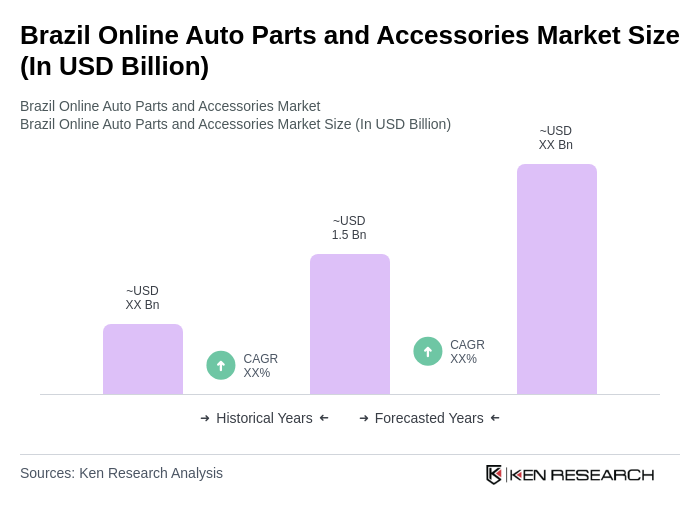
- The Brazil Online Auto Parts and Accessories Market is valued at approximately USD 1.5 billion, based on a five-year historical analysis. This figure reflects the size of the online segment specifically, which is distinct from the broader auto parts market that includes offline channels. The market’s expansion is primarily driven by increasing e-commerce penetration, rising vehicle ownership, and a growing preference for online shopping among Brazilian consumers. The convenience of online purchasing, competitive pricing, and a wide range of product offerings continue to fuel market growth.
- Key cities such as São Paulo, Rio de Janeiro, and Belo Horizonte remain dominant hubsdue to their large populations, high vehicle ownership rates, and robust logistics infrastructure. These urban centers facilitate efficient delivery of auto parts and accessories and host numerous automotive workshops and service centers, further driving demand.
- In 2023, the Brazilian government strengthened consumer protection in online transactions through the “Lei do E-commerce” (Law No. 14.206/2021) issued by the National Congress. This regulation mandates clear disclosure of product information, return policies, and warranty terms for auto parts sold online. The law aims to enhance transparency, ensure consumer rights, and foster trust in e-commerce platforms, directly benefiting the online auto parts market .
Brazil Online Auto Parts and Accessories Market Segmentation
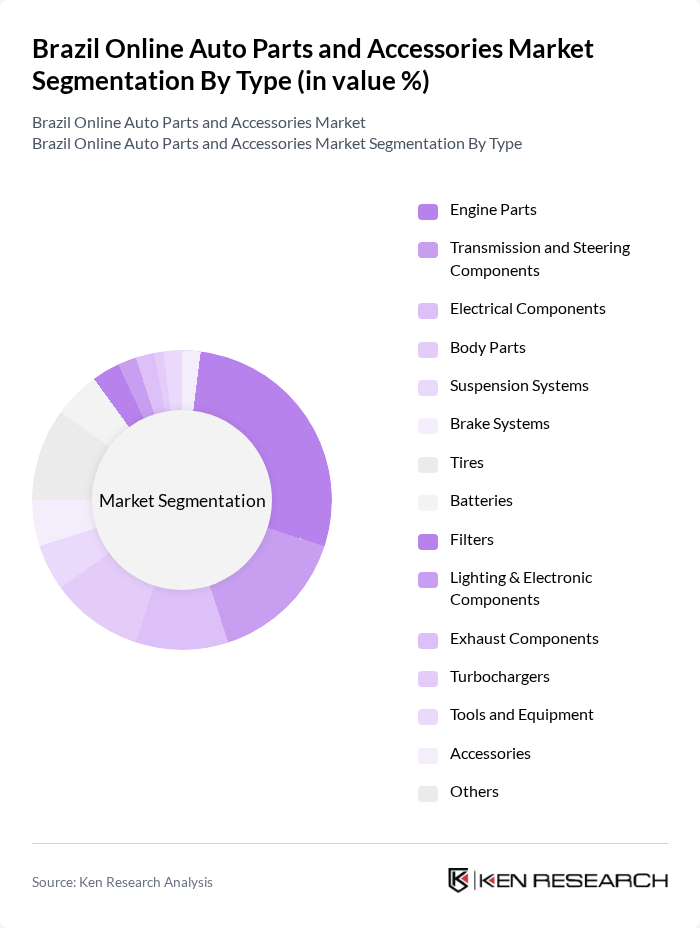
By Type:The market is segmented into various types of auto parts and accessories, including engine parts, transmission and steering components, electrical components, body parts, suspension systems, brake systems, tires, batteries, filters, lighting & electronic components, exhaust components, turbochargers, tools and equipment, accessories, and others.Engine parts and tires are the most dominant categories, reflecting their essential role in vehicle performance and safety. The ongoing increase in vehicle numbers and the popularity of DIY maintenance are driving higher demand for these components. Transmission, steering, and lighting components also show notable growth, supported by consumer priorities for maintenance and upgrades.
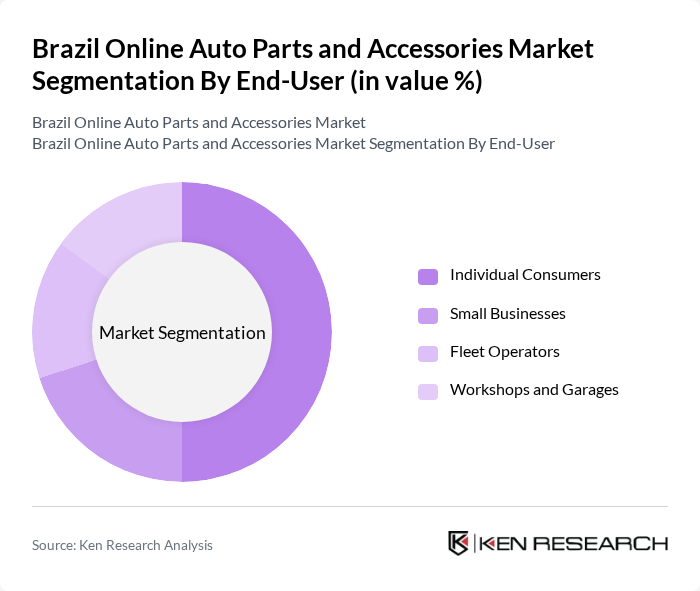
By End-User:The end-user segmentation includes individual consumers, small businesses, fleet operators, and workshops and garages.Individual consumers remain the largest segment, driven by a strong trend toward DIY vehicle maintenance and repair, as well as the convenience and affordability of online purchasing. Fleet operators and workshops also contribute significantly, requiring a steady supply of parts for ongoing maintenance and repairs.
Brazil Online Auto Parts and Accessories Market Competitive Landscape
The Brazil Online Auto Parts and Accessories Market is characterized by a dynamic mix of regional and international players. Leading participants such as Mercado Livre, OLX Brasil, AutoZone Brasil, Webmotors, iCarros, Amazon Brasil, Peça Rara, Connect Parts, AutoPecasOnline, AutoFácil, Trocafiltros, Mão na Roda, Carro na Rede, Peças e Acessórios, Rede PitStop, Lojas Americanas, Magazine Luiza, Via Varejo, Grupo Pão de Açúcar, B2W Digital, Continental contribute to innovation, geographic expansion, and service delivery in this space.
Brazil Online Auto Parts and Accessories Market Industry Analysis
Growth Drivers
- Increasing E-commerce Adoption:The Brazilian e-commerce sector is projected to reach R$ 200 billion in future, driven by a 20% increase in online shopping. This surge is attributed to improved internet access, with over 85% of the population now online. The convenience of purchasing auto parts online, combined with competitive pricing, is encouraging consumers to shift from traditional retail to e-commerce platforms, significantly impacting the auto parts market.
- Rising Vehicle Ownership:Brazil's vehicle ownership has seen a steady increase, with approximately 60 million registered vehicles in future, up from 48 million in 2020. This growth is fueled by a growing middle class and increased disposable income, leading to higher demand for auto parts and accessories. As vehicle ownership rises, so does the need for maintenance and replacement parts, further driving the online auto parts market.
- Technological Advancements in Auto Parts:The auto parts industry is experiencing rapid technological advancements, with innovations such as smart sensors and eco-friendly materials. In future, the market for advanced auto parts is expected to grow by R$ 10 billion, reflecting a shift towards high-tech solutions. These advancements not only enhance vehicle performance but also attract tech-savvy consumers who prefer purchasing innovative products online, boosting e-commerce sales.
Market Challenges
- Intense Competition:The Brazilian online auto parts market is characterized by fierce competition, with over 1,500 e-commerce platforms vying for market share. This saturation leads to price wars, reducing profit margins for retailers. In future, the average profit margin is expected to decline to 5%, down from 8% in 2020, as companies struggle to differentiate themselves in a crowded marketplace, impacting overall market stability.
- Supply Chain Disruptions:The Brazilian auto parts market faces significant supply chain challenges, exacerbated by global disruptions. In future, delays in shipping and increased logistics costs are projected to rise by 15%, affecting inventory levels and delivery times. These disruptions can lead to stock shortages, impacting customer satisfaction and sales. Retailers must adapt to these challenges to maintain competitiveness in the online marketplace.
Brazil Online Auto Parts and Accessories Market Future Outlook
The future of the Brazilian online auto parts market appears promising, driven by ongoing digital transformation and consumer preferences for convenience. As e-commerce continues to expand, businesses will increasingly leverage technology to enhance customer experiences. Additionally, the integration of AI and data analytics will enable personalized marketing strategies, fostering customer loyalty. Companies that adapt to these trends and invest in innovative solutions are likely to thrive in this evolving landscape, positioning themselves for long-term success.
Market Opportunities
- Expansion of Online Marketplaces:The growth of online marketplaces presents a significant opportunity for auto parts retailers. With an estimated 30% increase in marketplace sales expected in future, businesses can tap into a broader customer base. Collaborating with established platforms can enhance visibility and drive sales, allowing retailers to reach consumers who prefer shopping through trusted online channels.
- Increasing Demand for Eco-friendly Products:As environmental awareness rises, the demand for eco-friendly auto parts is expected to grow significantly. In future, the market for sustainable auto parts is projected to reach R$ 5 billion. Retailers that offer green alternatives can attract environmentally conscious consumers, creating a competitive edge in the online marketplace and contributing to sustainable practices within the industry.
Scope of the Report
| Segment | Sub-Segments |
|---|---|
| By Type | Engine Parts Transmission and Steering Components Electrical Components Body Parts Suspension Systems Brake Systems Tires Batteries Filters Lighting & Electronic Components Exhaust Components Turbochargers Tools and Equipment Accessories Others |
| By End-User | Individual Consumers Small Businesses Fleet Operators Workshops and Garages |
| By Sales Channel | Online Marketplaces Direct-to-Consumer (D2C) Platforms Third-Party E-commerce Platforms Retail Chains with Online Presence Distributors |
| By Price Range | Budget Mid-range Premium |
| By Brand | OEM Parts Aftermarket Brands Performance Parts Remanufactured Parts Private Labels |
| By Geographic Distribution | Urban Areas Suburban Areas Rural Areas |
| By Product Lifecycle Stage | New Products Mature Products End-of-life Products |
Key Target Audience
Investors and Venture Capitalist Firms
Government and Regulatory Bodies (e.g., Agência Nacional de Transportes Terrestres, Departamento Nacional de Trânsito)
Manufacturers and Producers
Distributors and Retailers
Automotive Repair Shops and Service Centers
Logistics and Supply Chain Companies
Industry Associations (e.g., Associação Nacional dos Fabricantes de Autopeças)
Financial Institutions
Players Mentioned in the Report:
Mercado Livre
OLX Brasil
AutoZone Brasil
Webmotors
iCarros
Amazon Brasil
Peca Rara
Connect Parts
AutoPecasOnline
AutoFacil
Trocafiltros
Mao na Roda
Carro na Rede
Pecas e Acessorios
Rede PitStop
Lojas Americanas
Magazine Luiza
Via Varejo
Grupo Pao de Acucar
B2W Digital
Continental
Table of Contents
Market Assessment Phase
1. Executive Summary and Approach
2. Brazil Online Auto Parts and Accessories Market Overview
2.1 Key Insights and Strategic Recommendations
2.2 Brazil Online Auto Parts and Accessories Market Overview
2.3 Definition and Scope
2.4 Evolution of Market Ecosystem
2.5 Timeline of Key Regulatory Milestones
2.6 Value Chain & Stakeholder Mapping
2.7 Business Cycle Analysis
2.8 Policy & Incentive Landscape
3. Brazil Online Auto Parts and Accessories Market Analysis
3.1 Growth Drivers
3.1.1 Increasing E-commerce Adoption
3.1.2 Rising Vehicle Ownership
3.1.3 Demand for Cost-effective Solutions
3.1.4 Technological Advancements in Auto Parts
3.2 Market Challenges
3.2.1 Intense Competition
3.2.2 Regulatory Compliance Issues
3.2.3 Supply Chain Disruptions
3.2.4 Consumer Trust and Quality Concerns
3.3 Market Opportunities
3.3.1 Expansion of Online Marketplaces
3.3.2 Growth in Aftermarket Services
3.3.3 Increasing Demand for Eco-friendly Products
3.3.4 Partnerships with Local Distributors
3.4 Market Trends
3.4.1 Shift Towards Mobile Commerce
3.4.2 Personalization in Customer Experience
3.4.3 Rise of Subscription Services
3.4.4 Integration of AI in Customer Service
3.5 Government Regulation
3.5.1 Import Tariffs on Auto Parts
3.5.2 Environmental Regulations
3.5.3 Consumer Protection Laws
3.5.4 E-commerce Regulations
4. SWOT Analysis
5. Stakeholder Analysis
6. Porter's Five Forces Analysis
7. Brazil Online Auto Parts and Accessories Market Market Size, 2019-2024
7.1 By Value
7.2 By Volume
7.3 By Average Selling Price
8. Brazil Online Auto Parts and Accessories Market Segmentation
8.1 By Type
8.1.1 Engine Parts
8.1.2 Transmission and Steering Components
8.1.3 Electrical Components
8.1.4 Body Parts
8.1.5 Suspension Systems
8.1.6 Brake Systems
8.1.7 Tires
8.1.8 Batteries
8.1.9 Filters
8.1.10 Lighting & Electronic Components
8.1.11 Exhaust Components
8.1.12 Turbochargers
8.1.13 Tools and Equipment
8.1.14 Accessories
8.1.15 Others
8.2 By End-User
8.2.1 Individual Consumers
8.2.2 Small Businesses
8.2.3 Fleet Operators
8.2.4 Workshops and Garages
8.3 By Sales Channel
8.3.1 Online Marketplaces
8.3.2 Direct-to-Consumer (D2C) Platforms
8.3.3 Third-Party E-commerce Platforms
8.3.4 Retail Chains with Online Presence
8.3.5 Distributors
8.4 By Price Range
8.4.1 Budget
8.4.2 Mid-range
8.4.3 Premium
8.5 By Brand
8.5.1 OEM Parts
8.5.2 Aftermarket Brands
8.5.3 Performance Parts
8.5.4 Remanufactured Parts
8.5.5 Private Labels
8.6 By Geographic Distribution
8.6.1 Urban Areas
8.6.2 Suburban Areas
8.6.3 Rural Areas
8.7 By Product Lifecycle Stage
8.7.1 New Products
8.7.2 Mature Products
8.7.3 End-of-life Products
9. Brazil Online Auto Parts and Accessories Market Competitive Analysis
9.1 Market Share of Key Players(Micro, Small, Medium, Large Enterprises)
9.2 KPIs for Cross Comparison of Key Players
9.2.1 Company Name
9.2.2 Group Size (Large, Medium, or Small as per industry convention)
9.2.3 Revenue Growth Rate
9.2.4 Online Sales Volume
9.2.5 Website Traffic
9.2.6 Customer Acquisition Cost
9.2.7 Customer Retention Rate
9.2.8 Average Order Value
9.2.9 Market Penetration Rate
9.2.10 Pricing Strategy
9.2.11 Product Return Rate
9.2.12 Inventory Turnover Ratio
9.2.13 Number of SKUs Listed Online
9.2.14 Geographic Coverage
9.2.15 Share of Aftermarket vs OEM Sales
9.3 SWOT Analysis of Top Players
9.4 Pricing Analysis(By Class and Payload)
9.5 List of Major Companies
9.5.1 Mercado Livre
9.5.2 OLX Brasil
9.5.3 AutoZone Brasil
9.5.4 Webmotors
9.5.5 iCarros
9.5.6 Amazon Brasil
9.5.7 Peça Rara
9.5.8 Connect Parts
9.5.9 AutoPecasOnline
9.5.10 AutoFácil
9.5.11 Trocafiltros
9.5.12 Mão na Roda
9.5.13 Carro na Rede
9.5.14 Peças e Acessórios
9.5.15 Rede PitStop
9.5.16 Lojas Americanas
9.5.17 Magazine Luiza
9.5.18 Via Varejo
9.5.19 Grupo Pão de Açúcar
9.5.20 B2W Digital
9.5.21 Continental
10. Brazil Online Auto Parts and Accessories Market End-User Analysis
10.1 Procurement Behavior of Key Ministries
10.1.1 Government Fleet Management
10.1.2 Public Transportation Maintenance
10.1.3 Infrastructure Projects
10.2 Corporate Spend on Infrastructure & Energy
10.2.1 Investment in Vehicle Maintenance
10.2.2 Budget Allocation for Spare Parts
10.2.3 Expenditure on Upgrades
10.3 Pain Point Analysis by End-User Category
10.3.1 Quality Assurance Issues
10.3.2 Delivery Timeliness
10.3.3 Cost Management
10.4 User Readiness for Adoption
10.4.1 Digital Literacy Levels
10.4.2 Access to Technology
10.4.3 Willingness to Shift to Online Platforms
10.5 Post-Deployment ROI and Use Case Expansion
10.5.1 Performance Metrics Tracking
10.5.2 Customer Feedback Mechanisms
10.5.3 Future Investment Plans
11. Brazil Online Auto Parts and Accessories Market Future Size, 2025-2030
11.1 By Value
11.2 By Volume
11.3 By Average Selling Price
Go-To-Market Strategy Phase
1. Whitespace Analysis + Business Model Canvas
1.1 Market Gaps Identification
1.2 Value Proposition Development
1.3 Revenue Streams Analysis
1.4 Cost Structure Evaluation
1.5 Key Partnerships Exploration
1.6 Customer Segmentation
1.7 Channels of Distribution
2. Marketing and Positioning Recommendations
2.1 Branding Strategies
2.2 Product USPs
2.3 Target Audience Engagement
2.4 Digital Marketing Tactics
2.5 Offline Marketing Strategies
3. Distribution Plan
3.1 Urban Retail Strategies
3.2 Rural NGO Tie-ups
3.3 Logistics and Supply Chain Management
3.4 Distribution Partnerships
4. Channel & Pricing Gaps
4.1 Underserved Routes
4.2 Pricing Bands Analysis
4.3 Competitor Pricing Strategies
4.4 Consumer Price Sensitivity
5. Unmet Demand & Latent Needs
5.1 Category Gaps Identification
5.2 Consumer Segments Analysis
5.3 Emerging Trends Exploration
6. Customer Relationship
6.1 Loyalty Programs
6.2 After-sales Service Enhancements
6.3 Customer Feedback Integration
7. Value Proposition
7.1 Sustainability Initiatives
7.2 Integrated Supply Chains
7.3 Customer-Centric Innovations
8. Key Activities
8.1 Regulatory Compliance
8.2 Branding Initiatives
8.3 Distribution Setup
9. Entry Strategy Evaluation
9.1 Domestic Market Entry Strategy
9.1.1 Product Mix Considerations
9.1.2 Pricing Band Strategy
9.1.3 Packaging Solutions
9.2 Export Entry Strategy
9.2.1 Target Countries Identification
9.2.2 Compliance Roadmap Development
10. Entry Mode Assessment
10.1 Joint Ventures
10.2 Greenfield Investments
10.3 Mergers & Acquisitions
10.4 Distributor Model Evaluation
11. Capital and Timeline Estimation
11.1 Capital Requirements Analysis
11.2 Timelines for Implementation
12. Control vs Risk Trade-Off
12.1 Ownership vs Partnerships
13. Profitability Outlook
13.1 Breakeven Analysis
13.2 Long-term Sustainability Strategies
14. Potential Partner List
14.1 Distributors
14.2 Joint Ventures
14.3 Acquisition Targets
15. Execution Roadmap
15.1 Phased Plan for Market Entry
15.1.1 Market Setup
15.1.2 Market Entry
15.1.3 Growth Acceleration
15.1.4 Scale & Stabilize
15.2 Key Activities and Milestones
15.2.1 Milestone Planning
15.2.2 Activity Tracking
Research Methodology
Phase 1: Approach1
Desk Research
- Analysis of industry reports from Brazilian automotive associations and market research firms
- Review of government publications and trade statistics related to auto parts and accessories
- Examination of online sales data and consumer behavior reports from e-commerce platforms
Primary Research
- Interviews with key stakeholders in the auto parts supply chain, including manufacturers and distributors
- Surveys targeting automotive repair shops and service centers to understand purchasing patterns
- Focus groups with consumers to gauge preferences and brand loyalty in auto parts purchasing
Validation & Triangulation
- Cross-validation of findings through multiple data sources, including trade publications and expert opinions
- Triangulation of market size estimates using sales data, consumer surveys, and expert interviews
- Sanity checks through expert panel reviews to ensure data accuracy and reliability
Phase 2: Market Size Estimation1
Top-down Assessment
- Estimation of total market size based on national automotive sales and repair service expenditures
- Segmentation of the market by product categories, including OEM and aftermarket parts
- Incorporation of growth trends in e-commerce and online sales channels for auto parts
Bottom-up Modeling
- Collection of sales data from leading auto parts retailers and online platforms
- Estimation of average transaction values and purchase frequencies across different consumer segments
- Volume and revenue projections based on historical sales data and market trends
Forecasting & Scenario Analysis
- Multi-variable forecasting models incorporating economic indicators and automotive industry trends
- Scenario analysis based on potential regulatory changes and shifts in consumer behavior
- Development of baseline, optimistic, and pessimistic market growth projections through 2030
Phase 3: CATI Sample Composition1
| Scope Item/Segment | Sample Size | Target Respondent Profiles |
|---|---|---|
| Retail Auto Parts Sales | 100 | Store Managers, Sales Representatives |
| Automotive Repair Services | 90 | Service Managers, Technicians |
| Online Auto Parts Retailers | 60 | E-commerce Managers, Digital Marketing Specialists |
| Consumer Preferences in Auto Parts | 80 | Car Owners, Automotive Enthusiasts |
| Supply Chain Insights | 50 | Logistics Coordinators, Procurement Managers |
Frequently Asked Questions
What is the current value of the Brazil Online Auto Parts and Accessories Market?
The Brazil Online Auto Parts and Accessories Market is valued at approximately USD 1.5 billion, reflecting the online segment's growth driven by increasing e-commerce penetration, rising vehicle ownership, and consumer preference for online shopping.
Which cities are the main hubs for the online auto parts market in Brazil?
What recent regulations have impacted the online auto parts market in Brazil?
What are the main types of auto parts sold online in Brazil?
Other Regional/Country Reports
Indonesia Online Auto Parts and Accessories Market
Malaysia Online Auto Parts and Accessories Market
KSA Online Auto Parts and Accessories Market
APAC Online Auto Parts and Accessories Market
SEA Online Auto Parts and Accessories Market
Vietnam Online Auto Parts and Accessories Market
Other Adjacent Reports
Brazil Automotive Aftermarket Market
UK E-Commerce Logistics MarketPhilippines Vehicle Maintenance Services Market
Kuwait Automotive Electronics (ECUs, Sensors, Controllers) Market Size, Share, Growth Drivers, Trends, Opportunities, Competitive Landscape & Forecast 2025–2030Japan Tire and Wheel Market
Us Automotive Battery Market Size, Share, Growth Drivers, Trends, Opportunities & Forecast 2025–2030KSA Car Accessories Customization Market
KSA Fleet Management Software MarketBrazil Used Vehicle Sales Market
Thailand Automotive Insurance Market
Why Buy From Us?

What makes us stand out is that our consultants follow Robust, Refine and Result (RRR) methodology. Robust for clear definitions, approaches and sanity checking, Refine for differentiating respondents' facts and opinions, and Result for presenting data with story.

We have set a benchmark in the industry by offering our clients with syndicated and customized market research reports featuring coverage of entire market as well as meticulous research and analyst insights.

While we don't replace traditional research, we flip the method upside down. Our dual approach of Top Bottom & Bottom Top ensures quality deliverable by not just verifying company fundamentals but also looking at the sector and macroeconomic factors.

With one step in the future, our research team constantly tries to show you the bigger picture. We help with some of the tough questions you may encounter along the way: How is the industry positioned? Best marketing channel? KPI's of competitors? By aligning every element, we help maximize success.

Our report gives you instant access to the answers and sources that other companies might choose to hide. We elaborate each steps of research methodology we have used and showcase you the sample size to earn your trust.

If you need any support, we are here! We pride ourselves on universe strength, data quality, and quick, friendly, and professional service.