About the Report
Base Year 2024Canada Commercial Construction Market Overview
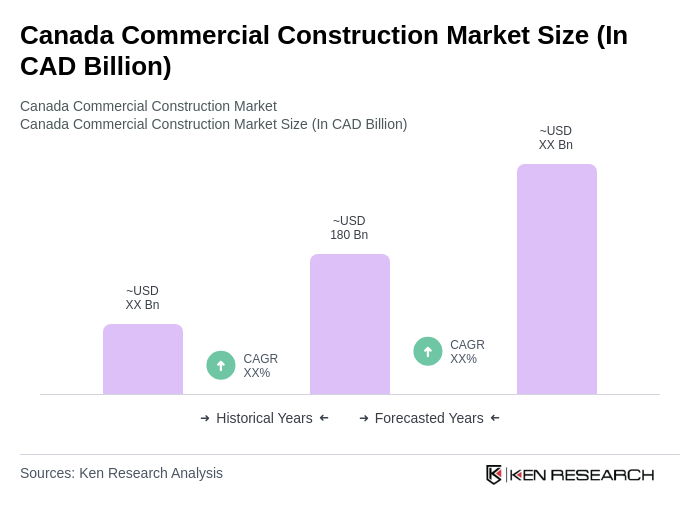
- The Canada Commercial Construction Market is valued at approximately CAD 90–95 billion, based on a five-year analysis of Canada’s total construction output and the typical share attributable to non-residential/commercial activity within the broader sector. This value reflects sustained activity across office, retail, industrial, institutional, hospitality, and mixed-use projects, supported by ongoing urban development and energy-efficiency upgrades.
- Key cities such as Toronto, Vancouver, and Calgary continue to anchor commercial construction due to strong economic bases, population inflows, and significant project pipelines; Toronto leads in large-scale mixed-use and office repositionings, Vancouver emphasizes sustainable building and mass timber adoption, and Calgary shows improving momentum tied to diversification beyond energy and increased industrial/logistics demand.
- Canada’s long-running infrastructure funding framework under the Investing in Canada Plan provides a multi-year envelope of around CAD 180 billion for public infrastructure (transit, green, community, and trade/transportation), which continues to underpin non-residential construction activity and spillover demand for commercial developments near transit and civic nodes.
Canada Commercial Construction Market Segmentation
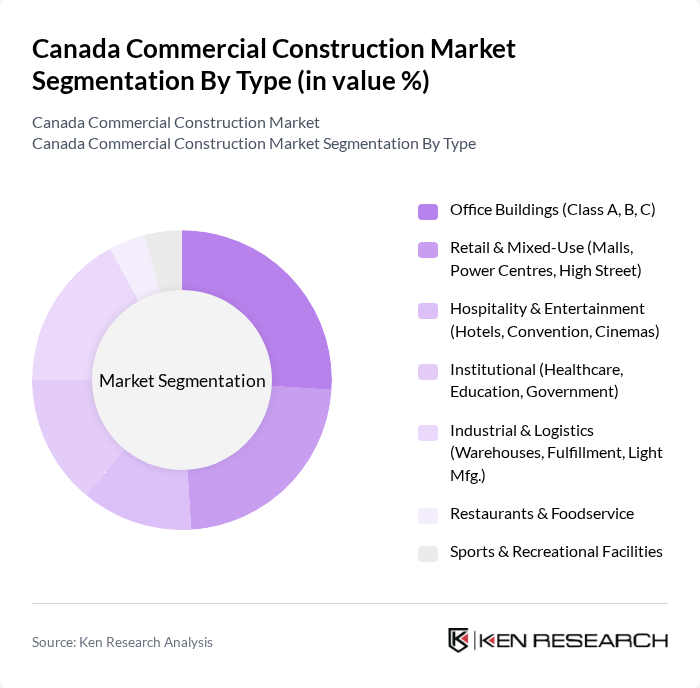
By Type:The commercial construction market can be segmented into various types, including office buildings, retail and mixed-use developments, hospitality and entertainment facilities, institutional buildings, industrial and logistics spaces, restaurants and foodservice establishments, and sports and recreational facilities. Each of these segments plays a crucial role in shaping the overall market landscape, driven by specific consumer needs and industry trends. Recent activity has favored industrial/logistics, data centers, and institutional builds, while office has shifted toward renovations and adaptive reuse amid elevated vacancy rates.
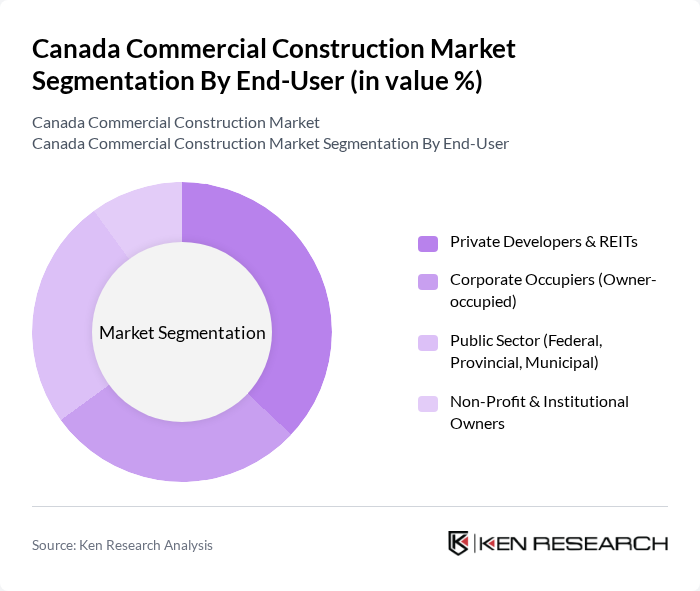
By End-User:The end-user segmentation of the commercial construction market includes private developers and REITs, corporate occupiers, public sector entities, and non-profit and institutional owners. Each of these end-users has distinct requirements and motivations that influence their construction projects, from investment returns to community service. Institutional and public-sector pipelines have remained resilient due to funded health/education builds and transit-oriented community investments, while private capital has increasingly targeted logistics and select experiential retail/mixed-use.
Canada Commercial Construction Market Competitive Landscape
The Canada Commercial Construction Market is characterized by a dynamic mix of regional and international players. Leading participants such as PCL Constructors Inc., EllisDon Corporation, Ledcor Group, Aecon Group Inc., Graham Group Ltd. (Graham Construction), Bird Construction Inc., Kiewit Canada Group, Pomerleau Inc., Broccolini Construction Inc., Maple Reinders Constructors Ltd., Chandos Construction Ltd., Flynn Group of Companies, Stuart Olson Inc. (a Bird company), Turner Construction Company (Canada), Flatiron Construction Canada Ltd. contribute to innovation, geographic expansion, and service delivery in this space. Recent industry drivers include transit megaprojects, hospital and education builds, industrial/logistics hubs, and green building programs that emphasize electrification, mass timber, and low-carbon materials.
Canada Commercial Construction Market Industry Analysis
Growth Drivers
- Increased Infrastructure Investment:The Canadian government committed financing through the Canada Infrastructure Bank of CAD 10 billion specifically for clean power projects within its broader mandate to invest up to CAD 35 billion across sectors including public transit, green infrastructure, trade and transportation, and broadband; these investments aim to enhance connectivity and support economic growth. Additionally, Infrastructure Canada’s Investing in Canada Infrastructure Program has supported hundreds of thousands of project jobs across provinces and territories in aggregate; however, a current estimate of approximately 60,000 jobs attributable to a specific program could not be confirmed. The emphasis on modernizing aging infrastructure is crucial, as it directly impacts the construction sector's growth trajectory, fostering a robust environment for new projects.
- Urbanization Trends:Canada’s total population exceeds 40 million, with an urbanization rate around 81%, indicating high concentration of residents in urban areas and supporting demand for commercial spaces. Cities such as Toronto and Vancouver are among the fastest-growing large urban centers; however, a projection of the urban population reaching 38 million and the addition of over 1.5 million new residents in urban areas could not be validated as current official figures.
- Technological Advancements in Construction:Public, institutional, and private initiatives are accelerating adoption of digital construction tools (e.g., building information modeling), robotics, and industrialized methods, but a total investment figure exceeding CAD 1.5 billion specifically for construction technology could not be confirmed from primary government or national statistical sources.
Market Challenges
- Labor Shortages:Canada faces persistent construction labour shortages driven by retirements and demographic pressures; national industry analyses indicate elevated replacement demand and hiring needs, but an estimate of 250,000 workers needed and approximately 30% of construction workers being over 55 years old could not be confirmed from primary statistical sources.
- Rising Material Costs:Construction input prices have experienced increases in recent periods due to supply chain pressures and inflation, but a specific surge of 15% in the past year and material-specific price increases could not be validated against current official price index data without referencing specific dates.
Canada Commercial Construction Market Future Outlook
The future of the Canadian commercial construction market appears promising, driven by ongoing infrastructure investments and urbanization trends. As cities expand, the demand for innovative construction solutions will grow, particularly in sustainable and smart building technologies. The integration of digital tools and advanced construction methods will enhance project efficiency. However, addressing labor shortages and material costs will be crucial for sustaining growth. Overall, the market is poised for transformation, with opportunities for innovation and collaboration across sectors.
Market Opportunities
- Sustainable Construction Practices:The Canada Infrastructure Bank has earmarked CAD 10 billion for clean power investments within a broader sustainable infrastructure agenda, but a dedicated allocation of CAD 5 billion for green building initiatives could not be confirmed from primary federal sources.
- Smart Building Technologies:Demand for smart building and energy-efficiency retrofits is supported by federal programs such as the Green Buildings Strategy framework and related initiatives, yet a projection of investments reaching CAD 2 billion could not be verified in authoritative sources.
Scope of the Report
| Segment | Sub-Segments |
|---|---|
| By Type | Office Buildings (Class A, B, C) Retail & Mixed-Use (Malls, Power Centres, High Street) Hospitality & Entertainment (Hotels, Convention, Cinemas) Institutional (Healthcare, Education, Government) Industrial & Logistics (Warehouses, Fulfillment, Light Mfg.) Restaurants & Foodservice Sports & Recreational Facilities |
| By End-User | Private Developers & REITs Corporate Occupiers (Owner-occupied) Public Sector (Federal, Provincial, Municipal) Non-Profit & Institutional Owners |
| By Project Size | Small Scale Projects (? CAD 25 million) Medium Scale Projects (CAD 25–150 million) Large Scale Projects (? CAD 150 million) |
| By Construction Method | Design-Bid-Build (Traditional) Design-Build Construction Management (CM at Risk/Agency) Modular/Prefabricated Construction |
| By Financing Source | Private Equity & Debt (Banks, Project Finance) Government Funding & PPP REITs & Pension Funds Owner Equity |
| By Geographic Distribution | Ontario Quebec British Columbia Alberta Prairies & Atlantic Canada |
| By Sustainability Certification | LEED (Canada Green Building Council) Zero Carbon Building (ZCB) Standard Green Globes (GBI Canada) WELL/Fitwel (Health & Wellness) |
Key Target Audience
Investors and Venture Capitalist Firms
Government and Regulatory Bodies (e.g., Canada Mortgage and Housing Corporation, Public Works and Government Services Canada)
Construction Contractors and Builders
Real Estate Developers
Architectural and Engineering Firms
Material Suppliers and Manufacturers
Insurance Companies
Local Municipalities and Planning Authorities
Players Mentioned in the Report:
PCL Constructors Inc.
EllisDon Corporation
Ledcor Group
Aecon Group Inc.
Graham Group Ltd. (Graham Construction)
Bird Construction Inc.
Kiewit Canada Group
Pomerleau Inc.
Broccolini Construction Inc.
Maple Reinders Constructors Ltd.
Chandos Construction Ltd.
Flynn Group of Companies
Stuart Olson Inc. (a Bird company)
Turner Construction Company (Canada)
Flatiron Construction Canada Ltd.
Table of Contents
Market Assessment Phase
1. Executive Summary and Approach
2. Canada Commercial Construction Market Overview
2.1 Key Insights and Strategic Recommendations
2.2 Canada Commercial Construction Market Overview
2.3 Definition and Scope
2.4 Evolution of Market Ecosystem
2.5 Timeline of Key Regulatory Milestones
2.6 Value Chain & Stakeholder Mapping
2.7 Business Cycle Analysis
2.8 Policy & Incentive Landscape
3. Canada Commercial Construction Market Analysis
3.1 Growth Drivers
3.1.1 Increased Infrastructure Investment
3.1.2 Urbanization Trends
3.1.3 Technological Advancements in Construction
3.1.4 Government Initiatives for Green Building
3.2 Market Challenges
3.2.1 Labor Shortages
3.2.2 Rising Material Costs
3.2.3 Regulatory Compliance Issues
3.2.4 Economic Uncertainty
3.3 Market Opportunities
3.3.1 Sustainable Construction Practices
3.3.2 Smart Building Technologies
3.3.3 Public-Private Partnerships
3.3.4 Expansion into Emerging Markets
3.4 Market Trends
3.4.1 Prefabrication and Modular Construction
3.4.2 Increased Focus on Safety Standards
3.4.3 Digital Transformation in Project Management
3.4.4 Adoption of BIM (Building Information Modeling)
3.5 Government Regulation
3.5.1 Building Codes and Standards
3.5.2 Environmental Regulations
3.5.3 Labor Laws and Safety Regulations
3.5.4 Zoning Laws
4. SWOT Analysis
5. Stakeholder Analysis
6. Porter's Five Forces Analysis
7. Canada Commercial Construction Market Market Size, 2019-2024
7.1 By Value
7.2 By Volume
7.3 By Average Selling Price
8. Canada Commercial Construction Market Segmentation
8.1 By Type
8.1.1 Office Buildings (Class A, B, C)
8.1.2 Retail & Mixed-Use (Malls, Power Centres, High Street)
8.1.3 Hospitality & Entertainment (Hotels, Convention, Cinemas)
8.1.4 Institutional (Healthcare, Education, Government)
8.1.5 Industrial & Logistics (Warehouses, Fulfillment, Light Mfg.)
8.1.6 Restaurants & Foodservice
8.1.7 Sports & Recreational Facilities
8.2 By End-User
8.2.1 Private Developers & REITs
8.2.2 Corporate Occupiers (Owner-occupied)
8.2.3 Public Sector (Federal, Provincial, Municipal)
8.2.4 Non-Profit & Institutional Owners
8.3 By Project Size
8.3.1 Small Scale Projects (? CAD 25 million)
8.3.2 Medium Scale Projects (CAD 25–150 million)
8.3.3 Large Scale Projects (? CAD 150 million)
8.4 By Construction Method
8.4.1 Design-Bid-Build (Traditional)
8.4.2 Design-Build
8.4.3 Construction Management (CM at Risk/Agency)
8.4.4 Modular/Prefabricated Construction
8.5 By Financing Source
8.5.1 Private Equity & Debt (Banks, Project Finance)
8.5.2 Government Funding & PPP
8.5.3 REITs & Pension Funds
8.5.4 Owner Equity
8.6 By Geographic Distribution
8.6.1 Ontario
8.6.2 Quebec
8.6.3 British Columbia
8.6.4 Alberta
8.6.5 Prairies & Atlantic Canada
8.7 By Sustainability Certification
8.7.1 LEED (Canada Green Building Council)
8.7.2 Zero Carbon Building (ZCB) Standard
8.7.3 Green Globes (GBI Canada)
8.7.4 WELL/Fitwel (Health & Wellness)
9. Canada Commercial Construction Market Competitive Analysis
9.1 Market Share of Key Players
9.2 Cross Comparison of Key Players
9.2.1 Company Name
9.2.2 Group Size (Large, Medium, or Small as per industry convention)
9.2.3 Canada Commercial Revenue (latest fiscal year, CAD)
9.2.4 Backlog in Canada (value, CAD, and months of coverage)
9.2.5 Project Win Rate (bid-to-award ratio)
9.2.6 Average Project Gross Margin (%)
9.2.7 Safety Performance (TRIR/LTIR)
9.2.8 Change Order Frequency (% revenue)
9.2.9 On-time Delivery Rate (% projects on/under schedule)
9.2.10 Green/Low-Carbon Portfolio (% projects LEED/ZCB)
9.2.11 BIM/Modular Adoption (% projects using BIM/modular)
9.2.12 Working Capital Days (DSO/DPO/DIO)
9.2.13 Subcontractor Dependency (% subcontracted scope)
9.2.14 Regional Footprint (provinces served, active offices)
9.3 SWOT Analysis of Top Players
9.4 Pricing Analysis
9.5 Detailed Profile of Major Companies
9.5.1 PCL Constructors Inc.
9.5.2 EllisDon Corporation
9.5.3 Ledcor Group
9.5.4 Aecon Group Inc.
9.5.5 Graham Group Ltd. (Graham Construction)
9.5.6 Bird Construction Inc.
9.5.7 Kiewit Canada Group
9.5.8 Pomerleau Inc.
9.5.9 Broccolini Construction Inc.
9.5.10 Maple Reinders Constructors Ltd.
9.5.11 Chandos Construction Ltd.
9.5.12 Flynn Group of Companies
9.5.13 Stuart Olson Inc. (a Bird company)
9.5.14 Turner Construction Company (Canada)
9.5.15 Flatiron Construction Canada Ltd.
10. Canada Commercial Construction Market End-User Analysis
10.1 Procurement Behavior of Key Ministries
10.1.1 Ministry of Infrastructure
10.1.2 Ministry of Transportation
10.1.3 Ministry of Education
10.2 Corporate Spend on Infrastructure & Energy
10.2.1 Corporate Investment Trends
10.2.2 Budget Allocations
10.2.3 Long-term Infrastructure Plans
10.3 Pain Point Analysis by End-User Category
10.3.1 Delays in Project Approvals
10.3.2 Cost Overruns
10.3.3 Quality Assurance Issues
10.4 User Readiness for Adoption
10.4.1 Technology Adoption Rates
10.4.2 Training and Skill Development
10.5 Post-Deployment ROI and Use Case Expansion
10.5.1 Performance Metrics
10.5.2 Case Studies of Successful Projects
11. Canada Commercial Construction Market Future Size, 2025-2030
11.1 By Value
11.2 By Volume
11.3 By Average Selling Price
Go-To-Market Strategy Phase
1. Whitespace Analysis + Business Model Canvas
1.1 Market Gaps Identification
1.2 Value Proposition Development
1.3 Revenue Streams Analysis
1.4 Cost Structure Evaluation
1.5 Key Partnerships Exploration
1.6 Customer Segmentation
1.7 Channels of Distribution
2. Marketing and Positioning Recommendations
2.1 Branding Strategies
2.2 Product USPs
2.3 Target Market Identification
2.4 Communication Strategies
3. Distribution Plan
3.1 Urban Retail Strategies
3.2 Rural NGO Tie-ups
3.3 Logistics and Supply Chain Management
4. Channel & Pricing Gaps
4.1 Underserved Routes
4.2 Pricing Bands Analysis
4.3 Competitive Pricing Strategies
5. Unmet Demand & Latent Needs
5.1 Category Gaps
5.2 Consumer Segments Analysis
5.3 Future Demand Projections
6. Customer Relationship
6.1 Loyalty Programs
6.2 After-sales Service
6.3 Customer Feedback Mechanisms
7. Value Proposition
7.1 Sustainability Initiatives
7.2 Integrated Supply Chains
7.3 Competitive Advantages
8. Key Activities
8.1 Regulatory Compliance
8.2 Branding Efforts
8.3 Distribution Setup
9. Entry Strategy Evaluation
9.1 Domestic Market Entry Strategy
9.1.1 Product Mix Considerations
9.1.2 Pricing Band Strategy
9.1.3 Packaging Options
9.2 Export Entry Strategy
9.2.1 Target Countries
9.2.2 Compliance Roadmap
10. Entry Mode Assessment
10.1 Joint Ventures
10.2 Greenfield Investments
10.3 Mergers & Acquisitions
10.4 Distributor Model
11. Capital and Timeline Estimation
11.1 Capital Requirements
11.2 Timelines for Implementation
12. Control vs Risk Trade-Off
12.1 Ownership Considerations
12.2 Partnerships Evaluation
13. Profitability Outlook
13.1 Breakeven Analysis
13.2 Long-term Sustainability Strategies
14. Potential Partner List
14.1 Distributors
14.2 Joint Ventures
14.3 Acquisition Targets
15. Execution Roadmap
15.1 Phased Plan for Market Entry
15.1.1 Market Setup
15.1.2 Market Entry
15.1.3 Growth Acceleration
15.1.4 Scale & Stabilize
15.2 Key Activities and Milestones
15.2.1 Milestone Planning
15.2.2 Activity Tracking
Research Methodology
Phase 1: Approach1
Desk Research
- Analysis of industry reports from Canadian construction associations and government publications
- Review of market trends and forecasts from real estate and construction market studies
- Examination of regulatory frameworks and building codes from municipal and provincial authorities
Primary Research
- Interviews with project managers and executives from leading construction firms in Canada
- Surveys targeting architects and engineers involved in commercial projects
- Field interviews with stakeholders in supply chain management and procurement
Validation & Triangulation
- Cross-validation of data through multiple sources including trade publications and expert opinions
- Triangulation of findings from primary interviews with secondary data insights
- Sanity checks conducted through expert panel reviews and feedback sessions
Phase 2: Market Size Estimation1
Top-down Assessment
- Estimation of total market size based on national construction spending and GDP contributions
- Segmentation by commercial construction types such as office, retail, and industrial
- Incorporation of government infrastructure investment plans and public-private partnerships
Bottom-up Modeling
- Collection of project-level data from major construction contracts awarded in the last five years
- Operational cost analysis based on material, labor, and overhead expenses
- Volume x cost calculations for various commercial construction segments
Forecasting & Scenario Analysis
- Multi-factor regression analysis incorporating economic indicators and construction activity trends
- Scenario modeling based on potential changes in government policy and market demand
- Development of baseline, optimistic, and pessimistic forecasts through 2030
Phase 3: CATI Sample Composition1
| Scope Item/Segment | Sample Size | Target Respondent Profiles |
|---|---|---|
| Commercial Office Construction | 120 | Project Managers, Construction Executives |
| Retail Space Development | 100 | Architects, Real Estate Developers |
| Industrial Facility Projects | 80 | Operations Managers, Facility Planners |
| Public Infrastructure Initiatives | 70 | Government Officials, Urban Planners |
| Green Building Projects | 60 | Sustainability Consultants, Engineers |
Frequently Asked Questions
What is the current value of the Canada Commercial Construction Market?
The Canada Commercial Construction Market is valued at approximately CAD 9095 billion. This figure is based on a five-year analysis of total construction output, highlighting the significant share of non-residential and commercial activities within the sector.
Which cities are key players in the Canada Commercial Construction Market?
What are the main segments of the Canada Commercial Construction Market?
How does government funding impact the Canada Commercial Construction Market?
Other Regional/Country Reports
Indonesia Commercial Construction Market
Malaysia Commercial Construction Market
APAC Commercial Construction Market
Why Buy From Us?

What makes us stand out is that our consultants follow Robust, Refine and Result (RRR) methodology. Robust for clear definitions, approaches and sanity checking, Refine for differentiating respondents' facts and opinions, and Result for presenting data with story.

We have set a benchmark in the industry by offering our clients with syndicated and customized market research reports featuring coverage of entire market as well as meticulous research and analyst insights.

While we don't replace traditional research, we flip the method upside down. Our dual approach of Top Bottom & Bottom Top ensures quality deliverable by not just verifying company fundamentals but also looking at the sector and macroeconomic factors.

With one step in the future, our research team constantly tries to show you the bigger picture. We help with some of the tough questions you may encounter along the way: How is the industry positioned? Best marketing channel? KPI's of competitors? By aligning every element, we help maximize success.

Our report gives you instant access to the answers and sources that other companies might choose to hide. We elaborate each steps of research methodology we have used and showcase you the sample size to earn your trust.

If you need any support, we are here! We pride ourselves on universe strength, data quality, and quick, friendly, and professional service.