About the Report
Base Year 2024Europe Gas Turbine Market Overview
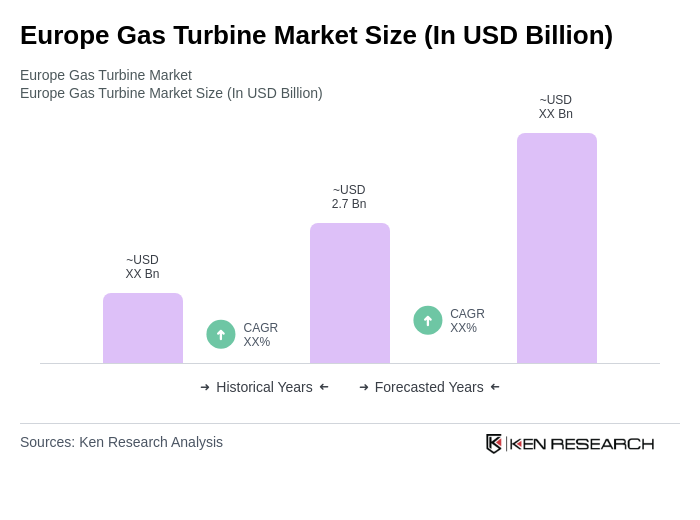
- The Europe Gas Turbine Market is valued at approximately USD 2.7 billion, based on a five-year historical analysis. This level aligns with multiple industry trackers that place the regional market in the low-to-mid single billions, reflecting installed base services plus new equipment demand driven by flexible generation needs alongside renewables integration .
- Growth is primarily driven by the increasing demand for efficient power generation solutions, the transition toward cleaner energy sources, and the need for flexible capacity to balance variable wind and solar. European renewables additions and grid-balancing needs are cited as key drivers for gas turbines, especially combined-cycle assets that provide high efficiency and fast ramping .
- In 2023 and onward, the European Green Deal framework and related Fit for 55 legislation reinforce the objective of climate neutrality by 2050, tightening emissions performance standards and promoting cleaner dispatchable generation. Gas turbines are being adapted via high-efficiency combined cycle designs and hydrogen co-firing readiness to align with decarbonization pathways and system adequacy needs .
Europe Gas Turbine Market Segmentation
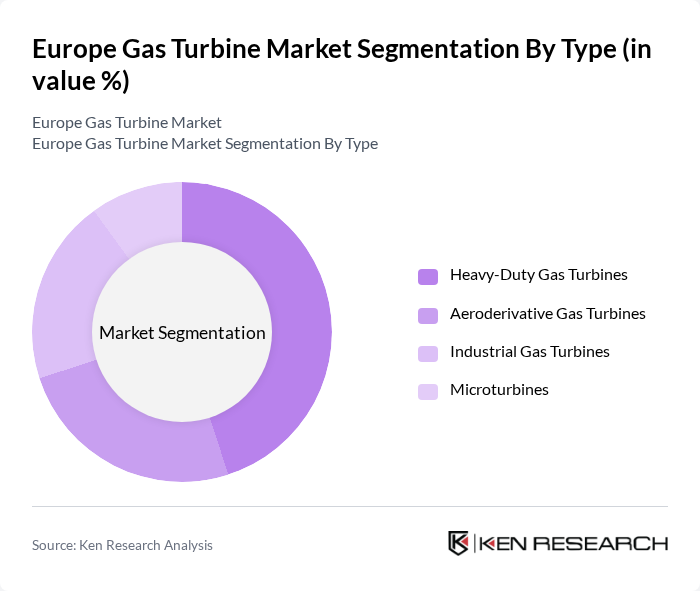
By Type:The market is segmented into Heavy-Duty Gas Turbines, Aeroderivative Gas Turbines, Industrial Gas Turbines, and Microturbines. Heavy-Duty Gas Turbines are leading the market due to their high efficiency and reliability in large-scale power generation applications. Aeroderivative Gas Turbines are gaining traction for their flexibility and quick start-up capabilities, making them suitable for peaking power plants. Industrial Gas Turbines are widely used in various industrial applications, while Microturbines are emerging as a solution for distributed generation and combined heat and power systems .
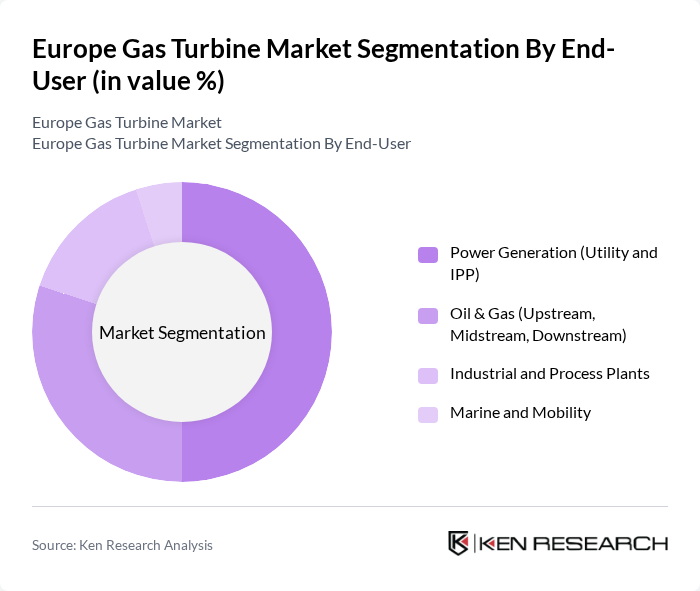
By End-User:The market is segmented into Power Generation (Utility and IPP), Oil & Gas (Upstream, Midstream, Downstream), Industrial and Process Plants, and Marine and Mobility. The Power Generation sector is the largest end-user, driven by the need for reliable and efficient electricity generation. The Oil & Gas sector also plays a significant role, utilizing gas turbines for various applications, including compression and power generation. Industrial and Process Plants are increasingly adopting gas turbines for their energy needs, while the Marine and Mobility sector is exploring gas turbines for propulsion and auxiliary power .
Europe Gas Turbine Market Competitive Landscape
The Europe Gas Turbine Market is characterized by a dynamic mix of regional and international players. Leading participants such as Siemens Energy AG, GE Vernova Inc. (Gas Power), Mitsubishi Power, Ltd., Ansaldo Energia S.p.A., Rolls-Royce Holdings plc (Rolls-Royce plc), Kawasaki Heavy Industries, Ltd., Solar Turbines Incorporated (a Caterpillar company), MAN Energy Solutions SE, Baker Hughes Company (Baker Hughes Gas Technology), Wärtsilä Corporation, Capstone Green Energy Corporation, Doosan Enerbility Co., Ltd., OPRA Turbines B.V., Zorya-Mashproekt (State Enterprise, Ukraine), Alstom S.A. (heritage fleet; legacy support) contribute to innovation, geographic expansion, and service delivery in this space.
Europe Gas Turbine Market Industry Analysis
Growth Drivers
- Increasing Demand for Clean Energy Solutions:The European Union aims to achieve a 55% reduction in greenhouse gas emissions by 2030, driving the demand for cleaner energy sources. In the future, investments in renewable energy are expected to reach €41 billion, with gas turbines playing a crucial role in transitioning from coal. The shift towards natural gas, which emits 50% less CO2 than coal, is expected to further boost gas turbine installations, supporting the EU's climate goals.
- Technological Advancements in Gas Turbine Efficiency:The average efficiency of gas turbines has improved significantly, with modern units achieving efficiencies of up to 64%. This advancement is supported by a €10 billion investment in R&D by leading manufacturers in the future. Enhanced efficiency not only reduces operational costs but also aligns with the EU's energy efficiency directive, which mandates a 32.5% improvement in energy efficiency by 2030, further driving market growth.
- Government Initiatives for Renewable Energy Integration:The European Commission's Green Deal aims to integrate renewable energy sources into the grid, with a target of 70% renewable energy by 2030. In the future, €30 billion is expected to be allocated for infrastructure upgrades to support this transition. Gas turbines are essential for balancing intermittent renewable sources, ensuring grid stability, and meeting the increasing energy demand projected to rise by 1.5% annually through 2024.
Market Challenges
- High Initial Capital Investment:The average cost of installing a gas turbine power plant ranges from €800 million to €1.2 billion, posing a significant barrier for new entrants. In the future, only 15 new gas turbine projects are anticipated to be initiated in Europe, primarily due to financial constraints. This high capital requirement limits the ability of smaller companies to compete, thereby slowing market growth and innovation in the sector.
- Stringent Environmental Regulations:The European Union has implemented strict regulations, such as the Industrial Emissions Directive, which mandates significant reductions in NOx and SOx emissions. Compliance costs can reach up to €50 million per facility, impacting profitability. In the future, 25% of gas turbine operators are expected to report challenges in meeting these regulations, leading to increased operational costs and potential project delays, hindering market expansion.
Europe Gas Turbine Market Future Outlook
The Europe gas turbine market is poised for significant transformation driven by technological advancements and regulatory frameworks. As the region pushes towards carbon neutrality by 2050, the integration of gas turbines with renewable energy sources will become increasingly vital. The focus on digitalization and smart technologies will enhance operational efficiency, while investments in hybrid systems will create new avenues for growth. The market is expected to adapt rapidly to evolving energy demands and environmental standards, ensuring a sustainable energy future.
Market Opportunities
- Expansion into Emerging Markets:Emerging markets in Eastern Europe and Southeast Asia present significant opportunities for gas turbine manufacturers. With energy demand projected to grow by 3% annually in these regions, investments in gas turbine technology can facilitate energy access and reliability, potentially generating revenues exceeding €5 billion in the future.
- Development of Hybrid Energy Systems:The rise of hybrid energy systems combining gas turbines with renewable sources offers a lucrative opportunity. In the future, investments in hybrid systems are expected to reach €2 billion, with projections indicating a 20% increase thereafter. This trend not only enhances energy efficiency but also aligns with sustainability goals, making it a strategic focus for industry players.
Scope of the Report
| Segment | Sub-Segments |
|---|---|
| By Type | Heavy-Duty Gas Turbines Aeroderivative Gas Turbines Industrial Gas Turbines Microturbines |
| By End-User | Power Generation (Utility and IPP) Oil & Gas (Upstream, Midstream, Downstream) Industrial and Process Plants Marine and Mobility |
| By Application | Combined Cycle Power Plants Open Cycle/Peaker Plants Cogeneration/CHP Systems Mechanical Drive and Compression |
| By Fuel Type | Natural Gas Hydrogen Blends Biogas/Syngas Liquid Fuels (Diesel, Kerosene) |
| By Distribution Channel | Direct OEM Sales EPC/Project Developers Aftermarket and Service Providers Distributors/Channel Partners |
| By Region | Western Europe Eastern Europe Northern Europe Southern Europe |
| By Policy Support | Capacity Mechanisms and Ancillary Services Emissions Trading System (EU ETS) and Carbon Pricing Renewable/Low-Carbon Gas Incentives (e.g., Hydrogen) Grid Flexibility and Reserve Market Rules |
Key Target Audience
Investors and Venture Capitalist Firms
Government and Regulatory Bodies (e.g., European Commission, National Energy Regulator)
Manufacturers and Producers
Energy Utilities and Power Generation Companies
Infrastructure Development Agencies
Environmental Protection Agencies (e.g., European Environment Agency)
Industry Associations (e.g., European Turbine Network)
Financial Institutions and Banks
Players Mentioned in the Report:
Siemens Energy AG
GE Vernova Inc. (Gas Power)
Mitsubishi Power, Ltd.
Ansaldo Energia S.p.A.
Rolls-Royce Holdings plc (Rolls-Royce plc)
Kawasaki Heavy Industries, Ltd.
Solar Turbines Incorporated (a Caterpillar company)
MAN Energy Solutions SE
Baker Hughes Company (Baker Hughes Gas Technology)
Wartsila Corporation
Capstone Green Energy Corporation
Doosan Enerbility Co., Ltd.
OPRA Turbines B.V.
Zorya-Mashproekt (State Enterprise, Ukraine)
Alstom S.A. (heritage fleet; legacy support)
Table of Contents
Market Assessment Phase
1. Executive Summary and Approach
2. Europe Gas Turbine Market Overview
2.1 Key Insights and Strategic Recommendations
2.2 Europe Gas Turbine Market Overview
2.3 Definition and Scope
2.4 Evolution of Market Ecosystem
2.5 Timeline of Key Regulatory Milestones
2.6 Value Chain & Stakeholder Mapping
2.7 Business Cycle Analysis
2.8 Policy & Incentive Landscape
3. Europe Gas Turbine Market Analysis
3.1 Growth Drivers
3.1.1 Increasing Demand for Clean Energy Solutions
3.1.2 Technological Advancements in Gas Turbine Efficiency
3.1.3 Government Initiatives for Renewable Energy Integration
3.1.4 Rising Industrialization and Urbanization
3.2 Market Challenges
3.2.1 High Initial Capital Investment
3.2.2 Stringent Environmental Regulations
3.2.3 Competition from Alternative Energy Sources
3.2.4 Supply Chain Disruptions
3.3 Market Opportunities
3.3.1 Expansion into Emerging Markets
3.3.2 Development of Hybrid Energy Systems
3.3.3 Investment in R&D for Innovative Turbine Designs
3.3.4 Strategic Partnerships and Collaborations
3.4 Market Trends
3.4.1 Shift Towards Digitalization and Smart Technologies
3.4.2 Increasing Focus on Sustainability and Carbon Neutrality
3.4.3 Growth of Distributed Energy Resources
3.4.4 Adoption of Predictive Maintenance Practices
3.5 Government Regulation
3.5.1 Emission Standards and Compliance Requirements
3.5.2 Incentives for Renewable Energy Projects
3.5.3 Grid Connection Regulations
3.5.4 Safety and Operational Standards
4. SWOT Analysis
5. Stakeholder Analysis
6. Porter's Five Forces Analysis
7. Europe Gas Turbine Market Market Size, 2019-2024
7.1 By Value
7.2 By Volume
7.3 By Average Selling Price
8. Europe Gas Turbine Market Segmentation
8.1 By Type
8.1.1 Heavy-Duty Gas Turbines
8.1.2 Aeroderivative Gas Turbines
8.1.3 Industrial Gas Turbines
8.1.4 Microturbines
8.2 By End-User
8.2.1 Power Generation (Utility and IPP)
8.2.2 Oil & Gas (Upstream, Midstream, Downstream)
8.2.3 Industrial and Process Plants
8.2.4 Marine and Mobility
8.3 By Application
8.3.1 Combined Cycle Power Plants
8.3.2 Open Cycle/Peaker Plants
8.3.3 Cogeneration/CHP Systems
8.3.4 Mechanical Drive and Compression
8.4 By Fuel Type
8.4.1 Natural Gas
8.4.2 Hydrogen Blends
8.4.3 Biogas/Syngas
8.4.4 Liquid Fuels (Diesel, Kerosene)
8.5 By Distribution Channel
8.5.1 Direct OEM Sales
8.5.2 EPC/Project Developers
8.5.3 Aftermarket and Service Providers
8.5.4 Distributors/Channel Partners
8.6 By Region
8.6.1 Western Europe
8.6.2 Eastern Europe
8.6.3 Northern Europe
8.6.4 Southern Europe
8.7 By Policy Support
8.7.1 Capacity Mechanisms and Ancillary Services
8.7.2 Emissions Trading System (EU ETS) and Carbon Pricing
8.7.3 Renewable/Low-Carbon Gas Incentives (e.g., Hydrogen)
8.7.4 Grid Flexibility and Reserve Market Rules
9. Europe Gas Turbine Market Competitive Analysis
9.1 Market Share of Key Players
9.2 Cross Comparison of Key Players
9.2.1 Company Name
9.2.2 Installed Base in Europe (GW)
9.2.3 New Order Intake in Europe (Last 12–24 Months)
9.2.4 Revenue from Europe Gas Turbine Segment
9.2.5 Service/Asp Revenue Mix (%)
9.2.6 Average Fleet Efficiency (CCGT, % LHV)
9.2.7 Hydrogen Co-firing Capability (% by Volume)
9.2.8 Warranty/Availability Guarantees (% Availability)
9.2.9 Average Lead Time (Months) for H-class/Aeroderivative
9.2.10 Aftermarket Footprint (Service Centers/Field Techs in Europe)
9.2.11 Levelized Cost of Electricity Benchmarks (EUR/MWh, CCGT/OCC)
9.2.12 Emissions Performance (gCO2/kWh; NOx ppm with DLN)
9.3 SWOT Analysis of Top Players
9.4 Pricing Analysis
9.5 Detailed Profile of Major Companies
9.5.1 Siemens Energy AG
9.5.2 GE Vernova Inc. (Gas Power)
9.5.3 Mitsubishi Power, Ltd.
9.5.4 Ansaldo Energia S.p.A.
9.5.5 Rolls-Royce Holdings plc (Rolls-Royce plc)
9.5.6 Kawasaki Heavy Industries, Ltd.
9.5.7 Solar Turbines Incorporated (a Caterpillar company)
9.5.8 MAN Energy Solutions SE
9.5.9 Baker Hughes Company (Baker Hughes Gas Technology)
9.5.10 Wärtsilä Corporation
9.5.11 Capstone Green Energy Corporation
9.5.12 Doosan Enerbility Co., Ltd.
9.5.13 OPRA Turbines B.V.
9.5.14 Zorya-Mashproekt (State Enterprise, Ukraine)
9.5.15 Alstom S.A. (heritage fleet; legacy support)
10. Europe Gas Turbine Market End-User Analysis
10.1 Procurement Behavior of Key Ministries
10.1.1 Government Energy Procurement Policies
10.1.2 Budget Allocations for Energy Projects
10.1.3 Tendering Processes and Requirements
10.2 Corporate Spend on Infrastructure & Energy
10.2.1 Investment Trends in Energy Infrastructure
10.2.2 Corporate Sustainability Initiatives
10.2.3 Energy Efficiency Investments
10.3 Pain Point Analysis by End-User Category
10.3.1 Cost Management Challenges
10.3.2 Reliability and Maintenance Issues
10.3.3 Regulatory Compliance Difficulties
10.4 User Readiness for Adoption
10.4.1 Awareness of Gas Turbine Benefits
10.4.2 Financial Readiness for Investment
10.4.3 Technical Capability for Implementation
10.5 Post-Deployment ROI and Use Case Expansion
10.5.1 Performance Metrics Evaluation
10.5.2 Scalability of Solutions
10.5.3 Long-term Cost Savings Analysis
11. Europe Gas Turbine Market Future Size, 2025-2030
11.1 By Value
11.2 By Volume
11.3 By Average Selling Price
Go-To-Market Strategy Phase
1. Whitespace Analysis + Business Model Canvas
1.1 Market Gaps Identification
1.2 Value Proposition Development
1.3 Revenue Streams Analysis
1.4 Key Partnerships Exploration
1.5 Customer Segmentation
1.6 Cost Structure Assessment
1.7 Competitive Advantage Analysis
2. Marketing and Positioning Recommendations
2.1 Branding Strategies
2.2 Product USPs
2.3 Target Market Positioning
2.4 Communication Strategies
2.5 Digital Marketing Approaches
3. Distribution Plan
3.1 Urban Retail Strategies
3.2 Rural NGO Tie-ups
3.3 Online Distribution Channels
3.4 Direct Sales Approaches
4. Channel & Pricing Gaps
4.1 Underserved Routes
4.2 Pricing Bands Analysis
4.3 Competitor Pricing Strategies
4.4 Customer Willingness to Pay
5. Unmet Demand & Latent Needs
5.1 Category Gaps Identification
5.2 Consumer Segments Analysis
5.3 Emerging Trends Exploration
6. Customer Relationship
6.1 Loyalty Programs Development
6.2 After-sales Service Strategies
6.3 Customer Feedback Mechanisms
7. Value Proposition
7.1 Sustainability Initiatives
7.2 Integrated Supply Chains
7.3 Competitive Differentiation
8. Key Activities
8.1 Regulatory Compliance
8.2 Branding Initiatives
8.3 Distribution Setup
9. Entry Strategy Evaluation
9.1 Domestic Market Entry Strategy
9.1.1 Product Mix Considerations
9.1.2 Pricing Band Strategies
9.1.3 Packaging Options
9.2 Export Entry Strategy
9.2.1 Target Countries Identification
9.2.2 Compliance Roadmap Development
10. Entry Mode Assessment
10.1 Joint Ventures
10.2 Greenfield Investments
10.3 Mergers & Acquisitions
10.4 Distributor Model Evaluation
11. Capital and Timeline Estimation
11.1 Capital Requirements Analysis
11.2 Timelines for Implementation
12. Control vs Risk Trade-Off
12.1 Ownership vs Partnerships
13. Profitability Outlook
13.1 Breakeven Analysis
13.2 Long-term Sustainability Strategies
14. Potential Partner List
14.1 Distributors Identification
14.2 Joint Ventures Opportunities
14.3 Acquisition Targets
15. Execution Roadmap
15.1 Phased Plan for Market Entry
15.1.1 Market Setup
15.1.2 Market Entry
15.1.3 Growth Acceleration
15.1.4 Scale & Stabilize
15.2 Key Activities and Milestones
15.2.1 Milestone Planning
15.2.2 Activity Tracking
Research Methodology
Phase 1: Approach1
Desk Research
- Analysis of industry reports from European energy agencies and market research firms
- Review of government publications and energy policy documents related to gas turbine technology
- Examination of trade journals and technical papers focusing on advancements in gas turbine efficiency and applications
Primary Research
- Interviews with engineers and technical experts from leading gas turbine manufacturers
- Surveys with energy sector analysts and consultants specializing in gas turbine applications
- Field interviews with operators of gas turbine power plants to gather operational insights
Validation & Triangulation
- Cross-validation of data through multiple sources including industry reports and expert interviews
- Triangulation of market trends using sales data, installation figures, and regulatory impacts
- Sanity checks conducted through expert panel reviews to ensure data accuracy and relevance
Phase 2: Market Size Estimation1
Top-down Assessment
- Estimation of the gas turbine market size based on national energy consumption statistics
- Segmentation of the market by application areas such as power generation, oil & gas, and industrial uses
- Incorporation of EU energy transition policies and their impact on gas turbine adoption
Bottom-up Modeling
- Collection of data on installed gas turbine capacity from major energy producers
- Operational cost analysis based on maintenance and fuel consumption metrics
- Volume x cost calculations for different turbine models and configurations
Forecasting & Scenario Analysis
- Multi-variable regression analysis incorporating factors such as energy demand growth and technological advancements
- Scenario modeling based on potential regulatory changes and market dynamics
- Development of baseline, optimistic, and pessimistic forecasts through 2030
Phase 3: CATI Sample Composition1
| Scope Item/Segment | Sample Size | Target Respondent Profiles |
|---|---|---|
| Power Generation Sector | 120 | Plant Managers, Energy Analysts |
| Oil & Gas Industry | 100 | Operations Directors, Technical Engineers |
| Industrial Applications | 80 | Facility Managers, Procurement Specialists |
| Research & Development | 60 | R&D Managers, Innovation Leads |
| Regulatory Bodies | 40 | Policy Makers, Regulatory Analysts |
Frequently Asked Questions
What is the current value of the Europe Gas Turbine Market?
The Europe Gas Turbine Market is valued at approximately USD 2.7 billion, reflecting a combination of installed base services and new equipment demand driven by the need for flexible power generation and renewable energy integration.
What factors are driving growth in the Europe Gas Turbine Market?
How does the European Green Deal impact the gas turbine market?
What types of gas turbines are available in the European market?
Other Regional/Country Reports
Why Buy From Us?

What makes us stand out is that our consultants follow Robust, Refine and Result (RRR) methodology. Robust for clear definitions, approaches and sanity checking, Refine for differentiating respondents' facts and opinions, and Result for presenting data with story.

We have set a benchmark in the industry by offering our clients with syndicated and customized market research reports featuring coverage of entire market as well as meticulous research and analyst insights.

While we don't replace traditional research, we flip the method upside down. Our dual approach of Top Bottom & Bottom Top ensures quality deliverable by not just verifying company fundamentals but also looking at the sector and macroeconomic factors.

With one step in the future, our research team constantly tries to show you the bigger picture. We help with some of the tough questions you may encounter along the way: How is the industry positioned? Best marketing channel? KPI's of competitors? By aligning every element, we help maximize success.

Our report gives you instant access to the answers and sources that other companies might choose to hide. We elaborate each steps of research methodology we have used and showcase you the sample size to earn your trust.

If you need any support, we are here! We pride ourselves on universe strength, data quality, and quick, friendly, and professional service.