About the Report
Base Year 2024North America Gas Turbine Market Overview
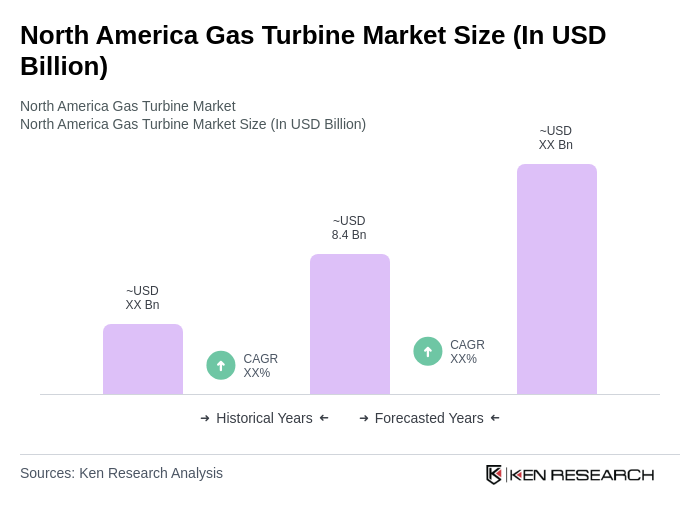
- The North America Gas Turbine Market is valued at USD 8.4 billion, based on a five-year historical analysis. This valuation aligns with recent industry reporting for the region and reflects stable demand across utility and industrial applications driven by natural gas availability and fleet modernization .
- The United States and Canada dominate the North America Gas Turbine Market due to their robust industrial base and significant investments in energy infrastructure. The U.S. maintains the largest installed base and ongoing additions tied to grid reliability and gas-fired capacity, while Canada’s policies targeting emissions reduction and efficiency support gas turbine deployments in power and oil and gas sectors .
- In 2023, the U.S. government began implementing major provisions of the Inflation Reduction Act, which expanded clean energy tax credits that indirectly support flexible, lower-emission thermal generation and hydrogen-ready equipment used with gas turbines, strengthening their role in balancing renewables and enabling decarbonization pathways (e.g., clean hydrogen production credits, storage incentives) .
North America Gas Turbine Market Segmentation
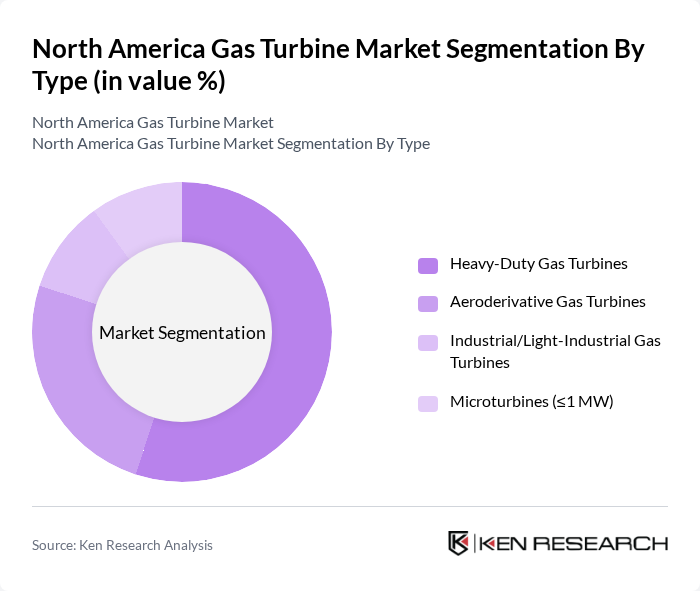
By Type:The market is segmented into Heavy-Duty Gas Turbines, Aeroderivative Gas Turbines, Industrial/Light-Industrial Gas Turbines, and Microturbines (?1 MW). Heavy-Duty Gas Turbines are leading the market due to their high efficiency and reliability in large-scale combined-cycle and baseload applications. Aeroderivative Gas Turbines are also gaining traction for their fast-start, cycling capability, and suitability for peaking and grid-balancing, including integration with renewables and emergency capacity needs .
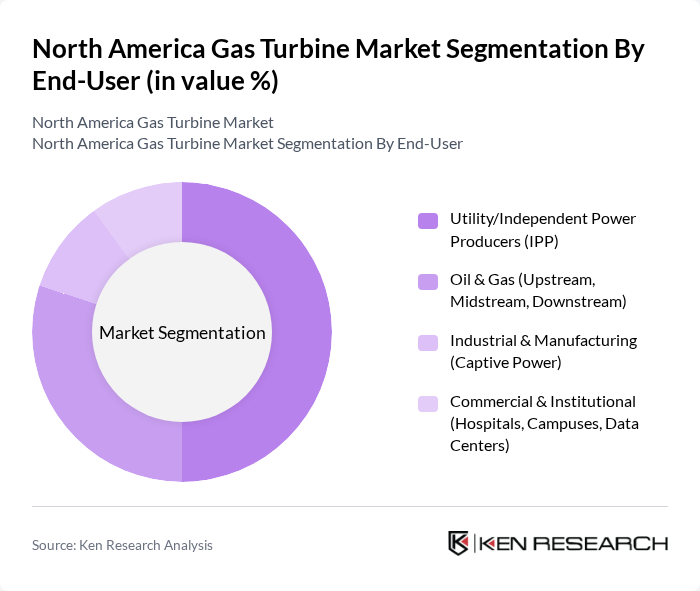
By End-User:The market is categorized into Utility/Independent Power Producers (IPP), Oil & Gas (Upstream, Midstream, Downstream), Industrial & Manufacturing (Captive Power), and Commercial & Institutional (Hospitals, Campuses, Data Centers). The Utility/IPP segment is the largest due to ongoing gas-fired fleet additions for reliability, flexible peaking, and combined-cycle efficiency. The Oil & Gas sector also significantly contributes to the market through turbines used in mechanical drive and onsite power for extraction, processing, and pipeline compression .
North America Gas Turbine Market Competitive Landscape
The North America Gas Turbine Market is characterized by a dynamic mix of regional and international players. Leading participants such as GE Vernova (Gas Power, including Aeroderivative), Siemens Energy, Mitsubishi Power Americas, Inc., Ansaldo Energia S.p.A., Solar Turbines Incorporated (Caterpillar Company), Rolls-Royce plc (MTU Aero Engines partnerships for industrial aero), Caterpillar Inc. (Turbomachinery through Solar Turbines), Baker Hughes Company (Nuovo Pignone Turbomachinery), MAN Energy Solutions SE, Woodward, Inc. (Controls and Fuel Systems), Doosan Enerbility Co., Ltd., Wärtsilä Corporation (Hybrid/CHP and services), Kawasaki Heavy Industries, Ltd., Capstone Green Energy Corporation, OPRA Turbines B.V. contribute to innovation, geographic expansion, and service delivery in this space .
North America Gas Turbine Market Industry Analysis
Growth Drivers
- Increasing Demand for Clean Energy:The North American gas turbine market is significantly driven by the rising demand for clean energy solutions. In future, the renewable energy sector is projected to reach$1.8 trillion, with natural gas playing a crucial role in transitioning from coal. The U.S. Energy Information Administration (EIA) reported that natural gas accounted forabout 43%of U.S. utility-scale electricity generation in recent data, highlighting its importance in reducing carbon emissions while meeting energy needs.
- Technological Advancements in Turbine Efficiency:Continuous innovations in turbine technology are enhancing efficiency and performance. In future, advancements in combined cycle gas turbine (CCGT) systems are expected to improve efficiency rates to over64%, according to the International Energy Agency (IEA). These improvements not only reduce operational costs but also support the shift towards more sustainable energy production, making gas turbines a preferred choice for power generation.
- Government Incentives for Renewable Energy:Government policies are increasingly favoring renewable energy sources, including natural gas. In future, federal and state incentives are projected to exceed$25 billion, aimed at promoting cleaner energy technologies. The U.S. Department of Energy's initiatives, such as tax credits and grants, are designed to encourage investments in gas turbine technologies, further driving market growth and adoption across various sectors.
Market Challenges
- High Initial Capital Investment:One of the significant challenges facing the gas turbine market is the high initial capital investment required for installation and infrastructure development. In future, the average cost of a gas turbine power plant is estimated to be around$1,200per kW, translating to substantial upfront costs. This financial barrier can deter potential investors and slow down the adoption of gas turbine technologies in various regions.
- Regulatory Compliance Complexity:Navigating the complex regulatory landscape poses a challenge for gas turbine operators. In future, compliance with stringent emission standards set by the Environmental Protection Agency (EPA) will require significant investments in technology upgrades. The cost of compliance is projected to reach$6 billionacross the industry, impacting profitability and operational efficiency for many companies in the gas turbine sector.
North America Gas Turbine Market Future Outlook
The North American gas turbine market is poised for significant transformation driven by technological advancements and a shift towards sustainable energy solutions. As the demand for cleaner energy sources continues to rise, gas turbines will play a pivotal role in meeting energy needs while reducing emissions. The integration of digital technologies and hybrid energy systems will further enhance operational efficiency, positioning the market for robust growth. Additionally, the expansion of natural gas infrastructure will facilitate broader adoption across various sectors, ensuring a resilient energy future.
Market Opportunities
- Growth in Industrial Applications:The industrial sector is increasingly adopting gas turbines for power generation, with a projected increase in demand of20%in future. Industries such as manufacturing and oil and gas are leveraging gas turbines for their efficiency and lower emissions, creating substantial opportunities for market players to expand their offerings and capture new clients.
- Increasing Adoption of Combined Cycle Power Plants:The trend towards combined cycle power plants is expected to create significant market opportunities. In future, the number of CCGT plants in North America is anticipated to grow by15%, driven by their higher efficiency and lower emissions compared to traditional plants. This shift presents a lucrative avenue for investment and technological innovation in the gas turbine market.
Scope of the Report
| Segment | Sub-Segments |
|---|---|
| By Type | Heavy-Duty Gas Turbines Aeroderivative Gas Turbines Industrial/Light-Industrial Gas Turbines Microturbines (?1 MW) |
| By End-User | Utility/Independent Power Producers (IPP) Oil & Gas (Upstream, Midstream, Downstream) Industrial & Manufacturing (Captive Power) Commercial & Institutional (Hospitals, Campuses, Data Centers) |
| By Application | Combined Cycle Power Generation Simple Cycle/Peaking Power Combined Heat and Power (CHP)/Cogeneration Mechanical Drive/Compression |
| By Fuel Type | Natural Gas Distillate/Other Liquid Fuels (Dual-Fuel) Hydrogen-Ready Blends Biogas/Syngas |
| By Sales Channel | Direct (OEM) EPC/Integrators Authorized Distributors Aftermarket/Service Agreements |
| By Installation Location | Onshore Offshore (Platforms, FPSOs) Remote/Distributed Sites (Microgrids) Brownfield Retrofits/Repowers |
| By Capacity | ?40 MW –120 MW –300 MW ?300 MW |
Key Target Audience
Investors and Venture Capitalist Firms
Government and Regulatory Bodies (e.g., U.S. Department of Energy, Environmental Protection Agency)
Manufacturers and Producers
Energy Utilities and Power Generation Companies
Oil and Gas Companies
Technology Providers
Industry Associations (e.g., Gas Turbine Association)
Financial Institutions
Players Mentioned in the Report:
GE Vernova (Gas Power, including Aeroderivative)
Siemens Energy
Mitsubishi Power Americas, Inc.
Ansaldo Energia S.p.A.
Solar Turbines Incorporated (Caterpillar Company)
Rolls-Royce plc (MTU Aero Engines partnerships for industrial aero)
Caterpillar Inc. (Turbomachinery through Solar Turbines)
Baker Hughes Company (Nuovo Pignone Turbomachinery)
MAN Energy Solutions SE
Woodward, Inc. (Controls and Fuel Systems)
Doosan Enerbility Co., Ltd.
Wartsila Corporation (Hybrid/CHP and services)
Kawasaki Heavy Industries, Ltd.
Capstone Green Energy Corporation
OPRA Turbines B.V.
Table of Contents
Market Assessment Phase
1. Executive Summary and Approach
2. North America Gas Turbine Market Overview
2.1 Key Insights and Strategic Recommendations
2.2 North America Gas Turbine Market Overview
2.3 Definition and Scope
2.4 Evolution of Market Ecosystem
2.5 Timeline of Key Regulatory Milestones
2.6 Value Chain & Stakeholder Mapping
2.7 Business Cycle Analysis
2.8 Policy & Incentive Landscape
3. North America Gas Turbine Market Analysis
3.1 Growth Drivers
3.1.1 Increasing Demand for Clean Energy
3.1.2 Technological Advancements in Turbine Efficiency
3.1.3 Government Incentives for Renewable Energy
3.1.4 Expansion of Natural Gas Infrastructure
3.2 Market Challenges
3.2.1 High Initial Capital Investment
3.2.2 Regulatory Compliance Complexity
3.2.3 Competition from Alternative Energy Sources
3.2.4 Supply Chain Disruptions
3.3 Market Opportunities
3.3.1 Growth in Industrial Applications
3.3.2 Increasing Adoption of Combined Cycle Power Plants
3.3.3 Expansion into Emerging Markets
3.3.4 Technological Innovations in Turbine Design
3.4 Market Trends
3.4.1 Shift Towards Decentralized Energy Generation
3.4.2 Integration of Digital Technologies in Operations
3.4.3 Focus on Sustainability and Emission Reductions
3.4.4 Rise of Hybrid Energy Systems
3.5 Government Regulation
3.5.1 Emission Standards and Compliance Regulations
3.5.2 Renewable Energy Portfolio Standards
3.5.3 Federal and State Incentives for Gas Turbines
3.5.4 Safety and Operational Regulations
4. SWOT Analysis
5. Stakeholder Analysis
6. Porter's Five Forces Analysis
7. North America Gas Turbine Market Market Size, 2019-2024
7.1 By Value
7.2 By Volume
7.3 By Average Selling Price
8. North America Gas Turbine Market Segmentation
8.1 By Type
8.1.1 Heavy-Duty Gas Turbines
8.1.2 Aeroderivative Gas Turbines
8.1.3 Industrial/Light-Industrial Gas Turbines
8.1.4 Microturbines (?1 MW)
8.2 By End-User
8.2.1 Utility/Independent Power Producers (IPP)
8.2.2 Oil & Gas (Upstream, Midstream, Downstream)
8.2.3 Industrial & Manufacturing (Captive Power)
8.2.4 Commercial & Institutional (Hospitals, Campuses, Data Centers)
8.3 By Application
8.3.1 Combined Cycle Power Generation
8.3.2 Simple Cycle/Peaking Power
8.3.3 Combined Heat and Power (CHP)/Cogeneration
8.3.4 Mechanical Drive/Compression
8.4 By Fuel Type
8.4.1 Natural Gas
8.4.2 Distillate/Other Liquid Fuels (Dual-Fuel)
8.4.3 Hydrogen-Ready Blends
8.4.4 Biogas/Syngas
8.5 By Sales Channel
8.5.1 Direct (OEM)
8.5.2 EPC/Integrators
8.5.3 Authorized Distributors
8.5.4 Aftermarket/Service Agreements
8.6 By Installation Location
8.6.1 Onshore
8.6.2 Offshore (Platforms, FPSOs)
8.6.3 Remote/Distributed Sites (Microgrids)
8.6.4 Brownfield Retrofits/Repowers
8.7 By Capacity
8.7.1 ?40 MW
8.7.2 40–120 MW
8.7.3 120–300 MW
8.7.4 ?300 MW
9. North America Gas Turbine Market Competitive Analysis
9.1 Market Share of Key Players
9.2 Cross Comparison of Key Players
9.2.1 OEM/Company Name
9.2.2 Installed Base in North America (GW or number of units)
9.2.3 Annual Turbine Shipments to North America (units/MW)
9.2.4 Revenue from Gas Turbines & Services in North America (USD)
9.2.5 Aftermarket Share (LTSA/CSA contracts, % of fleet under service)
9.2.6 Product Portfolio Breadth (aero, heavy-duty, industrial, hydrogen-ready)
9.2.7 Efficiency & Emissions Benchmarks (CC efficiency %, NOx ppm)
9.2.8 Lead Time/Delivery Cycle (months) and Fast-Start Capability
9.2.9 R&D and Hydrogen Blending Readiness (max H2 %, roadmap)
9.2.10 North America Market Share (%) by Capacity Class
9.2.11 Service Network Density (service centers, field engineers)
9.2.12 Average LTSA Price per MW-year (USD) and Parts Availability
9.3 SWOT Analysis of Top Players
9.4 Pricing Analysis
9.5 Detailed Profile of Major Companies
9.5.1 GE Vernova (Gas Power, including Aeroderivative)
9.5.2 Siemens Energy
9.5.3 Mitsubishi Power Americas, Inc.
9.5.4 Ansaldo Energia S.p.A.
9.5.5 Solar Turbines Incorporated (Caterpillar Company)
9.5.6 Rolls-Royce plc (MTU Aero Engines partnerships for industrial aero)
9.5.7 Caterpillar Inc. (Turbomachinery through Solar Turbines)
9.5.8 Baker Hughes Company (Nuovo Pignone Turbomachinery)
9.5.9 MAN Energy Solutions SE
9.5.10 Woodward, Inc. (Controls and Fuel Systems)
9.5.11 Doosan Enerbility Co., Ltd.
9.5.12 Wärtsilä Corporation (Hybrid/CHP and services)
9.5.13 Kawasaki Heavy Industries, Ltd.
9.5.14 Capstone Green Energy Corporation
9.5.15 OPRA Turbines B.V.
10. North America Gas Turbine Market End-User Analysis
10.1 Procurement Behavior of Key Ministries
10.1.1 Federal Energy Procurement Strategies
10.1.2 State-Level Energy Initiatives
10.1.3 Budget Allocation Trends
10.2 Corporate Spend on Infrastructure & Energy
10.2.1 Investment in Renewable Energy Projects
10.2.2 Infrastructure Upgrades and Maintenance
10.2.3 Energy Efficiency Programs
10.3 Pain Point Analysis by End-User Category
10.3.1 Cost Management Challenges
10.3.2 Reliability and Performance Issues
10.3.3 Regulatory Compliance Difficulties
10.4 User Readiness for Adoption
10.4.1 Awareness of Gas Turbine Benefits
10.4.2 Training and Skill Development Needs
10.4.3 Financial Readiness for Investment
10.5 Post-Deployment ROI and Use Case Expansion
10.5.1 Performance Metrics Evaluation
10.5.2 Scalability of Solutions
10.5.3 Long-term Maintenance Considerations
11. North America Gas Turbine Market Future Size, 2025-2030
11.1 By Value
11.2 By Volume
11.3 By Average Selling Price
Go-To-Market Strategy Phase
1. Whitespace Analysis + Business Model Canvas
1.1 Market Gaps Identification
1.2 Business Model Framework
2. Marketing and Positioning Recommendations
2.1 Branding Strategies
2.2 Product USPs
3. Distribution Plan
3.1 Urban Retail Strategies
3.2 Rural NGO Tie-ups
4. Channel & Pricing Gaps
4.1 Underserved Routes
4.2 Pricing Bands Analysis
5. Unmet Demand & Latent Needs
5.1 Category Gaps
5.2 Consumer Segments
6. Customer Relationship
6.1 Loyalty Programs
6.2 After-sales Service
7. Value Proposition
7.1 Sustainability Initiatives
7.2 Integrated Supply Chains
8. Key Activities
8.1 Regulatory Compliance
8.2 Branding Efforts
8.3 Distribution Setup
9. Entry Strategy Evaluation
9.1 Domestic Market Entry Strategy
9.1.1 Product Mix Considerations
9.1.2 Pricing Band Strategy
9.1.3 Packaging Solutions
9.2 Export Entry Strategy
9.2.1 Target Countries Identification
9.2.2 Compliance Roadmap Development
10. Entry Mode Assessment
10.1 Joint Ventures
10.2 Greenfield Investments
10.3 Mergers & Acquisitions
10.4 Distributor Model Evaluation
11. Capital and Timeline Estimation
11.1 Capital Requirements Analysis
11.2 Timelines for Implementation
12. Control vs Risk Trade-Off
12.1 Ownership Considerations
12.2 Partnerships Evaluation
13. Profitability Outlook
13.1 Breakeven Analysis
13.2 Long-term Sustainability Assessment
14. Potential Partner List
14.1 Distributors Identification
14.2 Joint Ventures Opportunities
14.3 Acquisition Targets
15. Execution Roadmap
15.1 Phased Plan for Market Entry
15.1.1 Market Setup
15.1.2 Market Entry
15.1.3 Growth Acceleration
15.1.4 Scale & Stabilize
15.2 Key Activities and Milestones
15.2.1 Milestone Planning
15.2.2 Activity Tracking
Research Methodology
Phase 1: Approach1
Desk Research
- Analysis of industry reports from energy and power associations in North America
- Review of government publications and energy statistics from the U.S. Energy Information Administration (EIA)
- Examination of market trends and forecasts from academic journals and trade publications
Primary Research
- Interviews with gas turbine manufacturers and suppliers to gather insights on production capabilities
- Surveys with end-users in sectors such as power generation and oil & gas to understand demand dynamics
- Field interviews with maintenance and operations managers at power plants utilizing gas turbines
Validation & Triangulation
- Cross-validation of data through multiple sources including trade publications and expert opinions
- Triangulation of market data with historical performance metrics and future projections
- Sanity checks conducted through expert panel reviews comprising industry veterans
Phase 2: Market Size Estimation1
Top-down Assessment
- Estimation of the total addressable market based on national energy consumption statistics
- Segmentation of the market by application areas such as power generation, aviation, and industrial use
- Incorporation of regulatory impacts and incentives for gas turbine adoption in energy policies
Bottom-up Modeling
- Collection of sales data from leading gas turbine manufacturers to establish baseline volumes
- Operational cost analysis based on maintenance and fuel efficiency metrics
- Volume x cost calculations to derive revenue estimates for different market segments
Forecasting & Scenario Analysis
- Multi-variable regression analysis incorporating factors such as energy prices and technological advancements
- Scenario modeling based on potential shifts in energy policy and market demand fluctuations
- Development of baseline, optimistic, and pessimistic forecasts through 2030
Phase 3: CATI Sample Composition1
| Scope Item/Segment | Sample Size | Target Respondent Profiles |
|---|---|---|
| Power Generation Sector | 120 | Plant Managers, Energy Analysts |
| Aviation Gas Turbines | 90 | Aerospace Engineers, Procurement Managers |
| Industrial Applications | 80 | Operations Directors, Facility Managers |
| Gas Turbine Maintenance Services | 70 | Maintenance Supervisors, Technical Managers |
| Research & Development in Turbine Technology | 60 | R&D Engineers, Innovation Managers |
Frequently Asked Questions
What is the current value of the North America Gas Turbine Market?
The North America Gas Turbine Market is valued at approximately USD 8.4 billion, reflecting stable demand driven by natural gas availability and fleet modernization across utility and industrial applications.
Which countries dominate the North America Gas Turbine Market?
How does the Inflation Reduction Act impact the gas turbine market?
What types of gas turbines are available in the North America market?
Why Buy From Us?

What makes us stand out is that our consultants follow Robust, Refine and Result (RRR) methodology. Robust for clear definitions, approaches and sanity checking, Refine for differentiating respondents' facts and opinions, and Result for presenting data with story.

We have set a benchmark in the industry by offering our clients with syndicated and customized market research reports featuring coverage of entire market as well as meticulous research and analyst insights.

While we don't replace traditional research, we flip the method upside down. Our dual approach of Top Bottom & Bottom Top ensures quality deliverable by not just verifying company fundamentals but also looking at the sector and macroeconomic factors.

With one step in the future, our research team constantly tries to show you the bigger picture. We help with some of the tough questions you may encounter along the way: How is the industry positioned? Best marketing channel? KPI's of competitors? By aligning every element, we help maximize success.

Our report gives you instant access to the answers and sources that other companies might choose to hide. We elaborate each steps of research methodology we have used and showcase you the sample size to earn your trust.

If you need any support, we are here! We pride ourselves on universe strength, data quality, and quick, friendly, and professional service.