About the Report
Base Year 2024Europe Vegetable Seed Market Overview
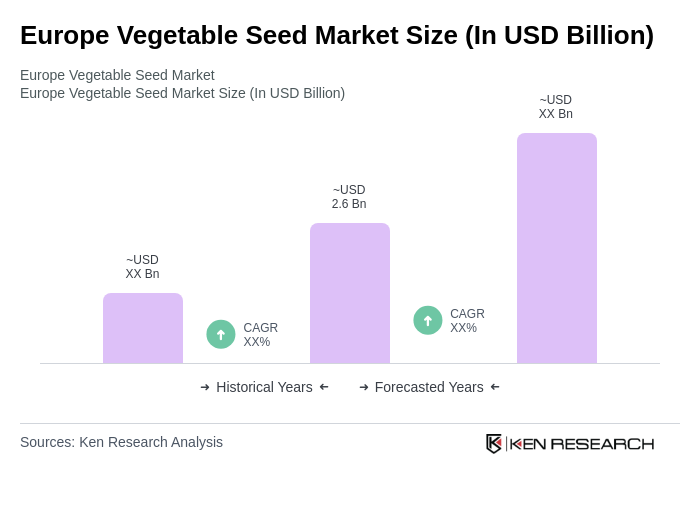
- The Europe Vegetable Seed Market is valued at USD 2.6 billion, based on a five-year historical analysis. This growth is primarily driven by increasing consumer demand for fresh produce, advancements in seed technology such as disease-resistant and high-yield varieties, and a growing focus on sustainable agricultural practices. The market has seen a notable rise in the adoption of hybrid and organic seeds, reflecting the evolving preferences of health-conscious consumers and the influence of sustainability initiatives.
- Countries such as Germany, France, and the Netherlands continue to dominate the Europe Vegetable Seed Market due to their advanced agricultural practices, strong research and development capabilities, and robust distribution networks. These nations have established themselves as key players in the seed industry, leveraging technological advancements such as precision farming and favorable climatic conditions to enhance vegetable production.
- In 2023, the European Union implemented regulations aimed at promoting sustainable agriculture, including the European Green Deal and Regulation (EU) 2018/848 on organic production and labelling of organic products, issued by the European Parliament and Council. This regulatory framework encourages the use of organic seeds and environmentally friendly farming practices, requiring certified organic seed use and traceability for organic vegetable production, with compliance monitored by national authorities. These measures aim to reduce the environmental impact of agriculture while ensuring food security across member states.
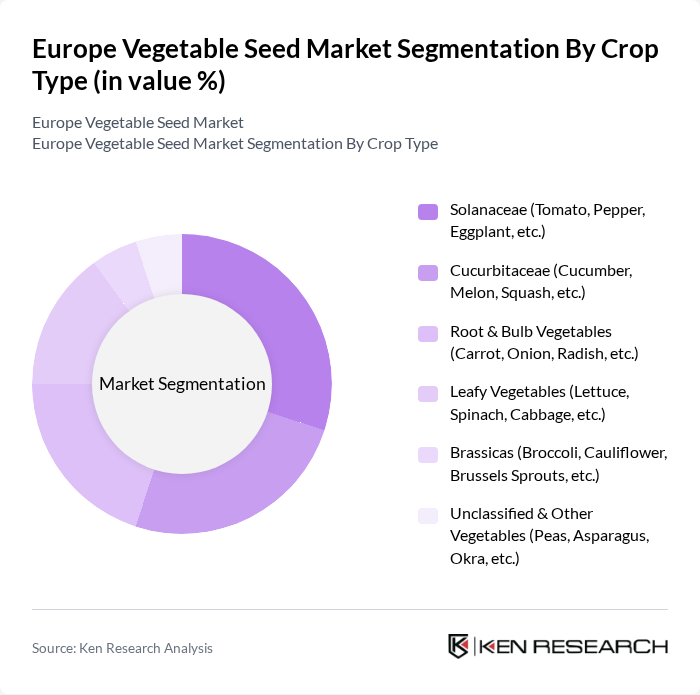
Europe Vegetable Seed Market Segmentation
By Crop Type:The crop type segmentation includes various categories of vegetables cultivated for consumption. The primary subsegments are Solanaceae, Cucurbitaceae, Root & Bulb Vegetables, Leafy Vegetables, Brassicas, and Unclassified & Other Vegetables. Each of these subsegments plays a crucial role in the overall market dynamics, driven by consumer preferences for nutritional value, culinary versatility, and seasonal availability, as well as agricultural trends such as the adoption of improved seed varieties and protected cultivation methods.
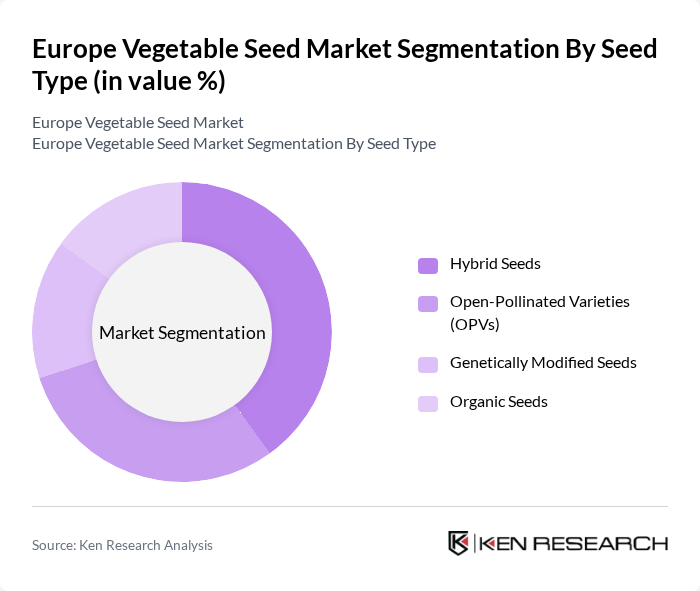
By Seed Type:The seed type segmentation encompasses categories of seeds utilized in vegetable cultivation, including Hybrid Seeds, Open-Pollinated Varieties (OPVs), Genetically Modified Seeds, and Organic Seeds. Each seed type has distinct characteristics and applications, influencing market dynamics based on consumer preferences for yield, disease resistance, and sustainability, as well as regulatory frameworks governing seed certification and the use of genetically modified organisms.
Europe Vegetable Seed Market Competitive Landscape
The Europe Vegetable Seed Market is characterized by a dynamic mix of regional and international players. Leading participants such as Bayer Crop Science, Syngenta AG, BASF SE (Nunhems), Corteva Agriscience, Limagrain (Vilmorin & Cie), Rijk Zwaan Zaadteelt en Zaadhandel B.V., Sakata Seed Corporation, Enza Zaden Beheer B.V., DLF Seeds A/S, Seminis Vegetable Seeds, Inc. (Bayer), Bejo Zaden B.V., East-West Seed International Ltd., Takii & Co., Ltd., Harris Seeds (Ivor Davis & Sons Ltd.), Clause (HM.CLAUSE, Groupe Limagrain) contribute to innovation, geographic expansion, and service delivery in this space.
Europe Vegetable Seed Market Industry Analysis
Growth Drivers
- Increasing Demand for Organic Vegetables:The European organic vegetable market is projected to reach €13.8 billion in future, driven by a 10% annual growth rate. This surge is attributed to consumers' preference for organic produce, which is perceived as healthier and more environmentally friendly. The European Union reported that organic farmland increased by approximately 2.5 million hectares in recent years, indicating a robust shift towards organic farming practices, thereby boosting the demand for organic vegetable seeds significantly.
- Technological Advancements in Seed Breeding:The European vegetable seed industry is witnessing a technological revolution, with investments in seed breeding technologies reaching €1 billion in future. Innovations such as CRISPR and gene editing are enhancing seed traits, leading to higher yields and disease resistance. The European Commission's funding for agricultural research has increased by 15% since recent years, facilitating the development of superior seed varieties that cater to evolving market demands and climate challenges.
- Rising Health Consciousness Among Consumers:A significant shift towards healthier eating habits is evident, with over half of Europeans prioritizing nutrition in their food choices. This trend is driving the demand for fresh vegetables, particularly those perceived as nutritious. The World Health Organization reported that increasing vegetable consumption can reduce chronic diseases, prompting consumers to seek high-quality vegetable seeds that yield nutrient-rich produce, thus propelling market growth in the vegetable seed sector.
Market Challenges
- Stringent Regulatory Requirements:The European vegetable seed market faces significant challenges due to stringent regulations, particularly concerning genetically modified organisms (GMOs). Compliance costs for seed producers can exceed €500,000 annually, impacting profitability. The European Food Safety Authority (EFSA) enforces rigorous testing and approval processes, which can delay product launches by up to three years, hindering innovation and market responsiveness in a competitive landscape.
- Climate Change Impacts on Crop Yields:Climate change poses a substantial threat to agricultural productivity, with projections indicating a potential yield reduction of 10-20% for key vegetable crops in future. Extreme weather events, such as droughts and floods, are becoming more frequent in Europe, adversely affecting seed germination and crop health. The European Environment Agency reported that there has been a notable increase in crop loss due to climate-related factors, challenging the stability of the vegetable seed market.
Europe Vegetable Seed Market Future Outlook
The future of the Europe vegetable seed market appears promising, driven by technological advancements and a growing emphasis on sustainability. As precision agriculture techniques gain traction, farmers are expected to adopt innovative seed solutions that enhance productivity and resource efficiency. Additionally, the rise of e-commerce platforms for seed distribution is likely to reshape market dynamics, making high-quality seeds more accessible to a broader audience, thus fostering growth in the sector.
Market Opportunities
- Growth in Sustainable Farming Practices:The shift towards sustainable farming is creating opportunities for vegetable seed producers to develop eco-friendly seed varieties. With the European Union aiming for a significant share of agricultural land to be organic in future, the demand for sustainable seeds is expected to rise significantly, providing a lucrative market for innovative seed companies.
- Development of Genetically Modified Seeds:Despite regulatory challenges, the development of genetically modified seeds presents a significant opportunity. With the potential to enhance yield and resilience against pests, these seeds can address food security concerns. The European Commission's ongoing discussions on GMO regulations may pave the way for increased acceptance and market entry, benefiting producers and consumers alike.
Scope of the Report
| Segment | Sub-Segments |
|---|---|
| By Crop Type | Solanaceae (Tomato, Pepper, Eggplant, etc.) Cucurbitaceae (Cucumber, Melon, Squash, etc.) Root & Bulb Vegetables (Carrot, Onion, Radish, etc.) Leafy Vegetables (Lettuce, Spinach, Cabbage, etc.) Brassicas (Broccoli, Cauliflower, Brussels Sprouts, etc.) Unclassified & Other Vegetables (Peas, Asparagus, Okra, etc.) |
| By Seed Type | Hybrid Seeds Open-Pollinated Varieties (OPVs) Genetically Modified Seeds Organic Seeds |
| By Application | Commercial Farming Protected Cultivation (Greenhouse/Glasshouse) Home Gardening Research and Development |
| By Distribution Channel | Direct Sales Distributors/Dealers Retail Outlets Online Sales |
| By Country/Region | Western Europe (Germany, France, UK, Netherlands, etc.) Eastern Europe (Poland, Russia, etc.) Northern Europe (Denmark, Sweden, etc.) Southern Europe (Spain, Italy, Greece, etc.) |
Key Target Audience
Investors and Venture Capitalist Firms
Government and Regulatory Bodies (e.g., European Food Safety Authority, Ministry of Agriculture)
Seed Manufacturers and Producers
Distributors and Retailers
Agri-tech Companies
Industry Associations (e.g., European Seed Association)
Financial Institutions
Biotechnology Firms
Players Mentioned in the Report:
Bayer Crop Science
Syngenta AG
BASF SE (Nunhems)
Corteva Agriscience
Limagrain (Vilmorin & Cie)
Rijk Zwaan Zaadteelt en Zaadhandel B.V.
Sakata Seed Corporation
Enza Zaden Beheer B.V.
DLF Seeds A/S
Seminis Vegetable Seeds, Inc. (Bayer)
Bejo Zaden B.V.
East-West Seed International Ltd.
Takii & Co., Ltd.
Harris Seeds (Ivor Davis & Sons Ltd.)
Clause (HM.CLAUSE, Groupe Limagrain)
Table of Contents
Market Assessment Phase
1. Executive Summary and Approach
2. Europe Vegetable Seed Market Overview
2.1 Key Insights and Strategic Recommendations
2.2 Europe Vegetable Seed Market Overview
2.3 Definition and Scope
2.4 Evolution of Market Ecosystem
2.5 Timeline of Key Regulatory Milestones
2.6 Value Chain & Stakeholder Mapping
2.7 Business Cycle Analysis
2.8 Policy & Incentive Landscape
3. Europe Vegetable Seed Market Analysis
3.1 Growth Drivers
3.1.1 Increasing demand for organic vegetables
3.1.2 Technological advancements in seed breeding
3.1.3 Rising health consciousness among consumers
3.1.4 Expansion of urban agriculture initiatives
3.2 Market Challenges
3.2.1 Stringent regulatory requirements
3.2.2 Climate change impacts on crop yields
3.2.3 High competition among seed producers
3.2.4 Supply chain disruptions
3.3 Market Opportunities
3.3.1 Growth in sustainable farming practices
3.3.2 Development of genetically modified seeds
3.3.3 Increasing investment in agricultural technology
3.3.4 Expansion into emerging markets
3.4 Market Trends
3.4.1 Shift towards precision agriculture
3.4.2 Rise of e-commerce in seed distribution
3.4.3 Growing popularity of heirloom varieties
3.4.4 Increased focus on seed quality and performance
3.5 Government Regulation
3.5.1 EU regulations on seed quality standards
3.5.2 Restrictions on genetically modified organisms (GMOs)
3.5.3 Policies promoting organic farming
3.5.4 Environmental regulations affecting agricultural practices
4. SWOT Analysis
5. Stakeholder Analysis
6. Porter's Five Forces Analysis
7. Europe Vegetable Seed Market Market Size, 2019-2024
7.1 By Value
7.2 By Volume
7.3 By Average Selling Price
8. Europe Vegetable Seed Market Segmentation
8.1 By Crop Type
8.1.1 Solanaceae (Tomato, Pepper, Eggplant, etc.)
8.1.2 Cucurbitaceae (Cucumber, Melon, Squash, etc.)
8.1.3 Root & Bulb Vegetables (Carrot, Onion, Radish, etc.)
8.1.4 Leafy Vegetables (Lettuce, Spinach, Cabbage, etc.)
8.1.5 Brassicas (Broccoli, Cauliflower, Brussels Sprouts, etc.)
8.1.6 Unclassified & Other Vegetables (Peas, Asparagus, Okra, etc.)
8.2 By Seed Type
8.2.1 Hybrid Seeds
8.2.2 Open-Pollinated Varieties (OPVs)
8.2.3 Genetically Modified Seeds
8.2.4 Organic Seeds
8.3 By Application
8.3.1 Commercial Farming
8.3.2 Protected Cultivation (Greenhouse/Glasshouse)
8.3.3 Home Gardening
8.3.4 Research and Development
8.4 By Distribution Channel
8.4.1 Direct Sales
8.4.2 Distributors/Dealers
8.4.3 Retail Outlets
8.4.4 Online Sales
8.5 By Country/Region
8.5.1 Western Europe (Germany, France, UK, Netherlands, etc.)
8.5.2 Eastern Europe (Poland, Russia, etc.)
8.5.3 Northern Europe (Denmark, Sweden, etc.)
8.5.4 Southern Europe (Spain, Italy, Greece, etc.)
9. Europe Vegetable Seed Market Competitive Analysis
9.1 Market Share of Key Players
9.2 KPIs for Cross Comparison of Key Players
9.2.1 Market Share (%)
9.2.2 Revenue (Europe Vegetable Seeds Segment, USD Million)
9.2.3 Revenue Growth Rate (CAGR %)
9.2.4 R&D Investment as % of Revenue
9.2.5 Number of Vegetable Seed Varieties Commercialized
9.2.6 Geographic Presence (Number of European Countries Served)
9.2.7 Distribution Network Strength (Number of Distributors/Dealers)
9.2.8 Portfolio Diversification Index (Crop Types/Segments)
9.2.9 Share of Organic/Hybrid/GM Seeds in Portfolio (%)
9.2.10 Customer Segmentation (Commercial, Protected, Home Garden, etc.)
9.2.11 Patent/Variety Protection Filings (Last 5 Years)
9.2.12 Sustainability/ESG Initiatives (Qualitative/Quantitative)
9.3 SWOT Analysis of Top Players
9.4 Pricing Analysis
9.5 List of Major Companies
9.5.1 Bayer Crop Science
9.5.2 Syngenta AG
9.5.3 BASF SE (Nunhems)
9.5.4 Corteva Agriscience
9.5.5 Limagrain (Vilmorin & Cie)
9.5.6 Rijk Zwaan Zaadteelt en Zaadhandel B.V.
9.5.7 Sakata Seed Corporation
9.5.8 Enza Zaden Beheer B.V.
9.5.9 DLF Seeds A/S
9.5.10 Seminis Vegetable Seeds, Inc. (Bayer)
9.5.11 Bejo Zaden B.V.
9.5.12 East-West Seed International Ltd.
9.5.13 Takii & Co., Ltd.
9.5.14 Harris Seeds (Ivor Davis & Sons Ltd.)
9.5.15 Clause (HM.CLAUSE, Groupe Limagrain)
10. Europe Vegetable Seed Market End-User Analysis
10.1 Procurement Behavior of Key Ministries
10.1.1 Budget Allocation Trends
10.1.2 Procurement Processes
10.1.3 Supplier Selection Criteria
10.2 Corporate Spend on Infrastructure & Energy
10.2.1 Investment in Sustainable Practices
10.2.2 Budget for Seed Procurement
10.2.3 Infrastructure Development Plans
10.3 Pain Point Analysis by End-User Category
10.3.1 Quality Assurance Issues
10.3.2 Supply Chain Reliability
10.3.3 Cost Management Challenges
10.4 User Readiness for Adoption
10.4.1 Awareness of New Technologies
10.4.2 Training and Support Needs
10.4.3 Financial Readiness
10.5 Post-Deployment ROI and Use Case Expansion
10.5.1 Measurement of Success Metrics
10.5.2 Case Studies of Successful Implementations
10.5.3 Future Investment Plans
11. Europe Vegetable Seed Market Future Size, 2025-2030
11.1 By Value
11.2 By Volume
11.3 By Average Selling Price
Go-To-Market Strategy Phase
1. Whitespace Analysis + Business Model Canvas
1.1 Market Gaps Identification
1.2 Business Model Development
1.3 Value Proposition Analysis
2. Marketing and Positioning Recommendations
2.1 Branding Strategies
2.2 Product USPs
3. Distribution Plan
3.1 Urban Retail Strategies
3.2 Rural NGO Tie-ups
4. Channel & Pricing Gaps
4.1 Underserved Routes
4.2 Pricing Bands Analysis
5. Unmet Demand & Latent Needs
5.1 Category Gaps
5.2 Consumer Segments
6. Customer Relationship
6.1 Loyalty Programs
6.2 After-sales Service
7. Value Proposition
7.1 Sustainability Initiatives
7.2 Integrated Supply Chains
8. Key Activities
8.1 Regulatory Compliance
8.2 Branding Efforts
8.3 Distribution Setup
9. Entry Strategy Evaluation
9.1 Domestic Market Entry Strategy
9.1.1 Product Mix Considerations
9.1.2 Pricing Band Strategy
9.1.3 Packaging Innovations
9.2 Export Entry Strategy
9.2.1 Target Countries Identification
9.2.2 Compliance Roadmap Development
10. Entry Mode Assessment
10.1 Joint Ventures
10.2 Greenfield Investments
10.3 Mergers & Acquisitions
10.4 Distributor Model Evaluation
11. Capital and Timeline Estimation
11.1 Capital Requirements Analysis
11.2 Timelines for Implementation
12. Control vs Risk Trade-Off
12.1 Ownership vs Partnerships
13. Profitability Outlook
13.1 Breakeven Analysis
13.2 Long-term Sustainability Strategies
14. Potential Partner List
14.1 Distributors
14.2 Joint Ventures
14.3 Acquisition Targets
15. Execution Roadmap
15.1 Phased Plan for Market Entry
15.1.1 Market Setup
15.1.2 Market Entry
15.1.3 Growth Acceleration
15.1.4 Scale & Stabilize
15.2 Key Activities and Milestones
15.2.1 Milestone Planning
15.2.2 Activity Tracking
Research Methodology
Phase 1: Approach1
Desk Research
- Analysis of industry reports from agricultural organizations and seed associations in Europe
- Review of market trends and forecasts from government agricultural departments and trade publications
- Examination of academic journals and research papers focusing on vegetable seed innovations and market dynamics
Primary Research
- Interviews with seed producers and distributors to gather insights on market challenges and opportunities
- Surveys targeting agronomists and horticulturists to understand preferences and trends in vegetable seed varieties
- Field visits to nurseries and farms to observe seed usage and cultivation practices
Validation & Triangulation
- Cross-validation of data from multiple sources including trade associations and market players
- Triangulation of findings from primary interviews with secondary data to ensure consistency
- Sanity checks through expert panels comprising agronomists and market analysts
Phase 2: Market Size Estimation1
Top-down Assessment
- Estimation of the total addressable market based on agricultural output and vegetable cultivation areas
- Segmentation of the market by vegetable type, region, and distribution channel
- Incorporation of EU agricultural policies and funding initiatives impacting seed production
Bottom-up Modeling
- Collection of sales data from leading vegetable seed companies to establish baseline volumes
- Analysis of pricing strategies across different seed varieties and their impact on market dynamics
- Volume x price calculations to derive revenue estimates for each segment
Forecasting & Scenario Analysis
- Utilization of time-series analysis to project future market growth based on historical data
- Scenario modeling considering factors such as climate change, technological advancements, and consumer preferences
- Development of multiple forecasts (baseline, optimistic, and pessimistic) through 2030
Phase 3: CATI Sample Composition1
| Scope Item/Segment | Sample Size | Target Respondent Profiles |
|---|---|---|
| Commercial Vegetable Seed Producers | 80 | Production Managers, Business Development Executives |
| Retail Seed Distributors | 60 | Sales Managers, Category Buyers |
| Research Institutions in Agriculture | 40 | Agricultural Researchers, Seed Technology Experts |
| Farmers and Growers | 90 | Vegetable Farmers, Cooperative Leaders |
| Government Agricultural Agencies | 50 | Policy Makers, Agricultural Extension Officers |
Frequently Asked Questions
What is the current value of the Europe Vegetable Seed Market?
The Europe Vegetable Seed Market is valued at approximately USD 2.6 billion, reflecting a significant growth trend driven by consumer demand for fresh produce, advancements in seed technology, and a focus on sustainable agricultural practices.
Which countries dominate the Europe Vegetable Seed Market?
What are the key drivers of growth in the Europe Vegetable Seed Market?
What challenges does the Europe Vegetable Seed Market face?
Why Buy From Us?

What makes us stand out is that our consultants follow Robust, Refine and Result (RRR) methodology. Robust for clear definitions, approaches and sanity checking, Refine for differentiating respondents' facts and opinions, and Result for presenting data with story.

We have set a benchmark in the industry by offering our clients with syndicated and customized market research reports featuring coverage of entire market as well as meticulous research and analyst insights.

While we don't replace traditional research, we flip the method upside down. Our dual approach of Top Bottom & Bottom Top ensures quality deliverable by not just verifying company fundamentals but also looking at the sector and macroeconomic factors.

With one step in the future, our research team constantly tries to show you the bigger picture. We help with some of the tough questions you may encounter along the way: How is the industry positioned? Best marketing channel? KPI's of competitors? By aligning every element, we help maximize success.

Our report gives you instant access to the answers and sources that other companies might choose to hide. We elaborate each steps of research methodology we have used and showcase you the sample size to earn your trust.

If you need any support, we are here! We pride ourselves on universe strength, data quality, and quick, friendly, and professional service.