About the Report
Base Year 2024France Real Estate and Co-Living Market Overview
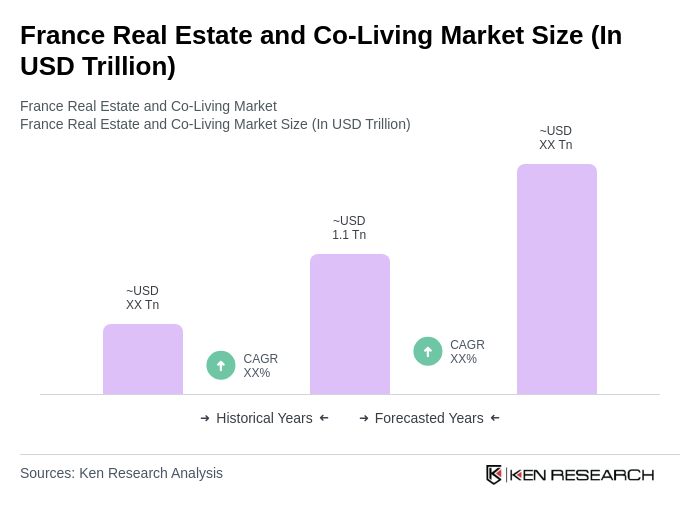
- The France Real Estate and Co-Living Market is valued at approximatelyUSD 1.1 trillion, based on a five-year historical analysis. This value reflects the stabilization of property prices after several years of correction, with renewed buyer activity and increased transaction volumes in major cities. Growth is primarily driven by urbanization, a rising demand for affordable housing, and a marked shift towards co-living spaces that appeal to young professionals and students. The market has seen a notable increase in investment, especially in metropolitan areas, as developers respond to evolving consumer preferences and the growing appeal of flexible living arrangements .
- Key cities dominating the market includeParis, Lyon, and Marseille. Paris, as the capital, continues to attract a significant number of international investors and expatriates, supported by stable property values and high demand in prime districts. Lyon and Marseille benefit from their strategic locations, robust local economies, and vibrant cultural scenes. These cities are experiencing a surge in co-living and shared accommodation developments, catering to the increasing population of young professionals and students seeking flexible, community-oriented living solutions .
- In 2023, the French government implemented theRE2020 (Réglementation Environnementale 2020)regulation, issued by the Ministry for the Ecological Transition. This regulation mandates that all new residential buildings meet stringent energy efficiency standards, including the integration of renewable energy sources and sustainable construction materials. RE2020 aims to significantly reduce carbon emissions from the housing sector and promote environmentally responsible building practices, reinforcing France's commitment to sustainable urban development .
France Real Estate and Co-Living Market Segmentation
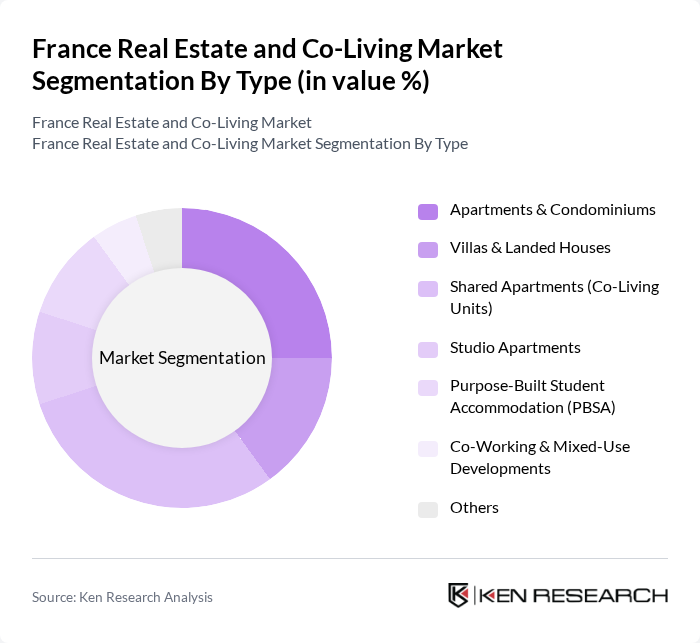
By Type:The market is segmented into Apartments & Condominiums, Villas & Landed Houses, Shared Apartments (Co-Living Units), Studio Apartments, Purpose-Built Student Accommodation (PBSA), Co-Working & Mixed-Use Developments, and Others. Among these,Shared Apartments (Co-Living Units)have emerged as the dominant segment, driven by the increasing popularity of communal living among millennials and young professionals. This segment addresses the need for affordable, flexible housing and fosters a sense of community, making it particularly attractive in urban centers where housing costs are high and social connectivity is valued .
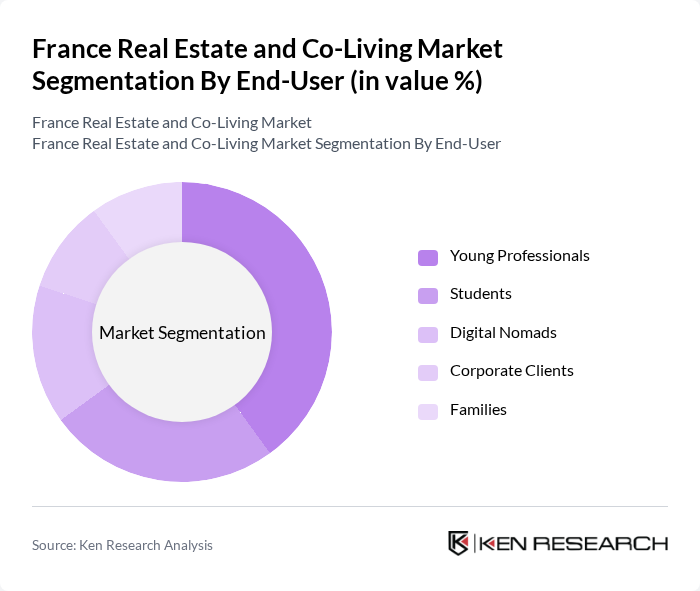
By End-User:The end-user segmentation includes Young Professionals, Students, Digital Nomads, Corporate Clients, and Families.Young Professionalsrepresent the largest segment, reflecting the increasing number of individuals entering the workforce and seeking flexible, amenity-rich living arrangements. This demographic is particularly drawn to co-living spaces that offer community engagement, networking opportunities, and tailored services, making them a primary driver of market growth .
France Real Estate and Co-Living Market Competitive Landscape
The France Real Estate and Co-Living Market is characterized by a dynamic mix of regional and international players. Leading participants such as Nexity, Bouygues Immobilier, Icade, Unibail-Rodamco-Westfield, Covivio (formerly Foncière des Régions), Les Jardins d'Arcadie, Colonies, The Social Hub (formerly The Student Hotel), WeWork, Homelike, Roomlala, BnBSitter, Co-Liv, Oxygène, Urban Campus contribute to innovation, geographic expansion, and service delivery in this space.
France Real Estate and Co-Living Market Industry Analysis
Growth Drivers
- Urbanization Trends:France's urban population is projected to reach 81% by future, up from 80% in 2020, according to the World Bank. This rapid urbanization drives demand for housing, particularly in metropolitan areas like Paris, where the population density is approximately 21,000 people per square kilometer. The influx of residents into cities necessitates innovative housing solutions, including co-living spaces, which cater to the needs of young professionals and students seeking affordable living arrangements.
- Demand for Affordable Housing:The average rent in Paris has surged to €1,200 per month, making affordability a pressing issue. The French government aims to build 500,000 new homes annually by future to address this crisis. Co-living spaces, which typically offer lower rental costs and shared amenities, are increasingly appealing to budget-conscious individuals. This trend is further supported by a 15% increase in demand for affordable housing options in urban areas over the past two years, as reported by INSEE.
- Rise of Remote Work:The shift towards remote work has led to a 30% increase in demand for flexible living arrangements, as many professionals seek to balance work and lifestyle. A survey by the French Ministry of Labor indicates that 40% of employees prefer hybrid work models, prompting a surge in co-living spaces that cater to this demographic. These spaces often provide work-friendly environments, fostering collaboration and community among residents, which is essential in the evolving work landscape.
Market Challenges
- Regulatory Hurdles:The French real estate market faces significant regulatory challenges, including stringent zoning laws and building codes. In future, the government is expected to enforce new regulations that could delay the approval process for co-living developments by up to six months. These regulations aim to ensure safety and sustainability but can hinder the rapid expansion of co-living spaces, limiting options for potential residents in urban areas.
- Economic Uncertainty:France's GDP growth is projected to slow to 1% in future, down from 2.5% in 2023, according to the IMF. This economic uncertainty can lead to reduced consumer spending and investment in real estate. Additionally, rising inflation, currently at 4%, may impact disposable income, making it challenging for individuals to commit to long-term housing solutions. Such economic conditions can dampen the growth of the co-living market as potential residents become more cautious.
France Real Estate and Co-Living Market Future Outlook
The future of the France real estate and co-living market appears promising, driven by evolving consumer preferences and urbanization. As cities continue to grow, the demand for innovative housing solutions will likely increase. The integration of technology in co-living spaces, such as smart home features, will enhance the living experience. Additionally, partnerships with local governments to promote affordable housing initiatives will further support market growth, ensuring that co-living remains a viable option for diverse demographics in urban areas.
Market Opportunities
- Expansion of Co-Living Spaces:The demand for co-living spaces is expected to rise, with an estimated 25% increase in new developments by future. This growth presents opportunities for investors and developers to create tailored living environments that cater to young professionals and students, enhancing community engagement and collaboration among residents.
- Investment in Green Buildings:With sustainability becoming a priority, investments in green buildings are projected to increase by 20% in the next two years. Developers focusing on eco-friendly materials and energy-efficient designs can attract environmentally conscious tenants, aligning with government initiatives aimed at reducing carbon footprints in urban housing.
Scope of the Report
| Segment | Sub-Segments |
|---|---|
| By Type | Apartments & Condominiums Villas & Landed Houses Shared Apartments (Co-Living Units) Studio Apartments Purpose-Built Student Accommodation (PBSA) Co-Working & Mixed-Use Developments Others |
| By End-User | Young Professionals Students Digital Nomads Corporate Clients Families |
| By Region | Île-de-France (Paris Region) Auvergne-Rhône-Alpes Provence-Alpes-Côte d'Azur Occitanie Nouvelle-Aquitaine Hauts-de-France |
| By Price Range | Affordable/Budget Options Mid-Range Options Premium/Luxury Options |
| By Service Offering | Fully Furnished Utilities Included Community Events & Services Smart Home Features |
| By Duration of Stay | Short-Term Rentals Long-Term Rentals |
| By Policy Support | Subsidies for Co-Living Projects Tax Exemptions for Developers Government Grants |
Key Target Audience
Investors and Venture Capitalist Firms
Government and Regulatory Bodies (e.g., Ministère de la Cohésion des Territoires, Agence Nationale de l'Habitat)
Real Estate Developers
Property Management Companies
Co-Living Space Operators
Urban Planners and Architects
Financial Institutions
Real Estate Investment Trusts (REITs)
Players Mentioned in the Report:
Nexity
Bouygues Immobilier
Icade
Unibail-Rodamco-Westfield
Covivio (formerly Fonciere des Regions)
Les Jardins d'Arcadie
Colonies
The Social Hub (formerly The Student Hotel)
WeWork
Homelike
Roomlala
BnBSitter
Co-Liv
Oxygene
Urban Campus
Table of Contents
Market Assessment Phase
1. Executive Summary and Approach
2. France Real Estate and Co-Living Market Overview
2.1 Key Insights and Strategic Recommendations
2.2 France Real Estate and Co-Living Market Overview
2.3 Definition and Scope
2.4 Evolution of Market Ecosystem
2.5 Timeline of Key Regulatory Milestones
2.6 Value Chain & Stakeholder Mapping
2.7 Business Cycle Analysis
2.8 Policy & Incentive Landscape
3. France Real Estate and Co-Living Market Analysis
3.1 Growth Drivers
3.1.1 Urbanization Trends
3.1.2 Demand for Affordable Housing
3.1.3 Rise of Remote Work
3.1.4 Sustainability Initiatives
3.2 Market Challenges
3.2.1 Regulatory Hurdles
3.2.2 Economic Uncertainty
3.2.3 Competition from Traditional Housing
3.2.4 Changing Consumer Preferences
3.3 Market Opportunities
3.3.1 Expansion of Co-Living Spaces
3.3.2 Technological Integration
3.3.3 Partnerships with Local Governments
3.3.4 Investment in Green Buildings
3.4 Market Trends
3.4.1 Increased Focus on Community Living
3.4.2 Flexible Lease Terms
3.4.3 Integration of Smart Home Technologies
3.4.4 Growth of Short-Term Rentals
3.5 Government Regulation
3.5.1 Housing Affordability Policies
3.5.2 Zoning Laws for Co-Living
3.5.3 Environmental Regulations
3.5.4 Tax Incentives for Developers
4. SWOT Analysis
5. Stakeholder Analysis
6. Porter's Five Forces Analysis
7. France Real Estate and Co-Living Market Market Size, 2019-2024
7.1 By Value
7.2 By Volume
7.3 By Average Selling Price
8. France Real Estate and Co-Living Market Segmentation
8.1 By Type
8.1.1 Apartments & Condominiums
8.1.2 Villas & Landed Houses
8.1.3 Shared Apartments (Co-Living Units)
8.1.4 Studio Apartments
8.1.5 Purpose-Built Student Accommodation (PBSA)
8.1.6 Co-Working & Mixed-Use Developments
8.1.7 Others
8.2 By End-User
8.2.1 Young Professionals
8.2.2 Students
8.2.3 Digital Nomads
8.2.4 Corporate Clients
8.2.5 Families
8.3 By Region
8.3.1 Île-de-France (Paris Region)
8.3.2 Auvergne-Rhône-Alpes
8.3.3 Provence-Alpes-Côte d'Azur
8.3.4 Occitanie
8.3.5 Nouvelle-Aquitaine
8.3.6 Hauts-de-France
8.4 By Price Range
8.4.1 Affordable/Budget Options
8.4.2 Mid-Range Options
8.4.3 Premium/Luxury Options
8.5 By Service Offering
8.5.1 Fully Furnished
8.5.2 Utilities Included
8.5.3 Community Events & Services
8.5.4 Smart Home Features
8.6 By Duration of Stay
8.6.1 Short-Term Rentals
8.6.2 Long-Term Rentals
8.7 By Policy Support
8.7.1 Subsidies for Co-Living Projects
8.7.2 Tax Exemptions for Developers
8.7.3 Government Grants
9. France Real Estate and Co-Living Market Competitive Analysis
9.1 Market Share of Key Players
9.2 Cross Comparison of Key Players
9.2.1 Company Name
9.2.2 Portfolio Size (Units/Properties Managed)
9.2.3 Revenue Growth Rate
9.2.4 Occupancy Rate (%)
9.2.5 Average Monthly Rent per Unit (€)
9.2.6 Customer Satisfaction Score (NPS or Equivalent)
9.2.7 Market Penetration Rate (%)
9.2.8 Average Length of Stay (Months)
9.2.9 Return on Investment (ROI)
9.2.10 Brand Recognition (Survey/Index Score)
9.2.11 ESG/Green Building Certifications
9.2.12 Digital Platform Adoption Rate
9.3 SWOT Analysis of Top Players
9.4 Pricing Analysis
9.5 Detailed Profile of Major Companies
9.5.1 Nexity
9.5.2 Bouygues Immobilier
9.5.3 Icade
9.5.4 Unibail-Rodamco-Westfield
9.5.5 Covivio (formerly Foncière des Régions)
9.5.6 Les Jardins d'Arcadie
9.5.7 Colonies
9.5.8 The Social Hub (formerly The Student Hotel)
9.5.9 WeWork
9.5.10 Homelike
9.5.11 Roomlala
9.5.12 BnBSitter
9.5.13 Co-Liv
9.5.14 Oxygène
9.5.15 Urban Campus
10. France Real Estate and Co-Living Market End-User Analysis
10.1 Procurement Behavior of Key Ministries
10.1.1 Ministry of Housing
10.1.2 Ministry of Urban Affairs
10.1.3 Ministry of Economy and Finance
10.2 Corporate Spend on Infrastructure & Energy
10.2.1 Corporate Real Estate Investments
10.2.2 Sustainability Initiatives
10.2.3 Co-Living Partnerships
10.3 Pain Point Analysis by End-User Category
10.3.1 Affordability Issues
10.3.2 Space Constraints
10.3.3 Community Engagement
10.4 User Readiness for Adoption
10.4.1 Awareness of Co-Living Benefits
10.4.2 Acceptance of Shared Living
10.4.3 Financial Preparedness
10.5 Post-Deployment ROI and Use Case Expansion
10.5.1 Cost Savings Analysis
10.5.2 User Satisfaction Metrics
10.5.3 Expansion into New Markets
11. France Real Estate and Co-Living Market Future Size, 2025-2030
11.1 By Value
11.2 By Volume
11.3 By Average Selling Price
Go-To-Market Strategy Phase
1. Whitespace Analysis + Business Model Canvas
1.1 Market Gaps Identification
1.2 Value Proposition Development
1.3 Revenue Streams Analysis
1.4 Cost Structure Evaluation
1.5 Key Partnerships
1.6 Customer Segments
1.7 Channels
2. Marketing and Positioning Recommendations
2.1 Branding Strategies
2.2 Product USPs
2.3 Target Audience Identification
2.4 Communication Strategy
2.5 Digital Marketing Tactics
3. Distribution Plan
3.1 Urban Retail vs Rural NGO Tie-ups
3.2 Distribution Channels
3.3 Logistics and Supply Chain
4. Channel & Pricing Gaps
4.1 Underserved Routes
4.2 Pricing Bands
4.3 Competitive Pricing Analysis
5. Unmet Demand & Latent Needs
5.1 Category Gaps
5.2 Consumer Segments
5.3 Emerging Trends
6. Customer Relationship
6.1 Loyalty Programs
6.2 After-sales Service
6.3 Customer Feedback Mechanisms
7. Value Proposition
7.1 Sustainability
7.2 Integrated Supply Chains
7.3 Unique Selling Points
8. Key Activities
8.1 Regulatory Compliance
8.2 Branding
8.3 Distribution Setup
9. Entry Strategy Evaluation
9.1 Domestic Market Entry Strategy
9.1.1 Product Mix
9.1.2 Pricing Band
9.1.3 Packaging
9.2 Export Entry Strategy
9.2.1 Target Countries
9.2.2 Compliance Roadmap
10. Entry Mode Assessment
10.1 Joint Ventures
10.2 Greenfield Investments
10.3 Mergers & Acquisitions
10.4 Distributor Model
11. Capital and Timeline Estimation
11.1 Capital Requirements
11.2 Timelines
12. Control vs Risk Trade-Off
12.1 Ownership vs Partnerships
13. Profitability Outlook
13.1 Breakeven Analysis
13.2 Long-term Sustainability
14. Potential Partner List
14.1 Distributors
14.2 Joint Ventures
14.3 Acquisition Targets
15. Execution Roadmap
15.1 Phased Plan for Market Entry
15.1.1 Market Setup
15.1.2 Market Entry
15.1.3 Growth Acceleration
15.1.4 Scale & Stabilize
15.2 Key Activities and Milestones
15.2.1 Activity Timeline
15.2.2 Milestone Tracking
Research Methodology
Phase 1: Approach1
Desk Research
- Analysis of national real estate reports from INSEE and other governmental bodies
- Review of co-living market studies published by industry associations and think tanks
- Examination of demographic and economic data from Eurostat and local municipalities
Primary Research
- Interviews with real estate developers specializing in co-living spaces
- Surveys with property managers and operators in urban areas
- Focus groups with potential co-living residents to understand preferences and needs
Validation & Triangulation
- Cross-validation of findings with multiple data sources, including market reports and expert opinions
- Triangulation of qualitative insights from interviews with quantitative data from surveys
- Sanity checks through expert panel reviews comprising real estate analysts and urban planners
Phase 2: Market Size Estimation1
Top-down Assessment
- Estimation of the total addressable market based on urban population growth and housing demand
- Segmentation of the market by geographic regions and demographic profiles
- Incorporation of trends in remote work and urban migration patterns affecting co-living demand
Bottom-up Modeling
- Analysis of occupancy rates and rental prices from existing co-living properties
- Cost structure evaluation including operational expenses and capital investments
- Volume x price calculations to derive revenue projections for co-living operators
Forecasting & Scenario Analysis
- Multi-factor regression analysis incorporating economic indicators and housing market trends
- Scenario modeling based on potential regulatory changes and shifts in consumer preferences
- Development of baseline, optimistic, and pessimistic forecasts through 2030
Phase 3: CATI Sample Composition1
| Scope Item/Segment | Sample Size | Target Respondent Profiles |
|---|---|---|
| Urban Co-Living Operators | 60 | Property Managers, Business Development Managers |
| Potential Co-Living Residents | 100 | Young Professionals, Students, Digital Nomads |
| Real Estate Developers | 40 | Project Managers, Investment Analysts |
| Urban Planners and Policy Makers | 40 | City Officials, Urban Development Consultants |
| Market Analysts and Researchers | 40 | Real Estate Analysts, Economic Researchers |
Frequently Asked Questions
What is the current value of the France Real Estate and Co-Living Market?
The France Real Estate and Co-Living Market is valued at approximately USD 1.1 trillion, reflecting a stabilization of property prices and increased buyer activity, particularly in major cities like Paris, Lyon, and Marseille.
What factors are driving growth in the France Real Estate and Co-Living Market?
Which cities are the main players in the France Real Estate Market?
What is the RE2020 regulation in France?
Other Regional/Country Reports
Indonesia Real Estate and Co-Living Market
Malaysia Real Estate and Co-Living Market
KSA Real Estate and Co-Living Market
APAC Real Estate and Co-Living Market
SEA Real Estate and Co-Living Market
Other Adjacent Reports
Qatar Co-Working Space Market
Oman Short-Term Rental Market
Qatar Smart Home Technology MarketMexico Sustainable Building Materials Market
Mexico Real Estate Investment Market
India Housing Finance Market Outlook to 2030Global interior design market report size, share, growth drivers, trends, opportunities & forecast 2025–2030Vietnam Urban Planning Market
UAE Hospitality Services Market
Why Buy From Us?

What makes us stand out is that our consultants follow Robust, Refine and Result (RRR) methodology. Robust for clear definitions, approaches and sanity checking, Refine for differentiating respondents' facts and opinions, and Result for presenting data with story.

We have set a benchmark in the industry by offering our clients with syndicated and customized market research reports featuring coverage of entire market as well as meticulous research and analyst insights.

While we don't replace traditional research, we flip the method upside down. Our dual approach of Top Bottom & Bottom Top ensures quality deliverable by not just verifying company fundamentals but also looking at the sector and macroeconomic factors.

With one step in the future, our research team constantly tries to show you the bigger picture. We help with some of the tough questions you may encounter along the way: How is the industry positioned? Best marketing channel? KPI's of competitors? By aligning every element, we help maximize success.

Our report gives you instant access to the answers and sources that other companies might choose to hide. We elaborate each steps of research methodology we have used and showcase you the sample size to earn your trust.

If you need any support, we are here! We pride ourselves on universe strength, data quality, and quick, friendly, and professional service.