GCC Augmented Shopping Market Size Share Growth Drivers Trends Opportunities & Forecast 2025–2030

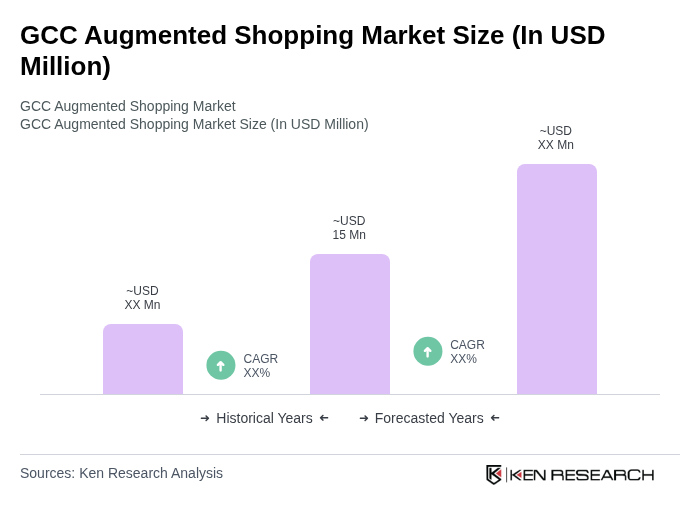
GCC augmented shopping market driven by digital growth, valued at USD 15M, with UAE and Saudi Arabia leading the adoption.

Region:Middle East

Author(s):Dev

Product Code:KRAC0930

Pages:83

Published On:December 2025
About the Report

Base Year 2024

GCC Augmented Shopping Market Overview

  • The GCC Augmented Shopping Market is valued at USD 15 million, based on a five-year historical analysis. This growth is primarily driven by increasing digital infrastructure investments, widespread smartphone use, and expanding e-commerce ecosystems facilitating immersive shopping experiences.
  • Key players in this market include tech-advanced nations like the UAE and Saudi Arabia, where strong digital transformation agendas and e-commerce growth propel adoption. The UAE's focus on innovation and Saudi Arabia's Vision 2030 initiative are pivotal in shaping the market landscape.
  • In 2024, the UAE government announced a strategic initiative to enhance the digital economy, allocating USD 1 billion to support technology adoption in retail. This initiative aims to foster innovation and improve customer engagement through augmented reality solutions.
GCC Augmented Shopping Market Size

GCC Augmented Shopping Market Segmentation

By Type:The market is segmented into various types, including Virtual Try-On Solutions, AR Navigation Tools, Interactive Product Displays, AR-Enhanced Customer Service, and Others. Among these, Virtual Try-On Solutions are leading due to their ability to enhance customer experience by allowing users to visualize products before purchase. This technology is particularly popular in the fashion and beauty sectors, where consumers seek to make informed decisions. The increasing demand for personalized shopping experiences is driving the growth of this segment.
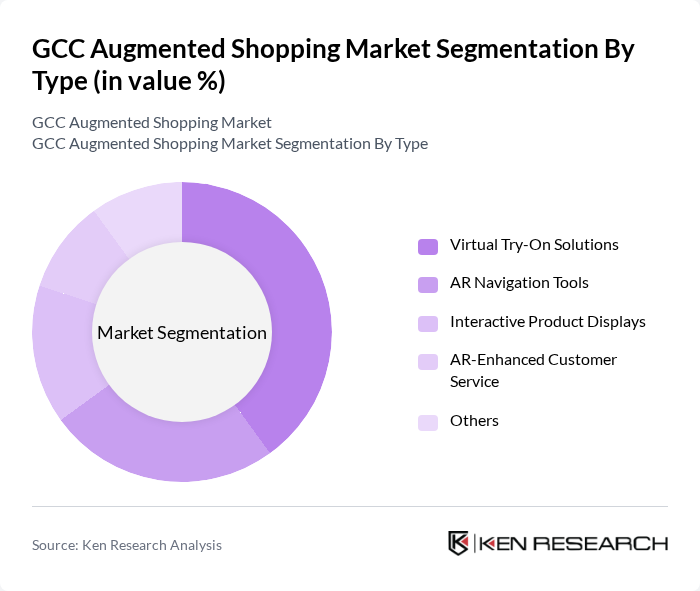
GCC Augmented Shopping Market segmentation by Type.

By End-User:The end-user segmentation includes Retail, Fashion, Home Decor, Automotive, and Others. The Retail sector is the dominant segment, driven by the increasing integration of augmented reality in shopping experiences. Retailers are leveraging AR to create engaging in-store experiences and enhance online shopping, which is crucial for attracting tech-savvy consumers. The demand for innovative shopping solutions is pushing retailers to adopt AR technologies to stay competitive.
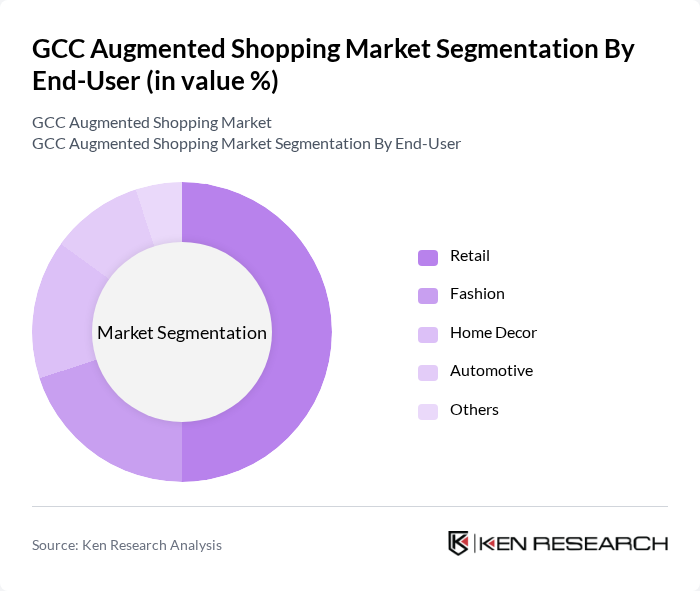
GCC Augmented Shopping Market segmentation by End-User.

GCC Augmented Shopping Market Competitive Landscape

The GCC Augmented Shopping Market is characterized by a dynamic mix of regional and international players. Leading participants such as IKEA, Amazon, Carrefour, Majid Al Futtaim, Al-Futtaim Group, Noon.com, Souq.com, Ounass, Namshi, Chalhoub Group, Landmark Group, Emaar Malls, Alshaya Group, Jashanmal Group, Al-Hokair Group contribute to innovation, geographic expansion, and service delivery in this space.

IKEA

1943

Älmhult, Sweden

Amazon

1994

Seattle, USA

Carrefour

1959

Massy, France

Majid Al Futtaim

1992

Dubai, UAE

Noon.com

2017

Dubai, UAE

Company

Establishment Year

Headquarters

Group Size (Large, Medium, or Small as per industry convention)

Customer Acquisition Cost

Customer Retention Rate

Average Order Value

Conversion Rate

Pricing Strategy

GCC Augmented Shopping Market Industry Analysis

Growth Drivers

  • Expanding Smart Retail Market in UAE:The UAE smart retail market generatedUSD 817.9 millionin revenue in future. This growth is driven by the integration of technologies such as AR-based product displays and intelligent systems, which enhance the shopping experience. The increasing consumer preference for digital solutions is further propelling this market, making it a significant driver for augmented shopping adoption across the region.
  • GCC AR & VR Revenue Growth:The GCC AR & VR market is projected to reachUSD 337.1 millionin revenue by future. This anticipated growth reflects a robust demand for immersive technologies in retail environments, indicating a shift towards more engaging shopping experiences. As retailers adopt AR solutions, the market is expected to mature, providing a fertile ground for augmented shopping innovations.
  • Robust Consumer Spending on Technology:In Q2 future, UAE consumers spentUSD 1.5 billionon technology and durable goods. This high level of spending demonstrates a strong consumer appetite for tech-driven solutions, which is crucial for the adoption of augmented shopping experiences. As consumers increasingly seek personalized and interactive shopping options, the demand for AR technologies is likely to rise significantly.

Market Challenges

  • High Infrastructure Barriers:The data center capacity in the GCC reached290.5 megawatts, but building and scaling such infrastructure remains capital-intensive. The high costs associated with establishing robust digital frameworks can delay the rollout of augmented shopping solutions, particularly in less-resourced GCC states. This challenge may hinder the overall growth of the augmented shopping market.
  • Consumer Sentiment Volatility:Tech and durable goods spending stabilized atUSD 1.5 billionin Q2 future after previous growth. This stabilization indicates potential fluctuations in consumer demand for technology-heavy shopping experiences, which could temper the momentum for AR shopping adoption. Retailers may need to navigate these changing consumer sentiments carefully.

GCC Augmented Shopping Market Future Outlook

The GCC augmented shopping market is poised for significant transformation, driven by the increasing integration of AR technologies in retail. With the projected growth of the AR & VR market toUSD 337.1 millionby future, retailers are likely to adopt immersive solutions that enhance customer engagement. Additionally, the ongoing expansion of the smart retail market, valued atUSD 817.9 millionin future, will further facilitate the adoption of AR applications, creating a dynamic retail landscape that prioritizes consumer experience and innovation.

Market Opportunities

  • Untapped AR Software Usage in UAE:The AR software revenue is projected to reachUSD 52.4 millionin future. This presents a significant opportunity for retailers to integrate AR into their platforms, particularly through virtual try-on features, enhancing the shopping experience and driving sales.
  • Scaling Smart Retail Ecosystem:With the smart retail market atUSD 817.9 millionin future, there is a substantial opportunity for integrating AR with smart systems. This integration can enhance customer interactions in high-footfall shopping environments, leading to increased engagement and sales.

Scope of the Report

SegmentSub-Segments
By Type

Virtual Try-On Solutions

AR Navigation Tools

Interactive Product Displays

AR-Enhanced Customer Service

Others

By End-User

Retail

Fashion

Home Decor

Automotive

Others

By Region

UAE

Saudi Arabia

Qatar

Kuwait

Oman

By Technology

AR Software Solutions

AR Hardware Devices

Cloud-Based AR Services

Others

By Application

In-Store Experiences

Online Shopping

Marketing Campaigns

Customer Engagement

Others

By Investment Source

Private Investments

Venture Capital

Government Funding

Corporate Investments

Others

By Policy Support

Government Grants

Tax Incentives

Regulatory Support

Others

Key Target Audience

Investors and Venture Capitalist Firms

Government and Regulatory Bodies (e.g., Ministry of Commerce and Industry, Telecommunications Regulatory Authority)

Manufacturers and Producers of Augmented Reality Devices

Distributors and Retailers of Augmented Shopping Solutions

Technology Providers specializing in Augmented Reality Software

Industry Associations related to Retail and Technology

Financial Institutions focusing on Technology Investments

Advertising and Marketing Agencies utilizing Augmented Reality

Players Mentioned in the Report:

IKEA

Amazon

Carrefour

Majid Al Futtaim

Al-Futtaim Group

Noon.com

Souq.com

Ounass

Namshi

Chalhoub Group

Landmark Group

Emaar Malls

Alshaya Group

Jashanmal Group

Al-Hokair Group

Table of Contents

Market Assessment Phase

1. Executive Summary and Approach


2. GCC Augmented Shopping Market Overview

2.1 Key Insights and Strategic Recommendations

2.2 GCC Augmented Shopping Market Overview

2.3 Definition and Scope

2.4 Evolution of Market Ecosystem

2.5 Timeline of Key Regulatory Milestones

2.6 Value Chain & Stakeholder Mapping

2.7 Business Cycle Analysis

2.8 Policy & Incentive Landscape


3. GCC Augmented Shopping Market Analysis

3.1 Growth Drivers

3.1.1 Increasing smartphone penetration
3.1.2 Rising consumer demand for personalized shopping experiences
3.1.3 Expansion of e-commerce platforms
3.1.4 Advancements in AR technology

3.2 Market Challenges

3.2.1 High implementation costs
3.2.2 Limited consumer awareness
3.2.3 Data privacy concerns
3.2.4 Integration with existing retail systems

3.3 Market Opportunities

3.3.1 Growth in online retail
3.3.2 Partnerships with tech companies
3.3.3 Development of AR-enabled products
3.3.4 Expansion into emerging markets

3.4 Market Trends

3.4.1 Increasing use of AR in marketing
3.4.2 Shift towards omnichannel retailing
3.4.3 Enhanced customer engagement through AR
3.4.4 Adoption of AI in augmented shopping experiences

3.5 Government Regulation

3.5.1 Data protection regulations
3.5.2 E-commerce regulations
3.5.3 Consumer protection laws
3.5.4 Taxation policies for digital services

4. SWOT Analysis


5. Stakeholder Analysis


6. Porter's Five Forces Analysis


7. GCC Augmented Shopping Market Market Size, 2019-2024

7.1 By Value

7.2 By Volume

7.3 By Average Selling Price


8. GCC Augmented Shopping Market Segmentation

8.1 By Type

8.1.1 Virtual Try-On Solutions
8.1.2 AR Navigation Tools
8.1.3 Interactive Product Displays
8.1.4 AR-Enhanced Customer Service
8.1.5 Others

8.2 By End-User

8.2.1 Retail
8.2.2 Fashion
8.2.3 Home Decor
8.2.4 Automotive
8.2.5 Others

8.3 By Region

8.3.1 UAE
8.3.2 Saudi Arabia
8.3.3 Qatar
8.3.4 Kuwait
8.3.5 Oman

8.4 By Technology

8.4.1 AR Software Solutions
8.4.2 AR Hardware Devices
8.4.3 Cloud-Based AR Services
8.4.4 Others

8.5 By Application

8.5.1 In-Store Experiences
8.5.2 Online Shopping
8.5.3 Marketing Campaigns
8.5.4 Customer Engagement
8.5.5 Others

8.6 By Investment Source

8.6.1 Private Investments
8.6.2 Venture Capital
8.6.3 Government Funding
8.6.4 Corporate Investments
8.6.5 Others

8.7 By Policy Support

8.7.1 Government Grants
8.7.2 Tax Incentives
8.7.3 Regulatory Support
8.7.4 Others

9. GCC Augmented Shopping Market Competitive Analysis

9.1 Market Share of Key Players

9.2 Cross Comparison of Key Players

9.2.1 Company Name
9.2.2 Group Size (Large, Medium, or Small as per industry convention)
9.2.3 Customer Acquisition Cost
9.2.4 Customer Retention Rate
9.2.5 Average Order Value
9.2.6 Conversion Rate
9.2.7 Pricing Strategy
9.2.8 Market Penetration Rate
9.2.9 Revenue Growth Rate
9.2.10 Customer Satisfaction Score

9.3 SWOT Analysis of Top Players

9.4 Pricing Analysis

9.5 Detailed Profile of Major Companies

9.5.1 IKEA
9.5.2 Amazon
9.5.3 Carrefour
9.5.4 Majid Al Futtaim
9.5.5 Al-Futtaim Group
9.5.6 Noon.com
9.5.7 Souq.com
9.5.8 Ounass
9.5.9 Namshi
9.5.10 Chalhoub Group
9.5.11 Landmark Group
9.5.12 Emaar Malls
9.5.13 Alshaya Group
9.5.14 Jashanmal Group
9.5.15 Al-Hokair Group

10. GCC Augmented Shopping Market End-User Analysis

10.1 Procurement Behavior of Key Ministries

10.1.1 Government procurement processes
10.1.2 Budget allocation for technology
10.1.3 Collaboration with private sector
10.1.4 Evaluation criteria for AR solutions

10.2 Corporate Spend on Infrastructure & Energy

10.2.1 Investment in digital transformation
10.2.2 Budget for AR technology
10.2.3 Spending on customer experience enhancements
10.2.4 Allocation for training and development

10.3 Pain Point Analysis by End-User Category

10.3.1 Retail sector challenges
10.3.2 Consumer behavior insights
10.3.3 Technology integration issues
10.3.4 Cost-related concerns

10.4 User Readiness for Adoption

10.4.1 Awareness of AR benefits
10.4.2 Technical infrastructure readiness
10.4.3 Training needs for staff
10.4.4 Consumer willingness to adopt

10.5 Post-Deployment ROI and Use Case Expansion

10.5.1 Measurement of ROI
10.5.2 Case studies of successful implementations
10.5.3 Expansion into new use cases
10.5.4 Long-term benefits analysis

11. GCC Augmented Shopping Market Future Size, 2025-2030

11.1 By Value

11.2 By Volume

11.3 By Average Selling Price


Go-To-Market Strategy Phase

1. Whitespace Analysis + Business Model Canvas

1.1 Market gaps identification

1.2 Business model development

1.3 Value proposition analysis

1.4 Competitive landscape overview


2. Marketing and Positioning Recommendations

2.1 Branding strategies

2.2 Product USPs

2.3 Target audience segmentation

2.4 Marketing channels selection


3. Distribution Plan

3.1 Urban retail strategies

3.2 Rural NGO tie-ups

3.3 E-commerce platform partnerships

3.4 Logistics and supply chain management


4. Channel & Pricing Gaps

4.1 Underserved routes

4.2 Pricing bands analysis

4.3 Competitor pricing strategies

4.4 Consumer price sensitivity


5. Unmet Demand & Latent Needs

5.1 Category gaps identification

5.2 Consumer segments analysis

5.3 Emerging trends exploration

5.4 Future demand forecasting


6. Customer Relationship

6.1 Loyalty programs design

6.2 After-sales service strategies

6.3 Customer feedback mechanisms

6.4 Community engagement initiatives


7. Value Proposition

7.1 Sustainability initiatives

7.2 Integrated supply chains

7.3 Unique selling points

7.4 Customer-centric approach


8. Key Activities

8.1 Regulatory compliance measures

8.2 Branding efforts

8.3 Distribution setup

8.4 Training and development programs


9. Entry Strategy Evaluation

9.1 Domestic Market Entry Strategy

9.1.1 Product mix considerations
9.1.2 Pricing band strategies
9.1.3 Packaging innovations

9.2 Export Entry Strategy

9.2.1 Target countries analysis
9.2.2 Compliance roadmap development

10. Entry Mode Assessment

10.1 Joint Ventures

10.2 Greenfield investments

10.3 Mergers & Acquisitions

10.4 Distributor Model evaluation


11. Capital and Timeline Estimation

11.1 Capital requirements analysis

11.2 Timelines for market entry

11.3 Resource allocation planning

11.4 Risk assessment


12. Control vs Risk Trade-Off

12.1 Ownership considerations

12.2 Partnerships evaluation

12.3 Risk management strategies

12.4 Long-term sustainability planning


13. Profitability Outlook

13.1 Breakeven analysis

13.2 Long-term sustainability strategies

13.3 Financial forecasting

13.4 Investment return expectations


14. Potential Partner List

14.1 Distributors identification

14.2 Joint Ventures opportunities

14.3 Acquisition targets

14.4 Strategic alliances


15. Execution Roadmap

15.1 Phased Plan for Market Entry

15.1.1 Market Setup
15.1.2 Market Entry
15.1.3 Growth Acceleration
15.1.4 Scale & Stabilize

15.2 Key Activities and Milestones

15.2.1 Milestone tracking
15.2.2 Activity scheduling
15.2.3 Performance metrics
15.2.4 Resource allocation

Research Methodology

ApproachModellingSample

Phase 1: Approach1

Desk Research

  • Market reports from industry associations and trade publications focused on augmented shopping technologies
  • Analysis of consumer behavior studies and trends in the GCC region related to e-commerce and augmented reality
  • Review of government publications and initiatives promoting digital transformation in retail

Primary Research

  • Interviews with technology providers specializing in augmented reality solutions for retail
  • Surveys with consumers to gauge acceptance and usage of augmented shopping experiences
  • Focus groups with retail executives to understand strategic priorities and challenges in adopting augmented shopping

Validation & Triangulation

  • Cross-validation of findings through multiple data sources, including sales data and consumer feedback
  • Triangulation of insights from primary interviews with secondary data trends
  • Sanity checks through expert panels comprising industry veterans and academic researchers

Phase 2: Market Size Estimation1

Top-down Assessment

  • Estimation of the augmented shopping market size based on overall e-commerce growth in the GCC
  • Segmentation of the market by product categories and consumer demographics
  • Incorporation of regional economic indicators and consumer spending patterns

Bottom-up Modeling

  • Data collection from leading augmented reality solution providers on their market penetration and revenue
  • Estimation of user adoption rates based on survey data and industry benchmarks
  • Calculation of average revenue per user (ARPU) for augmented shopping applications

Forecasting & Scenario Analysis

  • Multi-factor analysis considering technological advancements and consumer trends in the GCC
  • Scenario modeling based on varying levels of market adoption and regulatory impacts
  • Development of baseline, optimistic, and pessimistic forecasts through 2030

Phase 3: CATI Sample Composition1

Scope Item/SegmentSample SizeTarget Respondent Profiles
Consumer Adoption of Augmented Shopping150Online Shoppers, Tech-Savvy Consumers
Retail Executive Insights100CEOs, CTOs, Marketing Directors
Technology Provider Perspectives80Product Managers, Business Development Leads
Market Analysts and Consultants60Industry Analysts, Market Researchers
Consumer Experience Feedback120Frequent Online Shoppers, Augmented Reality Users

Frequently Asked Questions

What is the current value of the GCC Augmented Shopping Market?

The GCC Augmented Shopping Market is valued at approximately USD 15 million, reflecting a five-year historical analysis. This growth is attributed to advancements in digital infrastructure, smartphone usage, and the expansion of e-commerce ecosystems that enhance immersive shopping experiences.

Which countries are leading in the GCC Augmented Shopping Market?

What initiatives has the UAE government taken to support augmented shopping?

What are the main types of augmented shopping solutions in the GCC market?

Other Regional/Country Reports

Indonesia Augmented Shopping Market

Malaysia Augmented Shopping Market

KSA Augmented Shopping Market

APAC Augmented Shopping Market

SEA Augmented Shopping Market

Vietnam Augmented Shopping Market

Why Buy From Us?

Refine Robust Result (RRR) Framework

What makes us stand out is that our consultants follow Robust, Refine and Result (RRR) methodology. Robust for clear definitions, approaches and sanity checking, Refine for differentiating respondents' facts and opinions, and Result for presenting data with story.

Our Reach Is Unmatched

We have set a benchmark in the industry by offering our clients with syndicated and customized market research reports featuring coverage of entire market as well as meticulous research and analyst insights.

Shifting the Research Paradigm

While we don't replace traditional research, we flip the method upside down. Our dual approach of Top Bottom & Bottom Top ensures quality deliverable by not just verifying company fundamentals but also looking at the sector and macroeconomic factors.

More Insights-Better Decisions

With one step in the future, our research team constantly tries to show you the bigger picture. We help with some of the tough questions you may encounter along the way: How is the industry positioned? Best marketing channel? KPI's of competitors? By aligning every element, we help maximize success.

Transparency and Trust

Our report gives you instant access to the answers and sources that other companies might choose to hide. We elaborate each steps of research methodology we have used and showcase you the sample size to earn your trust.

Round the Clock Support

If you need any support, we are here! We pride ourselves on universe strength, data quality, and quick, friendly, and professional service.

Why Clients Choose Us?

400000+
Reports in repository
150+
Consulting projects a year
100+
Analysts
8000+
Client Queries in 2022








