GCC Body Worn Insect Repellent Market Size Share Growth Drivers Trends Opportunities & Forecast 2025–2030

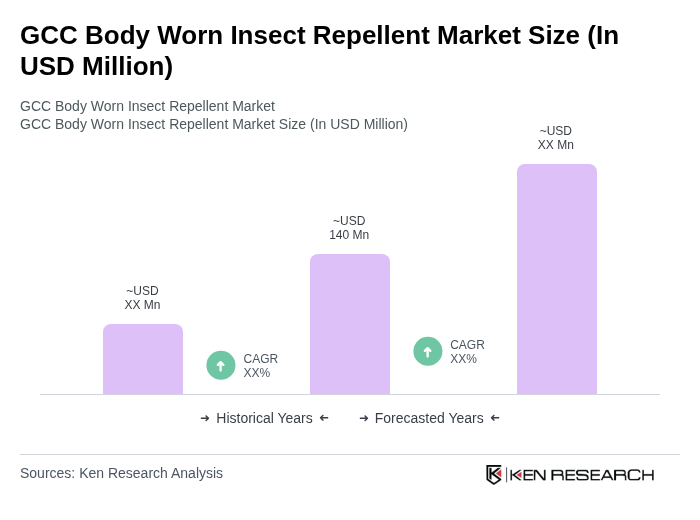
The GCC Body Worn Insect Repellent Market, valued at USD 140 million, is driven by rising awareness of insect-borne diseases and preference for plant-based repellents in urban and tourism sectors.

Region:Middle East

Author(s):Dev

Product Code:KRAA3804

Pages:96

Published On:January 2026
About the Report

Base Year 2024

GCC Body Worn Insect Repellent Market Overview

  • The GCC Body Worn Insect Repellent Market is valued at USD 140 million, based on a five-year historical analysis and benchmarking against the global body worn insect repellent market size of around USD 480–530 million and a strong Middle East & Africa contribution. This growth is primarily driven by increasing awareness of health risks associated with insect bites in hot climates, including the GCC, where warm temperatures and urban green spaces support mosquito proliferation. The rising incidence and risk of vector-borne diseases such as dengue, malaria, chikungunya and West Nile virus in the wider Middle East and adjacent regions has led to sustained demand for effective personal insect repellent solutions.
  • Key players in this market include Saudi Arabia, the UAE, and Qatar, which dominate due to their relatively high urban population density, large expatriate base, and significant outdoor and leisure activities. The urbanization and tourism sectors in these countries further contribute to the demand for body-worn insect repellents, as residents and visitors seek protection from insects while engaging in activities such as outdoor dining, sports, desert safaris, coastal tourism, and pilgrimages in Saudi Arabia.
  • In 2023, the UAE government strengthened regulations on insect repellent products through the UAE Cabinet Resolution No. 38 of 2023 on the Executive Regulations of Federal Law No. 10 of 2015 on Food Safety, issued by the UAE Cabinet, which governs biocidal substances in contact with skin and public-health pest control chemicals. Under this framework, insect repellent products used in public spaces must comply with registration and safety requirements administered by authorities such as the Ministry of Climate Change and Environment and the Emirates Authority for Standardization and Metrology, including restrictions on certain active substances and labelling, which is encouraging wider adoption of low-toxicity and plant-based formulations in the market.
GCC Body Worn Insect Repellent Market Size

GCC Body Worn Insect Repellent Market Segmentation

By Product Type:The product type segmentation includes various forms of body-worn insect repellents, catering to different consumer preferences and usage scenarios. The dominant sub-segment is Lotions, Sprays & Creams (Body-applied), which accounts for a significant portion of the market due to its ease of application, relatively lower unit price, and broad availability through supermarkets, pharmacies, and online channels. Consumers often prefer these products for their versatility and immediate protection against insects. Other segments like Wristbands & Wearable Bands and Patches & Stickers are gaining traction, particularly among outdoor enthusiasts, children, and travelers seeking convenient, portable, and often fragrance-based or plant-derived long-lasting solutions.
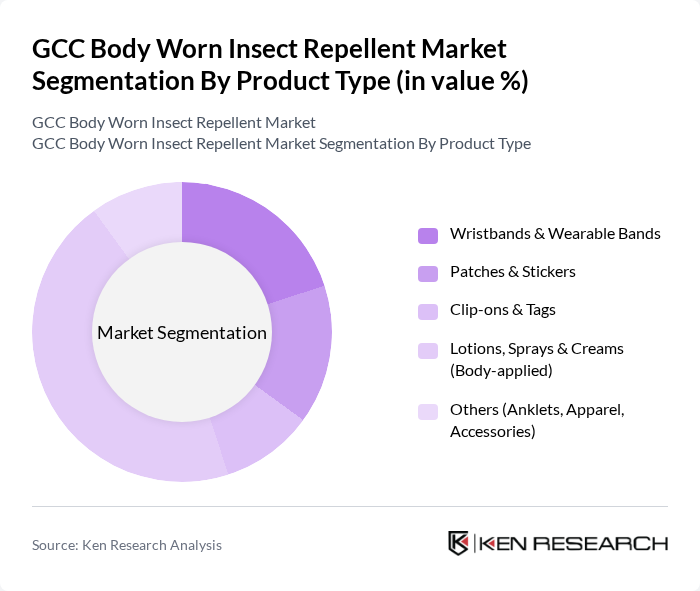
GCC Body Worn Insect Repellent Market segmentation by Product Type.

By Active Ingredient:This segmentation focuses on the active ingredients used in body-worn insect repellents, which significantly influence consumer choice and product effectiveness. The DEET-based segment leads the market due to its long-established, broad-spectrum efficacy against mosquitoes, ticks, and other biting insects and its continued endorsement by major health authorities in many regions. However, there is a growing trend towards Plant-based options, such as those containing Citronella, Lemon Eucalyptus (oil of lemon eucalyptus/PMD), and other essential oils, driven by increasing consumer awareness of skin-sensitivity issues and preference for more natural and eco-conscious formulations. Picaridin-based products are also gaining popularity for their effectiveness comparable to DEET at similar concentrations, lower odor, and better cosmetic acceptability on skin, which supports premium product positioning in urban GCC markets.
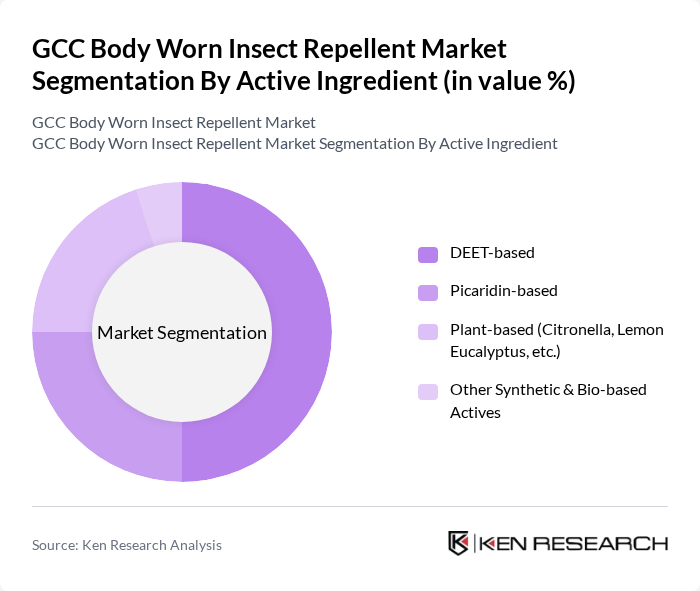
GCC Body Worn Insect Repellent Market segmentation by Active Ingredient.

GCC Body Worn Insect Repellent Market Competitive Landscape

The GCC Body Worn Insect Repellent Market is characterized by a dynamic mix of regional and international players. Leading participants such as SC Johnson & Son, Inc. (OFF!), Reckitt Benckiser Group plc (Mortein), Spectrum Brands Holdings, Inc. (Cutter, Repel), Godrej Consumer Products Ltd. (Goodknight), Dabur India Ltd., Avon Products, Inc. (Skin So Soft), Henkel AG & Co. KGaA, Sawyer Products, Inc., Thermacell Repellents, Inc., Insect Shield, LLC, Para'Kito, Coghlan's Ltd., Local & Regional GCC Brands contribute to innovation, geographic expansion, and service delivery in this space.

SC Johnson & Son, Inc. (OFF!)

1886

Racine, Wisconsin, USA

Reckitt Benckiser Group plc (Mortein)

1823

Slough, United Kingdom

Spectrum Brands Holdings, Inc. (Cutter, Repel)

1906

Middleton, Wisconsin, USA

Godrej Consumer Products Ltd. (Goodknight)

2001

Mumbai, India

Dabur India Ltd.

1884

Ghaziabad, India

Company

Establishment Year

Headquarters

Group Size (Large, Medium, or Small as per industry convention)

GCC Body Worn Insect Repellent Revenue (US$ Mn), Latest Year

3-year Revenue CAGR in GCC Body Worn Segment (%)

GCC Market Share (%)

Distribution Reach in GCC (No. of Retail & Online Partners)

Average Selling Price Positioning vs Market (Index)

GCC Body Worn Insect Repellent Market Industry Analysis

Growth Drivers

  • Increasing Awareness of Health Risks:The GCC region has seen a significant rise in awareness regarding health risks associated with insect bites, particularly diseases like dengue and malaria. According to the World Health Organization, there were over 1,200 reported cases of dengue in the GCC in future. This heightened awareness is driving consumers to seek effective insect repellents, particularly body worn options that offer prolonged protection during outdoor activities.
  • Rising Demand for Natural Products:The demand for natural and organic insect repellents is surging, with the GCC market witnessing a 35% increase in sales of such products in future. Consumers are increasingly concerned about chemical exposure, leading to a shift towards eco-friendly alternatives. This trend is supported by a report from the Gulf Cooperation Council, indicating that 70% of consumers prefer natural ingredients in personal care products, including insect repellents.
  • Growth in Outdoor Recreational Activities:The GCC region has experienced a 25% increase in outdoor recreational activities, such as camping and hiking, in future. This growth is attributed to improved infrastructure and a rising interest in health and wellness. As more individuals engage in outdoor pursuits, the demand for body worn insect repellents is expected to rise, with consumers seeking effective solutions to protect against insect bites during these activities.

Market Challenges

  • Intense Competition from Chemical-Based Repellents:The body worn insect repellent market faces intense competition from established chemical-based products, which dominate approximately 65% of the market share in the GCC. These products often offer lower prices and immediate effectiveness, making it challenging for natural alternatives to gain traction. As a result, companies must innovate to differentiate their offerings and capture consumer interest in a crowded marketplace.
  • Regulatory Hurdles for Product Approvals:Regulatory challenges pose significant barriers to entry for new products in the GCC market. The approval process for body worn insect repellents can take up to 10 months, as companies must comply with stringent safety and efficacy standards set by local health authorities. This lengthy process can delay product launches and increase costs, hindering market growth and innovation in the sector.

GCC Body Worn Insect Repellent Market Future Outlook

The future of the GCC body worn insect repellent market appears promising, driven by increasing consumer awareness and a shift towards sustainable products. As outdoor activities continue to rise, the demand for effective insect protection will likely grow. Companies are expected to invest in innovative formulations and eco-friendly solutions, aligning with consumer preferences for natural ingredients. Additionally, the expansion of e-commerce platforms will facilitate greater accessibility, allowing brands to reach a broader audience and enhance market penetration.

Market Opportunities

  • Development of Innovative Formulations:There is a significant opportunity for companies to develop innovative product formulations that combine effectiveness with natural ingredients. With a growing consumer base seeking safer alternatives, brands that invest in research and development can capture market share and meet the rising demand for eco-friendly insect repellents.
  • Collaborations with Outdoor Brands:Collaborating with outdoor and travel brands presents a lucrative opportunity for body worn insect repellent manufacturers. By partnering with established companies in the outdoor sector, brands can leverage existing customer bases and enhance product visibility, ultimately driving sales and increasing brand loyalty among outdoor enthusiasts.

Scope of the Report

SegmentSub-Segments
By Product Type

Wristbands & Wearable Bands

Patches & Stickers

Clip-ons & Tags

Lotions, Sprays & Creams (Body-applied)

Others (Anklets, Apparel, Accessories)

By Active Ingredient

DEET-based

Picaridin-based

Plant-based (Citronella, Lemon Eucalyptus, etc.)

Other Synthetic & Bio-based Actives

By Application/Insect Type

Mosquito Repellent

Tick & Flea Repellent

Multi-insect (Mosquito, Fly, Bug)

Others

By Distribution Channel

Pharmacies & Drugstores

Supermarkets/Hypermarkets

Convenience & Specialty Outdoor Stores

Online (E-commerce & Brand Websites)

Others

By End-User

Households & Individual Consumers

Tourists & Travelers

Outdoor Workers (Construction, Oil & Gas, Agriculture)

Institutional & Government Programs

Others

By Region

Saudi Arabia

UAE

Qatar

Kuwait

Oman

Bahrain

Rest of GCC

By Consumer Age Group

Babies & Children

Adults

Seniors

Key Target Audience

Investors and Venture Capitalist Firms

Government and Regulatory Bodies (e.g., Gulf Cooperation Council, Ministry of Health and Prevention)

Manufacturers and Producers

Distributors and Retailers

Outdoor and Recreational Organizations

Health and Safety Agencies (e.g., Centers for Disease Control and Prevention)

Environmental Protection Agencies (e.g., Ministry of Environment and Water)

Tourism and Hospitality Industry Stakeholders

Players Mentioned in the Report:

SC Johnson & Son, Inc. (OFF!)

Reckitt Benckiser Group plc (Mortein)

Spectrum Brands Holdings, Inc. (Cutter, Repel)

Godrej Consumer Products Ltd. (Goodknight)

Dabur India Ltd.

Avon Products, Inc. (Skin So Soft)

Henkel AG & Co. KGaA

Sawyer Products, Inc.

Thermacell Repellents, Inc.

Insect Shield, LLC

Para'Kito

Coghlan's Ltd.

Local & Regional GCC Brands

Table of Contents

Market Assessment Phase

1. Executive Summary and Approach


2. GCC Body Worn Insect Repellent Market Overview

2.1 Key Insights and Strategic Recommendations

2.2 GCC Body Worn Insect Repellent Market Overview

2.3 Definition and Scope

2.4 Evolution of Market Ecosystem

2.5 Timeline of Key Regulatory Milestones

2.6 Value Chain & Stakeholder Mapping

2.7 Business Cycle Analysis

2.8 Policy & Incentive Landscape


3. GCC Body Worn Insect Repellent Market Analysis

3.1 Growth Drivers

3.1.1 Increasing awareness of health risks associated with insect bites
3.1.2 Rising demand for natural and organic insect repellents
3.1.3 Growth in outdoor recreational activities
3.1.4 Expansion of tourism in the GCC region

3.2 Market Challenges

3.2.1 Intense competition from chemical-based repellents
3.2.2 Regulatory hurdles for product approvals
3.2.3 Limited consumer awareness about body worn options
3.2.4 Price sensitivity among consumers

3.3 Market Opportunities

3.3.1 Development of innovative product formulations
3.3.2 Collaborations with outdoor and travel brands
3.3.3 Expansion into e-commerce platforms
3.3.4 Increasing government initiatives for public health

3.4 Market Trends

3.4.1 Shift towards eco-friendly and sustainable products
3.4.2 Growing popularity of wearable technology
3.4.3 Customization and personalization of products
3.4.4 Rise in DIY insect repellent solutions

3.5 Government Regulation

3.5.1 Standards for product safety and efficacy
3.5.2 Labeling requirements for natural ingredients
3.5.3 Import regulations for foreign products
3.5.4 Environmental regulations on chemical usage

4. SWOT Analysis


5. Stakeholder Analysis


6. Porter's Five Forces Analysis


7. GCC Body Worn Insect Repellent Market Market Size, 2019-2024

7.1 By Value

7.2 By Volume

7.3 By Average Selling Price


8. GCC Body Worn Insect Repellent Market Segmentation

8.1 By Product Type

8.1.1 Wristbands & Wearable Bands
8.1.2 Patches & Stickers
8.1.3 Clip-ons & Tags
8.1.4 Lotions, Sprays & Creams (Body-applied)
8.1.5 Others (Anklets, Apparel, Accessories)

8.2 By Active Ingredient

8.2.1 DEET-based
8.2.2 Picaridin-based
8.2.3 Plant-based (Citronella, Lemon Eucalyptus, etc.)
8.2.4 Other Synthetic & Bio-based Actives

8.3 By Application/Insect Type

8.3.1 Mosquito Repellent
8.3.2 Tick & Flea Repellent
8.3.3 Multi-insect (Mosquito, Fly, Bug)
8.3.4 Others

8.4 By Distribution Channel

8.4.1 Pharmacies & Drugstores
8.4.2 Supermarkets/Hypermarkets
8.4.3 Convenience & Specialty Outdoor Stores
8.4.4 Online (E-commerce & Brand Websites)
8.4.5 Others

8.5 By End-User

8.5.1 Households & Individual Consumers
8.5.2 Tourists & Travelers
8.5.3 Outdoor Workers (Construction, Oil & Gas, Agriculture)
8.5.4 Institutional & Government Programs
8.5.5 Others

8.6 By Region

8.6.1 Saudi Arabia
8.6.2 UAE
8.6.3 Qatar
8.6.4 Kuwait
8.6.5 Oman
8.6.6 Bahrain
8.6.7 Rest of GCC

8.7 By Consumer Age Group

8.7.1 Babies & Children
8.7.2 Adults
8.7.3 Seniors

9. GCC Body Worn Insect Repellent Market Competitive Analysis

9.1 Market Share of Key Players

9.2 Cross Comparison of Key Players

9.2.1 Company Name
9.2.2 Group Size (Large, Medium, or Small as per industry convention)
9.2.3 GCC Body Worn Insect Repellent Revenue (US$ Mn), Latest Year
9.2.4 3-year Revenue CAGR in GCC Body Worn Segment (%)
9.2.5 GCC Market Share (%)
9.2.6 Distribution Reach in GCC (No. of Retail & Online Partners)
9.2.7 Average Selling Price Positioning vs Market (Index)
9.2.8 Gross Margin (%) – Body Worn Insect Repellent Portfolio
9.2.9 R&D / Innovation Intensity (% of Revenue)
9.2.10 Marketing & Promotion Spend in GCC (% of Revenue)
9.2.11 Brand Awareness & Preference Score (Survey-based Index)
9.2.12 Digital Reach (Website/App Traffic, Social Media Followers)

9.3 SWOT Analysis of Top Players

9.4 Pricing Analysis

9.5 Detailed Profile of Major Companies

9.5.1 SC Johnson & Son, Inc. (OFF!)
9.5.2 Reckitt Benckiser Group plc (Mortein)
9.5.3 Spectrum Brands Holdings, Inc. (Cutter, Repel)
9.5.4 Godrej Consumer Products Ltd. (Goodknight)
9.5.5 Dabur India Ltd.
9.5.6 Avon Products, Inc. (Skin So Soft)
9.5.7 Henkel AG & Co. KGaA
9.5.8 Sawyer Products, Inc.
9.5.9 Thermacell Repellents, Inc.
9.5.10 Insect Shield, LLC
9.5.11 Para'Kito
9.5.12 Coghlan's Ltd.
9.5.13 Local & Regional GCC Brands

10. GCC Body Worn Insect Repellent Market End-User Analysis

10.1 Procurement Behavior of Key Ministries

10.1.1 Government health initiatives
10.1.2 Budget allocation for public health
10.1.3 Collaboration with NGOs
10.1.4 Procurement processes and timelines

10.2 Corporate Spend on Infrastructure & Energy

10.2.1 Investment in health and safety measures
10.2.2 Budget for employee wellness programs
10.2.3 Spending on outdoor events and activities
10.2.4 Corporate social responsibility initiatives

10.3 Pain Point Analysis by End-User Category

10.3.1 Effectiveness of products
10.3.2 Availability of products
10.3.3 Price sensitivity
10.3.4 Environmental concerns

10.4 User Readiness for Adoption

10.4.1 Awareness of body worn options
10.4.2 Willingness to pay for premium products
10.4.3 Acceptance of new technologies
10.4.4 Feedback from early adopters

10.5 Post-Deployment ROI and Use Case Expansion

10.5.1 Measurement of effectiveness
10.5.2 User satisfaction surveys
10.5.3 Expansion into new markets
10.5.4 Long-term health benefits

11. GCC Body Worn Insect Repellent Market Future Size, 2025-2030

11.1 By Value

11.2 By Volume

11.3 By Average Selling Price


Go-To-Market Strategy Phase

1. Whitespace Analysis + Business Model Canvas

1.1 Market Gaps Identification

1.2 Value Proposition Development

1.3 Revenue Streams Analysis

1.4 Cost Structure Evaluation

1.5 Key Partnerships Exploration

1.6 Customer Segments Definition

1.7 Channels of Distribution


2. Marketing and Positioning Recommendations

2.1 Branding Strategies

2.2 Product USPs


3. Distribution Plan

3.1 Urban Retail vs Rural NGO Tie-ups


4. Channel & Pricing Gaps

4.1 Underserved Routes

4.2 Pricing Bands


5. Unmet Demand & Latent Needs

5.1 Category Gaps

5.2 Consumer Segments


6. Customer Relationship

6.1 Loyalty Programs

6.2 After-sales Service


7. Value Proposition

7.1 Sustainability

7.2 Integrated Supply Chains


8. Key Activities

8.1 Regulatory Compliance

8.2 Branding

8.3 Distribution Setup


9. Entry Strategy Evaluation

9.1 Domestic Market Entry Strategy

9.1.1 Product Mix
9.1.2 Pricing Band
9.1.3 Packaging

9.2 Export Entry Strategy

9.2.1 Target Countries
9.2.2 Compliance Roadmap

10. Entry Mode Assessment

10.1 JV

10.2 Greenfield

10.3 M&A

10.4 Distributor Model


11. Capital and Timeline Estimation

11.1 Capital Requirements

11.2 Timelines


12. Control vs Risk Trade-Off

12.1 Ownership vs Partnerships


13. Profitability Outlook

13.1 Breakeven Analysis

13.2 Long-term Sustainability


14. Potential Partner List

14.1 Distributors

14.2 JVs

14.3 Acquisition Targets


15. Execution Roadmap

15.1 Phased Plan for Market Entry

15.1.1 Market Setup
15.1.2 Market Entry
15.1.3 Growth Acceleration
15.1.4 Scale & Stabilize

15.2 Key Activities and Milestones

15.2.1 Milestone Planning
15.2.2 Activity Tracking

Research Methodology

ApproachModellingSample

Phase 1: Approach1

Desk Research

  • Analysis of market reports from industry associations in the GCC region
  • Review of government publications on health and safety regulations regarding insect repellents
  • Examination of academic journals and articles focusing on consumer behavior towards insect repellents

Primary Research

  • Interviews with product managers at leading insect repellent manufacturers
  • Surveys conducted with retailers specializing in personal care and outdoor products
  • Focus groups with consumers to understand preferences and usage patterns of body worn insect repellents

Validation & Triangulation

  • Cross-validation of findings through multiple data sources including sales data and consumer feedback
  • Triangulation of insights from primary interviews with secondary data trends
  • Sanity checks through expert reviews from entomologists and market analysts

Phase 2: Market Size Estimation1

Top-down Assessment

  • Estimation of market size based on overall personal care product sales in the GCC
  • Segmentation of the market by product type, including sprays, lotions, and wearable devices
  • Incorporation of demographic data to assess potential market growth among different age groups

Bottom-up Modeling

  • Collection of sales data from major retailers and e-commerce platforms in the GCC
  • Estimation of average selling prices and volume sold for each product category
  • Analysis of distribution channels to determine market penetration rates

Forecasting & Scenario Analysis

  • Utilization of historical sales data to project future growth rates through 2030
  • Scenario analysis based on potential regulatory changes affecting product formulations
  • Assessment of market dynamics influenced by climate change and increased outdoor activities

Phase 3: CATI Sample Composition1

Scope Item/SegmentSample SizeTarget Respondent Profiles
Retail Sales of Insect Repellents120Store Managers, Category Buyers
Consumer Preferences for Insect Repellents140Outdoor Enthusiasts, Families with Children
Market Trends in Personal Care Products100Market Analysts, Product Developers
Regulatory Impact on Insect Repellent Formulations80Regulatory Affairs Specialists, Compliance Officers
Distribution Channel Effectiveness90Logistics Managers, Supply Chain Analysts

Frequently Asked Questions

What is the current value of the GCC Body Worn Insect Repellent Market?

The GCC Body Worn Insect Repellent Market is valued at approximately USD 140 million, reflecting a significant contribution from the Middle East and Africa, and is benchmarked against the global market size of USD 480530 million.

What factors are driving the growth of the GCC Body Worn Insect Repellent Market?

Which countries are the leading players in the GCC Body Worn Insect Repellent Market?

What are the main product types in the GCC Body Worn Insect Repellent Market?

Other Regional/Country Reports

Indonesia Body Worn Insect Repellent Market

Malaysia Body Worn Insect Repellent Market

KSA Body Worn Insect Repellent Market

APAC Body Worn Insect Repellent Market

SEA Body Worn Insect Repellent Market

Vietnam Body Worn Insect Repellent Market

Why Buy From Us?

Refine Robust Result (RRR) Framework

What makes us stand out is that our consultants follow Robust, Refine and Result (RRR) methodology. Robust for clear definitions, approaches and sanity checking, Refine for differentiating respondents' facts and opinions, and Result for presenting data with story.

Our Reach Is Unmatched

We have set a benchmark in the industry by offering our clients with syndicated and customized market research reports featuring coverage of entire market as well as meticulous research and analyst insights.

Shifting the Research Paradigm

While we don't replace traditional research, we flip the method upside down. Our dual approach of Top Bottom & Bottom Top ensures quality deliverable by not just verifying company fundamentals but also looking at the sector and macroeconomic factors.

More Insights-Better Decisions

With one step in the future, our research team constantly tries to show you the bigger picture. We help with some of the tough questions you may encounter along the way: How is the industry positioned? Best marketing channel? KPI's of competitors? By aligning every element, we help maximize success.

Transparency and Trust

Our report gives you instant access to the answers and sources that other companies might choose to hide. We elaborate each steps of research methodology we have used and showcase you the sample size to earn your trust.

Round the Clock Support

If you need any support, we are here! We pride ourselves on universe strength, data quality, and quick, friendly, and professional service.

Why Clients Choose Us?

400000+
Reports in repository
150+
Consulting projects a year
100+
Analysts
8000+
Client Queries in 2022








