About the Report
Base Year 2024Listen to the audio summary
GCC Dental 3D Printing Market Overview
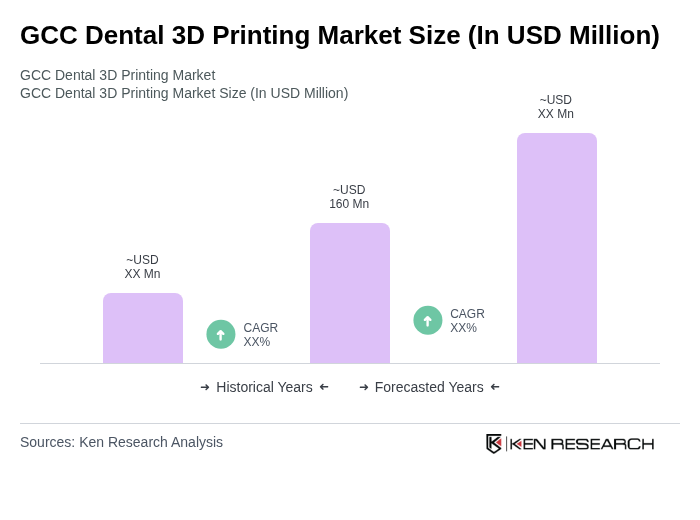
- The GCC Dental 3D Printing Market is valued at USD 160 million, based on a five-year historical analysis of regional adoption within the broader GCC 3D printing and global dental 3D printing markets. This growth is primarily driven by advancements in dental technology, increasing demand for customized and chairside dental solutions, digital workflows (intraoral scanners, CAD/CAM, and cloud-based design), and the rising prevalence of dental caries and tooth loss in aging and lifestyle-affected populations. The integration of 3D printing in dental practices and laboratories has transformed the production of dental implants, crowns, bridges, dentures, aligners, and surgical guides, supporting same-day dentistry, improving treatment accuracy, and enhancing operational efficiency.
- Key players in this market include Saudi Arabia and the UAE, which dominate due to their robust healthcare infrastructure, higher healthcare expenditure, supportive national digital health strategies, and strong focus on cosmetic and restorative dentistry. The presence of leading dental technology vendors, specialized dental labs, and academic and research institutions in these countries further supports market growth, making them pivotal hubs for innovation, training, and adoption of 3D printing technologies in dentistry within the GCC.
- In 2023, the UAE government implemented regulations to promote the use of advanced technologies in healthcare, including dental 3D printing. A key framework is Federal Decree-Law No. 8 of 2019 on Medical Products, the Pharmacy Profession and Healthcare Facilities, issued by the UAE Ministry of Health and Prevention, which governs manufacture, import, registration, and quality and safety requirements for medical devices, including 3D?printed medical and dental products, and requires licensing of facilities, device registration, and adherence to recognized technical standards. In parallel, Dubai Health Authority and the Dubai Health Regulator framework require healthcare providers using 3D-printed devices for clinical applications to obtain facility and service licensing, maintain documented quality management systems, and ensure traceability and validation of 3D-printed dental devices in line with international best practice.
GCC Dental 3D Printing Market Segmentation
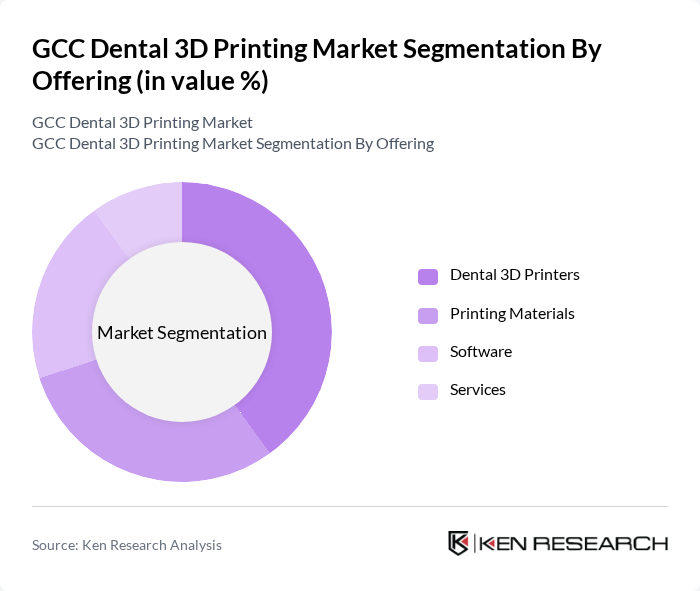
By Offering:The market is segmented into four main categories: Dental 3D Printers, Printing Materials, Software, and Services. Each of these segments plays a crucial role in the overall market dynamics, with specific applications and technologies driving their growth, and with hardware and materials currently accounting for the majority of spending, while software and services gain share as digital workflows and outsourced design/printing models expand.
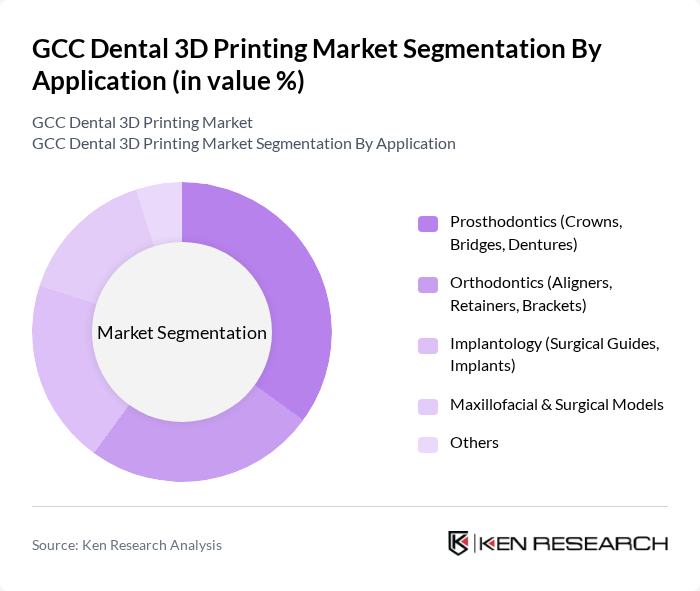
By Application:The applications of dental 3D printing are diverse, including Prosthodontics (Crowns, Bridges, Dentures), Orthodontics (Aligners, Retainers, Brackets), Implantology (Surgical Guides, Implants), Maxillofacial & Surgical Models, and Others. Each application addresses specific dental needs and contributes to the overall market growth, with prosthodontics and orthodontics currently representing the largest demand globally owing to high procedure volumes, increasing use of clear aligners, and broader adoption of digital indirect bonding and model production in labs.
GCC Dental 3D Printing Market Competitive Landscape
The GCC Dental 3D Printing Market is characterized by a dynamic mix of regional and international players. Leading participants such as Stratasys Ltd., 3D Systems Corporation, Formlabs Inc., EnvisionTEC GmbH (Desktop Health), Dentsply Sirona Inc., Align Technology, Inc., Materialise NV, Dental Wings Inc., Renishaw plc, EOS GmbH, SprintRay Inc., 3Shape A/S, BEGO GmbH & Co. KG, Carbon, Inc., Local & Regional GCC Dental 3D Printing Players contribute to innovation, geographic expansion, and service delivery in this space.
GCC Dental 3D Printing Market Industry Analysis
Growth Drivers
- Increasing Demand for Customized Dental Solutions:The GCC region has witnessed a significant rise in the demand for customized dental solutions, driven by a growing population of over 59 million. This demographic shift is accompanied by an increase in disposable income, with average per capita income projected at around $30,000. As patients seek personalized dental care, the adoption of 3D printing technology, which allows for tailored dental products, is expected to surge, enhancing patient satisfaction and treatment outcomes.
- Advancements in 3D Printing Technology:Technological advancements in 3D printing are propelling the GCC dental market forward. In future, the introduction of faster and more precise 3D printers is anticipated, with capabilities to produce dental models in under two hours. The global 3D printing market is projected to reach about $30 billion, indicating a robust investment in research and development. These innovations are expected to improve the efficiency and quality of dental products, making them more accessible to dental professionals.
- Rising Awareness of Dental Aesthetics:The increasing awareness of dental aesthetics among the GCC population is a key growth driver. With a focus on cosmetic dentistry, the market for aesthetic dental solutions is projected to grow, supported by an increase in dental tourism in the region. Patients are increasingly seeking procedures that enhance their smiles, leading to a higher demand for 3D printed dental products that offer superior aesthetics and functionality, thus driving market growth.
Market Challenges
- High Initial Investment Costs:One of the significant challenges facing the GCC dental 3D printing market is the high initial investment required for advanced 3D printing equipment. The cost of high-quality 3D printers can range from about $15,000 for entry-level professional systems to over $200,000 for advanced industrial-grade dental 3D printers, which poses a barrier for many dental clinics and laboratories. This financial hurdle can limit the adoption of 3D printing technology, particularly among smaller practices that may struggle to allocate such capital for equipment.
- Regulatory Compliance Issues:Regulatory compliance remains a critical challenge in the GCC dental 3D printing market. The region's regulatory framework for dental products is still evolving, with varying standards across countries. In future, the lack of clear guidelines can lead to delays in product approvals, hindering market entry for new technologies. This uncertainty can deter investment and innovation, impacting the overall growth of the dental 3D printing sector.
GCC Dental 3D Printing Market Future Outlook
The future of the GCC dental 3D printing market appears promising, driven by technological advancements and increasing consumer demand for personalized dental solutions. As the region's healthcare infrastructure continues to improve, the integration of digital dentistry and AI technologies is expected to enhance operational efficiencies in future. Furthermore, the growing geriatric population in GCC countries is projected to increase substantially in future, creating higher demand for dental care solutions. This will necessitate innovative dental care solutions, further propelling market growth and adoption of 3D printing technologies.
Market Opportunities
- Expansion of Dental Clinics and Laboratories:The rapid expansion of dental clinics and laboratories in the GCC region presents a significant opportunity for 3D printing technology. As the number of dental facilities increases in future, the demand for efficient and cost-effective dental solutions will increase, creating a favorable environment for 3D printing adoption in dental practices.
- Integration of AI and Machine Learning in 3D Printing:The integration of AI and machine learning into 3D printing processes offers substantial opportunities for innovation. AI-driven design software is expected to enhance the customization of dental products in future, improving accuracy and reducing production time. This technological synergy can lead to better patient outcomes and increased operational efficiency for dental practices.
Scope of the Report
| Segment | Sub-Segments |
|---|---|
| By Offering | Dental 3D Printers Printing Materials Software Services |
| By Application | Prosthodontics (Crowns, Bridges, Dentures) Orthodontics (Aligners, Retainers, Brackets) Implantology (Surgical Guides, Implants) Maxillofacial & Surgical Models Others |
| By Technology | Vat Photopolymerization (SLA, DLP, LCD) Material Jetting / PolyJet Selective Laser Sintering (SLS) Fused Deposition Modeling (FDM) Others |
| By Material Type | Photopolymer Resins Metals & Alloys Ceramics Composites Others |
| By End-User | Dental Laboratories Dental Hospitals & Clinics Dental Academic & Research Institutions Others |
| By Distribution Channel | Direct Sales (OEMs) Distributors / Dealers Online Channels Others |
| By Region | Saudi Arabia UAE Qatar Kuwait Oman Bahrain |
Key Target Audience
Investors and Venture Capitalist Firms
Government and Regulatory Bodies (e.g., Ministry of Health, Saudi Food and Drug Authority)
Dental Equipment Manufacturers
3D Printing Technology Providers
Dental Clinics and Practices
Dental Laboratories
Healthcare Technology Innovators
Insurance Companies and Payers
Players Mentioned in the Report:
Stratasys Ltd.
3D Systems Corporation
Formlabs Inc.
EnvisionTEC GmbH (Desktop Health)
Dentsply Sirona Inc.
Align Technology, Inc.
Materialise NV
Dental Wings Inc.
Renishaw plc
EOS GmbH
SprintRay Inc.
3Shape A/S
BEGO GmbH & Co. KG
Carbon, Inc.
Local & Regional GCC Dental 3D Printing Players
Table of Contents
Market Assessment Phase
1. Executive Summary and Approach
2. GCC Dental 3D Printing Market Overview
2.1 Key Insights and Strategic Recommendations
2.2 GCC Dental 3D Printing Market Overview
2.3 Definition and Scope
2.4 Evolution of Market Ecosystem
2.5 Timeline of Key Regulatory Milestones
2.6 Value Chain & Stakeholder Mapping
2.7 Business Cycle Analysis
2.8 Policy & Incentive Landscape
3. GCC Dental 3D Printing Market Analysis
3.1 Growth Drivers
3.1.1 Increasing Demand for Customized Dental Solutions
3.1.2 Advancements in 3D Printing Technology
3.1.3 Rising Awareness of Dental Aesthetics
3.1.4 Cost-Effectiveness of 3D Printing in Dental Applications
3.2 Market Challenges
3.2.1 High Initial Investment Costs
3.2.2 Regulatory Compliance Issues
3.2.3 Limited Awareness Among Dental Professionals
3.2.4 Competition from Traditional Dental Manufacturing Methods
3.3 Market Opportunities
3.3.1 Expansion of Dental Clinics and Laboratories
3.3.2 Integration of AI and Machine Learning in 3D Printing
3.3.3 Growing Geriatric Population Requiring Dental Care
3.3.4 Potential for Exporting 3D Printed Dental Products
3.4 Market Trends
3.4.1 Increasing Adoption of Digital Dentistry
3.4.2 Rise of Biocompatible Materials in 3D Printing
3.4.3 Shift Towards Sustainable Manufacturing Practices
3.4.4 Collaboration Between Dental Professionals and 3D Printing Companies
3.5 Government Regulation
3.5.1 Standards for Dental Materials and Products
3.5.2 Licensing Requirements for Dental 3D Printing Facilities
3.5.3 Guidelines for Patient Safety and Data Protection
3.5.4 Incentives for Adoption of Innovative Dental Technologies
4. SWOT Analysis
5. Stakeholder Analysis
6. Porter's Five Forces Analysis
7. GCC Dental 3D Printing Market Size, 2019-2024
7.1 By Value
7.2 By Volume
7.3 By Average Selling Price
8. GCC Dental 3D Printing Market Segmentation
8.1 By Offering
8.1.1 Dental 3D Printers
8.1.2 Printing Materials
8.1.3 Software
8.1.4 Services
8.2 By Application
8.2.1 Prosthodontics (Crowns, Bridges, Dentures)
8.2.2 Orthodontics (Aligners, Retainers, Brackets)
8.2.3 Implantology (Surgical Guides, Implants)
8.2.4 Maxillofacial & Surgical Models
8.2.5 Others
8.3 By Technology
8.3.1 Vat Photopolymerization (SLA, DLP, LCD)
8.3.2 Material Jetting / PolyJet
8.3.3 Selective Laser Sintering (SLS)
8.3.4 Fused Deposition Modeling (FDM)
8.3.5 Others
8.4 By Material Type
8.4.1 Photopolymer Resins
8.4.2 Metals & Alloys
8.4.3 Ceramics
8.4.4 Composites
8.4.5 Others
8.5 By End-User
8.5.1 Dental Laboratories
8.5.2 Dental Hospitals & Clinics
8.5.3 Dental Academic & Research Institutions
8.5.4 Others
8.6 By Distribution Channel
8.6.1 Direct Sales (OEMs)
8.6.2 Distributors / Dealers
8.6.3 Online Channels
8.6.4 Others
8.7 By Region
8.7.1 Saudi Arabia
8.7.2 UAE
8.7.3 Qatar
8.7.4 Kuwait
8.7.5 Oman
8.7.6 Bahrain
9. GCC Dental 3D Printing Market Competitive Analysis
9.1 Market Share of Key Players
9.2 Cross Comparison of Key Players
9.2.1 Company Name
9.2.2 Revenue (Global and GCC, Latest Fiscal Year)
9.2.3 3D Printing Dental Revenue Share (%)
9.2.4 3-Year Revenue CAGR in GCC Dental 3D Printing
9.2.5 Installed Base of Dental 3D Printers in GCC
9.2.6 Average Selling Price (Printer & Per-Part)
9.2.7 EBITDA Margin from Dental 3D Printing Business
9.2.8 R&D Intensity (% of Revenue in Dental 3D Printing)
9.2.9 New Product Launches / Approvals (Last 3 Years)
9.2.10 GCC Coverage (No. of Countries / Key Accounts)
9.3 SWOT Analysis of Top Players
9.4 Pricing Analysis
9.5 Detailed Profile of Major Companies
9.5.1 Stratasys Ltd.
9.5.2 3D Systems Corporation
9.5.3 Formlabs Inc.
9.5.4 EnvisionTEC GmbH (Desktop Health)
9.5.5 Dentsply Sirona Inc.
9.5.6 Align Technology, Inc.
9.5.7 Materialise NV
9.5.8 Dental Wings Inc.
9.5.9 Renishaw plc
9.5.10 EOS GmbH
9.5.11 SprintRay Inc.
9.5.12 3Shape A/S
9.5.13 BEGO GmbH & Co. KG
9.5.14 Carbon, Inc.
9.5.15 Local & Regional GCC Dental 3D Printing Players
10. GCC Dental 3D Printing Market End-User Analysis
10.1 Procurement Behavior of Key Ministries
10.1.1 Government Procurement Policies
10.1.2 Budget Allocations for Dental Services
10.1.3 Evaluation Criteria for Suppliers
10.1.4 Collaboration with Private Sector
10.2 Corporate Spend on Infrastructure & Energy
10.2.1 Investment in Dental Infrastructure
10.2.2 Funding for Technological Upgrades
10.2.3 Partnerships with 3D Printing Firms
10.2.4 Cost Management Strategies
10.3 Pain Point Analysis by End-User Category
10.3.1 Challenges Faced by Dental Clinics
10.3.2 Issues in Dental Laboratories
10.3.3 Concerns of Hospitals
10.3.4 Needs of Research Institutions
10.4 User Readiness for Adoption
10.4.1 Awareness of 3D Printing Benefits
10.4.2 Training and Skill Development
10.4.3 Infrastructure Readiness
10.4.4 Financial Preparedness
10.5 Post-Deployment ROI and Use Case Expansion
10.5.1 Measurement of ROI
10.5.2 Case Studies of Successful Implementations
10.5.3 Potential for Scaling Operations
10.5.4 Future Use Cases in Dentistry
11. GCC Dental 3D Printing Market Future Size, 2025-2030
11.1 By Value
11.2 By Volume
11.3 By Average Selling Price
Go-To-Market Strategy Phase
1. Whitespace Analysis + Business Model Canvas
1.1 Market Gaps Identification
1.2 Business Model Development
1.3 Value Proposition Analysis
1.4 Revenue Streams Exploration
1.5 Cost Structure Assessment
1.6 Key Partnerships Identification
1.7 Customer Segmentation
2. Marketing and Positioning Recommendations
2.1 Branding Strategies
2.2 Product USPs
2.3 Target Market Identification
2.4 Communication Strategy
2.5 Digital Marketing Approaches
2.6 Customer Engagement Tactics
2.7 Performance Metrics
3. Distribution Plan
3.1 Urban Retail Strategies
3.2 Rural NGO Tie-ups
3.3 Online Distribution Channels
3.4 Partnerships with Dental Suppliers
3.5 Logistics and Supply Chain Management
3.6 Distribution Cost Analysis
3.7 Performance Evaluation
4. Channel & Pricing Gaps
4.1 Underserved Routes
4.2 Pricing Bands Analysis
4.3 Competitor Pricing Strategies
4.4 Customer Price Sensitivity
4.5 Value-Based Pricing Models
4.6 Pricing Optimization Techniques
4.7 Pricing Strategy Recommendations
5. Unmet Demand & Latent Needs
5.1 Category Gaps Identification
5.2 Consumer Segments Analysis
5.3 Emerging Trends and Needs
5.4 Product Development Opportunities
5.5 Market Entry Strategies
5.6 Customer Feedback Mechanisms
5.7 Future Demand Projections
6. Customer Relationship
6.1 Loyalty Programs
6.2 After-sales Service
6.3 Customer Feedback Systems
6.4 Relationship Management Strategies
6.5 Customer Retention Techniques
6.6 Engagement through Social Media
6.7 Performance Metrics
7. Value Proposition
7.1 Sustainability Initiatives
7.2 Integrated Supply Chains
7.3 Unique Selling Propositions
7.4 Customer-Centric Innovations
7.5 Competitive Advantages
7.6 Value Delivery Mechanisms
7.7 Performance Metrics
8. Key Activities
8.1 Regulatory Compliance
8.2 Branding Initiatives
8.3 Distribution Setup
8.4 Training and Development
8.5 Marketing Campaigns
8.6 Performance Monitoring
8.7 Continuous Improvement Strategies
9. Entry Strategy Evaluation
9.1 Domestic Market Entry Strategy
9.1.1 Product Mix Considerations
9.1.2 Pricing Band Analysis
9.1.3 Packaging Strategies
9.2 Export Entry Strategy
9.2.1 Target Countries Identification
9.2.2 Compliance Roadmap Development
10. Entry Mode Assessment
10.1 Joint Ventures
10.2 Greenfield Investments
10.3 Mergers & Acquisitions
10.4 Distributor Model Evaluation
10.5 Risk Assessment
10.6 Strategic Fit Analysis
10.7 Performance Metrics
11. Capital and Timeline Estimation
11.1 Capital Requirements
11.2 Timelines for Implementation
11.3 Financial Projections
11.4 Funding Sources
11.5 Risk Management Strategies
11.6 Performance Metrics
12. Control vs Risk Trade-Off
12.1 Ownership vs Partnerships
12.2 Risk Mitigation Strategies
12.3 Control Mechanisms
12.4 Performance Metrics
13. Profitability Outlook
13.1 Breakeven Analysis
13.2 Long-term Sustainability Strategies
13.3 Financial Health Indicators
13.4 Performance Metrics
14. Potential Partner List
14.1 Distributors
14.2 Joint Ventures
14.3 Acquisition Targets
14.4 Strategic Alliances
14.5 Performance Metrics
15. Execution Roadmap
15.1 Phased Plan for Market Entry
15.1.1 Market Setup
15.1.2 Market Entry
15.1.3 Growth Acceleration
15.1.4 Scale & Stabilize
15.2 Key Activities and Milestones
15.2.1 Activity Planning
15.2.2 Milestone Tracking
15.2.3 Performance Evaluation
Research Methodology
Phase 1: Approach1
Desk Research
- Industry reports from dental associations and 3D printing organizations
- Market analysis publications focusing on the GCC dental sector
- Government publications and healthcare regulations impacting dental practices
Primary Research
- Interviews with dental practitioners and clinic owners in the GCC region
- Surveys targeting dental technicians and 3D printing service providers
- Focus groups with dental industry experts and educators
Validation & Triangulation
- Cross-validation of findings through multiple expert interviews
- Triangulation of data from primary and secondary sources
- Sanity checks through peer reviews and expert panel discussions
Phase 2: Market Size Estimation1
Top-down Assessment
- Analysis of overall healthcare expenditure in the GCC region
- Estimation of dental care spending as a percentage of total healthcare costs
- Incorporation of growth rates from dental technology adoption trends
Bottom-up Modeling
- Volume estimates based on the number of dental clinics and procedures performed
- Cost analysis of 3D printing materials and equipment used in dental applications
- Revenue projections based on service pricing and market penetration rates
Forecasting & Scenario Analysis
- Multi-factor regression analysis considering population growth and dental health trends
- Scenario modeling based on technological advancements and regulatory changes
- Baseline, optimistic, and pessimistic forecasts through 2030
Phase 3: CATI Sample Composition1
| Scope Item/Segment | Sample Size | Target Respondent Profiles |
|---|---|---|
| Dental Clinics in UAE | 120 | Dentists, Clinic Managers |
| 3D Printing Service Providers | 80 | Operations Managers, Technical Directors |
| Dental Equipment Suppliers | 60 | Sales Managers, Product Specialists |
| Dental Education Institutions | 45 | Faculty Members, Program Coordinators |
| Regulatory Bodies in Healthcare | 40 | Policy Makers, Compliance Officers |
Frequently Asked Questions
What is the current value of the GCC Dental 3D Printing Market?
The GCC Dental 3D Printing Market is valued at approximately USD 160 million, reflecting significant growth driven by advancements in dental technology and increasing demand for customized dental solutions.
What are the main drivers of growth in the GCC Dental 3D Printing Market?
Which countries dominate the GCC Dental 3D Printing Market?
What applications are most common in the GCC Dental 3D Printing Market?
Other Regional/Country Reports
Indonesia Dental 3D Printing Market
Malaysia Dental 3D Printing Market
KSA Dental 3D Printing Market
APAC Dental 3D Printing Market
SEA Dental 3D Printing Market
Other Adjacent Reports
Singapore Orthodontics Market
Bahrain Prosthodontics Market
UAE Dental CAD/CAM Market
Oman Intraoral Scanners Market
Indonesia Medical 3D Printing Market
Philippines Dental Materials Market
United States Digital Dentistry Market Outlook to 2030: Size, Share, Growth and TrendsGlobal Dental Software Market Outlook 2030Middle East cosmetic dentistry market size, share, growth drivers, trends, opportunities & forecast 2025–2030Why Buy From Us?

What makes us stand out is that our consultants follow Robust, Refine and Result (RRR) methodology. Robust for clear definitions, approaches and sanity checking, Refine for differentiating respondents' facts and opinions, and Result for presenting data with story.

We have set a benchmark in the industry by offering our clients with syndicated and customized market research reports featuring coverage of entire market as well as meticulous research and analyst insights.

While we don't replace traditional research, we flip the method upside down. Our dual approach of Top Bottom & Bottom Top ensures quality deliverable by not just verifying company fundamentals but also looking at the sector and macroeconomic factors.

With one step in the future, our research team constantly tries to show you the bigger picture. We help with some of the tough questions you may encounter along the way: How is the industry positioned? Best marketing channel? KPI's of competitors? By aligning every element, we help maximize success.

Our report gives you instant access to the answers and sources that other companies might choose to hide. We elaborate each steps of research methodology we have used and showcase you the sample size to earn your trust.

If you need any support, we are here! We pride ourselves on universe strength, data quality, and quick, friendly, and professional service.