About the Report
Base Year 2024Listen to the audio summary
Global Dental 3D Printing Market Overview
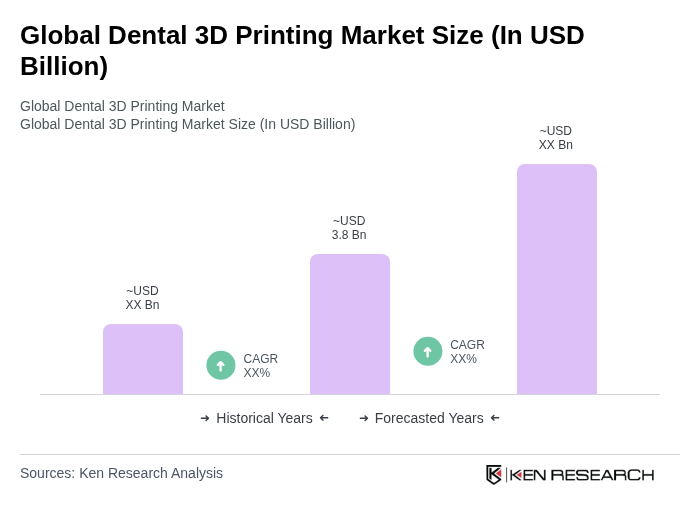
- The Global Dental 3D Printing Market is valued at USD 3.8 billion, based on a five-year historical analysis. This growth is primarily driven by advancements in dental technology, increasing demand for customized dental solutions, and the rising prevalence of dental disorders. The integration of 3D printing in dental practices has significantly enhanced the efficiency and accuracy of dental procedures, leading to a surge in adoption among dental professionals. Key growth drivers include the rapid uptake of digital dentistry, development of biocompatible materials, and the ability to produce precise, patient-specific restorations with reduced material waste and faster turnaround times .
- Key players in this market include the United States, Germany, and Japan, which dominate due to their strong healthcare infrastructure, high investment in research and development, and a growing number of dental clinics adopting advanced technologies. The presence of leading manufacturers and a robust supply chain further contribute to the market's growth in these regions. North America holds the largest market share, supported by favorable reimbursement policies, strong dental laboratory networks, and high demand for cosmetic dentistry. Asia-Pacific is experiencing rapid growth due to rising dental tourism, increasing disposable incomes, and government initiatives promoting healthcare digitization .
- In 2023, the U.S. Food and Drug Administration (FDA) issued updated guidelines for the use of 3D printing technologies in dental practices, including the “Technical Considerations for Additive Manufactured Medical Devices” (FDA, 2023). This regulation provides operational standards for the design, manufacturing, and post-processing of 3D-printed dental devices, with requirements for material biocompatibility, device labeling, and performance testing. The initiative also includes funding for research and development to enhance patient safety and encourage innovation in dental technology .
Global Dental 3D Printing Market Segmentation
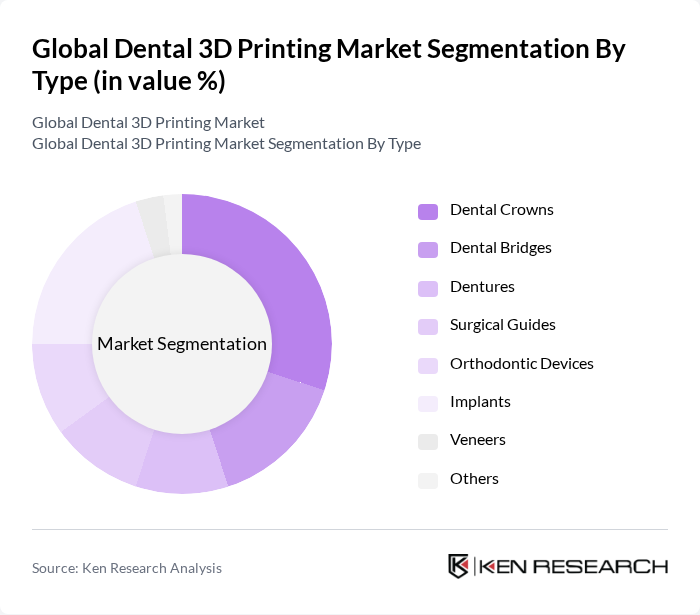
By Type:The market is segmented into various types, including Dental Crowns, Dental Bridges, Dentures, Surgical Guides, Orthodontic Devices, Implants, Veneers, and Others. Among these, Dental Crowns and Implants are particularly prominent due to their high demand for restorative and cosmetic dental procedures. The increasing trend towards personalized dental solutions has also led to a rise in the adoption of these products. Prosthodontic applications (crowns, bridges, dentures, veneers) collectively account for the largest share, driven by the need for precise, customized restorations and the shift toward digital workflows in dental labs .
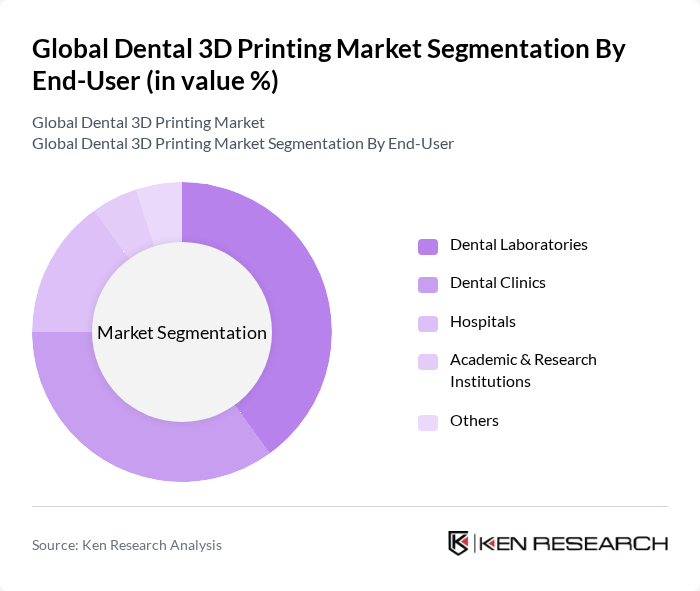
By End-User:The end-user segmentation includes Dental Laboratories, Dental Clinics, Hospitals, Academic & Research Institutions, and Others. Dental Clinics and Laboratories are the primary consumers of 3D printing technologies, driven by the need for efficient and precise dental solutions. The increasing number of dental practices adopting advanced technologies is propelling the growth of this segment. Dental laboratories lead in adoption due to their role in producing customized prosthetics and restorative devices, while clinics increasingly utilize chairside 3D printing for rapid patient care .
Global Dental 3D Printing Market Competitive Landscape
The Global Dental 3D Printing Market is characterized by a dynamic mix of regional and international players. Leading participants such as Stratasys Ltd., 3D Systems Corporation, Align Technology, Inc., Dentsply Sirona Inc., Materialise NV, Formlabs Inc., EnvisionTEC GmbH, Carbon, Inc., Renishaw plc, EOS GmbH, Zortrax S.A., Prodways Group, SLM Solutions Group AG, Asiga, SprintRay Inc. contribute to innovation, geographic expansion, and service delivery in this space.
Global Dental 3D Printing Market Industry Analysis
Growth Drivers
- Increasing Demand for Customized Dental Solutions:The global dental market is witnessing a surge in demand for personalized dental solutions, driven by a growing population of over 8 billion in future. This trend is supported by the increasing number of dental procedures, which reached approximately 300 million annually. Customized solutions, such as crowns and aligners, are becoming essential, as they enhance patient satisfaction and treatment outcomes, thereby propelling the adoption of 3D printing technologies in dental practices.
- Advancements in 3D Printing Technology:The dental 3D printing sector is benefiting from rapid technological advancements, with the global 3D printing market expected to reach $35 billion in future. Innovations in materials and printing techniques, such as resin-based and metal 3D printing, are enhancing the precision and efficiency of dental applications. These advancements enable dental professionals to produce high-quality prosthetics and orthodontic devices, significantly improving treatment timelines and patient outcomes, thus driving market growth.
- Rising Prevalence of Dental Disorders:The World Health Organization reported that nearly 3.5 billion people suffer from oral diseases, highlighting a significant public health concern. This rising prevalence is expected to increase the demand for dental services, with an estimated 1.5 billion dental visits projected in future. Consequently, the need for efficient and effective dental solutions, including 3D printed devices, is becoming critical, further stimulating the growth of the dental 3D printing market.
Market Challenges
- High Initial Investment Costs:The adoption of dental 3D printing technology is hindered by substantial initial investment costs, which can exceed $100,000 for advanced 3D printers. Many dental practices, especially smaller ones, struggle to allocate such capital, limiting their ability to integrate these technologies. This financial barrier can slow down the overall market growth, as practices may opt for traditional methods that require lower upfront investments.
- Regulatory Hurdles and Compliance Issues:Navigating the regulatory landscape poses significant challenges for dental 3D printing. In the U.S., the FDA mandates rigorous testing and approval processes for dental devices, which can take several years and cost upwards of $1 million. These regulatory hurdles can delay product launches and increase costs, discouraging innovation and limiting the market's potential for growth in the dental sector.
Global Dental 3D Printing Market Future Outlook
The future of the dental 3D printing market appears promising, driven by technological advancements and increasing consumer awareness. As dental professionals become more familiar with 3D printing capabilities, the integration of AI and machine learning is expected to enhance design and production processes. Additionally, the growing trend of digital dentistry will likely lead to more efficient workflows, improving patient outcomes and satisfaction. These factors will collectively contribute to a more robust market landscape in the coming years.
Market Opportunities
- Expansion of Dental Clinics and Laboratories:The increasing number of dental clinics, projected to reach over 200,000 globally in future, presents significant opportunities for 3D printing adoption. As these facilities seek to enhance service offerings and improve patient care, the demand for 3D printed dental solutions will likely rise, creating a favorable environment for market growth.
- Integration of AI and Machine Learning in 3D Printing:The integration of AI and machine learning technologies into dental 3D printing processes is expected to revolutionize the industry. In future, AI-driven design software can enhance precision and reduce production times, making 3D printing more accessible and efficient for dental professionals. This technological synergy will likely open new avenues for innovation and market expansion.
Scope of the Report
| Segment | Sub-Segments |
|---|---|
| By Type | Dental Crowns Dental Bridges Dentures Surgical Guides Orthodontic Devices Implants Veneers Others |
| By End-User | Dental Laboratories Dental Clinics Hospitals Academic & Research Institutions Others |
| By Material | Photopolymer Resins Metal Alloys Ceramics Polymers/Plastics Composites Others |
| By Technology | Vat Photopolymerization (SLA, DLP) PolyJet Technology Fused Deposition Modeling (FDM) Selective Laser Sintering (SLS) Others |
| By Application | Prosthodontics Orthodontics Implantology Oral Surgery Aesthetic Dentistry Others |
| By Region | North America Europe Asia-Pacific Latin America Middle East & Africa |
| By Policy Support | Subsidies for dental technology adoption Tax incentives for dental practices Grants for research and development Others |
Key Target Audience
Investors and Venture Capitalist Firms
Government and Regulatory Bodies (e.g., Food and Drug Administration, European Medicines Agency)
Manufacturers and Producers of 3D Printing Equipment
Dental Clinics and Laboratories
Healthcare Providers and Dental Professionals
Material Suppliers for 3D Printing
Industry Associations and Trade Organizations
Insurance Companies and Payers
Players Mentioned in the Report:
Stratasys Ltd.
3D Systems Corporation
Align Technology, Inc.
Dentsply Sirona Inc.
Materialise NV
Formlabs Inc.
EnvisionTEC GmbH
Carbon, Inc.
Renishaw plc
EOS GmbH
Zortrax S.A.
Prodways Group
SLM Solutions Group AG
Asiga
SprintRay Inc.
Table of Contents
Market Assessment Phase
1. Executive Summary and Approach
2. Global Dental 3D Printing Market Overview
2.1 Key Insights and Strategic Recommendations
2.2 Global Dental 3D Printing Market Overview
2.3 Definition and Scope
2.4 Evolution of Market Ecosystem
2.5 Timeline of Key Regulatory Milestones
2.6 Value Chain & Stakeholder Mapping
2.7 Business Cycle Analysis
2.8 Policy & Incentive Landscape
3. Global Dental 3D Printing Market Analysis
3.1 Growth Drivers
3.1.1 Increasing demand for customized dental solutions
3.1.2 Advancements in 3D printing technology
3.1.3 Rising prevalence of dental disorders
3.1.4 Cost-effectiveness of 3D printing in dental applications
3.2 Market Challenges
3.2.1 High initial investment costs
3.2.2 Regulatory hurdles and compliance issues
3.2.3 Limited awareness among dental professionals
3.2.4 Material limitations in 3D printing
3.3 Market Opportunities
3.3.1 Expansion of dental clinics and laboratories
3.3.2 Integration of AI and machine learning in 3D printing
3.3.3 Growing trend of digital dentistry
3.3.4 Collaborations and partnerships in the industry
3.4 Market Trends
3.4.1 Increasing adoption of biocompatible materials
3.4.2 Rise of on-demand manufacturing
3.4.3 Shift towards sustainable practices in dental 3D printing
3.4.4 Enhanced software solutions for design and production
3.5 Government Regulation
3.5.1 FDA regulations on dental devices
3.5.2 CE marking requirements in Europe
3.5.3 Guidelines for material safety and efficacy
3.5.4 Standards for quality assurance in dental 3D printing
4. SWOT Analysis
5. Stakeholder Analysis
6. Porter's Five Forces Analysis
7. Global Dental 3D Printing Market Market Size, 2019-2024
7.1 By Value
7.2 By Volume
7.3 By Average Selling Price
8. Global Dental 3D Printing Market Segmentation
8.1 By Type
8.1.1 Dental Crowns
8.1.2 Dental Bridges
8.1.3 Dentures
8.1.4 Surgical Guides
8.1.5 Orthodontic Devices
8.1.6 Implants
8.1.7 Veneers
8.1.8 Others
8.2 By End-User
8.2.1 Dental Laboratories
8.2.2 Dental Clinics
8.2.3 Hospitals
8.2.4 Academic & Research Institutions
8.2.5 Others
8.3 By Material
8.3.1 Photopolymer Resins
8.3.2 Metal Alloys
8.3.3 Ceramics
8.3.4 Polymers/Plastics
8.3.5 Composites
8.3.6 Others
8.4 By Technology
8.4.1 Vat Photopolymerization (SLA, DLP)
8.4.2 PolyJet Technology
8.4.3 Fused Deposition Modeling (FDM)
8.4.4 Selective Laser Sintering (SLS)
8.4.5 Others
8.5 By Application
8.5.1 Prosthodontics
8.5.2 Orthodontics
8.5.3 Implantology
8.5.4 Oral Surgery
8.5.5 Aesthetic Dentistry
8.5.6 Others
8.6 By Region
8.6.1 North America
8.6.2 Europe
8.6.3 Asia-Pacific
8.6.4 Latin America
8.6.5 Middle East & Africa
8.7 By Policy Support
8.7.1 Subsidies for dental technology adoption
8.7.2 Tax incentives for dental practices
8.7.3 Grants for research and development
8.7.4 Others
9. Global Dental 3D Printing Market Competitive Analysis
9.1 Market Share of Key Players
9.2 Cross Comparison of Key Players
9.2.1 Company Name
9.2.2 Company Size (Large, Medium, Small)
9.2.3 Revenue (USD, latest fiscal year)
9.2.4 Revenue Growth Rate (%)
9.2.5 Market Share (%)
9.2.6 Geographic Presence (Regions/Countries)
9.2.7 Product Portfolio Breadth (Dental 3D printers, materials, software, services)
9.2.8 R&D Intensity (R&D spend as % of revenue)
9.2.9 Number of Patents/Innovations (last 3 years)
9.2.10 Customer Segments Served (labs, clinics, hospitals, etc.)
9.2.11 Key Partnerships/Collaborations
9.2.12 Customer Satisfaction Index
9.2.13 Operational Efficiency (lead time, production yield, etc.)
9.2.14 Pricing Strategy (premium, value, etc.)
9.3 SWOT Analysis of Top Players
9.4 Pricing Analysis
9.5 Detailed Profile of Major Companies
9.5.1 Stratasys Ltd.
9.5.2 3D Systems Corporation
9.5.3 Align Technology, Inc.
9.5.4 Dentsply Sirona Inc.
9.5.5 Materialise NV
9.5.6 Formlabs Inc.
9.5.7 EnvisionTEC GmbH
9.5.8 Carbon, Inc.
9.5.9 Renishaw plc
9.5.10 EOS GmbH
9.5.11 Zortrax S.A.
9.5.12 Prodways Group
9.5.13 SLM Solutions Group AG
9.5.14 Asiga
9.5.15 SprintRay Inc.
10. Global Dental 3D Printing Market End-User Analysis
10.1 Procurement Behavior of Key Ministries
10.1.1 Government procurement policies
10.1.2 Budget allocation for dental services
10.1.3 Evaluation criteria for dental technology
10.1.4 Collaboration with private sectors
10.2 Corporate Spend on Infrastructure & Energy
10.2.1 Investment in dental technology infrastructure
10.2.2 Spending on training and development
10.2.3 Budget for research and innovation
10.2.4 Others
10.3 Pain Point Analysis by End-User Category
10.3.1 Challenges faced by dental clinics
10.3.2 Issues in dental laboratories
10.3.3 Concerns of hospitals
10.3.4 Others
10.4 User Readiness for Adoption
10.4.1 Awareness of 3D printing benefits
10.4.2 Training needs for dental professionals
10.4.3 Infrastructure readiness
10.4.4 Others
10.5 Post-Deployment ROI and Use Case Expansion
10.5.1 Measurement of ROI in dental practices
10.5.2 Case studies of successful implementations
10.5.3 Expansion into new applications
10.5.4 Others
11. Global Dental 3D Printing Market Future Size, 2025-2030
11.1 By Value
11.2 By Volume
11.3 By Average Selling Price
Go-To-Market Strategy Phase
1. Whitespace Analysis + Business Model Canvas
1.1 Market gaps and opportunities
1.2 Business model components
2. Marketing and Positioning Recommendations
2.1 Branding strategies
2.2 Product USPs
3. Distribution Plan
3.1 Urban retail vs rural NGO tie-ups
4. Channel & Pricing Gaps
4.1 Underserved routes
4.2 Pricing bands
5. Unmet Demand & Latent Needs
5.1 Category gaps
5.2 Consumer segments
6. Customer Relationship
6.1 Loyalty programs
6.2 After-sales service
7. Value Proposition
7.1 Sustainability
7.2 Integrated supply chains
8. Key Activities
8.1 Regulatory compliance
8.2 Branding
8.3 Distribution setup
9. Entry Strategy Evaluation
9.1 Domestic Market Entry Strategy
9.1.1 Product mix
9.1.2 Pricing band
9.1.3 Packaging
9.2 Export Entry Strategy
9.2.1 Target countries
9.2.2 Compliance roadmap
10. Entry Mode Assessment
10.1 JV
10.2 Greenfield
10.3 M&A
10.4 Distributor Model
11. Capital and Timeline Estimation
11.1 Capital requirements
11.2 Timelines
12. Control vs Risk Trade-Off
12.1 Ownership vs Partnerships
13. Profitability Outlook
13.1 Breakeven analysis
13.2 Long-term sustainability
14. Potential Partner List
14.1 Distributors
14.2 JVs
14.3 Acquisition targets
15. Execution Roadmap
15.1 Phased Plan for Market Entry
15.1.1 Market Setup
15.1.2 Market Entry
15.1.3 Growth Acceleration
15.1.4 Scale & Stabilize
15.2 Key Activities and Milestones
15.2.1 Milestone planning
15.2.2 Activity tracking
Research Methodology
Phase 1: Approach1
Desk Research
- Industry reports from dental associations and 3D printing organizations
- Market analysis publications focusing on dental technology advancements
- Regulatory frameworks and guidelines from health authorities regarding dental practices
Primary Research
- Interviews with dental practitioners and orthodontists utilizing 3D printing
- Surveys targeting dental laboratories and manufacturers of 3D printers
- Field interviews with dental technology experts and researchers
Validation & Triangulation
- Cross-validation of findings through multiple industry reports and expert opinions
- Triangulation of data from primary interviews and secondary sources
- Sanity checks conducted through expert panel discussions and feedback
Phase 2: Market Size Estimation1
Top-down Assessment
- Estimation of market size based on global dental expenditure and 3D printing adoption rates
- Segmentation by application areas such as prosthodontics, orthodontics, and surgical guides
- Incorporation of growth trends in dental clinics and laboratories adopting 3D printing technology
Bottom-up Modeling
- Volume estimates derived from the number of dental procedures utilizing 3D printing
- Cost analysis based on pricing models of 3D printed dental products
- Estimation of market share from leading manufacturers and their production capacities
Forecasting & Scenario Analysis
- Multi-factor regression analysis considering technological advancements and market penetration rates
- Scenario modeling based on regulatory changes and shifts in consumer preferences
- Baseline, optimistic, and pessimistic forecasts through 2030 based on market dynamics
Phase 3: CATI Sample Composition1
| Scope Item/Segment | Sample Size | Target Respondent Profiles |
|---|---|---|
| Dental Clinics Utilizing 3D Printing | 120 | Dentists, Clinic Managers |
| Dental Laboratories Adopting 3D Technology | 100 | Lab Technicians, Operations Managers |
| 3D Printer Manufacturers in Dental Sector | 80 | Product Managers, Sales Directors |
| Orthodontic Practices Implementing 3D Solutions | 70 | Orthodontists, Practice Owners |
| Dental Technology Researchers and Academics | 60 | Research Scientists, University Professors |
Frequently Asked Questions
What is the current value of the Global Dental 3D Printing Market?
The Global Dental 3D Printing Market is valued at approximately USD 3.8 billion, reflecting significant growth driven by advancements in dental technology, increased demand for customized solutions, and a rise in dental disorders.
What are the key drivers of growth in the Dental 3D Printing Market?
Which regions dominate the Global Dental 3D Printing Market?
What types of products are commonly produced using dental 3D printing?
Other Regional/Country Reports
Indonesia Dental 3D Printing Market
Malaysia Dental 3D Printing Market
KSA Dental 3D Printing Market
APAC Dental 3D Printing Market
SEA Dental 3D Printing Market
Other Adjacent Reports
Brazil Orthodontics Market
APAC dental prosthetics market report Size, Share, Growth Drivers, Trends, Opportunities & Forecast 2025–2030Kuwait Medical 3D Printing Market
Brazil Biocompatible Materials Market
United States Digital Dentistry Market Outlook to 2030: Size, Share, Growth and TrendsIndonesia Dental CAD/CAM Market
Qatar Dental Laboratories Market Report Size Share Growth Drivers Trends Opportunities & Forecast 2025–2030Middle East cosmetic dentistry market size, share, growth drivers, trends, opportunities & forecast 2025–2030United States Dental Equipment Market Outlook to 2030: Size, Share, Growth and TrendsWhy Buy From Us?

What makes us stand out is that our consultants follow Robust, Refine and Result (RRR) methodology. Robust for clear definitions, approaches and sanity checking, Refine for differentiating respondents' facts and opinions, and Result for presenting data with story.

We have set a benchmark in the industry by offering our clients with syndicated and customized market research reports featuring coverage of entire market as well as meticulous research and analyst insights.

While we don't replace traditional research, we flip the method upside down. Our dual approach of Top Bottom & Bottom Top ensures quality deliverable by not just verifying company fundamentals but also looking at the sector and macroeconomic factors.

With one step in the future, our research team constantly tries to show you the bigger picture. We help with some of the tough questions you may encounter along the way: How is the industry positioned? Best marketing channel? KPI's of competitors? By aligning every element, we help maximize success.

Our report gives you instant access to the answers and sources that other companies might choose to hide. We elaborate each steps of research methodology we have used and showcase you the sample size to earn your trust.

If you need any support, we are here! We pride ourselves on universe strength, data quality, and quick, friendly, and professional service.