About the Report
Base Year 2024GCC fashion face mask market Overview
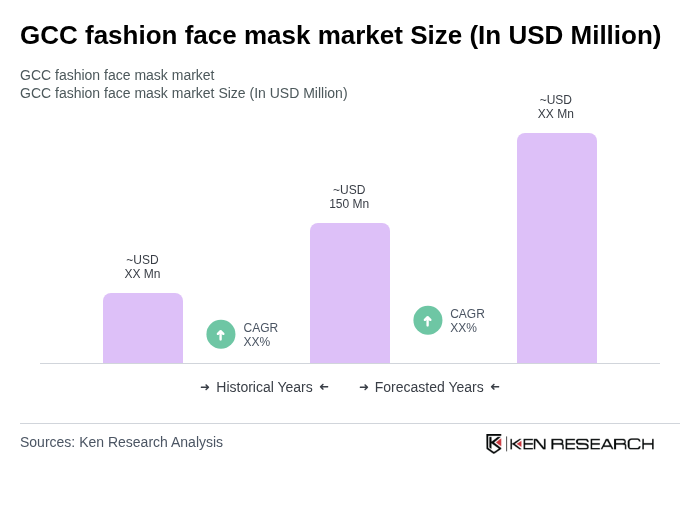
- The GCC fashion face mask market is valued at USD 150 million, based on a five-year historical analysis, positioned as a niche segment within the broader global fashion face mask market that is estimated at over USD 1.4–1.5 billion. This growth is primarily driven by heightened awareness of health and hygiene, particularly in urban areas, alongside the increasing demand for stylish and functional face coverings. Growing concerns over air quality and pollution in major GCC cities, coupled with the presence of international and regional fashion brands offering designed and printed masks, have supported the introduction of a diverse range of fashion masks.
- Key players in this market include the United Arab Emirates, Saudi Arabia, and Qatar, which dominate due to their affluent consumer base and strong fashion retail sectors. The UAE, particularly Dubai, is a recognized fashion and retail hub in the Middle East, attracting international brands and hosting a wide network of malls and specialty stores. Saudi Arabia’s rapid expansion of its fashion and lifestyle segment under its broader retail market transformation, together with rising discretionary spending, contributes to its market strength. Qatar’s investment in luxury retail and premium shopping destinations further enhances its position in the GCC fashion face mask market, especially for branded and designer masks sold through luxury retail formats.
- Across GCC countries, mask-use requirements were introduced during the COVID?19 public health emergency under binding health and safety regulations issued by national authorities, such as the Ministerial Resolution on Wearing Face Masks in Public Places issued by the UAE Ministry of Health and Prevention and National Emergency Crisis and Disasters Management Authority in 2020, the Mandatory Face Mask Regulations issued by the Saudi Ministry of Interior in 2020, and similar decrees by Qatar’s Council of Ministers under Law No. 17 of 1990 on Infectious Diseases. While many of these mandates were subsequently relaxed as conditions improved, the period of compulsory use strongly influenced consumer behavior, expanding acceptance of masks as everyday accessories and creating a base of demand for masks that comply with health guidelines while offering aesthetic and fashion appeal.
GCC fashion face mask market Segmentation
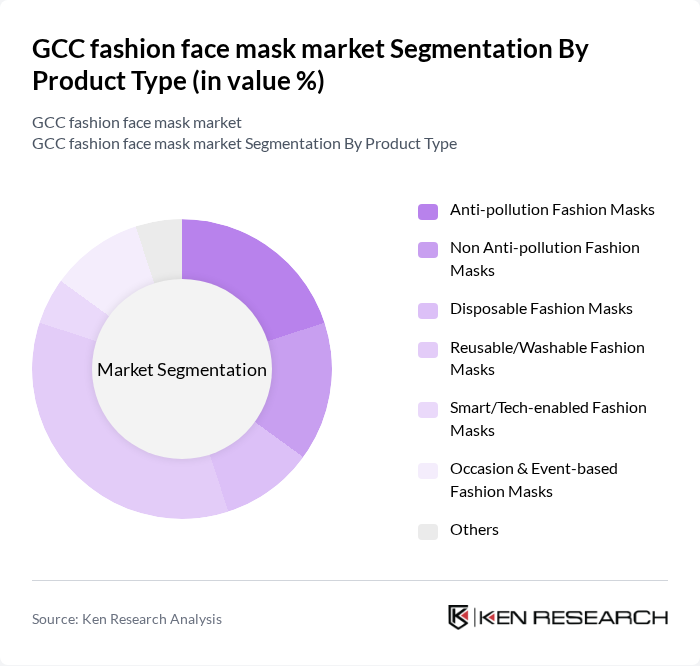
By Product Type:The product type segmentation includes various categories such as Anti-pollution Fashion Masks, Non Anti-pollution Fashion Masks, Disposable Fashion Masks, Reusable/Washable Fashion Masks, Smart/Tech-enabled Fashion Masks, Occasion & Event-based Fashion Masks, and Others. Anti-pollution and protective fashion masks have benefited from rising urban air pollution and growing awareness of respiratory health, in line with global trends where anti-pollution fashion masks represent the largest share of fashion mask revenues. At the same time, Reusable/Washable Fashion Masks have gained significant traction due to their sustainability, lower long?term cost per use, and alignment with eco-conscious consumer behavior, consistent with broader face mask and fashion mask markets that are shifting toward reusable and fabric-based options. Consumers are increasingly opting for masks that can be reused and incorporate design, branding, or personalization, and this segment is expected to remain prominent as it caters to both health and environmental considerations, especially in fashion-forward GCC urban centers.
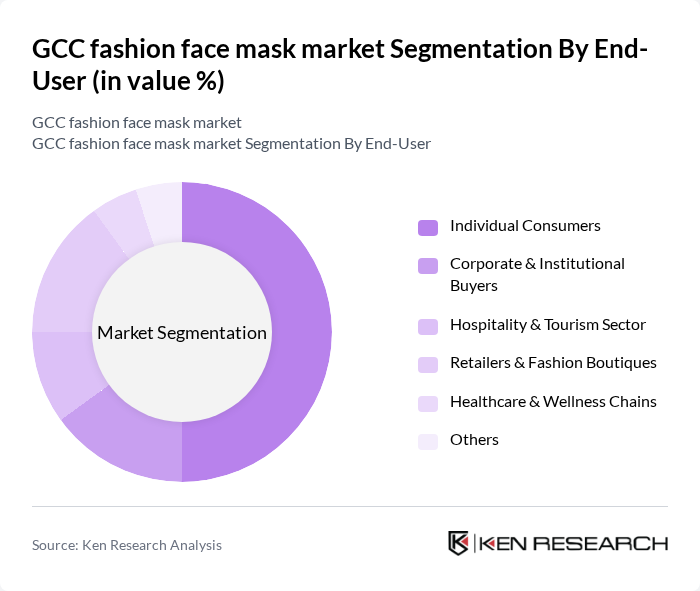
By End-User:This segmentation includes Individual Consumers, Corporate & Institutional Buyers, Hospitality & Tourism Sector, Retailers & Fashion Boutiques, Healthcare & Wellness Chains, and Others. The Individual Consumers segment is leading the market, driven by the rising trend of personalized fashion, social media–influenced styling, and the need for masks that combine comfort, breathability, and aesthetics, in line with global fashion mask consumption patterns. Corporate and institutional buyers, hospitality, and tourism stakeholders in the GCC also procure branded or uniform masks for staff and guests, supporting demand for coordinated or logo?bearing fashion masks, a trend echoed in global fashion and promotional mask segments. As consumers increasingly view masks as occasional or situational fashion accessories—for events, travel, or crowded settings—this end?user mix is expected to sustain a base level of demand even as everyday mandatory usage has eased.
GCC fashion face mask market Competitive Landscape
The GCC fashion face mask market is characterized by a dynamic mix of regional and international players. Leading participants such as Vogmask, Cambridge Mask Co, AirPop, Respro, Under Armour, Adidas, Nike, Puma, Reebok, Uniqlo, H&M, Zara, Burberry, Louis Vuitton, Gucci contribute to innovation, geographic expansion, and service delivery in this space.
GCC fashion face mask market Industry Analysis
Growth Drivers
- Increased Health Awareness:The GCC region has seen a significant rise in health awareness, particularly post-pandemic. According to the World Health Organization, health expenditure in the GCC countries is projected to reach $100 billion by 2025. This increased focus on health has led consumers to prioritize protective measures, including fashionable face masks. The demand for masks that combine safety with style has surged, with sales in the fashion face mask segment expected to exceed 50 million units in future.
- Rising Fashion Trends:The GCC fashion industry is valued at approximately $30 billion, with a growing segment dedicated to accessories, including face masks. As fashion-conscious consumers seek to express their individuality, the demand for stylish masks has increased. In future, it is estimated that 40% of mask purchases will be driven by fashion trends, reflecting a shift towards integrating masks into everyday attire, thus boosting sales in this niche market.
- Government Mandates on Mask Usage:Government regulations in the GCC have played a crucial role in driving mask usage. For instance, Saudi Arabia's Ministry of Health reported that mask-wearing compliance reached 90% in public spaces in recent times. Such mandates have created a sustained demand for masks, with an estimated 25 million masks sold monthly across the region. This regulatory environment ensures a steady market for fashionable masks, as consumers seek compliance without sacrificing style.
Market Challenges
- Supply Chain Disruptions:The GCC fashion face mask market faces significant supply chain challenges, exacerbated by global disruptions. In recent times, the World Bank reported that supply chain delays increased by 30% due to geopolitical tensions and pandemic-related restrictions. These disruptions have led to inconsistent availability of materials, affecting production timelines and ultimately limiting the market's ability to meet consumer demand for fashionable masks.
- Price Sensitivity Among Consumers:Economic fluctuations in the GCC region have heightened price sensitivity among consumers. The IMF projected a GDP growth rate of only 2.5% for future, leading to cautious spending habits. As consumers prioritize essential goods, the demand for high-priced fashion masks may decline. This challenge necessitates a strategic approach to pricing, balancing quality and affordability to maintain market share in a competitive landscape.
GCC fashion face mask market Future Outlook
The future of the GCC fashion face mask market appears promising, driven by evolving consumer preferences and innovative designs. As health awareness continues to rise, the integration of fashion and functionality will likely dominate market trends. Additionally, the anticipated growth of e-commerce platforms will facilitate wider access to diverse mask options, enhancing consumer choice. Companies that adapt to these trends and invest in sustainable practices are expected to thrive, positioning themselves favorably in a competitive landscape.
Market Opportunities
- Customization and Personalization:There is a growing opportunity for brands to offer customized masks tailored to individual preferences. With 60% of consumers expressing interest in personalized products, companies can leverage this trend to enhance customer engagement and loyalty, potentially increasing sales by 20% in future.
- Collaborations with Fashion Brands:Collaborating with established fashion brands presents a lucrative opportunity for mask manufacturers. Such partnerships can enhance brand visibility and credibility, tapping into the existing customer base of fashion labels. This strategy could lead to a projected 15% increase in market penetration in future, as consumers seek fashionable yet functional options.
Scope of the Report
| Segment | Sub-Segments |
|---|---|
| By Product Type | Anti-pollution Fashion Masks Non Anti-pollution Fashion Masks Disposable Fashion Masks Reusable/Washable Fashion Masks Smart/Tech-enabled Fashion Masks Occasion & Event-based Fashion Masks Others |
| By End-User | Individual Consumers Corporate & Institutional Buyers Hospitality & Tourism Sector Retailers & Fashion Boutiques Healthcare & Wellness Chains Others |
| By Distribution Channel | Supermarkets/Hypermarkets Pharmacies & Drugstores Fashion & Specialty Stores Online Marketplaces & E-commerce Platforms Brand-owned Online Channels Others |
| By Material | Cotton & Blended Fabrics Synthetic Fabrics (Polyester, Nylon, etc.) Silk & Premium Fabrics Non-woven & Filter-integrated Materials Sustainable & Eco-friendly Materials Others |
| By Design & Style | Plain & Solid-color Masks Printed & Patterned Masks Embellished/Embroidered & Couture Masks Branded & Co-branded Fashion Masks Cultural/Traditional & Modest Fashion Masks Others |
| By Demographic Segment | Men Women Unisex Children Teenagers & Young Adults Others |
| By Price Range | Economy/Budget Mid-Range Premium Luxury |
Key Target Audience
Investors and Venture Capitalist Firms
Government and Regulatory Bodies (e.g., Ministry of Health, Ministry of Commerce)
Manufacturers and Producers
Distributors and Retailers
Fashion Designers and Brands
Textile and Material Suppliers
Health and Safety Organizations
Trade Associations and Chambers of Commerce
Players Mentioned in the Report:
Vogmask
Cambridge Mask Co
AirPop
Respro
Under Armour
Adidas
Nike
Puma
Reebok
Uniqlo
H&M
Zara
Burberry
Louis Vuitton
Gucci
Table of Contents
Market Assessment Phase
1. Executive Summary and Approach
2. GCC fashion face mask market Overview
2.1 Key Insights and Strategic Recommendations
2.2 GCC fashion face mask market Overview
2.3 Definition and Scope
2.4 Evolution of Market Ecosystem
2.5 Timeline of Key Regulatory Milestones
2.6 Value Chain & Stakeholder Mapping
2.7 Business Cycle Analysis
2.8 Policy & Incentive Landscape
3. GCC fashion face mask market Analysis
3.1 Growth Drivers
3.1.1 Increased Health Awareness
3.1.2 Rising Fashion Trends
3.1.3 Government Mandates on Mask Usage
3.1.4 E-commerce Growth
3.2 Market Challenges
3.2.1 Supply Chain Disruptions
3.2.2 Price Sensitivity Among Consumers
3.2.3 Competition from Non-Fashion Masks
3.2.4 Regulatory Compliance Issues
3.3 Market Opportunities
3.3.1 Customization and Personalization
3.3.2 Collaborations with Fashion Brands
3.3.3 Expansion into New Markets
3.3.4 Sustainable Material Innovations
3.4 Market Trends
3.4.1 Rise of Eco-Friendly Masks
3.4.2 Integration of Technology in Masks
3.4.3 Increased Online Shopping for Fashion Masks
3.4.4 Seasonal and Event-Based Designs
3.5 Government Regulation
3.5.1 Mandatory Mask Policies in Public Spaces
3.5.2 Quality Standards for Face Masks
3.5.3 Import Regulations on Mask Materials
3.5.4 Health and Safety Guidelines for Manufacturers
4. SWOT Analysis
5. Stakeholder Analysis
6. Porter's Five Forces Analysis
7. GCC fashion face mask market Market Size, 2019-2024
7.1 By Value
7.2 By Volume
7.3 By Average Selling Price
8. GCC fashion face mask market Segmentation
8.1 By Product Type
8.1.1 Anti-pollution Fashion Masks
8.1.2 Non Anti-pollution Fashion Masks
8.1.3 Disposable Fashion Masks
8.1.4 Reusable/Washable Fashion Masks
8.1.5 Smart/Tech-enabled Fashion Masks
8.1.6 Occasion & Event-based Fashion Masks
8.1.7 Others
8.2 By End-User
8.2.1 Individual Consumers
8.2.2 Corporate & Institutional Buyers
8.2.3 Hospitality & Tourism Sector
8.2.4 Retailers & Fashion Boutiques
8.2.5 Healthcare & Wellness Chains
8.2.6 Others
8.3 By Distribution Channel
8.3.1 Supermarkets/Hypermarkets
8.3.2 Pharmacies & Drugstores
8.3.3 Fashion & Specialty Stores
8.3.4 Online Marketplaces & E-commerce Platforms
8.3.5 Brand-owned Online Channels
8.3.6 Others
8.4 By Material
8.4.1 Cotton & Blended Fabrics
8.4.2 Synthetic Fabrics (Polyester, Nylon, etc.)
8.4.3 Silk & Premium Fabrics
8.4.4 Non-woven & Filter-integrated Materials
8.4.5 Sustainable & Eco-friendly Materials
8.4.6 Others
8.5 By Design & Style
8.5.1 Plain & Solid-color Masks
8.5.2 Printed & Patterned Masks
8.5.3 Embellished/Embroidered & Couture Masks
8.5.4 Branded & Co-branded Fashion Masks
8.5.5 Cultural/Traditional & Modest Fashion Masks
8.5.6 Others
8.6 By Demographic Segment
8.6.1 Men
8.6.2 Women
8.6.3 Unisex
8.6.4 Children
8.6.5 Teenagers & Young Adults
8.6.6 Others
8.7 By Price Range
8.7.1 Economy/Budget
8.7.2 Mid-Range
8.7.3 Premium
8.7.4 Luxury
9. GCC fashion face mask market Competitive Analysis
9.1 Market Share of Key Players
9.2 Cross Comparison of Key Players
9.2.1 Company Name
9.2.2 Revenue (Latest Financial Year, USD Million)
9.2.3 3-year Revenue CAGR (%) in GCC
9.2.4 GCC Fashion Mask Revenue Share in Total Company Revenue (%)
9.2.5 Gross Margin (%) – Fashion Face Masks
9.2.6 Average Realized Price per Mask (USD)
9.2.7 Volume Sold (Million Units per Year)
9.2.8 GCC Country Footprint (Number of GCC Countries Served)
9.2.9 Retail & E-commerce Reach (Number of Active Channels/Platforms)
9.2.10 Marketing & Promotion Spend as % of Fashion Mask Revenue
9.2.11 New Product Launches in Last 24 Months (Number)
9.2.12 Customer Satisfaction / NPS Score
9.3 SWOT Analysis of Top Players
9.4 Pricing Analysis
9.5 Detailed Profile of Major Companies
9.5.1 Vogmask
9.5.2 Cambridge Mask Co
9.5.3 AirPop
9.5.4 Respro
9.5.5 Under Armour
9.5.6 Adidas
9.5.7 Nike
9.5.8 Puma
9.5.9 Reebok
9.5.10 Uniqlo
9.5.11 H&M
9.5.12 Zara
9.5.13 Burberry
9.5.14 Louis Vuitton
9.5.15 Gucci
10. GCC fashion face mask market End-User Analysis
10.1 Procurement Behavior of Key Ministries
10.1.1 Government Procurement Policies
10.1.2 Budget Allocations for Health and Safety
10.1.3 Supplier Selection Criteria
10.1.4 Contracting Processes
10.2 Corporate Spend on Infrastructure & Energy
10.2.1 Corporate Mask Procurement Trends
10.2.2 Budgeting for Employee Safety
10.2.3 Investment in Health Initiatives
10.2.4 Corporate Social Responsibility Efforts
10.3 Pain Point Analysis by End-User Category
10.3.1 Quality Concerns
10.3.2 Availability Issues
10.3.3 Price Sensitivity
10.3.4 Design Preferences
10.4 User Readiness for Adoption
10.4.1 Awareness Levels
10.4.2 Willingness to Pay
10.4.3 Adoption Barriers
10.4.4 Feedback Mechanisms
10.5 Post-Deployment ROI and Use Case Expansion
10.5.1 Measurement of Effectiveness
10.5.2 User Experience Feedback
10.5.3 Potential for Future Use Cases
10.5.4 Long-term Engagement Strategies
11. GCC fashion face mask market Future Size, 2025-2030
11.1 By Value
11.2 By Volume
11.3 By Average Selling Price
Go-To-Market Strategy Phase
1. Whitespace Analysis + Business Model Canvas
1.1 Market Gaps Identification
1.2 Value Proposition Development
1.3 Revenue Streams Analysis
1.4 Cost Structure Evaluation
1.5 Key Partnerships Exploration
1.6 Customer Segmentation
1.7 Channels of Distribution
2. Marketing and Positioning Recommendations
2.1 Branding Strategies
2.2 Product USPs
3. Distribution Plan
3.1 Urban Retail vs Rural NGO Tie-ups
4. Channel & Pricing Gaps
4.1 Underserved Routes
4.2 Pricing Bands
5. Unmet Demand & Latent Needs
5.1 Category Gaps
5.2 Consumer Segments
6. Customer Relationship
6.1 Loyalty Programs
6.2 After-sales Service
7. Value Proposition
7.1 Sustainability
7.2 Integrated Supply Chains
8. Key Activities
8.1 Regulatory Compliance
8.2 Branding
8.3 Distribution Setup
9. Entry Strategy Evaluation
9.1 Domestic Market Entry Strategy
9.1.1 Product Mix
9.1.2 Pricing Band
9.1.3 Packaging
9.2 Export Entry Strategy
9.2.1 Target Countries
9.2.2 Compliance Roadmap
10. Entry Mode Assessment
10.1 JV
10.2 Greenfield
10.3 M&A
10.4 Distributor Model
11. Capital and Timeline Estimation
11.1 Capital Requirements
11.2 Timelines
12. Control vs Risk Trade-Off
12.1 Ownership vs Partnerships
13. Profitability Outlook
13.1 Breakeven Analysis
13.2 Long-term Sustainability
14. Potential Partner List
14.1 Distributors
14.2 JVs
14.3 Acquisition Targets
15. Execution Roadmap
15.1 Phased Plan for Market Entry
15.1.1 Market Setup
15.1.2 Market Entry
15.1.3 Growth Acceleration
15.1.4 Scale & Stabilize
15.2 Key Activities and Milestones
15.2.1 Milestone Planning
15.2.2 Activity Tracking
Research Methodology
Phase 1: Approach1
Desk Research
- Market reports from industry associations and fashion councils in the GCC region
- Analysis of import/export data from customs authorities and trade databases
- Review of consumer behavior studies and fashion trends published in regional journals
Primary Research
- Interviews with fashion designers and manufacturers specializing in face masks
- Surveys with retailers and distributors in the GCC fashion market
- Focus groups with consumers to understand preferences and purchasing behavior
Validation & Triangulation
- Cross-validation of findings with sales data from major retail chains
- Triangulation of insights from primary interviews with secondary data trends
- Sanity checks through expert panels comprising industry veterans and market analysts
Phase 2: Market Size Estimation1
Top-down Assessment
- Estimation of total market size based on overall fashion industry growth in the GCC
- Segmentation by demographics, including age, gender, and income levels
- Incorporation of government health guidelines influencing face mask usage
Bottom-up Modeling
- Volume estimates based on production capacities of local manufacturers
- Pricing analysis derived from retail price points across various distribution channels
- Calculation of market size based on projected sales volumes and average selling prices
Forecasting & Scenario Analysis
- Multi-variable forecasting considering factors like pandemic impact and fashion trends
- Scenario analysis based on potential regulatory changes and consumer sentiment shifts
- Development of baseline, optimistic, and pessimistic market growth projections through 2028
Phase 3: CATI Sample Composition1
| Scope Item/Segment | Sample Size | Target Respondent Profiles |
|---|---|---|
| Fashion Retailers | 120 | Store Managers, Buyers, Merchandisers |
| Manufacturers of Face Masks | 90 | Production Managers, Quality Control Officers |
| Consumer Focus Groups | 80 | Fashion-conscious Consumers, Health-conscious Shoppers |
| Distributors and Wholesalers | 70 | Sales Representatives, Logistics Coordinators |
| Fashion Designers | 60 | Creative Directors, Product Designers |
Frequently Asked Questions
What is the current value of the GCC fashion face mask market?
The GCC fashion face mask market is valued at approximately USD 150 million, reflecting a niche segment within the global fashion face mask market, which is estimated at over USD 1.41.5 billion.
What factors are driving the growth of the GCC fashion face mask market?
Which countries are the leading players in the GCC fashion face mask market?
How has COVID-19 impacted consumer behavior regarding face masks in the GCC?
Other Regional/Country Reports
Indonesia Fashion Face Mask Market Size Share Growth Drivers Trends Opportunities & Forecast 2025–2030
Malaysia Fashion Face Mask Market Size Share Growth Drivers Trends Opportunities & Forecast 2025–2030
KSA Fashion Face Mask Market Size Share Growth Drivers Trends Opportunities & Forecast 2025–2030
APAC Fashion Face Mask Market Size Share Growth Drivers Trends Opportunities & Forecast 2025–2030
SEA Fashion Face Mask Market Size Share Growth Drivers Trends Opportunities & Forecast 2025–2030
Vietnam Fashion Face Mask Market Size Share Growth Drivers Trends Opportunities & Forecast 2025–2030
Other Adjacent Reports
South Africa Anti-Pollution Products Market
Malaysia Sustainable Fashion Market
China Sportswear Market Size, Share & Forecast, By Product Type, Sports Activity & Distribution Channel, 2026–2032Italy Luxury Goods Market Size, Share & Forecast, By Product Category, Price Tier & Distribution Channel, 2026–2032Egypt Respiratory Protection Market
Malaysia Health and Hygiene Products Market
UAE Reusable Textiles Market
Belgium Branded Apparel Market
Why Buy From Us?

What makes us stand out is that our consultants follow Robust, Refine and Result (RRR) methodology. Robust for clear definitions, approaches and sanity checking, Refine for differentiating respondents' facts and opinions, and Result for presenting data with story.

We have set a benchmark in the industry by offering our clients with syndicated and customized market research reports featuring coverage of entire market as well as meticulous research and analyst insights.

While we don't replace traditional research, we flip the method upside down. Our dual approach of Top Bottom & Bottom Top ensures quality deliverable by not just verifying company fundamentals but also looking at the sector and macroeconomic factors.

With one step in the future, our research team constantly tries to show you the bigger picture. We help with some of the tough questions you may encounter along the way: How is the industry positioned? Best marketing channel? KPI's of competitors? By aligning every element, we help maximize success.

Our report gives you instant access to the answers and sources that other companies might choose to hide. We elaborate each steps of research methodology we have used and showcase you the sample size to earn your trust.

If you need any support, we are here! We pride ourselves on universe strength, data quality, and quick, friendly, and professional service.