About the Report
Base Year 2024GCC Functional Water Market Overview
- The GCC Functional Water Market is valued at USD 1.2 billion, based on a five-year historical analysis. This growth is primarily driven by increasing health consciousness among consumers, rising disposable incomes, and a growing trend towards functional beverages that offer health benefits beyond hydration. The market has seen a significant uptick in demand for products that cater to wellness and fitness, reflecting a shift in consumer preferences towards healthier lifestyle choices.
- Key players in this market include Saudi Arabia, the United Arab Emirates, and Qatar. These countries dominate the market due to their high per capita income, urbanization, and a strong focus on health and wellness trends. The presence of a large expatriate population in the UAE and Qatar also contributes to the demand for diverse functional water products, making these regions pivotal in the GCC market landscape.
- The GCC Standard Specifications for Bottled Drinking Water, 2010 issued by the Gulf Standardization Organization (GSO), establishes mandatory quality and safety standards for bottled water products including functional variants. This binding instrument requires regular testing for microbiological, chemical, and physical contaminants, with specific thresholds such as maximum limits for heavy metals and pesticides, alongside standardized labeling requirements for ingredients and nutritional claims. Compliance mandates licensing from national authorities and adherence to production hygiene standards, ensuring consumer protection across GCC member states.

GCC Functional Water Market Segmentation
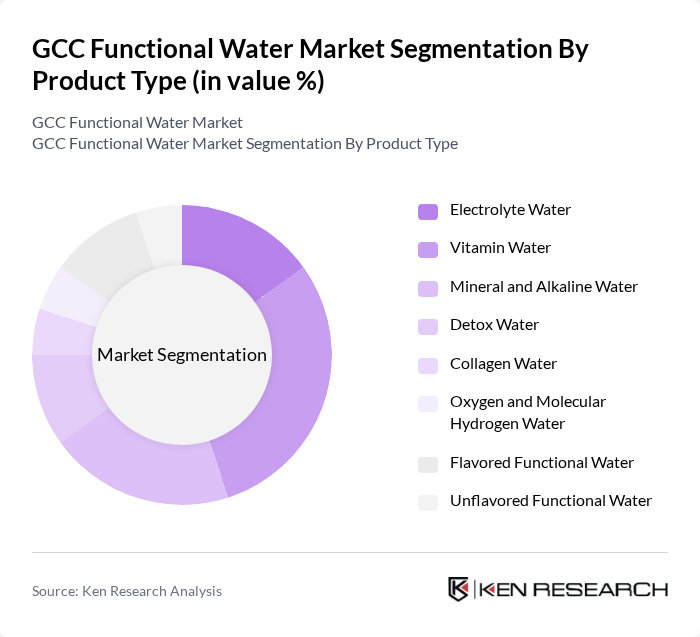
By Product Type:The product type segmentation includes various categories such as Electrolyte Water, Vitamin Water, Mineral and Alkaline Water, Detox Water, Collagen Water, Oxygen and Molecular Hydrogen Water, Flavored Functional Water, and Unflavored Functional Water. Among these, Vitamin Water has emerged as a leading sub-segment due to its appeal to health-conscious consumers seeking added nutritional benefits. The trend towards personalized nutrition and functional beverages has significantly boosted the demand for Vitamin Water, making it a preferred choice in the GCC region.
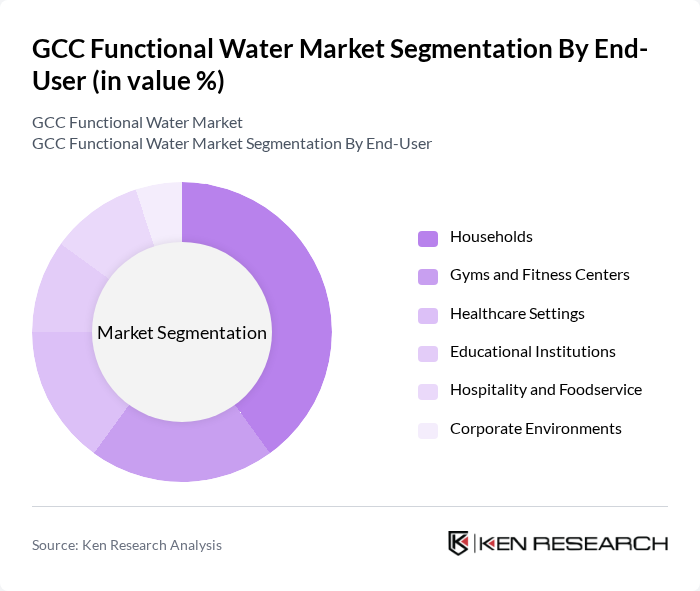
By End-User:The end-user segmentation encompasses various categories including Households, Gyms and Fitness Centers, Healthcare Settings, Educational Institutions, Hospitality and Foodservice, and Corporate Environments. Households represent the largest segment, driven by the increasing trend of health and wellness among families. The growing awareness of hydration's importance and the convenience of functional water products have made them a staple in many households across the GCC region.
GCC Functional Water Market Competitive Landscape
The GCC Functional Water Market is characterized by a dynamic mix of regional and international players. Leading participants such as Nestlé Waters, PepsiCo (Aquafina, Tropicana), The Coca-Cola Company (Smartwater, Dasani), Danone (Evian, Volvic), Suntory Beverage & Food, Masafi (GCC-based), Nova Water (GCC-based), Essentia Water, Hint Water, Core Hydration, Fiji Water, Voss Water, LaCroix, Al Ain Water (GCC-based), Oasis Water (GCC-based) contribute to innovation, geographic expansion, and service delivery in this space.
GCC Functional Water Market Industry Analysis
Growth Drivers
- Increasing Health Consciousness:The GCC region has witnessed a significant rise in health consciousness, with 65% of consumers actively seeking healthier beverage options. This trend is supported by a report from the World Health Organization, indicating that 75% of the population is prioritizing wellness. As a result, functional water, which offers hydration along with health benefits, is increasingly favored, driving market growth. The demand for low-calorie, nutrient-rich beverages is expected to continue rising, further boosting this segment.
- Rising Demand for Functional Beverages:The functional beverage market in the GCC is projected to reach $1.8 billion in the future, with functional water comprising a significant share. This growth is fueled by a shift in consumer preferences towards beverages that provide health benefits, such as enhanced hydration and added vitamins. According to Euromonitor International, the functional beverage sector is growing at a rate of 9% annually, indicating a robust demand for innovative products that cater to health-oriented consumers in the region.
- Expansion of Distribution Channels:The GCC functional water market is benefiting from the expansion of distribution channels, particularly through e-commerce. In future, online sales are expected to account for 30% of total beverage sales in the region, as reported by Statista. This shift allows brands to reach a broader audience, including health-conscious consumers who prefer the convenience of online shopping. Additionally, partnerships with retail chains are enhancing product availability, further driving market penetration and consumer access to functional water products.
Market Challenges
- High Competition:The GCC functional water market is characterized by intense competition, with over 55 brands vying for market share. This saturation leads to price wars and reduced profit margins, making it challenging for new entrants to establish themselves. According to a market analysis by Mordor Intelligence, the top five brands control 45% of the market, indicating a significant barrier for smaller companies. This competitive landscape necessitates innovative marketing strategies and product differentiation to succeed.
- Regulatory Compliance Issues:Navigating regulatory compliance poses a significant challenge for functional water brands in the GCC. The region's stringent food safety and labeling regulations require companies to invest in quality control and legal expertise. In future, the cost of compliance is estimated to reach $250,000 for mid-sized companies, according to the Gulf Cooperation Council's regulatory body. Failure to meet these standards can result in product recalls and reputational damage, hindering market growth and brand trust.
GCC Functional Water Market Future Outlook
The GCC functional water market is poised for continued growth, driven by evolving consumer preferences towards health and wellness. As more consumers prioritize hydration and functional benefits, brands are likely to innovate with new flavors and formulations. Additionally, the increasing integration of technology in marketing and distribution will enhance consumer engagement. Companies that adapt to these trends and invest in sustainable practices will likely capture a larger market share, positioning themselves favorably in the competitive landscape of functional beverages.
Market Opportunities
- Growth in E-commerce Platforms:The rise of e-commerce presents a significant opportunity for functional water brands. With online sales projected to grow by 30% in future, companies can leverage digital marketing strategies to reach health-conscious consumers. This shift allows brands to offer personalized shopping experiences, enhancing customer loyalty and expanding their market reach effectively.
- Introduction of Eco-friendly Packaging:As sustainability becomes a priority for consumers, the introduction of eco-friendly packaging can differentiate brands in the GCC market. Companies adopting biodegradable or recyclable materials are likely to attract environmentally conscious consumers. This trend aligns with the growing demand for sustainable products, potentially increasing market share and brand loyalty among eco-aware customers.
Scope of the Report
| Segment | Sub-Segments |
|---|---|
| By Product Type | Electrolyte Water Vitamin Water Mineral and Alkaline Water Detox Water Collagen Water Oxygen and Molecular Hydrogen Water Flavored Functional Water Unflavored Functional Water |
| By End-User | Households Gyms and Fitness Centers Healthcare Settings Educational Institutions Hospitality and Foodservice Corporate Environments |
| By Distribution Channel | Supermarkets and Hypermarkets Specialty and Fitness Outlets E-commerce Platforms Convenience Stores Direct Procurement Home and Office Delivery |
| By Packaging Type | PET Bottles Cans Tetra Packs Pouches Glass Bottles |
| By Pack Size | Single Serve (250-500ml) Standard (500-750ml) Family Pack (1-2L) Bulk/Institutional (5L+) |
| By Region | Saudi Arabia United Arab Emirates Kuwait Qatar Oman Bahrain |
| By Consumer Demographics | Age Group (18-24, 25-34, 35-44, 45+) Gender Income Level (Low, Middle, High) Lifestyle Preferences (Active, Health-Conscious, Premium) |
Key Target Audience
Investors and Venture Capitalist Firms
Government and Regulatory Bodies (e.g., Ministry of Environment and Water, GCC Standardization Organization)
Manufacturers and Producers
Distributors and Retailers
Water Utility Companies
Technology Providers
Industry Associations
Financial Institutions
Players Mentioned in the Report:
Nestle Waters
PepsiCo (Aquafina, Tropicana)
The Coca-Cola Company (Smartwater, Dasani)
Danone (Evian, Volvic)
Suntory Beverage & Food
Masafi (GCC-based)
Nova Water (GCC-based)
Essentia Water
Hint Water
Core Hydration
Fiji Water
Voss Water
LaCroix
Al Ain Water (GCC-based)
Oasis Water (GCC-based)
Table of Contents
Market Assessment Phase
1. Executive Summary and Approach
2. GCC Functional Water Market Overview
2.1 Key Insights and Strategic Recommendations
2.2 GCC Functional Water Market Overview
2.3 Definition and Scope
2.4 Evolution of Market Ecosystem
2.5 Timeline of Key Regulatory Milestones
2.6 Value Chain & Stakeholder Mapping
2.7 Business Cycle Analysis
2.8 Policy & Incentive Landscape
3. GCC Functional Water Market Analysis
3.1 Growth Drivers
3.1.1 Increasing Health Consciousness
3.1.2 Rising Demand for Functional Beverages
3.1.3 Innovative Product Development
3.1.4 Expansion of Distribution Channels
3.2 Market Challenges
3.2.1 High Competition
3.2.2 Regulatory Compliance Issues
3.2.3 Consumer Awareness and Education
3.2.4 Price Sensitivity Among Consumers
3.3 Market Opportunities
3.3.1 Growth in E-commerce Platforms
3.3.2 Collaborations with Health Institutions
3.3.3 Introduction of Eco-friendly Packaging
3.3.4 Expansion into Untapped Markets
3.4 Market Trends
3.4.1 Shift Towards Natural Ingredients
3.4.2 Increased Focus on Sustainability
3.4.3 Customization of Functional Water Products
3.4.4 Growth of Online Marketing Strategies
3.5 Government Regulation
3.5.1 Labeling and Health Claims Regulations
3.5.2 Quality Control Standards
3.5.3 Import and Export Regulations
3.5.4 Environmental Regulations on Packaging
4. SWOT Analysis
5. Stakeholder Analysis
6. Porter's Five Forces Analysis
7. GCC Functional Water Market Market Size, 2019-2024
7.1 By Value
7.2 By Volume
7.3 By Average Selling Price
8. GCC Functional Water Market Segmentation
8.1 By Product Type
8.1.1 Electrolyte Water
8.1.2 Vitamin Water
8.1.3 Mineral and Alkaline Water
8.1.4 Detox Water
8.1.5 Collagen Water
8.1.6 Oxygen and Molecular Hydrogen Water
8.1.7 Flavored Functional Water
8.1.8 Unflavored Functional Water
8.2 By End-User
8.2.1 Households
8.2.2 Gyms and Fitness Centers
8.2.3 Healthcare Settings
8.2.4 Educational Institutions
8.2.5 Hospitality and Foodservice
8.2.6 Corporate Environments
8.3 By Distribution Channel
8.3.1 Supermarkets and Hypermarkets
8.3.2 Specialty and Fitness Outlets
8.3.3 E-commerce Platforms
8.3.4 Convenience Stores
8.3.5 Direct Procurement
8.3.6 Home and Office Delivery
8.4 By Packaging Type
8.4.1 PET Bottles
8.4.2 Cans
8.4.3 Tetra Packs
8.4.4 Pouches
8.4.5 Glass Bottles
8.5 By Pack Size
8.5.1 Single Serve (250-500ml)
8.5.2 Standard (500-750ml)
8.5.3 Family Pack (1-2L)
8.5.4 Bulk/Institutional (5L+)
8.6 By Region
8.6.1 Saudi Arabia
8.6.2 United Arab Emirates
8.6.3 Kuwait
8.6.4 Qatar
8.6.5 Oman
8.6.6 Bahrain
8.7 By Consumer Demographics
8.7.1 Age Group (18-24, 25-34, 35-44, 45+)
8.7.2 Gender
8.7.3 Income Level (Low, Middle, High)
8.7.4 Lifestyle Preferences (Active, Health-Conscious, Premium)
9. GCC Functional Water Market Competitive Analysis
9.1 Market Share of Key Players
9.2 Cross Comparison of Key Players
9.2.1 Company Name
9.2.2 Company Size Classification (Large, Medium, Small)
9.2.3 Year-over-Year Revenue Growth Rate (%)
9.2.4 Market Share in GCC Region (%)
9.2.5 Geographic Presence (Number of GCC Countries)
9.2.6 Product Portfolio Breadth (Number of Functional Water Variants)
9.2.7 Distribution Channel Coverage (Retail, E-commerce, Direct)
9.2.8 Brand Recognition Score (1-10 Scale)
9.2.9 Average Retail Price Point (Premium/Mid-Range/Budget)
9.2.10 Sustainability Certifications and Eco-Friendly Initiatives
9.3 SWOT Analysis of Top Players
9.4 Pricing Analysis
9.5 Detailed Profile of Major Companies
9.5.1 Nestlé Waters
9.5.2 PepsiCo (Aquafina, Tropicana)
9.5.3 The Coca-Cola Company (Smartwater, Dasani)
9.5.4 Danone (Evian, Volvic)
9.5.5 Suntory Beverage & Food
9.5.6 Masafi (GCC-based)
9.5.7 Nova Water (GCC-based)
9.5.8 Essentia Water
9.5.9 Hint Water
9.5.10 Core Hydration
9.5.11 Fiji Water
9.5.12 Voss Water
9.5.13 LaCroix
9.5.14 Al Ain Water (GCC-based)
9.5.15 Oasis Water (GCC-based)
10. GCC Functional Water Market End-User Analysis
10.1 Procurement Behavior of Key Ministries
10.1.1 Government Health Initiatives
10.1.2 Budget Allocations for Wellness Programs
10.1.3 Partnerships with Health Organizations
10.1.4 Procurement Policies for Functional Beverages
10.2 Corporate Spend on Infrastructure & Energy
10.2.1 Investment in Health and Wellness Programs
10.2.2 Budget for Employee Wellness Initiatives
10.2.3 Expenditure on Sustainable Products
10.2.4 Corporate Social Responsibility Spending
10.3 Pain Point Analysis by End-User Category
10.3.1 Health Concerns
10.3.2 Accessibility Issues
10.3.3 Price Sensitivity
10.3.4 Quality Assurance
10.4 User Readiness for Adoption
10.4.1 Awareness of Functional Benefits
10.4.2 Willingness to Pay for Quality
10.4.3 Availability of Products
10.4.4 Brand Loyalty
10.5 Post-Deployment ROI and Use Case Expansion
10.5.1 Measurement of Health Outcomes
10.5.2 Consumer Feedback Mechanisms
10.5.3 Expansion into New Markets
10.5.4 Long-term Customer Engagement Strategies
11. GCC Functional Water Market Future Size, 2025-2030
11.1 By Value
11.2 By Volume
11.3 By Average Selling Price
Go-To-Market Strategy Phase
1. Whitespace Analysis + Business Model Canvas
1.1 Market Gaps Identification
1.2 Business Model Framework
2. Marketing and Positioning Recommendations
2.1 Branding Strategies
2.2 Product USPs
3. Distribution Plan
3.1 Urban Retail vs Rural NGO Tie-ups
4. Channel & Pricing Gaps
4.1 Underserved Routes
4.2 Pricing Bands
5. Unmet Demand & Latent Needs
5.1 Category Gaps
5.2 Consumer Segments
6. Customer Relationship
6.1 Loyalty Programs
6.2 After-sales Service
7. Value Proposition
7.1 Sustainability
7.2 Integrated Supply Chains
8. Key Activities
8.1 Regulatory Compliance
8.2 Branding
8.3 Distribution Setup
9. Entry Strategy Evaluation
9.1 Domestic Market Entry Strategy
9.1.1 Product Mix
9.1.2 Pricing Band
9.1.3 Packaging
9.2 Export Entry Strategy
9.2.1 Target Countries
9.2.2 Compliance Roadmap
10. Entry Mode Assessment
10.1 JV
10.2 Greenfield
10.3 M&A
10.4 Distributor Model
11. Capital and Timeline Estimation
11.1 Capital Requirements
11.2 Timelines
12. Control vs Risk Trade-Off
12.1 Ownership vs Partnerships
13. Profitability Outlook
13.1 Breakeven Analysis
13.2 Long-term Sustainability
14. Potential Partner List
14.1 Distributors
14.2 JVs
14.3 Acquisition Targets
15. Execution Roadmap
Research Methodology
Phase 1: Approach1
Desk Research
- Analysis of market reports from GCC water authorities and environmental agencies
- Review of academic publications on functional water applications and technologies
- Examination of industry white papers and case studies from leading water technology firms
Primary Research
- Interviews with water resource managers in GCC municipalities
- Surveys with manufacturers of functional water products and technologies
- Field interviews with end-users in sectors such as agriculture and healthcare
Validation & Triangulation
- Cross-validation of findings through multiple data sources including government and industry reports
- Triangulation of qualitative insights from interviews with quantitative data from surveys
- Sanity checks conducted through expert panel reviews and feedback sessions
Phase 2: Market Size Estimation1
Top-down Assessment
- Estimation of market size based on national water consumption statistics and trends
- Segmentation by application areas such as agriculture, industrial, and residential use
- Incorporation of government initiatives promoting sustainable water usage
Bottom-up Modeling
- Volume estimates derived from sales data of functional water products
- Cost analysis based on pricing models of leading suppliers in the GCC region
- Calculation of market size using volume x price methodology for each segment
Forecasting & Scenario Analysis
- Multi-variable regression analysis incorporating population growth and urbanization rates
- Scenario modeling based on potential regulatory changes and technological advancements
- Development of baseline, optimistic, and pessimistic forecasts through 2030
Phase 3: CATI Sample Composition1
| Scope Item/Segment | Sample Size | Target Respondent Profiles |
|---|---|---|
| Agricultural Water Management | 120 | Agronomists, Farm Managers |
| Industrial Water Treatment Solutions | 100 | Plant Managers, Environmental Compliance Officers |
| Residential Functional Water Products | 90 | Homeowners, Facility Managers |
| Healthcare Water Purification Systems | 80 | Healthcare Administrators, Facility Engineers |
| Water Quality Monitoring Technologies | 110 | Environmental Scientists, Quality Control Managers |
Frequently Asked Questions
What is the current value of the GCC Functional Water Market?
The GCC Functional Water Market is valued at approximately USD 1.2 billion, reflecting a significant growth trend driven by increasing health consciousness, rising disposable incomes, and a shift towards functional beverages that offer health benefits beyond mere hydration.
Which countries dominate the GCC Functional Water Market?
What are the main product types in the GCC Functional Water Market?
What are the primary end-user segments for functional water in the GCC?
Other Regional/Country Reports
Indonesia Functional Water Market
Malaysia Functional Water Market
APAC Functional Water Market
Other Adjacent Reports
Mexico Vitamin Beverages Market
Germany Alkaline Water Market
Egypt Electrolyte Beverages Market
Indonesia Flavored Water Market Size, Share & Forecast, By Product Type, Packaging Format & Distribution Channel, 2026-2031Singapore Detox Beverages Market
Saudi Arabia Energy Drinks Market Size, Share & Forecast, By Product Type, Price Tier & Distribution Channel, 2025-2032Mexico Herbal Infusions Market
Kuwait Probiotic Drinks Market
Why Buy From Us?

What makes us stand out is that our consultants follow Robust, Refine and Result (RRR) methodology. Robust for clear definitions, approaches and sanity checking, Refine for differentiating respondents' facts and opinions, and Result for presenting data with story.

We have set a benchmark in the industry by offering our clients with syndicated and customized market research reports featuring coverage of entire market as well as meticulous research and analyst insights.

While we don't replace traditional research, we flip the method upside down. Our dual approach of Top Bottom & Bottom Top ensures quality deliverable by not just verifying company fundamentals but also looking at the sector and macroeconomic factors.

With one step in the future, our research team constantly tries to show you the bigger picture. We help with some of the tough questions you may encounter along the way: How is the industry positioned? Best marketing channel? KPI's of competitors? By aligning every element, we help maximize success.

Our report gives you instant access to the answers and sources that other companies might choose to hide. We elaborate each steps of research methodology we have used and showcase you the sample size to earn your trust.

If you need any support, we are here! We pride ourselves on universe strength, data quality, and quick, friendly, and professional service.