About the Report
Base Year 2025GCC Gold Market Overview
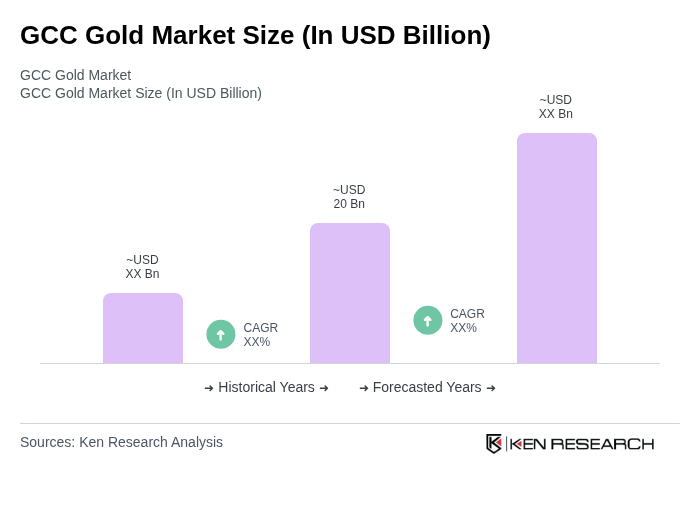
- The GCC Gold Market is valued at approximately USD 20 billion, based on a five-year historical analysis of jewelry, bullion, coins, and investment-grade products across the region.This growth is primarily driven by the region's cultural affinity for gold, increasing consumer demand for jewelry, and the rising trend of gold as a safe-haven investment during economic uncertainties.The market has seen a steady influx of investments, particularly in gold-backed financial products and organized bullion trade, including exchange-traded products and digital gold platforms, which have further bolstered its size.
- The United Arab Emirates, particularly Dubai, stands out as a dominant player in the GCC Gold Market due to its strategic location as a trading hub, tax-efficient environment for bullion, and a well-established retail and refining sector.Between 13% and 15% of gold traded globally passes through Dubai every year, underscoring its role as a leading physical gold hub.Saudi Arabia also plays a significant role, driven by its large population, strong bridal and ceremonial demand for gold jewelry, and expanding mining and retail infrastructure supported by Vision 2030 initiatives.Other countries like Qatar and Kuwait contribute to the market through their affluent populations, growing luxury retail ecosystems, and sustained demand for high-end gold jewelry and investment-grade bullion.
- In 2023, GCC governments strengthened regulations to enhance transparency in gold trading, mandating stricter documentation, hallmarking, and traceability for gold products sold in the region.For example, in the United Arab Emirates, the Responsible Sourcing of Gold and Precious Metals Policy issued by the Dubai Multi Commodities Centre (DMCC) and the federal Anti-Money Laundering and Combating the Financing of Terrorism framework require gold refiners and traders to implement due diligence, maintain transaction records, and ensure that gold is accompanied by verifiable certificates and conformity documentation to protect consumers and uphold product integrity.These measures aim to ensure the quality and authenticity of gold products, foster trust in the market, and encourage more institutional and retail investments in gold.
GCC Gold Market Segmentation
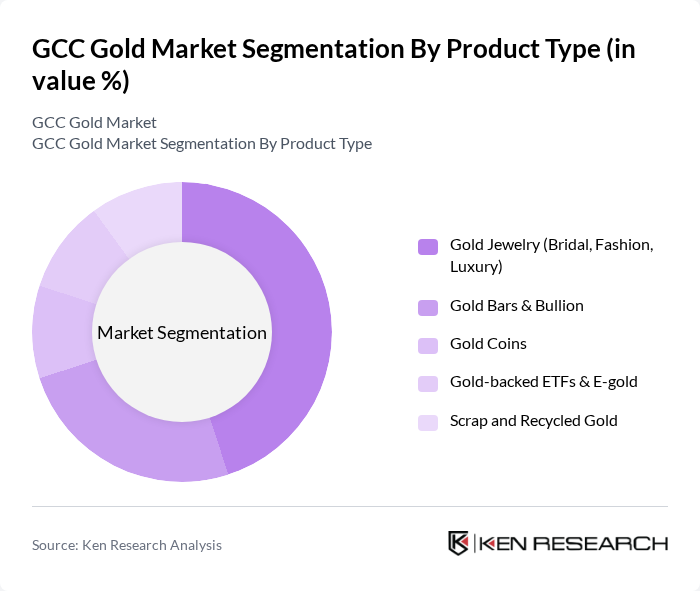
By Product Type:The product type segmentation of the GCC Gold Market includes various categories such as Gold Jewelry (Bridal, Fashion, Luxury), Gold Bars & Bullion, Gold Coins, Gold-backed ETFs & E-gold, and Scrap and Recycled Gold. Gold Jewelry, particularly bridal and luxury segments, remains the structural backbone of the market due to deep-rooted cultural significance, dowry and wedding customs, and consumer preferences for gold as both adornment and a store of value. The growing prominence of branded and organized retail chains, alongside designs that blend traditional motifs with contemporary styles, continues to support the dominance of jewelry within GCC gold consumption.
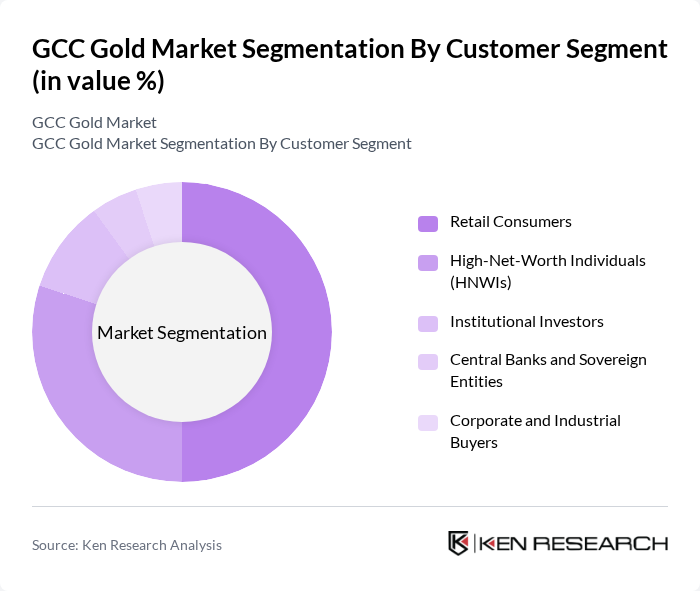
By Customer Segment:The customer segment of the GCC Gold Market includes Retail Consumers, High-Net-Worth Individuals (HNWIs), Institutional Investors, Central Banks and Sovereign Entities, and Corporate and Industrial Buyers. Retail Consumers and HNWIs are the leading segments, driven by cultural practices, rising disposable incomes, and the growing trend of gold as an investment vehicle among affluent individuals and expatriate communities. At the same time, institutional investors and sovereign entities are increasingly using gold-backed products and physical bullion for portfolio diversification and reserve management, reinforcing the investment profile of gold in the region.
GCC Gold Market Competitive Landscape
The GCC Gold Market is characterized by a dynamic mix of regional and international players. Leading participants such as Al Etihad Gold DMCC, Emirates Gold DMCC, Al Ghaith Gold, Malabar Gold & Diamonds, Damas Jewellery, Joyalukkas Jewellers, Pure Gold Jewellers, Kalyan Jewellers, Tanishq (Titan Company), Ta??mac?l?k (Representative Trading & Logistics Entities), Senco Gold & Diamonds, Riddhi Siddhi Bullion Ltd., PAMP / MKS PAMP, Rand Refinery, APMEX (American Precious Metals Exchange) contribute to innovation, geographic expansion, and service delivery in this space.
GCC Gold Market Industry Analysis
Growth Drivers
- Increasing Consumer Demand for Gold Jewelry:The GCC region has witnessed a significant rise in consumer demand for gold jewelry, with the market valued at approximately USD 17 billion in future.This growth is driven by cultural factors, as gold jewelry is often associated with weddings and celebrations. Additionally, the region's population is projected to reach around 60 million in future, further boosting demand.The World Gold Council reported an increase in gold jewelry consumption in the Middle East region, highlighting the robust market potential.
- Rising Investment in Gold as a Safe-Haven Asset:In future, gold investments in the GCC are described as having surged to USD 5 billion, reflecting a growing trend among investors seeking stability amid economic uncertainties.The geopolitical tensions and inflationary pressures have led to an increase in gold purchases as a hedge against market volatility.According to the IMF, economic growth in the GCC region is expected to remain moderate but positive in future, further encouraging investment in gold as a secure asset class.
- Expansion of E-commerce Platforms for Gold Sales:The rise of e-commerce has transformed gold sales in the GCC, with online transactions described as accounting for 30 percent of total gold sales in future.Major platforms like Souq and Noon have reported an increase in gold sales through their websites.The digital shift is supported by high internet penetration in the region, which is among the highest globally, facilitating easier access to gold purchasing for consumers.
Market Challenges
- Fluctuating Gold Prices:The GCC gold market faces challenges due to fluctuating gold prices, which have seen international benchmark prices move within a broad range in recent periods. This unpredictability can deter consumers and investors, leading to a decline in sales. The World Bank indicates that gold prices may remain volatile in future, influenced by global economic conditions and central bank policies, impacting consumer confidence and spending in the region.
- Regulatory Compliance Complexities:The gold market in the GCC is hindered by complex regulatory compliance requirements. These regulations can create barriers for new entrants and small businesses, limiting market competition. The compliance costs can stifle innovation and growth. The need for streamlined regulations is critical for fostering a more dynamic market environment.
GCC Gold Market Future Outlook
The GCC gold market is poised for significant transformation, driven by technological advancements and evolving consumer preferences. The increasing shift towards digital platforms for gold trading is expected to enhance accessibility and convenience for consumers. Additionally, the growing awareness of gold as a hedge against inflation will likely sustain investment interest.As the region's economies stabilize, the demand for gold jewelry and investment is anticipated to remain robust, fostering a resilient market landscape in future.
Market Opportunities
- Growth in Gold-Backed Financial Products:The introduction of gold-backed financial products, such as ETFs and mutual funds, presents a lucrative opportunity in the GCC. With a market size noted as USD 2 billion in future, these products cater to investors seeking exposure to gold without physical ownership, appealing to a broader audience and enhancing market liquidity.
- Increasing Popularity of Gold Investment Schemes:Gold investment schemes are gaining traction, with participation described as increasing by 30 percent in future.These schemes offer consumers a structured way to invest in gold, often with lower entry costs. As financial literacy improves, more individuals are likely to engage in these schemes, further driving demand and market growth in the GCC.
Scope of the Report
| Segment | Sub-Segments |
|---|---|
| By Product Type | Gold Jewelry Gold Bars & Bullion Gold Coins Gold-backed ETFs & E-gold Scrap and Recycled Gold |
| By Customer Segment | Retail Consumers High-Net-Worth Individuals Institutional Investors Central Banks and Sovereign Entities Corporate and Industrial Buyers |
| By Country | United Arab Emirates Kingdom of Saudi Arabia Qatar Kuwait Oman Bahrain |
| By Use Case | Investment and Wealth Preservation Jewelry Manufacturing and Retail Industrial and Technology Applications Religious, Cultural, and Gift Purposes |
| By Sales Channel | Traditional Gold Souks Organized Retail Chains Banks and Financial Institutions Online and Digital Platforms Wholesale and B2B Trade |
| By Price Band | Mass Market Premium Luxury Ultra-luxury |
| By Carat and Purity | 22K and 21K Jewelry 18K and Below Jewelry 24K Investment-grade Gold |
Key Target Audience
Investors and Venture Capitalist Firms
Government and Regulatory Bodies
Gold Mining Companies
Jewelry Manufacturers and Retailers
Precious Metals Traders
Commodity Exchanges
Wealth Management Firms
Importers and Exporters of Gold
Players Mentioned in the Report:
Al Etihad Gold DMCC
Emirates Gold DMCC
Al Ghaith Gold
Malabar Gold & Diamonds
Damas Jewellery
Joyalukkas Jewellers
Pure Gold Jewellers
Kalyan Jewellers
Tanishq (Titan Company)
Tasmaclk (Representative Trading & Logistics Entities)
Table of Contents
Market Assessment Phase
1. Executive Summary and Approach
2. GCC Gold Market Overview
2.1 Key Insights and Strategic Recommendations
2.2 GCC Gold Market Overview
2.3 Definition and Scope
2.4 Evolution of Market Ecosystem
2.5 Timeline of Key Regulatory Milestones
2.6 Value Chain & Stakeholder Mapping
2.7 Business Cycle Analysis
2.8 Policy & Incentive Landscape
3. GCC Gold Market Analysis
3.1 Growth Drivers
3.1.1 Increasing consumer demand for gold jewelry
3.1.2 Rising investment in gold as a safe-haven asset
3.1.3 Expansion of e-commerce platforms for gold sales
3.1.4 Government initiatives to promote gold trading
3.2 Market Challenges
3.2.1 Fluctuating gold prices
3.2.2 Regulatory compliance complexities
3.2.3 Competition from alternative investment options
3.2.4 Economic instability affecting consumer spending
3.3 Market Opportunities
3.3.1 Growth in gold-backed financial products
3.3.2 Increasing popularity of gold investment schemes
3.3.3 Technological advancements in gold trading
3.3.4 Expansion into untapped markets within the GCC
3.4 Market Trends
3.4.1 Shift towards sustainable and ethical gold sourcing
3.4.2 Rise of digital gold trading platforms
3.4.3 Increasing customization in gold jewelry
3.4.4 Growing awareness of gold as a hedge against inflation
3.5 Government Regulation
3.5.1 Import/export regulations on gold
3.5.2 Taxation policies affecting gold transactions
3.5.3 Consumer protection laws in gold trading
3.5.4 Licensing requirements for gold dealers
4. SWOT Analysis
5. Stakeholder Analysis
6. Porter's Five Forces Analysis
7. GCC Gold Market Market Size, 2019-2024
7.1 By Value
7.2 By Volume
7.3 By Average Selling Price
8. GCC Gold Market Segmentation
8.1 By Product Type
8.1.1 Gold Jewelry (Bridal, Fashion, Luxury)
8.1.2 Gold Bars & Bullion
8.1.3 Gold Coins
8.1.4 Gold-backed ETFs & E-gold
8.1.5 Scrap and Recycled Gold
8.2 By Customer Segment
8.2.1 Retail Consumers
8.2.2 High-Net-Worth Individuals (HNWIs)
8.2.3 Institutional Investors
8.2.4 Central Banks and Sovereign Entities
8.2.5 Corporate and Industrial Buyers
8.3 By Country
8.3.1 United Arab Emirates
8.3.2 Kingdom of Saudi Arabia
8.3.3 Qatar
8.3.4 Kuwait
8.3.5 Oman
8.3.6 Bahrain
8.4 By Use Case
8.4.1 Investment and Wealth Preservation
8.4.2 Jewelry Manufacturing and Retail
8.4.3 Industrial and Technology Applications
8.4.4 Religious, Cultural, and Gift Purposes
8.5 By Sales Channel
8.5.1 Traditional Gold Souks
8.5.2 Organized Retail Chains
8.5.3 Banks and Financial Institutions
8.5.4 Online and Digital Platforms
8.5.5 Wholesale and B2B Trade
8.6 By Price Band
8.6.1 Mass Market
8.6.2 Premium
8.6.3 Luxury
8.6.4 Ultra-luxury
8.7 By Carat and Purity
8.7.1 22K and 21K Jewelry
8.7.2 18K and Below Jewelry
8.7.3 24K Investment-grade Gold
9. GCC Gold Market Competitive Analysis
9.1 Market Share of Key Players
9.2 Cross Comparison of Key Players
9.2.1 Company Name
9.2.2 Market Share (%)
9.2.3 Total Revenues (USD Million)
9.2.4 Revenue Growth Rate (CAGR, %)
9.2.5 EBITDA Margin (%)
9.2.6 Return on Invested Capital (ROIC, %)
9.2.7 Average Realised Gold Price vs Benchmark (%)
9.2.8 Retail Network Size (Number of Outlets)
9.2.9 Share of Digital / Online Sales (%)
9.2.10 Average Ticket Size per Customer (USD)
9.2.11 Customer Lifetime Value (CLV, USD)
9.2.12 Inventory Turnover Ratio
9.2.13 Working Capital Cycle (Days)
9.2.14 CAPEX Intensity (% of Revenue)
9.2.15 ESG and Compliance Score (Internal Index)
9.3 SWOT Analysis of Top Players
9.4 Pricing Analysis
9.5 Detailed Profile of Major Companies
9.5.1 Al Etihad Gold DMCC
9.5.2 Emirates Gold DMCC
9.5.3 Al Ghaith Gold
9.5.4 Malabar Gold & Diamonds
9.5.5 Damas Jewellery
9.5.6 Joyalukkas Jewellers
9.5.7 Pure Gold Jewellers
9.5.8 Kalyan Jewellers
9.5.9 Tanishq (Titan Company)
9.5.10 Ta??mac?l?k (Representative Trading & Logistics Entities)
9.5.11 Senco Gold & Diamonds
9.5.12 Riddhi Siddhi Bullion Ltd.
9.5.13 PAMP / MKS PAMP
9.5.14 Rand Refinery
9.5.15 APMEX (American Precious Metals Exchange)
10. GCC Gold Market End-User Analysis
10.1 Procurement Behavior of Key Ministries
10.1.1 Government procurement policies
10.1.2 Budget allocation for gold purchases
10.1.3 Supplier selection criteria
10.1.4 Compliance with regulatory standards
10.2 Corporate Spend on Infrastructure & Energy
10.2.1 Investment in gold-related infrastructure
10.2.2 Corporate gold purchasing trends
10.2.3 Impact of economic conditions on spending
10.2.4 Strategic partnerships for gold sourcing
10.3 Pain Point Analysis by End-User Category
10.3.1 Challenges faced by individual consumers
10.3.2 Issues for retailers in gold supply
10.3.3 Investment concerns for financial institutions
10.3.4 Regulatory hurdles for businesses
10.4 User Readiness for Adoption
10.4.1 Awareness of gold investment options
10.4.2 Readiness to adopt digital trading platforms
10.4.3 Acceptance of gold-backed financial products
10.4.4 Training needs for end-users
10.5 Post-Deployment ROI and Use Case Expansion
10.5.1 Measurement of ROI in gold investments
10.5.2 Case studies of successful gold investments
10.5.3 Expansion opportunities in gold trading
10.5.4 Long-term benefits of gold ownership
11. GCC Gold Market Future Size, 2025-2030
11.1 By Value
11.2 By Volume
11.3 By Average Selling Price
Go-To-Market Strategy Phase
1. Whitespace Analysis + Business Model Canvas
1.1 Market gaps and opportunities
1.2 Business model components
2. Marketing and Positioning Recommendations
2.1 Branding strategies
2.2 Product USPs
3. Distribution Plan
3.1 Urban retail vs rural NGO tie-ups
4. Channel & Pricing Gaps
4.1 Underserved routes
4.2 Pricing bands
5. Unmet Demand & Latent Needs
5.1 Category gaps
5.2 Consumer segments
6. Customer Relationship
6.1 Loyalty programs
6.2 After-sales service
7. Value Proposition
7.1 Sustainability
7.2 Integrated supply chains
8. Key Activities
8.1 Regulatory compliance
8.2 Branding
8.3 Distribution setup
9. Entry Strategy Evaluation
9.1 Domestic Market Entry Strategy
9.1.1 Product mix
9.1.2 Pricing band
9.1.3 Packaging
9.2 Export Entry Strategy
9.2.1 Target countries
9.2.2 Compliance roadmap
10. Entry Mode Assessment
10.1 JV
10.2 Greenfield
10.3 M&A
10.4 Distributor Model
11. Capital and Timeline Estimation
11.1 Capital requirements
11.2 Timelines
12. Control vs Risk Trade-Off
12.1 Ownership vs Partnerships
13. Profitability Outlook
13.1 Breakeven analysis
13.2 Long-term sustainability
14. Potential Partner List
14.1 Distributors
14.2 JVs
14.3 Acquisition targets
15. Execution Roadmap
15.1 Phased Plan for Market Entry
15.1.1 Market Setup
15.1.2 Market Entry
15.1.3 Growth Acceleration
15.1.4 Scale & Stabilize
15.2 Key Activities and Milestones
15.2.1 Milestone tracking
15.2.2 Activity scheduling
Research Methodology
Phase 1: Approach1
Desk Research
- Analysis of trade statistics from the Gulf Cooperation Council (GCC) gold trade reports
- Review of market reports from industry associations and financial institutions
- Examination of regulatory frameworks and policies affecting gold trading in GCC countries
Primary Research
- Interviews with gold traders and jewelers across major GCC markets
- Surveys targeting financial analysts specializing in precious metals
- Field interviews with representatives from gold mining companies operating in the region
Validation & Triangulation
- Cross-validation of findings through multiple data sources, including trade volumes and pricing trends
- Triangulation of insights from primary interviews with secondary data from market reports
- Sanity checks conducted through expert panel discussions with industry veterans
Phase 2: Market Size Estimation1
Top-down Assessment
- Estimation of total gold demand in the GCC based on historical consumption patterns
- Segmentation of market size by end-user categories such as jewelry, investment, and industrial use
- Incorporation of macroeconomic indicators such as GDP growth and consumer spending trends
Bottom-up Modeling
- Collection of sales data from leading gold retailers and wholesalers in the GCC
- Estimation of average transaction values and frequency of purchases across different segments
- Volume x price analysis to derive revenue estimates for each market segment
Forecasting & Scenario Analysis
- Multi-factor regression analysis incorporating gold price fluctuations and economic indicators
- Scenario modeling based on potential regulatory changes and shifts in consumer preferences
- Development of baseline, optimistic, and pessimistic forecasts through 2030
Phase 3: CATI Sample Composition1
| Scope Item/Segment | Sample Size | Target Respondent Profiles |
|---|---|---|
| Jewelry Retail Sector | 60 | Store Managers, Sales Executives |
| Gold Investment Firms | 50 | Investment Advisors, Portfolio Managers |
| Gold Mining Companies | 40 | Operations Managers, Financial Analysts |
| Wholesale Gold Traders | 45 | Trade Executives, Supply Chain Managers |
| Regulatory Bodies | 40 | Policy Makers, Compliance Officers |
Frequently Asked Questions
What is the current value of the GCC Gold Market?
The GCC Gold Market is valued at approximately USD 20 billion, driven by cultural affinity for gold, increasing consumer demand for jewelry, and the trend of gold as a safe-haven investment during economic uncertainties.
Which country is the largest player in the GCC Gold Market?
What factors are driving growth in the GCC Gold Market?
How have regulations changed in the GCC Gold Market in 2023?
Other Regional/Country Reports
Indonesia Gold Market
Malaysia Gold Market
APAC Gold Market
Other Adjacent Reports
Vietnam Precious Metals Investment Market
UAE E-commerce Retail Market
Philippines Bullion Trading Market
KSA Financial Services Market Size, Share & Forecast, By Product Type, Customer Segment & Distribution Channel, 2026-2031Philippines Consumer Electronics Market Size, Share & Forecast, By Product Type, Price Tier & Distribution Channel, 2025–2032Italy Luxury Goods Market Size, Share & Forecast, By Product Category, Price Tier & Distribution Channel, 2026–2032Bahrain digital payment solutions market size, share, growth drivers, trends, opportunities & forecast 2025–2030Qatar Investment Fund Market
Mexico Market Regulatory Compliance Solutions Market
Why Buy From Us?

What makes us stand out is that our consultants follow Robust, Refine and Result (RRR) methodology. Robust for clear definitions, approaches and sanity checking, Refine for differentiating respondents' facts and opinions, and Result for presenting data with story.

We have set a benchmark in the industry by offering our clients with syndicated and customized market research reports featuring coverage of entire market as well as meticulous research and analyst insights.

While we don't replace traditional research, we flip the method upside down. Our dual approach of Top Bottom & Bottom Top ensures quality deliverable by not just verifying company fundamentals but also looking at the sector and macroeconomic factors.

With one step in the future, our research team constantly tries to show you the bigger picture. We help with some of the tough questions you may encounter along the way: How is the industry positioned? Best marketing channel? KPI's of competitors? By aligning every element, we help maximize success.

Our report gives you instant access to the answers and sources that other companies might choose to hide. We elaborate each steps of research methodology we have used and showcase you the sample size to earn your trust.

If you need any support, we are here! We pride ourselves on universe strength, data quality, and quick, friendly, and professional service.