GCC hoverboard market report Size, Share, Growth Drivers, Trends, Opportunities & Forecast 2025–2030

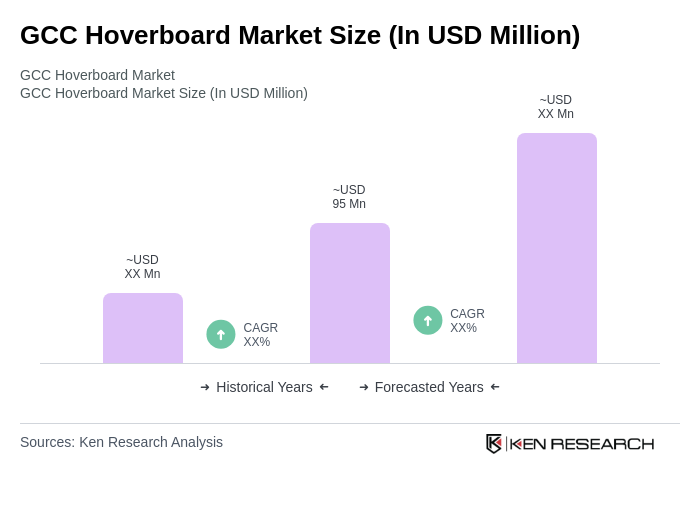
The GCC Hoverboard Market, valued at USD 95 million, is growing due to urbanization, tech innovations in battery life and safety, and rising demand for personal mobility solutions.

Region:Middle East

Author(s):Shubham

Product Code:KRAC4914

Pages:85

Published On:October 2025
About the Report

Base Year 2024

GCC Hoverboard Market Overview

  • The GCC Hoverboard Market is valued at USD 95 million, based on a five-year historical analysis of regional market share within the global hoverboard market. This growth is primarily driven by increasing consumer interest in personal mobility solutions, ongoing advancements in hoverboard design such as improved battery life and safety features, and a rising trend towards eco-friendly transportation options. The market has seen a surge in demand as consumers seek innovative and fun ways to navigate urban environments, supported by the integration of smart features like Bluetooth connectivity and mobile app controls .
  • Key players in this market include the United Arab Emirates and Saudi Arabia, which dominate due to their high disposable incomes, rapid urbanization, and a strong culture of recreational activities. The presence of major retail and e-commerce platforms in these countries further supports market growth, making hoverboards easily accessible to consumers. Additionally, the adoption of hoverboards is driven by the need for local commute and the popularity of green mobility alternatives .
  • In 2023, the UAE government implemented the “Technical Regulation for Electric Personal Mobility Devices” issued by the Emirates Authority for Standardization and Metrology (ESMA), which mandates that hoverboards sold in the UAE must comply with specific safety standards including battery safety, speed limits, and certification requirements. This regulation aims to enhance user safety and promote responsible usage, ensuring that hoverboards are safe for both riders and pedestrians in urban areas .
GCC Hoverboard Market Size

GCC Hoverboard Market Segmentation

By Type:The hoverboard market can be segmented into several types, including double-wheeled hoverboards, single-wheeled hoverboards, off-road hoverboards, hoverboards with Bluetooth speakers, hoverboards with LED lights, performance hoverboards, and others. Each type caters to different consumer preferences and usage scenarios, influencing market dynamics. Double-wheeled hoverboards are favored for their superior stability and ease of use, making them ideal for beginners and casual riders, while off-road models appeal to adventure seekers and outdoor enthusiasts. The integration of Bluetooth speakers and LED lights reflects the growing demand for smart and customizable mobility devices .
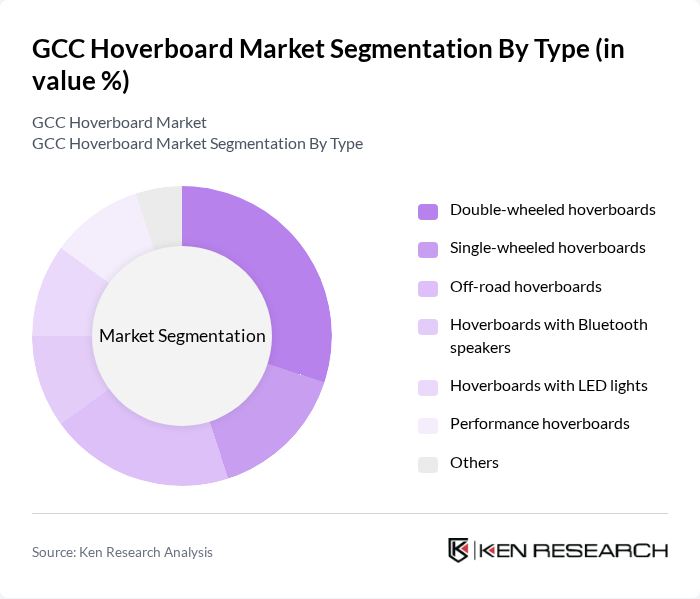
GCC Hoverboard Market segmentation by Type.

The double-wheeled hoverboards segment is currently dominating the market due to their stability and ease of use, making them particularly appealing to beginners and casual riders. This type of hoverboard is favored for urban commuting and recreational use, as it provides a balance of safety and performance. Additionally, the growing trend of personal mobility solutions has led to increased adoption among individual consumers, further solidifying its market leadership. Double-wheeled models account for the largest share among product types in both global and regional markets .

By End-User:The end-user segmentation includes individual consumers, schools and educational institutions, rental services (urban mobility, tourism), and corporate events and promotions. Each segment has unique requirements and preferences that influence the types of hoverboards purchased. Individual consumers represent the largest segment, driven by the increasing popularity of personal mobility devices for commuting and leisure activities. Schools and institutions use hoverboards for educational and recreational purposes, while rental services cater to tourists and urban commuters seeking short-distance mobility solutions. Corporate events and promotions leverage hoverboards for brand engagement and experiential marketing .
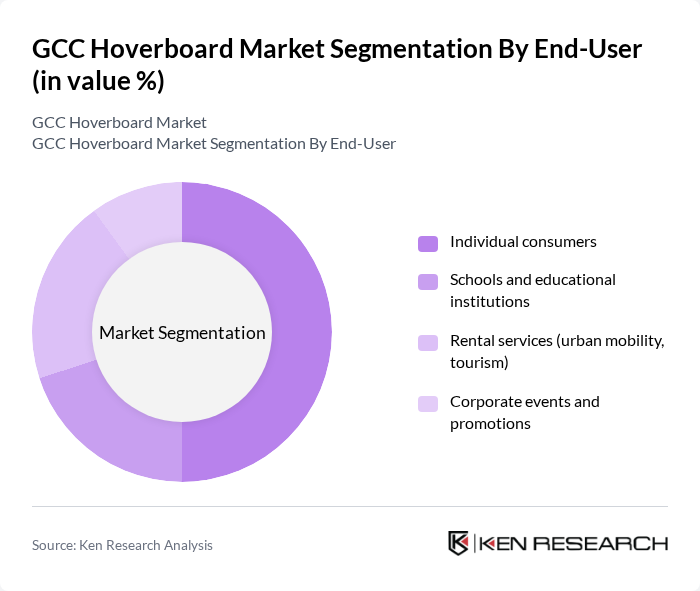
GCC Hoverboard Market segmentation by End-User.

Individual consumers represent the largest segment in the hoverboard market, driven by the increasing popularity of personal mobility devices for commuting and leisure activities. This segment is characterized by a diverse demographic, including teenagers and young adults who are attracted to the fun and innovative aspects of hoverboards. The growing trend of urban mobility solutions and the integration of smart features have further propelled this segment's growth, making it a key driver in the overall market .

GCC Hoverboard Market Competitive Landscape

The GCC Hoverboard Market is characterized by a dynamic mix of regional and international players. Leading participants such as Razor USA LLC, Swagtron, TOMOLOO Technology Industrial Co. Ltd., Hover-1, Jetson Electric Bikes LLC, Segway Inc. (Ninebot), XPRIT, GOTRAX, EPIKGO, Halo Board, Razor Hovertrax, Gyroor, Hangzhou Chic Intelligent Technology Co. Ltd., Shenzhen Rooder Technology Co. Ltd., Airwheel contribute to innovation, geographic expansion, and service delivery in this space .

Razor USA LLC

2000

California, USA

Swagtron

2015

Illinois, USA

TOMOLOO Technology Industrial Co. Ltd.

2013

Hangzhou, China

Hover-1

2017

California, USA

Jetson Electric Bikes LLC

2015

New York, USA

Company

Establishment Year

Headquarters

Group Size (Large, Medium, or Small as per industry convention)

Revenue Growth Rate (YoY %)

Market Penetration Rate (GCC market share %)

Customer Retention Rate (%)

Pricing Strategy (Budget, Mid-range, Premium)

Product Innovation Rate (Number of new models launched per year)

GCC Hoverboard Market Industry Analysis

Growth Drivers

  • Increasing Popularity of Personal Mobility Devices:The GCC region has witnessed a surge in personal mobility device usage, with over 1.5 million units sold in the recent past. This trend is driven by a growing consumer preference for convenient and efficient transportation options. The World Bank reported that urban populations in GCC countries are expected to reach 90% in the near future, further fueling demand for personal mobility solutions like hoverboards, which offer a practical alternative to traditional vehicles.
  • Rising Urbanization and Traffic Congestion:Urbanization in the GCC is accelerating, with cities like Dubai and Riyadh experiencing population growth rates of 3.5% annually. This rapid urban expansion has led to significant traffic congestion, prompting residents to seek alternative transportation methods. According to the International Transport Forum, traffic congestion costs GCC economies approximately $29 billion annually, highlighting the urgent need for efficient personal mobility solutions such as hoverboards to alleviate urban transport challenges.
  • Technological Advancements in Battery Life and Safety:The hoverboard industry is benefiting from advancements in battery technology, with new models featuring lithium-ion batteries that last up to 20 miles on a single charge. The GCC's focus on innovation is evident, as the region invests over $1 billion in smart mobility initiatives. Enhanced safety features, including anti-slip surfaces and improved braking systems, are also becoming standard, addressing consumer concerns and driving market growth in the near future.

Market Challenges

  • Regulatory Hurdles and Safety Standards:The hoverboard market in the GCC faces significant regulatory challenges, with varying safety standards across member states. For instance, the UAE has implemented strict regulations requiring hoverboards to meet specific safety certifications. Non-compliance can lead to fines exceeding $10,000, deterring manufacturers and retailers from entering the market. This fragmented regulatory landscape complicates market entry and can stifle innovation in the hoverboard sector.
  • High Competition from Alternative Personal Transport Modes:The GCC hoverboard market is increasingly competitive, with alternatives such as electric scooters and bicycles gaining traction. In the recent past, electric scooter sales in the region reached 800,000 units, reflecting a growing preference for diverse personal transport options. This competition poses a challenge for hoverboard manufacturers, as they must differentiate their products and offer unique features to capture market share amidst a crowded landscape.

GCC Hoverboard Market Future Outlook

The future of the GCC hoverboard market appears promising, driven by increasing urbanization and a shift towards sustainable transportation solutions. As cities continue to expand, the demand for efficient personal mobility devices is expected to rise. Additionally, advancements in technology will likely lead to the development of smarter, safer hoverboards, enhancing user experience. The integration of IoT features and partnerships with urban mobility initiatives will further shape the market landscape, creating new opportunities for growth and innovation in the near future.

Market Opportunities

  • Expansion into Untapped Regional Markets:There is significant potential for hoverboard manufacturers to expand into less saturated markets within the GCC, such as Oman and Bahrain. These regions are experiencing increased interest in personal mobility devices, with a projected growth rate of 15% in the near future. Targeting these markets can provide manufacturers with new revenue streams and enhance brand visibility.
  • Development of Smart Hoverboards with IoT Integration:The rise of smart technology presents an opportunity for hoverboard manufacturers to innovate by integrating IoT features. This could include GPS tracking, mobile app connectivity, and enhanced safety alerts. As consumer demand for smart devices grows, developing IoT-enabled hoverboards could capture a significant market share, appealing to tech-savvy consumers looking for advanced personal mobility solutions.

Scope of the Report

SegmentSub-Segments
By Type

Double-wheeled hoverboards

Single-wheeled hoverboards

Off-road hoverboards

Hoverboards with Bluetooth speakers

Hoverboards with LED lights

Performance hoverboards

Others

By End-User

Individual consumers

Schools and educational institutions

Rental services (urban mobility, tourism)

Corporate events and promotions

By Sales Channel

Online retail (e-commerce platforms)

Brick-and-mortar stores

Specialty sports shops

Rental outlets

By Price Range

Budget hoverboards

Mid-range hoverboards

Premium hoverboards

By Distribution Mode

Direct sales

Distributors

E-commerce platforms

By Brand Loyalty

Brand loyal customers

Price-sensitive customers

First-time buyers

By Usage Frequency

Daily users

Occasional users

Seasonal users

Key Target Audience

Investors and Venture Capitalist Firms

Government and Regulatory Bodies (e.g., Ministry of Economy, Ministry of Transport)

Manufacturers and Producers

Distributors and Retailers

Logistics and Supply Chain Companies

Technology Providers

Industry Associations (e.g., Gulf Cooperation Council (GCC) Business Council)

Financial Institutions

Players Mentioned in the Report:

Razor USA LLC

Swagtron

TOMOLOO Technology Industrial Co. Ltd.

Hover-1

Jetson Electric Bikes LLC

Segway Inc. (Ninebot)

XPRIT

GOTRAX

EPIKGO

Halo Board

Razor Hovertrax

Gyroor

Hangzhou Chic Intelligent Technology Co. Ltd.

Shenzhen Rooder Technology Co. Ltd.

Airwheel

Table of Contents

Market Assessment Phase

1. Executive Summary and Approach


2. GCC Hoverboard Market Overview

2.1 Key Insights and Strategic Recommendations

2.2 GCC Hoverboard Market Overview

2.3 Definition and Scope

2.4 Evolution of Market Ecosystem

2.5 Timeline of Key Regulatory Milestones

2.6 Value Chain & Stakeholder Mapping

2.7 Business Cycle Analysis

2.8 Policy & Incentive Landscape


3. GCC Hoverboard Market Analysis

3.1 Growth Drivers

3.1.1 Increasing popularity of personal mobility devices
3.1.2 Rising urbanization and traffic congestion
3.1.3 Technological advancements in battery life and safety
3.1.4 Growing demand for eco-friendly transportation options

3.2 Market Challenges

3.2.1 Regulatory hurdles and safety standards
3.2.2 High competition from alternative personal transport modes
3.2.3 Limited consumer awareness and education
3.2.4 Supply chain disruptions affecting availability

3.3 Market Opportunities

3.3.1 Expansion into untapped regional markets
3.3.2 Development of smart hoverboards with IoT integration
3.3.3 Partnerships with urban mobility initiatives
3.3.4 Customization options for niche consumer segments

3.4 Market Trends

3.4.1 Increasing focus on sustainability and eco-friendliness
3.4.2 Growth of e-commerce platforms for hoverboard sales
3.4.3 Rise in hoverboard rental services in urban areas
3.4.4 Enhanced safety features becoming standard

3.5 Government Regulation

3.5.1 Implementation of safety standards for hoverboards
3.5.2 Regulations on battery disposal and recycling
3.5.3 Licensing requirements for hoverboard rental services
3.5.4 Restrictions on hoverboard usage in public spaces

4. SWOT Analysis


5. Stakeholder Analysis


6. Porter's Five Forces Analysis


7. GCC Hoverboard Market Market Size, 2019-2024

7.1 By Value

7.2 By Volume

7.3 By Average Selling Price


8. GCC Hoverboard Market Segmentation

8.1 By Type

8.1.1 Double-wheeled hoverboards
8.1.2 Single-wheeled hoverboards
8.1.3 Off-road hoverboards
8.1.4 Hoverboards with Bluetooth speakers
8.1.5 Hoverboards with LED lights
8.1.6 Performance hoverboards
8.1.7 Others

8.2 By End-User

8.2.1 Individual consumers
8.2.2 Schools and educational institutions
8.2.3 Rental services (urban mobility, tourism)
8.2.4 Corporate events and promotions

8.3 By Sales Channel

8.3.1 Online retail (e-commerce platforms)
8.3.2 Brick-and-mortar stores
8.3.3 Specialty sports shops
8.3.4 Rental outlets

8.4 By Price Range

8.4.1 Budget hoverboards
8.4.2 Mid-range hoverboards
8.4.3 Premium hoverboards

8.5 By Distribution Mode

8.5.1 Direct sales
8.5.2 Distributors
8.5.3 E-commerce platforms

8.6 By Brand Loyalty

8.6.1 Brand loyal customers
8.6.2 Price-sensitive customers
8.6.3 First-time buyers

8.7 By Usage Frequency

8.7.1 Daily users
8.7.2 Occasional users
8.7.3 Seasonal users

9. GCC Hoverboard Market Competitive Analysis

9.1 Market Share of Key Players

9.2 Cross Comparison of Key Players

9.2.1 Company Name
9.2.2 Group Size (Large, Medium, or Small as per industry convention)
9.2.3 Revenue Growth Rate (YoY %)
9.2.4 Market Penetration Rate (GCC market share %)
9.2.5 Customer Retention Rate (%)
9.2.6 Pricing Strategy (Budget, Mid-range, Premium)
9.2.7 Product Innovation Rate (Number of new models launched per year)
9.2.8 Distribution Efficiency (Number of retail/distribution points in GCC)
9.2.9 Brand Recognition Score (Survey-based or social media metrics)
9.2.10 Customer Satisfaction Index (Net Promoter Score or equivalent)

9.3 SWOT Analysis of Top Players

9.4 Pricing Analysis

9.5 Detailed Profile of Major Companies

9.5.1 Razor USA LLC
9.5.2 Swagtron
9.5.3 TOMOLOO Technology Industrial Co. Ltd.
9.5.4 Hover-1
9.5.5 Jetson Electric Bikes LLC
9.5.6 Segway Inc. (Ninebot)
9.5.7 XPRIT
9.5.8 GOTRAX
9.5.9 EPIKGO
9.5.10 Halo Board
9.5.11 Razor Hovertrax
9.5.12 Gyroor
9.5.13 Hangzhou Chic Intelligent Technology Co. Ltd.
9.5.14 Shenzhen Rooder Technology Co. Ltd.
9.5.15 Airwheel

10. GCC Hoverboard Market End-User Analysis

10.1 Procurement Behavior of Key Ministries

10.1.1 Government procurement policies
10.1.2 Budget allocation for personal mobility solutions
10.1.3 Evaluation criteria for hoverboard purchases

10.2 Corporate Spend on Infrastructure & Energy

10.2.1 Investment in sustainable transport solutions
10.2.2 Budgeting for employee mobility programs

10.3 Pain Point Analysis by End-User Category

10.3.1 Safety concerns among users
10.3.2 Maintenance and repair issues
10.3.3 Cost of ownership

10.4 User Readiness for Adoption

10.4.1 Awareness of hoverboard benefits
10.4.2 Accessibility of hoverboards in the market

10.5 Post-Deployment ROI and Use Case Expansion

10.5.1 Analysis of cost savings from hoverboard use
10.5.2 Expansion into new user demographics

11. GCC Hoverboard Market Future Size, 2025-2030

11.1 By Value

11.2 By Volume

11.3 By Average Selling Price


Go-To-Market Strategy Phase

1. Whitespace Analysis + Business Model Canvas

1.1 Market gaps and opportunities

1.2 Business model components


2. Marketing and Positioning Recommendations

2.1 Branding strategies

2.2 Product USPs


3. Distribution Plan

3.1 Urban retail vs rural NGO tie-ups


4. Channel & Pricing Gaps

4.1 Underserved routes

4.2 Pricing bands


5. Unmet Demand & Latent Needs

5.1 Category gaps

5.2 Consumer segments


6. Customer Relationship

6.1 Loyalty programs

6.2 After-sales service


7. Value Proposition

7.1 Sustainability

7.2 Integrated supply chains


8. Key Activities

8.1 Regulatory compliance

8.2 Branding

8.3 Distribution setup


9. Entry Strategy Evaluation

9.1 Domestic Market Entry Strategy

9.1.1 Product mix
9.1.2 Pricing band
9.1.3 Packaging

9.2 Export Entry Strategy

9.2.1 Target countries
9.2.2 Compliance roadmap

10. Entry Mode Assessment

10.1 JV

10.2 Greenfield

10.3 M&A

10.4 Distributor Model


11. Capital and Timeline Estimation

11.1 Capital requirements

11.2 Timelines


12. Control vs Risk Trade-Off

12.1 Ownership vs Partnerships


13. Profitability Outlook

13.1 Breakeven analysis

13.2 Long-term sustainability


14. Potential Partner List

14.1 Distributors

14.2 JVs

14.3 Acquisition targets


15. Execution Roadmap

15.1 Phased Plan for Market Entry

15.1.1 Market Setup
15.1.2 Market Entry
15.1.3 Growth Acceleration
15.1.4 Scale & Stabilize

15.2 Key Activities and Milestones

15.2.1 Milestone tracking
15.2.2 Activity scheduling

Research Methodology

ApproachModellingSample

Phase 1: Approach1

Desk Research

  • Market reports from industry associations and trade publications specific to the GCC hoverboard market
  • Government publications and regulatory frameworks related to electric mobility and consumer electronics
  • Analysis of online sales data and consumer behavior trends from e-commerce platforms in the GCC region

Primary Research

  • Interviews with product managers and marketing executives from leading hoverboard manufacturers
  • Surveys targeting retailers and distributors in the GCC hoverboard market
  • Focus group discussions with end-users to gather insights on preferences and usage patterns

Validation & Triangulation

  • Cross-validation of findings through multiple data sources, including sales data and consumer feedback
  • Triangulation of market trends with insights from industry experts and market analysts
  • Sanity checks through expert panel reviews to ensure data accuracy and relevance

Phase 2: Market Size Estimation1

Top-down Assessment

  • Estimation of total addressable market (TAM) based on population demographics and urbanization rates in the GCC
  • Analysis of hoverboard sales trends in relation to overall electric vehicle adoption rates
  • Incorporation of government initiatives promoting electric mobility and sustainability in urban areas

Bottom-up Modeling

  • Volume estimates based on sales data from major retailers and online platforms
  • Cost analysis of hoverboard production and distribution to determine pricing strategies
  • Calculation of market size based on unit sales and average selling price (ASP) of hoverboards

Forecasting & Scenario Analysis

  • Multi-factor regression analysis incorporating economic indicators, consumer trends, and technological advancements
  • Scenario modeling based on potential regulatory changes and shifts in consumer preferences
  • Development of baseline, optimistic, and pessimistic forecasts through 2030

Phase 3: CATI Sample Composition1

Scope Item/SegmentSample SizeTarget Respondent Profiles
Retail Market Insights100Store Managers, Sales Representatives
Consumer Preferences120End-users, Hobbyists, Parents
Distribution Channel Analysis80Distributors, Wholesalers
Regulatory Impact Assessment50Policy Makers, Industry Experts
Market Trend Evaluation70Market Analysts, Research Consultants

Frequently Asked Questions

What is the current value of the GCC Hoverboard Market?

The GCC Hoverboard Market is valued at approximately USD 95 million, reflecting a growing consumer interest in personal mobility solutions and advancements in hoverboard technology, including improved battery life and safety features.

Which countries dominate the GCC Hoverboard Market?

What are the key regulations affecting hoverboard sales in the UAE?

What types of hoverboards are available in the GCC market?

Other Regional/Country Reports

Global Hoverboard Market Outlook to 2030

Indonesia Hoverboard Market

Malaysia Hoverboard Market

KSA Hoverboard Market

APAC Hoverboard Market

SEA Hoverboard Market

Other Adjacent Reports

India Electric Scooter Market Outlook to 2030

Germany Electric Bicycle Market

KSA Micro-Mobility Market

Indonesia Personal Electric Vehicle Market

Malaysia Urban Mobility Solution Market

Mexico Battery Technology Market

Egypt IoT Device Market

Malaysia Safety Equipment Market

Kuwait Recreational Vehicle Market Size, Share, Growth Drivers, Trends, Opportunities & Forecast 2025–2030

UAE E-Commerce Retail Market

Why Buy From Us?

Refine Robust Result (RRR) Framework

What makes us stand out is that our consultants follow Robust, Refine and Result (RRR) methodology. Robust for clear definitions, approaches and sanity checking, Refine for differentiating respondents' facts and opinions, and Result for presenting data with story.

Our Reach Is Unmatched

We have set a benchmark in the industry by offering our clients with syndicated and customized market research reports featuring coverage of entire market as well as meticulous research and analyst insights.

Shifting the Research Paradigm

While we don't replace traditional research, we flip the method upside down. Our dual approach of Top Bottom & Bottom Top ensures quality deliverable by not just verifying company fundamentals but also looking at the sector and macroeconomic factors.

More Insights-Better Decisions

With one step in the future, our research team constantly tries to show you the bigger picture. We help with some of the tough questions you may encounter along the way: How is the industry positioned? Best marketing channel? KPI's of competitors? By aligning every element, we help maximize success.

Transparency and Trust

Our report gives you instant access to the answers and sources that other companies might choose to hide. We elaborate each steps of research methodology we have used and showcase you the sample size to earn your trust.

Round the Clock Support

If you need any support, we are here! We pride ourselves on universe strength, data quality, and quick, friendly, and professional service.

Why Clients Choose Us?

400000+
Reports in repository
150+
Consulting projects a year
100+
Analysts
8000+
Client Queries in 2022








