GCC Medicated Shampoo Market Size Share Growth Drivers Trends Opportunities & Forecast 2025–2030

GCC medicated shampoo market grows with scalp health awareness and demand for natural ingredients.

Region:Middle East

Author(s):Rebecca

Product Code:KRAB1061

Pages:98

Published On:December 2025
About the Report

Base Year 2024

GCC Medicated Shampoo Market Overview

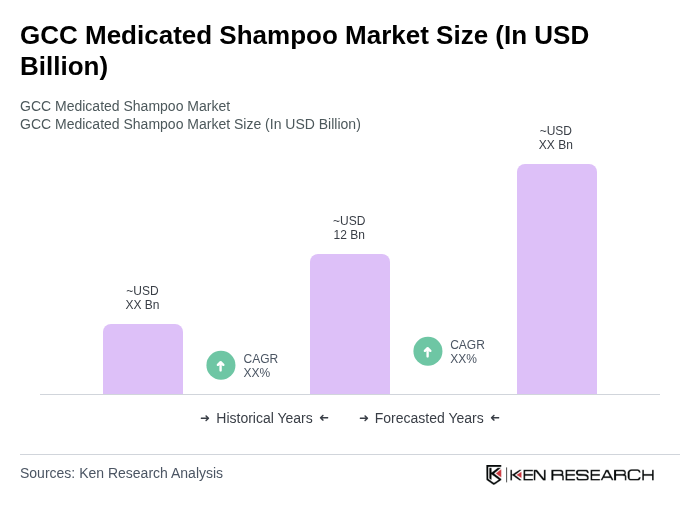
  • The GCC Medicated Shampoo Market is valued at USD 12 billion, based on a five-year historical analysis. This growth is primarily driven by increasing awareness of scalp health and rising demand for effective hair care solutions, including anti-dandruff and scalp treatment formulations, as consumers become more educated about conditions such as itchiness and hair loss. Additionally, the shift toward cleaner, herbal, and natural ingredients is contributing to market momentum as consumer preferences evolve globally.
  • Key consumption hubs in the GCC include Saudi Arabia and the UAE, which dominate the market due to high disposable income, urbanized markets, and extensive retail penetration. The presence of major multinational companies such as L’Oréal Middle East, Unilever Gulf, and Procter & Gamble Gulf further strengthens the market, as these companies leverage local consumer insights and diverse product portfolios in both medicated and natural segments.
  • The GCC Standardization Organization’s Gulf Technical Regulation GSO 1943:2024 mandates stringent safety, labeling, and packaging standards for cosmetics and personal care products, including allowable levels of heavy metals and compliance with GMP practices, ensuring product integrity in the region.
GCC Medicated Shampoo Market Size

GCC Medicated Shampoo Market Segmentation

By Type:The medicated shampoo market is segmented into various types, including anti-dandruff, anti-hair fall, moisturizing, clarifying, and others. Among these, the anti-dandruff segment is currently leading the market due to the high prevalence of dandruff-related issues among consumers. The increasing awareness of scalp health and the effectiveness of anti-dandruff formulations are driving this segment's growth. Additionally, the anti-hair fall segment is gaining traction as consumers seek solutions for hair loss, further diversifying the market.
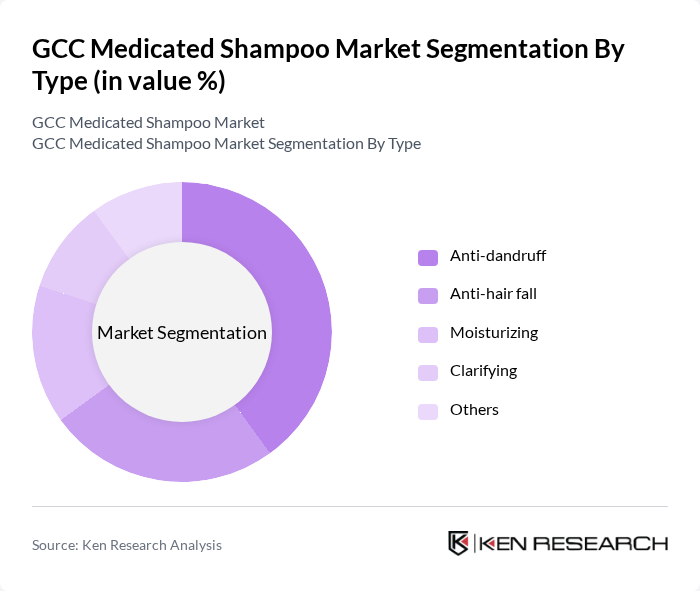
GCC Medicated Shampoo Market segmentation by Type.

By End-User:The end-user segmentation includes individuals, salons, healthcare facilities, and others. The individual segment dominates the market as personal care and grooming become increasingly important to consumers. Salons also represent a significant portion of the market, as they often use medicated shampoos for professional treatments. The growing trend of self-care and at-home treatments is further boosting the individual segment, while healthcare facilities are increasingly incorporating medicated shampoos into their patient care protocols.
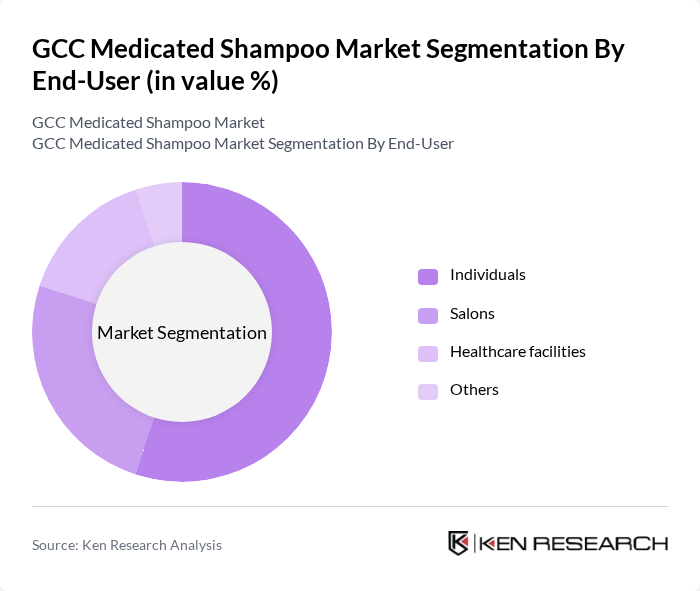
GCC Medicated Shampoo Market segmentation by End-User.

GCC Medicated Shampoo Market Competitive Landscape

The GCC Medicated Shampoo Market is characterized by a dynamic mix of regional and international players. Leading participants such as Head & Shoulders, Nizoral, Selsun Blue, Neutrogena, T/Gel, Dove, Pantene, Herbal Essences, L'Oreal, Garnier, Biolage, Paul Mitchell, Aveda, Kérastase, and OGX contribute to innovation, geographic expansion, and service delivery in this space.

Head & Shoulders

1961

Cincinnati, Ohio, USA

Nizoral

1991

New York, New York, USA

Selsun Blue

1978

New York, New York, USA

Neutrogena

1930

Los Angeles, California, USA

Dove

1957

London, United Kingdom

Company

Establishment Year

Headquarters

Group Size (Large, Medium, or Small as per industry convention)

Revenue Growth Rate

Market Penetration Rate

Customer Retention Rate

Product Innovation Rate

Distribution Efficiency

GCC Medicated Shampoo Market Industry Analysis

Growth Drivers

  • Strong GCC GDP Base:The GCC's real GDP at constant prices reached USD 456.3 billion in future, reflecting a robust economic foundation. This growth is primarily driven by increasing non-oil activities, which bolster consumer spending power. As disposable incomes rise, consumers are more inclined to invest in personal care products, including medicated shampoos, thereby enhancing market demand. The economic diversification efforts further support this trend, creating a favorable environment for personal care industries.
  • High GDP Per Capita in UAE:The UAE's nominal GDP per capita is projected to be approximately USD 49,550 in future, indicating elevated income levels. This affluence creates favorable conditions for consumers to purchase premium and specialized personal care products, including medicated shampoos. The high purchasing power allows consumers to prioritize quality and efficacy in their hair care choices, driving demand for innovative and effective medicated solutions in the market.
  • Healthy Banking Sector Enabling Affordability:The commercial bank assets among GCC countries totaled USD 3.53 trillion at the end of future, showcasing a strong financial sector. This robust banking environment supports consumer credit availability, enabling higher discretionary spending on personal care products, including medicated shampoos. As consumers gain access to credit, they are more likely to invest in specialized hair care solutions, further propelling market growth in the region.

Market Challenges

  • Decline in Regional Shampoo Production:GCC shampoo production fell to 82 thousand tons in future, indicating a contraction in local manufacturing capabilities. This decline may lead to increased costs or a greater reliance on imports, which can affect the availability and pricing of medicated shampoos. The reduced production capacity poses a significant challenge for brands aiming to meet growing consumer demand while maintaining competitive pricing in the market.
  • Import–Export Price Disparities:In future, the import price of shampoo varied significantly, with Qatar at USD 7,584 per ton and the UAE at USD 3,960 per ton. Such disparities complicate supply chain pricing strategies and cost management for manufacturers and distributors. The fluctuating import costs can create challenges in maintaining competitive pricing for medicated shampoos, potentially impacting market dynamics and consumer accessibility.

GCC Medicated Shampoo Market Future Outlook

The GCC medicated shampoo market is poised for significant growth, driven by emerging trends such as the increasing demand for specialized formulations and the rise of e-commerce platforms. As consumer preferences shift towards natural and organic ingredients, brands that innovate in this space are likely to capture a larger market share. Additionally, the expansion of digital retail channels will facilitate greater accessibility, allowing consumers to explore a wider range of medicated shampoo options tailored to their specific needs.

Market Opportunities

  • Medicated Shampoo Segment Growth:The medicated shampoo market in Saudi Arabia reached USD 92.96 million, while in the UAE, it reached USD 269.32 million in future. These figures highlight substantial and growing demand, indicating significant opportunities for brands to scale regionally in untapped GCC markets. The increasing awareness of scalp health and personal hygiene further supports this growth trajectory.
  • Export Potential from GCC Hubs:The UAE's export price for shampoo was USD 4,857 per ton, while Saudi Arabia's was USD 2,672 per ton in future. This premium pricing for exports suggests that GCC hubs like the UAE could serve as regional manufacturing and export centers for medicated shampoos. Leveraging this potential can enhance market reach and profitability for local manufacturers.

Scope of the Report

SegmentSub-Segments
By Type

Anti-dandruff

Anti-hair fall

Moisturizing

Clarifying

Others

By End-User

Individuals

Salons

Healthcare facilities

Others

By Distribution Channel

Online retail

Supermarkets/Hypermarkets

Pharmacies

Specialty stores

Others

By Ingredient Type

Natural ingredients

Synthetic ingredients

Herbal extracts

Others

By Packaging Type

Bottles

Tubes

Sachets

Others

By Price Range

Premium

Mid-range

Economy

Others

By Region

GCC Countries

Others

Key Target Audience

Investors and Venture Capitalist Firms

Government and Regulatory Bodies (e.g., Ministry of Health, Saudi Food and Drug Authority)

Manufacturers and Producers

Distributors and Retailers

Pharmaceutical Companies

Health and Wellness Organizations

Beauty and Personal Care Brands

Insurance Companies

Players Mentioned in the Report:

Head & Shoulders

Nizoral

Selsun Blue

Neutrogena

T/Gel

Dove

Pantene

Herbal Essences

L'Oreal

Garnier

Biolage

Paul Mitchell

Aveda

Kerastase

OGX

Table of Contents

Market Assessment Phase

1. Executive Summary and Approach


2. GCC Medicated Shampoo Market Overview

2.1 Key Insights and Strategic Recommendations

2.2 GCC Medicated Shampoo Market Overview

2.3 Definition and Scope

2.4 Evolution of Market Ecosystem

2.5 Timeline of Key Regulatory Milestones

2.6 Value Chain & Stakeholder Mapping

2.7 Business Cycle Analysis

2.8 Policy & Incentive Landscape


3. GCC Medicated Shampoo Market Analysis

3.1 Growth Drivers

3.1.1 Increasing prevalence of scalp disorders
3.1.2 Rising awareness about personal hygiene
3.1.3 Growth in the e-commerce sector
3.1.4 Demand for natural and organic ingredients

3.2 Market Challenges

3.2.1 High competition among brands
3.2.2 Regulatory hurdles in product formulation
3.2.3 Price sensitivity among consumers
3.2.4 Limited distribution channels in rural areas

3.3 Market Opportunities

3.3.1 Expansion into emerging markets
3.3.2 Development of specialized medicated shampoos
3.3.3 Collaborations with dermatologists
3.3.4 Increasing demand for eco-friendly packaging

3.4 Market Trends

3.4.1 Shift towards online shopping
3.4.2 Growing popularity of subscription services
3.4.3 Rise in influencer marketing
3.4.4 Focus on personalized hair care solutions

3.5 Government Regulation

3.5.1 Compliance with health and safety standards
3.5.2 Labeling requirements for medicated products
3.5.3 Restrictions on certain chemical ingredients
3.5.4 Guidelines for advertising and marketing claims

4. SWOT Analysis


5. Stakeholder Analysis


6. Porter's Five Forces Analysis


7. GCC Medicated Shampoo Market Size, 2019-2024

7.1 By Value

7.2 By Volume

7.3 By Average Selling Price


8. GCC Medicated Shampoo Market Segmentation

8.1 By Type

8.1.1 Anti-dandruff
8.1.2 Anti-hair fall
8.1.3 Moisturizing
8.1.4 Clarifying
8.1.5 Others

8.2 By End-User

8.2.1 Individuals
8.2.2 Salons
8.2.3 Healthcare facilities
8.2.4 Others

8.3 By Distribution Channel

8.3.1 Online retail
8.3.2 Supermarkets/Hypermarkets
8.3.3 Pharmacies
8.3.4 Specialty stores
8.3.5 Others

8.4 By Ingredient Type

8.4.1 Natural ingredients
8.4.2 Synthetic ingredients
8.4.3 Herbal extracts
8.4.4 Others

8.5 By Packaging Type

8.5.1 Bottles
8.5.2 Tubes
8.5.3 Sachets
8.5.4 Others

8.6 By Price Range

8.6.1 Premium
8.6.2 Mid-range
8.6.3 Economy
8.6.4 Others

8.7 By Region

8.7.1 GCC Countries
8.7.2 Others

9. GCC Medicated Shampoo Market Competitive Analysis

9.1 Market Share of Key Players

9.2 Cross Comparison of Key Players

9.2.1 Company Name
9.2.2 Group Size (Large, Medium, or Small as per industry convention)
9.2.3 Revenue Growth Rate
9.2.4 Market Penetration Rate
9.2.5 Customer Retention Rate
9.2.6 Product Innovation Rate
9.2.7 Distribution Efficiency
9.2.8 Pricing Strategy
9.2.9 Brand Recognition
9.2.10 Customer Satisfaction Score

9.3 SWOT Analysis of Top Players

9.4 Pricing Analysis

9.5 Detailed Profile of Major Companies

9.5.1 Head & Shoulders
9.5.2 Nizoral
9.5.3 Selsun Blue
9.5.4 Neutrogena
9.5.5 T/Gel
9.5.6 Dove
9.5.7 Pantene
9.5.8 Herbal Essences
9.5.9 L'Oreal
9.5.10 Garnier
9.5.11 Biolage
9.5.12 Paul Mitchell
9.5.13 Aveda
9.5.14 Kérastase
9.5.15 OGX

10. GCC Medicated Shampoo Market End-User Analysis

10.1 Procurement Behavior of Key Ministries

10.1.1 Government contracts for healthcare
10.1.2 Bulk purchasing trends
10.1.3 Preference for local suppliers
10.1.4 Compliance with health regulations

10.2 Corporate Spend on Infrastructure & Energy

10.2.1 Investment in employee wellness programs
10.2.2 Budget allocation for personal care products
10.2.3 Trends in corporate gifting
10.2.4 Partnerships with health and beauty brands

10.3 Pain Point Analysis by End-User Category

10.3.1 Effectiveness of medicated shampoos
10.3.2 Availability of products
10.3.3 Price sensitivity
10.3.4 Brand loyalty challenges

10.4 User Readiness for Adoption

10.4.1 Awareness of medicated shampoo benefits
10.4.2 Willingness to switch brands
10.4.3 Accessibility of products
10.4.4 Influence of recommendations

10.5 Post-Deployment ROI and Use Case Expansion

10.5.1 Measurement of product effectiveness
10.5.2 Customer feedback mechanisms
10.5.3 Opportunities for product line expansion
10.5.4 Long-term customer engagement strategies

11. GCC Medicated Shampoo Market Future Size, 2025-2030

11.1 By Value

11.2 By Volume

11.3 By Average Selling Price


Go-To-Market Strategy Phase

1. Whitespace Analysis + Business Model Canvas

1.1 Market gaps identification

1.2 Value proposition development

1.3 Revenue model exploration

1.4 Customer segmentation analysis

1.5 Competitive landscape overview

1.6 Key partnerships identification

1.7 Resource allocation strategy


2. Marketing and Positioning Recommendations

2.1 Branding strategies

2.2 Product USPs

2.3 Target audience definition

2.4 Marketing channels selection

2.5 Campaign effectiveness metrics


3. Distribution Plan

3.1 Urban retail strategies

3.2 Rural NGO tie-ups

3.3 Online distribution channels

3.4 Partnerships with retailers

3.5 Logistics and supply chain management


4. Channel & Pricing Gaps

4.1 Underserved routes

4.2 Pricing bands analysis

4.3 Competitor pricing strategies

4.4 Consumer price sensitivity

4.5 Recommendations for pricing adjustments


5. Unmet Demand & Latent Needs

5.1 Category gaps identification

5.2 Consumer segments analysis

5.3 Product development opportunities

5.4 Market entry strategies for new products


6. Customer Relationship

6.1 Loyalty programs design

6.2 After-sales service strategies

6.3 Customer engagement initiatives

6.4 Feedback collection mechanisms

6.5 Community building efforts


7. Value Proposition

7.1 Sustainability initiatives

7.2 Integrated supply chains

7.3 Unique selling propositions

7.4 Customer-centric product features

7.5 Brand storytelling techniques


8. Key Activities

8.1 Regulatory compliance measures

8.2 Branding strategies implementation

8.3 Distribution setup processes

8.4 Marketing campaign execution

8.5 Performance monitoring systems


9. Entry Strategy Evaluation

9.1 Domestic Market Entry Strategy

9.1.1 Product mix considerations
9.1.2 Pricing band analysis
9.1.3 Packaging strategies

9.2 Export Entry Strategy

9.2.1 Target countries selection
9.2.2 Compliance roadmap development

10. Entry Mode Assessment

10.1 Joint Ventures

10.2 Greenfield investments

10.3 Mergers & Acquisitions

10.4 Distributor Model evaluation


11. Capital and Timeline Estimation

11.1 Capital requirements analysis

11.2 Timelines for market entry

11.3 Budget allocation strategies


12. Control vs Risk Trade-Off

12.1 Ownership considerations

12.2 Partnerships evaluation

12.3 Risk management strategies


13. Profitability Outlook

13.1 Breakeven analysis

13.2 Long-term sustainability strategies

13.3 Financial forecasting


14. Potential Partner List

14.1 Distributors identification

14.2 Joint Ventures opportunities

14.3 Acquisition targets analysis


15. Execution Roadmap

15.1 Phased Plan for Market Entry

15.1.1 Market Setup
15.1.2 Market Entry
15.1.3 Growth Acceleration
15.1.4 Scale & Stabilize

15.2 Key Activities and Milestones

15.2.1 Milestone tracking
15.2.2 Activity scheduling
15.2.3 Resource allocation

Research Methodology

ApproachModellingSample

Phase 1: Approach1

Desk Research

  • Analysis of market reports from industry associations and trade publications
  • Review of academic journals and white papers on medicated shampoo formulations
  • Examination of consumer behavior studies and market trends in the GCC region

Primary Research

  • Interviews with dermatologists and trichologists to understand consumer needs
  • Surveys with retailers and distributors to gauge market demand and pricing
  • Focus groups with end-users to gather insights on product preferences and usage

Validation & Triangulation

  • Cross-validation of findings through multiple data sources including sales data and expert opinions
  • Triangulation of consumer insights with market size estimates and growth projections
  • Sanity checks through expert panel reviews to ensure data reliability

Phase 2: Market Size Estimation1

Top-down Assessment

  • Estimation of total market size based on national health and beauty care spending
  • Segmentation by product type, including anti-dandruff, anti-hair fall, and others
  • Incorporation of demographic factors influencing medicated shampoo consumption

Bottom-up Modeling

  • Collection of sales data from leading medicated shampoo brands in the GCC
  • Estimation of average selling prices and volume sold across different channels
  • Analysis of distribution networks and their impact on market penetration

Forecasting & Scenario Analysis

  • Multi-factor regression analysis considering factors like population growth and health awareness
  • Scenario planning based on potential regulatory changes and market entry of new players
  • Development of baseline, optimistic, and pessimistic forecasts through 2030

Phase 3: CATI Sample Composition1

Scope Item/SegmentSample SizeTarget Respondent Profiles
Consumer Insights on Medicated Shampoo150End-users, Health-conscious Consumers
Retailer Feedback on Product Demand100Store Managers, Beauty Product Buyers
Dermatologist Recommendations50Dermatologists, Trichologists
Market Trends from Distributors80Distributors, Supply Chain Managers
Brand Perception Studies70Brand Managers, Marketing Executives

Frequently Asked Questions

What is the current value of the GCC Medicated Shampoo Market?

The GCC Medicated Shampoo Market is valued at approximately USD 12 billion, reflecting a robust growth driven by increasing consumer awareness of scalp health and demand for effective hair care solutions, particularly anti-dandruff and scalp treatment formulations.

Which countries are the key consumption hubs for medicated shampoos in the GCC?

What are the main types of medicated shampoos available in the GCC market?

How does the GCC Standardization Organization regulate medicated shampoos?

Other Regional/Country Reports

Indonesia Medicated Shampoo Market Size Share Growth Drivers Trends Opportunities & Forecast 2025–2030

Malaysia Medicated Shampoo Market Size Share Growth Drivers Trends Opportunities & Forecast 2025–2030

KSA Medicated Shampoo Market Size Share Growth Drivers Trends Opportunities & Forecast 2025–2030

APAC Medicated Shampoo Market Size Share Growth Drivers Trends Opportunities & Forecast 2025–2030

SEA Medicated Shampoo Market Size Share Growth Drivers Trends Opportunities & Forecast 2025–2030

Vietnam Medicated Shampoo Market Size Share Growth Drivers Trends Opportunities & Forecast 2025–2030

Other Adjacent Reports

KSA hair care products market report size, share, growth drivers, trends, opportunities & forecast 2025–2030Vietnam Personal Care Products Market Size Share Growth Drivers Trends Opportunities & Forecast 2025–2030UAE Cosmetics Market Report Size Share Growth Drivers Trends Opportunities & Forecast 2025–2030

Japan Natural Ingredients Market

Bahrain Herbal Products Market

Brazil Scalp Treatment Market

Kuwait Anti-Dandruff Products Market

Bahrain Hair Loss Treatment Market

Philippines Salon Products Market

Oman E-commerce Retail Market

Why Buy From Us?

Refine Robust Result (RRR) Framework

What makes us stand out is that our consultants follow Robust, Refine and Result (RRR) methodology. Robust for clear definitions, approaches and sanity checking, Refine for differentiating respondents' facts and opinions, and Result for presenting data with story.

Our Reach Is Unmatched

We have set a benchmark in the industry by offering our clients with syndicated and customized market research reports featuring coverage of entire market as well as meticulous research and analyst insights.

Shifting the Research Paradigm

While we don't replace traditional research, we flip the method upside down. Our dual approach of Top Bottom & Bottom Top ensures quality deliverable by not just verifying company fundamentals but also looking at the sector and macroeconomic factors.

More Insights-Better Decisions

With one step in the future, our research team constantly tries to show you the bigger picture. We help with some of the tough questions you may encounter along the way: How is the industry positioned? Best marketing channel? KPI's of competitors? By aligning every element, we help maximize success.

Transparency and Trust

Our report gives you instant access to the answers and sources that other companies might choose to hide. We elaborate each steps of research methodology we have used and showcase you the sample size to earn your trust.

Round the Clock Support

If you need any support, we are here! We pride ourselves on universe strength, data quality, and quick, friendly, and professional service.

Why Clients Choose Us?

400000+
Reports in repository
150+
Consulting projects a year
100+
Analysts
8000+
Client Queries in 2022








