About the Report
Base Year 2024GCC Nicotine Pouches Market Overview
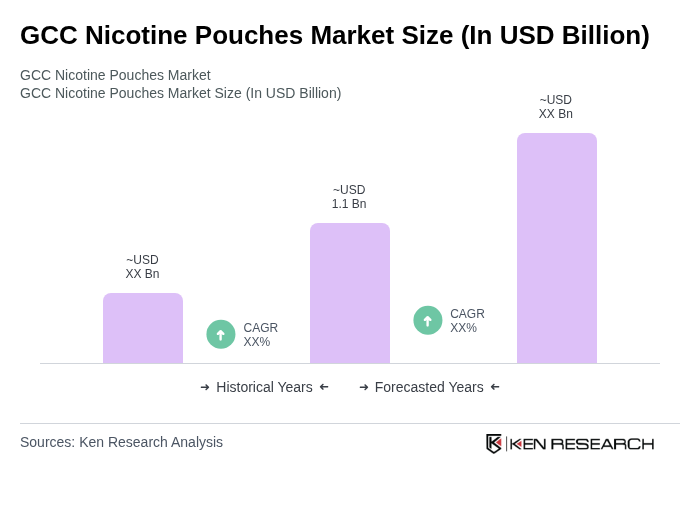
- The GCC Nicotine Pouches Market is valued at USD 1.1 billion, based on a five-year historical analysis. This growth is primarily driven by the increasing acceptance of nicotine pouches as a less harmful alternative to traditional tobacco products, coupled with rising consumer awareness regarding health risks associated with smoking. The market has seen a surge in demand due to changing lifestyles and the growing trend of smoking cessation among younger demographics.
- Key players in this market include Saudi Arabia and the United Arab Emirates, which dominate due to their large populations and increasing disposable incomes. The cultural shift towards alternative nicotine products, along with supportive regulatory frameworks, has facilitated the rapid growth of nicotine pouch consumption in these regions. Additionally, the presence of major international brands has further strengthened the market in these countries.
- The Federal Law No. 15 of 2023 on Regulating the Use and Control of Tobacco and its Derivatives, issued by the UAE Ministry of Health and Prevention, standardizes the production, import, and sale of nicotine pouches, ensuring product safety and quality. This regulation mandates that all nicotine pouch manufacturers obtain product registration, comply with maximum nicotine concentration limits of 20 mg per gram, and adhere to labeling and packaging standards including health warnings and child-resistant features.
GCC Nicotine Pouches Market Segmentation
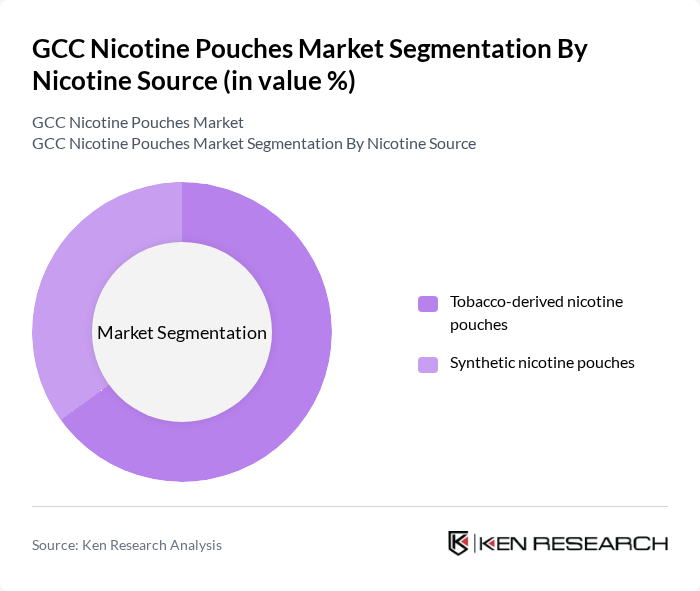
By Nicotine Source:The nicotine pouches market is segmented into two primary sources: tobacco-derived nicotine pouches and synthetic nicotine pouches. Tobacco-derived nicotine pouches are made from natural tobacco, while synthetic nicotine pouches are created using chemical processes to replicate nicotine without tobacco. The demand for synthetic nicotine pouches has been increasing due to their appeal to health-conscious consumers seeking alternatives to traditional tobacco products.
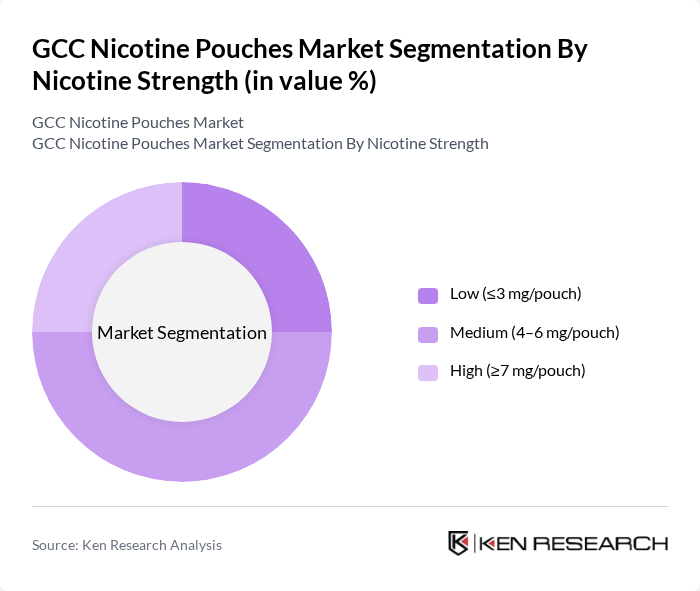
By Nicotine Strength:The market is also segmented by nicotine strength, which includes low (?3 mg/pouch), medium (4–6 mg/pouch), and high (?7 mg/pouch) nicotine pouches. The medium strength segment is currently leading the market, as it caters to a broad range of consumers, including those transitioning from traditional smoking to nicotine pouches. This segment's popularity is driven by its balanced nicotine delivery, appealing to both new users and those looking to reduce their nicotine intake.
GCC Nicotine Pouches Market Competitive Landscape
The GCC Nicotine Pouches Market is characterized by a dynamic mix of regional and international players. Leading participants such as Swedish Match AB (ZYN), Philip Morris International Inc. (VEEV NIO, Shiro), British American Tobacco p.l.c. (Velo, Lyft), Altria Group, Inc. (on nicotine pouches), Japan Tobacco International (Nordic Spirit), Imperial Brands PLC (Skruf, Zones), GN Tobacco Sweden AB (White Fox, Siberia nicotine pouches), Skruf Snus AB, NIQO Co. / Nicopods ehf., Tobacco Concept Factory Sp. z o.o. (Killa, Pablo), Vont AB (Vont nicotine pouches), Snus Arabia Trading LLC (regional distributor), Local & private-label brands in GCC retail and vape channels, Online-first D2C brands active in GCC, Other emerging regional players contribute to innovation, geographic expansion, and service delivery in this space.
GCC Nicotine Pouches Market Industry Analysis
Growth Drivers
- Increasing Consumer Preference for Smoke-Free Alternatives:The GCC region has witnessed a significant shift towards smoke-free products, with the nicotine pouches market growing by 15 million units in future alone. This trend is driven by a growing awareness of the health risks associated with traditional smoking. According to the World Health Organization, approximately 30% of smokers in the GCC are actively seeking alternatives, indicating a robust demand for nicotine pouches as a viable substitute.
- Rising Health Consciousness Among Consumers:Health consciousness is on the rise in the GCC, with a reported 40% increase in consumers prioritizing wellness products. The prevalence of lifestyle diseases has prompted a shift towards less harmful alternatives. The Gulf Cooperation Council's health statistics indicate that 60% of the population is now more informed about the risks of tobacco, leading to a surge in the adoption of nicotine pouches as a healthier option.
- Expansion of Distribution Channels:The distribution landscape for nicotine pouches in the GCC is evolving, with a 25% increase in retail outlets offering these products in future. E-commerce platforms have also seen a 35% rise in sales, making nicotine pouches more accessible. This expansion is supported by government initiatives to promote smoke-free products, enhancing visibility and availability for consumers across the region.
Market Challenges
- Stringent Regulatory Frameworks:The GCC faces stringent regulations regarding nicotine products, with new laws implemented in future that require extensive product testing and compliance. These regulations can delay product launches and increase operational costs by up to 20%. Companies must navigate complex legal landscapes, which can hinder market entry and limit growth opportunities for new entrants in the nicotine pouch sector.
- Competition from Traditional Tobacco Products:Traditional tobacco products continue to dominate the market, with a reported 70% market share in the GCC. This stronghold poses a significant challenge for nicotine pouches, as many consumers remain loyal to established brands. The competition is intensified by aggressive marketing strategies from tobacco companies, making it difficult for newer, smoke-free alternatives to gain traction in a crowded marketplace.
GCC Nicotine Pouches Market Future Outlook
The future of the GCC nicotine pouches market appears promising, driven by evolving consumer preferences and increasing health awareness. As more individuals seek smoke-free alternatives, the market is likely to see innovative product developments and a broader range of flavors. Additionally, the rise of e-commerce will facilitate easier access to these products, further enhancing market penetration. Companies that adapt to these trends and invest in marketing strategies targeting younger demographics will likely thrive in this dynamic landscape.
Market Opportunities
- Growth in E-Commerce and Online Sales:The e-commerce sector in the GCC is projected to grow by 30% in future, providing a significant opportunity for nicotine pouch brands to reach a wider audience. Online platforms allow for targeted marketing and direct consumer engagement, which can enhance brand loyalty and increase sales volumes significantly.
- Potential for Product Diversification:There is a growing demand for diverse product offerings, with consumers showing interest in unique flavors and formulations. Companies that invest in research and development to create innovative products can capture a larger market share, as evidenced by a 20% increase in sales for brands that introduced new flavors in future.
Scope of the Report
| Segment | Sub-Segments |
|---|---|
| By Nicotine Source | Tobacco-derived nicotine pouches Synthetic nicotine pouches |
| By Nicotine Strength | Low (?3 mg/pouch) Medium (4–6 mg/pouch) High (?7 mg/pouch) |
| By Flavor | Mint & menthol Fruit Tobacco-inspired Coffee & beverage Other flavors |
| By Consumer Type | Current cigarette smokers Former smokers / switchers from other nicotine products Dual users (pouches + other nicotine formats) New-to-nicotine adult users |
| By Distribution Channel | Convenience stores & petrol stations Supermarkets / hypermarkets Vape shops & specialty outlets E-commerce & direct-to-consumer platforms Duty-free & travel retail |
| By Price Tier | Value / economy Mainstream Premium |
| By Country | Saudi Arabia United Arab Emirates Qatar Kuwait Oman Bahrain |
Key Target Audience
Investors and Venture Capitalist Firms
Government and Regulatory Bodies (e.g., Gulf Cooperation Council, Ministry of Health in various GCC countries)
Manufacturers and Producers
Distributors and Retailers
Importers and Exporters
Health Organizations (e.g., World Health Organization, local health ministries)
Industry Associations (e.g., Tobacco Manufacturers Association)
Financial Institutions
Players Mentioned in the Report:
Swedish Match AB (ZYN)
Philip Morris International Inc. (VEEV NIO, Shiro)
British American Tobacco p.l.c. (Velo, Lyft)
Altria Group, Inc. (on nicotine pouches)
Japan Tobacco International (Nordic Spirit)
Imperial Brands PLC (Skruf, Zones)
GN Tobacco Sweden AB (White Fox, Siberia nicotine pouches)
Skruf Snus AB
NIQO Co. / Nicopods ehf.
Tobacco Concept Factory Sp. z o.o. (Killa, Pablo)
Vont AB (Vont nicotine pouches)
Snus Arabia Trading LLC (regional distributor)
Local & private-label brands in GCC retail and vape channels
Online-first D2C brands active in GCC
Other emerging regional players
Table of Contents
Market Assessment Phase
1. Executive Summary and Approach
2. GCC Nicotine Pouches Market Overview
2.1 Key Insights and Strategic Recommendations
2.2 GCC Nicotine Pouches Market Overview
2.3 Definition and Scope
2.4 Evolution of Market Ecosystem
2.5 Timeline of Key Regulatory Milestones
2.6 Value Chain & Stakeholder Mapping
2.7 Business Cycle Analysis
2.8 Policy & Incentive Landscape
3. GCC Nicotine Pouches Market Analysis
3.1 Growth Drivers
3.1.1 Increasing consumer preference for smoke-free alternatives
3.1.2 Rising health consciousness among consumers
3.1.3 Expansion of distribution channels
3.1.4 Innovative product offerings and flavors
3.2 Market Challenges
3.2.1 Stringent regulatory frameworks
3.2.2 Competition from traditional tobacco products
3.2.3 Limited consumer awareness
3.2.4 Price sensitivity among consumers
3.3 Market Opportunities
3.3.1 Growth in e-commerce and online sales
3.3.2 Potential for product diversification
3.3.3 Increasing demand from younger demographics
3.3.4 Expansion into untapped markets within the GCC
3.4 Market Trends
3.4.1 Shift towards premium products
3.4.2 Rise of sustainability-focused brands
3.4.3 Increased marketing efforts targeting millennials
3.4.4 Adoption of technology in product development
3.5 Government Regulation
3.5.1 Age restrictions on sales
3.5.2 Labeling and packaging requirements
3.5.3 Taxation policies on nicotine products
3.5.4 Advertising restrictions
4. SWOT Analysis
5. Stakeholder Analysis
6. Porter's Five Forces Analysis
7. GCC Nicotine Pouches Market Market Size, 2019-2024
7.1 By Value
7.2 By Volume
7.3 By Average Selling Price
8. GCC Nicotine Pouches Market Segmentation
8.1 By Nicotine Source
8.1.1 Tobacco-derived nicotine pouches
8.1.2 Synthetic nicotine pouches
8.2 By Nicotine Strength
8.2.1 Low (?3 mg/pouch)
8.2.2 Medium (4–6 mg/pouch)
8.2.3 High (?7 mg/pouch)
8.3 By Flavor
8.3.1 Mint & menthol
8.3.2 Fruit
8.3.3 Tobacco-inspired
8.3.4 Coffee & beverage
8.3.5 Other flavors
8.4 By Consumer Type
8.4.1 Current cigarette smokers
8.4.2 Former smokers / switchers from other nicotine products
8.4.3 Dual users (pouches + other nicotine formats)
8.4.4 New-to-nicotine adult users
8.5 By Distribution Channel
8.5.1 Convenience stores & petrol stations
8.5.2 Supermarkets / hypermarkets
8.5.3 Vape shops & specialty outlets
8.5.4 E-commerce & direct-to-consumer platforms
8.5.5 Duty-free & travel retail
8.6 By Price Tier
8.6.1 Value / economy
8.6.2 Mainstream
8.6.3 Premium
8.7 By Country
8.7.1 Saudi Arabia
8.7.2 United Arab Emirates
8.7.3 Qatar
8.7.4 Kuwait
8.7.5 Oman
8.7.6 Bahrain
9. GCC Nicotine Pouches Market Competitive Analysis
9.1 Market Share of Key Players
9.2 Cross Comparison of Key Players
9.2.1 Company name
9.2.2 Group size (global major, regional player, local niche)
9.2.3 GCC nicotine pouch revenue (USD, latest year)
9.2.4 GCC nicotine pouch volume sold (million cans/pouches, latest year)
9.2.5 3-year CAGR in GCC nicotine pouch revenue
9.2.6 GCC market share (%) by value
9.2.7 Number of GCC countries with active distribution
9.2.8 Number of SKUs / flavors offered in GCC
9.2.9 Share of online sales in total GCC sales (%)
9.2.10 Average pack price in GCC (USD per can/pouch)
9.2.11 Regulatory / compliance status in key GCC markets
9.2.12 Brand awareness index among adult nicotine users in GCC
9.3 SWOT Analysis of Top Players
9.4 Pricing Analysis
9.5 Detailed Profile of Major Companies
9.5.1 Swedish Match AB (ZYN)
9.5.2 Philip Morris International Inc. (VEEV NIO, Shiro)
9.5.3 British American Tobacco p.l.c. (Velo, Lyft)
9.5.4 Altria Group, Inc. (on nicotine pouches)
9.5.5 Japan Tobacco International (Nordic Spirit)
9.5.6 Imperial Brands PLC (Skruf, Zones)
9.5.7 GN Tobacco Sweden AB (White Fox, Siberia nicotine pouches)
9.5.8 Skruf Snus AB
9.5.9 NIQO Co. / Nicopods ehf.
9.5.10 Tobacco Concept Factory Sp. z o.o. (Killa, Pablo)
9.5.11 Vont AB (Vont nicotine pouches)
9.5.12 Snus Arabia Trading LLC (regional distributor)
9.5.13 Local & private-label brands in GCC retail and vape channels
9.5.14 Online-first D2C brands active in GCC
9.5.15 Other emerging regional players
10. GCC Nicotine Pouches Market End-User Analysis
10.1 Procurement Behavior of Key Ministries
10.1.1 Government procurement policies
10.1.2 Budget allocation for nicotine products
10.1.3 Supplier selection criteria
10.1.4 Compliance with health regulations
10.2 Corporate Spend on Infrastructure & Energy
10.2.1 Investment in production facilities
10.2.2 Expenditure on marketing and branding
10.2.3 Funding for research and development
10.2.4 Partnerships with distributors
10.3 Pain Point Analysis by End-User Category
10.3.1 Accessibility of products
10.3.2 Quality concerns
10.3.3 Price sensitivity
10.3.4 Variety of flavors
10.4 User Readiness for Adoption
10.4.1 Awareness of nicotine pouches
10.4.2 Willingness to switch from traditional products
10.4.3 Perceived health benefits
10.4.4 Availability of products
10.5 Post-Deployment ROI and Use Case Expansion
10.5.1 Measurement of sales growth
10.5.2 Customer feedback and satisfaction
10.5.3 Market share analysis
10.5.4 Opportunities for product line expansion
11. GCC Nicotine Pouches Market Future Size, 2025-2030
11.1 By Value
11.2 By Volume
11.3 By Average Selling Price
Go-To-Market Strategy Phase
1. Whitespace Analysis + Business Model Canvas
1.1 Market gaps identification
1.2 Value proposition development
1.3 Revenue model exploration
1.4 Customer segment targeting
1.5 Competitive landscape assessment
1.6 Key partnerships identification
1.7 Resource allocation strategy
2. Marketing and Positioning Recommendations
2.1 Branding strategies
2.2 Product USPs
2.3 Target audience engagement
2.4 Digital marketing tactics
2.5 Offline marketing strategies
2.6 Customer loyalty initiatives
2.7 Performance metrics
3. Distribution Plan
3.1 Urban retail strategies
3.2 Rural NGO tie-ups
3.3 E-commerce integration
3.4 Logistics and supply chain management
3.5 Distribution partnerships
3.6 Inventory management
3.7 Market entry strategies
4. Channel & Pricing Gaps
4.1 Underserved routes
4.2 Pricing bands analysis
4.3 Competitor pricing strategies
4.4 Consumer price sensitivity
4.5 Value-based pricing models
4.6 Discount and promotion strategies
4.7 Pricing optimization techniques
5. Unmet Demand & Latent Needs
5.1 Category gaps identification
5.2 Consumer segments analysis
5.3 Product development opportunities
5.4 Market entry barriers
5.5 Customer feedback incorporation
5.6 Future trends forecasting
5.7 Strategic recommendations
6. Customer Relationship
6.1 Loyalty programs
6.2 After-sales service
6.3 Customer engagement strategies
6.4 Feedback mechanisms
6.5 Community building initiatives
6.6 Customer education programs
6.7 Performance tracking
7. Value Proposition
7.1 Sustainability initiatives
7.2 Integrated supply chains
7.3 Unique selling propositions
7.4 Customer-centric approaches
7.5 Competitive advantages
7.6 Market differentiation strategies
7.7 Long-term value creation
8. Key Activities
8.1 Regulatory compliance
8.2 Branding efforts
8.3 Distribution setup
8.4 Marketing campaigns
8.5 Product development
8.6 Stakeholder engagement
8.7 Performance evaluation
9. Entry Strategy Evaluation
9.1 Domestic Market Entry Strategy
9.1.1 Product mix considerations
9.1.2 Pricing band analysis
9.1.3 Packaging strategies
9.2 Export Entry Strategy
9.2.1 Target countries identification
9.2.2 Compliance roadmap development
10. Entry Mode Assessment
10.1 Joint Ventures
10.2 Greenfield Investments
10.3 Mergers & Acquisitions
10.4 Distributor Model
10.5 Risk assessment
10.6 Strategic fit evaluation
10.7 Long-term sustainability
11. Capital and Timeline Estimation
11.1 Capital requirements
11.2 Timelines for market entry
11.3 Financial projections
11.4 Funding sources
11.5 Budget allocation
11.6 Risk management strategies
11.7 Milestone tracking
12. Control vs Risk Trade-Off
12.1 Ownership considerations
12.2 Partnership dynamics
12.3 Risk mitigation strategies
12.4 Control mechanisms
12.5 Long-term implications
12.6 Strategic alignment
12.7 Performance monitoring
13. Profitability Outlook
13.1 Breakeven analysis
13.2 Long-term sustainability
13.3 Profit margin assessment
13.4 Revenue growth projections
13.5 Cost management strategies
13.6 Financial health indicators
13.7 Investment returns
14. Potential Partner List
14.1 Distributors
14.2 Joint Ventures
14.3 Acquisition targets
14.4 Strategic alliances
14.5 Local market experts
14.6 Supply chain partners
14.7 Regulatory consultants
15. Execution Roadmap
15.1 Phased Plan for Market Entry
15.1.1 Market Setup
15.1.2 Market Entry
15.1.3 Growth Acceleration
15.1.4 Scale & Stabilize
15.2 Key Activities and Milestones
15.2.1 Initial launch activities
15.2.2 Performance reviews
15.2.3 Expansion plans<
Research Methodology
Phase 1: Approach1
Desk Research
- Analysis of market reports from industry associations and trade publications specific to the GCC region
- Review of government publications and health regulations related to nicotine products in GCC countries
- Examination of consumer behavior studies and market trends from reputable market research firms
Primary Research
- Interviews with key stakeholders including manufacturers, distributors, and retailers of nicotine pouches
- Surveys targeting consumers to understand preferences, usage patterns, and purchasing behavior
- Focus group discussions with health professionals to gauge perceptions of nicotine pouches
Validation & Triangulation
- Cross-validation of findings through multiple data sources including sales data and consumer insights
- Triangulation of qualitative insights from interviews with quantitative data from surveys
- Sanity checks conducted through expert panel reviews comprising industry veterans and market analysts
Phase 2: Market Size Estimation1
Top-down Assessment
- Estimation of the overall tobacco market size in the GCC and its segmentation into nicotine pouches
- Analysis of demographic trends and smoking cessation initiatives impacting nicotine pouch adoption
- Incorporation of regional economic indicators and disposable income trends affecting consumer spending
Bottom-up Modeling
- Collection of sales data from leading nicotine pouch manufacturers and retailers in the GCC
- Estimation of average price points and volume sold across different distribution channels
- Calculation of market size based on unit sales and revenue generated from nicotine pouch products
Forecasting & Scenario Analysis
- Development of forecasting models based on historical sales data and market growth rates
- Scenario analysis considering regulatory changes, health trends, and market entry of new products
- Projections of market growth through 2030 under various economic and regulatory conditions
Phase 3: CATI Sample Composition1
| Scope Item/Segment | Sample Size | Target Respondent Profiles |
|---|---|---|
| Consumer Preferences for Nicotine Pouches | 120 | Adult Smokers, Vapers, and Nicotine Users |
| Retail Insights on Nicotine Pouch Sales | 100 | Store Managers, Retail Buyers |
| Health Professional Perspectives on Nicotine Products | 80 | Doctors, Pharmacists, Public Health Officials |
| Distribution Channel Effectiveness | 70 | Distributors, Wholesalers, Supply Chain Managers |
| Market Entry Barriers for New Brands | 60 | Entrepreneurs, Business Development Managers |
Frequently Asked Questions
What is the current value of the GCC Nicotine Pouches Market?
The GCC Nicotine Pouches Market is valued at approximately USD 1.1 billion, reflecting a significant growth trend driven by increasing consumer acceptance of nicotine pouches as a less harmful alternative to traditional tobacco products.
What factors are driving the growth of the GCC Nicotine Pouches Market?
Which countries are leading in the GCC Nicotine Pouches Market?
What regulations govern the sale of nicotine pouches in the GCC?
Other Regional/Country Reports
Other Adjacent Reports
Brazil Electronic Cigarettes Market
UAE Nicotine Replacement Therapy Market Report Size Share Growth Drivers Trends Opportunities & Forecast 2025–2030Vietnam Smoking Cessation Aids Market
Mexico Heated Tobacco Products Market
KSA Vaping Devices Market
Japan Tobacco Alternatives Market
Thailand Oral Nicotine Delivery Market
Egypt Cannabis Products Market
Brazil Wellness Supplements Market
Why Buy From Us?

What makes us stand out is that our consultants follow Robust, Refine and Result (RRR) methodology. Robust for clear definitions, approaches and sanity checking, Refine for differentiating respondents' facts and opinions, and Result for presenting data with story.

We have set a benchmark in the industry by offering our clients with syndicated and customized market research reports featuring coverage of entire market as well as meticulous research and analyst insights.

While we don't replace traditional research, we flip the method upside down. Our dual approach of Top Bottom & Bottom Top ensures quality deliverable by not just verifying company fundamentals but also looking at the sector and macroeconomic factors.

With one step in the future, our research team constantly tries to show you the bigger picture. We help with some of the tough questions you may encounter along the way: How is the industry positioned? Best marketing channel? KPI's of competitors? By aligning every element, we help maximize success.

Our report gives you instant access to the answers and sources that other companies might choose to hide. We elaborate each steps of research methodology we have used and showcase you the sample size to earn your trust.

If you need any support, we are here! We pride ourselves on universe strength, data quality, and quick, friendly, and professional service.