About the Report
Base Year 2024Germany Real Estate Digital Market Overview
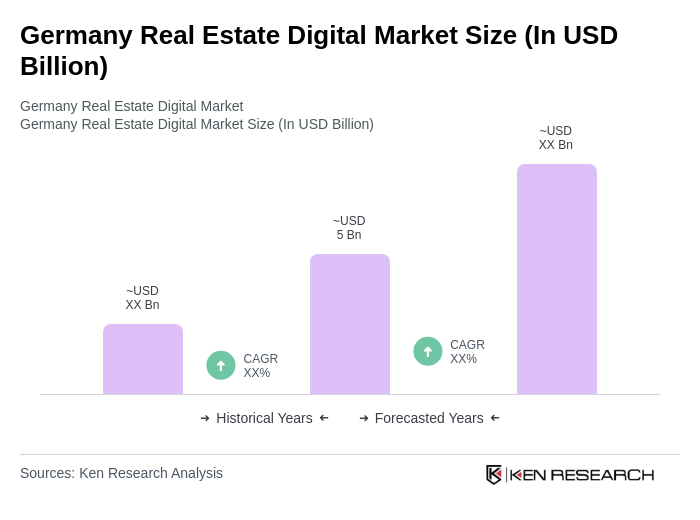
- The Germany Real Estate Digital Market is valued at USD 5 billion, based on a five-year historical analysis. This growth is primarily driven by the increasing digitization of real estate transactions, the rise of online property listings, and the growing demand for efficient property management solutions. The market has seen a significant shift towards digital platforms, enabling buyers and sellers to connect seamlessly.
- Key cities such as Berlin, Munich, and Frankfurt dominate the market due to their robust economic conditions, high population density, and significant foreign investment. These urban centers are characterized by a vibrant real estate landscape, attracting both local and international buyers, which further fuels the growth of digital marketplaces in the sector.
- In 2023, the German government implemented regulations aimed at enhancing transparency in real estate transactions. This includes mandatory disclosures for property listings and stricter guidelines for online platforms to ensure consumer protection. Such regulations are designed to foster trust and integrity in the digital real estate marketplace.
Germany Real Estate Digital Market Segmentation
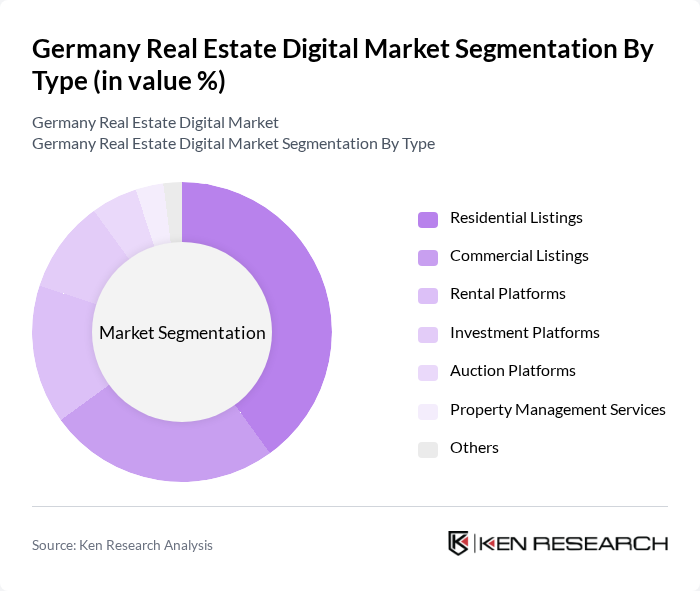
By Type:The market is segmented into various types, including Residential Listings, Commercial Listings, Rental Platforms, Investment Platforms, Auction Platforms, Property Management Services, and Others. Each of these subsegments caters to different consumer needs and preferences, with Residential Listings being particularly popular due to the high demand for housing in urban areas.
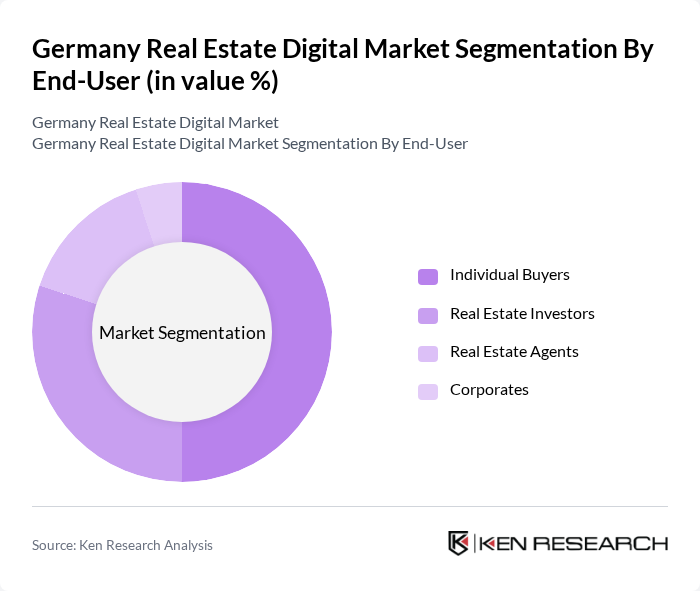
By End-User:The end-user segmentation includes Individual Buyers, Real Estate Investors, Real Estate Agents, and Corporates. Individual Buyers represent a significant portion of the market, driven by the increasing trend of homeownership and the desire for personal investment in real estate.
Germany Real Estate Digital Market Competitive Landscape
The Germany Real Estate Digital Market is characterized by a dynamic mix of regional and international players. Leading participants such as ImmobilienScout24, Immowelt AG, eBay Kleinanzeigen, Homeday GmbH, PlanetHome AG, Funda, Baufi24, Ziegert Bank- und Immobilienconsulting GmbH, Engel & Völkers AG, Vonovia SE, Deutsche Wohnen SE, LEG Immobilien AG, TAG Immobilien AG, Grand City Properties S.A., ADO Properties S.A. contribute to innovation, geographic expansion, and service delivery in this space.
Germany Real Estate Digital Market Industry Analysis
Growth Drivers
- Increasing Urbanization:Germany's urban population is projected to reach approximately 80% in the future, up from 77% in 2020, according to the Federal Statistical Office. This surge in urbanization drives demand for digital real estate solutions, as more individuals seek housing in metropolitan areas. The influx of residents into cities like Berlin and Munich has led to a significant increase in property listings, necessitating efficient digital platforms to cater to the growing population's housing needs.
- Technological Advancements in Property Listings:The integration of advanced technologies, such as AI and machine learning, has transformed property listings in Germany. In the future, it is estimated that over 60% of real estate transactions will utilize digital platforms, enhancing the efficiency of property searches. The adoption of 3D modeling and virtual reality tools has also improved user engagement, allowing potential buyers to explore properties remotely, thus streamlining the buying process significantly.
- Rising Demand for Digital Transactions:The shift towards digital transactions in the real estate sector is evident, with a reported 45% increase in online property transactions from 2020 to 2023. This trend is driven by consumer preferences for convenience and speed, particularly among younger demographics. As of the future, it is anticipated that digital transactions will account for over €50 billion in real estate sales, reflecting a significant transformation in how properties are bought and sold in Germany.
Market Challenges
- Regulatory Compliance Issues:The German real estate market faces stringent regulatory frameworks, particularly concerning data protection and transaction transparency. Compliance with the General Data Protection Regulation (GDPR) has become a significant hurdle for digital platforms, with fines reaching up to €20 million for violations. As of the future, companies must invest heavily in compliance measures, diverting resources from innovation and growth, which can stifle market expansion.
- High Competition among Digital Platforms:The competitive landscape in Germany's digital real estate market is intensifying, with over 200 platforms vying for market share. This saturation leads to price wars and reduced profit margins, making it challenging for new entrants to establish themselves. By the future, it is expected that only the top 10 platforms will dominate 70% of the market, leaving smaller players struggling to survive amidst fierce competition and limited differentiation.
Germany Real Estate Digital Market Future Outlook
The future of Germany's real estate digital market appears promising, driven by technological innovations and evolving consumer preferences. As urbanization continues, digital platforms will increasingly integrate advanced technologies like AI and blockchain to enhance transaction security and efficiency. Additionally, the growing emphasis on sustainability will likely shape market offerings, with more platforms focusing on eco-friendly properties. Overall, the market is poised for significant transformation, adapting to the needs of a tech-savvy population seeking seamless real estate experiences.
Market Opportunities
- Expansion into Suburban Areas:As urban living costs rise, there is a growing trend of families relocating to suburban regions. This shift presents an opportunity for digital platforms to expand their services into these areas, catering to the increasing demand for affordable housing options. In the future, suburban property listings are expected to grow by 30%, providing a lucrative market for digital real estate services.
- Integration of AI and Big Data Analytics:The incorporation of AI and big data analytics into real estate platforms can significantly enhance user experience and operational efficiency. In the future, platforms utilizing these technologies are projected to improve property matching accuracy by 40%, leading to higher customer satisfaction and increased transaction volumes. This technological integration will be crucial for platforms aiming to differentiate themselves in a competitive market.
Scope of the Report
| Segment | Sub-Segments |
|---|---|
| By Type | Residential Listings Commercial Listings Rental Platforms Investment Platforms Auction Platforms Property Management Services Others |
| By End-User | Individual Buyers Real Estate Investors Real Estate Agents Corporates |
| By Sales Channel | Online Marketplaces Direct Sales Mobile Applications Social Media Platforms |
| By Property Type | Single-Family Homes Multi-Family Homes Commercial Properties Land Sales |
| By Geographic Focus | Major Cities Suburban Areas Rural Areas International Listings |
| By Customer Segment | First-Time Buyers Luxury Buyers Investors Renters |
| By Service Type | Listing Services Marketing Services Consulting Services Others |
Key Target Audience
Investors and Venture Capitalist Firms
Government and Regulatory Bodies (e.g., Bundesanstalt für Immobilienaufgaben, Deutsches Institut für Normung e.V.)
Real Estate Developers
Property Management Companies
Real Estate Investment Trusts (REITs)
Financial Institutions
Technology Providers
Real Estate Brokers and Agents
Players Mentioned in the Report:
ImmobilienScout24
Immowelt AG
eBay Kleinanzeigen
Homeday GmbH
PlanetHome AG
Funda
Baufi24
Ziegert Bank- und Immobilienconsulting GmbH
Engel & Volkers AG
Vonovia SE
Deutsche Wohnen SE
LEG Immobilien AG
TAG Immobilien AG
Grand City Properties S.A.
ADO Properties S.A.
Table of Contents
Market Assessment Phase
1. Executive Summary and Approach
2. Germany Real Estate Digital Market Overview
2.1 Key Insights and Strategic Recommendations
2.2 Germany Real Estate Digital Market Overview
2.3 Definition and Scope
2.4 Evolution of Market Ecosystem
2.5 Timeline of Key Regulatory Milestones
2.6 Value Chain & Stakeholder Mapping
2.7 Business Cycle Analysis
2.8 Policy & Incentive Landscape
3. Germany Real Estate Digital Market Analysis
3.1 Growth Drivers
3.1.1 Increasing Urbanization
3.1.2 Technological Advancements in Property Listings
3.1.3 Rising Demand for Digital Transactions
3.1.4 Enhanced User Experience through Mobile Platforms
3.2 Market Challenges
3.2.1 Regulatory Compliance Issues
3.2.2 High Competition among Digital Platforms
3.2.3 Data Privacy Concerns
3.2.4 Market Saturation in Major Cities
3.3 Market Opportunities
3.3.1 Expansion into Suburban Areas
3.3.2 Integration of AI and Big Data Analytics
3.3.3 Partnerships with Real Estate Agencies
3.3.4 Development of Niche Marketplaces
3.4 Market Trends
3.4.1 Growth of Virtual Tours and Augmented Reality
3.4.2 Increasing Use of Blockchain for Transactions
3.4.3 Shift towards Sustainable Real Estate Solutions
3.4.4 Rise of Subscription-Based Models
3.5 Government Regulation
3.5.1 Data Protection Regulations (GDPR)
3.5.2 Real Estate Licensing Requirements
3.5.3 Anti-Money Laundering Laws
3.5.4 Taxation Policies on Digital Transactions
4. SWOT Analysis
5. Stakeholder Analysis
6. Porter's Five Forces Analysis
7. Germany Real Estate Digital Market Market Size, 2019-2024
7.1 By Value
7.2 By Volume
7.3 By Average Selling Price
8. Germany Real Estate Digital Market Segmentation
8.1 By Type
8.1.1 Residential Listings
8.1.2 Commercial Listings
8.1.3 Rental Platforms
8.1.4 Investment Platforms
8.1.5 Auction Platforms
8.1.6 Property Management Services
8.1.7 Others
8.2 By End-User
8.2.1 Individual Buyers
8.2.2 Real Estate Investors
8.2.3 Real Estate Agents
8.2.4 Corporates
8.3 By Sales Channel
8.3.1 Online Marketplaces
8.3.2 Direct Sales
8.3.3 Mobile Applications
8.3.4 Social Media Platforms
8.4 By Property Type
8.4.1 Single-Family Homes
8.4.2 Multi-Family Homes
8.4.3 Commercial Properties
8.4.4 Land Sales
8.5 By Geographic Focus
8.5.1 Major Cities
8.5.2 Suburban Areas
8.5.3 Rural Areas
8.5.4 International Listings
8.6 By Customer Segment
8.6.1 First-Time Buyers
8.6.2 Luxury Buyers
8.6.3 Investors
8.6.4 Renters
8.7 By Service Type
8.7.1 Listing Services
8.7.2 Marketing Services
8.7.3 Consulting Services
8.7.4 Others
9. Germany Real Estate Digital Market Competitive Analysis
9.1 Market Share of Key Players
9.2 Cross Comparison of Key Players
9.2.1 Company Name
9.2.2 Group Size (Large, Medium, or Small as per industry convention)
9.2.3 Revenue Growth Rate
9.2.4 Customer Acquisition Cost
9.2.5 Market Penetration Rate
9.2.6 Customer Retention Rate
9.2.7 Pricing Strategy
9.2.8 Average Transaction Value
9.2.9 User Engagement Metrics
9.2.10 Return on Investment (ROI)
9.3 SWOT Analysis of Top Players
9.4 Pricing Analysis
9.5 Detailed Profile of Major Companies
9.5.1 ImmobilienScout24
9.5.2 Immowelt AG
9.5.3 eBay Kleinanzeigen
9.5.4 Homeday GmbH
9.5.5 PlanetHome AG
9.5.6 Funda
9.5.7 Baufi24
9.5.8 Ziegert Bank- und Immobilienconsulting GmbH
9.5.9 Engel & Völkers AG
9.5.10 Vonovia SE
9.5.11 Deutsche Wohnen SE
9.5.12 LEG Immobilien AG
9.5.13 TAG Immobilien AG
9.5.14 Grand City Properties S.A.
9.5.15 ADO Properties S.A.
10. Germany Real Estate Digital Market End-User Analysis
10.1 Procurement Behavior of Key Ministries
10.1.1 Budget Allocation Trends
10.1.2 Decision-Making Processes
10.1.3 Preferred Procurement Channels
10.2 Corporate Spend on Infrastructure & Energy
10.2.1 Investment Priorities
10.2.2 Spending Patterns
10.2.3 Key Drivers of Corporate Spend
10.3 Pain Point Analysis by End-User Category
10.3.1 Common Challenges Faced by Buyers
10.3.2 Issues Encountered by Real Estate Agents
10.3.3 Barriers for Investors
10.4 User Readiness for Adoption
10.4.1 Technology Adoption Rates
10.4.2 Training and Support Needs
10.4.3 User Feedback Mechanisms
10.5 Post-Deployment ROI and Use Case Expansion
10.5.1 Measurement of ROI
10.5.2 Case Studies of Successful Implementations
10.5.3 Future Use Case Opportunities
11. Germany Real Estate Digital Market Future Size, 2025-2030
11.1 By Value
11.2 By Volume
11.3 By Average Selling Price
Go-To-Market Strategy Phase
1. Whitespace Analysis + Business Model Canvas
1.1 Market Gaps Identification
1.2 Business Model Framework
2. Marketing and Positioning Recommendations
2.1 Branding Strategies
2.2 Product USPs
3. Distribution Plan
3.1 Urban Retail vs Rural NGO Tie-Ups
4. Channel & Pricing Gaps
4.1 Underserved Routes
4.2 Pricing Bands
5. Unmet Demand & Latent Needs
5.1 Category Gaps
5.2 Consumer Segments
6. Customer Relationship
6.1 Loyalty Programs
6.2 After-Sales Service
7. Value Proposition
7.1 Sustainability
7.2 Integrated Supply Chains
8. Key Activities
8.1 Regulatory Compliance
8.2 Branding
8.3 Distribution Setup
9. Entry Strategy Evaluation
9.1 Domestic Market Entry Strategy
9.1.1 Product Mix
9.1.2 Pricing Band
9.1.3 Packaging
9.2 Export Entry Strategy
9.2.1 Target Countries
9.2.2 Compliance Roadmap
10. Entry Mode Assessment
10.1 Joint Ventures
10.2 Greenfield Investments
10.3 Mergers & Acquisitions
10.4 Distributor Model
11. Capital and Timeline Estimation
11.1 Capital Requirements
11.2 Timelines
12. Control vs Risk Trade-Off
12.1 Ownership vs Partnerships
13. Profitability Outlook
13.1 Breakeven Analysis
13.2 Long-Term Sustainability
14. Potential Partner List
14.1 Distributors
14.2 Joint Ventures
14.3 Acquisition Targets
15. Execution Roadmap
15.1 Phased Plan for Market Entry
15.1.1 Market Setup
15.1.2 Market Entry
15.1.3 Growth Acceleration
15.1.4 Scale & Stabilize
15.2 Key Activities and Milestones
15.2.1 Activity Timeline
15.2.2 Milestone Tracking
Research Methodology
Phase 1: Approach1
Desk Research
- Analysis of market reports from real estate associations and government publications
- Review of online property listings and transaction data from major real estate platforms
- Examination of demographic and economic data from statistical agencies and research institutions
Primary Research
- Interviews with real estate agents and brokers specializing in the digital market
- Surveys with property developers and investors focusing on digital transformation
- Field interviews with technology providers in the real estate sector
Validation & Triangulation
- Cross-validation of findings through multiple data sources, including industry reports and expert opinions
- Triangulation of market trends using sales data, consumer behavior studies, and regulatory impacts
- Sanity checks through expert panel reviews and feedback from industry stakeholders
Phase 2: Market Size Estimation1
Top-down Assessment
- Estimation of the overall real estate market size in Germany and its digital segment
- Segmentation of the market by property type, including residential, commercial, and industrial
- Incorporation of trends in digital adoption and technology integration in real estate transactions
Bottom-up Modeling
- Collection of data from leading real estate firms on transaction volumes and digital service usage
- Operational cost analysis based on technology implementation and service delivery models
- Volume x cost calculations for various digital real estate services offered
Forecasting & Scenario Analysis
- Multi-factor regression analysis incorporating economic indicators, digital adoption rates, and consumer preferences
- Scenario modeling based on potential regulatory changes and market disruptions
- Development of baseline, optimistic, and pessimistic forecasts through 2030
Phase 3: CATI Sample Composition1
| Scope Item/Segment | Sample Size | Target Respondent Profiles |
|---|---|---|
| Residential Real Estate Agents | 150 | Real Estate Agents, Brokers |
| Commercial Property Developers | 100 | Property Developers, Investment Managers |
| Technology Providers in Real Estate | 80 | Tech Entrepreneurs, Product Managers |
| Real Estate Investors | 70 | Institutional Investors, Private Equity Firms |
| Digital Marketing Specialists for Real Estate | 60 | Marketing Managers, Digital Strategists |
Frequently Asked Questions
What is the current value of the Germany Real Estate Digital Market?
The Germany Real Estate Digital Market is valued at approximately USD 5 billion, reflecting significant growth driven by the increasing digitization of real estate transactions and the rise of online property listings.
Which cities dominate the Germany Real Estate Digital Market?
What regulations has the German government implemented for real estate transactions?
What are the main segments of the Germany Real Estate Digital Market?
Other Regional/Country Reports
Indonesia Real Estate Digital Marketplaces Market
Malaysia Real Estate Digital Marketplaces Market
KSA Real Estate Digital Marketplaces Market
APAC Real Estate Digital Marketplaces Market
Other Adjacent Reports
Brazil PropTech Market
Oman Real Estate Software MarketBrazil Digital Property Management Market
Singapore Online Real Estate Auction Market
Qatar Real Estate Investment Platform Market
South Korea Property Data Analytics Market
Kuwait Virtual Reality Real Estate Market
Malaysia Blockchain Real Estate Market
Philippines AI Property Valuation Market
Smart Building Technology MarketWhy Buy From Us?

What makes us stand out is that our consultants follow Robust, Refine and Result (RRR) methodology. Robust for clear definitions, approaches and sanity checking, Refine for differentiating respondents' facts and opinions, and Result for presenting data with story.

We have set a benchmark in the industry by offering our clients with syndicated and customized market research reports featuring coverage of entire market as well as meticulous research and analyst insights.

While we don't replace traditional research, we flip the method upside down. Our dual approach of Top Bottom & Bottom Top ensures quality deliverable by not just verifying company fundamentals but also looking at the sector and macroeconomic factors.

With one step in the future, our research team constantly tries to show you the bigger picture. We help with some of the tough questions you may encounter along the way: How is the industry positioned? Best marketing channel? KPI's of competitors? By aligning every element, we help maximize success.

Our report gives you instant access to the answers and sources that other companies might choose to hide. We elaborate each steps of research methodology we have used and showcase you the sample size to earn your trust.

If you need any support, we are here! We pride ourselves on universe strength, data quality, and quick, friendly, and professional service.