About the Report
Base Year 2024Germany Retail Media and Online Advertising Market Overview
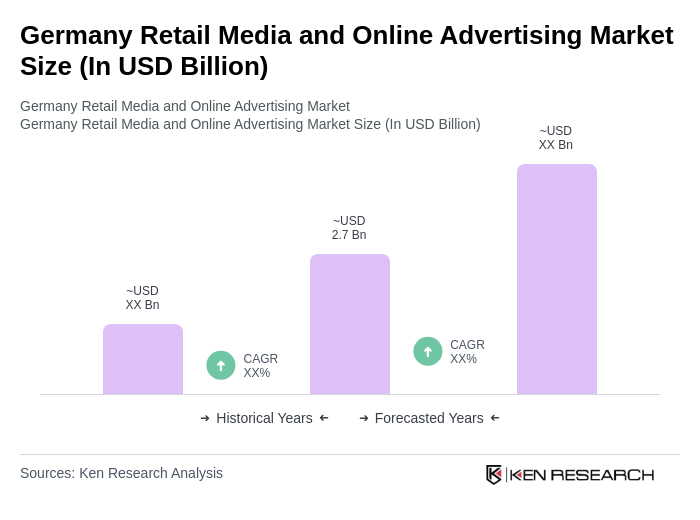
- The Germany Retail Media and Online Advertising Market is valued at USD 2.7 billion, based on a five-year historical analysis. This growth is primarily driven by the increasing shift of advertising budgets from traditional media to digital platforms, the rapid expansion of e-commerce, and the widespread adoption of mobile shopping. The demand for targeted advertising solutions has surged as brands seek to optimize their marketing strategies and enhance customer engagement, with more than 80% of digital advertisers in Germany allocating budgets to retail media and planning to increase their spending in the near term .
- Key cities such as Berlin, Munich, and Frankfurt dominate the market due to their robust digital infrastructure, high concentration of tech companies, and a large consumer base. These urban centers are recognized as hubs for innovation and creativity, attracting both local and international brands looking to leverage retail media for effective advertising campaigns .
- In 2023, the German government strengthened data privacy and transparency requirements for online advertising through the Federal Act on Data Protection and Privacy in Telecommunications and Telemedia (TTDSG), issued by the Federal Ministry of Justice. This regulation mandates companies to obtain explicit user consent before collecting personal data for targeted advertising, thereby promoting ethical advertising practices and safeguarding consumer rights .
Germany Retail Media and Online Advertising Market Segmentation
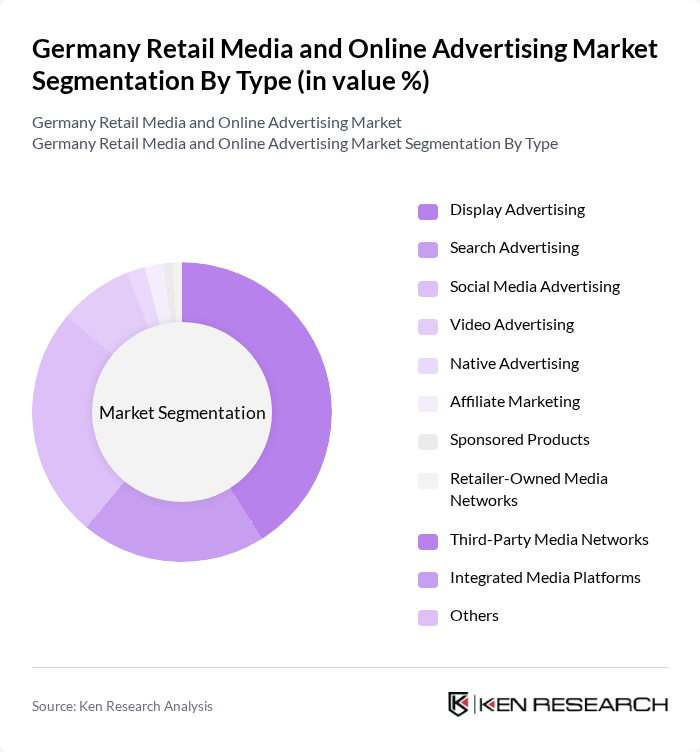
By Type:The market is segmented into various types of advertising, including Display Advertising, Search Advertising, Social Media Advertising, Video Advertising, Native Advertising, Affiliate Marketing, Sponsored Products, Retailer-Owned Media Networks, Third-Party Media Networks, Integrated Media Platforms, and Others. Among these, Display Advertising and Social Media Advertising are particularly prominent due to their effectiveness in reaching targeted audiences and driving engagement. Display ads hold the largest segment share, reflecting the strong demand for visually engaging formats, while social media advertising benefits from the high penetration of platforms among German consumers .
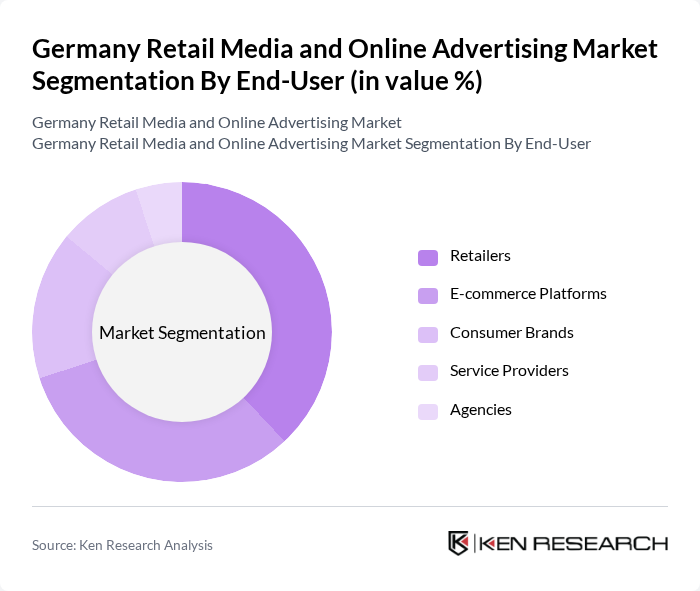
By End-User:The end-user segmentation includes Retailers, E-commerce Platforms, Consumer Brands, Service Providers, and Agencies. Retailers and E-commerce Platforms are the leading segments, as they heavily invest in online advertising to drive sales and enhance customer experience. Retailers are increasingly leveraging in-store digital signage and omnichannel strategies, while e-commerce platforms focus on personalized and data-driven campaigns .
Germany Retail Media and Online Advertising Market Competitive Landscape
The Germany Retail Media and Online Advertising Market is characterized by a dynamic mix of regional and international players. Leading participants such as Amazon Advertising, Google Ads, Meta Ads (Facebook & Instagram), Criteo, Adform, Rakuten Advertising, Awin, TradeDoubler, Outbrain, Taboola, MediaMath, Sizmek, AdRoll, Verve Group, Quantcast, Schwarz Media (Schwarz Gruppe), Otto Advertising, Zalando Marketing Services, Kaufland Marketing Services, Rewe Media, OBI First Media Group, Mirakl, CitrusAd contribute to innovation, geographic expansion, and service delivery in this space.
Germany Retail Media and Online Advertising Market Industry Analysis
Growth Drivers
- Increased E-commerce Adoption:The German e-commerce sector is projected to reach €89 billion in future, driven by a 10% annual growth rate. This surge is attributed to changing consumer behaviors, with 80% of Germans shopping online regularly. The rise in digital payment options and improved logistics has further facilitated this trend, making e-commerce a primary channel for retail media and online advertising, thus enhancing overall market growth.
- Enhanced Targeting Capabilities:Advances in data analytics have enabled retailers to achieve more precise audience targeting. In future, it is estimated that 60% of advertising budgets will be allocated to targeted campaigns, reflecting a shift towards data-driven strategies. This capability allows brands to reach specific demographics effectively, increasing conversion rates and maximizing return on investment, which is crucial for the competitive landscape of retail media.
- Rise of Mobile Shopping:Mobile commerce in Germany is expected to account for €30 billion in sales by future, representing a significant portion of total e-commerce. With over 60% of consumers using mobile devices for shopping, retailers are increasingly investing in mobile-optimized advertising strategies. This trend not only enhances user experience but also drives higher engagement rates, making mobile a critical driver for retail media growth.
Market Challenges
- Data Privacy Regulations:The implementation of GDPR has imposed strict data handling requirements on businesses, affecting advertising strategies. In future, compliance costs are projected to reach €1 billion for the retail sector. These regulations limit the use of consumer data for targeted advertising, posing a significant challenge for marketers aiming to personalize their campaigns while adhering to legal standards.
- High Competition Among Platforms:The German retail media landscape is characterized by intense competition, with over 200 platforms vying for market share. This saturation leads to increased advertising costs, with average CPC rates rising by 15% in future. As platforms compete for limited consumer attention, brands must innovate continuously to stand out, which can strain marketing budgets and resources.
Germany Retail Media and Online Advertising Market Future Outlook
The future of the German retail media and online advertising market appears promising, driven by technological advancements and evolving consumer preferences. As brands increasingly adopt omnichannel strategies, the integration of AI and machine learning will enhance personalization and targeting capabilities. Furthermore, the growing emphasis on sustainability in advertising will shape brand narratives, appealing to environmentally conscious consumers. These trends indicate a dynamic market landscape, fostering innovation and collaboration among stakeholders.
Market Opportunities
- Growth of Omnichannel Retailing:The shift towards omnichannel retailing presents significant opportunities, with 70% of consumers preferring brands that offer seamless shopping experiences. This trend encourages retailers to integrate online and offline channels, enhancing customer engagement and loyalty, ultimately driving sales growth in the retail media sector.
- Expansion of Programmatic Advertising:The programmatic advertising market in Germany is expected to grow to €4 billion in future. This growth is fueled by increased automation and efficiency in ad buying processes, allowing brands to optimize their advertising spend and reach targeted audiences more effectively, thus enhancing overall campaign performance.
Scope of the Report
| Segment | Sub-Segments |
|---|---|
| By Type | Display Advertising Search Advertising Social Media Advertising Video Advertising Native Advertising Affiliate Marketing Sponsored Products Retailer-Owned Media Networks Third-Party Media Networks Integrated Media Platforms Others |
| By End-User | Retailers E-commerce Platforms Consumer Brands Service Providers Agencies |
| By Sales Channel | Online Marketplaces Direct Sales Third-Party Platforms Brick-and-Mortar Retailers Others |
| By Audience Targeting | Demographic Targeting Behavioral Targeting Contextual Targeting Retargeting |
| By Campaign Objective | Brand Awareness Lead Generation Customer Acquisition Customer Retention |
| By Format | Banner Ads Sponsored Content Pop-up Ads Shoppable Media Others |
| By Industry Vertical | Fashion and Apparel Electronics Food and Beverage Health and Beauty Automotive Travel and Tourism Home Improvement & DIY Others |
Key Target Audience
Investors and Venture Capitalist Firms
Government and Regulatory Bodies (e.g., Federal Ministry for Economic Affairs and Energy, Federal Cartel Office)
Retail Chains and Supermarket Groups
Advertising Agencies and Media Buyers
Digital Marketing Platforms and Technology Providers
Brand Manufacturers and Product Owners
E-commerce Platforms and Online Marketplaces
Industry Associations and Trade Organizations
Players Mentioned in the Report:
Amazon Advertising
Google Ads
Meta Ads (Facebook & Instagram)
Criteo
Adform
Rakuten Advertising
Awin
TradeDoubler
Outbrain
Taboola
MediaMath
Sizmek
AdRoll
Verve Group
Quantcast
Schwarz Media (Schwarz Gruppe)
Otto Advertising
Zalando Marketing Services
Kaufland Marketing Services
Rewe Media
OBI First Media Group
Mirakl
CitrusAd
Table of Contents
Market Assessment Phase
1. Executive Summary and Approach
2. Germany Retail Media and Online Advertising Market Overview
2.1 Key Insights and Strategic Recommendations
2.2 Germany Retail Media and Online Advertising Market Overview
2.3 Definition and Scope
2.4 Evolution of Market Ecosystem
2.5 Timeline of Key Regulatory Milestones
2.6 Value Chain & Stakeholder Mapping
2.7 Business Cycle Analysis
2.8 Policy & Incentive Landscape
3. Germany Retail Media and Online Advertising Market Analysis
3.1 Growth Drivers
3.1.1 Increased E-commerce Adoption
3.1.2 Enhanced Targeting Capabilities
3.1.3 Rise of Mobile Shopping
3.1.4 Integration of AI in Advertising
3.2 Market Challenges
3.2.1 Data Privacy Regulations
3.2.2 High Competition Among Platforms
3.2.3 Ad Fraud Concerns
3.2.4 Rapidly Changing Consumer Preferences
3.3 Market Opportunities
3.3.1 Growth of Omnichannel Retailing
3.3.2 Expansion of Programmatic Advertising
3.3.3 Increased Investment in Digital Marketing
3.3.4 Collaboration with Influencers
3.4 Market Trends
3.4.1 Shift Towards Personalization
3.4.2 Growth of Video Advertising
3.4.3 Emphasis on Sustainability in Advertising
3.4.4 Use of Augmented Reality in Campaigns
3.5 Government Regulation
3.5.1 GDPR Compliance Requirements
3.5.2 Advertising Standards Authority Guidelines
3.5.3 E-commerce Directive Regulations
3.5.4 Consumer Protection Laws
4. SWOT Analysis
5. Stakeholder Analysis
6. Porter's Five Forces Analysis
7. Germany Retail Media and Online Advertising Market Market Size, 2019-2024
7.1 By Value
7.2 By Volume
7.3 By Average Selling Price
8. Germany Retail Media and Online Advertising Market Segmentation
8.1 By Type
8.1.1 Display Advertising
8.1.2 Search Advertising
8.1.3 Social Media Advertising
8.1.4 Video Advertising
8.1.5 Native Advertising
8.1.6 Affiliate Marketing
8.1.7 Sponsored Products
8.1.8 Retailer-Owned Media Networks
8.1.9 Third-Party Media Networks
8.1.10 Integrated Media Platforms
8.1.11 Others
8.2 By End-User
8.2.1 Retailers
8.2.2 E-commerce Platforms
8.2.3 Consumer Brands
8.2.4 Service Providers
8.2.5 Agencies
8.3 By Sales Channel
8.3.1 Online Marketplaces
8.3.2 Direct Sales
8.3.3 Third-Party Platforms
8.3.4 Brick-and-Mortar Retailers
8.3.5 Others
8.4 By Audience Targeting
8.4.1 Demographic Targeting
8.4.2 Behavioral Targeting
8.4.3 Contextual Targeting
8.4.4 Retargeting
8.5 By Campaign Objective
8.5.1 Brand Awareness
8.5.2 Lead Generation
8.5.3 Customer Acquisition
8.5.4 Customer Retention
8.6 By Format
8.6.1 Banner Ads
8.6.2 Sponsored Content
8.6.3 Pop-up Ads
8.6.4 Shoppable Media
8.6.5 Others
8.7 By Industry Vertical
8.7.1 Fashion and Apparel
8.7.2 Electronics
8.7.3 Food and Beverage
8.7.4 Health and Beauty
8.7.5 Automotive
8.7.6 Travel and Tourism
8.7.7 Home Improvement & DIY
8.7.8 Others
9. Germany Retail Media and Online Advertising Market Competitive Analysis
9.1 Market Share of Key Players
9.2 Cross Comparison of Key Players
9.2.1 Company Name
9.2.2 Group Size (Large, Medium, or Small as per industry convention)
9.2.3 Revenue Growth Rate
9.2.4 Customer Acquisition Cost (CAC)
9.2.5 Customer Lifetime Value (CLV)
9.2.6 Conversion Rate
9.2.7 Return on Advertising Spend (ROAS)
9.2.8 Pricing Strategy
9.2.9 Market Penetration Rate
9.2.10 Brand Equity Score
9.2.11 Share of Voice
9.2.12 Ad Impressions & Click-Through Rate (CTR)
9.2.13 Retailer Monetization Rate
9.2.14 Share of Retailer-Owned Media Network Revenue
9.3 SWOT Analysis of Top Players
9.4 Pricing Analysis
9.5 Detailed Profile of Major Companies
9.5.1 Amazon Advertising
9.5.2 Google Ads
9.5.3 Meta Ads (Facebook & Instagram)
9.5.4 Criteo
9.5.5 Adform
9.5.6 Rakuten Advertising
9.5.7 Awin
9.5.8 TradeDoubler
9.5.9 Outbrain
9.5.10 Taboola
9.5.11 MediaMath
9.5.12 Sizmek
9.5.13 AdRoll
9.5.14 Verve Group
9.5.15 Quantcast
9.5.16 Schwarz Media (Schwarz Gruppe)
9.5.17 Otto Advertising
9.5.18 Zalando Marketing Services
9.5.19 Kaufland Marketing Services
9.5.20 Rewe Media
9.5.21 OBI First Media Group
9.5.22 Mirakl
9.5.23 CitrusAd
10. Germany Retail Media and Online Advertising Market End-User Analysis
10.1 Procurement Behavior of Key Ministries
10.1.1 Digital Advertising Spend Trends
10.1.2 Preferred Advertising Channels
10.1.3 Budget Allocation Strategies
10.2 Corporate Spend on Infrastructure & Energy
10.2.1 Investment in Digital Infrastructure
10.2.2 Spending on Marketing Technologies
10.2.3 Budget for Online Campaigns
10.3 Pain Point Analysis by End-User Category
10.3.1 Challenges in Ad Placement
10.3.2 Issues with Data Privacy Compliance
10.3.3 Difficulty in Measuring ROI
10.4 User Readiness for Adoption
10.4.1 Awareness of Digital Advertising Benefits
10.4.2 Readiness to Invest in New Technologies
10.4.3 Training Needs for Staff
10.5 Post-Deployment ROI and Use Case Expansion
10.5.1 Evaluation of Campaign Effectiveness
10.5.2 Opportunities for Scaling Successful Campaigns
10.5.3 Feedback Mechanisms for Continuous Improvement
11. Germany Retail Media and Online Advertising Market Future Size, 2025-2030
11.1 By Value
11.2 By Volume
11.3 By Average Selling Price
Go-To-Market Strategy Phase
1. Whitespace Analysis + Business Model Canvas
1.1 Market Gaps Identification
1.2 Business Model Development
1.3 Value Proposition Analysis
1.4 Revenue Streams Exploration
2. Marketing and Positioning Recommendations
2.1 Branding Strategies
2.2 Product USPs
2.3 Target Audience Segmentation
2.4 Communication Strategies
3. Distribution Plan
3.1 Urban Retail Strategies
3.2 Rural NGO Tie-ups
3.3 Online vs Offline Distribution
3.4 Partnership Opportunities
4. Channel & Pricing Gaps
4.1 Underserved Routes
4.2 Pricing Bands Analysis
4.3 Competitive Pricing Strategies
5. Unmet Demand & Latent Needs
5.1 Category Gaps Identification
5.2 Consumer Segments Analysis
5.3 Emerging Trends Exploration
6. Customer Relationship
6.1 Loyalty Programs Development
6.2 After-sales Service Strategies
6.3 Customer Feedback Mechanisms
7. Value Proposition
7.1 Sustainability Initiatives
7.2 Integrated Supply Chains
7.3 Unique Selling Points
8. Key Activities
8.1 Regulatory Compliance
8.2 Branding Initiatives
8.3 Distribution Setup
9. Entry Strategy Evaluation
9.1 Domestic Market Entry Strategy
9.1.1 Product Mix Considerations
9.1.2 Pricing Band Strategies
9.1.3 Packaging Innovations
9.2 Export Entry Strategy
9.2.1 Target Countries Identification
9.2.2 Compliance Roadmap Development
10. Entry Mode Assessment
10.1 Joint Ventures
10.2 Greenfield Investments
10.3 Mergers & Acquisitions
10.4 Distributor Model Evaluation
11. Capital and Timeline Estimation
11.1 Capital Requirements Analysis
11.2 Timelines for Market Entry
12. Control vs Risk Trade-Off
12.1 Ownership vs Partnerships
12.2 Risk Mitigation Strategies
13. Profitability Outlook
13.1 Breakeven Analysis
13.2 Long-term Sustainability Strategies
14. Potential Partner List
14.1 Distributors Identification
14.2 Joint Ventures Opportunities
14.3 Acquisition Targets
15. Execution Roadmap
15.1 Phased Plan for Market Entry
15.1.1 Market Setup
15.1.2 Market Entry
15.1.3 Growth Acceleration
15.1.4 Scale & Stabilize
15.2 Key Activities and Milestones
15.2.1 Milestone Planning
15.2.2 Activity Tracking
Research Methodology
Phase 1: Approach1
Desk Research
- Analysis of industry reports from market research firms focusing on retail media and online advertising trends in Germany
- Review of government publications and statistics related to digital advertising expenditures and retail growth
- Examination of case studies and white papers from leading advertising agencies and retail platforms
Primary Research
- Interviews with marketing executives from major retail chains to understand their advertising strategies
- Surveys targeting digital marketing professionals to gather insights on media spending and effectiveness
- Focus groups with consumers to assess perceptions and responses to retail media advertising
Validation & Triangulation
- Cross-validation of findings through comparison with historical advertising spend data and growth rates
- Triangulation of insights from primary interviews with secondary data sources to ensure consistency
- Sanity checks conducted through expert panel reviews comprising industry veterans and analysts
Phase 2: Market Size Estimation1
Top-down Assessment
- Estimation of total advertising spend in Germany, segmented by digital and traditional media
- Analysis of growth rates in e-commerce and its impact on retail media spending
- Incorporation of macroeconomic indicators such as GDP growth and consumer spending trends
Bottom-up Modeling
- Collection of data on advertising budgets from a sample of retail companies across various sectors
- Estimation of average spend per channel (e.g., social media, search engines, display ads) based on industry benchmarks
- Calculation of total market size by aggregating individual company data and extrapolating to the broader market
Forecasting & Scenario Analysis
- Development of forecasting models based on historical growth trends and future market drivers
- Scenario analysis considering factors such as regulatory changes, technological advancements, and shifts in consumer behavior
- Creation of multiple projections (baseline, optimistic, and pessimistic) to account for market volatility
Phase 3: CATI Sample Composition1
| Scope Item/Segment | Sample Size | Target Respondent Profiles |
|---|---|---|
| Retail Media Strategies | 100 | Marketing Directors, Brand Managers |
| Online Advertising Effectiveness | 80 | Digital Marketing Specialists, Analytics Managers |
| Consumer Engagement with Retail Ads | 60 | Market Researchers, Consumer Insights Analysts |
| Trends in E-commerce Advertising | 90 | E-commerce Managers, Digital Strategy Leads |
| Impact of Social Media on Retail | 70 | Social Media Managers, Content Strategists |
Frequently Asked Questions
What is the current value of the Germany Retail Media and Online Advertising Market?
The Germany Retail Media and Online Advertising Market is valued at approximately USD 2.7 billion, reflecting a significant shift of advertising budgets from traditional media to digital platforms, driven by the growth of e-commerce and mobile shopping.
What are the key cities driving the retail media market in Germany?
How has the German government influenced online advertising?
What types of advertising are prominent in the German market?
Other Regional/Country Reports
Indonesia Retail Media and Online Advertising Market
Malaysia Retail Media and Online Advertising Market
KSA Retail Media and Online Advertising Market
APAC Retail Media and Online Advertising Market
SEA Retail Media and Online Advertising Market
Vietnam Retail Media and Online Advertising Market
Other Adjacent Reports
Oman Social Media Advertising Market
Saudi Arabia Programmatic Advertising MarketGlobal AdTech Market Outlook to 2030Saudi Arabia data analytics market report Size, Share, Growth Drivers, Trends, Opportunities & Forecast 2025–2030UAE Location Targeted Mobile Advertising MarketIndonesia Influencer Marketing Market Outlook to 2030Oman Affiliate Marketing Market
KSA Omnichannel Retail Market
Why Buy From Us?

What makes us stand out is that our consultants follow Robust, Refine and Result (RRR) methodology. Robust for clear definitions, approaches and sanity checking, Refine for differentiating respondents' facts and opinions, and Result for presenting data with story.

We have set a benchmark in the industry by offering our clients with syndicated and customized market research reports featuring coverage of entire market as well as meticulous research and analyst insights.

While we don't replace traditional research, we flip the method upside down. Our dual approach of Top Bottom & Bottom Top ensures quality deliverable by not just verifying company fundamentals but also looking at the sector and macroeconomic factors.

With one step in the future, our research team constantly tries to show you the bigger picture. We help with some of the tough questions you may encounter along the way: How is the industry positioned? Best marketing channel? KPI's of competitors? By aligning every element, we help maximize success.

Our report gives you instant access to the answers and sources that other companies might choose to hide. We elaborate each steps of research methodology we have used and showcase you the sample size to earn your trust.

If you need any support, we are here! We pride ourselves on universe strength, data quality, and quick, friendly, and professional service.