About the Report
Base Year 2024Global Aliphatic Hydrocarbon Market Overview
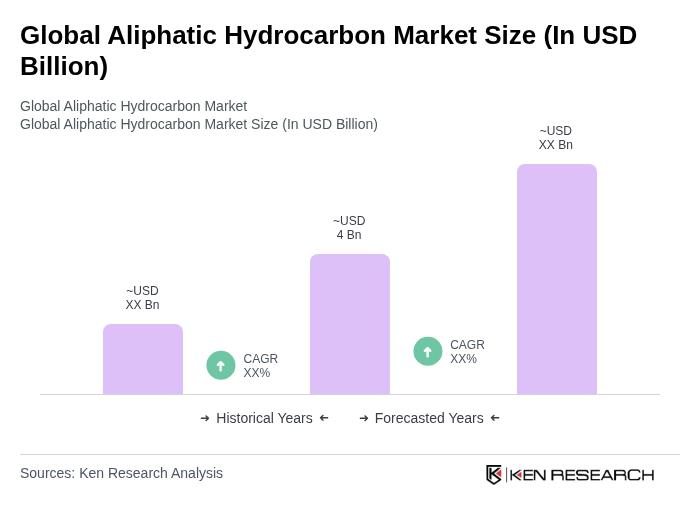
- The Global Aliphatic Hydrocarbon Market was valued at USD 4 billion, based on a five-year historical analysis. This growth is primarily driven by the increasing demand for solvents in various applications, including paints, coatings, aerosols, adhesives and sealants, mining, oil and gas, and water treatment, where aliphatic hydrocarbons are widely used as low-aromatic or dearomatized solvents. The rise in industrial activities, expanding construction and automotive production, and the shift toward high-purity, low-odor solvent grades have further fueled the need for aliphatic hydrocarbons in manufacturing and formulation processes.
- Key players in this market include the United States, China, and other Asia Pacific economies, which dominate due to their robust industrial bases, significant investments in petrochemicals, and strong presence of paints, coatings, and automotive manufacturing clusters. Asia Pacific holds the largest revenue share in the aliphatic hydrocarbon market, supported by rapid urbanization, infrastructure development, and growing solvent consumption in India, Japan, South Korea, and China, while North America remains a major demand center driven by automotive, industrial maintenance, and construction sectors.
- The European Union has implemented a series of stringent regulations on volatile organic compounds (VOCs) emissions and solvent use, which have a direct impact on the aliphatic hydrocarbon market. Key binding instruments include Directive 2010/75/EU on industrial emissions (integrated pollution prevention and control), issued by the European Parliament and of the Council, which sets emission limit values for VOCs from installations using organic solvents, and Directive 2004/42/EC on the limitation of emissions of VOCs due to the use of organic solvents in certain paints, varnishes and vehicle refinishing products, which establishes maximum VOC content thresholds for many solvent-borne coatings. These frameworks promote the use of lower-VOC and higher-solids formulations, driving manufacturers of aliphatic hydrocarbons toward more refined, low-aromatic, and environmentally oriented solvent grades to maintain compliance and address customer sustainability requirements in Europe.
Global Aliphatic Hydrocarbon Market Segmentation
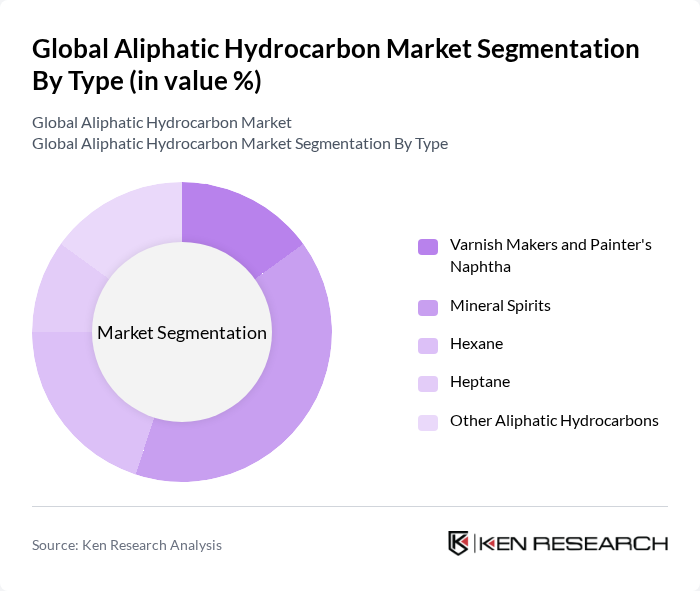
By Type:The aliphatic hydrocarbon market is segmented into various types, including Varnish Makers and Painter's Naphtha, Mineral Spirits, Hexane, Heptane, and Other Aliphatic Hydrocarbons. Among these, Mineral Spirits (also referred to as white spirits) and Varnish Makers and Painter's Naphtha are among the most widely used solvent types in paints and coatings, metalworking fluids, and cleaning formulations, owing to their good solvency for resins, controlled evaporation rates, and relatively low cost compared with oxygenated solvents. In parallel, n-hexane and n-heptane are increasingly in demand for high-purity applications, including polymerization, specialty chemical synthesis, and adhesive and sealant formulations, where tighter boiling ranges and low aromatic content are critical quality parameters.
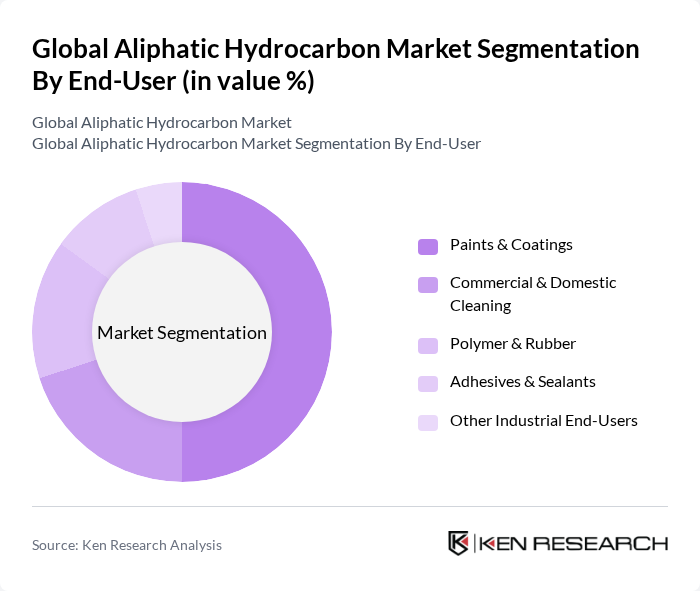
By End-User:The end-user segmentation of the aliphatic hydrocarbon market includes Paints & Coatings, Commercial & Domestic Cleaning, Polymer & Rubber, Adhesives & Sealants, and Other Industrial End-Users. The Paints & Coatings segment is the most significant, supported by expanding construction, infrastructure renovation, automotive OEM and refinish activities, and industrial maintenance, where aliphatic hydrocarbons are used as diluents, viscosity modifiers, and carriers in alkyd, polyurethane, and other solvent-borne systems. Commercial & Domestic Cleaning, along with Adhesives & Sealants and Polymer & Rubber processing, represent additional key demand centers as formulators seek low-odor, low-aromatic, and consistent-quality hydrocarbon solvents for degreasing, surface preparation, contact adhesives, and elastomer compounding.
Global Aliphatic Hydrocarbon Market Competitive Landscape
The Global Aliphatic Hydrocarbon Market is characterized by a dynamic mix of regional and international players. Leading participants such as ExxonMobil Corporation, Shell plc, Chevron Corporation, BP p.l.c., TotalEnergies SE, LyondellBasell Industries N.V., Sasol Limited, INEOS Group Holdings S.A., Calumet Specialty Products Partners, L.P., HCS Group GmbH (Haltermann Carless), Gadiv Petrochemical Industries Ltd., Pure Chemicals Co., Kandla Energy & Chemicals Ltd., Ganga Rasaynie Pvt. Ltd., Repsol S.A. contribute to innovation, geographic expansion, and service delivery in this space, with many of these companies offering extensive portfolios of aliphatic hydrocarbon solvents, thinners, and specialty dearomatized grades tailored for coatings, adhesives, automotive, and industrial cleaning applications.
Global Aliphatic Hydrocarbon Market Industry Analysis
Growth Drivers
- Increasing Demand from Automotive Sector:The automotive sector is projected to consume approximately 1.5 million tons of aliphatic hydrocarbons in future, driven by the production of lightweight vehicles. The global automotive industry is expected to reach a value of USD 4 trillion, with a significant portion allocated to materials that enhance fuel efficiency. This demand is further supported by the anticipated growth in electric vehicle production, which requires high-quality hydrocarbons for manufacturing components, thereby boosting the aliphatic hydrocarbon market.
- Expansion of Chemical Manufacturing:The chemical manufacturing sector is expected to grow by 3.5% annually, reaching a market value of USD 5 trillion in future. This growth is largely attributed to the increasing production of specialty chemicals, which utilize aliphatic hydrocarbons as key feedstock. In future, the sector consumed over 2 million tons of aliphatic hydrocarbons, and this figure is projected to rise as manufacturers seek to innovate and expand their product lines, further driving market demand.
- Technological Advancements in Extraction Processes:Innovations in extraction technologies, such as enhanced oil recovery and advanced distillation methods, are expected to increase the efficiency of aliphatic hydrocarbon production by 20% in future. These advancements not only reduce operational costs but also improve yield rates, allowing producers to meet the rising demand from various sectors. The investment in R&D for these technologies is projected to exceed USD 10 billion, indicating a strong commitment to enhancing production capabilities.
Market Challenges
- Volatility in Raw Material Prices:The aliphatic hydrocarbon market faces significant challenges due to fluctuations in raw material prices, which can vary by as much as 30% within a year. In future, crude oil prices surged to USD 90 per barrel, impacting production costs for aliphatic hydrocarbons. This volatility creates uncertainty for manufacturers, making it difficult to maintain stable pricing and profitability, ultimately affecting market growth and investment decisions.
- Stringent Environmental Regulations:Increasingly stringent environmental regulations are imposing compliance costs on aliphatic hydrocarbon producers. In future, it is estimated that companies will spend over USD 5 billion to meet new emission standards set by various governments. These regulations aim to reduce greenhouse gas emissions and promote sustainable practices, which can hinder production capabilities and increase operational costs, posing a significant challenge to market players.
Global Aliphatic Hydrocarbon Market Future Outlook
The future of the aliphatic hydrocarbon market appears promising, driven by a shift towards sustainable practices and increased investment in research and development. As industries adapt to environmental regulations, the focus on eco-friendly products will likely enhance market growth. Additionally, digital transformation in operations is expected to streamline processes, improve efficiency, and reduce costs, positioning companies favorably in a competitive landscape. The integration of innovative technologies will further support the market's evolution, ensuring resilience against challenges.
Market Opportunities
- Growth in Renewable Energy Sector:The renewable energy sector is projected to grow by 15% annually, creating opportunities for aliphatic hydrocarbons in biofuel production. This shift towards cleaner energy sources is expected to drive demand for hydrocarbons as feedstock, potentially increasing market share in sustainable applications and enhancing overall profitability for producers.
- Emerging Markets Expansion:Emerging markets, particularly in Asia-Pacific, are expected to witness a 10% increase in demand for aliphatic hydrocarbons in future. Rapid industrialization and urbanization in these regions are driving the need for various chemical products, presenting significant growth opportunities for market players looking to expand their footprint in these high-potential areas.
Scope of the Report
| Segment | Sub-Segments |
|---|---|
| By Type | Varnish Makers and Painter's Naphtha Mineral Spirits Hexane Heptane Other Aliphatic Hydrocarbons |
| By End-User | Paints & Coatings Commercial & Domestic Cleaning Polymer & Rubber Adhesives & Sealants Other Industrial End-Users |
| By Application | Solvents & Thinners Diluents for Paints & Inks Degreasing & Cleaning Agents Adhesive Formulations Other Specialty Applications |
| By Source | Petroleum-derived Aliphatic Hydrocarbons Natural Gas-derived Aliphatic Hydrocarbons Bio-based Aliphatic Hydrocarbons Others |
| By Distribution Channel | Direct Sales to Industrial Customers Specialty Chemical Distributors Online/Broker-mediated Sales Others |
| By Geography | North America Europe Asia-Pacific Middle East & Africa Latin America |
| By Regulatory Compliance | VOC Emission Standards Compliance Environmental & REACH Regulations Occupational Health & Safety Standards Other Regional Regulatory Frameworks |
Key Target Audience
Investors and Venture Capitalist Firms
Government and Regulatory Bodies (e.g., Environmental Protection Agency, Department of Energy)
Manufacturers and Producers
Distributors and Retailers
Petroleum and Chemical Industry Associations
Financial Institutions
Logistics and Supply Chain Companies
Oil and Gas Exploration Companies
Players Mentioned in the Report:
ExxonMobil Corporation
Shell plc
Chevron Corporation
BP p.l.c.
TotalEnergies SE
LyondellBasell Industries N.V.
Sasol Limited
INEOS Group Holdings S.A.
Calumet Specialty Products Partners, L.P.
HCS Group GmbH (Haltermann Carless)
Gadiv Petrochemical Industries Ltd.
Pure Chemicals Co.
Kandla Energy & Chemicals Ltd.
Ganga Rasaynie Pvt. Ltd.
Repsol S.A.
Table of Contents
Market Assessment Phase
1. Executive Summary and Approach
2. Global Aliphatic Hydrocarbon Market Overview
2.1 Key Insights and Strategic Recommendations
2.2 Global Aliphatic Hydrocarbon Market Overview
2.3 Definition and Scope
2.4 Evolution of Market Ecosystem
2.5 Timeline of Key Regulatory Milestones
2.6 Value Chain & Stakeholder Mapping
2.7 Business Cycle Analysis
2.8 Policy & Incentive Landscape
3. Global Aliphatic Hydrocarbon Market Analysis
3.1 Growth Drivers
3.1.1 Increasing Demand from Automotive Sector
3.1.2 Expansion of Chemical Manufacturing
3.1.3 Rising Adoption of Eco-friendly Products
3.1.4 Technological Advancements in Extraction Processes
3.2 Market Challenges
3.2.1 Volatility in Raw Material Prices
3.2.2 Stringent Environmental Regulations
3.2.3 Competition from Alternative Fuels
3.2.4 Supply Chain Disruptions
3.3 Market Opportunities
3.3.1 Growth in Renewable Energy Sector
3.3.2 Emerging Markets Expansion
3.3.3 Innovations in Hydrocarbon Processing
3.3.4 Strategic Partnerships and Collaborations
3.4 Market Trends
3.4.1 Shift Towards Sustainable Practices
3.4.2 Increasing Investment in R&D
3.4.3 Digital Transformation in Operations
3.4.4 Focus on Circular Economy Initiatives
3.5 Government Regulation
3.5.1 Emission Standards Compliance
3.5.2 Tax Incentives for Green Technologies
3.5.3 Import Tariffs on Hydrocarbon Products
3.5.4 Safety Regulations in Hydrocarbon Processing
4. SWOT Analysis
5. Stakeholder Analysis
6. Porter's Five Forces Analysis
7. Global Aliphatic Hydrocarbon Market Market Size, 2019-2024
7.1 By Value
7.2 By Volume
7.3 By Average Selling Price
8. Global Aliphatic Hydrocarbon Market Segmentation
8.1 By Type
8.1.1 Varnish Makers and Painter's Naphtha
8.1.2 Mineral Spirits
8.1.3 Hexane
8.1.4 Heptane
8.1.5 Other Aliphatic Hydrocarbons
8.2 By End-User
8.2.1 Paints & Coatings
8.2.2 Commercial & Domestic Cleaning
8.2.3 Polymer & Rubber
8.2.4 Adhesives & Sealants
8.2.5 Other Industrial End-Users
8.3 By Application
8.3.1 Solvents & Thinners
8.3.2 Diluents for Paints & Inks
8.3.3 Degreasing & Cleaning Agents
8.3.4 Adhesive Formulations
8.3.5 Other Specialty Applications
8.4 By Source
8.4.1 Petroleum-derived Aliphatic Hydrocarbons
8.4.2 Natural Gas-derived Aliphatic Hydrocarbons
8.4.3 Bio-based Aliphatic Hydrocarbons
8.4.4 Others
8.5 By Distribution Channel
8.5.1 Direct Sales to Industrial Customers
8.5.2 Specialty Chemical Distributors
8.5.3 Online/Broker-mediated Sales
8.5.4 Others
8.6 By Geography
8.6.1 North America
8.6.2 Europe
8.6.3 Asia-Pacific
8.6.4 Middle East & Africa
8.6.5 Latin America
8.7 By Regulatory Compliance
8.7.1 VOC Emission Standards Compliance
8.7.2 Environmental & REACH Regulations
8.7.3 Occupational Health & Safety Standards
8.7.4 Other Regional Regulatory Frameworks
9. Global Aliphatic Hydrocarbon Market Competitive Analysis
9.1 Market Share of Key Players
9.2 Cross Comparison of Key Players
9.2.1 Company Name
9.2.2 Company Size (Revenue Tier)
9.2.3 Aliphatic Hydrocarbon Revenue (USD million)
9.2.4 Aliphatic Hydrocarbon Revenue Growth Rate (CAGR, %)
9.2.5 Regional Footprint (Number of Regions/Countries Served)
9.2.6 Production Capacity for Aliphatic Hydrocarbons (ktpa)
9.2.7 Capacity Utilization Rate (%)
9.2.8 Product Portfolio Breadth (Number of Aliphatic Grades/Types)
9.2.9 Share of Specialty vs Commodity Grades (%)
9.2.10 Average Realization / Price per Ton (USD/ton)
9.2.11 R&D Intensity (R&D Spend as % of Sales)
9.2.12 ESG/Compliance Metrics (VOC, REACH, GHS Coverage)
9.3 SWOT Analysis of Top Players
9.4 Pricing Analysis
9.5 Detailed Profile of Major Companies
9.5.1 ExxonMobil Corporation
9.5.2 Shell plc
9.5.3 Chevron Corporation
9.5.4 BP p.l.c.
9.5.5 TotalEnergies SE
9.5.6 LyondellBasell Industries N.V.
9.5.7 Sasol Limited
9.5.8 INEOS Group Holdings S.A.
9.5.9 Calumet Specialty Products Partners, L.P.
9.5.10 HCS Group GmbH (Haltermann Carless)
9.5.11 Gadiv Petrochemical Industries Ltd.
9.5.12 Pure Chemicals Co.
9.5.13 Kandla Energy & Chemicals Ltd.
9.5.14 Ganga Rasaynie Pvt. Ltd.
9.5.15 Repsol S.A.
10. Global Aliphatic Hydrocarbon Market End-User Analysis
10.1 Procurement Behavior of Key Ministries
10.1.1 Budget Allocation Trends
10.1.2 Procurement Processes
10.1.3 Supplier Selection Criteria
10.1.4 Contract Management Practices
10.2 Corporate Spend on Infrastructure & Energy
10.2.1 Investment Trends
10.2.2 Cost Management Strategies
10.2.3 Energy Efficiency Initiatives
10.2.4 Infrastructure Development Plans
10.3 Pain Point Analysis by End-User Category
10.3.1 Supply Chain Issues
10.3.2 Quality Control Challenges
10.3.3 Regulatory Compliance Difficulties
10.3.4 Cost Pressures
10.4 User Readiness for Adoption
10.4.1 Technology Adoption Rates
10.4.2 Training and Support Needs
10.4.3 Infrastructure Readiness
10.4.4 Change Management Strategies
10.5 Post-Deployment ROI and Use Case Expansion
10.5.1 Performance Metrics
10.5.2 User Satisfaction Levels
10.5.3 Scalability Potential
10.5.4 Future Investment Plans
11. Global Aliphatic Hydrocarbon Market Future Size, 2025-2030
11.1 By Value
11.2 By Volume
11.3 By Average Selling Price
Go-To-Market Strategy Phase
1. Whitespace Analysis + Business Model Canvas
1.1 Market Gaps Identification
1.2 Value Proposition Development
1.3 Revenue Model Structuring
1.4 Customer Segmentation Analysis
1.5 Competitive Landscape Overview
1.6 Key Partnerships Identification
1.7 Risk Assessment
2. Marketing and Positioning Recommendations
2.1 Branding Strategies
2.2 Product USPs
2.3 Target Audience Definition
2.4 Communication Strategy
2.5 Digital Marketing Tactics
2.6 Market Penetration Strategies
2.7 Customer Engagement Plans
3. Distribution Plan
3.1 Urban Retail Strategies
3.2 Rural NGO Tie-ups
3.3 E-commerce Integration
3.4 Logistics Optimization
3.5 Channel Partner Development
3.6 Inventory Management Solutions
3.7 Distribution Network Expansion
4. Channel & Pricing Gaps
4.1 Underserved Routes
4.2 Pricing Bands Analysis
4.3 Competitor Pricing Strategies
4.4 Customer Price Sensitivity
4.5 Value-based Pricing Models
4.6 Discounting Strategies
4.7 Price Optimization Techniques
5. Unmet Demand & Latent Needs
5.1 Category Gaps
5.2 Consumer Segments Analysis
5.3 Product Development Opportunities
5.4 Service Enhancement Areas
5.5 Market Entry Barriers
5.6 Customer Feedback Mechanisms
5.7 Future Trends Anticipation
6. Customer Relationship
6.1 Loyalty Programs
6.2 After-sales Service
6.3 Customer Feedback Loops
6.4 Relationship Management Tools
6.5 Community Engagement Initiatives
6.6 Customer Education Programs
6.7 Retention Strategies
7. Value Proposition
7.1 Sustainability Initiatives
7.2 Integrated Supply Chains
7.3 Customer-Centric Innovations
7.4 Competitive Differentiation
7.5 Value Delivery Mechanisms
7.6 Brand Loyalty Building
7.7 Market Positioning Strategies
8. Key Activities
8.1 Regulatory Compliance
8.2 Branding Initiatives
8.3 Distribution Setup
8.4 Market Research Activities
8.5 Training and Development Programs
8.6 Performance Monitoring
8.7 Stakeholder Engagement
9. Entry Strategy Evaluation
9.1 Domestic Market Entry Strategy
9.1.1 Product Mix
9.1.2 Pricing Band
9.1.3 Packaging Solutions
9.2 Export Entry Strategy
9.2.1 Target Countries
9.2.2 Compliance Roadmap
10. Entry Mode Assessment
10.1 Joint Ventures
10.2 Greenfield Investments
10.3 Mergers & Acquisitions
10.4 Distributor Model
10.5 Risk Assessment
10.6 Market Adaptation Strategies
10.7 Partnership Evaluation
11. Capital and Timeline Estimation
11.1 Capital Requirements
11.2 Timelines
11.3 Funding Sources
11.4 Financial Projections
11.5 Investment Strategies
11.6 Cost-Benefit Analysis
12. Control vs Risk Trade-Off
12.1 Ownership vs Partnerships
12.2 Risk Mitigation Strategies
12.3 Control Mechanisms
12.4 Partnership Dynamics
12.5 Long-term Sustainability
12.6 Exit Strategies
13. Profitability Outlook
13.1 Breakeven Analysis
13.2 Long-term Sustainability
13.3 Profit Margin Projections
13.4 Revenue Growth Forecasts
13.5 Cost Management Strategies
13.6 Financial Health Indicators
14. Potential Partner List
14.1 Distributors
14.2 Joint Ventures
14.3 Acquisition Targets
14.4 Strategic Alliances
14.5 Supplier Partnerships
14.6 Research Collaborations
14.7 Community Engagement Partners
15. Execution Roadmap
15.1 Phased Plan for Market Entry
15.1.1 Market Setup
15.1.2 Market Entry
15.1.3 Growth Acceleration
15.1.4 Scale & Stabilize
15.2 Key Activities and Milestones
15.2.1 Activity Planning
15.2.2 Milestone Tracking
15.2.3 Performance Evaluatio
Research Methodology
Phase 1: Approach1
Desk Research
- Industry reports from the International Energy Agency (IEA) and American Petroleum Institute (API)
- Market analysis from trade associations such as the American Chemical Society (ACS)
- Published articles and white papers on aliphatic hydrocarbons from scientific journals
Primary Research
- Interviews with chemical engineers and product managers in aliphatic hydrocarbon production
- Surveys with industry analysts and market researchers specializing in petrochemicals
- Field interviews with operational managers at refineries and chemical plants
Validation & Triangulation
- Cross-validation of data through multiple industry reports and publications
- Triangulation of findings from primary interviews with secondary data sources
- Sanity checks through expert panel discussions and feedback sessions
Phase 2: Market Size Estimation1
Top-down Assessment
- Analysis of global oil production statistics to estimate aliphatic hydrocarbon output
- Segmentation of market size by application areas such as solvents, fuels, and lubricants
- Incorporation of regional demand forecasts based on economic growth indicators
Bottom-up Modeling
- Volume estimates based on production capacities of leading aliphatic hydrocarbon manufacturers
- Cost analysis derived from raw material prices and production processes
- Estimation of market share based on sales data from key players in the industry
Forecasting & Scenario Analysis
- Multi-variable regression analysis incorporating factors like crude oil prices and environmental regulations
- Scenario modeling based on potential shifts in consumer preferences and technological advancements
- Development of baseline, optimistic, and pessimistic forecasts through 2030
Phase 3: CATI Sample Composition1
| Scope Item/Segment | Sample Size | Target Respondent Profiles |
|---|---|---|
| Aliphatic Hydrocarbon Production | 120 | Production Managers, Chemical Engineers |
| Market Demand Analysis | 90 | Market Analysts, Business Development Managers |
| Regulatory Compliance Insights | 70 | Compliance Officers, Environmental Managers |
| Application Development in Solvents | 80 | Product Development Managers, R&D Scientists |
| End-User Sector Feedback | 100 | Procurement Officers, Supply Chain Managers |
Frequently Asked Questions
What is the current value of the Global Aliphatic Hydrocarbon Market?
The Global Aliphatic Hydrocarbon Market was valued at approximately USD 4 billion, based on a five-year historical analysis. This valuation reflects the increasing demand for solvents across various applications, including paints, coatings, and industrial processes.
What are the primary drivers of growth in the aliphatic hydrocarbon market?
Which regions dominate the Global Aliphatic Hydrocarbon Market?
What are the main types of aliphatic hydrocarbons?
Other Regional/Country Reports
Indonesia Aliphatic Hydrocarbon Market
Malaysia Aliphatic Hydrocarbon Market
KSA Aliphatic Hydrocarbon Market
APAC Aliphatic Hydrocarbon Market
SEA Aliphatic Hydrocarbon Market
Vietnam Aliphatic Hydrocarbon Market
Other Adjacent Reports
Belgium Industrial Solvents Market
United States Paints and Coatings Market Outlook to 2030: Size, Share, Growth and TrendsUAE Adhesives and Sealants MarketVietnam Polymer and Rubber Market
Brazil Commercial Cleaning Market
Indonesia Automotive Manufacturing Market Outlook to 2030India Construction Materials Market Outlook to 2030GCC Africa Mining Chemicals Market Report Size Share Growth Drivers Trends Opportunities & Forecast 2025–2030United States Water Treatment Chemicals Market Outlook to 2030: Size, Share, Growth and TrendsWhy Buy From Us?

What makes us stand out is that our consultants follow Robust, Refine and Result (RRR) methodology. Robust for clear definitions, approaches and sanity checking, Refine for differentiating respondents' facts and opinions, and Result for presenting data with story.

We have set a benchmark in the industry by offering our clients with syndicated and customized market research reports featuring coverage of entire market as well as meticulous research and analyst insights.

While we don't replace traditional research, we flip the method upside down. Our dual approach of Top Bottom & Bottom Top ensures quality deliverable by not just verifying company fundamentals but also looking at the sector and macroeconomic factors.

With one step in the future, our research team constantly tries to show you the bigger picture. We help with some of the tough questions you may encounter along the way: How is the industry positioned? Best marketing channel? KPI's of competitors? By aligning every element, we help maximize success.

Our report gives you instant access to the answers and sources that other companies might choose to hide. We elaborate each steps of research methodology we have used and showcase you the sample size to earn your trust.

If you need any support, we are here! We pride ourselves on universe strength, data quality, and quick, friendly, and professional service.