Global Asbestos Market

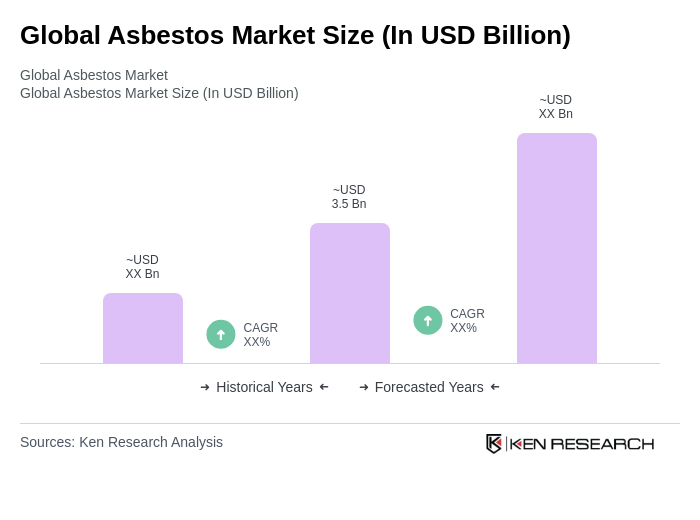
The Global Asbestos Market, valued at USD 3.5 billion, sees growth from construction and fire-resistant needs in Asia-Pacific, with Chrysotile dominant and challenges from health risks and EU bans.

Region:Global

Author(s):Shubham

Product Code:KRAA3171

Pages:83

Published On:August 2025
About the Report

Base Year 2024

Global Asbestos Market Overview

  • The Global Asbestos Market is valued at USD 3.5 billion, based on a five-year historical analysis. This value is supported by recent studies indicating continued demand for asbestos in construction materials, automotive parts, and insulation products, particularly in emerging markets where cost-effective and fire-resistant materials remain essential. Growth is further driven by infrastructure expansion in Asia-Pacific and limited substitutes in certain industrial applications, despite ongoing health concerns and regulatory scrutiny .
  • China, India, and Russia remain the dominant countries in the Global Asbestos Market, owing to their extensive industrial activities, robust construction sectors, and significant production capacity. These nations continue to utilize asbestos in a range of applications, especially in cement products and manufacturing, where cost and material performance are prioritized .
  • The European Union has enacted stringent controls on asbestos use, notably through Directive (EU) 2023/2668 of the European Parliament and of the Council, issued in 2023. This directive mandates member states to phase out asbestos-containing materials by 2028, requiring comprehensive risk assessments, safe removal protocols, and strict exposure limits to protect public health and the environment .
Global Asbestos Market Size

Global Asbestos Market Segmentation

By Type:The asbestos market is segmented into Chrysotile, Amosite, Crocidolite, Anthophyllite, Tremolite, Actinolite, and Others. Chrysotile remains the most widely used type, accounting for the vast majority of global consumption due to its flexibility, heat resistance, and cost-effectiveness. It is predominantly used in construction materials and automotive components. Demand for Chrysotile is especially high in developing regions, where regulatory enforcement is weaker and affordable building materials are in demand .
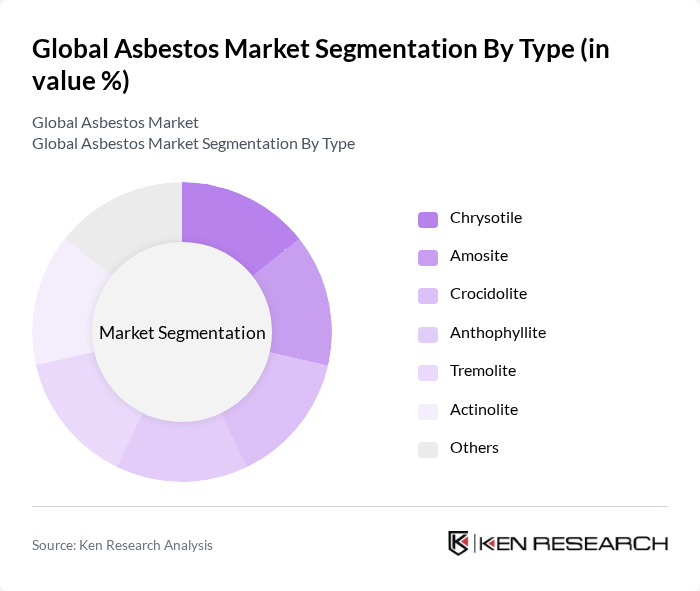
Global Asbestos Market segmentation by Type.

By End-User:The asbestos market is segmented by end-user industries, including Construction and Building, Automotive, Electrical and Electronics, Manufacturing, Shipbuilding, and Others. The Construction and Building sector is the largest consumer, utilizing asbestos for insulation, roofing, and fireproofing. The automotive industry also contributes significantly, especially in brake linings and clutches. Demand is sustained by infrastructure growth in Asia-Pacific and the cost advantages of asbestos cement products in emerging markets .
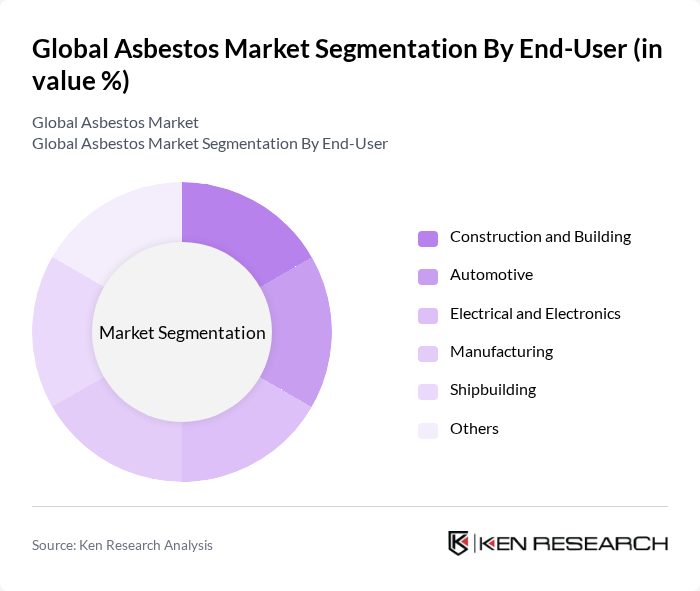
Global Asbestos Market segmentation by End-User.

Global Asbestos Market Competitive Landscape

The Global Asbestos Market is characterized by a dynamic mix of regional and international players. Leading participants such as Uralasbest (Russia), Brasilit (Saint-Gobain Group, Brazil), Zhejiang Fangda Building Materials Co., Ltd. (China), Balangir Asbestos Cement Products Ltd. (India), Everest Industries Limited (India), Pizhou Julong Asbestos Co., Ltd. (China), China National Building Material Company Limited (CNBM), Samatech (South Africa), American Fiber Cement Corporation (USA), Etex Group (Belgium), Saint-Gobain S.A. (France), CSR Limited (Australia), PELSA Company (Mexico), NICHIAS Corporation (Japan), PT. Semen Indonesia (Persero) Tbk (Indonesia) contribute to innovation, geographic expansion, and service delivery in this space.

Uralasbest

1934

Russia

Brasilit (Saint-Gobain Group)

1940

Brazil

Zhejiang Fangda Building Materials Co., Ltd.

1995

China

Balangir Asbestos Cement Products Ltd.

1985

India

Everest Industries Limited

1934

India

Company

Establishment Year

Headquarters

Group Size (Large, Medium, or Small as per industry convention)

Revenue (USD, latest fiscal year)

Revenue Growth Rate (CAGR %)

Market Share (%)

Geographic Presence (Regions/Countries)

Product Portfolio Breadth (Types/Applications)

Global Asbestos Market Industry Analysis

Growth Drivers

  • Increased Demand in Construction Industry:The construction sector is projected to reach $12 trillion globally in future, driving the demand for asbestos products. In regions like None, where infrastructure development is critical, the need for durable materials is paramount. Asbestos, known for its strength and insulation properties, is increasingly utilized in roofing, flooring, and insulation. This trend is supported by a 6% annual increase in construction spending, highlighting the material's relevance in modern building practices.
  • Rising Awareness of Fire-Resistant Materials:With fire incidents causing over 3,500 fatalities annually in None, the demand for fire-resistant materials is surging. Asbestos, recognized for its fire-retardant properties, is being integrated into various construction applications. The global fire safety market is expected to exceed $120 billion in future, with asbestos playing a crucial role in meeting safety standards. This heightened awareness is prompting builders to prioritize materials that enhance safety and compliance.
  • Technological Advancements in Asbestos Products:Innovations in asbestos processing are enhancing product safety and performance. For instance, the development of encapsulated asbestos products minimizes health risks while maintaining the material's beneficial properties. In None, investments in R&D are projected to reach $1.2 billion in future, fostering advancements that improve product quality. These technological improvements are crucial for addressing regulatory concerns and meeting market demands for safer construction materials.

Market Challenges

  • Stringent Regulatory Frameworks:The regulatory landscape surrounding asbestos is becoming increasingly stringent, with many countries implementing bans or severe restrictions. In None, compliance with regulations from bodies like the Environmental Protection Agency (EPA) is mandatory, impacting production and usage. As of future, over 70 countries have enacted laws limiting asbestos use, creating barriers for manufacturers and increasing operational costs, which can hinder market growth.
  • Health Risks Associated with Asbestos:The health implications of asbestos exposure, including mesothelioma and asbestosis, pose significant challenges. In None, approximately 3,000 new cases of asbestos-related diseases are reported annually, leading to public fear and resistance against its use. This stigma affects market acceptance and drives demand for alternative materials, complicating the landscape for asbestos manufacturers who must navigate these health concerns while ensuring product safety.

Global Asbestos Market Future Outlook

The future of the asbestos market in None is shaped by a complex interplay of regulatory pressures and technological advancements. As the construction industry continues to expand, the demand for innovative, safer asbestos products is likely to grow. Companies are expected to invest in research to develop encapsulated and recycled asbestos materials, aligning with safety regulations. Additionally, strategic partnerships may emerge to enhance product offerings, ensuring that asbestos remains relevant in a competitive market landscape focused on sustainability and safety.

Market Opportunities

  • Growth in Emerging Economies:Emerging markets in None are experiencing rapid urbanization, with construction spending projected to increase by $600 billion in future. This growth presents a significant opportunity for asbestos manufacturers to supply materials that meet the rising demand for infrastructure development, particularly in residential and commercial sectors.
  • Innovations in Asbestos Recycling:The recycling of asbestos materials is gaining traction, with potential savings of $250 million annually in waste management costs. As regulations evolve, companies that invest in recycling technologies can capitalize on this opportunity, providing sustainable solutions while addressing environmental concerns associated with asbestos disposal.

Scope of the Report

SegmentSub-Segments
By Type

Chrysotile

Amosite

Crocidolite

Anthophyllite

Tremolite

Actinolite

Others

By End-User

Construction and Building

Automotive

Electrical and Electronics

Manufacturing

Shipbuilding

Others

By Application

Insulation Materials

Roofing and Cement Products

Fireproofing

Automotive Brakes and Clutches

Soundproofing

Reinforcement

Others

By Distribution Channel

Direct Sales

Distributors

Online Sales

Retail

Others

By Region

Asia Pacific

North America

Europe

South America

Middle East & Africa

Others

By Price Range

Low

Medium

High

By Regulatory Compliance

ISO Standards

National Regulations

Environmental Compliance

Others

Key Target Audience

Investors and Venture Capitalist Firms

Government and Regulatory Bodies (e.g., Environmental Protection Agency, Occupational Safety and Health Administration)

Manufacturers and Producers

Distributors and Retailers

Construction and Demolition Companies

Health and Safety Organizations

Insurance Companies

Legal Firms Specializing in Asbestos Litigation

Players Mentioned in the Report:

Uralasbest (Russia)

Brasilit (Saint-Gobain Group, Brazil)

Zhejiang Fangda Building Materials Co., Ltd. (China)

Balangir Asbestos Cement Products Ltd. (India)

Everest Industries Limited (India)

Pizhou Julong Asbestos Co., Ltd. (China)

China National Building Material Company Limited (CNBM)

Samatech (South Africa)

American Fiber Cement Corporation (USA)

Etex Group (Belgium)

Saint-Gobain S.A. (France)

CSR Limited (Australia)

PELSA Company (Mexico)

NICHIAS Corporation (Japan)

PT. Semen Indonesia (Persero) Tbk (Indonesia)

Table of Contents

Market Assessment Phase

1. Executive Summary and Approach


2. Global Asbestos Market Overview

2.1 Key Insights and Strategic Recommendations

2.2 Global Asbestos Market Overview

2.3 Definition and Scope

2.4 Evolution of Market Ecosystem

2.5 Timeline of Key Regulatory Milestones

2.6 Value Chain & Stakeholder Mapping

2.7 Business Cycle Analysis

2.8 Policy & Incentive Landscape


3. Global Asbestos Market Analysis

3.1 Growth Drivers

3.1.1 Increased Demand in Construction Industry
3.1.2 Rising Awareness of Fire-Resistant Materials
3.1.3 Expansion of Emerging Markets
3.1.4 Technological Advancements in Asbestos Products

3.2 Market Challenges

3.2.1 Stringent Regulatory Frameworks
3.2.2 Health Risks Associated with Asbestos
3.2.3 Market Stigma and Public Perception
3.2.4 Competition from Alternative Materials

3.3 Market Opportunities

3.3.1 Growth in Emerging Economies
3.3.2 Innovations in Asbestos Recycling
3.3.3 Increased Infrastructure Development
3.3.4 Strategic Partnerships and Collaborations

3.4 Market Trends

3.4.1 Shift Towards Safer Asbestos Products
3.4.2 Increased Investment in Asbestos Research
3.4.3 Growing Demand for Asbestos in Emerging Markets
3.4.4 Regulatory Changes Impacting Market Dynamics

3.5 Government Regulation

3.5.1 Asbestos Ban in Several Countries
3.5.2 Occupational Safety and Health Administration (OSHA) Guidelines
3.5.3 Environmental Protection Agency (EPA) Regulations
3.5.4 International Agency for Research on Cancer (IARC) Classifications

4. SWOT Analysis


5. Stakeholder Analysis


6. Porter's Five Forces Analysis


7. Global Asbestos Market Market Size, 2019-2024

7.1 By Value

7.2 By Volume

7.3 By Average Selling Price


8. Global Asbestos Market Segmentation

8.1 By Type

8.1.1 Chrysotile
8.1.2 Amosite
8.1.3 Crocidolite
8.1.4 Anthophyllite
8.1.5 Tremolite
8.1.6 Actinolite
8.1.7 Others

8.2 By End-User

8.2.1 Construction and Building
8.2.2 Automotive
8.2.3 Electrical and Electronics
8.2.4 Manufacturing
8.2.5 Shipbuilding
8.2.6 Others

8.3 By Application

8.3.1 Insulation Materials
8.3.2 Roofing and Cement Products
8.3.3 Fireproofing
8.3.4 Automotive Brakes and Clutches
8.3.5 Soundproofing
8.3.6 Reinforcement
8.3.7 Others

8.4 By Distribution Channel

8.4.1 Direct Sales
8.4.2 Distributors
8.4.3 Online Sales
8.4.4 Retail
8.4.5 Others

8.5 By Region

8.5.1 Asia Pacific
8.5.2 North America
8.5.3 Europe
8.5.4 South America
8.5.5 Middle East & Africa
8.5.6 Others

8.6 By Price Range

8.6.1 Low
8.6.2 Medium
8.6.3 High

8.7 By Regulatory Compliance

8.7.1 ISO Standards
8.7.2 National Regulations
8.7.3 Environmental Compliance
8.7.4 Others

9. Global Asbestos Market Competitive Analysis

9.1 Market Share of Key Players

9.2 Cross Comparison of Key Players

9.2.1 Company Name
9.2.2 Group Size (Large, Medium, or Small as per industry convention)
9.2.3 Revenue (USD, latest fiscal year)
9.2.4 Revenue Growth Rate (CAGR %)
9.2.5 Market Share (%)
9.2.6 Geographic Presence (Regions/Countries)
9.2.7 Product Portfolio Breadth (Types/Applications)
9.2.8 Key End-User Segments Served
9.2.9 Production Capacity (tons/year)
9.2.10 Supply Chain Integration (Backward/Forward)
9.2.11 R&D Investment (% of Revenue)
9.2.12 Regulatory Compliance Record
9.2.13 Sustainability Initiatives
9.2.14 Pricing Strategy
9.2.15 Brand Recognition

9.3 SWOT Analysis of Top Players

9.4 Pricing Analysis

9.5 Detailed Profile of Major Companies

9.5.1 Uralasbest (Russia)
9.5.2 Brasilit (Saint-Gobain Group, Brazil)
9.5.3 Zhejiang Fangda Building Materials Co., Ltd. (China)
9.5.4 Balangir Asbestos Cement Products Ltd. (India)
9.5.5 Everest Industries Limited (India)
9.5.6 Pizhou Julong Asbestos Co., Ltd. (China)
9.5.7 China National Building Material Company Limited (CNBM)
9.5.8 Samatech (South Africa)
9.5.9 American Fiber Cement Corporation (USA)
9.5.10 Etex Group (Belgium)
9.5.11 Saint-Gobain S.A. (France)
9.5.12 CSR Limited (Australia)
9.5.13 PELSA Company (Mexico)
9.5.14 NICHIAS Corporation (Japan)
9.5.15 PT. Semen Indonesia (Persero) Tbk (Indonesia)

10. Global Asbestos Market End-User Analysis

10.1 Procurement Behavior of Key Ministries

10.1.1 Government Contracts
10.1.2 Compliance with Safety Standards
10.1.3 Budget Allocation for Asbestos Management
10.1.4 Supplier Selection Criteria

10.2 Corporate Spend on Infrastructure & Energy

10.2.1 Investment in Asbestos-Related Projects
10.2.2 Budgeting for Safety Compliance
10.2.3 Long-term Infrastructure Planning

10.3 Pain Point Analysis by End-User Category

10.3.1 Health and Safety Concerns
10.3.2 Regulatory Compliance Challenges
10.3.3 Cost Management Issues

10.4 User Readiness for Adoption

10.4.1 Training and Awareness Programs
10.4.2 Availability of Resources
10.4.3 Technological Readiness

10.5 Post-Deployment ROI and Use Case Expansion

10.5.1 Performance Metrics Evaluation
10.5.2 Long-term Cost Savings
10.5.3 Expansion into New Applications

11. Global Asbestos Market Future Size, 2025-2030

11.1 By Value

11.2 By Volume

11.3 By Average Selling Price


Go-To-Market Strategy Phase

1. Whitespace Analysis + Business Model Canvas

1.1 Market Gaps Identification

1.2 Value Proposition Development

1.3 Revenue Streams Analysis

1.4 Customer Segmentation

1.5 Key Partnerships

1.6 Cost Structure Analysis

1.7 Competitive Advantage


2. Marketing and Positioning Recommendations

2.1 Branding Strategies

2.2 Product USPs

2.3 Target Market Identification

2.4 Communication Strategy

2.5 Digital Marketing Approaches


3. Distribution Plan

3.1 Urban Retail Strategies

3.2 Rural NGO Tie-ups

3.3 E-commerce Integration

3.4 Logistics and Supply Chain Management


4. Channel & Pricing Gaps

4.1 Underserved Routes

4.2 Pricing Bands Analysis

4.3 Competitor Pricing Strategies


5. Unmet Demand & Latent Needs

5.1 Category Gaps Identification

5.2 Consumer Segments Analysis

5.3 Product Development Opportunities


6. Customer Relationship

6.1 Loyalty Programs

6.2 After-sales Service

6.3 Customer Feedback Mechanisms


7. Value Proposition

7.1 Sustainability Initiatives

7.2 Integrated Supply Chains

7.3 Customer-Centric Innovations


8. Key Activities

8.1 Regulatory Compliance

8.2 Branding Efforts

8.3 Distribution Setup


9. Entry Strategy Evaluation

9.1 Domestic Market Entry Strategy

9.1.1 Product Mix Considerations
9.1.2 Pricing Band Strategy
9.1.3 Packaging Innovations

9.2 Export Entry Strategy

9.2.1 Target Countries Identification
9.2.2 Compliance Roadmap Development

10. Entry Mode Assessment

10.1 Joint Ventures

10.2 Greenfield Investments

10.3 Mergers & Acquisitions

10.4 Distributor Model Evaluation


11. Capital and Timeline Estimation

11.1 Capital Requirements Analysis

11.2 Timelines for Market Entry


12. Control vs Risk Trade-Off

12.1 Ownership vs Partnerships


13. Profitability Outlook

13.1 Breakeven Analysis

13.2 Long-term Sustainability Strategies


14. Potential Partner List

14.1 Distributors

14.2 Joint Ventures

14.3 Acquisition Targets


15. Execution Roadmap

15.1 Phased Plan for Market Entry

15.1.1 Market Setup
15.1.2 Market Entry
15.1.3 Growth Acceleration
15.1.4 Scale & Stabilize

15.2 Key Activities and Milestones

15.2.1 Milestone Planning
15.2.2 Activity Tracking

Research Methodology

ApproachModellingSample

Phase 1: Approach1

Desk Research

  • Analysis of global asbestos production and consumption statistics from industry reports
  • Review of regulatory frameworks and safety guidelines from international health organizations
  • Examination of market trends and forecasts from trade publications and market analysis reports

Primary Research

  • Interviews with industry experts, including environmental health specialists and asbestos consultants
  • Surveys with manufacturers and distributors of asbestos-related products
  • Field interviews with construction and demolition contractors involved in asbestos handling

Validation & Triangulation

  • Cross-validation of data through multiple sources, including government publications and industry associations
  • Triangulation of findings from primary interviews with secondary data insights
  • Sanity checks conducted through expert panel discussions to ensure data reliability

Phase 2: Market Size Estimation1

Top-down Assessment

  • Estimation of the global asbestos market size based on historical consumption data and growth rates
  • Segmentation of the market by application areas such as construction, automotive, and industrial products
  • Incorporation of regional market dynamics and regulatory impacts on asbestos usage

Bottom-up Modeling

  • Collection of firm-level data from key players in the asbestos supply chain
  • Estimation of production capacities and sales volumes across different regions
  • Analysis of pricing trends and cost structures for asbestos products

Forecasting & Scenario Analysis

  • Development of predictive models based on historical data and market drivers
  • Scenario analysis considering potential regulatory changes and market shifts
  • Projections of market growth under various economic conditions through 2030

Phase 3: CATI Sample Composition1

Scope Item/SegmentSample SizeTarget Respondent Profiles
Construction Industry Usage100Project Managers, Safety Officers
Asbestos Product Manufacturing60Production Managers, Quality Control Specialists
Environmental Health & Safety50Health Inspectors, Compliance Officers
Regulatory Bodies & NGOs40Policy Makers, Environmental Advocates
Asbestos Remediation Services50Site Managers, Environmental Consultants

Frequently Asked Questions

What is the current value of the Global Asbestos Market?

The Global Asbestos Market is valued at approximately USD 3.5 billion, based on a five-year historical analysis. This valuation reflects ongoing demand in construction materials, automotive parts, and insulation products, particularly in emerging markets.

Which countries dominate the Global Asbestos Market?

What are the main applications of asbestos in the construction industry?

What types of asbestos are commonly used in the market?

Other Adjacent Reports

Bahrain Fiberglass Insulation Market

Kuwait Mineral Wool Market

Global Ceramic Fiber Market Outlook 2030

Brazil Asbestos Remediation Market

Philippines Fire Retardant Materials Market

Egypt Automotive Friction Materials Market

Oman Construction Cement Market

Qatar roofing materials market size, share, growth drivers, trends, opportunities & forecast 2025–2030

Bahrain Industrial Gaskets Market

Kuwait Hazardous Waste Management Market Report Size, Share, Growth Drivers, Trends, Opportunities & Forecast 2025–2030

Why Buy From Us?

Refine Robust Result (RRR) Framework

What makes us stand out is that our consultants follow Robust, Refine and Result (RRR) methodology. Robust for clear definitions, approaches and sanity checking, Refine for differentiating respondents' facts and opinions, and Result for presenting data with story.

Our Reach Is Unmatched

We have set a benchmark in the industry by offering our clients with syndicated and customized market research reports featuring coverage of entire market as well as meticulous research and analyst insights.

Shifting the Research Paradigm

While we don't replace traditional research, we flip the method upside down. Our dual approach of Top Bottom & Bottom Top ensures quality deliverable by not just verifying company fundamentals but also looking at the sector and macroeconomic factors.

More Insights-Better Decisions

With one step in the future, our research team constantly tries to show you the bigger picture. We help with some of the tough questions you may encounter along the way: How is the industry positioned? Best marketing channel? KPI's of competitors? By aligning every element, we help maximize success.

Transparency and Trust

Our report gives you instant access to the answers and sources that other companies might choose to hide. We elaborate each steps of research methodology we have used and showcase you the sample size to earn your trust.

Round the Clock Support

If you need any support, we are here! We pride ourselves on universe strength, data quality, and quick, friendly, and professional service.

Why Clients Choose Us?

400000+
Reports in repository
150+
Consulting projects a year
100+
Analysts
8000+
Client Queries in 2022








