About the Report
Base Year 2024Global Biofuel From Sugar Crops Market Overview
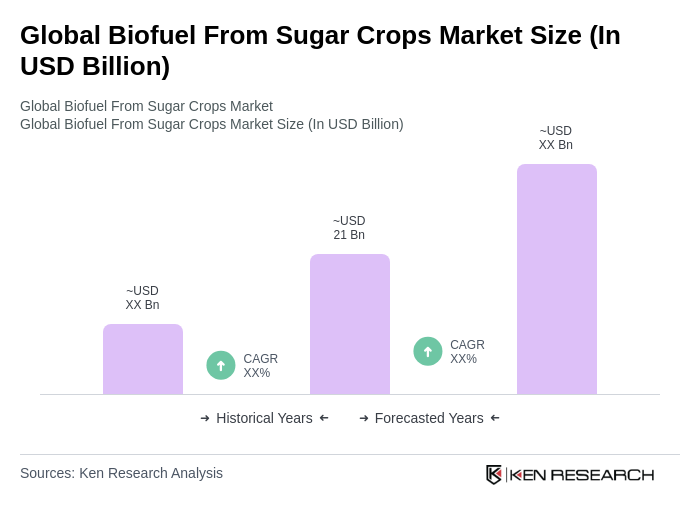
- The Global Biofuel From Sugar Crops Market is valued at USD 21 billion, based on a five-year historical analysis. This growth is primarily driven by the increasing demand for renewable energy sources, government policies promoting biofuels, and the rising awareness of environmental sustainability among consumers. Strong policy support and rising decarbonization targets in transport continue to underpin ethanol demand from sugarcane and sugar beet. The market has seen a significant shift towards biofuels as a viable alternative to fossil fuels, contributing to its robust expansion.
- Countries such as Brazil, the United States, and India dominate the Global Biofuel From Sugar Crops Market due to their extensive agricultural resources and established infrastructure for biofuel production. Brazil leads with its advanced sugarcane ethanol industry and widespread E27–E100 ethanol use, while the U.S. ethanol program is dominated by corn (not a sugar crop) but shapes global biofuel policy and trade; India is rapidly increasing ethanol blending using sugarcane molasses/juice supported by national blending programs and production capacity expansion.
- The Renewable Fuel Standard (RFS) is a longstanding U.S. policy administered by the EPA that requires renewable fuel volumes to be blended into transportation fuel; annual volume requirements were updated through final “set” rules, ensuring continued obligated blending and market demand impacts rather than being newly implemented in 2023. This regulation aims to reduce greenhouse gas emissions and promote renewable fuels, supporting steady demand for ethanol, including sugarcane-based volumes qualifying under advanced categories.
Global Biofuel From Sugar Crops Market Segmentation
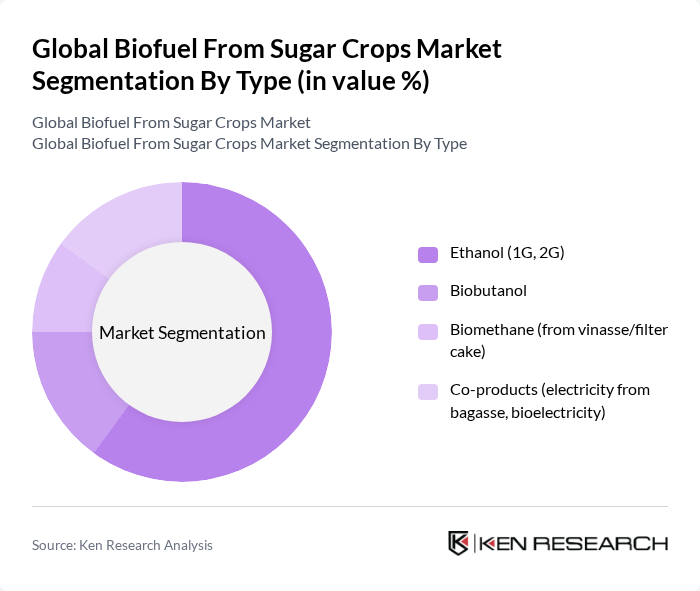
By Type:The market is segmented into various types of biofuels derived from sugar crops, including Ethanol (1G, 2G), Biobutanol, Biomethane (from vinasse/filter cake), and Co-products (electricity from bagasse, bioelectricity). Ethanol, particularly, has emerged as the leading sub-segment due to its widespread use in transportation fuels and its established production processes.
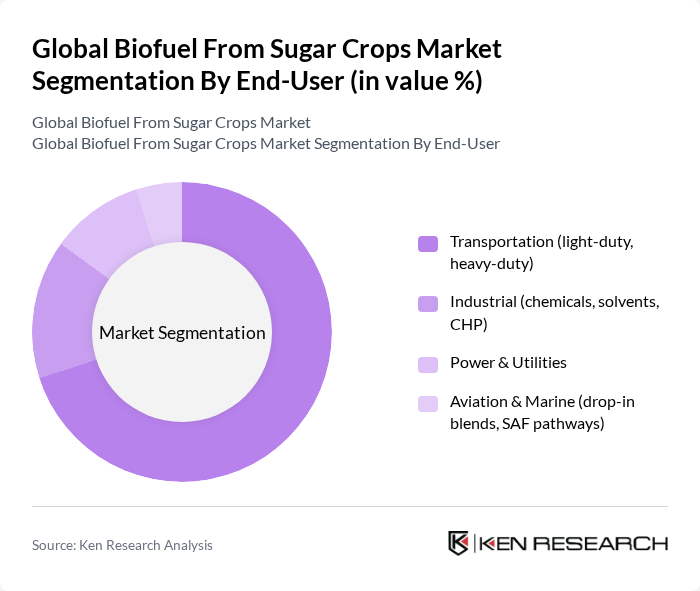
By End-User:The end-user segmentation includes Transportation (light-duty, heavy-duty), Industrial (chemicals, solvents, CHP), Power & Utilities, and Aviation & Marine (drop-in blends, SAF pathways). The transportation sector is the dominant end-user, driven by the increasing adoption of biofuels in vehicles and the push for cleaner fuel alternatives.
Global Biofuel From Sugar Crops Market Competitive Landscape
The Global Biofuel From Sugar Crops Market is characterized by a dynamic mix of regional and international players. Leading participants such as Raízen S.A., Cosan S.A., Tereos S.A., Copersucar S.A., São Martinho S.A., Biosev S.A. (Louis Dreyfus Company Bioenergy), BP Bunge Bioenergia, Mitr Phol Group, Shree Renuka Sugars Ltd., Bajaj Hindusthan Sugar Ltd., Balrampur Chini Mills Ltd., Dalmia Bharat Sugar and Industries Ltd., Nordzucker AG, Südzucker AG (CropEnergies AG), Cristal Union (Cristanol) contribute to innovation, geographic expansion, and service delivery in this space.
Global Biofuel From Sugar Crops Market Industry Analysis
Growth Drivers
- Increasing Demand for Renewable Energy:The global renewable energy market is projected to reach $2.15 trillion in the near future, driven by a shift towards sustainable energy sources. In the near future, biofuels accounted for approximately 3.5% of the total energy consumption, with sugar crops contributing significantly. This demand is fueled by rising oil prices, which averaged $85 per barrel in the near future, prompting countries to seek alternative energy solutions to enhance energy security and reduce dependency on fossil fuels.
- Government Support and Subsidies:In the near future, governments worldwide allocated over $25 billion in subsidies for biofuel production, with a significant portion directed towards sugar crop-based biofuels. For instance, the U.S. Renewable Fuel Standard mandates the blending of 15 billion gallons of ethanol annually, creating a stable market for sugar-derived biofuels. This financial backing encourages investment in biofuel technologies, fostering growth in the sector and enhancing production capabilities.
- Technological Advancements in Biofuel Production:The biofuel industry has seen substantial technological innovations, with investments in R&D reaching $6 billion in the near future. These advancements include improved fermentation processes and enzyme technologies that enhance yield efficiency. For example, new methods have increased ethanol production from sugarcane by 20%, making it more competitive against fossil fuels. Such innovations are crucial for meeting the growing energy demands while reducing production costs.
Market Challenges
- Fluctuating Raw Material Prices:The volatility of sugar prices poses a significant challenge for biofuel producers. In the near future, sugar prices fluctuated between $0.16 and $0.22 per pound, influenced by global supply chain disruptions and climate conditions. This unpredictability affects profit margins for biofuel manufacturers, making it difficult to maintain stable production costs and pricing strategies, ultimately impacting market growth.
- Competition from Fossil Fuels:Despite the growth of biofuels, fossil fuels remain the dominant energy source, accounting for approximately 80% of global energy consumption in the near future. The low prices of crude oil, which averaged $85 per barrel, continue to challenge the competitiveness of biofuels. This competition is exacerbated by the established infrastructure and market presence of fossil fuels, making it difficult for biofuels to gain significant market share.
Global Biofuel From Sugar Crops Market Future Outlook
The future of the biofuel market from sugar crops appears promising, driven by increasing global energy demands and a shift towards sustainable practices. As countries implement stricter emission reduction targets, the biofuel sector is expected to expand. Innovations in second-generation biofuels and digital technologies will enhance production efficiency. Furthermore, consumer preferences for eco-friendly products will likely drive market growth, creating a favorable environment for investment and development in the biofuel industry.
Market Opportunities
- Expansion into Emerging Markets:Emerging markets, particularly in Asia and Africa, present significant opportunities for biofuel growth. With a combined population of over 3.5 billion, these regions are increasingly investing in renewable energy solutions. For instance, India aims to achieve 25% ethanol blending in the near future, creating a robust market for sugar-based biofuels and attracting foreign investments.
- Development of Advanced Biofuels:The advancement of second-generation biofuels, derived from non-food feedstocks, offers a substantial opportunity for market growth. With an estimated investment of $2 billion in the near future, companies are focusing on developing technologies that convert agricultural waste into biofuels. This not only enhances sustainability but also reduces competition with food crops, addressing food security concerns.
Scope of the Report
| Segment | Sub-Segments |
|---|---|
| By Type | Ethanol (1G, 2G) Biobutanol Biomethane (from vinasse/filter cake) Co-products (electricity from bagasse, bioelectricity) |
| By End-User | Transportation (light-duty, heavy-duty) Industrial (chemicals, solvents, CHP) Power & Utilities Aviation & Marine (drop-in blends, SAF pathways) |
| By Feedstock | Sugarcane Sugar Beet Molasses Sweet Sorghum |
| By Distribution Channel | Fuel Blenders & Oil Marketing Companies Bulk Offtake (B2B, industrial) Retail Fuel Stations Direct Utility PPAs (bagasse power) |
| By Application | Transportation Fuels (E10–E100) Chemicals & Bioproducts (ETAC, MEG, solvents) Power Generation (bagasse cogeneration) On-site Energy & Steam |
| By Region | North America Europe Asia-Pacific Latin America |
| By Policy Support | Blending Mandates (e.g., E10/E20) Excise/Tariff Exemptions & Tax Credits Renewable Fuel Standard/Renewable Energy Certificates Sustainability Certification (ISCC, RenovaBio CBIOs) |
Key Target Audience
Investors and Venture Capitalist Firms
Government and Regulatory Bodies (e.g., U.S. Department of Energy, European Commission)
Manufacturers and Producers of Biofuels
Biofuel Technology Developers
Energy Policy Makers
Environmental NGOs and Advocacy Groups
Biofuel Trade Associations
Financial Institutions and Banks
Players Mentioned in the Report:
Raizen S.A.
Cosan S.A.
Tereos S.A.
Copersucar S.A.
Sao Martinho S.A.
Biosev S.A. (Louis Dreyfus Company Bioenergy)
BP Bunge Bioenergia
Mitr Phol Group
Shree Renuka Sugars Ltd.
Bajaj Hindusthan Sugar Ltd.
Balrampur Chini Mills Ltd.
Dalmia Bharat Sugar and Industries Ltd.
Nordzucker AG
Sudzucker AG (CropEnergies AG)
Cristal Union (Cristanol)
Table of Contents
Market Assessment Phase
1. Executive Summary and Approach
2. Global Biofuel From Sugar Crops Market Overview
2.1 Key Insights and Strategic Recommendations
2.2 Global Biofuel From Sugar Crops Market Overview
2.3 Definition and Scope
2.4 Evolution of Market Ecosystem
2.5 Timeline of Key Regulatory Milestones
2.6 Value Chain & Stakeholder Mapping
2.7 Business Cycle Analysis
2.8 Policy & Incentive Landscape
3. Global Biofuel From Sugar Crops Market Analysis
3.1 Growth Drivers
3.1.1 Increasing Demand for Renewable Energy
3.1.2 Government Support and Subsidies
3.1.3 Technological Advancements in Biofuel Production
3.1.4 Rising Environmental Concerns
3.2 Market Challenges
3.2.1 Fluctuating Raw Material Prices
3.2.2 Competition from Fossil Fuels
3.2.3 Regulatory Hurdles
3.2.4 Limited Infrastructure for Distribution
3.3 Market Opportunities
3.3.1 Expansion into Emerging Markets
3.3.2 Development of Advanced Biofuels
3.3.3 Strategic Partnerships and Collaborations
3.3.4 Increasing Investment in R&D
3.4 Market Trends
3.4.1 Shift Towards Sustainable Practices
3.4.2 Growth of Second-Generation Biofuels
3.4.3 Integration of Digital Technologies
3.4.4 Consumer Preference for Eco-Friendly Products
3.5 Government Regulation
3.5.1 Renewable Fuel Standards
3.5.2 Emission Reduction Targets
3.5.3 Biofuel Blending Mandates
3.5.4 Tax Incentives for Biofuel Production
4. SWOT Analysis
5. Stakeholder Analysis
6. Porter's Five Forces Analysis
7. Global Biofuel From Sugar Crops Market Market Size, 2019-2024
7.1 By Value
7.2 By Volume
7.3 By Average Selling Price
8. Global Biofuel From Sugar Crops Market Segmentation
8.1 By Type
8.1.1 Ethanol (1G, 2G)
8.1.2 Biobutanol
8.1.3 Biomethane (from vinasse/filter cake)
8.1.4 Co-products (electricity from bagasse, bioelectricity)
8.2 By End-User
8.2.1 Transportation (light-duty, heavy-duty)
8.2.2 Industrial (chemicals, solvents, CHP)
8.2.3 Power & Utilities
8.2.4 Aviation & Marine (drop-in blends, SAF pathways)
8.3 By Feedstock
8.3.1 Sugarcane
8.3.2 Sugar Beet
8.3.3 Molasses
8.3.4 Sweet Sorghum
8.4 By Distribution Channel
8.4.1 Fuel Blenders & Oil Marketing Companies
8.4.2 Bulk Offtake (B2B, industrial)
8.4.3 Retail Fuel Stations
8.4.4 Direct Utility PPAs (bagasse power)
8.5 By Application
8.5.1 Transportation Fuels (E10–E100)
8.5.2 Chemicals & Bioproducts (ETAC, MEG, solvents)
8.5.3 Power Generation (bagasse cogeneration)
8.5.4 On-site Energy & Steam
8.6 By Region
8.6.1 North America
8.6.2 Europe
8.6.3 Asia-Pacific
8.6.4 Latin America
8.7 By Policy Support
8.7.1 Blending Mandates (e.g., E10/E20)
8.7.2 Excise/Tariff Exemptions & Tax Credits
8.7.3 Renewable Fuel Standard/Renewable Energy Certificates
8.7.4 Sustainability Certification (ISCC, RenovaBio CBIOs)
9. Global Biofuel From Sugar Crops Market Competitive Analysis
9.1 Market Share of Key Players
9.2 Cross Comparison of Key Players
9.2.1 Company Name
9.2.2 Group Size (Large, Medium, or Small as per industry convention)
9.2.3 Installed Ethanol Capacity (MLY)
9.2.4 Share of Sugar-Crop Feedstock (%)
9.2.5 Geographic Footprint (No. of plants, regions)
9.2.6 Average Plant Yield (L ethanol/tonne cane or beet)
9.2.7 Co-generation Capacity (MW from bagasse)
9.2.8 Production Cost per Liter (USD/L)
9.2.9 Blending Partnerships (No. of OMC/offtake agreements)
9.2.10 GHG Reduction vs Gasoline (%)
9.2.11 Capex Intensity (USD per MLPY)
9.2.12 R&D/Innovation Pipeline (2G ethanol, biogas, biobutanol)
9.3 SWOT Analysis of Top Players
9.4 Pricing Analysis
9.5 Detailed Profile of Major Companies
9.5.1 Raízen S.A.
9.5.2 Cosan S.A.
9.5.3 Tereos S.A.
9.5.4 Copersucar S.A.
9.5.5 São Martinho S.A.
9.5.6 Biosev S.A. (Louis Dreyfus Company Bioenergy)
9.5.7 BP Bunge Bioenergia
9.5.8 Mitr Phol Group
9.5.9 Shree Renuka Sugars Ltd.
9.5.10 Bajaj Hindusthan Sugar Ltd.
9.5.11 Balrampur Chini Mills Ltd.
9.5.12 Dalmia Bharat Sugar and Industries Ltd.
9.5.13 Nordzucker AG
9.5.14 Südzucker AG (CropEnergies AG)
9.5.15 Cristal Union (Cristanol)
10. Global Biofuel From Sugar Crops Market End-User Analysis
10.1 Procurement Behavior of Key Ministries
10.1.1 Government Procurement Policies
10.1.2 Budget Allocations for Biofuels
10.1.3 Collaboration with Private Sector
10.2 Corporate Spend on Infrastructure & Energy
10.2.1 Investment in Renewable Energy Projects
10.2.2 Budget for Biofuel Infrastructure Development
10.2.3 Partnerships with Biofuel Producers
10.3 Pain Point Analysis by End-User Category
10.3.1 Cost of Biofuel Production
10.3.2 Supply Chain Disruptions
10.3.3 Regulatory Compliance Challenges
10.4 User Readiness for Adoption
10.4.1 Awareness of Biofuel Benefits
10.4.2 Availability of Biofuel Options
10.4.3 Training and Support for Users
10.5 Post-Deployment ROI and Use Case Expansion
10.5.1 Measurement of ROI in Biofuel Projects
10.5.2 Case Studies of Successful Implementations
10.5.3 Future Expansion Opportunities
11. Global Biofuel From Sugar Crops Market Future Size, 2025-2030
11.1 By Value
11.2 By Volume
11.3 By Average Selling Price
Go-To-Market Strategy Phase
1. Whitespace Analysis + Business Model Canvas
1.1 Market Gaps Identification
1.2 Business Model Development
2. Marketing and Positioning Recommendations
2.1 Branding Strategies
2.2 Product USPs
3. Distribution Plan
3.1 Urban Retail vs Rural NGO Tie-ups
4. Channel & Pricing Gaps
4.1 Underserved Routes
4.2 Pricing Bands
5. Unmet Demand & Latent Needs
5.1 Category Gaps
5.2 Consumer Segments
6. Customer Relationship
6.1 Loyalty Programs
6.2 After-sales Service
7. Value Proposition
7.1 Sustainability
7.2 Integrated Supply Chains
8. Key Activities
8.1 Regulatory Compliance
8.2 Branding
8.3 Distribution Setup
9. Entry Strategy Evaluation
9.1 Domestic Market Entry Strategy
9.1.1 Product Mix
9.1.2 Pricing Band
9.1.3 Packaging
9.2 Export Entry Strategy
9.2.1 Target Countries
9.2.2 Compliance Roadmap
10. Entry Mode Assessment
10.1 JV
10.2 Greenfield
10.3 M&A
10.4 Distributor Model
11. Capital and Timeline Estimation
11.1 Capital Requirements
11.2 Timelines
12. Control vs Risk Trade-Off
12.1 Ownership vs Partnerships
13. Profitability Outlook
13.1 Breakeven Analysis
13.2 Long-term Sustainability
14. Potential Partner List
14.1 Distributors
14.2 JVs
14.3 Acquisition Targets
15. Execution Roadmap
15.1 Phased Plan for Market Entry
15.1.1 Market Setup
15.1.2 Market Entry
15.1.3 Growth Acceleration
15.1.4 Scale & Stabilize
15.2 Key Activities and Milestones
15.2.1 Activity Planning
15.2.2 Milestone Tracking
Research Methodology
Phase 1: Approach1
Desk Research
- Analysis of global biofuel production statistics from the International Energy Agency (IEA)
- Review of market reports and white papers from agricultural and biofuel associations
- Examination of government policies and incentives related to biofuel production from relevant ministries
Primary Research
- Interviews with biofuel producers and sugar crop farmers to gather insights on production practices
- Surveys with industry experts and analysts to understand market trends and challenges
- Field visits to biofuel production facilities to observe operational processes and technology used
Validation & Triangulation
- Cross-validation of data from multiple sources including trade publications and industry reports
- Triangulation of findings from primary interviews with secondary data insights
- Sanity checks through expert panel discussions to ensure data accuracy and relevance
Phase 2: Market Size Estimation1
Top-down Assessment
- Estimation of biofuel market size based on global energy consumption statistics
- Segmentation of market by type of biofuel derived from sugar crops (e.g., ethanol, biodiesel)
- Incorporation of regional demand forecasts based on energy policies and sustainability goals
Bottom-up Modeling
- Collection of production data from leading sugar crop producers and biofuel manufacturers
- Cost analysis of sugar crop cultivation and biofuel conversion processes
- Volume estimates based on historical production data and projected growth rates
Forecasting & Scenario Analysis
- Multi-variable regression analysis incorporating factors such as oil prices, technological advancements, and regulatory changes
- Scenario modeling based on varying levels of government support and market adoption rates
- Development of baseline, optimistic, and pessimistic forecasts through 2030
Phase 3: CATI Sample Composition1
| Scope Item/Segment | Sample Size | Target Respondent Profiles |
|---|---|---|
| Biofuel Production Facilities | 90 | Plant Managers, Production Supervisors |
| Sugar Crop Farmers | 120 | Farm Owners, Agricultural Consultants |
| Biofuel Technology Providers | 80 | R&D Managers, Technology Officers |
| Government Regulatory Bodies | 50 | Policy Makers, Environmental Analysts |
| Industry Analysts and Experts | 60 | Market Researchers, Economic Advisors |
Frequently Asked Questions
What is the current value of the Global Biofuel From Sugar Crops Market?
The Global Biofuel From Sugar Crops Market is valued at approximately USD 21 billion, reflecting a robust growth driven by increasing demand for renewable energy, supportive government policies, and heightened consumer awareness regarding environmental sustainability.
Which countries are leading in the Global Biofuel From Sugar Crops Market?
What are the main types of biofuels derived from sugar crops?
What are the key drivers of growth in the biofuel market?
Other Regional/Country Reports
Indonesia Biofuel Market
Malaysia Biofuel Market
APAC Biofuel Market
SEA Biofuel Market
Why Buy From Us?

What makes us stand out is that our consultants follow Robust, Refine and Result (RRR) methodology. Robust for clear definitions, approaches and sanity checking, Refine for differentiating respondents' facts and opinions, and Result for presenting data with story.

We have set a benchmark in the industry by offering our clients with syndicated and customized market research reports featuring coverage of entire market as well as meticulous research and analyst insights.

While we don't replace traditional research, we flip the method upside down. Our dual approach of Top Bottom & Bottom Top ensures quality deliverable by not just verifying company fundamentals but also looking at the sector and macroeconomic factors.

With one step in the future, our research team constantly tries to show you the bigger picture. We help with some of the tough questions you may encounter along the way: How is the industry positioned? Best marketing channel? KPI's of competitors? By aligning every element, we help maximize success.

Our report gives you instant access to the answers and sources that other companies might choose to hide. We elaborate each steps of research methodology we have used and showcase you the sample size to earn your trust.

If you need any support, we are here! We pride ourselves on universe strength, data quality, and quick, friendly, and professional service.