About the Report
Base Year 2024Global Bullet Proof Jacket Market Overview
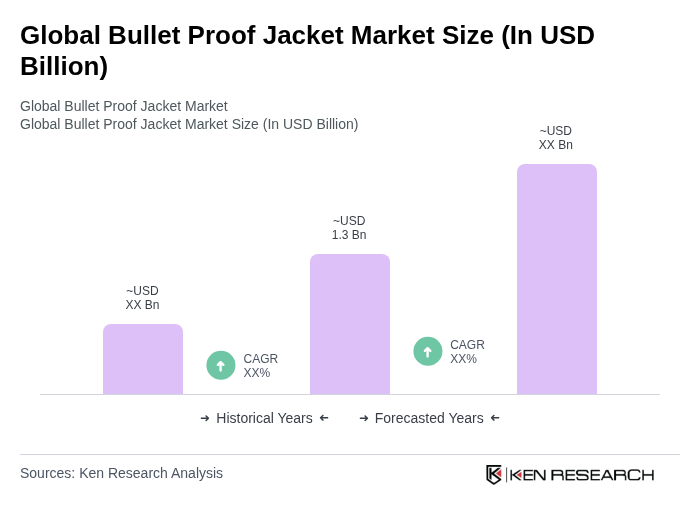
- The Global Bullet Proof Jacket Market is valued at USD 1.3 billion, based on a five-year historical analysis of recent industry reports. This growth is primarily driven by increasing security concerns, rising crime rates, intensifying geopolitical tensions, and the growing demand for personal protection in both military and civilian sectors. The market has seen a surge in demand for advanced materials and technologies such as high?performance aramids, ultra?high?molecular?weight polyethylene, and ergonomically designed carrier systems that enhance the effectiveness, durability, and comfort of bulletproof jackets.
- Key players in this market include the United States, China, and several European nations. The U.S. holds a leading position due to its substantial defense budget, large law enforcement base, and continuous procurement of advanced body armor for military and police forces. China and other Asia Pacific countries are rapidly increasing their market share through defense modernization programs and expanding domestic production, while European countries are accelerating investments in soldier systems and public security in response to rising defense spending and evolving threat environments.
- In the United States, performance and certification requirements for law enforcement body armor are primarily governed by the National Institute of Justice (NIJ) Standard 0101.06 for ballistic resistance and NIJ Standard 0115.00 for stab resistance, issued by the U.S. Department of Justice. Many federal and state agencies require issued armor to comply with these NIJ standards or equivalent specifications as a condition of procurement, which effectively drives demand for NIJ?compliant bulletproof jackets across law enforcement agencies.
Global Bullet Proof Jacket Market Segmentation
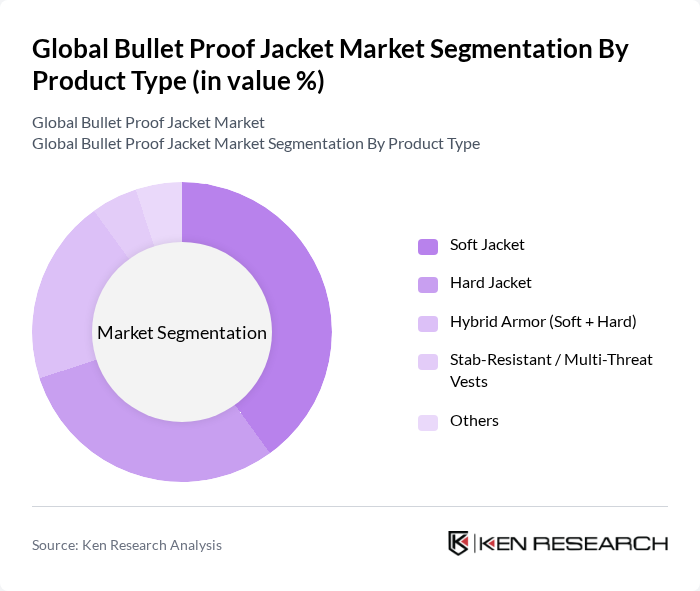
By Product Type:The product type segmentation includes various categories of bulletproof jackets, each designed for specific protection needs and scenarios. The dominant sub-segment in this category is the Soft Jacket, which is favored for its lightweight and flexible design, making it suitable for everyday wear by police officers, security personnel, and certain civilian users. Hard Jackets are also significant, particularly in military and tactical applications, due to their superior protection against rifle and high-caliber rounds when used with ceramic or composite plates. Hybrid Armor is gaining traction as it combines soft armor panels with hard inserts to balance mobility, weight, and multi?threat protection, appealing to a broader range of users in high?risk operations.
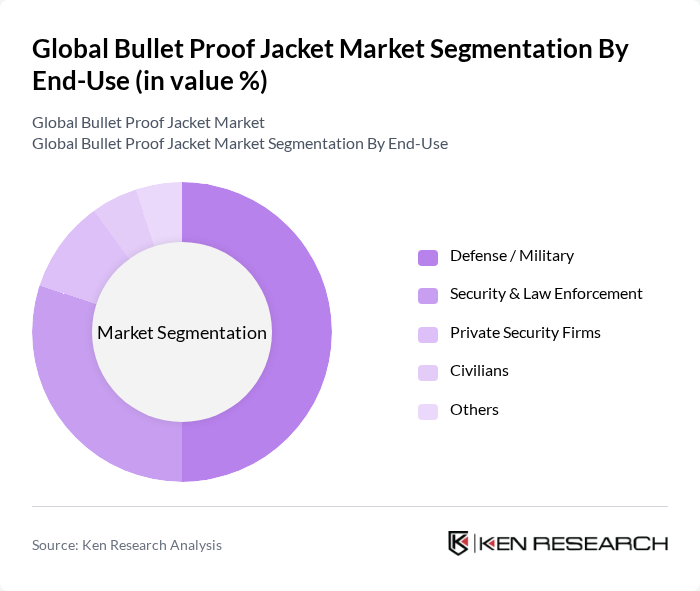
By End-Use:The end-use segmentation highlights the various sectors utilizing bulletproof jackets, with the Defense / Military segment leading the market, reflecting the high share of defense spending and large?scale procurement programs for armed forces worldwide. This is supported by ongoing global conflicts, modernization of soldier systems, and the need for enhanced protection against small arms and fragmentation. The Security & Law Enforcement segment is also significant, driven by increasing threats to public safety, urban crime, and the need to equip police, border security, and corrections officers with lightweight, comfortable armor suitable for daily duty use. Private security firms and civilian users are emerging as important segments, reflecting a growing awareness of personal safety, demand from high?net?worth individuals, and adoption of concealed vests in sectors such as banking, retail, and critical infrastructure protection.
Global Bullet Proof Jacket Market Competitive Landscape
The Global Bullet Proof Jacket Market is characterized by a dynamic mix of regional and international players. Leading participants such as DuPont de Nemours, Inc., The Safariland Group, Armor Express, Inc., Point Blank Enterprises, Inc., Honeywell International Inc., BAE Systems plc, 3M Company, Ballistic Body Armor, Inc., U.S. Armor Corporation, MKU Limited, Rheinmetall AG, Vista Outdoor Inc., Condor Outdoor Products, Inc., Tactical Assault Gear (TAG), Security Pro USA (SecPro) contribute to innovation, geographic expansion, and service delivery in this space.
Global Bullet Proof Jacket Market Industry Analysis
Growth Drivers
- Increasing Global Security Concerns:The global security market is projected to reach $300 billion in future, driven by rising threats from terrorism and civil unrest. Countries are investing heavily in security measures, with the U.S. alone allocating $50 billion for homeland security in future. This heightened focus on safety is propelling demand for bulletproof jackets, as individuals and organizations seek reliable protective gear to mitigate risks associated with violent incidents.
- Rising Demand from Law Enforcement Agencies:Law enforcement agencies worldwide are expected to increase their budgets by 5% in future, amounting to approximately $20 billion. This growth is primarily due to the need for enhanced protective equipment, including bulletproof jackets. As police forces face escalating threats, the procurement of advanced protective gear becomes a priority, driving significant market growth in the bulletproof jacket sector.
- Technological Advancements in Materials:The global market for advanced materials in protective gear is anticipated to reach $15 billion in future, with innovations in lightweight and flexible materials leading the charge. Companies are investing in research and development to create bulletproof jackets that offer superior protection without compromising comfort. This trend is expected to attract a broader consumer base, including civilians seeking personal safety solutions, thereby boosting market growth.
Market Challenges
- High Manufacturing Costs:The production of bulletproof jackets involves expensive materials such as Kevlar and Dyneema, with costs reaching up to $500 per unit. In future, manufacturers are projected to face a 10% increase in raw material prices due to supply chain disruptions. This financial burden can limit the ability of companies to offer competitive pricing, potentially stifling market growth and accessibility for consumers.
- Stringent Regulatory Requirements:Compliance with international safety standards, such as NIJ (National Institute of Justice) certifications, imposes significant operational costs on manufacturers. In future, the average cost of obtaining necessary certifications is estimated at $100,000 per product line. These regulatory hurdles can deter new entrants and limit innovation, creating a challenging environment for companies looking to expand their product offerings in the bulletproof jacket market.
Global Bullet Proof Jacket Market Future Outlook
The bulletproof jacket market is poised for significant evolution, driven by technological advancements and changing consumer preferences. As smart technology integration becomes more prevalent, manufacturers are likely to develop jackets equipped with features such as communication systems and health monitoring. Additionally, the growing trend towards eco-friendly materials will likely influence product development, appealing to environmentally conscious consumers. These trends indicate a dynamic market landscape that will adapt to meet the evolving needs of users in various sectors.
Market Opportunities
- Expansion into Emerging Markets:Emerging markets, particularly in Asia and Africa, are witnessing a surge in demand for personal protective equipment. With a projected increase in security spending of 8% in these regions in future, companies have a significant opportunity to penetrate these markets, catering to a growing middle class increasingly concerned about safety.
- Customization for Specific User Needs:The demand for tailored protective gear is on the rise, with consumers seeking products that meet their unique requirements. By offering customizable options, manufacturers can tap into niche markets, enhancing customer satisfaction and loyalty. This approach is expected to drive sales growth, particularly among specialized sectors such as private security and personal defense.
Scope of the Report
| Segment | Sub-Segments |
|---|---|
| By Product Type | Soft Jacket Hard Jacket Hybrid Armor (Soft + Hard) Stab-Resistant / Multi-Threat Vests Others |
| By End-Use | Defense / Military Security & Law Enforcement Private Security Firms Civilians Others |
| By Material Type | Aramid Fiber (e.g., Kevlar, Twaron) UHMWPE (Ultra High Molecular Weight Polyethylene) Ceramic Plates Steel Plates Others (Composites & Advanced Fibers) |
| By Protection Level (NIJ) | Level IIA Level II Level IIIA Level III Level IV |
| By Application | Routine Patrol & Daily Duty Tactical & Special Operations Riot Control & Crowd Management High-Risk Combat / Counter-Terror Others |
| By Distribution Channel | Government / Institutional Tenders Direct Sales (OEM to Agency) Distributors / Dealers Online Channels (B2B & B2C) Others |
| By Region | North America Europe Asia-Pacific Latin America Middle East & Africa |
Key Target Audience
Investors and Venture Capitalist Firms
Government and Regulatory Bodies (e.g., Department of Defense, Department of Homeland Security)
Manufacturers and Producers
Distributors and Retailers
Law Enforcement Agencies
Military Organizations
Security and Defense Contractors
Insurance Companies
Players Mentioned in the Report:
DuPont de Nemours, Inc.
The Safariland Group
Armor Express, Inc.
Point Blank Enterprises, Inc.
Honeywell International Inc.
BAE Systems plc
3M Company
Ballistic Body Armor, Inc.
U.S. Armor Corporation
MKU Limited
Rheinmetall AG
Vista Outdoor Inc.
Condor Outdoor Products, Inc.
Tactical Assault Gear (TAG)
Security Pro USA (SecPro)
Table of Contents
Market Assessment Phase
1. Executive Summary and Approach
2. Global Bullet Proof Jacket Market Overview
2.1 Key Insights and Strategic Recommendations
2.2 Global Bullet Proof Jacket Market Overview
2.3 Definition and Scope
2.4 Evolution of Market Ecosystem
2.5 Timeline of Key Regulatory Milestones
2.6 Value Chain & Stakeholder Mapping
2.7 Business Cycle Analysis
2.8 Policy & Incentive Landscape
3. Global Bullet Proof Jacket Market Analysis
3.1 Growth Drivers
3.1.1 Increasing global security concerns
3.1.2 Rising demand from law enforcement agencies
3.1.3 Technological advancements in materials
3.1.4 Growing awareness of personal safety
3.2 Market Challenges
3.2.1 High manufacturing costs
3.2.2 Stringent regulatory requirements
3.2.3 Competition from alternative protective gear
3.2.4 Limited consumer awareness in emerging markets
3.3 Market Opportunities
3.3.1 Expansion into emerging markets
3.3.2 Development of lightweight materials
3.3.3 Customization for specific user needs
3.3.4 Partnerships with security firms
3.4 Market Trends
3.4.1 Increasing adoption of smart technology
3.4.2 Growth in e-commerce for protective gear
3.4.3 Rising demand for eco-friendly materials
3.4.4 Enhanced focus on product design and comfort
3.5 Government Regulation
3.5.1 Compliance with international safety standards
3.5.2 Import/export regulations on protective gear
3.5.3 Certification requirements for manufacturers
3.5.4 Regulations on marketing and sales of body armor
4. SWOT Analysis
5. Stakeholder Analysis
6. Porter's Five Forces Analysis
7. Global Bullet Proof Jacket Market Market Size, 2019-2024
7.1 By Value
7.2 By Volume
7.3 By Average Selling Price
8. Global Bullet Proof Jacket Market Segmentation
8.1 By Product Type
8.1.1 Soft Jacket
8.1.2 Hard Jacket
8.1.3 Hybrid Armor (Soft + Hard)
8.1.4 Stab-Resistant / Multi-Threat Vests
8.1.5 Others
8.2 By End-Use
8.2.1 Defense / Military
8.2.2 Security & Law Enforcement
8.2.3 Private Security Firms
8.2.4 Civilians
8.2.5 Others
8.3 By Material Type
8.3.1 Aramid Fiber (e.g., Kevlar, Twaron)
8.3.2 UHMWPE (Ultra High Molecular Weight Polyethylene)
8.3.3 Ceramic Plates
8.3.4 Steel Plates
8.3.5 Others (Composites & Advanced Fibers)
8.4 By Protection Level (NIJ)
8.4.1 Level IIA
8.4.2 Level II
8.4.3 Level IIIA
8.4.4 Level III
8.4.5 Level IV
8.5 By Application
8.5.1 Routine Patrol & Daily Duty
8.5.2 Tactical & Special Operations
8.5.3 Riot Control & Crowd Management
8.5.4 High-Risk Combat / Counter-Terror
8.5.5 Others
8.6 By Distribution Channel
8.6.1 Government / Institutional Tenders
8.6.2 Direct Sales (OEM to Agency)
8.6.3 Distributors / Dealers
8.6.4 Online Channels (B2B & B2C)
8.6.5 Others
8.7 By Region
8.7.1 North America
8.7.2 Europe
8.7.3 Asia-Pacific
8.7.4 Latin America
8.7.5 Middle East & Africa
9. Global Bullet Proof Jacket Market Competitive Analysis
9.1 Market Share of Key Players
9.2 Cross Comparison of Key Players
9.2.1 Company Name
9.2.2 Group Size (Large, Medium, or Small as per industry convention)
9.2.3 Global Bullet Proof Jacket Revenue (US$ Mn)
9.2.4 3-Year CAGR in Jacket Revenues (%)
9.2.5 EBITDA Margin (%)
9.2.6 R&D Intensity (% of Revenue)
9.2.7 Market Share by Volume (%)
9.2.8 Average Realized Price per Unit (US$)
9.2.9 Order Book / Backlog Coverage (Months)
9.2.10 Win Rate in Competitive Tenders (%)
9.2.11 On-Time Delivery Rate (%)
9.2.12 NIJ-Certified SKUs (Count)
9.2.13 Geographic Footprint (No. of Countries Served)
9.3 SWOT Analysis of Top Players
9.4 Pricing Analysis
9.5 Detailed Profile of Major Companies
9.5.1 DuPont de Nemours, Inc.
9.5.2 The Safariland Group
9.5.3 Armor Express, Inc.
9.5.4 Point Blank Enterprises, Inc.
9.5.5 Honeywell International Inc.
9.5.6 BAE Systems plc
9.5.7 3M Company
9.5.8 Ballistic Body Armor, Inc.
9.5.9 U.S. Armor Corporation
9.5.10 MKU Limited
9.5.11 Rheinmetall AG
9.5.12 Vista Outdoor Inc.
9.5.13 Condor Outdoor Products, Inc.
9.5.14 Tactical Assault Gear (TAG)
9.5.15 Security Pro USA (SecPro)
10. Global Bullet Proof Jacket Market End-User Analysis
10.1 Procurement Behavior of Key Ministries
10.1.1 Budget Allocation Trends
10.1.2 Procurement Processes
10.1.3 Supplier Selection Criteria
10.1.4 Contract Management Practices
10.2 Corporate Spend on Infrastructure & Energy
10.2.1 Investment Trends in Security
10.2.2 Budgeting for Protective Gear
10.2.3 Long-term Contracts vs. One-time Purchases
10.2.4 Impact of Economic Conditions
10.3 Pain Point Analysis by End-User Category
10.3.1 Cost Concerns
10.3.2 Quality and Performance Issues
10.3.3 Availability and Supply Chain Challenges
10.3.4 Compliance with Regulations
10.4 User Readiness for Adoption
10.4.1 Awareness Levels
10.4.2 Training and Support Needs
10.4.3 Adoption Barriers
10.4.4 Feedback Mechanisms
10.5 Post-Deployment ROI and Use Case Expansion
10.5.1 Performance Metrics
10.5.2 User Satisfaction Levels
10.5.3 Case Studies of Successful Deployments
10.5.4 Future Investment Plans
11. Global Bullet Proof Jacket Market Future Size, 2025-2030
11.1 By Value
11.2 By Volume
11.3 By Average Selling Price
Go-To-Market Strategy Phase
1. Whitespace Analysis + Business Model Canvas
1.1 Market Gaps Identification
1.2 Business Model Development
2. Marketing and Positioning Recommendations
2.1 Branding Strategies
2.2 Product USPs
3. Distribution Plan
3.1 Urban Retail vs Rural NGO Tie-ups
4. Channel & Pricing Gaps
4.1 Underserved Routes
4.2 Pricing Bands
5. Unmet Demand & Latent Needs
5.1 Category Gaps
5.2 Consumer Segments
6. Customer Relationship
6.1 Loyalty Programs
6.2 After-sales Service
7. Value Proposition
7.1 Sustainability
7.2 Integrated Supply Chains
8. Key Activities
8.1 Regulatory Compliance
8.2 Branding
8.3 Distribution Setup
9. Entry Strategy Evaluation
9.1 Domestic Market Entry Strategy
9.1.1 Product Mix
9.1.2 Pricing Band
9.1.3 Packaging
9.2 Export Entry Strategy
9.2.1 Target Countries
9.2.2 Compliance Roadmap
10. Entry Mode Assessment
10.1 JV
10.2 Greenfield
10.3 M&A
10.4 Distributor Model
11. Capital and Timeline Estimation
11.1 Capital Requirements
11.2 Timelines
12. Control vs Risk Trade-Off
12.1 Ownership vs Partnerships
13. Profitability Outlook
13.1 Breakeven Analysis
13.2 Long-term Sustainability
14. Potential Partner List
14.1 Distributors
14.2 JVs
14.3 Acquisition Targets
15. Execution Roadmap
15.1 Phased Plan for Market Entry
15.1.1 Market Setup
15.1.2 Market Entry
15.1.3 Growth Acceleration
15.1.4 Scale & Stabilize
15.2 Key Activities and Milestones
15.2.1 Milestone Planning
15.2.2 Activity Tracking
Research Methodology
Phase 1: Approach1
Desk Research
- Analysis of market reports from industry associations and defense publications
- Review of government regulations and standards related to personal protective equipment
- Examination of trade statistics and import/export data for bulletproof materials
Primary Research
- Interviews with manufacturers of bulletproof jackets and related materials
- Surveys with law enforcement and military procurement officers
- Field interviews with end-users, including security personnel and private contractors
Validation & Triangulation
- Cross-validation of findings through multiple industry expert interviews
- Triangulation of data from sales figures, market trends, and regulatory insights
- Sanity checks conducted through expert panel reviews and feedback sessions
Phase 2: Market Size Estimation1
Top-down Assessment
- Estimation of market size based on defense budgets and law enforcement spending
- Segmentation by application areas such as military, law enforcement, and civilian use
- Incorporation of growth rates from historical data and projected defense expenditures
Bottom-up Modeling
- Volume estimates derived from production capacities of leading manufacturers
- Cost analysis based on material sourcing and manufacturing processes
- Sales data from distributors and retailers in the bulletproof apparel market
Forecasting & Scenario Analysis
- Multi-factor regression analysis considering geopolitical factors and crime rates
- Scenario modeling based on potential changes in defense policies and public safety needs
- Baseline, optimistic, and pessimistic forecasts through 2030 based on market dynamics
Phase 3: CATI Sample Composition1
| Scope Item/Segment | Sample Size | Target Respondent Profiles |
|---|---|---|
| Military Procurement | 100 | Defense Procurement Officers, Military Logistics Managers |
| Law Enforcement Agencies | 80 | Police Chiefs, Tactical Unit Leaders |
| Private Security Firms | 70 | Security Directors, Operations Managers |
| Retail and Distribution Channels | 60 | Retail Managers, Supply Chain Coordinators |
| End-User Feedback | 90 | Security Personnel, Civilian Users |
Frequently Asked Questions
What is the current value of the Global Bullet Proof Jacket Market?
The Global Bullet Proof Jacket Market is valued at approximately USD 1.3 billion, driven by increasing security concerns, rising crime rates, and the demand for personal protection in military and civilian sectors.
What factors are driving the growth of the Bullet Proof Jacket Market?
Which regions are leading in the Bullet Proof Jacket Market?
What are the main types of bulletproof jackets available in the market?
Other Regional/Country Reports
Indonesia Bullet Proof Jacket Market
Malaysia Bullet Proof Jacket Market
KSA Bullet Proof Jacket Market
APAC Bullet Proof Jacket Market
SEA Bullet Proof Jacket Market
Vietnam Bullet Proof Jacket Market
Other Adjacent Reports
Qatar Ballistic Helmet Market
Mexico Tactical Gear Market
Oman Personal Protective Equipment Market Report Size Share Growth Drivers Trends Opportunities & Forecast 2025–2030UAE Military Apparel Market
Singapore Law Enforcement Equipment Market
Brazil Security Equipment Market
Middle East Aramid Fiber Market Report Size Share Growth Drivers Trends Opportunities & Forecast 2025–2030Bahrain Ballistic Materials Market
Vietnam advanced composites market size, share, growth drivers, trends, opportunities & forecast 2025–2030Why Buy From Us?

What makes us stand out is that our consultants follow Robust, Refine and Result (RRR) methodology. Robust for clear definitions, approaches and sanity checking, Refine for differentiating respondents' facts and opinions, and Result for presenting data with story.

We have set a benchmark in the industry by offering our clients with syndicated and customized market research reports featuring coverage of entire market as well as meticulous research and analyst insights.

While we don't replace traditional research, we flip the method upside down. Our dual approach of Top Bottom & Bottom Top ensures quality deliverable by not just verifying company fundamentals but also looking at the sector and macroeconomic factors.

With one step in the future, our research team constantly tries to show you the bigger picture. We help with some of the tough questions you may encounter along the way: How is the industry positioned? Best marketing channel? KPI's of competitors? By aligning every element, we help maximize success.

Our report gives you instant access to the answers and sources that other companies might choose to hide. We elaborate each steps of research methodology we have used and showcase you the sample size to earn your trust.

If you need any support, we are here! We pride ourselves on universe strength, data quality, and quick, friendly, and professional service.