About the Report
Base Year 2024Global Carbon Dioxide Market Overview
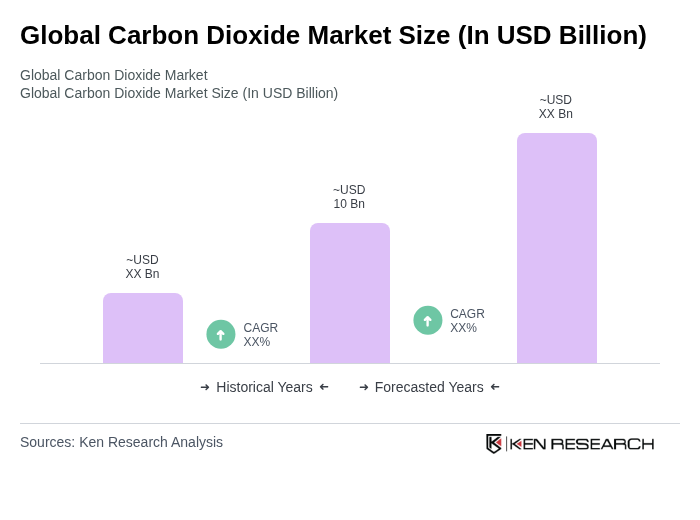
- The Global Carbon Dioxide Market is valued at USD 10 billion, based on a five-year historical analysis. This growth is primarily driven by the increasing demand for carbon dioxide in various applications, including food and beverage, healthcare, and enhanced oil recovery. The rising awareness of environmental sustainability, the adoption of carbon capture and utilization technologies, and the expansion of end-user industries such as agriculture and chemicals have further propelled market expansion .
- Key players in this market include the United States, China, and Germany, which dominate due to their advanced industrial sectors and significant investments in carbon capture and storage technologies. The presence of major manufacturing hubs, robust food and beverage industries, and a strong regulatory framework supporting carbon reduction initiatives also contribute to their market leadership .
- In 2023, the European Union implemented the Carbon Border Adjustment Mechanism (CBAM) through Regulation (EU) 2023/956, issued by the European Parliament and Council. This regulation imposes tariffs on imported goods based on their embedded carbon emissions, encouraging industries to adopt cleaner technologies and practices, thereby influencing the demand for carbon dioxide in various sectors .
Global Carbon Dioxide Market Segmentation
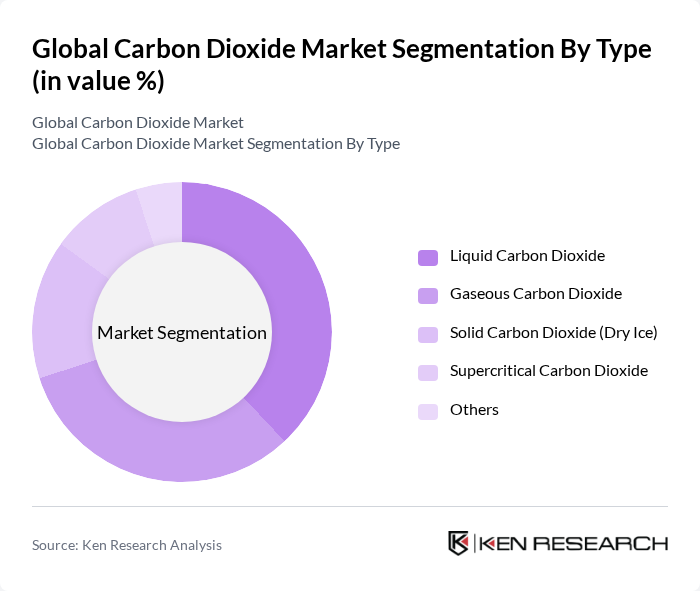
By Type:The market is segmented into various types of carbon dioxide, including Liquid Carbon Dioxide, Gaseous Carbon Dioxide, Solid Carbon Dioxide (Dry Ice), Supercritical Carbon Dioxide, and Others. Liquid Carbon Dioxide is a leading subsegment due to its extensive use in the food and beverage industry for carbonation and preservation. Gaseous Carbon Dioxide is primarily utilized in industrial applications such as welding and chemical manufacturing, while Solid Carbon Dioxide (dry ice) is significant in shipping and logistics for temperature-sensitive products .
By End-User:The market is segmented by end-user industries, including Food and Beverage, Chemical Manufacturing, Oil and Gas, Metal Processing, Healthcare and Medical, Firefighting, Rubber and Plastics, Water Treatment, and Others. The Food and Beverage sector is the dominant end-user, driven by the high demand for carbon dioxide in carbonated drinks and food preservation. Chemical Manufacturing utilizes carbon dioxide in processes such as urea and chemical production. The Oil and Gas industry is increasingly adopting carbon dioxide for enhanced oil recovery, further boosting its market presence .

Global Carbon Dioxide Market Competitive Landscape
The Global Carbon Dioxide Market is characterized by a dynamic mix of regional and international players. Leading participants such as Air Products and Chemicals, Inc., Linde plc, Messer Group GmbH, Air Liquide S.A., Praxair Technology, Inc. (now part of Linde plc), Taiyo Nippon Sanso Corporation, Gulf Cryo, Matheson Tri-Gas, Inc., Reliant Gases, Ltd., SICGIL India Limited, Continental Carbonic Products, Inc., Air Water Inc., Carbon Clean Solutions Limited, Aker Solutions ASA, Mitsubishi Heavy Industries, Ltd., BASF SE, Siemens AG, CarbonCure Technologies Inc., Climeworks AG, Global CCS Institute contribute to innovation, geographic expansion, and service delivery in this space.
Global Carbon Dioxide Market Industry Analysis
Growth Drivers
- Increasing Demand for Carbon Capture Technologies:The global carbon capture technology market is projected to reach $4 billion in future, driven by the need to mitigate climate change. With over 500 carbon capture projects in various stages globally, the demand for CO2 capture is surging. The U.S. Department of Energy has allocated $1.2 billion for research and development in this sector, highlighting the urgency for innovative solutions to reduce emissions and enhance sustainability.
- Rising Environmental Regulations and Standards:In future, countries are expected to implement stricter emissions regulations, with the European Union targeting a 55% reduction in greenhouse gas emissions in future. This regulatory environment is pushing industries to adopt carbon dioxide management strategies. The global market for carbon credits is anticipated to exceed $200 billion, incentivizing companies to invest in carbon capture and storage technologies to comply with these regulations.
- Expansion of Industrial Applications:The industrial sector is increasingly utilizing carbon dioxide in processes such as enhanced oil recovery and chemical manufacturing. In future, the demand for CO2 in industrial applications is projected to reach approximately 230 million metric tons. Industries are recognizing CO2's potential as a feedstock, with companies like LanzaTech and Carbon Clean Solutions leading the way in innovative applications, further driving market growth.
Market Challenges
- High Production Costs:The production of carbon dioxide, particularly through capture technologies, remains costly. In future, the average cost of capturing CO2 is estimated at $40 to $120 per ton, which poses a significant barrier for widespread adoption. Companies are struggling to balance operational costs with the need for sustainable practices, leading to hesitance in investment despite the potential long-term benefits.
- Limited Infrastructure for Distribution:The lack of adequate infrastructure for transporting captured CO2 is a critical challenge. In future, only approximately 5,000 miles of pipeline are available for CO2 transport in the U.S., limiting the ability to efficiently distribute captured carbon. This infrastructure gap hinders the scalability of carbon capture projects, as companies face logistical challenges in moving CO2 from capture sites to storage or utilization locations.
Global Carbon Dioxide Market Future Outlook
The future of the carbon dioxide market is poised for significant transformation, driven by technological advancements and increasing regulatory pressures. As industries adopt carbon capture and storage solutions, the market is expected to witness a surge in innovative applications. Furthermore, the integration of carbon dioxide into various sectors, including renewable energy and manufacturing, will enhance its value as a resource. The focus on sustainability will continue to shape investment strategies, fostering a more resilient and environmentally responsible market landscape.
Market Opportunities
- Technological Advancements in CO2 Utilization:Innovations in CO2 utilization technologies present a significant opportunity for market growth. Companies are exploring methods to convert CO2 into valuable products, such as fuels and chemicals. This shift could potentially create a market worth hundreds of billions of USD in future, attracting investments and fostering sustainable practices across various industries.
- Development of Carbon Trading Markets:The establishment of carbon trading markets is gaining momentum, providing financial incentives for emission reductions. In future, the global carbon market is projected to reach over $900 million for compliance markets and over $2 billion for voluntary markets, encouraging companies to invest in carbon capture technologies. This trend will not only drive demand for CO2 management solutions but also promote a more sustainable economic framework.
Scope of the Report
| Segment | Sub-Segments |
|---|---|
| By Type | Liquid Carbon Dioxide Gaseous Carbon Dioxide Solid Carbon Dioxide (Dry Ice) Supercritical Carbon Dioxide Others |
| By End-User | Food and Beverage Chemical Manufacturing Oil and Gas Metal Processing Healthcare and Medical Firefighting Rubber and Plastics Water Treatment Others |
| By Application | Enhanced Oil Recovery (EOR) Carbonated Beverages Refrigeration and Cooling Welding and Metal Fabrication Greenhouse Enrichment Medical and Pharmaceutical Fire Suppression Rubber and Plastics Production Others |
| By Source | Natural Sources Industrial Processes (e.g., Ammonia, Ethylene Oxide, Hydrogen Production) Captured CO2 (Carbon Capture and Storage/Utilization) Bio-based Sources Others |
| By Distribution Channel | Direct Sales Distributors Online Sales Others |
| By Region | North America Europe Asia-Pacific Latin America Middle East & Africa |
| By Policy Support | Government Subsidies Tax Incentives Research Grants Emission Trading Schemes Others |
Key Target Audience
Investors and Venture Capitalist Firms
Government and Regulatory Bodies (e.g., Environmental Protection Agency, International Energy Agency)
Carbon Capture and Storage Technology Providers
Energy Producers and Suppliers
Carbon Trading Platforms and Exchanges
Environmental NGOs and Advocacy Groups
Industrial Manufacturers with High Carbon Emissions
Carbon Offset Project Developers
Players Mentioned in the Report:
Air Products and Chemicals, Inc.
Linde plc
Messer Group GmbH
Air Liquide S.A.
Praxair Technology, Inc. (now part of Linde plc)
Taiyo Nippon Sanso Corporation
Gulf Cryo
Matheson Tri-Gas, Inc.
Reliant Gases, Ltd.
SICGIL India Limited
Continental Carbonic Products, Inc.
Air Water Inc.
Carbon Clean Solutions Limited
Aker Solutions ASA
Mitsubishi Heavy Industries, Ltd.
BASF SE
Siemens AG
CarbonCure Technologies Inc.
Climeworks AG
Global CCS Institute
Table of Contents
Market Assessment Phase
1. Executive Summary and Approach
2. Global Carbon Dioxide Market Overview
2.1 Key Insights and Strategic Recommendations
2.2 Global Carbon Dioxide Market Overview
2.3 Definition and Scope
2.4 Evolution of Market Ecosystem
2.5 Timeline of Key Regulatory Milestones
2.6 Value Chain & Stakeholder Mapping
2.7 Business Cycle Analysis
2.8 Policy & Incentive Landscape
3. Global Carbon Dioxide Market Analysis
3.1 Growth Drivers
3.1.1 Increasing Demand for Carbon Capture Technologies
3.1.2 Rising Environmental Regulations and Standards
3.1.3 Expansion of Industrial Applications
3.1.4 Growth in Food and Beverage Sector
3.2 Market Challenges
3.2.1 High Production Costs
3.2.2 Limited Infrastructure for Distribution
3.2.3 Regulatory Compliance Complexity
3.2.4 Market Volatility and Price Fluctuations
3.3 Market Opportunities
3.3.1 Technological Advancements in CO2 Utilization
3.3.2 Growing Investment in Renewable Energy
3.3.3 Expansion into Emerging Markets
3.3.4 Development of Carbon Trading Markets
3.4 Market Trends
3.4.1 Increasing Adoption of Carbon Capture and Storage (CCS)
3.4.2 Shift Towards Sustainable Practices in Industries
3.4.3 Rise of Carbon Dioxide as a Raw Material
3.4.4 Enhanced Focus on Circular Economy Initiatives
3.5 Government Regulation
3.5.1 Emission Reduction Targets
3.5.2 Carbon Pricing Mechanisms
3.5.3 Incentives for Carbon Capture Technologies
3.5.4 Regulations on Industrial Emissions
4. SWOT Analysis
5. Stakeholder Analysis
6. Porter's Five Forces Analysis
7. Global Carbon Dioxide Market Market Size, 2019-2024
7.1 By Value
7.2 By Volume
7.3 By Average Selling Price
8. Global Carbon Dioxide Market Segmentation
8.1 By Type
8.1.1 Liquid Carbon Dioxide
8.1.2 Gaseous Carbon Dioxide
8.1.3 Solid Carbon Dioxide (Dry Ice)
8.1.4 Supercritical Carbon Dioxide
8.1.5 Others
8.2 By End-User
8.2.1 Food and Beverage
8.2.2 Chemical Manufacturing
8.2.3 Oil and Gas
8.2.4 Metal Processing
8.2.5 Healthcare and Medical
8.2.6 Firefighting
8.2.7 Rubber and Plastics
8.2.8 Water Treatment
8.2.9 Others
8.3 By Application
8.3.1 Enhanced Oil Recovery (EOR)
8.3.2 Carbonated Beverages
8.3.3 Refrigeration and Cooling
8.3.4 Welding and Metal Fabrication
8.3.5 Greenhouse Enrichment
8.3.6 Medical and Pharmaceutical
8.3.7 Fire Suppression
8.3.8 Rubber and Plastics Production
8.3.9 Others
8.4 By Source
8.4.1 Natural Sources
8.4.2 Industrial Processes (e.g., Ammonia, Ethylene Oxide, Hydrogen Production)
8.4.3 Captured CO2 (Carbon Capture and Storage/Utilization)
8.4.4 Bio-based Sources
8.4.5 Others
8.5 By Distribution Channel
8.5.1 Direct Sales
8.5.2 Distributors
8.5.3 Online Sales
8.5.4 Others
8.6 By Region
8.6.1 North America
8.6.2 Europe
8.6.3 Asia-Pacific
8.6.4 Latin America
8.6.5 Middle East & Africa
8.7 By Policy Support
8.7.1 Government Subsidies
8.7.2 Tax Incentives
8.7.3 Research Grants
8.7.4 Emission Trading Schemes
8.7.5 Others
9. Global Carbon Dioxide Market Competitive Analysis
9.1 Market Share of Key Players
9.2 Cross Comparison of Key Players
9.2.1 Company Name
9.2.2 Company Size (by Revenue/Employees)
9.2.3 Revenue Growth Rate (CAGR)
9.2.4 Market Share in Global CO2 Market
9.2.5 Geographic Presence (Regions/Countries Served)
9.2.6 Production Capacity (Tons per Year)
9.2.7 Utilization Rate of Production Facilities
9.2.8 R&D Investment as % of Revenue
9.2.9 Number of Patents/Innovations in CO2 Capture/Utilization
9.2.10 Sustainability Initiatives (e.g., Emissions Reduction, Renewable Energy Use)
9.2.11 Key End-User Segments Served
9.2.12 Customer Base Diversification
9.2.13 Strategic Partnerships/Collaborations
9.2.14 Certifications (e.g., ISO, Responsible Care)
9.2.15 Pricing Strategy
9.3 SWOT Analysis of Top Players
9.4 Pricing Analysis
9.5 Detailed Profile of Major Companies
9.5.1 Air Products and Chemicals, Inc.
9.5.2 Linde plc
9.5.3 Messer Group GmbH
9.5.4 Air Liquide S.A.
9.5.5 Praxair Technology, Inc. (now part of Linde plc)
9.5.6 Taiyo Nippon Sanso Corporation
9.5.7 Gulf Cryo
9.5.8 Matheson Tri-Gas, Inc.
9.5.9 Reliant Gases, Ltd.
9.5.10 SICGIL India Limited
9.5.11 Continental Carbonic Products, Inc.
9.5.12 Air Water Inc.
9.5.13 Carbon Clean Solutions Limited
9.5.14 Aker Solutions ASA
9.5.15 Mitsubishi Heavy Industries, Ltd.
9.5.16 BASF SE
9.5.17 Siemens AG
9.5.18 CarbonCure Technologies Inc.
9.5.19 Climeworks AG
9.5.20 Global CCS Institute
10. Global Carbon Dioxide Market End-User Analysis
10.1 Procurement Behavior of Key Ministries
10.1.1 Government Procurement Policies
10.1.2 Budget Allocations for Carbon Management
10.1.3 Collaboration with Private Sector
10.1.4 Sustainability Goals and Initiatives
10.2 Corporate Spend on Infrastructure & Energy
10.2.1 Investment in Carbon Capture Technologies
10.2.2 Expenditure on Renewable Energy Sources
10.2.3 Budget for Compliance and Regulation
10.2.4 Others
10.3 Pain Point Analysis by End-User Category
10.3.1 Cost Management Challenges
10.3.2 Regulatory Compliance Issues
10.3.3 Technology Adoption Barriers
10.3.4 Others
10.4 User Readiness for Adoption
10.4.1 Awareness of Carbon Management Solutions
10.4.2 Willingness to Invest in Sustainable Practices
10.4.3 Training and Support Needs
10.4.4 Others
10.5 Post-Deployment ROI and Use Case Expansion
10.5.1 Measurement of Carbon Reduction
10.5.2 Financial Returns from Carbon Credits
10.5.3 Expansion into New Applications
10.5.4 Others
11. Global Carbon Dioxide Market Future Size, 2025-2030
11.1 By Value
11.2 By Volume
11.3 By Average Selling Price
Go-To-Market Strategy Phase
1. Whitespace Analysis + Business Model Canvas
1.1 Market Gaps Identification
1.2 Value Proposition Development
1.3 Revenue Streams Analysis
1.4 Cost Structure Evaluation
1.5 Key Partnerships Exploration
1.6 Customer Segmentation
1.7 Competitive Landscape Overview
2. Marketing and Positioning Recommendations
2.1 Branding Strategies
2.2 Product USPs
2.3 Target Market Identification
2.4 Communication Strategy
2.5 Digital Marketing Approach
2.6 Customer Engagement Tactics
2.7 Performance Metrics
3. Distribution Plan
3.1 Urban Retail Strategies
3.2 Rural NGO Tie-ups
3.3 E-commerce Integration
3.4 Logistics and Supply Chain Management
3.5 Distribution Partnerships
3.6 Inventory Management
3.7 Performance Tracking
4. Channel & Pricing Gaps
4.1 Underserved Routes
4.2 Pricing Bands Analysis
4.3 Competitor Pricing Strategies
4.4 Customer Price Sensitivity
4.5 Value-Based Pricing Models
4.6 Discount and Promotion Strategies
4.7 Pricing Optimization Techniques
5. Unmet Demand & Latent Needs
5.1 Category Gaps Identification
5.2 Consumer Segments Analysis
5.3 Emerging Trends Exploration
5.4 Customer Feedback Mechanisms
5.5 Product Development Opportunities
5.6 Market Entry Strategies
5.7 Performance Metrics
6. Customer Relationship
6.1 Loyalty Programs
6.2 After-sales Service
6.3 Customer Feedback Loops
6.4 Community Engagement Initiatives
6.5 Customer Education Programs
6.6 Relationship Management Tools
6.7 Performance Metrics
7. Value Proposition
7.1 Sustainability Initiatives
7.2 Integrated Supply Chains
7.3 Customer-Centric Solutions
7.4 Competitive Differentiation
7.5 Value Creation Strategies
7.6 Performance Metrics
8. Key Activities
8.1 Regulatory Compliance
8.2 Branding Initiatives
8.3 Distribution Setup
8.4 Market Research Activities
8.5 Stakeholder Engagement
8.6 Performance Metrics
9. Entry Strategy Evaluation
9.1 Domestic Market Entry Strategy
9.1.1 Product Mix Considerations
9.1.2 Pricing Band Analysis
9.1.3 Packaging Strategies
9.2 Export Entry Strategy
9.2.1 Target Countries Identification
9.2.2 Compliance Roadmap Development
10. Entry Mode Assessment
10.1 Joint Ventures
10.2 Greenfield Investments
10.3 Mergers & Acquisitions
10.4 Distributor Model Evaluation
11. Capital and Timeline Estimation
11.1 Capital Requirements Analysis
11.2 Timelines for Market Entry
12. Control vs Risk Trade-Off
12.1 Ownership vs Partnerships
13. Profitability Outlook
13.1 Breakeven Analysis
13.2 Long-term Sustainability Strategies
14. Potential Partner List
14.1 Distributors
14.2 Joint Ventures
14.3 Acquisition Targets
15. Execution Roadmap
15.1 Phased Plan for Market Entry
15.1.1 Market Setup
15.1.2 Market Entry
15.1.3 Growth Acceleration
15.1.4 Scale & Stabilize
15.2 Key Activities and Milestones
15.2.1 Milestone Tracking
15.2.2 Performance Metrics
Research Methodology
Phase 1: Approach1
Desk Research
- Analysis of global carbon dioxide emissions data from the International Energy Agency (IEA)
- Review of market reports from environmental agencies and research institutions
- Examination of industry publications and white papers on carbon capture technologies
Primary Research
- Interviews with environmental scientists specializing in carbon management
- Surveys with executives from leading carbon dioxide suppliers and technology firms
- Field interviews with policymakers involved in climate change initiatives
Validation & Triangulation
- Cross-validation of data from multiple sources including government reports and industry analyses
- Triangulation of findings through expert consultations and peer-reviewed studies
- Sanity checks using historical data trends and current market dynamics
Phase 2: Market Size Estimation1
Top-down Assessment
- Estimation of total carbon dioxide emissions by region and sector
- Analysis of regulatory frameworks impacting carbon pricing and trading
- Incorporation of global climate agreements and their implications on market growth
Bottom-up Modeling
- Collection of data on carbon capture and storage (CCS) project capacities
- Estimation of market share based on technology adoption rates across industries
- Volume and pricing analysis of carbon dioxide in various applications (e.g., food and beverage, enhanced oil recovery)
Forecasting & Scenario Analysis
- Multi-factor regression analysis incorporating economic growth, energy transition, and technological advancements
- Scenario modeling based on varying levels of regulatory enforcement and market incentives
- Development of baseline, optimistic, and pessimistic forecasts through 2035
Phase 3: CATI Sample Composition1
| Scope Item/Segment | Sample Size | Target Respondent Profiles |
|---|---|---|
| Carbon Capture Technology Providers | 60 | Technical Directors, R&D Managers |
| Industrial Emission Sources | 50 | Environmental Compliance Officers, Operations Managers |
| Government Regulatory Bodies | 40 | Policy Analysts, Environmental Regulators |
| Carbon Trading Platforms | 40 | Market Analysts, Business Development Managers |
| Research Institutions Focused on Climate Change | 40 | Climate Scientists, Research Directors |
Frequently Asked Questions
What is the current value of the Global Carbon Dioxide Market?
The Global Carbon Dioxide Market is valued at approximately USD 10 billion, driven by increasing demand across various sectors such as food and beverage, healthcare, and enhanced oil recovery, along with advancements in carbon capture technologies.
What are the main applications of carbon dioxide?
Which regions dominate the Global Carbon Dioxide Market?
What is the impact of the Carbon Border Adjustment Mechanism (CBAM)?
Other Regional/Country Reports
Other Adjacent Reports
Singapore Carbon Capture and Storage Market
Kuwait Enhanced Oil Recovery Market
Kuwait Industrial Gases Market Report Size, Share, Growth Drivers, Trends, Opportunities & Forecast 2025–2030South Africa Food and Beverage Carbonation Market
KSA Dry Ice Production Market
South Korea Chemical Feedstock Market
Thailand Carbon Credits Trading Market
Vietnam Welding and Metal Fabrication Market
Middle East Medical Gases Market Size, Share, Growth Drivers, Trends, Opportunities & Forecast 2025–2030United States Water Treatment Chemicals Market Outlook to 2030: Size, Share, Growth and TrendsWhy Buy From Us?

What makes us stand out is that our consultants follow Robust, Refine and Result (RRR) methodology. Robust for clear definitions, approaches and sanity checking, Refine for differentiating respondents' facts and opinions, and Result for presenting data with story.

We have set a benchmark in the industry by offering our clients with syndicated and customized market research reports featuring coverage of entire market as well as meticulous research and analyst insights.

While we don't replace traditional research, we flip the method upside down. Our dual approach of Top Bottom & Bottom Top ensures quality deliverable by not just verifying company fundamentals but also looking at the sector and macroeconomic factors.

With one step in the future, our research team constantly tries to show you the bigger picture. We help with some of the tough questions you may encounter along the way: How is the industry positioned? Best marketing channel? KPI's of competitors? By aligning every element, we help maximize success.

Our report gives you instant access to the answers and sources that other companies might choose to hide. We elaborate each steps of research methodology we have used and showcase you the sample size to earn your trust.

If you need any support, we are here! We pride ourselves on universe strength, data quality, and quick, friendly, and professional service.