Global Chromebook Market

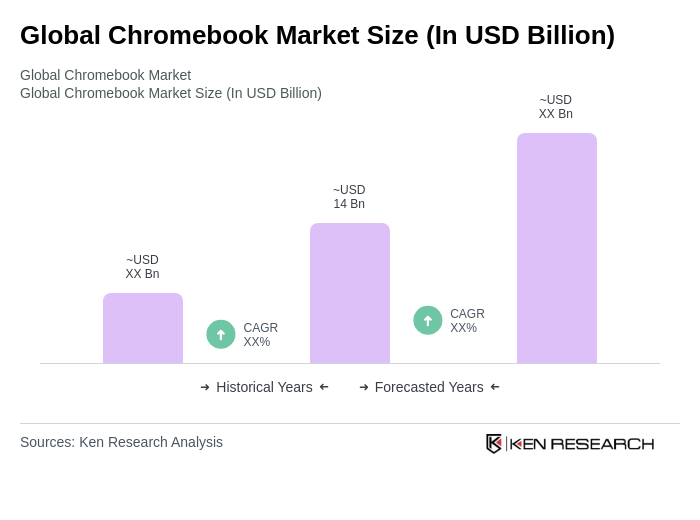
The global Chromebook market, valued at USD 14 billion, grows due to rising demand in education, cloud integration, and affordability, with strong presence in US and Europe.

Region:Global

Author(s):Rebecca

Product Code:KRAA2380

Pages:80

Published On:August 2025
About the Report

Base Year 2024

Global Chromebook Market Overview

  • The Global Chromebook Market is valued at USD 14 billion, based on a five-year historical analysis. Growth is primarily driven by the increasing adoption of cloud-based applications, the rise in remote and hybrid learning, and the demand for affordable, lightweight computing solutions. The market has seen a significant uptick in sales, particularly in educational institutions, where Chromebooks are favored for their ease of use, cost-effectiveness, and seamless integration with Google Workspace for Education and other cloud services .
  • The United States, Canada, and several European countries dominate the Chromebook market due to advanced educational infrastructure and high technology penetration in schools. The U.S. leads in sales, driven by large-scale initiatives to provide students with digital learning tools, while countries such as the UK and Germany follow closely, emphasizing technology integration in education and remote work environments .
  • In 2023, the U.S. government enacted the "Protecting Student Data in Educational Technology Act, 2023" issued by the U.S. Department of Education, mandating that all devices used in schools comply with specific cybersecurity standards. This regulation requires device manufacturers and school districts to implement robust encryption, regular security updates, and access controls to protect student data, thereby increasing demand for secure and reliable devices such as Chromebooks .
Global Chromebook Market Size

Global Chromebook Market Segmentation

By Type:The Chromebook market is segmented into Chromebook Laptops, Chromebook Convertibles (2-in-1), Chromebook Tablets, Gaming Chromebooks, and Others. Among these, Chromebook Laptops hold the largest share, primarily due to their widespread adoption in educational institutions and among consumers seeking affordable, reliable computing. The versatility, long battery life, and straightforward management of these devices make them a preferred choice for students, educators, and professionals. Chromebook Convertibles and Tablets are gaining traction for their flexibility and touch-based interfaces, while Gaming Chromebooks and other specialized models address emerging niche segments .
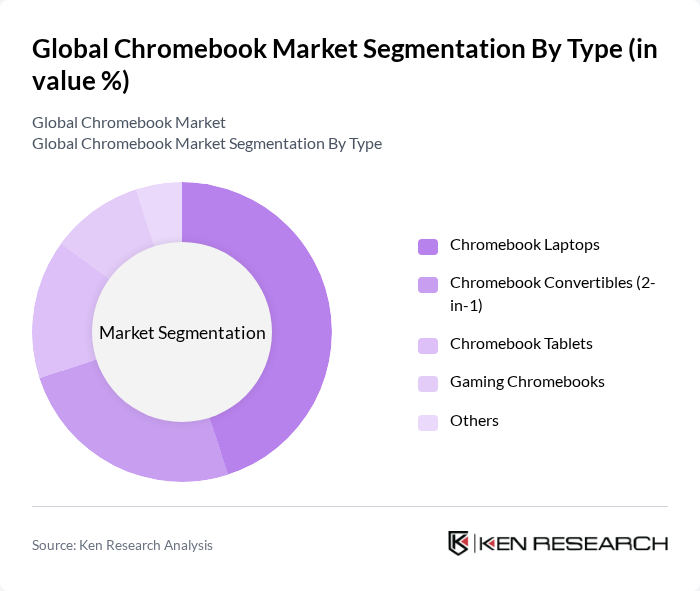
Global Chromebook Market segmentation by Type.

By End-User:The end-user segmentation includes Educational Institutions, Small and Medium Enterprises, Large Corporations, and Government Agencies. Educational Institutions represent the leading segment, driven by the increasing adoption of digital learning platforms and the need for cost-effective, easily managed devices for students and teachers. The focus on remote and hybrid education models has further accelerated Chromebook deployment in schools. Small and Medium Enterprises and Large Corporations are adopting Chromebooks for their security, manageability, and integration with cloud-based productivity suites, while Government Agencies utilize them for secure, scalable computing .
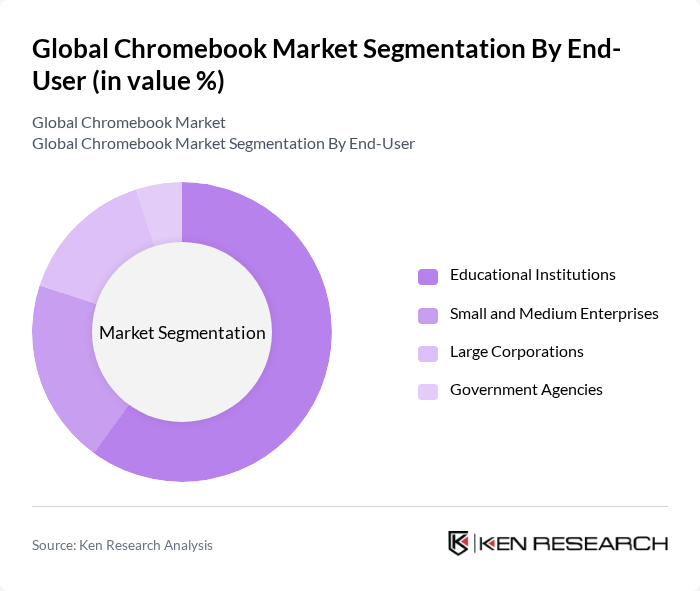
Global Chromebook Market segmentation by End-User.

Global Chromebook Market Competitive Landscape

The Global Chromebook Market is characterized by a dynamic mix of regional and international players. Leading participants such as HP Inc., Dell Technologies Inc., Lenovo Group Limited, Acer Inc., ASUS Computer International, Samsung Electronics Co., Ltd., Google LLC, Microsoft Corporation, Toshiba Corporation, LG Electronics Inc., Razer Inc., MSI Computer Corp., Chuwi Technology Co., Ltd., Huawei Technologies Co., Ltd., and Vizio Inc. contribute to innovation, geographic expansion, and service delivery in this space .

HP Inc.

1939

Palo Alto, California, USA

Dell Technologies Inc.

1984

Round Rock, Texas, USA

Lenovo Group Limited

1984

Beijing, China

Acer Inc.

1976

Xizhi, New Taipei, Taiwan

ASUS Computer International

1989

Fremont, California, USA

Company

Establishment Year

Headquarters

Group Size (Large, Medium, or Small as per industry convention)

Chromebook Unit Shipments

Revenue from Chromebook Segment

Chromebook Market Share (%)

Geographic Presence (Regions Served)

Product Portfolio Breadth (Models Offered)

Global Chromebook Market Industry Analysis

Growth Drivers

  • Increasing Adoption in Education Sector:The education sector is a significant driver for Chromebook adoption, with over 30 million devices deployed in U.S. schools alone in future. This trend is supported by the U.S. Department of Education's budget allocation of USD 7 billion for technology in schools in future, emphasizing digital learning. Additionally, 80% of educators report that Chromebooks enhance student engagement, making them a preferred choice for educational institutions seeking cost-effective solutions.
  • Rising Demand for Affordable Computing Solutions:The global push for affordable computing solutions is evident, with the average price of Chromebooks around USD 250, significantly lower than traditional laptops averaging USD 800. In future, the World Bank reports that approximately 2.6 billion people lack internet access globally, highlighting the ongoing demand for low-cost devices that facilitate online learning and work. This affordability aligns with the increasing need for budget-friendly technology in both educational and professional settings.
  • Enhanced Cloud-Based Applications:The rise of cloud-based applications is transforming how users interact with technology. In future, the global cloud computing market is expected to reach USD 600 billion, with Chromebooks being optimized for these services. This shift allows users to access powerful applications without requiring high-end hardware, making Chromebooks an attractive option for businesses and educational institutions looking to leverage cloud technology for efficiency and collaboration.

Market Challenges

  • Competition from Traditional Laptops:The Chromebook market faces stiff competition from traditional laptops, which accounted for approximately 60% of the global PC market in future. Many consumers still prefer the versatility and offline capabilities of traditional laptops, especially in regions with limited internet connectivity. This competition is exacerbated by the fact that traditional laptops often offer more robust software options, making it challenging for Chromebooks to capture a larger market share.
  • Limited Offline Functionality:Chromebooks primarily rely on internet connectivity, which poses a challenge in areas with poor internet access. In future, the International Telecommunication Union (ITU) estimates that approximately 2.6 billion people globally lack reliable internet access. This limitation restricts the usability of Chromebooks for tasks that require offline capabilities, leading to consumer hesitation in adopting these devices, particularly in developing regions where internet infrastructure is still evolving.

Global Chromebook Market Future Outlook

The future of the Chromebook market appears promising, driven by the ongoing digital transformation across various sectors. As educational institutions increasingly integrate technology into their curricula, the demand for Chromebooks is expected to rise. Furthermore, the expansion of cloud services and e-learning platforms will likely enhance the appeal of Chromebooks, making them indispensable tools for both students and professionals. The focus on affordability and accessibility will continue to shape market dynamics, fostering innovation and growth.

Market Opportunities

  • Expansion in Emerging Markets:Emerging markets present significant opportunities for Chromebook growth, with a projected increase in internet penetration rates from approximately 45% in future to 60% in future. This growth will drive demand for affordable computing solutions, as more individuals seek access to digital education and remote work opportunities, positioning Chromebooks as a viable option in these regions.
  • Development of Hybrid Models:The development of hybrid Chromebook models that combine tablet and laptop functionalities is gaining traction. In future, the global tablet market is expected to reach USD 100 billion, integrating these features into Chromebooks can attract a broader audience, particularly among students and professionals seeking versatile devices that cater to diverse needs and preferences.

Scope of the Report

SegmentSub-Segments
By Type

Chromebook Laptops

Chromebook Convertibles (2-in-1)

Chromebook Tablets

Gaming Chromebooks

Others

By End-User

Educational Institutions

Small and Medium Enterprises

Large Corporations

Government Agencies

By Distribution Channel

Online Retail

Offline Retail

Direct Sales

Others

By Price Range

Budget Chromebooks

Mid-Range Chromebooks

Premium Chromebooks

By Operating System Version

Chrome OS Standard

Chrome OS Enterprise

Chrome OS Education

By Form Factor

Traditional Laptops

in-1 Devices

Detachable Tablets

By Brand

HP

Dell

Lenovo

Acer

ASUS

Samsung

Others

Key Target Audience

Investors and Venture Capitalist Firms

Government and Regulatory Bodies (e.g., Federal Communications Commission, Department of Education)

Manufacturers and Producers

Distributors and Retailers

Telecommunications Companies

Technology Providers

Industry Associations

Financial Institutions

Players Mentioned in the Report:

HP Inc.

Dell Technologies Inc.

Lenovo Group Limited

Acer Inc.

ASUS Computer International

Samsung Electronics Co., Ltd.

Google LLC

Microsoft Corporation

Toshiba Corporation

LG Electronics Inc.

Razer Inc.

MSI Computer Corp.

Chuwi Technology Co., Ltd.

Huawei Technologies Co., Ltd.

Vizio Inc.

Table of Contents

Market Assessment Phase

1. Executive Summary and Approach


2. Global Chromebook Market Overview

2.1 Key Insights and Strategic Recommendations

2.2 Global Chromebook Market Overview

2.3 Definition and Scope

2.4 Evolution of Market Ecosystem

2.5 Timeline of Key Regulatory Milestones

2.6 Value Chain & Stakeholder Mapping

2.7 Business Cycle Analysis

2.8 Policy & Incentive Landscape


3. Global Chromebook Market Analysis

3.1 Growth Drivers

3.1.1 Increasing Adoption in Education Sector
3.1.2 Rising Demand for Affordable Computing Solutions
3.1.3 Enhanced Cloud-Based Applications
3.1.4 Growing Focus on Remote Learning

3.2 Market Challenges

3.2.1 Competition from Traditional Laptops
3.2.2 Limited Offline Functionality
3.2.3 Price Sensitivity Among Consumers
3.2.4 Rapid Technological Changes

3.3 Market Opportunities

3.3.1 Expansion in Emerging Markets
3.3.2 Development of Hybrid Models
3.3.3 Partnerships with Educational Institutions
3.3.4 Integration of Advanced Security Features

3.4 Market Trends

3.4.1 Shift Towards Cloud Computing
3.4.2 Increasing Use of Chromebooks in Enterprises
3.4.3 Growth of E-learning Platforms
3.4.4 Rise of Subscription-Based Services

3.5 Government Regulation

3.5.1 Policies Supporting Digital Education
3.5.2 Regulations on Data Privacy
3.5.3 Incentives for Technology Adoption in Schools
3.5.4 Standards for Device Accessibility

4. SWOT Analysis


5. Stakeholder Analysis


6. Porter's Five Forces Analysis


7. Global Chromebook Market Market Size, 2019-2024

7.1 By Value

7.2 By Volume

7.3 By Average Selling Price


8. Global Chromebook Market Segmentation

8.1 By Type

8.1.1 Chromebook Laptops
8.1.2 Chromebook Convertibles (2-in-1)
8.1.3 Chromebook Tablets
8.1.4 Gaming Chromebooks
8.1.5 Others

8.2 By End-User

8.2.1 Educational Institutions
8.2.2 Small and Medium Enterprises
8.2.3 Large Corporations
8.2.4 Government Agencies

8.3 By Distribution Channel

8.3.1 Online Retail
8.3.2 Offline Retail
8.3.3 Direct Sales
8.3.4 Others

8.4 By Price Range

8.4.1 Budget Chromebooks
8.4.2 Mid-Range Chromebooks
8.4.3 Premium Chromebooks

8.5 By Operating System Version

8.5.1 Chrome OS Standard
8.5.2 Chrome OS Enterprise
8.5.3 Chrome OS Education

8.6 By Form Factor

8.6.1 Traditional Laptops
8.6.2 2-in-1 Devices
8.6.3 Detachable Tablets

8.7 By Brand

8.7.1 HP
8.7.2 Dell
8.7.3 Lenovo
8.7.4 Acer
8.7.5 ASUS
8.7.6 Samsung
8.7.7 Others

9. Global Chromebook Market Competitive Analysis

9.1 Market Share of Key Players

9.2 Cross Comparison of Key Players

9.2.1 Company Name
9.2.2 Group Size (Large, Medium, or Small as per industry convention)
9.2.3 Chromebook Unit Shipments
9.2.4 Revenue from Chromebook Segment
9.2.5 Chromebook Market Share (%)
9.2.6 Geographic Presence (Regions Served)
9.2.7 Product Portfolio Breadth (Models Offered)
9.2.8 R&D Investment in Chromebook/Chrome OS
9.2.9 Channel Distribution Strength
9.2.10 Chromebook ASP (Average Selling Price)
9.2.11 Customer Segmentation (Education, Enterprise, Consumer)
9.2.12 Brand Recognition in Chromebook Segment

9.3 SWOT Analysis of Top Players

9.4 Pricing Analysis

9.5 Detailed Profile of Major Companies

9.5.1 HP Inc.
9.5.2 Dell Technologies Inc.
9.5.3 Lenovo Group Limited
9.5.4 Acer Inc.
9.5.5 ASUS Computer International
9.5.6 Samsung Electronics Co., Ltd.
9.5.7 Google LLC
9.5.8 Microsoft Corporation
9.5.9 Toshiba Corporation
9.5.10 LG Electronics Inc.
9.5.11 Razer Inc.
9.5.12 MSI Computer Corp.
9.5.13 Chuwi Technology Co., Ltd.
9.5.14 Huawei Technologies Co., Ltd.
9.5.15 Vizio Inc.

10. Global Chromebook Market End-User Analysis

10.1 Procurement Behavior of Key Ministries

10.1.1 Budget Allocation for Technology
10.1.2 Decision-Making Processes
10.1.3 Evaluation Criteria for Procurement

10.2 Corporate Spend on Infrastructure & Energy

10.2.1 Investment in IT Infrastructure
10.2.2 Spending on Employee Training
10.2.3 Budget for Software Licensing

10.3 Pain Point Analysis by End-User Category

10.3.1 Technical Support Challenges
10.3.2 Integration with Existing Systems
10.3.3 User Experience Issues

10.4 User Readiness for Adoption

10.4.1 Training and Support Needs
10.4.2 Awareness of Benefits
10.4.3 Resistance to Change

10.5 Post-Deployment ROI and Use Case Expansion

10.5.1 Measurement of ROI
10.5.2 Expansion into New Use Cases
10.5.3 Long-Term User Satisfaction

11. Global Chromebook Market Future Size, 2025-2030

11.1 By Value

11.2 By Volume

11.3 By Average Selling Price


Go-To-Market Strategy Phase

1. Whitespace Analysis + Business Model Canvas

1.1 Market Gaps Identification

1.2 Business Model Framework


2. Marketing and Positioning Recommendations

2.1 Branding Strategies

2.2 Product USPs


3. Distribution Plan

3.1 Urban Retail vs Rural NGO Tie-ups


4. Channel & Pricing Gaps

4.1 Underserved Routes

4.2 Pricing Bands


5. Unmet Demand & Latent Needs

5.1 Category Gaps

5.2 Consumer Segments


6. Customer Relationship

6.1 Loyalty Programs

6.2 After-sales Service


7. Value Proposition

7.1 Sustainability

7.2 Integrated Supply Chains


8. Key Activities

8.1 Regulatory Compliance

8.2 Branding

8.3 Distribution Setup


9. Entry Strategy Evaluation

9.1 Domestic Market Entry Strategy

9.1.1 Product Mix
9.1.2 Pricing Band
9.1.3 Packaging

9.2 Export Entry Strategy

9.2.1 Target Countries
9.2.2 Compliance Roadmap

10. Entry Mode Assessment

10.1 JV

10.2 Greenfield

10.3 M&A

10.4 Distributor Model


11. Capital and Timeline Estimation

11.1 Capital Requirements

11.2 Timelines


12. Control vs Risk Trade-Off

12.1 Ownership vs Partnerships


13. Profitability Outlook

13.1 Breakeven Analysis

13.2 Long-term Sustainability


14. Potential Partner List

14.1 Distributors

14.2 JVs

14.3 Acquisition Targets


15. Execution Roadmap

15.1 Phased Plan for Market Entry

15.1.1 Market Setup
15.1.2 Market Entry
15.1.3 Growth Acceleration
15.1.4 Scale & Stabilize

15.2 Key Activities and Milestones

15.2.1 Activity Planning
15.2.2 Milestone Tracking

Research Methodology

ApproachModellingSample

Phase 1: Approach1

Desk Research

  • Market reports from educational technology associations and industry publications
  • Government statistics on Chromebook adoption rates in schools and businesses
  • Analysis of online sales data from major e-commerce platforms

Primary Research

  • Interviews with IT managers in educational institutions and corporate sectors
  • Surveys targeting parents and students regarding Chromebook usage and preferences
  • Focus groups with educators discussing the impact of Chromebooks on learning

Validation & Triangulation

  • Cross-validation of findings with sales data from major Chromebook manufacturers
  • Triangulation of insights from primary interviews with secondary market data
  • Sanity checks through expert reviews from industry analysts and educators

Phase 2: Market Size Estimation1

Top-down Assessment

  • Analysis of global education technology spending trends and forecasts
  • Segmentation of market size by region, focusing on North America, Europe, and Asia-Pacific
  • Incorporation of government initiatives promoting digital learning tools

Bottom-up Modeling

  • Volume estimates based on sales data from leading Chromebook vendors
  • Cost analysis of Chromebooks including average selling prices and total units sold
  • Estimation of market share distribution among various educational and corporate segments

Forecasting & Scenario Analysis

  • Multi-variable regression analysis incorporating factors like remote learning trends and device affordability
  • Scenario planning based on potential shifts in educational policies and technology adoption rates
  • Baseline, optimistic, and pessimistic forecasts through 2030 based on current market dynamics

Phase 3: CATI Sample Composition1

Scope Item/SegmentSample SizeTarget Respondent Profiles
Educational Institutions100IT Managers, School Administrators
Corporate Sector Adoption60IT Managers, Training Coordinators
Parental Insights50Parents of K-12 Students
Student Feedback40High School and College Students
Educator Perspectives50Teachers, Curriculum Developers

Frequently Asked Questions

What is the current value of the Global Chromebook Market?

The Global Chromebook Market is valued at approximately USD 14 billion, driven by the increasing adoption of cloud-based applications and the demand for affordable computing solutions, particularly in educational institutions.

What factors are driving the growth of the Chromebook market?

Which regions dominate the Chromebook market?

How has government regulation impacted the Chromebook market?

Other Regional/Country Reports

Indonesia Global Chromebook Market

Malaysia Global Chromebook Market

KSA Global Chromebook Market

APAC Global Chromebook Market

SEA Global Chromebook Market

Vietnam Global Chromebook Market

Why Buy From Us?

Refine Robust Result (RRR) Framework

What makes us stand out is that our consultants follow Robust, Refine and Result (RRR) methodology. Robust for clear definitions, approaches and sanity checking, Refine for differentiating respondents' facts and opinions, and Result for presenting data with story.

Our Reach Is Unmatched

We have set a benchmark in the industry by offering our clients with syndicated and customized market research reports featuring coverage of entire market as well as meticulous research and analyst insights.

Shifting the Research Paradigm

While we don't replace traditional research, we flip the method upside down. Our dual approach of Top Bottom & Bottom Top ensures quality deliverable by not just verifying company fundamentals but also looking at the sector and macroeconomic factors.

More Insights-Better Decisions

With one step in the future, our research team constantly tries to show you the bigger picture. We help with some of the tough questions you may encounter along the way: How is the industry positioned? Best marketing channel? KPI's of competitors? By aligning every element, we help maximize success.

Transparency and Trust

Our report gives you instant access to the answers and sources that other companies might choose to hide. We elaborate each steps of research methodology we have used and showcase you the sample size to earn your trust.

Round the Clock Support

If you need any support, we are here! We pride ourselves on universe strength, data quality, and quick, friendly, and professional service.

Why Clients Choose Us?

400000+
Reports in repository
150+
Consulting projects a year
100+
Analysts
8000+
Client Queries in 2022








