About the Report
Base Year 2024Global Disposable Cups Market Overview
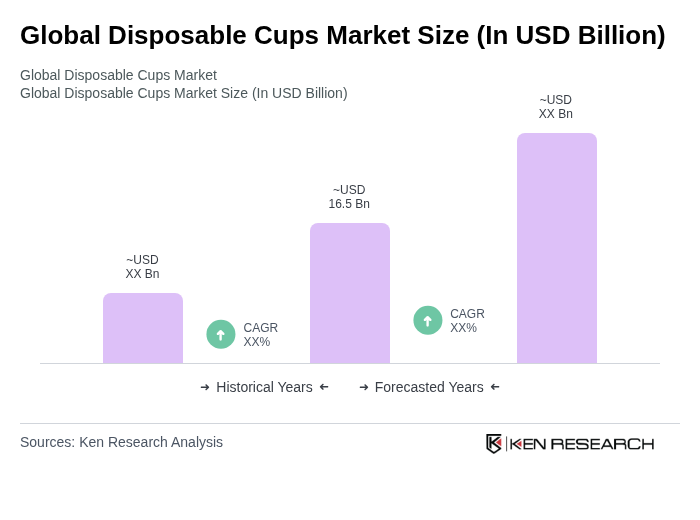
- The Global Disposable Cups Market is valued at USD 16.5 billion, based on a five-year historical analysis. This growth is primarily driven by the increasing demand for convenience in food and beverage consumption, accelerated urbanization, and the proliferation of online food delivery platforms. The market has seen a significant uptick in disposable cup usage across foodservice, retail, and institutional sectors, as consumers seek quick and hygienic solutions for their beverage needs. Sustainability trends, including the adoption of biodegradable materials and eco-friendly coatings, are also shaping market dynamics .
- Key players in this market include the United States, China, and Germany, which dominate due to their large consumer bases and robust foodservice industries. The United States leads with high demand for coffee and fast food, while China’s rapid urbanization and growing middle class contribute to increased disposable cup consumption. Germany's strong environmental regulations and consumer preference for sustainable packaging drive innovation in eco-friendly cup solutions, further solidifying its position in the market .
- In 2019, the European Union adopted Directive (EU) 2019/904 on the reduction of the impact of certain plastic products on the environment, issued by the European Parliament and Council. This directive requires member states to ensure that by 2025, at least 25% of plastic beverage cups are recycled, and it promotes the use of biodegradable and compostable materials in disposable cup production. The directive also mandates labeling and extended producer responsibility for single-use cups .
Global Disposable Cups Market Segmentation
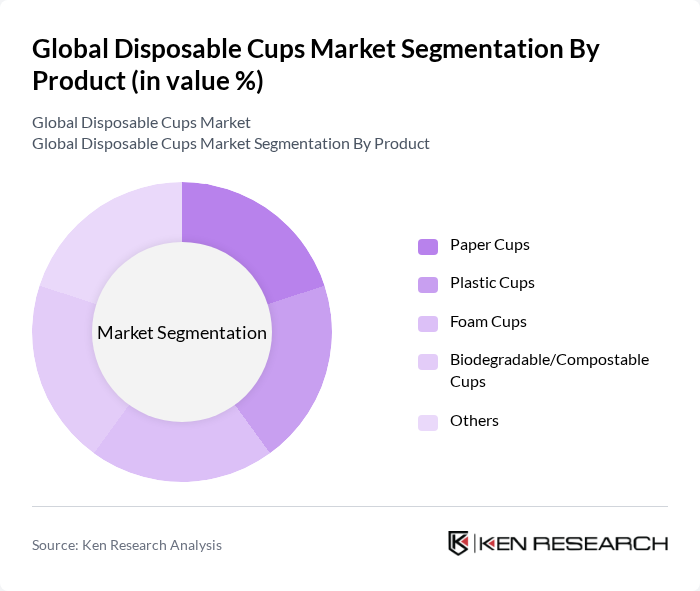
By Product:The disposable cups market is segmented into various product types, including paper cups, plastic cups, foam cups, biodegradable/compostable cups, and others. Among these, paper cups are currently leading the market, accounting for the largest share due to their recyclability and alignment with sustainability initiatives. The growing consumer preference for eco-friendly products has significantly boosted demand for biodegradable and compostable cups, which are gaining traction as alternatives to traditional plastic cups. Regulatory measures and corporate sustainability commitments are accelerating this shift .
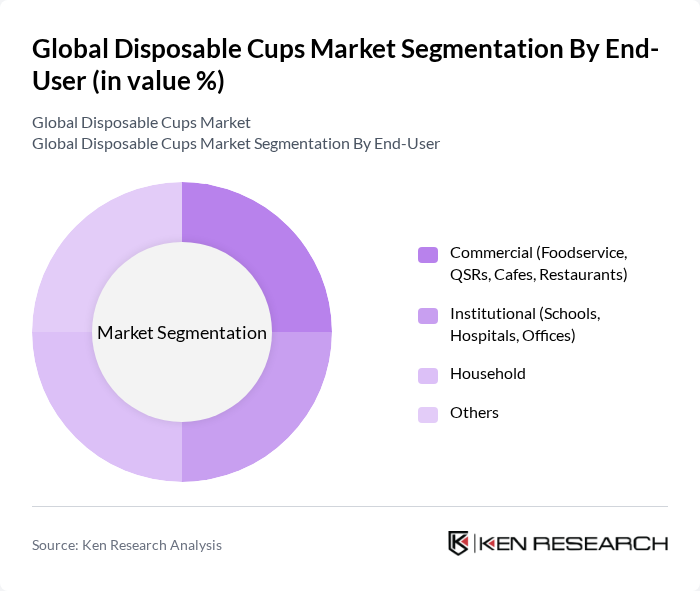
By End-User:The end-user segmentation includes commercial (foodservice, QSRs, cafes, restaurants), institutional (schools, hospitals, offices), household, and others. The commercial segment dominates the market, driven by the increasing number of quick-service restaurants, cafes, and the expansion of online food delivery services that rely heavily on disposable cups for serving beverages. The convenience, hygiene, and regulatory compliance offered by disposable cups in these settings are key factors contributing to their widespread use .
Global Disposable Cups Market Competitive Landscape
The Global Disposable Cups Market is characterized by a dynamic mix of regional and international players. Leading participants such as Dart Container Corporation, Huhtamaki Oyj, Berry Global, Inc., International Paper Company, Novolex Holdings, LLC, Pactiv Evergreen Inc., Genpak, LLC, Eco-Products, Inc., BioPak Pty Ltd, Stora Enso Oyj, WinCup, Inc., Fabri-Kal Corporation, Lollicup USA, Inc., Green Paper Products, LLC, Vegware Ltd contribute to innovation, geographic expansion, and service delivery in this space.
Global Disposable Cups Market Industry Analysis
Growth Drivers
- Increasing Demand for Convenience Products:The global trend towards convenience has significantly boosted the disposable cups market, with the foodservice sector alone projected to reach $4.2 trillion in future. This growth is driven by busy lifestyles, where consumers prefer ready-to-use products. In future, the demand for single-use cups surged, with an estimated 300 billion units consumed worldwide, reflecting a 5% increase from the previous period, according to industry reports.
- Growth in the Foodservice Industry:The foodservice industry is a major contributor to the disposable cups market, with an expected growth rate of 4.5% annually, reaching $4.5 trillion in future. This expansion is fueled by the rise of quick-service restaurants and coffee shops, which utilize disposable cups extensively. In future, the sector accounted for approximately 60% of disposable cup sales, highlighting its critical role in market dynamics, as reported by the National Restaurant Association.
- Rising Awareness of Hygiene and Safety:The COVID-19 pandemic heightened consumer awareness regarding hygiene, leading to increased demand for disposable cups. In future, 70% of consumers expressed a preference for single-use items in foodservice settings, according to a survey by the Food and Beverage Association. This trend is expected to persist, with the disposable cups market projected to benefit from heightened hygiene standards and safety protocols in food handling and service.
Market Challenges
- Environmental Concerns Regarding Plastic Waste:The environmental impact of disposable cups, particularly those made from plastic, poses a significant challenge. In future, an estimated 1 million plastic cups are discarded every minute globally, contributing to the growing plastic waste crisis. This has led to increased scrutiny from consumers and advocacy groups, pressuring manufacturers to adopt more sustainable practices and materials, as highlighted by the World Wildlife Fund.
- Regulatory Restrictions on Single-Use Plastics:Governments worldwide are implementing stricter regulations on single-use plastics, impacting the disposable cups market. In future, over 30 countries have enacted bans or restrictions on plastic cups, with the European Union aiming for a significant reduction in single-use plastic waste in future. These regulations are forcing manufacturers to innovate and transition to alternative materials, which can be costly and complex, according to the United Nations Environment Programme.
Global Disposable Cups Market Future Outlook
The future of the disposable cups market is poised for transformation, driven by sustainability trends and technological advancements. As consumers increasingly demand eco-friendly options, manufacturers are likely to invest in biodegradable materials and innovative designs. Additionally, the rise of e-commerce and online food delivery services will continue to shape market dynamics, with a focus on convenience and customization. Companies that adapt to these trends will likely capture significant market share, ensuring long-term growth and sustainability in the industry.
Market Opportunities
- Development of Biodegradable and Compostable Cups:The shift towards sustainable materials presents a lucrative opportunity for manufacturers. In future, the market for biodegradable cups was valued at $1.5 billion, with projections indicating a growth rate of 6% annually. Companies investing in research and development of compostable options can meet consumer demand while addressing environmental concerns, positioning themselves favorably in the market.
- Innovations in Cup Design and Functionality:There is a growing opportunity for innovation in cup design, focusing on functionality and user experience. In future, 40% of consumers expressed interest in cups with enhanced features, such as insulation and spill-proof designs. Manufacturers that prioritize design innovation can differentiate their products, attract new customers, and increase market share, as highlighted by recent consumer trend analyses.
Scope of the Report
| Segment | Sub-Segments |
|---|---|
| By Product | Paper Cups Plastic Cups Foam Cups Biodegradable/Compostable Cups Others |
| By End-User | Commercial (Foodservice, QSRs, Cafes, Restaurants) Institutional (Schools, Hospitals, Offices) Household Others |
| By Material | Paper Plastic Foam Bioplastics Others |
| By Size | Small (up to 8 oz) Medium (9-16 oz) Large (17 oz and above) Others |
| By Distribution Channel | Online Retail Supermarkets/Hypermarkets Convenience Stores Wholesale/B2B Others |
| By Region | North America Europe Asia-Pacific Latin America Middle East & Africa |
| By Application | Hot Beverages Cold Beverages Food Packaging Others |
Key Target Audience
Investors and Venture Capitalist Firms
Government and Regulatory Bodies (e.g., Environmental Protection Agency, Food and Drug Administration)
Manufacturers and Producers
Distributors and Retailers
Packaging Material Suppliers
Food Service Operators
Waste Management Companies
Industry Associations (e.g., National Association of Manufacturers)
Players Mentioned in the Report:
Dart Container Corporation
Huhtamaki Oyj
Berry Global, Inc.
International Paper Company
Novolex Holdings, LLC
Pactiv Evergreen Inc.
Genpak, LLC
Eco-Products, Inc.
BioPak Pty Ltd
Stora Enso Oyj
WinCup, Inc.
Fabri-Kal Corporation
Lollicup USA, Inc.
Green Paper Products, LLC
Vegware Ltd
Table of Contents
Market Assessment Phase
1. Executive Summary and Approach
2. Global Disposable Cups Market Overview
2.1 Key Insights and Strategic Recommendations
2.2 Global Disposable Cups Market Overview
2.3 Definition and Scope
2.4 Evolution of Market Ecosystem
2.5 Timeline of Key Regulatory Milestones
2.6 Value Chain & Stakeholder Mapping
2.7 Business Cycle Analysis
2.8 Policy & Incentive Landscape
3. Global Disposable Cups Market Analysis
3.1 Growth Drivers
3.1.1 Increasing demand for convenience products
3.1.2 Growth in the foodservice industry
3.1.3 Rising awareness of hygiene and safety
3.1.4 Expansion of e-commerce and delivery services
3.2 Market Challenges
3.2.1 Environmental concerns regarding plastic waste
3.2.2 Regulatory restrictions on single-use plastics
3.2.3 Competition from reusable alternatives
3.2.4 Fluctuating raw material prices
3.3 Market Opportunities
3.3.1 Development of biodegradable and compostable cups
3.3.2 Innovations in cup design and functionality
3.3.3 Expansion into emerging markets
3.3.4 Partnerships with eco-friendly brands
3.4 Market Trends
3.4.1 Shift towards sustainable packaging solutions
3.4.2 Customization and branding opportunities
3.4.3 Increased focus on online sales channels
3.4.4 Adoption of smart packaging technologies
3.5 Government Regulation
3.5.1 Bans on single-use plastics in various regions
3.5.2 Incentives for using sustainable materials
3.5.3 Compliance with health and safety standards
3.5.4 Labeling requirements for recyclable products
4. SWOT Analysis
5. Stakeholder Analysis
6. Porter's Five Forces Analysis
7. Global Disposable Cups Market Market Size, 2019-2024
7.1 By Value
7.2 By Volume
7.3 By Average Selling Price
8. Global Disposable Cups Market Segmentation
8.1 By Product
8.1.1 Paper Cups
8.1.2 Plastic Cups
8.1.3 Foam Cups
8.1.4 Biodegradable/Compostable Cups
8.1.5 Others
8.2 By End-User
8.2.1 Commercial (Foodservice, QSRs, Cafes, Restaurants)
8.2.2 Institutional (Schools, Hospitals, Offices)
8.2.3 Household
8.2.4 Others
8.3 By Material
8.3.1 Paper
8.3.2 Plastic
8.3.3 Foam
8.3.4 Bioplastics
8.3.5 Others
8.4 By Size
8.4.1 Small (up to 8 oz)
8.4.2 Medium (9-16 oz)
8.4.3 Large (17 oz and above)
8.4.4 Others
8.5 By Distribution Channel
8.5.1 Online Retail
8.5.2 Supermarkets/Hypermarkets
8.5.3 Convenience Stores
8.5.4 Wholesale/B2B
8.5.5 Others
8.6 By Region
8.6.1 North America
8.6.2 Europe
8.6.3 Asia-Pacific
8.6.4 Latin America
8.6.5 Middle East & Africa
8.7 By Application
8.7.1 Hot Beverages
8.7.2 Cold Beverages
8.7.3 Food Packaging
8.7.4 Others
9. Global Disposable Cups Market Competitive Analysis
9.1 Market Share of Key Players
9.2 KPIs for Cross Comparison of Key Players
9.2.1 Company Name
9.2.2 Company Size (Revenue, Employees)
9.2.3 Global Market Share (%)
9.2.4 Revenue Growth Rate (%)
9.2.5 Geographic Presence (Number of Countries/Regions)
9.2.6 Product Portfolio Breadth (Number of SKUs/Types)
9.2.7 Sustainability Initiatives (Recycled/Biodegradable Share, Certifications)
9.2.8 R&D/Innovation Spend (% of Revenue)
9.2.9 Distribution Network Strength (Channels, Reach)
9.2.10 Customer Base (Key End-User Segments Served)
9.3 SWOT Analysis of Top Players
9.4 Pricing Analysis
9.5 Detailed Profile of Major Companies
9.5.1 Dart Container Corporation
9.5.2 Huhtamaki Oyj
9.5.3 Berry Global, Inc.
9.5.4 International Paper Company
9.5.5 Novolex Holdings, LLC
9.5.6 Pactiv Evergreen Inc.
9.5.7 Genpak, LLC
9.5.8 Eco-Products, Inc.
9.5.9 BioPak Pty Ltd
9.5.10 Stora Enso Oyj
9.5.11 WinCup, Inc.
9.5.12 Fabri-Kal Corporation
9.5.13 Lollicup USA, Inc.
9.5.14 Green Paper Products, LLC
9.5.15 Vegware Ltd
10. Global Disposable Cups Market End-User Analysis
10.1 Procurement Behavior of Key Ministries
10.1.1 Government contracts and tenders
10.1.2 Sustainability criteria in procurement
10.1.3 Budget allocation for disposable products
10.1.4 Supplier diversity initiatives
10.2 Corporate Spend on Infrastructure & Energy
10.2.1 Investment in sustainable packaging
10.2.2 Budget for disposable cup procurement
10.2.3 Trends in corporate social responsibility spending
10.2.4 Cost-saving measures in procurement
10.3 Pain Point Analysis by End-User Category
10.3.1 Quality and durability concerns
10.3.2 Environmental impact of products
10.3.3 Supply chain reliability
10.3.4 Cost fluctuations
10.4 User Readiness for Adoption
10.4.1 Awareness of sustainable options
10.4.2 Willingness to pay for eco-friendly products
10.4.3 Training and education needs
10.4.4 Feedback mechanisms for product improvement
10.5 Post-Deployment ROI and Use Case Expansion
10.5.1 Measurement of cost savings
10.5.2 Customer satisfaction metrics
10.5.3 Opportunities for product line expansion
10.5.4 Long-term sustainability assessments
11. Global Disposable Cups Market Future Size, 2025-2030
11.1 By Value
11.2 By Volume
11.3 By Average Selling Price
Go-To-Market Strategy Phase
1. Whitespace Analysis + Business Model Canvas
1.1 Market gaps and opportunities
1.2 Value proposition development
1.3 Revenue model exploration
1.4 Customer segmentation analysis
1.5 Competitive landscape overview
1.6 Key partnerships and alliances
1.7 Risk assessment and mitigation strategies
2. Marketing and Positioning Recommendations
2.1 Branding strategies
2.2 Product USPs
2.3 Target audience identification
2.4 Marketing channels selection
2.5 Messaging and communication strategies
3. Distribution Plan
3.1 Urban retail vs rural NGO tie-ups
3.2 E-commerce strategies
3.3 Direct sales approaches
3.4 Partnerships with distributors
3.5 Logistics and supply chain management
4. Channel & Pricing Gaps
4.1 Underserved routes
4.2 Pricing bands
4.3 Competitor pricing analysis
4.4 Value-based pricing strategies
4.5 Discounts and promotions
5. Unmet Demand & Latent Needs
5.1 Category gaps
5.2 Consumer segments
5.3 Product development opportunities
5.4 Market entry barriers
5.5 Customer feedback integration
6. Customer Relationship
6.1 Loyalty programs
6.2 After-sales service
6.3 Customer engagement strategies
6.4 Feedback and improvement loops
6.5 Community building initiatives
7. Value Proposition
7.1 Sustainability
7.2 Integrated supply chains
7.3 Cost-effectiveness
7.4 Quality assurance
7.5 Customer-centric innovations
8. Key Activities
8.1 Regulatory compliance
8.2 Branding
8.3 Distribution setup
8.4 Market research and analysis
8.5 Training and development
9. Entry Strategy Evaluation
9.1 Domestic Market Entry Strategy
9.1.1 Product mix
9.1.2 Pricing band
9.1.3 Packaging
9.2 Export Entry Strategy
9.2.1 Target countries
9.2.2 Compliance roadmap
10. Entry Mode Assessment
10.1 JV
10.2 Greenfield
10.3 M&A
10.4 Distributor Model
11. Capital and Timeline Estimation
11.1 Capital requirements
11.2 Timelines
12. Control vs Risk Trade-Off
12.1 Ownership vs Partnerships
13. Profitability Outlook
13.1 Breakeven analysis
13.2 Long-term sustainability
14. Potential Partner List
14.1 Distributors
14.2 JVs
14.3 Acquisition targets
15. Execution Roadmap
15.1 Phased Plan for Market Entry
15.1.1 Market Setup
15.1.2 Market Entry
15.1.3 Growth Acceleration
15.1.4 Scale & Stabilize
15.2 Key Activities and Milestones
15.2.1 Milestone tracking
15.2.2 Performance metrics
Research Methodology
Phase 1: Approach1
Desk Research
- Industry reports from market research firms focusing on disposable cup trends
- Government publications on environmental regulations affecting disposable products
- Trade association data from the Paper and Plastic Products Manufacturers Association
Primary Research
- Interviews with product managers at leading disposable cup manufacturers
- Surveys with end-users in the food service and retail sectors
- Field interviews with sustainability officers in major restaurant chains
Validation & Triangulation
- Cross-validation of market size estimates using multiple data sources
- Triangulation of insights from primary interviews with secondary data findings
- Sanity checks through expert panel discussions and feedback sessions
Phase 2: Market Size Estimation1
Top-down Assessment
- Analysis of global consumption trends in disposable cups across regions
- Segmentation by material type (paper, plastic, biodegradable) and end-use applications
- Incorporation of macroeconomic indicators influencing disposable product demand
Bottom-up Modeling
- Volume estimates based on production data from key manufacturers
- Cost analysis of raw materials and production processes for disposable cups
- Sales data from major distributors and retailers in the food service industry
Forecasting & Scenario Analysis
- Multi-variable regression analysis incorporating consumer behavior trends
- Scenario modeling based on potential regulatory changes and sustainability initiatives
- Projections for market growth under various economic conditions through 2030
Phase 3: CATI Sample Composition1
| Scope Item/Segment | Sample Size | Target Respondent Profiles |
|---|---|---|
| Food Service Industry | 100 | Restaurant Owners, Catering Managers |
| Retail Sector | 80 | Store Managers, Purchasing Agents |
| Event Management Companies | 60 | Event Coordinators, Logistics Managers |
| Environmental Organizations | 40 | Sustainability Advocates, Policy Makers |
| Manufacturers of Disposable Products | 50 | Production Managers, R&D Specialists |
Frequently Asked Questions
What is the current value of the Global Disposable Cups Market?
The Global Disposable Cups Market is valued at approximately USD 16.5 billion, driven by increasing demand for convenience in food and beverage consumption, urbanization, and the rise of online food delivery platforms.
What factors are driving the growth of the disposable cups market?
Which regions are leading in the disposable cups market?
What types of disposable cups are most popular?
Other Regional/Country Reports
Indonesia Disposable Cups Market
Malaysia Disposable Cups Market
KSA Disposable Cups Market
APAC Disposable Cups Market
SEA Disposable Cups Market
Vietnam Disposable Cups Market
Other Adjacent Reports
Egypt Foodservice Packaging Market
India Beverage Packaging Market Size, Share & Forecast, By Material, Packaging Format, Beverage Type & Distribution Channel, 2026-2031Europe Sustainable Packaging Market Size, Share & Forecast 2025-2031Indonesia Biodegradable Materials Market
Philippines Takeaway Containers Market
South Korea Disposable Tableware Market
Bahrain Plastic Packaging Market Report Size Share Growth Drivers Trends Opportunities & Forecast 2025–2030Indonesia Paper Packaging Market Size, Share & Forecast, By Packaging Type, End-Use Industry & Sales Channel, 2026–2031South Africa Eco-Friendly Disposables Market
Philippines Food Delivery Supplies Market
Why Buy From Us?

What makes us stand out is that our consultants follow Robust, Refine and Result (RRR) methodology. Robust for clear definitions, approaches and sanity checking, Refine for differentiating respondents' facts and opinions, and Result for presenting data with story.

We have set a benchmark in the industry by offering our clients with syndicated and customized market research reports featuring coverage of entire market as well as meticulous research and analyst insights.

While we don't replace traditional research, we flip the method upside down. Our dual approach of Top Bottom & Bottom Top ensures quality deliverable by not just verifying company fundamentals but also looking at the sector and macroeconomic factors.

With one step in the future, our research team constantly tries to show you the bigger picture. We help with some of the tough questions you may encounter along the way: How is the industry positioned? Best marketing channel? KPI's of competitors? By aligning every element, we help maximize success.

Our report gives you instant access to the answers and sources that other companies might choose to hide. We elaborate each steps of research methodology we have used and showcase you the sample size to earn your trust.

If you need any support, we are here! We pride ourselves on universe strength, data quality, and quick, friendly, and professional service.