Ken Research Logo

Global Electric Vehicle Testing Inspection Certification (TIC) Market

The Global Electric Vehicle TIC Market, worth USD 1.3 billion, is growing due to rising EV demand, regulatory frameworks, and technological innovations in batteries and charging systems.

Region:Global

Author(s):Dev

Product Code:KRAD5112

Pages:95

Published On:December 2025

About the Report

Base Year 2024

Global Electric Vehicle Testing Inspection Certification (TIC) Market Overview

  • The Global Electric Vehicle Testing Inspection Certification (TIC) Market is valued at USD 1.3 billion, based on a five-year historical analysis. This growth is primarily driven by the increasing adoption of electric vehicles (EVs) globally, the rapid expansion of high-voltage battery platforms, and stringent safety and environmental regulations that necessitate comprehensive testing and certification processes for batteries, power electronics, charging systems, functional safety, and cybersecurity to ensure compliance and consumer safety.
  • Countries such as China, the United States, and Germany dominate the market due to their robust automotive industries, strong EV production bases, and significant investments in electric vehicle charging infrastructure and battery manufacturing. These nations have established comprehensive regulatory frameworks and financial incentives that promote the adoption of electric vehicles, such as purchase subsidies, tax benefits, fleet electrification mandates, and charging infrastructure programs, thereby driving demand for TIC services across vehicle, battery, and charging applications.
  • In 2023, the European Union began applying key provisions of Regulation (EU) 2019/2144, known as the General Safety Regulation, which mandates that all new vehicles, including electric vehicles, must undergo rigorous testing and type-approval procedures covering advanced driver-assistance systems, crash safety, and protection of vulnerable road users to ensure safety and environmental compliance. This regulation, issued by the European Parliament and the Council, aims to enhance road safety and reduce emissions, thereby boosting the demand for TIC services in the electric vehicle sector by requiring conformity assessment, periodic updates to test protocols, and compliance with UN Regulations incorporated under the EU type-approval framework.
Global Electric Vehicle Testing Inspection Certification (TIC) Market Size

Global Electric Vehicle Testing Inspection Certification (TIC) Market Segmentation

By Service Type:

Global Electric Vehicle Testing Inspection Certification (TIC) Market segmentation by Service Type.

The service type segmentation includes Testing, Inspection, and Certification. Among these, Testing is the leading sub-segment, driven by the need for comprehensive evaluations of electric vehicle components such as traction batteries, battery management systems, inverters, electric motors, high?voltage wiring, and integrated safety systems. The increasing complexity of EV technologies, including fast-charging capability, higher energy densities, and advanced software and connectivity, necessitates rigorous testing protocols to ensure performance, durability, functional safety, and thermal stability standards are met. Inspection services are also critical, focusing on compliance with regulatory standards for in-use vehicles, charging infrastructure audits, and production conformity, while Certification validates that products meet specific safety, electromagnetic compatibility, and environmental criteria under international and regional standards. The demand for Testing services is expected to remain strong as manufacturers and suppliers seek to shorten development cycles, support global type-approval, and ensure their products are market-ready and compliant with evolving EV safety, cybersecurity, and sustainability regulations.

By Sourcing Type:
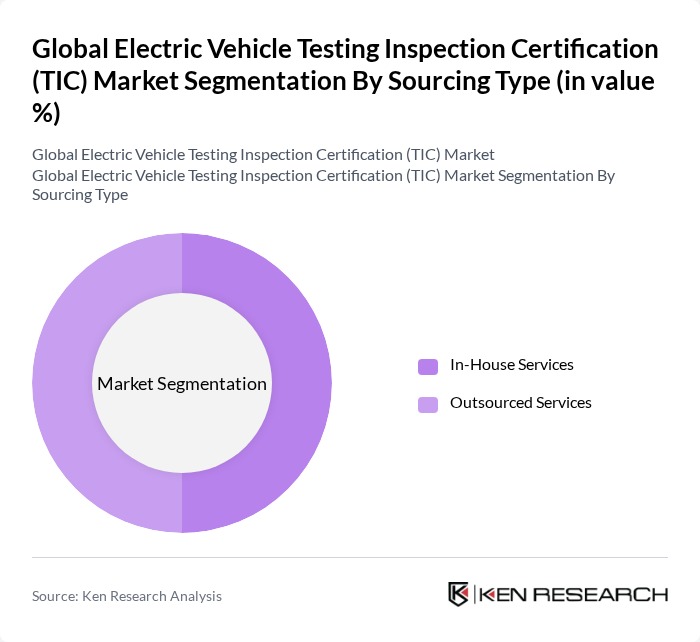
Global Electric Vehicle Testing Inspection Certification (TIC) Market segmentation by Sourcing Type.

This segmentation includes In-House Services and Outsourced Services. In-House Services remain important as many large automotive manufacturers and battery producers maintain internal laboratories to conduct core performance and durability testing, enabling tight control over intellectual property, quality, and development timelines. However, Outsourced Services are gaining strong traction and represent the larger share of the market, as companies increasingly rely on third?party laboratories and TIC providers for homologation, type-approval, specialized battery abuse testing, cyber and functional safety assessments, and multi-region certification, leveraging external expertise and global accreditation. The trend towards outsourcing is driven by the increasing complexity of EV technologies, the rapid evolution of international standards, and the high capital cost of advanced test equipment, which encourage OEMs and suppliers to partner with accredited TIC organizations for flexible capacity and market access support.

Global Electric Vehicle Testing Inspection Certification (TIC) Market Competitive Landscape

The Global Electric Vehicle Testing Inspection Certification (TIC) Market is characterized by a dynamic mix of regional and international players. Leading participants such as TÜV SÜD, SGS SA, Intertek Group plc, Bureau Veritas, DEKRA SE, UL Solutions Inc., DNV AS, Applus Services, S.A. (Applus+), Element Materials Technology Group, Eurofins Scientific SE, ATESTEO GmbH & Co. KG, FEV Group GmbH, Ricardo plc, AVL List GmbH, TÜV Rheinland AG contribute to innovation, geographic expansion, and service delivery in this space.

TÜV SÜD

1866

Munich, Germany

SGS SA

1878

Geneva, Switzerland

Intertek Group plc

1885

London, UK

Bureau Veritas

1828

Neuilly-sur-Seine, France

DEKRA SE

1925

Stuttgart, Germany

Company

Establishment Year

Headquarters

Service Portfolio Breadth in EV TIC (Testing / Inspection / Certification Coverage)

Revenue from EV TIC Services

EV TIC Revenue Growth Rate

Geographic Coverage (Number of Regions / Countries Served)

Number of EV-Dedicated Labs and Test Facilities

Key EV TIC Accreditations and Certifications (e.g., ISO/IEC 17025, ISO 17020)

Global Electric Vehicle Testing Inspection Certification (TIC) Market Industry Analysis

Growth Drivers

  • Increasing Demand for Electric Vehicles:The global electric vehicle (EV) market is projected to reach 40 million units sold in future, driven by consumer preference for sustainable transportation. This surge is supported by the International Energy Agency's report indicating a 35–40% increase in EV sales in the most recently assessed period, reflecting a growing shift towards electric mobility. As more consumers opt for EVs, the demand for testing, inspection, and certification services will inevitably rise, creating a robust market for TIC providers.
  • Stringent Government Regulations on Emissions:Governments worldwide are implementing stricter emissions regulations, with the European Union targeting a substantial reduction in CO2 emissions from new cars in future. In the U.S., the Biden administration aims for around 50% of all new vehicle sales to be electric in future. These regulations necessitate comprehensive testing and certification processes, thereby driving demand for TIC services to ensure compliance with evolving standards and promote environmental sustainability.
  • Advancements in Battery Technology:The global battery market is expected to grow to over $100 billion in future, fueled by innovations in lithium-ion and solid-state batteries. These advancements enhance EV performance, range, and safety, leading to increased consumer adoption. As battery technology evolves, the need for specialized testing and certification services to validate performance and safety standards becomes critical, further propelling the TIC market's growth in the electric vehicle sector.

Market Challenges

  • High Initial Investment Costs:The transition to electric vehicles involves significant upfront costs, with the average price of an EV exceeding $55,000 recently. This financial barrier can deter potential buyers, limiting market growth. Additionally, the costs associated with establishing testing and certification facilities can be substantial, posing challenges for TIC providers in scaling their operations to meet increasing demand in the electric vehicle market.
  • Limited Charging Infrastructure:As of recent data, there are approximately 150,000 public charging stations in the U.S., which is insufficient to support the projected growth of electric vehicles. The lack of widespread charging infrastructure can hinder consumer adoption and, consequently, the demand for TIC services. Addressing this challenge requires significant investment and collaboration between public and private sectors to expand charging networks and enhance accessibility for EV users.

Global Electric Vehicle Testing Inspection Certification (TIC) Market Future Outlook

The future of the electric vehicle testing inspection certification market appears promising, driven by technological advancements and regulatory support. As battery technologies continue to improve, the demand for rigorous testing and certification will increase, ensuring safety and performance standards are met. Additionally, the rise of autonomous electric vehicles will necessitate new testing protocols, creating further opportunities for TIC providers. The market is poised for growth as consumer awareness and government incentives continue to drive electric vehicle adoption.

Market Opportunities

  • Expansion of Charging Networks:The U.S. government plans to invest approximately $7.5 billion in EV charging infrastructure in future, significantly enhancing accessibility. This expansion presents TIC providers with opportunities to develop specialized services for new charging technologies, ensuring compliance with safety and performance standards, thus fostering consumer confidence in electric vehicle adoption.
  • Development of New Testing Technologies:The increasing complexity of electric vehicles necessitates innovative testing solutions. Investment in advanced testing technologies, such as AI-driven diagnostics, can streamline certification processes. This innovation not only enhances efficiency but also positions TIC providers as leaders in the evolving electric vehicle landscape, catering to the growing demand for reliable testing services.

Scope of the Report

SegmentSub-Segments
By Service Type

Testing

Inspection

Certification

By Sourcing Type

In-House Services

Outsourced Services

By Application

Safety and Security

Battery Systems

Electric Motor Testing

Charging Stations

Vehicle Inspection

By Vehicle Type

Battery Electric Vehicles (BEV)

Plug-in Hybrid Electric Vehicles (PHEV)

Fuel Cell Electric Vehicles (FCEV)

Others

By End-User

Automotive OEMs

Government Agencies

Independent Laboratories

Charging Infrastructure Providers

Others

By Region

North America

Europe

Asia-Pacific

Latin America

Middle East & Africa

Key Target Audience

Investors and Venture Capitalist Firms

Government and Regulatory Bodies (e.g., National Highway Traffic Safety Administration, Environmental Protection Agency)

Automotive Manufacturers

Electric Vehicle Charging Infrastructure Providers

Battery Manufacturers

Testing and Certification Laboratories

Automotive Industry Associations

Insurance Companies

Players Mentioned in the Report:

TUV SUD

SGS SA

Intertek Group plc

Bureau Veritas

DEKRA SE

UL Solutions Inc.

DNV AS

Applus Services, S.A. (Applus+)

Element Materials Technology Group

Eurofins Scientific SE

ATESTEO GmbH & Co. KG

FEV Group GmbH

Ricardo plc

AVL List GmbH

TUV Rheinland AG

Table of Contents

Market Assessment Phase

1. Executive Summary and Approach


2. Global Electric Vehicle Testing Inspection Certification (TIC) Market Overview

2.1 Key Insights and Strategic Recommendations

2.2 Global Electric Vehicle Testing Inspection Certification (TIC) Market Overview

2.3 Definition and Scope

2.4 Evolution of Market Ecosystem

2.5 Timeline of Key Regulatory Milestones

2.6 Value Chain & Stakeholder Mapping

2.7 Business Cycle Analysis

2.8 Policy & Incentive Landscape


3. Global Electric Vehicle Testing Inspection Certification (TIC) Market Analysis

3.1 Growth Drivers

3.1.1 Increasing demand for electric vehicles
3.1.2 Stringent government regulations on emissions
3.1.3 Advancements in battery technology
3.1.4 Growing consumer awareness of sustainability

3.2 Market Challenges

3.2.1 High initial investment costs
3.2.2 Limited charging infrastructure
3.2.3 Variability in regulatory standards
3.2.4 Competition from traditional vehicles

3.3 Market Opportunities

3.3.1 Expansion of charging networks
3.3.2 Development of new testing technologies
3.3.3 Partnerships with automotive manufacturers
3.3.4 Increased investment in R&D

3.4 Market Trends

3.4.1 Rise of autonomous electric vehicles
3.4.2 Integration of AI in testing processes
3.4.3 Shift towards sustainable materials
3.4.4 Growth of second-life battery applications

3.5 Government Regulation

3.5.1 Emission reduction targets
3.5.2 Safety standards for electric vehicles
3.5.3 Incentives for electric vehicle adoption
3.5.4 Certification requirements for TIC providers

4. SWOT Analysis


5. Stakeholder Analysis


6. Porter's Five Forces Analysis


7. Global Electric Vehicle Testing Inspection Certification (TIC) Market Market Size, 2019-2024

7.1 By Value

7.2 By Volume

7.3 By Average Selling Price


8. Global Electric Vehicle Testing Inspection Certification (TIC) Market Segmentation

8.1 By Service Type

8.1.1 Testing
8.1.2 Inspection
8.1.3 Certification

8.2 By Sourcing Type

8.2.1 In-House Services
8.2.2 Outsourced Services

8.3 By Application

8.3.1 Safety and Security
8.3.2 Battery Systems
8.3.3 Electric Motor Testing
8.3.4 Charging Stations
8.3.5 Vehicle Inspection

8.4 By Vehicle Type

8.4.1 Battery Electric Vehicles (BEV)
8.4.2 Plug-in Hybrid Electric Vehicles (PHEV)
8.4.3 Fuel Cell Electric Vehicles (FCEV)
8.4.4 Others

8.5 By End-User

8.5.1 Automotive OEMs
8.5.2 Government Agencies
8.5.3 Independent Laboratories
8.5.4 Charging Infrastructure Providers
8.5.5 Others

8.6 By Region

8.6.1 North America
8.6.2 Europe
8.6.3 Asia-Pacific
8.6.4 Latin America
8.6.5 Middle East & Africa

9. Global Electric Vehicle Testing Inspection Certification (TIC) Market Competitive Analysis

9.1 Market Share of Key Players

9.2 Cross Comparison of Key Players

9.2.1 Company Name
9.2.2 Service Portfolio Breadth in EV TIC (Testing / Inspection / Certification Coverage)
9.2.3 Revenue from EV TIC Services
9.2.4 EV TIC Revenue Growth Rate
9.2.5 Geographic Coverage (Number of Regions / Countries Served)
9.2.6 Number of EV-Dedicated Labs and Test Facilities
9.2.7 Key EV TIC Accreditations and Certifications (e.g., ISO/IEC 17025, ISO 17020)
9.2.8 Average Turnaround Time for EV Testing/Certification
9.2.9 Share of Automotive/EV in Total Company Revenue
9.2.10 R&D Spend Related to EV Testing and Validation
9.2.11 Strategic Partnerships with OEMs / Battery & Charger Manufacturers
9.2.12 EV TIC Contract Win Rate in Competitive Bids

9.3 SWOT Analysis of Top Players

9.4 Pricing Analysis

9.5 Detailed Profile of Major Companies

9.5.1 TÜV SÜD
9.5.2 SGS SA
9.5.3 Intertek Group plc
9.5.4 Bureau Veritas
9.5.5 DEKRA SE
9.5.6 UL Solutions Inc.
9.5.7 DNV AS
9.5.8 Applus Services, S.A. (Applus+)
9.5.9 Element Materials Technology Group
9.5.10 Eurofins Scientific SE
9.5.11 ATESTEO GmbH & Co. KG
9.5.12 FEV Group GmbH
9.5.13 Ricardo plc
9.5.14 AVL List GmbH
9.5.15 TÜV Rheinland AG

10. Global Electric Vehicle Testing Inspection Certification (TIC) Market End-User Analysis

10.1 Procurement Behavior of Key Ministries

10.1.1 Budget Allocation Trends
10.1.2 Procurement Processes
10.1.3 Key Decision-Makers
10.1.4 Contracting Preferences
10.1.5 Others

10.2 Corporate Spend on Infrastructure & Energy

10.2.1 Investment Priorities
10.2.2 Spending Patterns
10.2.3 Infrastructure Development Plans
10.2.4 Energy Efficiency Initiatives
10.2.5 Others

10.3 Pain Point Analysis by End-User Category

10.3.1 Common Challenges Faced
10.3.2 Specific Needs by Sector
10.3.3 Feedback Mechanisms
10.3.4 Support Requirements
10.3.5 Others

10.4 User Readiness for Adoption

10.4.1 Awareness Levels
10.4.2 Training Needs
10.4.3 Technology Acceptance
10.4.4 Infrastructure Readiness
10.4.5 Others

10.5 Post-Deployment ROI and Use Case Expansion

10.5.1 ROI Measurement Techniques
10.5.2 Use Case Development
10.5.3 Long-term Benefits
10.5.4 Scalability Potential
10.5.5 Others

11. Global Electric Vehicle Testing Inspection Certification (TIC) Market Future Size, 2025-2030

11.1 By Value

11.2 By Volume

11.3 By Average Selling Price


Go-To-Market Strategy Phase

1. Whitespace Analysis + Business Model Canvas

1.1 Market Gaps Identification

1.2 Business Model Development


2. Marketing and Positioning Recommendations

2.1 Branding Strategies

2.2 Product USPs


3. Distribution Plan

3.1 Urban Retail Strategies

3.2 Rural NGO Tie-ups


4. Channel & Pricing Gaps

4.1 Underserved Routes

4.2 Pricing Bands


5. Unmet Demand & Latent Needs

5.1 Category Gaps

5.2 Consumer Segments


6. Customer Relationship

6.1 Loyalty Programs

6.2 After-sales Service


7. Value Proposition

7.1 Sustainability Initiatives

7.2 Integrated Supply Chains


8. Key Activities

8.1 Regulatory Compliance

8.2 Branding

8.3 Distribution Setup


9. Entry Strategy Evaluation

9.1 Domestic Market Entry Strategy

9.1.1 Product Mix
9.1.2 Pricing Band
9.1.3 Packaging

9.2 Export Entry Strategy

9.2.1 Target Countries
9.2.2 Compliance Roadmap

10. Entry Mode Assessment

10.1 Joint Ventures

10.2 Greenfield Investments

10.3 Mergers & Acquisitions

10.4 Distributor Model


11. Capital and Timeline Estimation

11.1 Capital Requirements

11.2 Timelines


12. Control vs Risk Trade-Off

12.1 Ownership vs Partnerships


13. Profitability Outlook

13.1 Breakeven Analysis

13.2 Long-term Sustainability


14. Potential Partner List

14.1 Distributors

14.2 Joint Ventures

14.3 Acquisition Targets


15. Execution Roadmap

15.1 Phased Plan for Market Entry

15.1.1 Market Setup
15.1.2 Market Entry
15.1.3 Growth Acceleration
15.1.4 Scale & Stabilize

15.2 Key Activities and Milestones

15.2.1 Activity Planning
15.2.2 Milestone Tracking

Research Methodology

ApproachModellingSample

Phase 1: Approach1

Desk Research

  • Analysis of industry reports from organizations such as the International Energy Agency (IEA) and the Electric Vehicle Association
  • Review of government publications and policy documents related to electric vehicle regulations and standards
  • Examination of market trends and forecasts from automotive and energy sector publications

Primary Research

  • Interviews with regulatory bodies and certification agencies involved in electric vehicle testing
  • Surveys with electric vehicle manufacturers and component suppliers to understand testing requirements
  • Field interviews with industry experts and consultants specializing in electric vehicle technologies

Validation & Triangulation

  • Cross-validation of findings through multiple data sources, including market reports and expert opinions
  • Triangulation of data from manufacturers, regulatory bodies, and market analysts to ensure accuracy
  • Sanity checks conducted through expert panel reviews to validate assumptions and findings

Phase 2: Market Size Estimation1

Top-down Assessment

  • Estimation of the global electric vehicle market size and its growth trajectory
  • Analysis of the proportion of electric vehicles requiring TIC services based on regulatory mandates
  • Incorporation of regional market dynamics and government incentives for electric vehicle adoption

Bottom-up Modeling

  • Collection of data on the number of electric vehicles sold and projected growth rates
  • Estimation of average costs associated with testing, inspection, and certification processes
  • Calculation of total market size based on the volume of vehicles and average TIC service fees

Forecasting & Scenario Analysis

  • Multi-factor regression analysis incorporating variables such as technological advancements and consumer adoption rates
  • Scenario modeling based on potential changes in regulations and market conditions
  • Development of baseline, optimistic, and pessimistic forecasts through 2030

Phase 3: CATI Sample Composition1

Scope Item/SegmentSample SizeTarget Respondent Profiles
Electric Vehicle Manufacturers120Product Development Managers, Compliance Officers
Testing and Certification Agencies90Quality Assurance Managers, Regulatory Affairs Specialists
Component Suppliers70Supply Chain Managers, Technical Sales Representatives
Government Regulatory Bodies50Policy Makers, Environmental Compliance Officers
Industry Experts and Consultants40Market Analysts, Technology Consultants

Frequently Asked Questions

What is the current value of the Global Electric Vehicle Testing Inspection Certification (TIC) Market?

The Global Electric Vehicle Testing Inspection Certification (TIC) Market is valued at approximately USD 1.3 billion, reflecting a significant growth driven by the increasing adoption of electric vehicles and stringent safety regulations requiring comprehensive testing and certification processes.

What factors are driving the growth of the Electric Vehicle TIC Market?

Which countries dominate the Electric Vehicle TIC Market?

What are the main service types in the Electric Vehicle TIC Market?

Other Regional/Country Reports

Indonesia Electric Vehicle Testing Inspection Certification (TIC) Market

Malaysia Electric Vehicle Testing Inspection Certification (TIC) Market

KSA Electric Vehicle Testing Inspection Certification (TIC) Market

APAC Electric Vehicle Testing Inspection Certification (TIC) Market

SEA Electric Vehicle Testing Inspection Certification (TIC) Market

Vietnam Electric Vehicle Testing Inspection Certification (TIC) Market

Why Buy From Us?

Refine Robust Result (RRR) Framework

What makes us stand out is that our consultants follow Robust, Refine and Result (RRR) methodology. Robust for clear definitions, approaches and sanity checking, Refine for differentiating respondents' facts and opinions, and Result for presenting data with story.

Our Reach Is Unmatched

We have set a benchmark in the industry by offering our clients with syndicated and customized market research reports featuring coverage of entire market as well as meticulous research and analyst insights.

Shifting the Research Paradigm

While we don't replace traditional research, we flip the method upside down. Our dual approach of Top Bottom & Bottom Top ensures quality deliverable by not just verifying company fundamentals but also looking at the sector and macroeconomic factors.

More Insights-Better Decisions

With one step in the future, our research team constantly tries to show you the bigger picture. We help with some of the tough questions you may encounter along the way: How is the industry positioned? Best marketing channel? KPI's of competitors? By aligning every element, we help maximize success.

Transparency and Trust

Our report gives you instant access to the answers and sources that other companies might choose to hide. We elaborate each steps of research methodology we have used and showcase you the sample size to earn your trust.

Round the Clock Support

If you need any support, we are here! We pride ourselves on universe strength, data quality, and quick, friendly, and professional service.

Why Clients Choose Us?

400000+
Reports in repository
150+
Consulting projects a year
100+
Analysts
8000+
Client Queries in 2022








