Region:Global
Author(s):Rebecca
Product Code:KRAD1456
Pages:80
Published On:November 2025
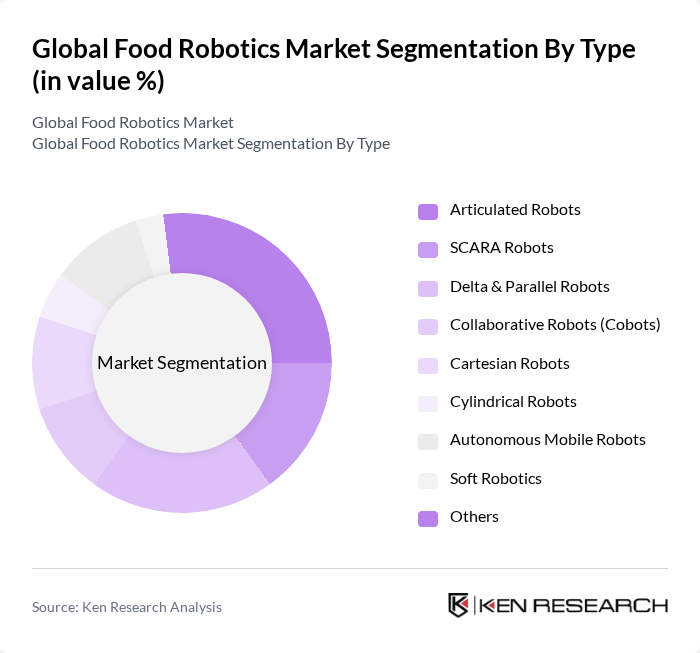
By Type:The food robotics market is segmented into articulated robots, SCARA robots, delta & parallel robots, collaborative robots (cobots), Cartesian robots, cylindrical robots, autonomous mobile robots, soft robotics, and others. Articulated robots dominate due to their versatility in handling complex food processing tasks, including automated cutting, packaging, and palletizing. SCARA and delta robots are widely used for high-speed pick-and-place operations, while cobots are gaining traction for safe human-robot collaboration. Autonomous mobile robots and soft robotics are increasingly adopted for flexible material handling and delicate food processing applications .
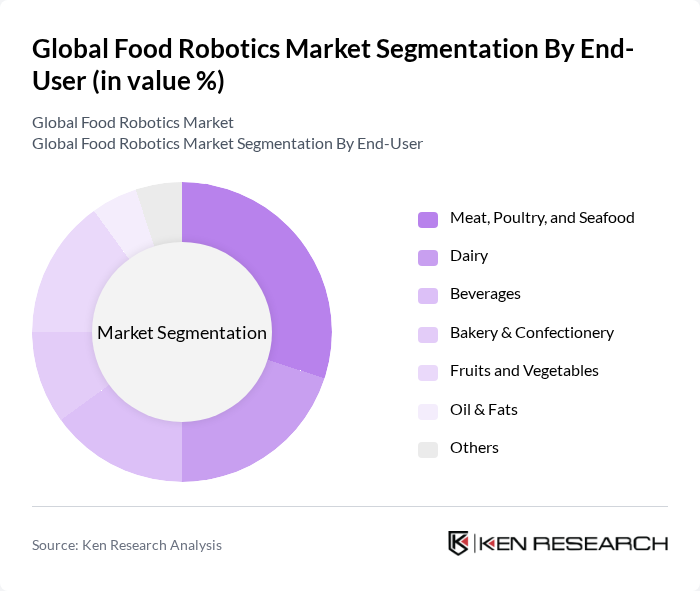
By End-User:The end-user segmentation encompasses meat, poultry, and seafood; dairy; beverages; bakery & confectionery; fruits and vegetables; oil & fats; and others. Meat, poultry, and seafood processing facilities have the highest adoption due to labor-intensive operations and the need for automated cutting, deboning, and packaging. Dairy and beverage sectors leverage robotics for hygiene, consistency, and high-speed bottling. Bakery, confectionery, fruits, and vegetables segments utilize robotics for sorting, packaging, and quality inspection, while oil & fats and other sectors focus on process optimization and safety compliance .
The Global Food Robotics Market is characterized by a dynamic mix of regional and international players. Leading participants such as ABB Ltd., FANUC Corporation, KUKA AG, Yaskawa Electric Corporation, Mitsubishi Electric Corporation, Omron Corporation, Universal Robots A/S, Siemens AG, Schneider Electric SE, Denso Corporation, Kawasaki Heavy Industries, Ltd., Rockwell Automation, Inc., Cognex Corporation, Blue Ocean Robotics ApS, Rethink Robotics GmbH contribute to innovation, geographic expansion, and service delivery in this space.
The future of the food robotics market appears promising, driven by ongoing technological advancements and increasing automation adoption. As companies seek to enhance efficiency and meet stringent food safety standards, the integration of AI and machine learning will become more prevalent. Additionally, the focus on sustainable practices will likely lead to innovations in robotics that minimize waste and energy consumption, further propelling market growth in future.
| Segment | Sub-Segments |
|---|---|
| By Type | Articulated Robots SCARA Robots Delta & Parallel Robots Collaborative Robots (Cobots) Cartesian Robots Cylindrical Robots Autonomous Mobile Robots Soft Robotics Others |
| By End-User | Meat, Poultry, and Seafood Dairy Beverages Bakery & Confectionery Fruits and Vegetables Oil & Fats Others |
| By Application | Palletizing & Depalletizing Packaging and Repackaging Pick-and-Place Cutting and Slicing Grading and Sorting Butchery Quality Inspection Cooking and Preparation Others |
| By Technology | Vision Systems Sensor Technologies Control Systems IoT & Industry 4.0 Integration Others |
| By Region | North America Europe Asia-Pacific Latin America Middle East & Africa |
| By Investment Source | Private Investments Government Funding Venture Capital Others |
| By Policy Support | Subsidies for Automation Tax Incentives Grants for Research and Development Others |
| Scope Item/Segment | Sample Size | Target Respondent Profiles |
|---|---|---|
| Food Processing Automation | 120 | Plant Managers, Automation Engineers |
| Packaging Robotics | 90 | Production Supervisors, Packaging Engineers |
| Logistics and Supply Chain Robotics | 60 | Logistics Coordinators, Supply Chain Analysts |
| Food Safety Compliance Automation | 50 | Quality Assurance Managers, Compliance Officers |
| Consumer Insights on Food Robotics | 70 | Food Industry Analysts, Market Researchers |
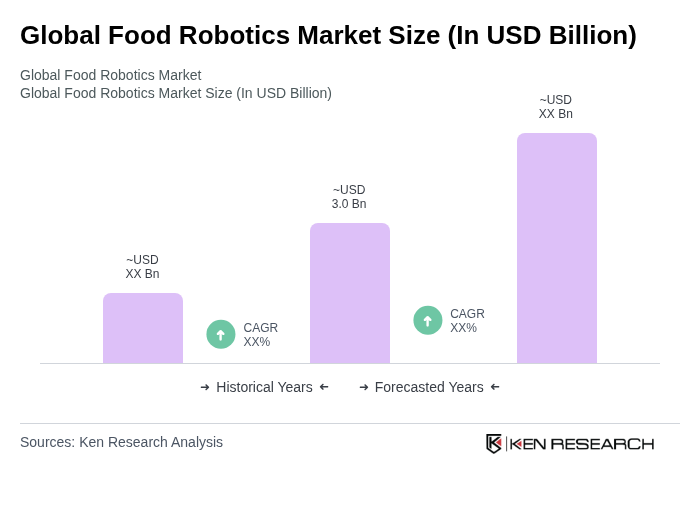
The Global Food Robotics Market is valued at approximately USD 3.0 billion, driven by the increasing demand for automation in food processing and packaging, as well as advancements in robotic technologies and AI integration.

What makes us stand out is that our consultants follow Robust, Refine and Result (RRR) methodology. Robust for clear definitions, approaches and sanity checking, Refine for differentiating respondents' facts and opinions, and Result for presenting data with story.

We have set a benchmark in the industry by offering our clients with syndicated and customized market research reports featuring coverage of entire market as well as meticulous research and analyst insights.

While we don't replace traditional research, we flip the method upside down. Our dual approach of Top Bottom & Bottom Top ensures quality deliverable by not just verifying company fundamentals but also looking at the sector and macroeconomic factors.

With one step in the future, our research team constantly tries to show you the bigger picture. We help with some of the tough questions you may encounter along the way: How is the industry positioned? Best marketing channel? KPI's of competitors? By aligning every element, we help maximize success.

Our report gives you instant access to the answers and sources that other companies might choose to hide. We elaborate each steps of research methodology we have used and showcase you the sample size to earn your trust.

If you need any support, we are here! We pride ourselves on universe strength, data quality, and quick, friendly, and professional service.













