Global Fruit Vegetables Market Size Share Growth Drivers Trends Opportunities & Forecast 2025–2030

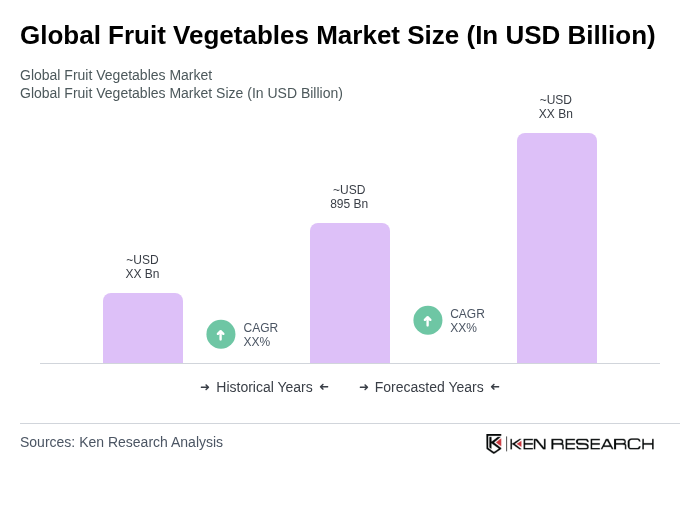
Global fruit vegetables market valued at $895 Bn, driven by health trends and e-commerce expansion, showing steady growth.

Region:Global

Author(s):Dev

Product Code:KRAE0111

Pages:92

Published On:December 2025
About the Report

Base Year 2024

Global Fruit Vegetables Market Overview

  • The Global Fruit Vegetables Market is valued at USD 895 billion, based on recent analysis. Key drivers include rising health consciousness and demand for convenient, longer-shelf-life produce supported by technological investments such as cold-chain infrastructure, high-pressure processing, and gene-edited cultivars that extend freshness. Additionally, e-commerce expansion and urban lifestyles are fueling consumption across regions.
  • Key players in this market include Dole plc and Fresh Del Monte Produce Inc., both vertically integrated and innovative in product offering, alongside Greenyard and Total Produce, which reinforce market dynamics through global distribution and sustainability initiatives. Regions with strong production and consumption, such as Asia-Pacific and North America, dominate the market due to efficient logistics and advanced retail systems.
  • In 2024, the U.S. Fresh Fruit and Vegetable Program allocates over USD 230 million annually in grants to state agencies to provide fresh produce snacks to elementary students, encouraging consumption and nutrition education. Such policies directly support demand and awareness within the broader fruit and vegetables market.
Global Fruit Vegetables Market Size

Global Fruit Vegetables Market Segmentation

By Type:The fruit and vegetables market is segmented into various types, including tomatoes, cucumbers, peppers, eggplants, zucchini, and others. Among these, tomatoes hold a significant share due to their versatility in culinary applications and high nutritional value. The increasing trend of healthy eating and the popularity of plant-based diets have further propelled the demand for tomatoes, making them a staple in households and restaurants alike.
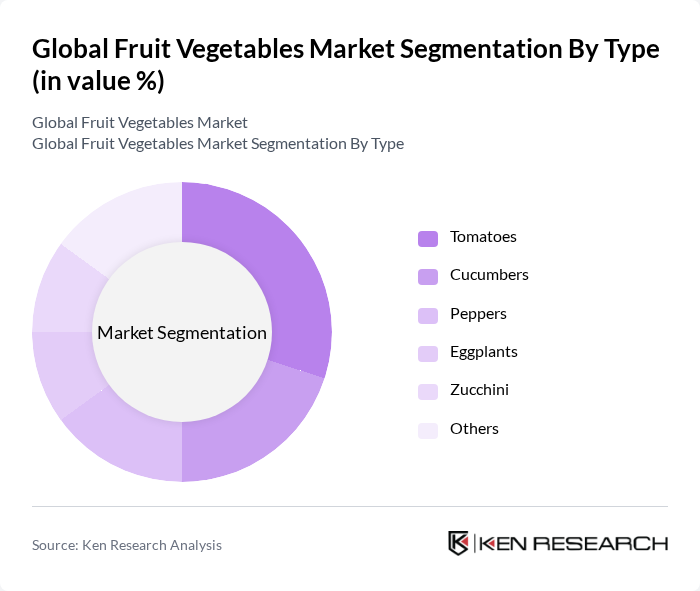
Global Fruit Vegetables Market segmentation by Type.

By End-User:The market is also segmented by end-user categories, including retail consumers, food service industry, food processing companies, export markets, and others. Retail consumers dominate the market, driven by the increasing trend of home cooking and the demand for fresh produce. The rise of health-conscious consumers has led to a surge in demand for organic and locally sourced fruits and vegetables, further solidifying the retail segment's position.
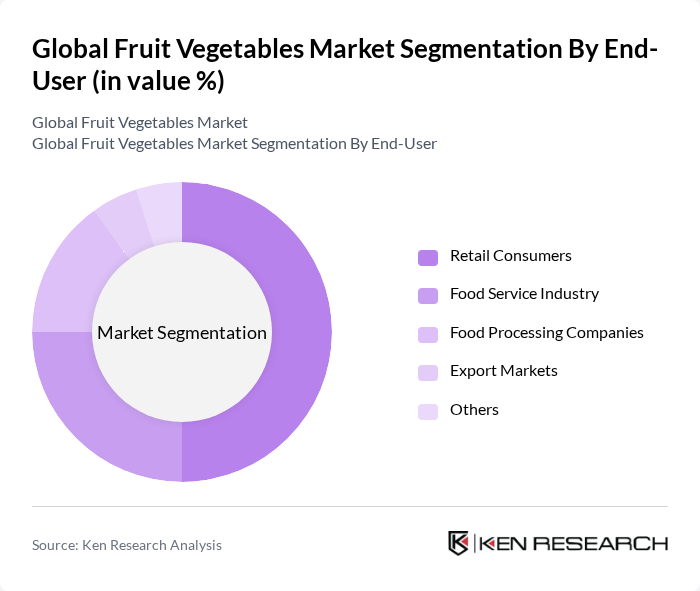
Global Fruit Vegetables Market segmentation by End-User.

Global Fruit Vegetables Market Competitive Landscape

The Global Fruit Vegetables Market is characterized by a dynamic mix of regional and international players. Leading participants such as Dole Food Company, Fresh Del Monte Produce Inc., Chiquita Brands International, Taylor Farms, Green Giant, Driscoll's, Bonduelle, Del Monte Foods, Sysco Corporation, Produce Alliance, The Wonderful Company, Ocean Spray Cranberries, Inc., Sun Pacific, Mann's Fresh Vegetables, Peri & Sons Farms contribute to innovation, geographic expansion, and service delivery in this space.

Dole Food Company

1851

Westlake Village, California, USA

Fresh Del Monte Produce Inc.

1886

Coral Gables, Florida, USA

Chiquita Brands International

1870

Fort Lauderdale, Florida, USA

Taylor Farms

1995

Salinas, California, USA

Green Giant

1903

Minneapolis, Minnesota, USA

Company

Establishment Year

Headquarters

Group Size (Large, Medium, or Small as per industry convention)

Revenue Growth Rate

Market Penetration Rate

Customer Retention Rate

Pricing Strategy

Product Diversification Index

Global Fruit Vegetables Market Industry Analysis

Growth Drivers

  • Increasing Health Consciousness:The global shift towards healthier lifestyles is driving the demand for fruit and vegetables. In future, the World Health Organization reported that 60% of adults are actively seeking to improve their diets, with a significant focus on increasing fruit and vegetable intake. This trend is supported by the rising prevalence of lifestyle-related diseases, which has prompted consumers to prioritize nutrient-rich foods, leading to an estimated increase of 15 million tons in fruit and vegetable consumption globally.
  • Rising Demand for Organic Produce:The organic fruit and vegetable market is experiencing robust growth, with sales projected to reach $60 billion in future, according to the Organic Trade Association. This surge is fueled by consumer awareness of the health benefits associated with organic produce, as well as environmental concerns. In the U.S. alone, organic fruit sales increased by 12% in the previous year, reflecting a growing preference for sustainably sourced products, which is expected to continue driving market expansion.
  • Expansion of Distribution Channels:The diversification of distribution channels is significantly enhancing market accessibility. In future, e-commerce sales of fresh produce are projected to exceed $30 billion, driven by the increasing adoption of online grocery shopping. Retailers are investing in logistics and technology to streamline supply chains, with 70% of supermarkets now offering online ordering options. This shift not only meets consumer demand for convenience but also expands the reach of fruit and vegetable products to previously underserved markets.

Market Challenges

  • Climate Change Impact:Climate change poses a significant threat to fruit and vegetable production, with the Food and Agriculture Organization estimating that global crop yields could decline by up to 30% by future due to extreme weather events. In future, unpredictable weather patterns are expected to disrupt harvests, leading to reduced supply and increased prices. This volatility challenges producers to adapt their practices, impacting overall market stability and profitability.
  • Supply Chain Disruptions:The global supply chain for fruit and vegetables remains vulnerable to disruptions, as evidenced by the COVID-19 pandemic's lasting effects. In future, logistical challenges are projected to increase transportation costs by 25%, affecting the timely delivery of fresh produce. Additionally, labor shortages in key agricultural regions are exacerbating these issues, leading to potential shortages and impacting the availability of products in retail markets.

Global Fruit Vegetables Market Future Outlook

The future of the fruit and vegetable market appears promising, driven by increasing consumer demand for health-oriented products and sustainable practices. As e-commerce continues to grow, more consumers will have access to fresh produce, enhancing market penetration. Additionally, innovations in agricultural technology, such as precision farming, are expected to improve yield efficiency. These trends indicate a dynamic market landscape, where adaptability and sustainability will be key to success in the coming years.

Market Opportunities

  • Growth in E-commerce for Fresh Produce:The rise of e-commerce presents a significant opportunity for the fruit and vegetable market. With online grocery shopping projected to grow by 30% in future, businesses can leverage this trend to reach a broader audience. Enhanced delivery services and subscription models can further capitalize on consumer preferences for convenience, potentially increasing sales and customer loyalty.
  • Development of New Varieties:The introduction of new fruit and vegetable varieties tailored to consumer preferences can drive market growth. In future, the demand for exotic and heirloom varieties is expected to rise, with sales projected to increase by 20%. This trend offers producers the chance to differentiate their offerings, attract niche markets, and enhance profitability through innovative product development.

Scope of the Report

SegmentSub-Segments
By Type

Tomatoes

Cucumbers

Peppers

Eggplants

Zucchini

Others

By End-User

Retail Consumers

Food Service Industry

Food Processing Companies

Export Markets

Others

By Distribution Channel

Supermarkets and Hypermarkets

Online Retail

Farmers' Markets

Wholesale Distributors

Others

By Packaging Type

Plastic Packaging

Glass Packaging

Paper Packaging

Biodegradable Packaging

Others

By Region

North America

Europe

Asia-Pacific

Latin America

Middle East & Africa

By Organic vs Conventional

Organic

Conventional

Others

By Seasonality

Seasonal

Year-Round

Others

Key Target Audience

Investors and Venture Capitalist Firms

Government and Regulatory Bodies (e.g., Food and Drug Administration, Department of Agriculture)

Manufacturers and Producers

Distributors and Retailers

Export and Import Agencies

Food Safety Authorities (e.g., European Food Safety Authority)

Industry Associations (e.g., International Fresh Produce Association)

Financial Institutions

Players Mentioned in the Report:

Dole Food Company

Fresh Del Monte Produce Inc.

Chiquita Brands International

Taylor Farms

Green Giant

Driscoll's

Bonduelle

Del Monte Foods

Sysco Corporation

Produce Alliance

The Wonderful Company

Ocean Spray Cranberries, Inc.

Sun Pacific

Mann's Fresh Vegetables

Peri & Sons Farms

Table of Contents

Market Assessment Phase

1. Executive Summary and Approach


2. Global Fruit Vegetables Market Overview

2.1 Key Insights and Strategic Recommendations

2.2 Global Fruit Vegetables Market Overview

2.3 Definition and Scope

2.4 Evolution of Market Ecosystem

2.5 Timeline of Key Regulatory Milestones

2.6 Value Chain & Stakeholder Mapping

2.7 Business Cycle Analysis

2.8 Policy & Incentive Landscape


3. Global Fruit Vegetables Market Analysis

3.1 Growth Drivers

3.1.1 Increasing Health Consciousness
3.1.2 Rising Demand for Organic Produce
3.1.3 Expansion of Distribution Channels
3.1.4 Technological Advancements in Agriculture

3.2 Market Challenges

3.2.1 Climate Change Impact
3.2.2 Supply Chain Disruptions
3.2.3 Price Volatility of Raw Materials
3.2.4 Regulatory Compliance Issues

3.3 Market Opportunities

3.3.1 Growth in E-commerce for Fresh Produce
3.3.2 Development of New Varieties
3.3.3 Increasing Export Potential
3.3.4 Collaborations with Health and Wellness Brands

3.4 Market Trends

3.4.1 Shift Towards Sustainable Farming Practices
3.4.2 Rise of Plant-Based Diets
3.4.3 Innovations in Packaging Solutions
3.4.4 Growing Popularity of Local Sourcing

3.5 Government Regulation

3.5.1 Food Safety Standards
3.5.2 Organic Certification Regulations
3.5.3 Import and Export Regulations
3.5.4 Environmental Protection Policies

4. SWOT Analysis


5. Stakeholder Analysis


6. Porter's Five Forces Analysis


7. Global Fruit Vegetables Market Market Size, 2019-2024

7.1 By Value

7.2 By Volume

7.3 By Average Selling Price


8. Global Fruit Vegetables Market Segmentation

8.1 By Type

8.1.1 Tomatoes
8.1.2 Cucumbers
8.1.3 Peppers
8.1.4 Eggplants
8.1.5 Zucchini
8.1.6 Others

8.2 By End-User

8.2.1 Retail Consumers
8.2.2 Food Service Industry
8.2.3 Food Processing Companies
8.2.4 Export Markets
8.2.5 Others

8.3 By Distribution Channel

8.3.1 Supermarkets and Hypermarkets
8.3.2 Online Retail
8.3.3 Farmers' Markets
8.3.4 Wholesale Distributors
8.3.5 Others

8.4 By Packaging Type

8.4.1 Plastic Packaging
8.4.2 Glass Packaging
8.4.3 Paper Packaging
8.4.4 Biodegradable Packaging
8.4.5 Others

8.5 By Region

8.5.1 North America
8.5.2 Europe
8.5.3 Asia-Pacific
8.5.4 Latin America
8.5.5 Middle East & Africa

8.6 By Organic vs Conventional

8.6.1 Organic
8.6.2 Conventional
8.6.3 Others

8.7 By Seasonality

8.7.1 Seasonal
8.7.2 Year-Round
8.7.3 Others

9. Global Fruit Vegetables Market Competitive Analysis

9.1 Market Share of Key Players

9.2 Cross Comparison of Key Players

9.2.1 Company Name
9.2.2 Group Size (Large, Medium, or Small as per industry convention)
9.2.3 Revenue Growth Rate
9.2.4 Market Penetration Rate
9.2.5 Customer Retention Rate
9.2.6 Pricing Strategy
9.2.7 Product Diversification Index
9.2.8 Supply Chain Efficiency
9.2.9 Brand Recognition Score
9.2.10 Distribution Network Coverage

9.3 SWOT Analysis of Top Players

9.4 Pricing Analysis

9.5 Detailed Profile of Major Companies

9.5.1 Dole Food Company
9.5.2 Fresh Del Monte Produce Inc.
9.5.3 Chiquita Brands International
9.5.4 Taylor Farms
9.5.5 Green Giant
9.5.6 Driscoll's
9.5.7 Bonduelle
9.5.8 Del Monte Foods
9.5.9 Sysco Corporation
9.5.10 Produce Alliance
9.5.11 The Wonderful Company
9.5.12 Ocean Spray Cranberries, Inc.
9.5.13 Sun Pacific
9.5.14 Mann's Fresh Vegetables
9.5.15 Peri & Sons Farms

10. Global Fruit Vegetables Market End-User Analysis

10.1 Procurement Behavior of Key Ministries

10.1.1 Government Procurement Policies
10.1.2 Budget Allocations for Fresh Produce
10.1.3 Supplier Selection Criteria
10.1.4 Contract Management Practices

10.2 Corporate Spend on Infrastructure & Energy

10.2.1 Investment in Cold Storage Facilities
10.2.2 Expenditure on Transportation Logistics
10.2.3 Funding for Sustainable Practices
10.2.4 Budget for Technology Integration

10.3 Pain Point Analysis by End-User Category

10.3.1 Quality Assurance Issues
10.3.2 Supply Chain Delays
10.3.3 Price Fluctuations
10.3.4 Limited Access to Organic Options

10.4 User Readiness for Adoption

10.4.1 Awareness of Health Benefits
10.4.2 Willingness to Pay for Quality
10.4.3 Adoption of Technology in Procurement
10.4.4 Feedback Mechanisms for Improvement

10.5 Post-Deployment ROI and Use Case Expansion

10.5.1 Measurement of Cost Savings
10.5.2 Evaluation of Customer Satisfaction
10.5.3 Analysis of Market Reach
10.5.4 Opportunities for Product Line Expansion

11. Global Fruit Vegetables Market Future Size, 2025-2030

11.1 By Value

11.2 By Volume

11.3 By Average Selling Price


Go-To-Market Strategy Phase

1. Whitespace Analysis + Business Model Canvas

1.1 Market Gaps Identification

1.2 Value Proposition Development

1.3 Revenue Streams Analysis

1.4 Cost Structure Evaluation

1.5 Key Partnerships Exploration

1.6 Customer Segmentation

1.7 Channels of Distribution


2. Marketing and Positioning Recommendations

2.1 Branding Strategies

2.2 Product USPs

2.3 Target Audience Identification

2.4 Communication Strategy

2.5 Digital Marketing Approaches

2.6 Trade Marketing Initiatives

2.7 Customer Engagement Tactics


3. Distribution Plan

3.1 Urban Retail Strategies

3.2 Rural NGO Tie-ups

3.3 Direct-to-Consumer Models

3.4 E-commerce Integration

3.5 Logistics Optimization

3.6 Inventory Management Solutions

3.7 Partnership with Local Distributors


4. Channel & Pricing Gaps

4.1 Underserved Routes

4.2 Pricing Bands Analysis

4.3 Competitor Pricing Strategies

4.4 Consumer Price Sensitivity

4.5 Value-Based Pricing Models

4.6 Discounting Strategies

4.7 Bundling Opportunities


5. Unmet Demand & Latent Needs

5.1 Category Gaps Identification

5.2 Consumer Segments Analysis

5.3 Product Development Opportunities

5.4 Market Entry Strategies

5.5 Innovation in Offerings

5.6 Feedback Collection Mechanisms

5.7 Trend Analysis for Future Needs


6. Customer Relationship

6.1 Loyalty Programs

6.2 After-sales Service

6.3 Customer Feedback Systems

6.4 Community Engagement Initiatives

6.5 Personalization Strategies

6.6 Customer Education Programs

6.7 Retention Strategies


7. Value Proposition

7.1 Sustainability Initiatives

7.2 Integrated Supply Chains

7.3 Quality Assurance Measures

7.4 Innovation in Product Offerings

7.5 Customer-Centric Approaches

7.6 Competitive Differentiation

7.7 Long-term Partnerships


8. Key Activities

8.1 Regulatory Compliance

8.2 Branding Initiatives

8.3 Distribution Setup

8.4 Market Research Activities

8.5 Training and Development

8.6 Performance Monitoring

8.7 Stakeholder Engagement


9. Entry Strategy Evaluation

9.1 Domestic Market Entry Strategy

9.1.1 Product Mix Considerations
9.1.2 Pricing Band Analysis
9.1.3 Packaging Innovations

9.2 Export Entry Strategy

9.2.1 Target Countries Identification
9.2.2 Compliance Roadmap Development

10. Entry Mode Assessment

10.1 Joint Ventures

10.2 Greenfield Investments

10.3 Mergers & Acquisitions

10.4 Distributor Model Evaluation


11. Capital and Timeline Estimation

11.1 Capital Requirements Analysis

11.2 Timelines for Implementation


12. Control vs Risk Trade-Off

12.1 Ownership vs Partnerships


13. Profitability Outlook

13.1 Breakeven Analysis

13.2 Long-term Sustainability Strategies


14. Potential Partner List

14.1 Distributors

14.2 Joint Ventures

14.3 Acquisition Targets


15. Execution Roadmap

15.1 Phased Plan for Market Entry

15.1.1 Market Setup
15.1.2 Market Entry
15.1.3 Growth Acceleration
15.1.4 Scale & Stabilize

15.2 Key Activities and Milestones

15.2.1 Milestone Planning
15.2.2 Activity Tracking

Research Methodology

ApproachModellingSample

Phase 1: Approach1

Desk Research

  • Analysis of market reports from agricultural organizations and trade associations
  • Review of government publications on fruit and vegetable production statistics
  • Examination of academic journals focusing on agricultural economics and market trends

Primary Research

  • Interviews with key stakeholders in the fruit and vegetable supply chain, including farmers and distributors
  • Surveys conducted with retailers to understand consumer preferences and purchasing behavior
  • Focus group discussions with consumers to gauge trends in fruit and vegetable consumption

Validation & Triangulation

  • Cross-validation of data from multiple sources, including trade publications and market surveys
  • Triangulation of findings from primary interviews with secondary data insights
  • Sanity checks through expert reviews from industry analysts and market specialists

Phase 2: Market Size Estimation1

Top-down Assessment

  • Estimation of total market size based on national agricultural output and export data
  • Segmentation of the market by product type, including fresh produce and processed items
  • Incorporation of seasonal trends and regional consumption patterns into the analysis

Bottom-up Modeling

  • Collection of sales data from major retailers and wholesalers in the fruit and vegetable sector
  • Estimation of average prices and volumes sold across different market segments
  • Analysis of growth rates based on historical sales data and emerging market trends

Forecasting & Scenario Analysis

  • Development of forecasting models using historical data and market indicators
  • Scenario analysis based on potential impacts of climate change and trade policies
  • Creation of multiple growth scenarios, including best-case, worst-case, and most likely outcomes through 2030

Phase 3: CATI Sample Composition1

Scope Item/SegmentSample SizeTarget Respondent Profiles
Fresh Produce Retailers150Store Managers, Category Buyers
Wholesale Distributors100Distribution Managers, Sales Executives
Farmers and Growers80Farm Owners, Agricultural Consultants
Food Processing Companies70Production Managers, Quality Control Officers
Consumer Focus Groups60Health-conscious Consumers, Family Buyers

Frequently Asked Questions

What is the current value of the Global Fruit Vegetables Market?

The Global Fruit Vegetables Market is valued at approximately USD 895 billion, driven by increasing health consciousness, demand for convenient produce, and technological advancements in cold-chain infrastructure and processing methods.

What are the key drivers of growth in the Global Fruit Vegetables Market?

Which regions dominate the Global Fruit Vegetables Market?

What types of fruits and vegetables are most popular in the market?

Other Regional/Country Reports

Indonesia Fruit Vegetables Market

Malaysia Fruit Vegetables Market

KSA Fruit Vegetables Market

APAC Fruit Vegetables Market

SEA Fruit Vegetables Market

Vietnam Fruit Vegetables Market

Other Adjacent Reports

Japan Cold Chain Logistics Market

Qatar Organic Produce Market

Malaysia E-commerce Grocery Market

UAE food processing equipment market size, share, growth drivers, trends, opportunities & forecast 2025–2030

Japan Agricultural Technology Market

KSA Retail Grocery Market

Singapore Plant-Based Foods Market

GCC Nutraceuticals MarketQatar Supply Chain Management Market Report Size Share Growth Drivers Trends Opportunities & Forecast 2025–2030

Japan Sustainable Agriculture Market

Why Buy From Us?

Refine Robust Result (RRR) Framework

What makes us stand out is that our consultants follow Robust, Refine and Result (RRR) methodology. Robust for clear definitions, approaches and sanity checking, Refine for differentiating respondents' facts and opinions, and Result for presenting data with story.

Our Reach Is Unmatched

We have set a benchmark in the industry by offering our clients with syndicated and customized market research reports featuring coverage of entire market as well as meticulous research and analyst insights.

Shifting the Research Paradigm

While we don't replace traditional research, we flip the method upside down. Our dual approach of Top Bottom & Bottom Top ensures quality deliverable by not just verifying company fundamentals but also looking at the sector and macroeconomic factors.

More Insights-Better Decisions

With one step in the future, our research team constantly tries to show you the bigger picture. We help with some of the tough questions you may encounter along the way: How is the industry positioned? Best marketing channel? KPI's of competitors? By aligning every element, we help maximize success.

Transparency and Trust

Our report gives you instant access to the answers and sources that other companies might choose to hide. We elaborate each steps of research methodology we have used and showcase you the sample size to earn your trust.

Round the Clock Support

If you need any support, we are here! We pride ourselves on universe strength, data quality, and quick, friendly, and professional service.

Why Clients Choose Us?

400000+
Reports in repository
150+
Consulting projects a year
100+
Analysts
8000+
Client Queries in 2022








