About the Report
Base Year 2024Global Luxury Furniture Market Overview
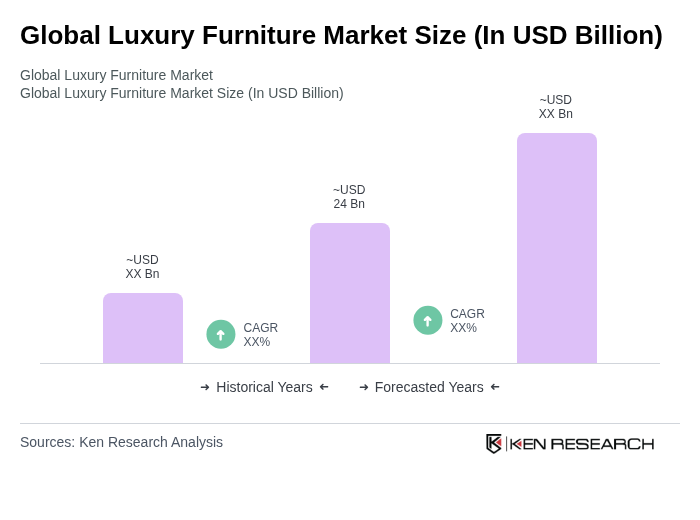
- The Global Luxury Furniture Market is valued at USD 24 billion, based on a five-year historical analysis. This growth is primarily driven by increasing disposable incomes, a rising trend in home decor, and a growing preference for high-quality, aesthetically pleasing furniture among consumers. The market has seen a significant shift towards customization and personalization, with consumers willing to invest in unique pieces that reflect their individual style. The influence of luxury lifestyle media, celebrity home tours, and high-end interior design influencers has further elevated the aspirational value of luxury furniture, driving demand in urban markets worldwide .
- Key players in this market are concentrated in regions such as North America and Europe, particularly in cities like New York, London, and Milan. These locations are known for their affluent populations and a strong culture of luxury consumption. The presence of renowned design houses and high-end retailers in these cities further solidifies their dominance in the luxury furniture market. Europe continues to lead the global market, with a strong emphasis on innovation, heritage craftsmanship, and sustainable production methods .
- In 2023, the European Union implemented the Ecodesign for Sustainable Products Regulation (ESPR), which sets binding requirements for the environmental performance of furniture products. This includes guidelines for responsible sourcing of materials, reduction of carbon footprints in manufacturing, and improved product durability and recyclability. The regulation encourages manufacturers to adopt eco-friendly practices, thereby enhancing the overall sustainability of the luxury furniture market .
Global Luxury Furniture Market Segmentation
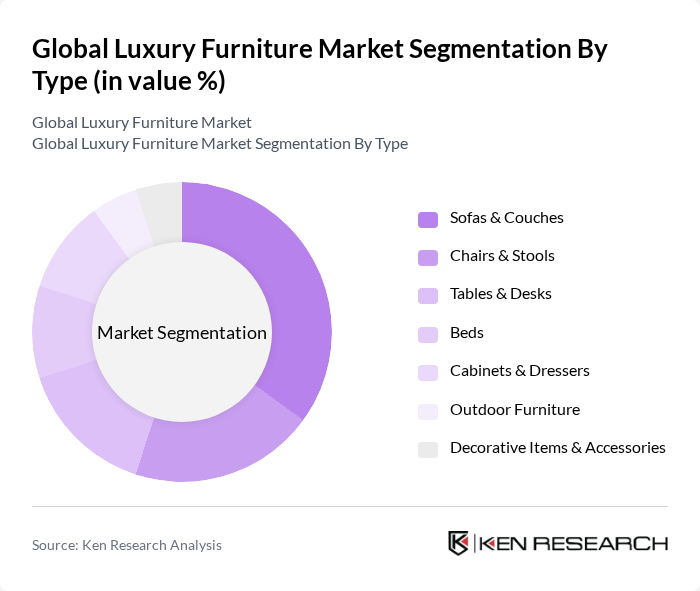
By Type:The luxury furniture market is segmented into various types, including sofas & couches, chairs & stools, tables & desks, beds, cabinets & dressers, outdoor furniture, and decorative items & accessories. Among these, sofas & couches dominate the market due to their essential role in living spaces and the increasing consumer preference for stylish and comfortable seating options. The trend towards open-plan living has further fueled the demand for versatile and aesthetically pleasing sofas. The growing focus on modular and space-saving designs is also shaping product development, especially in urban environments .
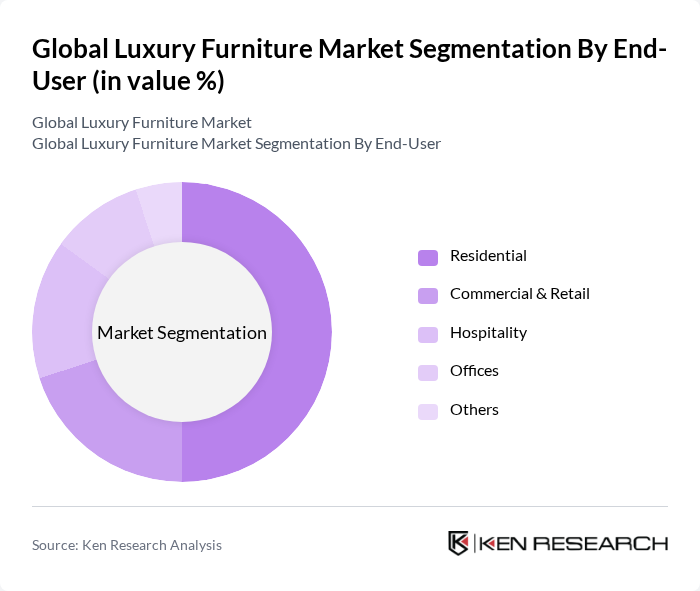
By End-User:The luxury furniture market is segmented by end-user into residential, commercial & retail, hospitality, offices, and others. The residential segment holds the largest share, driven by the increasing trend of home renovations and the desire for high-end furnishings among homeowners. The rise in disposable income and the growing influence of interior design trends have led consumers to invest more in luxury furniture for their living spaces. The commercial and hospitality sectors are also experiencing growth, supported by luxury real estate developments and upscale hotel projects .
Global Luxury Furniture Market Competitive Landscape
The Global Luxury Furniture Market is characterized by a dynamic mix of regional and international players. Leading participants such as Roche Bobois, RH (Restoration Hardware), Knoll, B&B Italia, Poltrona Frau, Minotti, Cassina, Ligne Roset, Fendi Casa, Armani/Casa, Baker Furniture, Theodore Alexander, Henredon, Christopher Guy, Duresta, Molteni & C, Flexform, Eichholtz, Bentley Home, Boca do Lobo contribute to innovation, geographic expansion, and service delivery in this space.
Global Luxury Furniture Market Industry Analysis
Growth Drivers
- Increasing Disposable Income Among Consumers:The global luxury furniture market is significantly driven by rising disposable incomes, particularly in emerging economies. For instance, the World Bank reported that the global middle class is expected to reach 5.3 billion in future, with a substantial increase in disposable income. In future, the average disposable income in high-income countries is projected to be around $52,000, enabling consumers to invest in luxury furniture, thus boosting market demand.
- Rising Demand for Sustainable and Eco-Friendly Furniture:The shift towards sustainability is reshaping consumer preferences in the luxury furniture sector. According to a report by the International Institute for Environment and Development, 70% of consumers in developed markets are willing to pay a premium for eco-friendly products. In future, the market for sustainable furniture is expected to grow by $16 billion, driven by increased awareness of environmental issues and the demand for responsibly sourced materials.
- Growth in the Real Estate and Hospitality Sectors:The luxury furniture market is benefiting from the expansion of the real estate and hospitality sectors. In future, the global real estate market is projected to reach $4.5 trillion, with luxury residential developments increasing. Additionally, the hospitality industry is expected to grow by 6% annually, leading to higher demand for upscale furniture in hotels and resorts, thereby driving market growth in luxury furnishings.
Market Challenges
- High Production Costs:One of the significant challenges facing the luxury furniture market is the high production costs associated with premium materials and craftsmanship. In future, the cost of raw materials such as hardwood and metals is expected to rise by 12%, impacting profit margins for manufacturers. This increase in production costs can lead to higher retail prices, potentially limiting consumer access to luxury furniture.
- Intense Competition from Affordable Furniture Brands:The luxury furniture market faces fierce competition from affordable furniture brands that offer stylish alternatives at lower prices. In future, the market share of budget furniture brands is projected to increase by 17%, attracting price-sensitive consumers. This competition can pressure luxury brands to innovate and differentiate their offerings, making it challenging to maintain market share and profitability.
Global Luxury Furniture Market Future Outlook
The future of the luxury furniture market appears promising, driven by evolving consumer preferences and technological advancements. As sustainability becomes a priority, brands that adopt eco-friendly practices are likely to gain a competitive edge. Additionally, the integration of smart technology in furniture design is expected to enhance functionality and appeal. With the rise of e-commerce, luxury furniture brands can reach a broader audience, facilitating growth and innovation in the sector.
Market Opportunities
- Expansion into Emerging Markets:Emerging markets present significant growth opportunities for luxury furniture brands. Countries like India and Brazil are experiencing rapid urbanization, with a projected increase in the middle class in future. This demographic shift is expected to drive demand for luxury furnishings, providing brands with a lucrative market to explore and expand their presence.
- Customization and Personalization Trends:The trend towards customization in luxury furniture is gaining traction, with consumers seeking unique pieces that reflect their personal style. In future, the demand for customized furniture is expected to grow by 22%, as brands that offer bespoke services can cater to individual preferences, enhancing customer satisfaction and loyalty in a competitive market.
Scope of the Report
| Segment | Sub-Segments |
|---|---|
| By Type | Sofas & Couches Chairs & Stools Tables & Desks Beds Cabinets & Dressers Outdoor Furniture (Patio, Rooftop, Beachfront, etc.) Decorative Items & Accessories |
| By End-User | Residential Commercial & Retail Hospitality (Hotels, Restaurants, Resorts) Offices Others |
| By Material | Wood Metal Glass Upholstery (Leather, Fabric, etc.) Plastic & Other Materials |
| By Style | Contemporary/Modern Traditional/Classic Rustic Industrial Minimalist Others |
| By Distribution Channel | Online Retail/E-commerce Offline Retail (Department Stores, Independent Retailers, Showrooms) Direct Sales Factory Outlets Others |
| By Price Range | Premium Mid-Range Luxury Entry-Level Luxury Others |
| By Region | North America (U.S., Canada, Mexico) Europe (U.K., Germany, France, Italy, Spain, Rest of Europe) Asia-Pacific (China, Japan, India, South Korea, Australia, Rest of Asia-Pacific) Latin America (Brazil, Argentina, Rest of Latin America) Middle East & Africa (UAE, Saudi Arabia, South Africa, Rest of MEA) |
Key Target Audience
Investors and Venture Capitalist Firms
Government and Regulatory Bodies (e.g., U.S. Department of Commerce, European Commission)
Manufacturers and Producers
Distributors and Retailers
Interior Designers and Architects
Luxury Real Estate Developers
Trade Associations (e.g., American Home Furnishings Alliance)
Financial Institutions
Players Mentioned in the Report:
Roche Bobois
RH (Restoration Hardware)
Knoll
B&B Italia
Poltrona Frau
Minotti
Cassina
Ligne Roset
Fendi Casa
Armani/Casa
Baker Furniture
Theodore Alexander
Henredon
Christopher Guy
Duresta
Molteni & C
Flexform
Eichholtz
Bentley Home
Boca do Lobo
Table of Contents
Market Assessment Phase
1. Executive Summary and Approach
2. Global Luxury Furniture Market Overview
2.1 Key Insights and Strategic Recommendations
2.2 Global Luxury Furniture Market Overview
2.3 Definition and Scope
2.4 Evolution of Market Ecosystem
2.5 Timeline of Key Regulatory Milestones
2.6 Value Chain & Stakeholder Mapping
2.7 Business Cycle Analysis
2.8 Policy & Incentive Landscape
3. Global Luxury Furniture Market Analysis
3.1 Growth Drivers
3.1.1 Increasing disposable income among consumers
3.1.2 Rising demand for sustainable and eco-friendly furniture
3.1.3 Growth in the real estate and hospitality sectors
3.1.4 Influence of social media and online marketing
3.2 Market Challenges
3.2.1 High production costs
3.2.2 Intense competition from affordable furniture brands
3.2.3 Supply chain disruptions
3.2.4 Changing consumer preferences
3.3 Market Opportunities
3.3.1 Expansion into emerging markets
3.3.2 Customization and personalization trends
3.3.3 Collaborations with interior designers
3.3.4 Growth of e-commerce platforms
3.4 Market Trends
3.4.1 Increasing focus on luxury and artisanal craftsmanship
3.4.2 Integration of technology in furniture design
3.4.3 Rise of multifunctional furniture
3.4.4 Emphasis on health and wellness in furniture design
3.5 Government Regulation
3.5.1 Environmental regulations on materials used
3.5.2 Safety standards for furniture products
3.5.3 Import/export tariffs affecting luxury goods
3.5.4 Regulations promoting sustainable practices
4. SWOT Analysis
5. Stakeholder Analysis
6. Porter's Five Forces Analysis
7. Global Luxury Furniture Market Market Size, 2019-2024
7.1 By Value
7.2 By Volume
7.3 By Average Selling Price
8. Global Luxury Furniture Market Segmentation
8.1 By Type
8.1.1 Sofas & Couches
8.1.2 Chairs & Stools
8.1.3 Tables & Desks
8.1.4 Beds
8.1.5 Cabinets & Dressers
8.1.6 Outdoor Furniture (Patio, Rooftop, Beachfront, etc.)
8.1.7 Decorative Items & Accessories
8.2 By End-User
8.2.1 Residential
8.2.2 Commercial & Retail
8.2.3 Hospitality (Hotels, Restaurants, Resorts)
8.2.4 Offices
8.2.5 Others
8.3 By Material
8.3.1 Wood
8.3.2 Metal
8.3.3 Glass
8.3.4 Upholstery (Leather, Fabric, etc.)
8.3.5 Plastic & Other Materials
8.4 By Style
8.4.1 Contemporary/Modern
8.4.2 Traditional/Classic
8.4.3 Rustic
8.4.4 Industrial
8.4.5 Minimalist
8.4.6 Others
8.5 By Distribution Channel
8.5.1 Online Retail/E-commerce
8.5.2 Offline Retail (Department Stores, Independent Retailers, Showrooms)
8.5.3 Direct Sales
8.5.4 Factory Outlets
8.5.5 Others
8.6 By Price Range
8.6.1 Premium
8.6.2 Mid-Range Luxury
8.6.3 Entry-Level Luxury
8.6.4 Others
8.7 By Region
8.7.1 North America (U.S., Canada, Mexico)
8.7.2 Europe (U.K., Germany, France, Italy, Spain, Rest of Europe)
8.7.3 Asia-Pacific (China, Japan, India, South Korea, Australia, Rest of Asia-Pacific)
8.7.4 Latin America (Brazil, Argentina, Rest of Latin America)
8.7.5 Middle East & Africa (UAE, Saudi Arabia, South Africa, Rest of MEA)
9. Global Luxury Furniture Market Competitive Analysis
9.1 Market Share of Key Players
9.2 Cross Comparison of Key Players
9.2.1 Company Name
9.2.2 Company Size (Large, Medium, Small – by revenue or employee count)
9.2.3 Annual Revenue (USD)
9.2.4 Revenue Growth Rate (%)
9.2.5 Market Share (%)
9.2.6 Geographic Presence (Number of countries/regions)
9.2.7 Number of Retail Outlets/Showrooms
9.2.8 Product Portfolio Breadth (Number of SKUs or categories)
9.2.9 Average Order Value (USD)
9.2.10 Customer Retention Rate (%)
9.2.11 Brand Recognition/Brand Value Index
9.2.12 Sustainability/ESG Score
9.2.13 Customer Satisfaction Index (NPS or equivalent)
9.3 SWOT Analysis of Top Players
9.4 Pricing Analysis
9.5 Detailed Profile of Major Companies
9.5.1 Roche Bobois
9.5.2 RH (Restoration Hardware)
9.5.3 Knoll
9.5.4 B&B Italia
9.5.5 Poltrona Frau
9.5.6 Minotti
9.5.7 Cassina
9.5.8 Ligne Roset
9.5.9 Fendi Casa
9.5.10 Armani/Casa
9.5.11 Baker Furniture
9.5.12 Theodore Alexander
9.5.13 Henredon
9.5.14 Christopher Guy
9.5.15 Duresta
9.5.16 Molteni & C
9.5.17 Flexform
9.5.18 Eichholtz
9.5.19 Bentley Home
9.5.20 Boca do Lobo
10. Global Luxury Furniture Market End-User Analysis
10.1 Procurement Behavior of Key Ministries
10.1.1 Government contracts for luxury furniture
10.1.2 Budget allocation for public spaces
10.1.3 Preference for local vs. international brands
10.1.4 Sustainability considerations in procurement
10.2 Corporate Spend on Infrastructure & Energy
10.2.1 Investment in office refurbishments
10.2.2 Spending on hospitality sector upgrades
10.2.3 Budgeting for luxury residential projects
10.2.4 Trends in corporate gifting of luxury furniture
10.3 Pain Point Analysis by End-User Category
10.3.1 Quality vs. cost concerns
10.3.2 Availability of customization options
10.3.3 Delivery and installation challenges
10.3.4 After-sales service issues
10.4 User Readiness for Adoption
10.4.1 Awareness of luxury furniture brands
10.4.2 Willingness to invest in high-end products
10.4.3 Trends in online shopping for luxury items
10.4.4 Influence of social media on purchasing decisions
10.5 Post-Deployment ROI and Use Case Expansion
10.5.1 Measuring satisfaction post-purchase
10.5.2 Trends in repeat purchases
10.5.3 Expansion into new product lines
10.5.4 Customer feedback for future improvements
11. Global Luxury Furniture Market Future Size, 2025-2030
11.1 By Value
11.2 By Volume
11.3 By Average Selling Price
Go-To-Market Strategy Phase
1. Whitespace Analysis + Business Model Canvas
1.1 Market Gaps Identification
1.2 Value Proposition Development
1.3 Revenue Streams Analysis
1.4 Customer Segmentation
1.5 Key Partnerships
1.6 Cost Structure Analysis
1.7 Channels of Distribution
2. Marketing and Positioning Recommendations
2.1 Branding strategies
2.2 Product USPs
3. Distribution Plan
3.1 Urban retail vs rural NGO tie-ups
4. Channel & Pricing Gaps
4.1 Underserved routes
4.2 Pricing bands
5. Unmet Demand & Latent Needs
5.1 Category gaps
5.2 Consumer segments
6. Customer Relationship
6.1 Loyalty programs
6.2 After-sales service
7. Value Proposition
7.1 Sustainability
7.2 Integrated supply chains
8. Key Activities
8.1 Regulatory compliance
8.2 Branding
8.3 Distribution setup
9. Entry Strategy Evaluation
9.1 Domestic Market Entry Strategy
9.1.1 Product mix
9.1.2 Pricing band
9.1.3 Packaging
9.2 Export Entry Strategy
9.2.1 Target countries
9.2.2 Compliance roadmap
10. Entry Mode Assessment
10.1 JV
10.2 Greenfield
10.3 M&A
10.4 Distributor Model
11. Capital and Timeline Estimation
11.1 Capital requirements
11.2 Timelines
12. Control vs Risk Trade-Off
12.1 Ownership vs Partnerships
13. Profitability Outlook
13.1 Breakeven analysis
13.2 Long-term sustainability
14. Potential Partner List
14.1 Distributors
14.2 JVs
14.3 Acquisition targets
15. Execution Roadmap
15.1 Phased Plan for Market Entry
15.1.1 Market Setup
15.1.2 Market Entry
15.1.3 Growth Acceleration
15.1.4 Scale & Stabilize
15.2 Key Activities and Milestones
15.2.1 Milestone Planning
15.2.2 Activity Tracking
Research Methodology
Phase 1: Approach1
Desk Research
- Industry reports from leading market research firms focusing on luxury furniture trends
- Trade publications and journals detailing market dynamics and consumer preferences
- Government and trade association data on import/export statistics for luxury furniture
Primary Research
- In-depth interviews with designers and manufacturers in the luxury furniture sector
- Surveys targeting high-end retailers and distributors to gather sales data
- Focus groups with affluent consumers to understand purchasing behavior and preferences
Validation & Triangulation
- Cross-validation of findings through multiple data sources including sales figures and consumer insights
- Triangulation of qualitative insights from interviews with quantitative data from surveys
- Sanity checks conducted through expert panel reviews comprising industry veterans
Phase 2: Market Size Estimation1
Top-down Assessment
- Analysis of global luxury market size and its share attributed to furniture
- Segmentation by geographic regions and consumer demographics
- Incorporation of macroeconomic factors influencing luxury spending
Bottom-up Modeling
- Estimation of sales volume based on unit sales from leading luxury furniture brands
- Cost analysis of production and distribution channels for luxury furniture
- Calculation of market size based on average selling prices and estimated sales volume
Forecasting & Scenario Analysis
- Multi-variable forecasting models incorporating economic indicators and consumer trends
- Scenario analysis based on potential shifts in consumer behavior and market disruptions
- Projections for market growth through 2030 under various economic conditions
Phase 3: CATI Sample Composition1
| Scope Item/Segment | Sample Size | Target Respondent Profiles |
|---|---|---|
| Luxury Furniture Retailers | 120 | Store Managers, Sales Directors |
| Interior Designers | 100 | Lead Designers, Project Managers |
| Manufacturers of Luxury Furniture | 80 | Production Managers, Quality Control Officers |
| High-End Consumers | 120 | Affluent Homeowners, Luxury Lifestyle Influencers |
| Distributors and Wholesalers | 70 | Distribution Managers, Supply Chain Analysts |
Frequently Asked Questions
What is the current value of the Global Luxury Furniture Market?
The Global Luxury Furniture Market is valued at approximately USD 24 billion, reflecting a significant growth trend driven by increasing disposable incomes and a rising preference for high-quality, aesthetically pleasing furniture among consumers.
What factors are driving the growth of the luxury furniture market?
Which regions dominate the Global Luxury Furniture Market?
What are the main segments of the luxury furniture market?
Other Regional/Country Reports
Indonesia Luxury Furniture Market
Malaysia Luxury Furniture Market
KSA Luxury Furniture Market
Other Adjacent Reports
Singapore Interior Design Market
Japan Home Decor Market
South Korea Luxury Lighting Market
Brazil Premium Bedding Market
Singapore High-End Flooring Market
Germany Custom Cabinetry Market
Malaysia Outdoor Patio Furniture Market
Philippines Antique Reproduction Market
Brazil Sustainable Materials Market
Oman Hospitality Furnishings Market
Why Buy From Us?

What makes us stand out is that our consultants follow Robust, Refine and Result (RRR) methodology. Robust for clear definitions, approaches and sanity checking, Refine for differentiating respondents' facts and opinions, and Result for presenting data with story.

We have set a benchmark in the industry by offering our clients with syndicated and customized market research reports featuring coverage of entire market as well as meticulous research and analyst insights.

While we don't replace traditional research, we flip the method upside down. Our dual approach of Top Bottom & Bottom Top ensures quality deliverable by not just verifying company fundamentals but also looking at the sector and macroeconomic factors.

With one step in the future, our research team constantly tries to show you the bigger picture. We help with some of the tough questions you may encounter along the way: How is the industry positioned? Best marketing channel? KPI's of competitors? By aligning every element, we help maximize success.

Our report gives you instant access to the answers and sources that other companies might choose to hide. We elaborate each steps of research methodology we have used and showcase you the sample size to earn your trust.

If you need any support, we are here! We pride ourselves on universe strength, data quality, and quick, friendly, and professional service.