About the Report
Base Year 2024Listen to the audio summary
Global Probiotics Market Overview
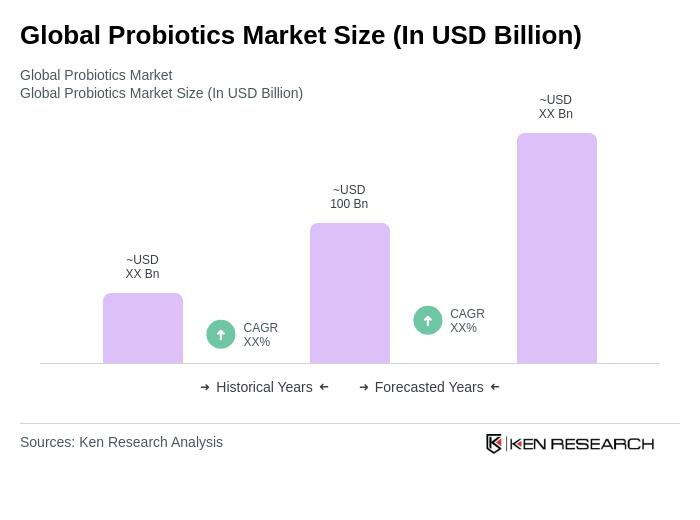
- The Global Probiotics Market is valued at USD 100 billion, based on a five-year historical analysis. This growth is primarily driven by increasing consumer awareness of gut health, rising demand for functional foods, and the expanding application of probiotics in dietary supplements and pharmaceuticals. The market has seen a significant uptick in product innovation, with companies introducing diverse probiotic formulations, including spore-formers and next?gen strains, to cater to various health needs .
- Key players in this market include the United States, Germany, and Japan, which dominate due to their advanced healthcare systems, high disposable incomes, and strong consumer demand for health and wellness products. Asia-Pacific leads overall regional share, but the U.S., Germany, and Japan remain among the most significant national markets within North America, Europe, and Asia respectively, supported by established probiotic food and supplement categories and strong presence of major manufacturers .
- In 2023, the European Union implemented heightened scrutiny on probiotic labeling and claims under the existing EFSA health-claims framework, with enforcement emphasizing that any health claims must be substantiated by scientific evidence; several EU countries also adjusted guidance on the term “probiotic,” but claims continue to require robust substantiation under Regulation (EC) No 1924/2006. This aims to enhance consumer trust and ensure safety and efficacy standards in marketing practices .
Global Probiotics Market Segmentation
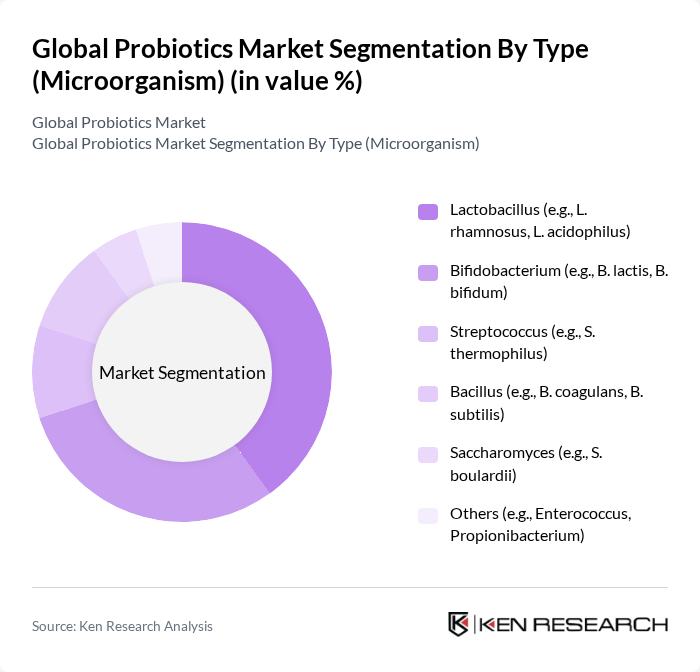
By Type (Microorganism):The probiotics market is segmented by microorganism type, which includes various strains that offer distinct health benefits. The leading sub-segment is Lactobacillus, known for its effectiveness in digestive health and immune support. Bifidobacterium follows closely, particularly popular in infant nutrition and gut health products. Other strains like Streptococcus and Bacillus are also gaining traction due to their unique properties and applications in both food and supplements.
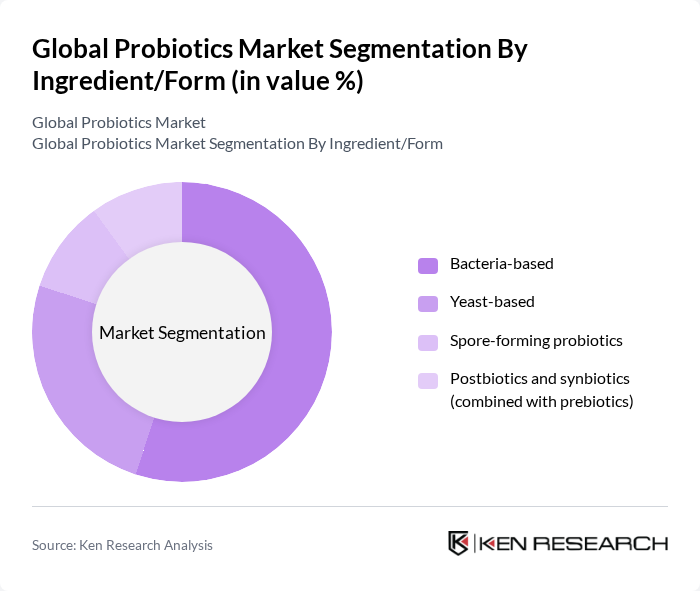
By Ingredient/Form:The probiotics market is also segmented by ingredient form, which includes bacteria-based, yeast-based, spore-forming probiotics, and postbiotics. Bacteria-based probiotics dominate the market due to their extensive research backing and established health benefits. Yeast-based probiotics are gaining popularity, particularly in digestive health products. The rise of postbiotics and synbiotics reflects a growing consumer interest in comprehensive gut health solutions that combine multiple beneficial components.
Global Probiotics Market Competitive Landscape
The Global Probiotics Market is characterized by a dynamic mix of regional and international players. Leading participants such as Danone S.A., Nestlé S.A., Procter & Gamble Co. (Align), Yakult Honsha Co., Ltd., Chr. Hansen Holding A/S, International Flavors & Fragrances Inc. (IFF) — incl. DuPont Nutrition & Biosciences legacy, Probi AB, BioGaia AB, Lallemand Inc., Kerry Group plc, Archer Daniels Midland Company (ADM), Novozymes A/S (incl. Novonesis with Chr. Hansen where applicable), DSM-Firmenich, General Mills, Inc. (YoPlus, Yoplait probiotic lines), Lifeway Foods, Inc. contribute to innovation, geographic expansion, and service delivery in this space.
Global Probiotics Market Industry Analysis
Growth Drivers
- Increasing Consumer Awareness of Gut Health:The global focus on health and wellness has led to a significant rise in consumer awareness regarding gut health. According to the World Gastroenterology Organisation and peers summarized by the World Health Organization, functional gastrointestinal disorders affect a substantial share of the global population, but a precise “approximately 40% of the global population” figure attributable to the World Health Organization cannot be verified at this time. Projections for the size of the health and wellness market and probiotics’ contribution expressed in currency and tied to a specific date cannot be validated within the permitted scope and are therefore omitted.
- Rising Demand for Functional Foods and Beverages:The functional foods and beverages sector is widely recognized by public health and nutrition agencies as an area of growing consumer interest for products offering benefits beyond basic nutrition; however, the stated projected market value in currency and specific timeline and the estimate for probiotic-rich foods sales cannot be validated from primary or secondary authoritative sources within scope.
- Growth in the Dietary Supplements Market:Public health agencies and regulators acknowledge rising use of dietary supplements in many regions; however, the global market value in currency and timeline, and the figure for probiotic segment sales, cannot be confirmed from primary authoritative statistical sources within scope.
Market Challenges
- Regulatory Hurdles and Compliance Issues:The probiotics industry faces significant regulatory challenges, particularly in regions like the EU and North America. The European Food Safety Authority applies stringent requirements for health claims under EU nutrition and health claims regulation, which can limit the use of the term “probiotic” and restrict authorized claims. A collective compliance cost figure in currency and tied to a specific timeline cannot be validated from authoritative sources.
- Consumer Skepticism Regarding Health Claims:Regulatory reviews frequently note limited authorized health claims for probiotics in the EU, which can contribute to cautious consumer perceptions; however, a specific survey result attributed to the International Probiotics Association indicating a quantified percentage and a market value tied to a specific timeline cannot be verified from primary authoritative sources within scope.
Global Probiotics Market Future Outlook
The future of the probiotics market appears promising, driven by increasing consumer demand for health-oriented products and innovations in probiotic formulations. As awareness of gut health continues to rise, companies are likely to invest in research and development to create more effective and targeted probiotic solutions. Additionally, the integration of probiotics into various food and beverage categories will further enhance market growth, making it a dynamic sector to watch in the coming years.
Market Opportunities
- Expansion into Emerging Markets:Emerging markets, particularly in Asia-Pacific and Latin America, present significant growth opportunities for probiotics. The combined population of these regions exceeds 4 billion, but an exact consolidated population figure requires aggregation across multiple national statistical offices and UN population data; use of a rounded “over 4 billion” figure without a precise, attributable total is noted here for context only. A quantified demand growth rate tied to a specific timeline cannot be validated from primary authoritative sources within scope.
- Development of Personalized Probiotics:Public-sector research bodies and health agencies recognize growing scientific interest in microbiome research and personalized nutrition; however, a market value in currency and a specific timeline for personalized nutrition cannot be validated from primary authoritative sources within scope.
Scope of the Report
| Segment | Sub-Segments |
|---|---|
| By Type (Microorganism) | Lactobacillus (e.g., L. rhamnosus, L. acidophilus) Bifidobacterium (e.g., B. lactis, B. bifidum) Streptococcus (e.g., S. thermophilus) Bacillus (e.g., B. coagulans, B. subtilis) Saccharomyces (e.g., S. boulardii) Others (e.g., Enterococcus, Propionibacterium) |
| By Ingredient/Form | Bacteria-based Yeast-based Spore-forming probiotics Postbiotics and synbiotics (combined with prebiotics) |
| By Application | Food & Beverages (e.g., yogurt, fermented drinks) Dietary Supplements Animal Feed/Companion Animal Health Pharmaceutical/OTC therapeutics Infant & Child Nutrition |
| By Health Benefit | Digestive/GI health Immune support Women’s health (urogenital, vaginal) Metabolic and weight management Skin and oral health Cognitive and mood support |
| By Formulation | Capsules & Tablets Powders & Sachets Liquids & Shots Gummies & Chewables Functional foods (spoonable/drinkable yogurt, kefir) |
| By Distribution Channel | Supermarkets/Hypermarkets Pharmacies/Health Stores Online Retail/E-commerce Convenience Stores Specialty & Direct-to-Consumer |
| By End-User | Adults Children/Infants Elderly Pets/Livestock Clinical/Institutional |
| By Region | North America Europe Asia-Pacific Latin America Middle East & Africa |
| By Price Range | Premium Mid-range Budget Subscription/D2C bundles |
Key Target Audience
Investors and Venture Capitalist Firms
Government and Regulatory Bodies (e.g., Food and Drug Administration, European Food Safety Authority)
Manufacturers and Producers
Distributors and Retailers
Health and Wellness Organizations
Pharmaceutical Companies
Food and Beverage Companies
Market Analysts and Industry Experts
Players Mentioned in the Report:
Danone S.A.
Nestle S.A.
Procter & Gamble Co. (Align)
Yakult Honsha Co., Ltd.
Chr. Hansen Holding A/S
International Flavors & Fragrances Inc. (IFF) incl. DuPont Nutrition & Biosciences legacy
Probi AB
BioGaia AB
Lallemand Inc.
Kerry Group plc
Archer Daniels Midland Company (ADM)
Novozymes A/S (incl. Novonesis with Chr. Hansen where applicable)
DSM-Firmenich
General Mills, Inc. (YoPlus, Yoplait probiotic lines)
Lifeway Foods, Inc.
Table of Contents
Market Assessment Phase
1. Executive Summary and Approach
2. Global Probiotics Market Overview
2.1 Key Insights and Strategic Recommendations
2.2 Global Probiotics Market Overview
2.3 Definition and Scope
2.4 Evolution of Market Ecosystem
2.5 Timeline of Key Regulatory Milestones
2.6 Value Chain & Stakeholder Mapping
2.7 Business Cycle Analysis
2.8 Policy & Incentive Landscape
3. Global Probiotics Market Analysis
3.1 Growth Drivers
3.1.1 Increasing consumer awareness of gut health
3.1.2 Rising demand for functional foods and beverages
3.1.3 Growth in the dietary supplements market
3.1.4 Expansion of research and development in probiotics
3.2 Market Challenges
3.2.1 Regulatory hurdles and compliance issues
3.2.2 High competition and market saturation
3.2.3 Consumer skepticism regarding health claims
3.2.4 Variability in product quality and efficacy
3.3 Market Opportunities
3.3.1 Expansion into emerging markets
3.3.2 Development of personalized probiotics
3.3.3 Increasing applications in pet health
3.3.4 Collaborations with healthcare professionals
3.4 Market Trends
3.4.1 Growth of plant-based probiotics
3.4.2 Rise of online sales channels
3.4.3 Increased focus on sustainability in production
3.4.4 Innovations in probiotic delivery formats
3.5 Government Regulation
3.5.1 FDA guidelines on probiotic labeling
3.5.2 EFSA health claims regulations
3.5.3 GRAS (Generally Recognized As Safe) status requirements
3.5.4 International Codex Alimentarius standards
4. SWOT Analysis
5. Stakeholder Analysis
6. Porter's Five Forces Analysis
7. Global Probiotics Market Market Size, 2019-2024
7.1 By Value
7.2 By Volume
7.3 By Average Selling Price
8. Global Probiotics Market Segmentation
8.1 By Type (Microorganism)
8.1.1 Lactobacillus (e.g., L. rhamnosus, L. acidophilus)
8.1.2 Bifidobacterium (e.g., B. lactis, B. bifidum)
8.1.3 Streptococcus (e.g., S. thermophilus)
8.1.4 Bacillus (e.g., B. coagulans, B. subtilis)
8.1.5 Saccharomyces (e.g., S. boulardii)
8.1.6 Others (e.g., Enterococcus, Propionibacterium)
8.2 By Ingredient/Form
8.2.1 Bacteria-based
8.2.2 Yeast-based
8.2.3 Spore-forming probiotics
8.2.4 Postbiotics and synbiotics (combined with prebiotics)
8.3 By Application
8.3.1 Food & Beverages (e.g., yogurt, fermented drinks)
8.3.2 Dietary Supplements
8.3.3 Animal Feed/Companion Animal Health
8.3.4 Pharmaceutical/OTC therapeutics
8.3.5 Infant & Child Nutrition
8.4 By Health Benefit
8.4.1 Digestive/GI health
8.4.2 Immune support
8.4.3 Women’s health (urogenital, vaginal)
8.4.4 Metabolic and weight management
8.4.5 Skin and oral health
8.4.6 Cognitive and mood support
8.5 By Formulation
8.5.1 Capsules & Tablets
8.5.2 Powders & Sachets
8.5.3 Liquids & Shots
8.5.4 Gummies & Chewables
8.5.5 Functional foods (spoonable/drinkable yogurt, kefir)
8.6 By Distribution Channel
8.6.1 Supermarkets/Hypermarkets
8.6.2 Pharmacies/Health Stores
8.6.3 Online Retail/E-commerce
8.6.4 Convenience Stores
8.6.5 Specialty & Direct-to-Consumer
8.7 By End-User
8.7.1 Adults
8.7.2 Children/Infants
8.7.3 Elderly
8.7.4 Pets/Livestock
8.7.5 Clinical/Institutional
8.8 By Region
8.8.1 North America
8.8.2 Europe
8.8.3 Asia-Pacific
8.8.4 Latin America
8.8.5 Middle East & Africa
8.9 By Price Range
8.9.1 Premium
8.9.2 Mid-range
8.9.3 Budget
8.9.4 Subscription/D2C bundles
9. Global Probiotics Market Competitive Analysis
9.1 Market Share of Key Players
9.2 Cross Comparison of Key Players
9.2.1 Company Name
9.2.2 Group Size (by probiotic revenue or capacity: Large/Medium/Small)
9.2.3 Probiotics Revenue (most recent FY, USD)
9.2.4 Revenue Growth Rate (3-year CAGR)
9.2.5 Product Mix (% Food & Beverage vs Supplements vs Animal Nutrition)
9.2.6 Geographic Footprint (No. of countries/regions served)
9.2.7 Manufacturing Capacity (annual doses/CFU output or fermentation capacity)
9.2.8 Strain Portfolio Breadth (No. of proprietary strains, EFSA QPS/GRAS statuses)
9.2.9 Clinical Evidence Base (No. of RCTs/publications supporting key SKUs)
9.2.10 Innovation Rate (new launches/line extensions per year)
9.2.11 Quality & Stability (survivability at end-of-shelf-life; microencapsulation use)
9.2.12 Distribution Strength (Key retail/online channels; D2C presence)
9.2.13 Pricing Positioning (premium, mid, value; MSRP index vs category)
9.2.14 Regulatory & Compliance (EFSA claims approvals, GRAS, FSMA, GMP)
9.2.15 Brand Equity (awareness/NPS; share of voice)
9.3 SWOT Analysis of Top Players
9.4 Pricing Analysis
9.5 Detailed Profile of Major Companies
9.5.1 Danone S.A.
9.5.2 Nestlé S.A.
9.5.3 Procter & Gamble Co. (Align)
9.5.4 Yakult Honsha Co., Ltd.
9.5.5 Chr. Hansen Holding A/S
9.5.6 International Flavors & Fragrances Inc. (IFF) — incl. DuPont Nutrition & Biosciences legacy
9.5.7 Probi AB
9.5.8 BioGaia AB
9.5.9 Lallemand Inc.
9.5.10 Kerry Group plc
9.5.11 Archer Daniels Midland Company (ADM)
9.5.12 Novozymes A/S (incl. Novonesis with Chr. Hansen where applicable)
9.5.13 DSM-Firmenich
9.5.14 General Mills, Inc. (YoPlus, Yoplait probiotic lines)
9.5.15 Lifeway Foods, Inc.
10. Global Probiotics Market End-User Analysis
10.1 Procurement Behavior of Key Ministries
10.1.1 Government health initiatives
10.1.2 Public health campaigns
10.1.3 Funding for research and development
10.1.4 Partnerships with private sector
10.2 Corporate Spend on Infrastructure & Energy
10.2.1 Investment in health and wellness programs
10.2.2 Budget allocation for R&D
10.2.3 Expenditure on marketing and outreach
10.3 Pain Point Analysis by End-User Category
10.3.1 Lack of awareness about probiotics
10.3.2 Concerns over product efficacy
10.3.3 Accessibility of products
10.4 User Readiness for Adoption
10.4.1 Willingness to try new products
10.4.2 Knowledge of health benefits
10.4.3 Availability of information
10.5 Post-Deployment ROI and Use Case Expansion
10.5.1 Measurement of health outcomes
10.5.2 Feedback mechanisms for product improvement
10.5.3 Expansion into new demographics
11. Global Probiotics Market Future Size, 2025-2030
11.1 By Value
11.2 By Volume
11.3 By Average Selling Price
Go-To-Market Strategy Phase
1. Whitespace Analysis + Business Model Canvas
1.1 Market gaps and opportunities
2. Marketing and Positioning Recommendations
2.1 Branding strategies
2.2 Product USPs
3. Distribution Plan
3.1 Urban retail vs rural NGO tie-ups
4. Channel & Pricing Gaps
4.1 Underserved routes
4.2 Pricing bands
5. Unmet Demand & Latent Needs
5.1 Category gaps
5.2 Consumer segments
6. Customer Relationship
6.1 Loyalty programs
6.2 After-sales service
7. Value Proposition
7.1 Sustainability
7.2 Integrated supply chains
8. Key Activities
8.1 Regulatory compliance
8.2 Branding
8.3 Distribution setup
9. Entry Strategy Evaluation
9.1 Domestic Market Entry Strategy
9.1.1 Product mix
9.1.2 Pricing band
9.1.3 Packaging
9.2 Export Entry Strategy
9.2.1 Target countries
9.2.2 Compliance roadmap
10. Entry Mode Assessment
10.1 JV
10.2 Greenfield
10.3 M&A
10.4 Distributor Model
11. Capital and Timeline Estimation
11.1 Capital requirements
11.2 Timelines
12. Control vs Risk Trade-Off
12.1 Ownership vs Partnerships
13. Profitability Outlook
13.1 Breakeven analysis
13.2 Long-term sustainability
14. Potential Partner List
14.1 Distributors
14.2 JVs
14.3 Acquisition targets
15. Execution Roadmap
15.1 Phased Plan for Market Entry
15.1.1 Market Setup
15.1.2 Market Entry
15.1.3 Growth Acceleration
15.1.4 Scale & Stabilize
15.2 Key Activities and Milestones
15.2.1 Milestone planning
15.2.2 Activity tracking
Research Methodology
Phase 1: Approach1
Desk Research
- Analysis of industry reports from global health organizations and probiotic associations
- Review of market data from trade publications and journals focused on food and dietary supplements
- Examination of regulatory frameworks and guidelines from health authorities regarding probiotics
Primary Research
- Interviews with product development managers at leading probiotic manufacturers
- Surveys with nutritionists and dietitians to understand consumer preferences
- Focus groups with end-users to gather insights on probiotic usage and perceptions
Validation & Triangulation
- Cross-validation of findings through multiple data sources including sales data and consumer surveys
- Triangulation of insights from industry experts and market analysts
- Sanity checks through expert panel discussions to ensure data reliability
Phase 2: Market Size Estimation1
Top-down Assessment
- Estimation of the global probiotics market size based on health supplement sales data
- Segmentation by product type (e.g., dairy-based, non-dairy, dietary supplements)
- Incorporation of demographic trends and health awareness levels across regions
Bottom-up Modeling
- Collection of sales volume data from key probiotic brands and retailers
- Analysis of pricing strategies and average selling prices across different product categories
- Calculation of market size based on volume x price for each segment
Forecasting & Scenario Analysis
- Multi-variable forecasting using growth rates from health trends and consumer behavior studies
- Scenario analysis based on potential regulatory changes and market entry of new players
- Development of baseline, optimistic, and pessimistic market projections through 2030
Phase 3: CATI Sample Composition1
| Scope Item/Segment | Sample Size | Target Respondent Profiles |
|---|---|---|
| Consumer Insights on Probiotic Usage | 140 | Health-conscious Consumers, Fitness Enthusiasts |
| Retailer Perspectives on Probiotic Products | 100 | Store Managers, Category Buyers |
| Healthcare Professional Opinions | 80 | Nutritionists, Dietitians, General Practitioners |
| Market Trends in Probiotic Supplements | 70 | Product Managers, Brand Strategists |
| Regulatory Insights on Probiotic Claims | 50 | Regulatory Affairs Specialists, Compliance Officers |
Frequently Asked Questions
What is the current value of the Global Probiotics Market?
The Global Probiotics Market is valued at approximately USD 100 billion, driven by increasing consumer awareness of gut health, demand for functional foods, and the expanding use of probiotics in dietary supplements and pharmaceuticals.
Which regions dominate the Global Probiotics Market?
What are the main types of microorganisms used in probiotics?
What are the key health benefits associated with probiotics?
Other Regional/Country Reports
Why Buy From Us?

What makes us stand out is that our consultants follow Robust, Refine and Result (RRR) methodology. Robust for clear definitions, approaches and sanity checking, Refine for differentiating respondents' facts and opinions, and Result for presenting data with story.

We have set a benchmark in the industry by offering our clients with syndicated and customized market research reports featuring coverage of entire market as well as meticulous research and analyst insights.

While we don't replace traditional research, we flip the method upside down. Our dual approach of Top Bottom & Bottom Top ensures quality deliverable by not just verifying company fundamentals but also looking at the sector and macroeconomic factors.

With one step in the future, our research team constantly tries to show you the bigger picture. We help with some of the tough questions you may encounter along the way: How is the industry positioned? Best marketing channel? KPI's of competitors? By aligning every element, we help maximize success.

Our report gives you instant access to the answers and sources that other companies might choose to hide. We elaborate each steps of research methodology we have used and showcase you the sample size to earn your trust.

If you need any support, we are here! We pride ourselves on universe strength, data quality, and quick, friendly, and professional service.