About the Report
Base Year 2024Global Solo Travel Market Overview
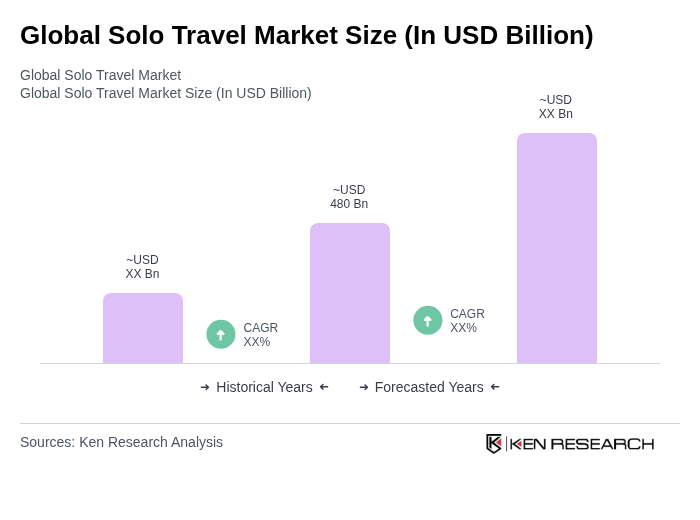
- The Global Solo Travel Market is valued at USD 480 billion, based on a five-year historical analysis. This growth is primarily driven by the increasing number of individuals seeking personalized travel experiences, the rise of digital platforms facilitating solo travel arrangements, and a growing acceptance of solo travel as a viable option for leisure and exploration. Additional growth drivers include the surge in digital nomadism, the influence of social media, and a heightened focus on wellness and self-discovery among travelers. The market has seen a significant uptick in demand as more people prioritize experiences over material possessions.
- Countries such as the United States, Canada, Australia, and various European nations dominate the solo travel market due to their well-established tourism infrastructure, diverse attractions, and strong safety records. These regions offer a wide range of activities and accommodations tailored for solo travelers, making them attractive destinations. Additionally, cultural openness and the availability of resources for solo travelers further enhance their appeal. Europe remains the largest regional market, accounting for about 40% of global solo travel spending, while North America is notable for its high demand from millennials and digital nomads.
- In 2023, the European Union implemented regulations aimed at enhancing consumer protection for solo travelers. This includes measures to ensure transparency in pricing and the provision of clear information regarding travel packages. The regulation mandates that travel companies disclose all fees upfront and provide comprehensive details about accommodations and activities, thereby fostering a more secure and informed travel environment for solo adventurers. The relevant binding instrument is the "Directive (EU) 2015/2302 of the European Parliament and of the Council on package travel and linked travel arrangements," which requires travel organizers to provide clear, comprehensive information and full price transparency to consumers.
Global Solo Travel Market Segmentation
By Type:The market is segmented into various types of travel experiences that cater to solo travelers. The primary subsegments include Adventure Travel, Cultural Travel, Wellness Travel, Eco-Tourism, Culinary Travel, Spiritual Travel, Leisure & Vacation Travel, and Others. Each of these subsegments appeals to different interests and preferences among solo travelers, contributing to the overall growth of the market. Adventure and leisure travel remain the most popular, with strong growth in wellness and eco-tourism driven by rising health consciousness and sustainability trends.
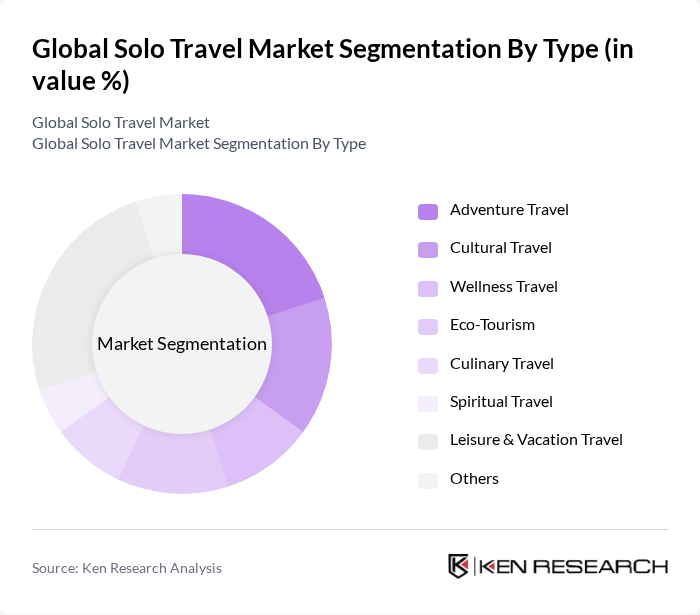
TheLeisure & Vacation Travelsubsegment is currently dominating the market, driven by the increasing number of individuals seeking relaxation and personal time away from their daily routines. This trend is particularly prevalent among millennials and Gen Z travelers, who prioritize experiences that allow them to unwind and explore new destinations at their own pace. The rise of social media has also played a significant role in promoting leisure travel, as individuals share their experiences and inspire others to embark on similar journeys.
By Age Group:The market is segmented by age groups, including Millennials (25–40 years), Gen Z (18–24 years), Gen X (41–56 years), Baby Boomers (57+ years), and Others. Each age group exhibits distinct travel preferences and behaviors, influencing the types of travel experiences they seek. Millennials and Gen Z are the most active segments, driven by a desire for self-discovery, adventure, and digital connectivity.
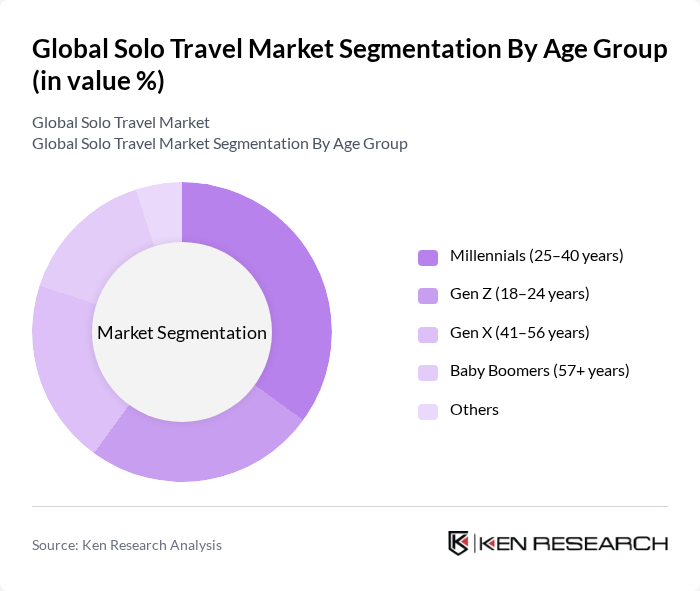
Millennialsare the leading age group in the solo travel market, driven by their desire for unique experiences and personal growth. This demographic is more inclined to travel solo as they seek to explore new cultures, engage in adventure activities, and connect with like-minded individuals. The influence of social media and travel blogs has further encouraged this trend, as millennials often share their travel stories and seek inspiration from others, making them a significant force in shaping the market.
Global Solo Travel Market Competitive Landscape
The Global Solo Travel Market is characterized by a dynamic mix of regional and international players. Leading participants such as Intrepid Travel, G Adventures, Solo Traveler World, Contiki, Hostelworld Group, Airbnb, Inc., Expedia Group, Booking Holdings Inc. (Booking.com, Kayak, Agoda), Trip.com Group, Viator (a Tripadvisor company), Lonely Planet, Skyscanner Ltd., Tripadvisor, Inc., Trafalgar, Travel Leaders Group contribute to innovation, geographic expansion, and service delivery in this space.
Global Solo Travel Market Industry Analysis
Growth Drivers
- Increasing Interest in Personalized Travel Experiences:The demand for personalized travel experiences is surging, with 70% of travelers expressing a preference for tailored itineraries. This trend is supported by the rise in disposable income, which is projected to reach $47 trillion globally in future. As consumers seek unique experiences, travel companies are responding by offering customized solo travel packages that cater to individual preferences, enhancing the appeal of solo travel.
- Rise of Social Media Influencing Travel Choices:Social media platforms have become pivotal in shaping travel decisions, with 80% of travelers using social media for inspiration. In future, the global social media advertising market is expected to exceed $210 billion, driving engagement and visibility for solo travel options. Influencers and user-generated content are increasingly showcasing solo travel experiences, encouraging more individuals to embark on their own journeys.
- Growth in Digital Nomadism and Remote Work:The digital nomad population is projected to reach 1.1 billion in future, fueled by the rise of remote work opportunities. This shift allows individuals to travel while maintaining their careers, with 62% of remote workers indicating a desire to travel solo. As companies embrace flexible work arrangements, the solo travel market is poised to benefit from this growing demographic seeking adventure and exploration.
Market Challenges
- Safety Concerns for Solo Travelers:Safety remains a significant concern for solo travelers, with 45% of individuals citing it as a primary barrier to travel. In future, global crime rates are expected to rise by 4%, particularly in popular tourist destinations. This trend necessitates enhanced safety measures and communication from travel providers to reassure potential solo travelers about their security while exploring new locations.
- High Costs Associated with Solo Travel:Solo travel often incurs higher costs, as travelers cannot share expenses. In future, average travel costs are projected to increase by 6%, impacting affordability. Additionally, solo travelers frequently face higher rates for accommodations and activities, which can deter budget-conscious individuals from pursuing solo adventures. Addressing these financial barriers is crucial for market growth.
Global Solo Travel Market Future Outlook
The future of the solo travel market appears promising, driven by evolving consumer preferences and technological advancements. As travelers increasingly prioritize unique experiences, the demand for personalized itineraries and sustainable travel options is expected to rise. Additionally, the integration of technology, such as mobile apps and virtual reality, will enhance travel planning and experiences. This dynamic landscape presents opportunities for travel companies to innovate and cater to the growing segment of solo travelers seeking adventure and self-discovery.
Market Opportunities
- Development of Solo Travel Communities:Establishing online and offline communities for solo travelers can foster connections and support. With 32% of solo travelers expressing interest in community engagement, travel companies can leverage this trend to create platforms that facilitate networking, sharing experiences, and organizing group trips, enhancing the overall travel experience.
- Customization of Travel Itineraries:Offering customizable travel itineraries tailored to individual preferences can significantly enhance customer satisfaction. As 67% of travelers seek personalized experiences, travel agencies can capitalize on this demand by providing flexible options that allow solo travelers to design their journeys, ultimately increasing loyalty and repeat business.
Scope of the Report
| Segment | Sub-Segments |
|---|---|
| By Type | Adventure Travel Cultural Travel Wellness Travel Eco-Tourism Culinary Travel Spiritual Travel Leisure & Vacation Travel Others |
| By Age Group | Millennials (25–40 years) Gen Z (18–24 years) Gen X (41–56 years) Baby Boomers (57+ years) Others |
| By Gender | Female Male Non-binary Others |
| By Travel Duration | Short-term (1–3 days) Medium-term (4–7 days) Long-term (8+ days) Others |
| By Booking Channel | Online Travel Agencies (OTAs) Direct Booking (Brand Websites/Apps) Travel Agents (Offline/Concierge) Social Media Platforms Others |
| By Accommodation Type | Hostels Hotels Vacation Rentals (e.g., Airbnb, Vrbo) Boutique Guesthouses Others |
| By Activity Type | Sightseeing & City Tours Adventure Sports & Outdoor Activities Cultural Experiences & Workshops Wellness & Retreats Food & Culinary Experiences Others |
| By Region | North America Europe Asia-Pacific Latin America Middle East & Africa |
Key Target Audience
Investors and Venture Capitalist Firms
Government and Regulatory Bodies (e.g., World Tourism Organization, National Tourism Boards)
Travel Agencies and Tour Operators
Hospitality Providers (e.g., Hotels, Hostels, Vacation Rentals)
Travel Technology Companies
Insurance Providers Specializing in Travel Insurance
Marketing and Advertising Agencies Focused on Travel
Online Travel Platforms and Booking Websites
Players Mentioned in the Report:
Intrepid Travel
G Adventures
Solo Traveler World
Contiki
Hostelworld Group
Airbnb, Inc.
Expedia Group
Booking Holdings Inc. (Booking.com, Kayak, Agoda)
Trip.com Group
Viator (a Tripadvisor company)
Lonely Planet
Skyscanner Ltd.
Tripadvisor, Inc.
Trafalgar
Travel Leaders Group
Table of Contents
Market Assessment Phase
1. Executive Summary and Approach
2. Global Solo Travel Market Overview
2.1 Key Insights and Strategic Recommendations
2.2 Global Solo Travel Market Overview
2.3 Definition and Scope
2.4 Evolution of Market Ecosystem
2.5 Timeline of Key Regulatory Milestones
2.6 Value Chain & Stakeholder Mapping
2.7 Business Cycle Analysis
2.8 Policy & Incentive Landscape
3. Global Solo Travel Market Analysis
3.1 Growth Drivers
3.1.1 Increasing interest in personalized travel experiences
3.1.2 Rise of social media influencing travel choices
3.1.3 Growth in digital nomadism and remote work
3.1.4 Expanding solo travel packages and services
3.2 Market Challenges
3.2.1 Safety concerns for solo travelers
3.2.2 High costs associated with solo travel
3.2.3 Limited availability of solo-friendly accommodations
3.2.4 Cultural barriers in certain destinations
3.3 Market Opportunities
3.3.1 Development of solo travel communities
3.3.2 Customization of travel itineraries
3.3.3 Partnerships with local guides and services
3.3.4 Growth in wellness and adventure travel segments
3.4 Market Trends
3.4.1 Increasing demand for sustainable travel options
3.4.2 Use of technology for enhanced travel experiences
3.4.3 Growth of solo travel events and meetups
3.4.4 Focus on mental health and self-discovery through travel
3.5 Government Regulation
3.5.1 Travel safety regulations and guidelines
3.5.2 Visa policies affecting solo travelers
3.5.3 Environmental regulations impacting travel operations
3.5.4 Consumer protection laws for travel services
4. SWOT Analysis
5. Stakeholder Analysis
6. Porter's Five Forces Analysis
7. Global Solo Travel Market Market Size, 2019-2024
7.1 By Value
7.2 By Volume
7.3 By Average Selling Price
8. Global Solo Travel Market Segmentation
8.1 By Type
8.1.1 Adventure Travel
8.1.2 Cultural Travel
8.1.3 Wellness Travel
8.1.4 Eco-Tourism
8.1.5 Culinary Travel
8.1.6 Spiritual Travel
8.1.7 Leisure & Vacation Travel
8.1.8 Others
8.2 By Age Group
8.2.1 Millennials (25–40 years)
8.2.2 Gen Z (18–24 years)
8.2.3 Gen X (41–56 years)
8.2.4 Baby Boomers (57+ years)
8.2.5 Others
8.3 By Gender
8.3.1 Female
8.3.2 Male
8.3.3 Non-binary
8.3.4 Others
8.4 By Travel Duration
8.4.1 Short-term (1–3 days)
8.4.2 Medium-term (4–7 days)
8.4.3 Long-term (8+ days)
8.4.4 Others
8.5 By Booking Channel
8.5.1 Online Travel Agencies (OTAs)
8.5.2 Direct Booking (Brand Websites/Apps)
8.5.3 Travel Agents (Offline/Concierge)
8.5.4 Social Media Platforms
8.5.5 Others
8.6 By Accommodation Type
8.6.1 Hostels
8.6.2 Hotels
8.6.3 Vacation Rentals (e.g., Airbnb, Vrbo)
8.6.4 Boutique Guesthouses
8.6.5 Others
8.7 By Activity Type
8.7.1 Sightseeing & City Tours
8.7.2 Adventure Sports & Outdoor Activities
8.7.3 Cultural Experiences & Workshops
8.7.4 Wellness & Retreats
8.7.5 Food & Culinary Experiences
8.7.6 Others
8.8 By Region
8.8.1 North America
8.8.2 Europe
8.8.3 Asia-Pacific
8.8.4 Latin America
8.8.5 Middle East & Africa
9. Global Solo Travel Market Competitive Analysis
9.1 Market Share of Key Players
9.2 Cross Comparison of Key Players
9.2.1 Company Name
9.2.2 Group Size (Large, Medium, or Small as per industry convention)
9.2.3 Customer Satisfaction Rate (%)
9.2.4 Revenue Growth Rate (YoY %)
9.2.5 Market Penetration Rate (Global/Regional Reach)
9.2.6 Average Booking Value (USD)
9.2.7 Repeat Customer Rate (%)
9.2.8 Average Trip Duration (Days)
9.2.9 Social Media Engagement Rate (%)
9.2.10 App Downloads/Active Users
9.2.11 Female Solo Traveler Share (%)
9.2.12 Net Promoter Score (NPS)
9.2.13 Brand Recognition Score
9.2.14 Sustainability Initiatives/Certifications
9.3 SWOT Analysis of Top Players
9.4 Pricing Analysis
9.5 Detailed Profile of Major Companies
9.5.1 Intrepid Travel
9.5.2 G Adventures
9.5.3 Solo Traveler World
9.5.4 Contiki
9.5.5 Hostelworld Group
9.5.6 Airbnb, Inc.
9.5.7 Expedia Group
9.5.8 Booking Holdings Inc. (Booking.com, Kayak, Agoda)
9.5.9 Trip.com Group
9.5.10 Viator (a Tripadvisor company)
9.5.11 Lonely Planet
9.5.12 Skyscanner Ltd.
9.5.13 Tripadvisor, Inc.
9.5.14 Trafalgar
9.5.15 Travel Leaders Group
10. Global Solo Travel Market End-User Analysis
10.1 Procurement Behavior of Key Ministries
10.1.1 Travel Budget Allocation
10.1.2 Preferred Travel Agencies
10.1.3 Compliance with Travel Policies
10.1.4 Feedback Mechanisms
10.2 Corporate Spend on Infrastructure & Energy
10.2.1 Investment in Travel Technology
10.2.2 Spending on Employee Travel
10.2.3 Partnerships with Travel Providers
10.2.4 Sustainability Initiatives
10.3 Pain Point Analysis by End-User Category
10.3.1 Safety Concerns
10.3.2 Cost Management
10.3.3 Accessibility Issues
10.3.4 Service Quality
10.4 User Readiness for Adoption
10.4.1 Awareness of Solo Travel Options
10.4.2 Willingness to Travel Alone
10.4.3 Preferences for Travel Packages
10.4.4 Feedback on Travel Experiences
10.5 Post-Deployment ROI and Use Case Expansion
10.5.1 Measurement of Travel Satisfaction
10.5.2 Analysis of Repeat Travel Behavior
10.5.3 Expansion into New Destinations
10.5.4 Long-term Engagement Strategies
11. Global Solo Travel Market Future Size, 2025-2030
11.1 By Value
11.2 By Volume
11.3 By Average Selling Price
Go-To-Market Strategy Phase
1. Whitespace Analysis + Business Model Canvas
1.1 Market Gaps Identification
1.2 Value Proposition Development
1.3 Revenue Streams Analysis
1.4 Customer Segmentation
1.5 Key Partnerships
1.6 Cost Structure
1.7 Channels of Distribution
2. Marketing and Positioning Recommendations
2.1 Branding Strategies
2.2 Product USPs
3. Distribution Plan
3.1 Urban Retail vs Rural NGO Tie-ups
4. Channel & Pricing Gaps
4.1 Underserved Routes
4.2 Pricing Bands
5. Unmet Demand & Latent Needs
5.1 Category Gaps
5.2 Consumer Segments
6. Customer Relationship
6.1 Loyalty Programs
6.2 After-sales Service
7. Value Proposition
7.1 Sustainability
7.2 Integrated Supply Chains
8. Key Activities
8.1 Regulatory Compliance
8.2 Branding
8.3 Distribution Setup
9. Entry Strategy Evaluation
9.1 Domestic Market Entry Strategy
9.1.1 Product Mix
9.1.2 Pricing Band
9.1.3 Packaging
9.2 Export Entry Strategy
9.2.1 Target Countries
9.2.2 Compliance Roadmap
10. Entry Mode Assessment
10.1 JV
10.2 Greenfield
10.3 M&A
10.4 Distributor Model
11. Capital and Timeline Estimation
11.1 Capital Requirements
11.2 Timelines
12. Control vs Risk Trade-Off
12.1 Ownership vs Partnerships
13. Profitability Outlook
13.1 Breakeven Analysis
13.2 Long-term Sustainability
14. Potential Partner List
14.1 Distributors
14.2 JVs
14.3 Acquisition Targets
15. Execution Roadmap
15.1 Phased Plan for Market Entry
15.1.1 Market Setup
15.1.2 Market Entry
15.1.3 Growth Acceleration
15.1.4 Scale & Stabilize
15.2 Key Activities and Milestones
15.2.1 Activity Planning
15.2.2 Milestone Tracking
Research Methodology
Phase 1: Approach1
Desk Research
- Analysis of global travel trends from industry reports and travel agencies
- Review of demographic data and travel behavior studies from tourism boards
- Examination of online travel forums and blogs to gauge solo traveler experiences
Primary Research
- Interviews with solo travel bloggers and influencers to gather insights on trends
- Surveys distributed to solo travelers to understand preferences and pain points
- Focus groups with travel agencies specializing in solo travel packages
Validation & Triangulation
- Cross-validation of findings with data from travel industry associations
- Triangulation of insights from primary interviews and secondary data sources
- Sanity checks through expert reviews from travel market analysts
Phase 2: Market Size Estimation1
Top-down Assessment
- Estimation of total travel market size and segmentation for solo travelers
- Analysis of growth rates in solo travel segments across different regions
- Incorporation of macroeconomic factors influencing travel behavior
Bottom-up Modeling
- Collection of data on solo travel bookings from major online travel agencies
- Estimation of average spending per trip by solo travelers
- Calculation of market size based on traveler demographics and trip frequency
Forecasting & Scenario Analysis
- Multi-factor regression analysis incorporating economic indicators and travel sentiment
- Scenario modeling based on potential impacts of global events on travel behavior
- Development of baseline, optimistic, and pessimistic forecasts through 2030
Phase 3: CATI Sample Composition1
| Scope Item/Segment | Sample Size | Target Respondent Profiles |
|---|---|---|
| Solo Travel Enthusiasts | 120 | Frequent Solo Travelers, Travel Bloggers |
| Travel Agency Clients | 85 | Solo Travel Package Customers, Travel Advisors |
| Adventure Travel Participants | 75 | Outdoor Enthusiasts, Adventure Tour Operators |
| Cultural Experience Seekers | 65 | Solo Travelers Interested in Cultural Tours, Tour Guides |
| Digital Nomads | 75 | Remote Workers, Co-working Space Users |
Frequently Asked Questions
What is the current value of the Global Solo Travel Market?
The Global Solo Travel Market is valued at approximately USD 480 billion, reflecting a significant growth trend driven by personalized travel experiences, digital platforms, and the increasing acceptance of solo travel as a leisure option.
What factors are driving the growth of the solo travel market?
Which regions dominate the Global Solo Travel Market?
What are the main types of travel experiences for solo travelers?
Other Regional/Country Reports
Indonesia Solo Travel Market
Malaysia Solo Travel Market
KSA Solo Travel Market
APAC Solo Travel Market
SEA Solo Travel Market
Other Adjacent Reports
Thailand Cultural Tourism Market
Saudi Arabia Culinary Tourism Market Report Size, Share, Growth Drivers, Trends, Opportunities & Forecast 2025–2030Qatar Online Travel Booking Market
Saudi Arabia Travel Insurance Market Outlook to 2030: Size, Share, Growth and TrendsKSA Hospitality Services Market
Bahrain Digital Nomad Services Market
Kuwait Sustainable Travel Market
Why Buy From Us?

What makes us stand out is that our consultants follow Robust, Refine and Result (RRR) methodology. Robust for clear definitions, approaches and sanity checking, Refine for differentiating respondents' facts and opinions, and Result for presenting data with story.

We have set a benchmark in the industry by offering our clients with syndicated and customized market research reports featuring coverage of entire market as well as meticulous research and analyst insights.

While we don't replace traditional research, we flip the method upside down. Our dual approach of Top Bottom & Bottom Top ensures quality deliverable by not just verifying company fundamentals but also looking at the sector and macroeconomic factors.

With one step in the future, our research team constantly tries to show you the bigger picture. We help with some of the tough questions you may encounter along the way: How is the industry positioned? Best marketing channel? KPI's of competitors? By aligning every element, we help maximize success.

Our report gives you instant access to the answers and sources that other companies might choose to hide. We elaborate each steps of research methodology we have used and showcase you the sample size to earn your trust.

If you need any support, we are here! We pride ourselves on universe strength, data quality, and quick, friendly, and professional service.