About the Report
Base Year 2024Global Southeast Nutraceutical Excipients Market Overview
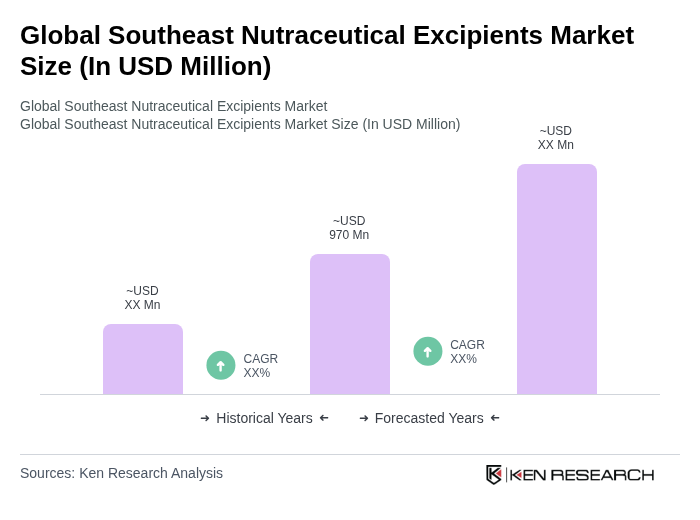
- The Global Southeast Nutraceutical Excipients Market is valued at USD 970 million, based on a five-year historical analysis and regional breakdowns of the South East Asia nutraceutical excipients market. This growth is primarily driven by the increasing demand for dietary supplements and functional foods, as consumers become more health-conscious and seek natural alternatives to traditional pharmaceuticals. The rise in disposable income, growing middle-class population, and heightened awareness of preventive healthcare and the health benefits associated with nutraceuticals further fuels market expansion, along with a shift toward clean-label, plant-based, and personalized nutrition products.
- Key players in this market include countries like Singapore, Malaysia, and Thailand, which hold a significant share due to their advanced manufacturing capabilities, regulatory oversight, and strong distribution networks. Singapore, in particular, has been identified as a leading market within Southeast Asia, supported by high health awareness, strong purchasing power, and innovation in nutraceutical and excipient technologies, while Malaysia and Thailand benefit from expanding pharmaceutical and food-processing sectors and rising demand for functional foods and supplements.
- In Southeast Asia, national regulators have implemented specific measures to enhance the quality and safety of nutraceutical and related health products, including excipients. For example, in Singapore the Health Supplements Guidelines issued by the Health Sciences Authority (HSA) and the Health Products (Good Manufacturing Practice for Licensed Manufacturers) Regulations 2010 require manufacturers of health products to comply with Good Manufacturing Practice (GMP) standards covering premises, quality systems, documentation, and product quality control. Similarly, across ASEAN, the ASEAN Guidelines for Good Manufacturing Practice for Traditional Medicines and Health Supplements issued by the ASEAN Consultative Committee for Standards and Quality (ACCSQ) harmonize GMP principles for manufacturers in member states, aiming to ensure product safety, quality, and consistency and thereby strengthen consumer confidence in nutraceutical products in the region.
Global Southeast Nutraceutical Excipients Market Segmentation
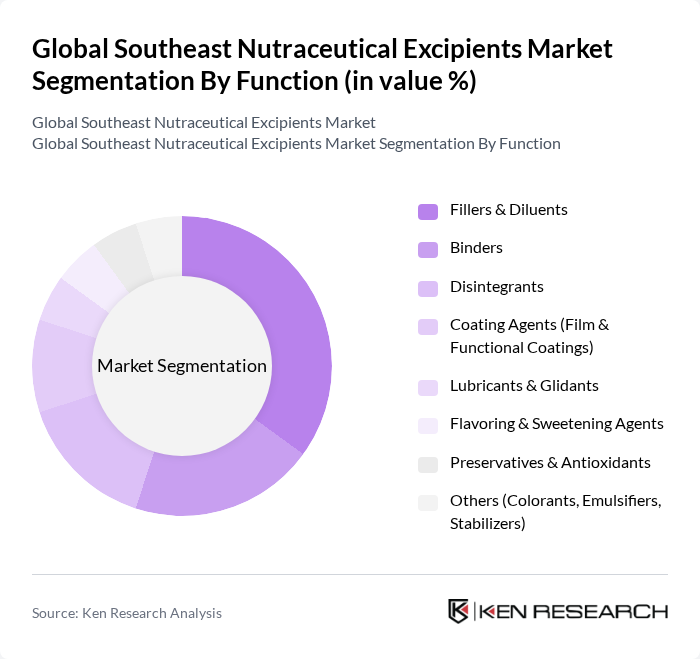
By Function:The market is segmented by function into various categories, including fillers & diluents, binders, disintegrants, coating agents, lubricants & glidants, flavoring & sweetening agents, preservatives & antioxidants, and others. Among these, fillers & diluents are the most widely used due to their essential role in enhancing the volume, flow properties, and stability of nutraceutical formulations, and global functional analyses consistently show fillers and diluents holding the largest share among excipient functionalities. The increasing demand for dietary supplements and functional foods, particularly in convenient formats such as tablets, capsules, gummies, and powders, drives the need for effective fillers that support dose uniformity, compressibility, and overall product integrity and consumer satisfaction.
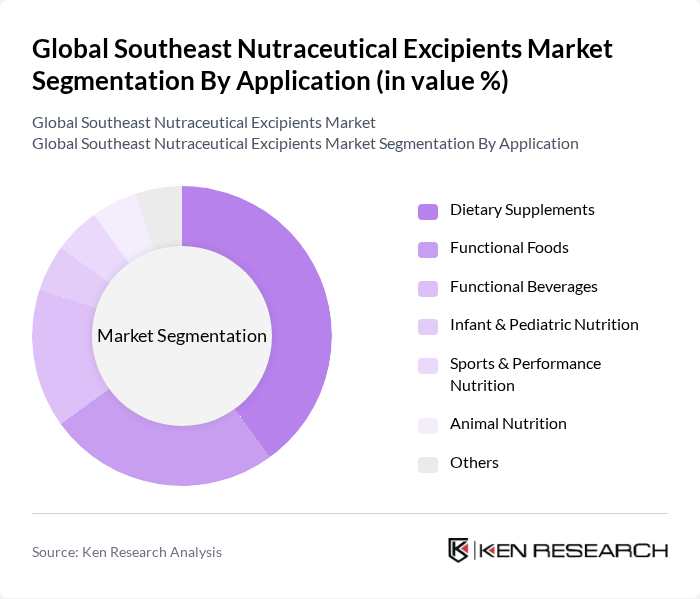
By Application:The market is also segmented by application, which includes dietary supplements, functional foods, functional beverages, infant & pediatric nutrition, sports & performance nutrition, animal nutrition, and others. The dietary supplements segment leads the market, driven by a growing consumer preference for health-enhancing products such as vitamins, minerals, probiotics, and botanical supplements, with preventive healthcare and self-directed wellness playing central roles in purchasing decisions. This trend is supported by increasing awareness of immune support, healthy aging, digestive health, and mental well-being, as well as the rapid uptake of dosage forms like gummies, chewables, and ready-to-mix powders that rely heavily on specialized excipients for palatability, stability, and controlled or modified release.
Global Southeast Nutraceutical Excipients Market Competitive Landscape
The Global Southeast Nutraceutical Excipients Market is characterized by a dynamic mix of regional and international players. Leading participants such as BASF SE, DuPont de Nemours, Inc., Evonik Industries AG, Ingredion Incorporated, Kerry Group plc, Roquette Frères, Ashland Inc., Dow Chemical Company, Colorcon, Inc., JRS PHARMA GmbH & Co. KG, Cargill, Incorporated, Sensient Technologies Corporation, SPI Pharma, Inc., Barentz International B.V., Behn Meyer Group contribute to innovation, geographic expansion, and service delivery in this space, offering a broad range of excipients for tablets, capsules, powders, gummies, and functional food and beverage applications.
Global Southeast Nutraceutical Excipients Market Industry Analysis
Growth Drivers
- Increasing Demand for Natural Ingredients:The global trend towards natural ingredients is significantly impacting the nutraceutical excipients market. In the future, the market for natural excipients is expected to be valued at approximately $1.5 billion, with a projected increase to $1.8 billion. This shift is driven by consumer preferences for clean-label products, as 70% of consumers express a desire for transparency in ingredient sourcing, according to a recent industry report by the World Health Organization.
- Rising Health Consciousness Among Consumers:Health consciousness is on the rise, with 60% of consumers actively seeking dietary supplements to enhance their well-being. The global dietary supplements market is anticipated to grow to $160 billion, with expectations to reach $180 billion. This trend is supported by increasing awareness of preventive healthcare, as evidenced by a 15% increase in health-related online searches, according to the International Health Organization.
- Expansion of the Dietary Supplements Market:The dietary supplements market is expanding rapidly, with a growth rate of 8% annually. In the future, the market size is projected to reach $180 billion. This growth is fueled by an increasing aging population, with over 1.2 billion people aged 60 and above globally, leading to higher demand for health supplements, as reported by the United Nations.
Market Challenges
- Stringent Regulatory Frameworks:The nutraceutical excipients market faces significant challenges due to stringent regulatory frameworks. In the future, over 50% of companies are expected to report difficulties in compliance with regulations set by the FDA and other global health authorities. These regulations often require extensive documentation and testing, leading to increased operational costs, which can exceed $600,000 annually for mid-sized companies, according to industry analysis by the Nutraceuticals Association.
- High Production Costs:High production costs remain a critical challenge for the nutraceutical excipients market. In the future, the average cost of producing natural excipients is expected to be approximately $3,200 per ton, compared to $1,600 per ton for synthetic alternatives. This price disparity can hinder market entry for smaller players, as reported by the Global Nutraceuticals Market Report, which highlights that 40% of new entrants struggle with cost management.
Global Southeast Nutraceutical Excipients Market Future Outlook
The future of the nutraceutical excipients market appears promising, driven by technological advancements and evolving consumer preferences. As personalization in product offerings becomes more prevalent, companies are expected to invest heavily in R&D, with global spending projected to reach $220 billion. Additionally, the integration of digital platforms for e-commerce is anticipated to enhance market accessibility, particularly in emerging markets, fostering growth and innovation in product development.
Market Opportunities
- Growth in E-commerce for Nutraceuticals:The rise of e-commerce presents a significant opportunity for the nutraceutical excipients market. In the future, online sales are expected to account for 30% of total nutraceutical sales, with projections indicating this could rise to 40%. This shift allows companies to reach a broader audience, particularly younger consumers who prefer online shopping, as reported by the E-commerce Association.
- Increasing Investment in R&D:Investment in research and development is crucial for innovation in the nutraceutical excipients market. In the future, global R&D spending in the nutraceutical sector is expected to increase to $220 billion. This investment is essential for developing new products that meet consumer demands for efficacy and safety, according to the Global Nutraceuticals Research Institute.
Scope of the Report
| Segment | Sub-Segments |
|---|---|
| By Function | Fillers & Diluents Binders Disintegrants Coating Agents (Film & Functional Coatings) Lubricants & Glidants Flavoring & Sweetening Agents Preservatives & Antioxidants Others (Colorants, Emulsifiers, Stabilizers) |
| By Application | Dietary Supplements Functional Foods Functional Beverages Infant & Pediatric Nutrition Sports & Performance Nutrition Animal Nutrition Others |
| By Dosage Form | Tablets Capsules & Softgels Powders & Granules Gummies & Chewables Liquids & Suspensions Others |
| By Distribution Channel | Business-to-Business (B2B) Direct Sales to Manufacturers Distributors & Traders Online Ingredient Marketplaces Others |
| By Country (Southeast Asia) | Singapore Malaysia Thailand Indonesia Vietnam Philippines Cambodia Myanmar Laos Brunei |
| By Source | Synthetic Plant-Based Animal-Based Mineral Others |
| By Functionality / Product Claims | Clean-Label & Organic Allergen-Free & Gluten-Free Modified-Release & Targeted Delivery Enhanced Bioavailability Systems Others |
Key Target Audience
Investors and Venture Capitalist Firms
Government and Regulatory Bodies (e.g., Food and Drug Administration, European Food Safety Authority)
Manufacturers and Producers
Distributors and Retailers
Pharmaceutical Companies
Health and Wellness Brands
Industry Associations (e.g., Council for Responsible Nutrition)
Financial Institutions
Players Mentioned in the Report:
BASF SE
DuPont de Nemours, Inc.
Evonik Industries AG
Ingredion Incorporated
Kerry Group plc
Roquette Freres
Ashland Inc.
Dow Chemical Company
Colorcon, Inc.
JRS PHARMA GmbH & Co. KG
Cargill, Incorporated
Sensient Technologies Corporation
SPI Pharma, Inc.
Barentz International B.V.
Behn Meyer Group
Table of Contents
Market Assessment Phase
1. Executive Summary and Approach
2. Global Southeast Nutraceutical Excipients Market Overview
2.1 Key Insights and Strategic Recommendations
2.2 Global Southeast Nutraceutical Excipients Market Overview
2.3 Definition and Scope
2.4 Evolution of Market Ecosystem
2.5 Timeline of Key Regulatory Milestones
2.6 Value Chain & Stakeholder Mapping
2.7 Business Cycle Analysis
2.8 Policy & Incentive Landscape
3. Global Southeast Nutraceutical Excipients Market Analysis
3.1 Growth Drivers
3.1.1 Increasing Demand for Natural Ingredients
3.1.2 Rising Health Consciousness Among Consumers
3.1.3 Expansion of the Dietary Supplements Market
3.1.4 Technological Advancements in Nutraceuticals
3.2 Market Challenges
3.2.1 Stringent Regulatory Frameworks
3.2.2 High Production Costs
3.2.3 Limited Awareness Among End-Users
3.2.4 Supply Chain Disruptions
3.3 Market Opportunities
3.3.1 Growth in E-commerce for Nutraceuticals
3.3.2 Increasing Investment in R&D
3.3.3 Expansion into Emerging Markets
3.3.4 Collaborations and Partnerships
3.4 Market Trends
3.4.1 Personalization of Nutraceutical Products
3.4.2 Shift Towards Plant-Based Excipients
3.4.3 Integration of Technology in Product Development
3.4.4 Focus on Sustainability and Eco-Friendly Practices
3.5 Government Regulation
3.5.1 Compliance with FDA Guidelines
3.5.2 Labeling Requirements for Nutraceuticals
3.5.3 Safety Assessments and Efficacy Claims
3.5.4 Import and Export Regulations
4. SWOT Analysis
5. Stakeholder Analysis
6. Porter's Five Forces Analysis
7. Global Southeast Nutraceutical Excipients Market Market Size, 2019-2024
7.1 By Value
7.2 By Volume
7.3 By Average Selling Price
8. Global Southeast Nutraceutical Excipients Market Segmentation
8.1 By Function
8.1.1 Fillers & Diluents
8.1.2 Binders
8.1.3 Disintegrants
8.1.4 Coating Agents (Film & Functional Coatings)
8.1.5 Lubricants & Glidants
8.1.6 Flavoring & Sweetening Agents
8.1.7 Preservatives & Antioxidants
8.1.8 Others (Colorants, Emulsifiers, Stabilizers)
8.2 By Application
8.2.1 Dietary Supplements
8.2.2 Functional Foods
8.2.3 Functional Beverages
8.2.4 Infant & Pediatric Nutrition
8.2.5 Sports & Performance Nutrition
8.2.6 Animal Nutrition
8.2.7 Others
8.3 By Dosage Form
8.3.1 Tablets
8.3.2 Capsules & Softgels
8.3.3 Powders & Granules
8.3.4 Gummies & Chewables
8.3.5 Liquids & Suspensions
8.3.6 Others
8.4 By Distribution Channel
8.4.1 Business-to-Business (B2B)
8.4.2 Direct Sales to Manufacturers
8.4.3 Distributors & Traders
8.4.4 Online Ingredient Marketplaces
8.4.5 Others
8.5 By Country (Southeast Asia)
8.5.1 Singapore
8.5.2 Malaysia
8.5.3 Thailand
8.5.4 Indonesia
8.5.5 Vietnam
8.5.6 Philippines
8.5.7 Cambodia
8.5.8 Myanmar
8.5.9 Laos
8.5.10 Brunei
8.6 By Source
8.6.1 Synthetic
8.6.2 Plant-Based
8.6.3 Animal-Based
8.6.4 Mineral
8.6.5 Others
8.7 By Functionality / Product Claims
8.7.1 Clean-Label & Organic
8.7.2 Allergen-Free & Gluten-Free
8.7.3 Modified-Release & Targeted Delivery
8.7.4 Enhanced Bioavailability Systems
8.7.5 Others
9. Global Southeast Nutraceutical Excipients Market Competitive Analysis
9.1 Market Share of Key Players
9.2 Cross Comparison of Key Players
9.2.1 Company Name
9.2.2 Group Size (Global, Regional, or Local Player)
9.2.3 Nutraceutical Excipients Revenue (USD Million, Southeast Asia)
9.2.4 Revenue Growth Rate in Nutraceutical Excipients (%)
9.2.5 Share of Nutraceutical Excipients in Total Excipients Portfolio (%)
9.2.6 Product Portfolio Breadth (Functions, Dosage Forms, Delivery Systems)
9.2.7 Geographic Footprint in Southeast Asia (Number of Countries Served)
9.2.8 Manufacturing & Formulation Footprint (Number of Plants / Facilities)
9.2.9 R&D Intensity (% of Revenue Spent on R&D)
9.2.10 Rate of New Product Launches / Line Extensions (Annual Count)
9.2.11 Strategic Partnerships & Distribution Alliances in Southeast Asia (Count)
9.2.12 Key End-Market Exposure (Supplements vs Functional Foods vs Beverages)
9.2.13 Average Selling Price Positioning (Premium / Mid / Value)
9.2.14 EBITDA Margin for Nutraceutical Excipients Business (%)
9.2.15 Sustainability & Clean-Label Credentials (Certifications / Claims)
9.3 SWOT Analysis of Top Players
9.4 Pricing Analysis
9.5 Detailed Profile of Major Companies
9.5.1 BASF SE
9.5.2 DuPont de Nemours, Inc.
9.5.3 Evonik Industries AG
9.5.4 Ingredion Incorporated
9.5.5 Kerry Group plc
9.5.6 Roquette Frères
9.5.7 Ashland Inc.
9.5.8 Dow Chemical Company
9.5.9 Colorcon, Inc.
9.5.10 JRS PHARMA GmbH & Co. KG
9.5.11 Cargill, Incorporated
9.5.12 Sensient Technologies Corporation
9.5.13 SPI Pharma, Inc.
9.5.14 Barentz International B.V.
9.5.15 Behn Meyer Group
10. Global Southeast Nutraceutical Excipients Market End-User Analysis
10.1 Procurement Behavior of Key Ministries
10.1.1 Government Procurement Policies
10.1.2 Budget Allocations for Nutraceuticals
10.1.3 Supplier Selection Criteria
10.1.4 Contract Management Practices
10.2 Corporate Spend on Infrastructure & Energy
10.2.1 Investment Trends in Nutraceutical Infrastructure
10.2.2 Energy Consumption Patterns
10.2.3 Sustainability Initiatives
10.2.4 Cost Management Strategies
10.3 Pain Point Analysis by End-User Category
10.3.1 Quality Assurance Challenges
10.3.2 Supply Chain Issues
10.3.3 Regulatory Compliance Difficulties
10.3.4 Market Access Barriers
10.4 User Readiness for Adoption
10.4.1 Awareness Levels
10.4.2 Training and Support Needs
10.4.3 Technology Adoption Rates
10.4.4 Feedback Mechanisms
10.5 Post-Deployment ROI and Use Case Expansion
10.5.1 Performance Metrics
10.5.2 Case Studies of Successful Implementations
10.5.3 Scalability Potential
10.5.4 Long-term Value Creation
11. Global Southeast Nutraceutical Excipients Market Future Size, 2025-2030
11.1 By Value
11.2 By Volume
11.3 By Average Selling Price
Go-To-Market Strategy Phase
1. Whitespace Analysis + Business Model Canvas
1.1 Market Gaps Identification
1.2 Business Model Framework
2. Marketing and Positioning Recommendations
2.1 Branding Strategies
2.2 Product USPs
3. Distribution Plan
3.1 Urban Retail Strategies
3.2 Rural NGO Tie-ups
4. Channel & Pricing Gaps
4.1 Underserved Routes
4.2 Pricing Bands
5. Unmet Demand & Latent Needs
5.1 Category Gaps
5.2 Consumer Segments
6. Customer Relationship
6.1 Loyalty Programs
6.2 After-sales Service
7. Value Proposition
7.1 Sustainability Initiatives
7.2 Integrated Supply Chains
8. Key Activities
8.1 Regulatory Compliance
8.2 Branding Efforts
8.3 Distribution Setup
9. Entry Strategy Evaluation
9.1 Domestic Market Entry Strategy
9.1.1 Product Mix
9.1.2 Pricing Band
9.1.3 Packaging Considerations
9.2 Export Entry Strategy
9.2.1 Target Countries
9.2.2 Compliance Roadmap
10. Entry Mode Assessment
10.1 Joint Ventures
10.2 Greenfield Investments
10.3 Mergers & Acquisitions
10.4 Distributor Model
11. Capital and Timeline Estimation
11.1 Capital Requirements
11.2 Timelines for Implementation
12. Control vs Risk Trade-Off
12.1 Ownership Considerations
12.2 Partnerships Evaluation
13. Profitability Outlook
13.1 Breakeven Analysis
13.2 Long-term Sustainability
14. Potential Partner List
14.1 Distributors
14.2 Joint Ventures
14.3 Acquisition Targets
15. Execution Roadmap
15.1 Phased Plan for Market Entry
15.1.1 Market Setup
15.1.2 Market Entry
15.1.3 Growth Acceleration
15.1.4 Scale & Stabilize
15.2 Key Activities and Milestones
15.2.1 Milestone Tracking
15.2.2 Activity Scheduling
Research Methodology
Phase 1: Approach1
Desk Research
- Analysis of industry reports from global health organizations and market research firms
- Review of scientific literature on nutraceutical excipients from academic journals
- Examination of regulatory guidelines and compliance documents from health authorities
Primary Research
- Interviews with formulators and product developers in the nutraceutical industry
- Surveys targeting quality assurance managers in manufacturing facilities
- Field interviews with supply chain experts in the excipients market
Validation & Triangulation
- Cross-validation of data through multiple industry sources and expert opinions
- Triangulation of market trends using sales data and regulatory changes
- Sanity checks conducted through expert panel discussions and feedback sessions
Phase 2: Market Size Estimation1
Top-down Assessment
- Estimation of market size based on global nutraceutical sales and excipient usage ratios
- Segmentation analysis by product type, application, and geographic region
- Incorporation of growth trends in health and wellness sectors influencing excipient demand
Bottom-up Modeling
- Collection of data from leading excipient manufacturers on production volumes
- Cost analysis based on pricing models of various excipient types
- Volume x cost calculations to derive revenue estimates for each segment
Forecasting & Scenario Analysis
- Utilization of time-series analysis to project future market trends
- Scenario modeling based on potential regulatory changes and consumer preferences
- Development of baseline, optimistic, and pessimistic forecasts through 2030
Phase 3: CATI Sample Composition1
| Scope Item/Segment | Sample Size | Target Respondent Profiles |
|---|---|---|
| Nutraceutical Product Development | 60 | Formulators, R&D Managers |
| Quality Assurance in Manufacturing | 50 | Quality Control Managers, Compliance Officers |
| Supply Chain Management for Excipients | 40 | Supply Chain Directors, Procurement Managers |
| Market Trends in Nutraceuticals | 50 | Market Analysts, Business Development Managers |
| Regulatory Compliance Insights | 40 | Regulatory Affairs Specialists, Legal Advisors |
Frequently Asked Questions
What is the current value of the Global Southeast Nutraceutical Excipients Market?
The Global Southeast Nutraceutical Excipients Market is valued at approximately USD 970 million, reflecting a significant growth driven by increasing consumer demand for dietary supplements and functional foods in the region.
What factors are driving the growth of the Nutraceutical Excipients Market in Southeast Asia?
Which countries are leading in the Southeast Nutraceutical Excipients Market?
What are the main functions of excipients in nutraceuticals?
Other Regional/Country Reports
Indonesia Nutraceutical Excipients Market
Malaysia Nutraceutical Excipients Market
KSA Nutraceutical Excipients Market
APAC Nutraceutical Excipients Market
SEA Nutraceutical Excipients Market
Other Adjacent Reports
Brazil Animal Nutrition Market
UAE Pharmaceutical Excipients MarketUSA Cosmeceuticals Market Outlook to 2030KSA Natural Ingredients Market
UAE Food Additives MarketWhy Buy From Us?

What makes us stand out is that our consultants follow Robust, Refine and Result (RRR) methodology. Robust for clear definitions, approaches and sanity checking, Refine for differentiating respondents' facts and opinions, and Result for presenting data with story.

We have set a benchmark in the industry by offering our clients with syndicated and customized market research reports featuring coverage of entire market as well as meticulous research and analyst insights.

While we don't replace traditional research, we flip the method upside down. Our dual approach of Top Bottom & Bottom Top ensures quality deliverable by not just verifying company fundamentals but also looking at the sector and macroeconomic factors.

With one step in the future, our research team constantly tries to show you the bigger picture. We help with some of the tough questions you may encounter along the way: How is the industry positioned? Best marketing channel? KPI's of competitors? By aligning every element, we help maximize success.

Our report gives you instant access to the answers and sources that other companies might choose to hide. We elaborate each steps of research methodology we have used and showcase you the sample size to earn your trust.

If you need any support, we are here! We pride ourselves on universe strength, data quality, and quick, friendly, and professional service.