Region:Global
Author(s):Rebecca
Product Code:KRAA2383
Pages:94
Published On:August 2025
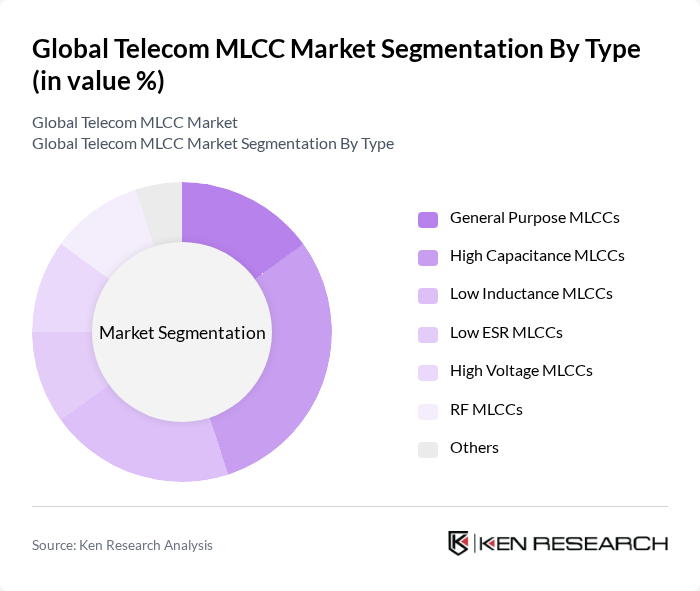
By Type:The market is segmented into various types of MLCCs, including General Purpose MLCCs, High Capacitance MLCCs, Low Inductance MLCCs, Low ESR MLCCs, High Voltage MLCCs, RF MLCCs, and Others. Among these, High Capacitance MLCCs are currently leading the market due to their essential role in high-frequency applications and the growing demand for compact electronic devices. The trend towards miniaturization in electronics, especially in 5G base stations and smartphones, has further propelled the adoption of these capacitors, making them a preferred choice for manufacturers.
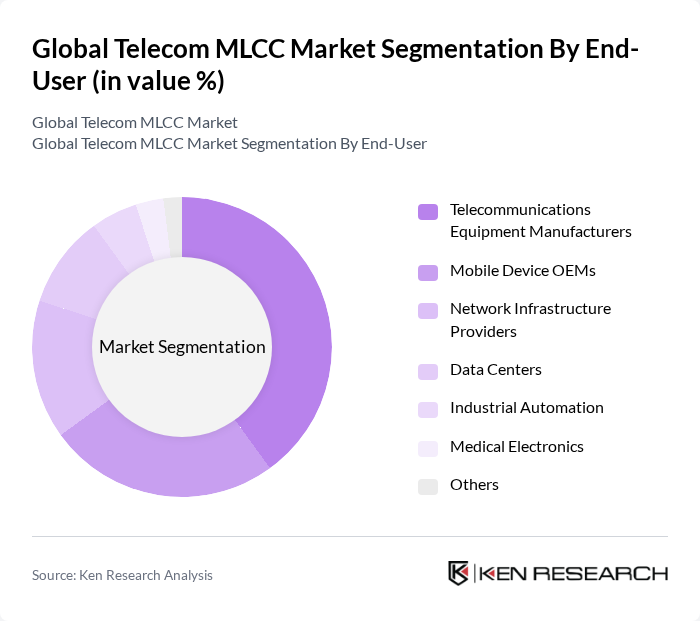
By End-User:The market is segmented by end-users, including Telecommunications Equipment Manufacturers, Mobile Device OEMs, Network Infrastructure Providers, Data Centers, Industrial Automation, Medical Electronics, and Others. Telecommunications Equipment Manufacturers are the leading end-users, driven by the increasing demand for advanced telecom infrastructure and the rollout of 5G networks. The need for reliable and efficient components in telecom equipment, especially for base stations and network hardware, has made this segment a significant contributor to overall market growth.
The Global Telecom MLCC Market is characterized by a dynamic mix of regional and international players. Leading participants such as Murata Manufacturing Co., Ltd., TDK Corporation, Samsung Electro-Mechanics, Yageo Corporation, Taiyo Yuden Co., Ltd., Vishay Intertechnology, Inc., KEMET Corporation, AVX Corporation, Panasonic Corporation, Nichicon Corporation, Walsin Technology Corporation, Chaozhou Three-Circle Group Co., Ltd., Nitto Denko Corporation, Kyocera Corporation, ROHM Semiconductor contribute to innovation, geographic expansion, and service delivery in this space.
The future of the telecom MLCC market appears promising, driven by technological advancements and increasing demand across various sectors. As manufacturers invest in innovative MLCC designs and production techniques, the market is likely to witness enhanced performance and efficiency. Additionally, the integration of AI in manufacturing processes is expected to streamline operations, reduce costs, and improve product quality, positioning the industry for robust growth in the coming years.
| Segment | Sub-Segments |
|---|---|
| By Type | General Purpose MLCCs High Capacitance MLCCs Low Inductance MLCCs Low ESR MLCCs High Voltage MLCCs RF MLCCs Others |
| By End-User | Telecommunications Equipment Manufacturers Mobile Device OEMs Network Infrastructure Providers Data Centers Industrial Automation Medical Electronics Others |
| By Application | Base Stations Routers & Switches Optical Transmission Equipment RF Modules Power Supply Units IoT Devices Others |
| By Dielectric Type | Class I (C0G, NP0) Class II (X7R, X5R, Y5V) Others |
| By Voltage Range | Low Voltage (up to 50V) Medium Voltage (51V–500V) High Voltage (above 500V) Others |
| By Region | North America Europe Asia Pacific Latin America Middle East & Africa |
| Scope Item/Segment | Sample Size | Target Respondent Profiles |
|---|---|---|
| Mobile Network Operators | 100 | Network Engineers, Procurement Managers |
| Telecom Equipment Manufacturers | 80 | Product Development Managers, Supply Chain Analysts |
| Telecom Regulatory Bodies | 40 | Policy Makers, Regulatory Affairs Specialists |
| Consumer Electronics Companies | 60 | R&D Managers, Product Managers |
| Telecom Industry Consultants | 50 | Market Analysts, Strategy Consultants |
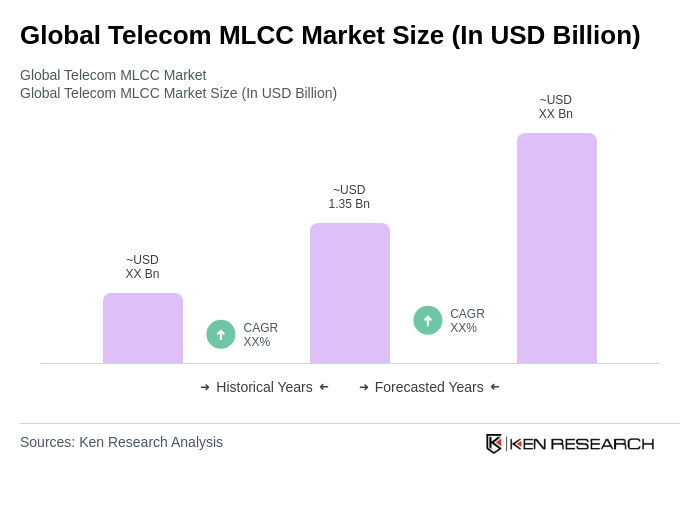
The Global Telecom MLCC Market is valued at approximately USD 1.35 billion, driven by the increasing demand for electronic devices, advancements in telecommunications infrastructure, and the growth of IoT applications.

What makes us stand out is that our consultants follow Robust, Refine and Result (RRR) methodology. Robust for clear definitions, approaches and sanity checking, Refine for differentiating respondents' facts and opinions, and Result for presenting data with story.

We have set a benchmark in the industry by offering our clients with syndicated and customized market research reports featuring coverage of entire market as well as meticulous research and analyst insights.

While we don't replace traditional research, we flip the method upside down. Our dual approach of Top Bottom & Bottom Top ensures quality deliverable by not just verifying company fundamentals but also looking at the sector and macroeconomic factors.

With one step in the future, our research team constantly tries to show you the bigger picture. We help with some of the tough questions you may encounter along the way: How is the industry positioned? Best marketing channel? KPI's of competitors? By aligning every element, we help maximize success.

Our report gives you instant access to the answers and sources that other companies might choose to hide. We elaborate each steps of research methodology we have used and showcase you the sample size to earn your trust.

If you need any support, we are here! We pride ourselves on universe strength, data quality, and quick, friendly, and professional service.













