About the Report
Base Year 2024Listen to the audio summary
India Crop Protection and Biopesticides Market Overview
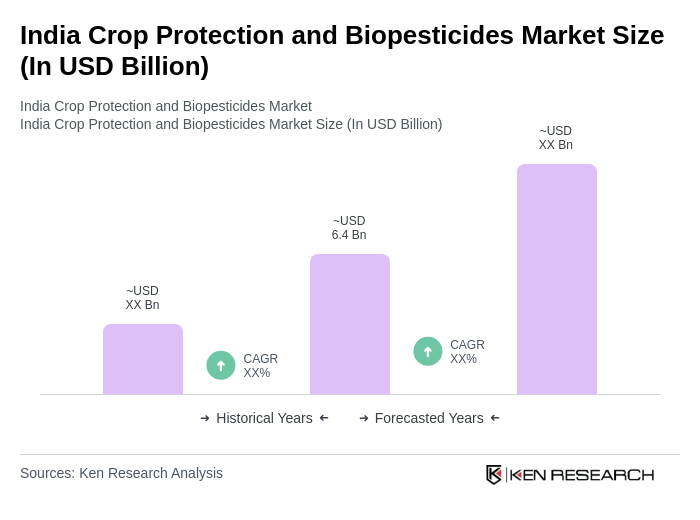
- The India Crop Protection and Biopesticides Market is valued at approximately USD 6.4 billion, based on a five-year historical analysis. This growth is primarily driven by the increasing demand for sustainable agricultural practices, rising awareness of environmental issues, and the need for effective pest management solutions. The market has seen a significant shift towards biopesticides, which are perceived as safer alternatives to chemical pesticides.
- Key regions dominating the market include Maharashtra, Punjab, and Haryana, which are known for their extensive agricultural activities and high crop yields. These areas benefit from favorable climatic conditions and a strong agricultural infrastructure, making them ideal for the adoption of advanced crop protection technologies. The concentration of agricultural research institutions and government support further enhances their market dominance.
- The National Mission on Sustainable Agriculture, issued by the Ministry of Agriculture & Farmers Welfare under the Government of India in 2010 and operationalized through subsequent annual guidelines, aims to promote organic farming and the use of biopesticides. This initiative provides financial support for farmers transitioning to organic practices and mandates the adoption of integrated pest management, thereby fostering a more sustainable agricultural ecosystem.
India Crop Protection and Biopesticides Market Segmentation
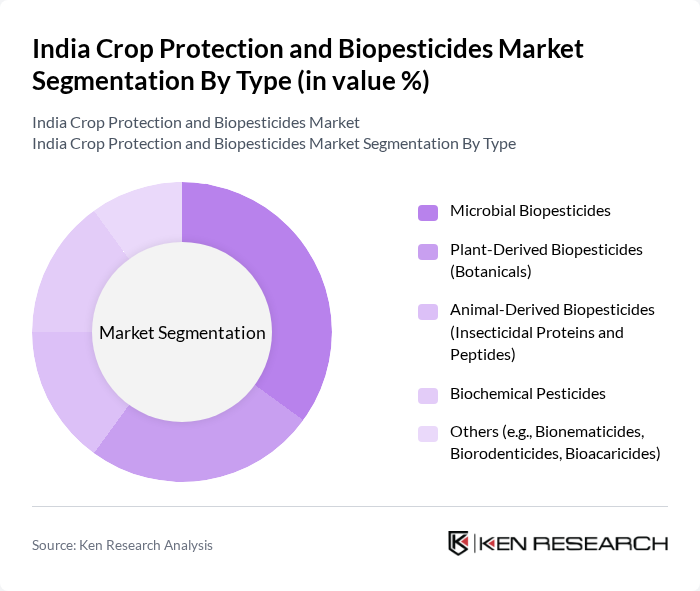
By Type:The market is segmented into various types of biopesticides, including microbial biopesticides, plant-derived biopesticides, animal-derived biopesticides, biochemical pesticides, and others. Among these, microbial biopesticides are gaining significant traction due to their effectiveness and lower environmental impact. The increasing preference for organic farming and the need for sustainable pest management solutions are driving the demand for these products.
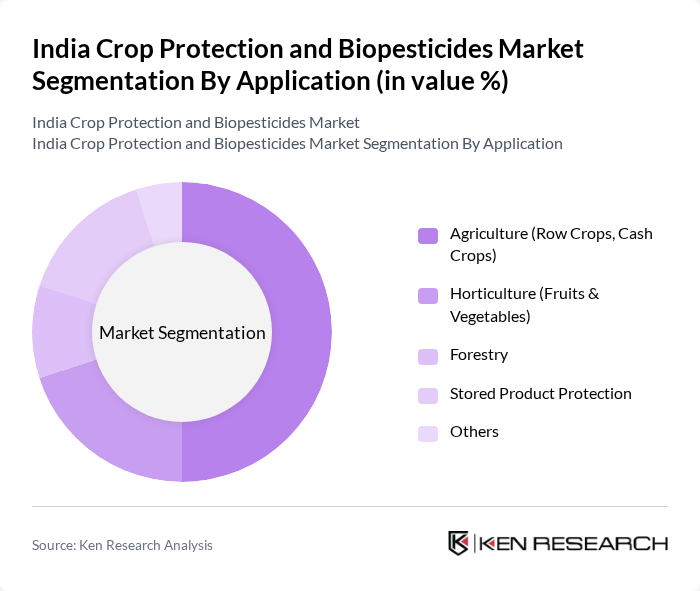
By Application:The applications of biopesticides are diverse, including agriculture (row crops and cash crops), horticulture (fruits and vegetables), forestry, stored product protection, and others. The agriculture segment, particularly row crops, dominates the market due to the high volume of pesticide usage in traditional farming practices. The increasing shift towards sustainable agriculture is further propelling the adoption of biopesticides in this segment.
India Crop Protection and Biopesticides Market Competitive Landscape
The India Crop Protection and Biopesticides Market is characterized by a dynamic mix of regional and international players. Leading participants such as Bayer CropScience Limited, Syngenta India Limited, UPL Limited, BASF India Limited, FMC India Private Limited, Rallis India Limited, Dhanuka Agritech Limited, Insecticides (India) Limited, Coromandel International Limited, T. Stanes and Company Limited, GrowTech Agri Science Private Limited, Gujarat State Fertilizers & Chemicals Limited, Mahindra Agri Solutions Limited, Adama Agricultural Solutions, Sumitomo Chemical India Limited contribute to innovation, geographic expansion, and service delivery in this space.
India Crop Protection and Biopesticides Market Industry Analysis
Growth Drivers
- Increasing Demand for Organic Farming:The organic farming sector in India has witnessed significant growth, with the area under organic cultivation reaching approximately2.8 million hectaresin future. This shift is driven by a consumer base increasingly willing to pay a premium for organic produce, which is projected to reach INR10,000 crorein future. The rising demand for chemical-free food is a key driver for biopesticides, as farmers seek sustainable alternatives to synthetic pesticides.
- Government Initiatives Promoting Sustainable Agriculture:The Indian government has allocatedINR 459 crorefor the promotion of organic farming and biopesticides in the future budget. Initiatives such as the Pradhan Mantri Krishi Sinchai Yojana aim to enhance sustainable agricultural practices. These policies not only support farmers financially but also encourage the adoption of biopesticides, which are essential for achieving the government's goal of increasing organic farming by25%in future.
- Rising Awareness About Health and Environmental Impacts:A growing segment of the Indian population is becoming increasingly aware of the health risks associated with chemical pesticides, with70%of consumers expressing concerns over pesticide residues in food. This awareness is driving demand for biopesticides, which are perceived as safer alternatives. The environmental benefits, including reduced soil and water contamination, further bolster the market for biopesticides, aligning with global sustainability trends.
Market Challenges
- Regulatory Hurdles in Product Approval:The approval process for biopesticides in India can be lengthy and complex, often taking up to2-3 years. This delay is primarily due to stringent regulatory requirements set by the Central Insecticides Board and Registration Committee. As of future,over 100 biopesticide productshave received approval, limiting market entry for new innovations and hindering overall market growth.
- High Cost of Biopesticide Production:The production cost of biopesticides is significantly higher than that of synthetic pesticides, with estimates indicating a cost differential of up to20-30%. This high cost is attributed to the complex manufacturing processes and the need for specialized raw materials. Consequently, many farmers, especially smallholders, may opt for cheaper synthetic alternatives, posing a challenge to the biopesticide market's expansion.
India Crop Protection and Biopesticides Market Future Outlook
The future of the India Crop Protection and Biopesticides Market appears promising, driven by increasing consumer demand for organic products and supportive government policies. As awareness of health and environmental issues continues to rise, the market is likely to see a shift towards biopesticides. Innovations in product formulations and the expansion of research collaborations will further enhance the market landscape, positioning biopesticides as a viable alternative to synthetic chemicals in agriculture.
Market Opportunities
- Expansion of Export Markets for Biopesticides:With global demand for organic products increasing, India has the opportunity to expand its biopesticide exports, which were valued at approximately INR500 crorein future. Targeting markets in Europe and North America, where regulations favor organic inputs, can significantly boost revenue and market presence for Indian biopesticide manufacturers.
- Development of New Biopesticide Products:The ongoing research and development in biopesticide formulations present a substantial opportunity for innovation. With over100new biopesticide products currently in the pipeline, the potential for market growth is significant. Collaborations with agricultural research institutions can accelerate product development, catering to diverse pest management needs across various crops.
Scope of the Report
| Segment | Sub-Segments |
|---|---|
| By Type | Microbial Biopesticides Plant-Derived Biopesticides (Botanicals) Animal-Derived Biopesticides (Insecticidal Proteins and Peptides) Biochemical Pesticides Others (e.g., Bionematicides, Biorodenticides, Bioacaricides) |
| By Application | Agriculture (Row Crops, Cash Crops) Horticulture (Fruits & Vegetables) Forestry Stored Product Protection Others |
| By End-User | Farmers Commercial Growers Government Agencies Agricultural Cooperatives Others |
| By Distribution Channel | Direct Sales Retail Outlets Online Platforms Others |
| By Region | North India South India East India West India |
| By Price Range | Low Price Mid Price High Price |
| By Policy Support | Subsidies Tax Exemptions Research Grants Others |
Key Target Audience
Investors and Venture Capitalist Firms
Government and Regulatory Bodies (e.g., Ministry of Agriculture and Farmers' Welfare, Central Insecticides Board)
Manufacturers and Producers
Distributors and Retailers
Agrochemical Companies
Biopesticide Developers
Industry Associations (e.g., Indian Biopesticides Association)
Financial Institutions
Players Mentioned in the Report:
Bayer CropScience Limited
Syngenta India Limited
UPL Limited
BASF India Limited
FMC India Private Limited
Rallis India Limited
Dhanuka Agritech Limited
Insecticides (India) Limited
Coromandel International Limited
T. Stanes and Company Limited
GrowTech Agri Science Private Limited
Gujarat State Fertilizers & Chemicals Limited
Mahindra Agri Solutions Limited
Adama Agricultural Solutions
Sumitomo Chemical India Limited
Table of Contents
Market Assessment Phase
1. Executive Summary and Approach
2. India Crop Protection and Biopesticides Market Overview
2.1 Key Insights and Strategic Recommendations
2.2 India Crop Protection and Biopesticides Market Overview
2.3 Definition and Scope
2.4 Evolution of Market Ecosystem
2.5 Timeline of Key Regulatory Milestones
2.6 Value Chain & Stakeholder Mapping
2.7 Business Cycle Analysis
2.8 Policy & Incentive Landscape
3. India Crop Protection and Biopesticides Market Analysis
3.1 Growth Drivers
3.1.1 Increasing demand for organic farming
3.1.2 Government initiatives promoting sustainable agriculture
3.1.3 Rising awareness about health and environmental impacts
3.1.4 Technological advancements in biopesticide formulations
3.2 Market Challenges
3.2.1 Regulatory hurdles in product approval
3.2.2 High cost of biopesticide production
3.2.3 Limited awareness among farmers
3.2.4 Competition from synthetic pesticides
3.3 Market Opportunities
3.3.1 Expansion of export markets for biopesticides
3.3.2 Development of new biopesticide products
3.3.3 Collaborations with agricultural research institutions
3.3.4 Increasing investment in agricultural technology
3.4 Market Trends
3.4.1 Shift towards integrated pest management (IPM)
3.4.2 Growing popularity of bio-based products
3.4.3 Rise in consumer demand for organic produce
3.4.4 Increased focus on sustainability in agriculture
3.5 Government Regulation
3.5.1 New guidelines for biopesticide registration
3.5.2 Subsidies for organic farming practices
3.5.3 Restrictions on harmful chemical pesticides
3.5.4 Promotion of research and development in biopesticides
4. SWOT Analysis
5. Stakeholder Analysis
6. Porter's Five Forces Analysis
7. India Crop Protection and Biopesticides Market Market Size, 2019-2024
7.1 By Value
7.2 By Volume
7.3 By Average Selling Price
8. India Crop Protection and Biopesticides Market Segmentation
8.1 By Type
8.1.1 Microbial Biopesticides
8.1.2 Plant-Derived Biopesticides (Botanicals)
8.1.3 Animal-Derived Biopesticides (Insecticidal Proteins and Peptides)
8.1.4 Biochemical Pesticides
8.1.5 Others (e.g., Bionematicides, Biorodenticides, Bioacaricides)
8.2 By Application
8.2.1 Agriculture (Row Crops, Cash Crops)
8.2.2 Horticulture (Fruits & Vegetables)
8.2.3 Forestry
8.2.4 Stored Product Protection
8.2.5 Others
8.3 By End-User
8.3.1 Farmers
8.3.2 Commercial Growers
8.3.3 Government Agencies
8.3.4 Agricultural Cooperatives
8.3.5 Others
8.4 By Distribution Channel
8.4.1 Direct Sales
8.4.2 Retail Outlets
8.4.3 Online Platforms
8.4.4 Others
8.5 By Region
8.5.1 North India
8.5.2 South India
8.5.3 East India
8.5.4 West India
8.6 By Price Range
8.6.1 Low Price
8.6.2 Mid Price
8.6.3 High Price
8.7 By Policy Support
8.7.1 Subsidies
8.7.2 Tax Exemptions
8.7.3 Research Grants
8.7.4 Others
9. India Crop Protection and Biopesticides Market Competitive Analysis
9.1 Market Share of Key Players
9.2 KPIs for Cross Comparison of Key Players
9.2.1 Company Name
9.2.2 Group Size (Large, Medium, or Small as per industry convention)
9.2.3 Revenue Growth Rate (CAGR %)
9.2.4 Market Share (%)
9.2.5 Product Portfolio Breadth (Number of Registered Products)
9.2.6 R&D Investment as % of Revenue
9.2.7 Distribution Network Coverage (Number of States/Regions Served)
9.2.8 Export Revenue Share (%)
9.2.9 Regulatory Approval Success Rate (%)
9.2.10 Customer Base (Number of Farmers/Clients Served)
9.2.11 Brand Recognition Index (Survey-Based Score)
9.2.12 Sustainability Initiatives (Number of Certified Sustainable Products/Practices)
9.3 SWOT Analysis of Top Players
9.4 Pricing Analysis
9.5 Detailed Profile of Major Companies
9.5.1 Bayer CropScience Limited
9.5.2 Syngenta India Limited
9.5.3 UPL Limited
9.5.4 BASF India Limited
9.5.5 FMC India Private Limited
9.5.6 Rallis India Limited
9.5.7 Dhanuka Agritech Limited
9.5.8 Insecticides (India) Limited
9.5.9 Coromandel International Limited
9.5.10 T. Stanes and Company Limited
9.5.11 GrowTech Agri Science Private Limited
9.5.12 Gujarat State Fertilizers & Chemicals Limited
9.5.13 Mahindra Agri Solutions Limited
9.5.14 Adama Agricultural Solutions
9.5.15 Sumitomo Chemical India Limited
10. India Crop Protection and Biopesticides Market End-User Analysis
10.1 Procurement Behavior of Key Ministries
10.1.1 Government procurement policies
10.1.2 Budget allocation for crop protection
10.1.3 Preference for biopesticides over chemical pesticides
10.1.4 Collaboration with agricultural research bodies
10.2 Corporate Spend on Infrastructure & Energy
10.2.1 Investment in sustainable farming practices
10.2.2 Funding for biopesticide research
10.2.3 Expenditure on training programs for farmers
10.3 Pain Point Analysis by End-User Category
10.3.1 Challenges faced by smallholder farmers
10.3.2 Issues with product availability
10.3.3 Concerns regarding efficacy of biopesticides
10.4 User Readiness for Adoption
10.4.1 Awareness levels among farmers
10.4.2 Training and support requirements
10.4.3 Perceived benefits of biopesticides
10.5 Post-Deployment ROI and Use Case Expansion
10.5.1 Measurement of yield improvements
10.5.2 Cost savings analysis
10.5.3 Expansion into new crop segments
11. India Crop Protection and Biopesticides Market Future Size, 2025-2030
11.1 By Value
11.2 By Volume
11.3 By Average Selling Price
Go-To-Market Strategy Phase
1. Whitespace Analysis + Business Model Canvas
1.1 Market gaps identification
1.2 Value proposition development
1.3 Revenue model exploration
1.4 Customer segmentation analysis
1.5 Competitive landscape overview
2. Marketing and Positioning Recommendations
2.1 Branding strategies
2.2 Product USPs
2.3 Target audience identification
2.4 Communication strategies
3. Distribution Plan
3.1 Urban retail strategies
3.2 Rural NGO tie-ups
3.3 E-commerce integration
3.4 Logistics optimization
4. Channel & Pricing Gaps
4.1 Underserved routes
4.2 Pricing bands analysis
4.3 Competitor pricing strategies
5. Unmet Demand & Latent Needs
5.1 Category gaps identification
5.2 Consumer segments analysis
5.3 Emerging trends exploration
6. Customer Relationship
6.1 Loyalty programs
6.2 After-sales service
6.3 Customer feedback mechanisms
7. Value Proposition
7.1 Sustainability initiatives
7.2 Integrated supply chains
7.3 Community engagement strategies
8. Key Activities
8.1 Regulatory compliance
8.2 Branding efforts
8.3 Distribution setup
9. Entry Strategy Evaluation
9.1 Domestic Market Entry Strategy
9.1.1 Product mix considerations
9.1.2 Pricing band strategies
9.1.3 Packaging innovations
9.2 Export Entry Strategy
9.2.1 Target countries analysis
9.2.2 Compliance roadmap development
10. Entry Mode Assessment
10.1 Joint Ventures
10.2 Greenfield investments
10.3 Mergers & Acquisitions
10.4 Distributor Model evaluation
11. Capital and Timeline Estimation
11.1 Capital requirements analysis
11.2 Timelines for market entry
12. Control vs Risk Trade-Off
12.1 Ownership considerations
12.2 Partnerships evaluation
13. Profitability Outlook
13.1 Breakeven analysis
13.2 Long-term sustainability strategies
14. Potential Partner List
14.1 Distributors identification
14.2 Joint Ventures exploration
14.3 Acquisition targets
15. Execution Roadmap
15.1 Phased Plan for Market Entry
15.1.1 Market Setup
15.1.2 Market Entry
15.1.3 Growth Acceleration
15.1.4 Scale & Stabilize
15.2 Key Activities and Milestones
15.2.1 Milestone tracking
15.2.2 Activity scheduling
Research Methodology
Phase 1: Approach1
Desk Research
- Analysis of agricultural production statistics from the Ministry of Agriculture & Farmers' Welfare
- Review of market reports and publications from industry associations like the Indian Biopesticides Association
- Examination of regulatory frameworks and guidelines from the Central Insecticides Board and Registration Committee
Primary Research
- Interviews with agronomists and crop protection specialists in leading agricultural universities
- Surveys with farmers and agricultural cooperatives regarding biopesticide usage
- Discussions with distributors and retailers in the agrochemical supply chain
Validation & Triangulation
- Cross-validation of findings with historical market data and growth trends
- Triangulation of insights from primary interviews with secondary data sources
- Sanity checks through expert panels comprising agribusiness consultants and market analysts
Phase 2: Market Size Estimation1
Top-down Assessment
- Estimation of total market size based on national agricultural expenditure and crop protection budgets
- Segmentation by crop type, application method, and geographical region
- Incorporation of government initiatives promoting sustainable agriculture and biopesticide adoption
Bottom-up Modeling
- Volume estimates derived from sales data of leading biopesticide manufacturers
- Cost analysis based on pricing models of various biopesticide products
- Calculation of market size using product volume multiplied by average selling price
Forecasting & Scenario Analysis
- Multi-variable forecasting using factors such as climate change impact and pest resistance trends
- Scenario modeling based on potential regulatory changes and market entry of new biopesticide technologies
- Development of baseline, optimistic, and pessimistic market growth projections through 2030
Phase 3: CATI Sample Composition1
| Scope Item/Segment | Sample Size | Target Respondent Profiles |
|---|---|---|
| Cereal Crop Protection | 120 | Farmers, Agronomists, Crop Advisors |
| Horticultural Biopesticides | 90 | Horticulturists, Agricultural Extension Officers |
| Organic Farming Practices | 60 | Organic Farmers, Certification Bodies |
| Distribution Channels for Biopesticides | 50 | Distributors, Retailers, Supply Chain Managers |
| Regulatory Compliance Insights | 40 | Regulatory Affairs Specialists, Compliance Officers |
Frequently Asked Questions
What is the current value of the India Crop Protection and Biopesticides Market?
The India Crop Protection and Biopesticides Market is valued at approximately USD 6.4 billion, reflecting a significant growth trend driven by the demand for sustainable agricultural practices and effective pest management solutions.
Which regions in India dominate the Crop Protection and Biopesticides Market?
What government initiatives support the use of biopesticides in India?
What types of biopesticides are available in the Indian market?
Other Regional/Country Reports
Indonesia Crop Protection and Biopesticides Market
Malaysia Crop Protection and Biopesticides Market
KSA Crop Protection and Biopesticides Market
APAC Crop Protection and Biopesticides Market
SEA Crop Protection and Biopesticides Market
Other Adjacent Reports
Kuwait Organic Farming Market
Asia Pacific Seed Treatment Market Outlook to 2030: Size, Share, Growth and TrendsKuwait Agricultural Biotechnology Market Size, Share, Growth Drivers, Trends, Opportunities & Forecast 2025–2030North America Precision Agriculture Market Outlook to 2030: Size, Share, Growth and TrendsThailand Irrigation Systems MarketBelgium Farm Machinery Market
Malaysia Crop Nutrition Market
South Africa Pest Monitoring Market
Bahrain Agrochemical Distribution Market
Why Buy From Us?

What makes us stand out is that our consultants follow Robust, Refine and Result (RRR) methodology. Robust for clear definitions, approaches and sanity checking, Refine for differentiating respondents' facts and opinions, and Result for presenting data with story.

We have set a benchmark in the industry by offering our clients with syndicated and customized market research reports featuring coverage of entire market as well as meticulous research and analyst insights.

While we don't replace traditional research, we flip the method upside down. Our dual approach of Top Bottom & Bottom Top ensures quality deliverable by not just verifying company fundamentals but also looking at the sector and macroeconomic factors.

With one step in the future, our research team constantly tries to show you the bigger picture. We help with some of the tough questions you may encounter along the way: How is the industry positioned? Best marketing channel? KPI's of competitors? By aligning every element, we help maximize success.

Our report gives you instant access to the answers and sources that other companies might choose to hide. We elaborate each steps of research methodology we have used and showcase you the sample size to earn your trust.

If you need any support, we are here! We pride ourselves on universe strength, data quality, and quick, friendly, and professional service.