India Smart Waste Management and IoT Bins Market

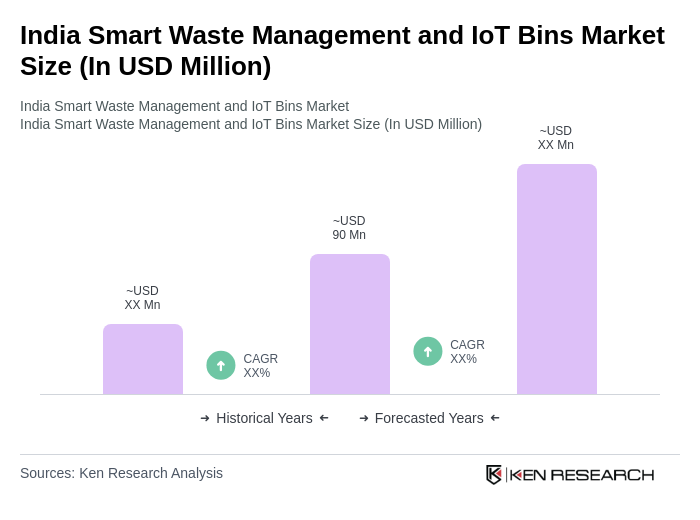
India Smart Waste Management and IoT Bins Market, valued at USD 90 million, is growing due to rapid urbanization, government regulations, and IoT advancements for optimized waste collection and sustainability.

Region:Asia

Author(s):Dev

Product Code:KRAB4208

Pages:85

Published On:October 2025
About the Report

Base Year 2024

India Smart Waste Management and IoT Bins Market Overview

  • The India Smart Waste Management and IoT Bins Market is valued at USD 90 million, based on a five-year historical analysis. This growth is primarily driven by rapid urbanization, government initiatives for smart cities, stricter environmental regulations, and the rising need for efficient waste management solutions. The integration of IoT technology in waste management systems has significantly enhanced operational efficiency, route optimization, and data-driven decision-making, enabling municipalities and private operators to reduce costs and improve service quality .
  • Key players in this market include metropolitan cities like Delhi, Mumbai, and Bengaluru, which dominate due to their high population density and waste generation rates. These cities are at the forefront of adopting smart waste management technologies, supported by local government policies aimed at improving urban infrastructure, sustainability, and compliance with new waste management standards .
  • The Solid Waste Management Rules, 2016, issued by the Ministry of Environment, Forest and Climate Change, and further strengthened by the 2024 amendments, mandate waste segregation at source, promote the use of smart collection and monitoring systems, and impose compliance requirements for municipalities and private operators. These regulations provide a binding framework for the deployment of IoT-enabled bins and smart waste management technologies across India .
India Smart Waste Management and IoT Bins Market Size

India Smart Waste Management and IoT Bins Market Segmentation

By Product Type:The product type segmentation includes various innovative solutions that cater to the needs of smart waste management. The subsegments are Smart Bins (IoT-enabled), Sensor Modules & Connectivity Solutions, Waste Collection Vehicles (GPS/IoT-enabled), Waste Processing & Sorting Equipment, Software Platforms & Data Analytics, and Others. Among these, Smart Bins (IoT-enabled) are leading the market due to their ability to optimize waste collection routes, enable real-time monitoring, and reduce operational costs through data analytics. The growing trend of urbanization, stricter compliance requirements, and the need for efficient waste management solutions are driving the demand for these smart bins .
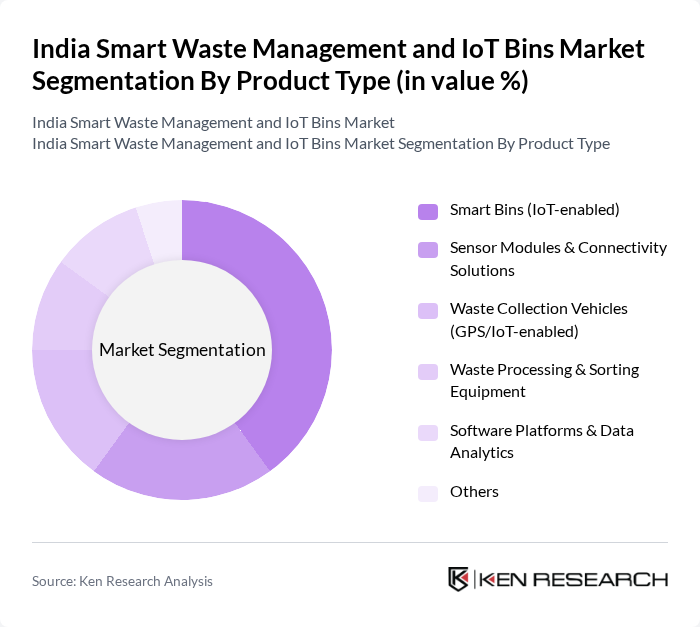
India Smart Waste Management and IoT Bins Market segmentation by Product Type.

By End-User:The end-user segmentation encompasses various sectors utilizing smart waste management solutions, including Residential, Commercial (Retail, Hospitality, Offices), Industrial, Government & Municipalities, and Healthcare & Institutions. The Commercial sector is currently dominating the market, driven by the increasing focus on sustainability, regulatory compliance, and corporate social responsibility among businesses. Retail and hospitality sectors are particularly keen on adopting smart waste management solutions to enhance operational efficiency, meet environmental standards, and reduce their environmental footprint .
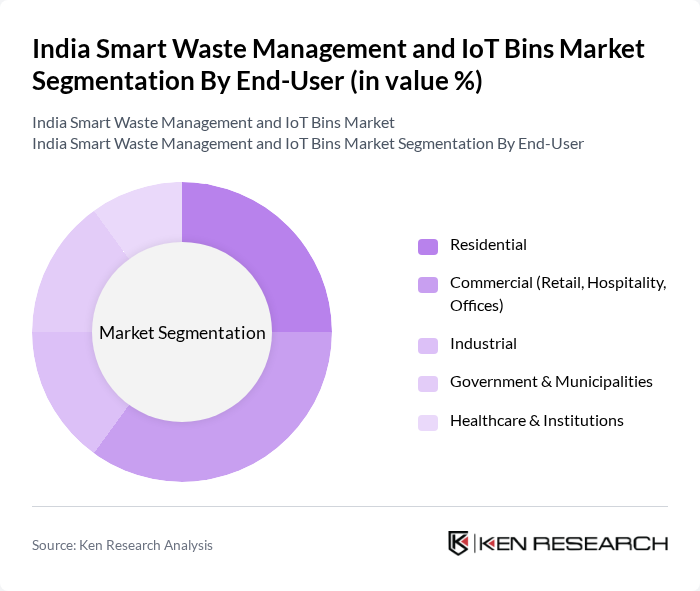
India Smart Waste Management and IoT Bins Market segmentation by End-User.

India Smart Waste Management and IoT Bins Market Competitive Landscape

The India Smart Waste Management and IoT Bins Market is characterized by a dynamic mix of regional and international players. Leading participants such as Antony Waste Handling Cell Ltd., Ecube Labs India Pvt. Ltd., IOTomation Ecotech Pvt. Ltd., Blue Planet Environmental Solutions India Pvt. Ltd., Sahaas Zero Waste, Recykal (Rapidue Technologies Pvt. Ltd.), Clean India Ventures Pvt. Ltd., NEPRA Resource Management Pvt. Ltd., Waste Ventures India Pvt. Ltd., Greenobin Recycling Pvt. Ltd., Bintix Waste Research Pvt. Ltd., EcoCentric Management Pvt. Ltd., Urbaser Sumeet India Pvt. Ltd., Tata Projects Ltd. (Smart Cities Division), Zigma Global Environ Solutions Pvt. Ltd. contribute to innovation, geographic expansion, and service delivery in this space.

Antony Waste Handling Cell Ltd.

2001

Mumbai, India

Ecube Labs India Pvt. Ltd.

2013

Bengaluru, India

IOTomation Ecotech Pvt. Ltd.

2015

Noida, India

Blue Planet Environmental Solutions India Pvt. Ltd.

2017

Gurugram, India

Sahaas Zero Waste

2013

Bengaluru, India

Company

Establishment Year

Headquarters

Group Size (Large, Medium, Small)

Revenue Growth Rate (YoY %)

Market Penetration Rate (Installations/City or Region)

Customer Retention Rate (%)

Average Contract Value (INR/USD)

Operational Efficiency (Bins Serviced/Day, Route Optimization)

India Smart Waste Management and IoT Bins Market Industry Analysis

Growth Drivers

  • Increasing Urbanization:India is experiencing rapid urbanization, with urban populations projected to reach 600 million in future, according to the Ministry of Housing and Urban Affairs. This surge necessitates efficient waste management solutions, as urban areas generate approximately 62 million tons of waste annually. The demand for smart waste management systems, including IoT bins, is driven by the need to manage this increasing waste volume effectively, ensuring cleaner and more sustainable urban environments.
  • Government Initiatives for Cleanliness:The Indian government has launched several initiatives, such as the Swachh Bharat Mission, which aims to eliminate open defecation and promote cleanliness. With a budget allocation of ?12,000 crore (approximately $1.5 billion) for urban sanitation, these initiatives are fostering the adoption of smart waste management technologies. The focus on cleanliness is driving municipalities to invest in IoT-enabled bins, enhancing waste collection efficiency and promoting public health.
  • Technological Advancements in Waste Management:The integration of advanced technologies, such as IoT and AI, is revolutionizing waste management in India. The market for smart waste management solutions is expected to benefit from the increasing deployment of IoT sensors, which can monitor bin levels and optimize collection routes. With over 1,000 smart bins already deployed in major cities, these technologies are enhancing operational efficiency and reducing costs associated with waste collection and disposal.

Market Challenges

  • Lack of Infrastructure:A significant challenge facing the smart waste management market in India is the inadequate infrastructure for waste collection and processing. According to the Central Pollution Control Board, only about 70% of the waste generated in urban areas is collected, and approximately 20% is processed. This lack of infrastructure hampers the effective implementation of smart waste management solutions, limiting their potential impact on urban cleanliness and sustainability.
  • High Initial Investment Costs:The initial investment required for implementing smart waste management systems can be a barrier for many municipalities. The cost of IoT bins, installation, and maintenance can exceed ?50,000 (approximately $670) per unit. With many cities facing budget constraints, the high upfront costs deter local governments from adopting these innovative solutions, slowing the overall market growth in the sector.

India Smart Waste Management and IoT Bins Market Future Outlook

The future of the smart waste management and IoT bins market in India appears promising, driven by increasing urbanization and government support for sustainable practices. As cities expand, the demand for efficient waste management solutions will rise, prompting further technological integration. Additionally, the focus on environmental sustainability will encourage investments in innovative waste management technologies, fostering a shift towards circular economy practices. This evolving landscape presents significant opportunities for growth and collaboration among stakeholders in the waste management sector.

Market Opportunities

  • Expansion of Smart City Projects:The Indian government has initiated 100 smart city projects, with an investment of ?48,000 crore (approximately $6.4 billion). These projects are expected to incorporate smart waste management solutions, creating a substantial market opportunity for IoT bins and related technologies, enhancing urban waste management efficiency.
  • Integration of AI and Machine Learning:The integration of AI and machine learning in waste management can optimize collection routes and improve recycling rates. With an estimated 30% of waste being recyclable, leveraging these technologies can significantly enhance operational efficiency, reduce costs, and promote sustainable waste practices, presenting a lucrative opportunity for market players.

Scope of the Report

SegmentSub-Segments
By Product Type

Smart Bins (IoT-enabled)

Sensor Modules & Connectivity Solutions

Waste Collection Vehicles (GPS/IoT-enabled)

Waste Processing & Sorting Equipment

Software Platforms & Data Analytics

Others

By End-User

Residential

Commercial (Retail, Hospitality, Offices)

Industrial

Government & Municipalities

Healthcare & Institutions

By Region

North India

South India

East India

West India

By Application

Urban Waste Management

Rural Waste Management

Hazardous & Biomedical Waste Management

E-Waste Management

Others

By Investment Source

Domestic Private Investment

Foreign Direct Investment (FDI)

Public-Private Partnerships (PPP)

Government Schemes & Grants

By Policy Support

Subsidies

Tax Exemptions

Grants

Regulatory Mandates

Others

By Distribution Mode

Direct Sales

Online Sales

Distributors & System Integrators

Others

Key Target Audience

Investors and Venture Capitalist Firms

Government and Regulatory Bodies (e.g., Ministry of Housing and Urban Affairs, Central Pollution Control Board)

Manufacturers and Producers of Smart Waste Management Solutions

Municipal Corporations and Local Government Authorities

Waste Management Service Providers

Technology Providers and IoT Solution Developers

Environmental NGOs and Advocacy Groups

Public-Private Partnership (PPP) Initiatives

Players Mentioned in the Report:

Antony Waste Handling Cell Ltd.

Ecube Labs India Pvt. Ltd.

IOTomation Ecotech Pvt. Ltd.

Blue Planet Environmental Solutions India Pvt. Ltd.

Sahaas Zero Waste

Recykal (Rapidue Technologies Pvt. Ltd.)

Clean India Ventures Pvt. Ltd.

NEPRA Resource Management Pvt. Ltd.

Waste Ventures India Pvt. Ltd.

Greenobin Recycling Pvt. Ltd.

Bintix Waste Research Pvt. Ltd.

EcoCentric Management Pvt. Ltd.

Urbaser Sumeet India Pvt. Ltd.

Tata Projects Ltd. (Smart Cities Division)

Zigma Global Environ Solutions Pvt. Ltd.

Table of Contents

Market Assessment Phase

1. Executive Summary and Approach


2. India Smart Waste Management and IoT Bins Market Overview

2.1 Key Insights and Strategic Recommendations

2.2 India Smart Waste Management and IoT Bins Market Overview

2.3 Definition and Scope

2.4 Evolution of Market Ecosystem

2.5 Timeline of Key Regulatory Milestones

2.6 Value Chain & Stakeholder Mapping

2.7 Business Cycle Analysis

2.8 Policy & Incentive Landscape


3. India Smart Waste Management and IoT Bins Market Analysis

3.1 Growth Drivers

3.1.1 Increasing Urbanization
3.1.2 Government Initiatives for Cleanliness
3.1.3 Technological Advancements in Waste Management
3.1.4 Rising Environmental Awareness

3.2 Market Challenges

3.2.1 Lack of Infrastructure
3.2.2 High Initial Investment Costs
3.2.3 Resistance to Change in Traditional Practices
3.2.4 Regulatory Compliance Issues

3.3 Market Opportunities

3.3.1 Expansion of Smart City Projects
3.3.2 Integration of AI and Machine Learning
3.3.3 Partnerships with Private Sector
3.3.4 Development of Sustainable Waste Solutions

3.4 Market Trends

3.4.1 Adoption of IoT Technologies
3.4.2 Focus on Circular Economy
3.4.3 Increased Investment in Waste-to-Energy Solutions
3.4.4 Growth of Mobile Applications for Waste Management

3.5 Government Regulation

3.5.1 Solid Waste Management Rules
3.5.2 E-Waste Management Rules
3.5.3 Plastic Waste Management Rules
3.5.4 National Cleanliness Campaigns

4. SWOT Analysis


5. Stakeholder Analysis


6. Porter's Five Forces Analysis


7. India Smart Waste Management and IoT Bins Market Market Size, 2019-2024

7.1 By Value

7.2 By Volume

7.3 By Average Selling Price


8. India Smart Waste Management and IoT Bins Market Segmentation

8.1 By Product Type

8.1.1 Smart Bins (IoT-enabled)
8.1.2 Sensor Modules & Connectivity Solutions
8.1.3 Waste Collection Vehicles (GPS/IoT-enabled)
8.1.4 Waste Processing & Sorting Equipment
8.1.5 Software Platforms & Data Analytics
8.1.6 Others

8.2 By End-User

8.2.1 Residential
8.2.2 Commercial (Retail, Hospitality, Offices)
8.2.3 Industrial
8.2.4 Government & Municipalities
8.2.5 Healthcare & Institutions

8.3 By Region

8.3.1 North India
8.3.2 South India
8.3.3 East India
8.3.4 West India

8.4 By Application

8.4.1 Urban Waste Management
8.4.2 Rural Waste Management
8.4.3 Hazardous & Biomedical Waste Management
8.4.4 E-Waste Management
8.4.5 Others

8.5 By Investment Source

8.5.1 Domestic Private Investment
8.5.2 Foreign Direct Investment (FDI)
8.5.3 Public-Private Partnerships (PPP)
8.5.4 Government Schemes & Grants

8.6 By Policy Support

8.6.1 Subsidies
8.6.2 Tax Exemptions
8.6.3 Grants
8.6.4 Regulatory Mandates
8.6.5 Others

8.7 By Distribution Mode

8.7.1 Direct Sales
8.7.2 Online Sales
8.7.3 Distributors & System Integrators
8.7.4 Others

9. India Smart Waste Management and IoT Bins Market Competitive Analysis

9.1 Market Share of Key Players

9.2 KPIs for Cross Comparison of Key Players

9.2.1 Company Name
9.2.2 Group Size (Large, Medium, Small)
9.2.3 Revenue Growth Rate (YoY %)
9.2.4 Market Penetration Rate (Installations/City or Region)
9.2.5 Customer Retention Rate (%)
9.2.6 Average Contract Value (INR/USD)
9.2.7 Operational Efficiency (Bins Serviced/Day, Route Optimization)
9.2.8 Technology Adoption Rate (IoT/AI Integration %)
9.2.9 Customer Satisfaction Score (NPS or Survey-based)
9.2.10 Brand Recognition (Industry Awards, Media Mentions)
9.2.11 Compliance Rate (Adherence to SWM Rules, Certifications)
9.2.12 Innovation Index (Patents, New Product Launches)

9.3 SWOT Analysis of Top Players

9.4 Pricing Analysis

9.5 Detailed Profile of Major Companies

9.5.1 Antony Waste Handling Cell Ltd.
9.5.2 Ecube Labs India Pvt. Ltd.
9.5.3 IOTomation Ecotech Pvt. Ltd.
9.5.4 Blue Planet Environmental Solutions India Pvt. Ltd.
9.5.5 Sahaas Zero Waste
9.5.6 Recykal (Rapidue Technologies Pvt. Ltd.)
9.5.7 Clean India Ventures Pvt. Ltd.
9.5.8 NEPRA Resource Management Pvt. Ltd.
9.5.9 Waste Ventures India Pvt. Ltd.
9.5.10 Greenobin Recycling Pvt. Ltd.
9.5.11 Bintix Waste Research Pvt. Ltd.
9.5.12 EcoCentric Management Pvt. Ltd.
9.5.13 Urbaser Sumeet India Pvt. Ltd.
9.5.14 Tata Projects Ltd. (Smart Cities Division)
9.5.15 Zigma Global Environ Solutions Pvt. Ltd.

10. India Smart Waste Management and IoT Bins Market End-User Analysis

10.1 Procurement Behavior of Key Ministries

10.1.1 Ministry of Urban Development
10.1.2 Ministry of Environment, Forest and Climate Change
10.1.3 Ministry of Housing and Urban Affairs

10.2 Corporate Spend on Infrastructure & Energy

10.2.1 Investment in Smart Waste Solutions
10.2.2 Budget Allocation for Waste Management
10.2.3 Corporate Social Responsibility Initiatives

10.3 Pain Point Analysis by End-User Category

10.3.1 Residential Users
10.3.2 Commercial Establishments
10.3.3 Industrial Users

10.4 User Readiness for Adoption

10.4.1 Awareness of Smart Solutions
10.4.2 Willingness to Invest
10.4.3 Training and Support Needs

10.5 Post-Deployment ROI and Use Case Expansion

10.5.1 Cost Savings Analysis
10.5.2 Performance Metrics
10.5.3 Future Expansion Opportunities

11. India Smart Waste Management and IoT Bins Market Future Size, 2025-2030

11.1 By Value

11.2 By Volume

11.3 By Average Selling Price


Go-To-Market Strategy Phase

1. Whitespace Analysis + Business Model Canvas

1.1 Market Gaps Identification

1.2 Business Model Framework


2. Marketing and Positioning Recommendations

2.1 Branding Strategies

2.2 Product USPs


3. Distribution Plan

3.1 Urban Retail vs Rural NGO Tie-ups


4. Channel & Pricing Gaps

4.1 Underserved Routes

4.2 Pricing Bands


5. Unmet Demand & Latent Needs

5.1 Category Gaps

5.2 Consumer Segments


6. Customer Relationship

6.1 Loyalty Programs

6.2 After-sales Service


7. Value Proposition

7.1 Sustainability

7.2 Integrated Supply Chains


8. Key Activities

8.1 Regulatory Compliance

8.2 Branding

8.3 Distribution Setup


9. Entry Strategy Evaluation

9.1 Domestic Market Entry Strategy

9.1.1 Product Mix
9.1.2 Pricing Band
9.1.3 Packaging

9.2 Export Entry Strategy

9.2.1 Target Countries
9.2.2 Compliance Roadmap

10. Entry Mode Assessment

10.1 JV

10.2 Greenfield

10.3 M&A

10.4 Distributor Model


11. Capital and Timeline Estimation

11.1 Capital Requirements

11.2 Timelines


12. Control vs Risk Trade-Off

12.1 Ownership vs Partnerships


13. Profitability Outlook

13.1 Breakeven Analysis

13.2 Long-term Sustainability


14. Potential Partner List

14.1 Distributors

14.2 JVs

14.3 Acquisition Targets


15. Execution Roadmap

15.1 Phased Plan for Market Entry

15.1.1 Market Setup
15.1.2 Market Entry
15.1.3 Growth Acceleration
15.1.4 Scale & Stabilize

15.2 Key Activities and Milestones

15.2.1 Activity Timeline
15.2.2 Milestone Tracking

Research Methodology

ApproachModellingSample

Phase 1: Approach1

Desk Research

  • Analysis of government reports on waste management policies and initiatives in India
  • Review of industry publications and white papers on IoT applications in waste management
  • Examination of market reports from environmental agencies and NGOs focused on urban waste management

Primary Research

  • Interviews with municipal waste management officials and city planners
  • Surveys with technology providers specializing in IoT solutions for waste management
  • Focus groups with end-users, including residents and businesses utilizing smart waste bins

Validation & Triangulation

  • Cross-validation of findings through multiple data sources, including government and private sector reports
  • Triangulation of qualitative insights from interviews with quantitative data from surveys
  • Sanity checks through expert reviews from industry stakeholders and academic professionals

Phase 2: Market Size Estimation1

Top-down Assessment

  • Estimation of total waste generation in urban areas and its correlation with IoT adoption
  • Analysis of government budgets allocated for smart city initiatives and waste management
  • Incorporation of projected growth rates for IoT technology in municipal services

Bottom-up Modeling

  • Collection of data on the number of smart bins deployed across major cities in India
  • Estimation of average costs associated with IoT-enabled waste management systems
  • Volume of waste processed through smart bins and associated revenue models

Forecasting & Scenario Analysis

  • Multi-factor regression analysis considering urbanization rates and technological advancements
  • Scenario modeling based on varying levels of government support and public adoption rates
  • Development of baseline, optimistic, and pessimistic forecasts through 2030

Phase 3: CATI Sample Composition1

Scope Item/SegmentSample SizeTarget Respondent Profiles
Municipal Waste Management Authorities100City Waste Managers, Environmental Officers
IoT Technology Providers60Product Managers, Business Development Executives
Smart Bin Manufacturers50Operations Managers, Sales Directors
End-Users of Smart Waste Solutions90Residents, Business Owners, Facility Managers
Environmental NGOs and Advocacy Groups40Policy Analysts, Program Coordinators

Frequently Asked Questions

What is the current value of the India Smart Waste Management and IoT Bins Market?

The India Smart Waste Management and IoT Bins Market is valued at approximately USD 90 million, driven by urbanization, government initiatives, and the need for efficient waste management solutions.

What factors are driving the growth of the smart waste management market in India?

Which cities in India are leading in the adoption of smart waste management technologies?

What are the main product types in the India Smart Waste Management market?

Other Regional/Country Reports

Indonesia Smart Waste Management and IoT Bins Market

Malaysia Smart Waste Management and IoT Bins Market

KSA Smart Waste Management and IoT Bins Market

APAC Smart Waste Management and IoT Bins Market

SEA Smart Waste Management and IoT Bins Market

Vietnam Smart Waste Management and IoT Bins Market

Why Buy From Us?

Refine Robust Result (RRR) Framework

What makes us stand out is that our consultants follow Robust, Refine and Result (RRR) methodology. Robust for clear definitions, approaches and sanity checking, Refine for differentiating respondents' facts and opinions, and Result for presenting data with story.

Our Reach Is Unmatched

We have set a benchmark in the industry by offering our clients with syndicated and customized market research reports featuring coverage of entire market as well as meticulous research and analyst insights.

Shifting the Research Paradigm

While we don't replace traditional research, we flip the method upside down. Our dual approach of Top Bottom & Bottom Top ensures quality deliverable by not just verifying company fundamentals but also looking at the sector and macroeconomic factors.

More Insights-Better Decisions

With one step in the future, our research team constantly tries to show you the bigger picture. We help with some of the tough questions you may encounter along the way: How is the industry positioned? Best marketing channel? KPI's of competitors? By aligning every element, we help maximize success.

Transparency and Trust

Our report gives you instant access to the answers and sources that other companies might choose to hide. We elaborate each steps of research methodology we have used and showcase you the sample size to earn your trust.

Round the Clock Support

If you need any support, we are here! We pride ourselves on universe strength, data quality, and quick, friendly, and professional service.

Why Clients Choose Us?

400000+
Reports in repository
150+
Consulting projects a year
100+
Analysts
8000+
Client Queries in 2022








