Indonesia Baby Car Seat Market Size Share Growth Drivers Trends Opportunities & Forecast 2025–2030

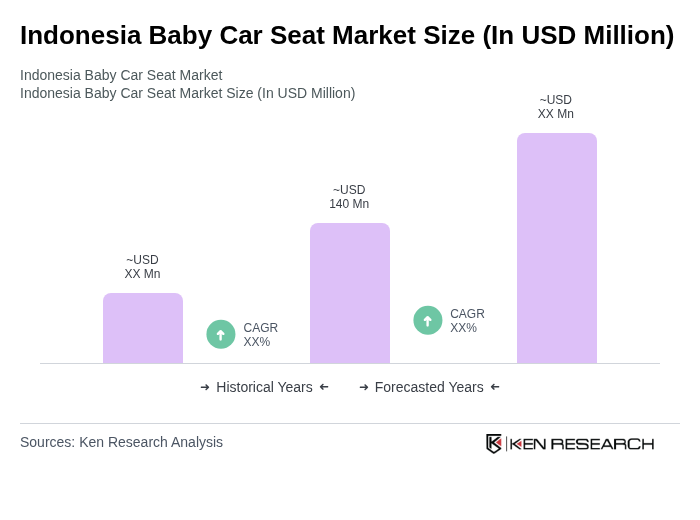
Indonesia baby car seat market, valued at USD 140 million, grows due to safety regulations, urbanization, and increasing vehicle ownership, led by infant car seats.

Region:Asia

Author(s):Shubham

Product Code:KRAD3033

Pages:97

Published On:January 2026
About the Report

Base Year 2024

Indonesia Baby Car Seat Market Overview

  • The Indonesia Baby Car Seat Market is valued at USD 140 million, based on a five-year historical analysis. This growth is primarily driven by increasing awareness of child safety regulations, rising disposable incomes, growing number of vehicle ownerships among families, escalating urbanization, and investment in automotive safety features. The market has seen a significant uptick in demand as parents prioritize safety features and compliance with local regulations regarding child transportation.
  • Key cities such as Jakarta, Surabaya, and Bandung dominate the market due to their high population density and urbanization rates. These cities have a larger concentration of families with children, leading to increased demand for baby car seats. Additionally, the presence of major retail outlets and online platforms in these urban areas facilitates easier access to a variety of baby car seat options.
  • The Minister of Transportation Regulation No. PM 110 Year 2019, issued by the Ministry of Transportation, mandates the use of child restraint systems for children under 12 years old or shorter than 135 cm in motor vehicles. This regulation requires appropriate child safety seats based on age and height during transportation, with compliance enforced through vehicle inspections and fines for violations. Compliance with this law has significantly boosted the demand for baby car seats, as parents are now more inclined to invest in these safety products to adhere to legal requirements.
Indonesia Baby Car Seat Market Size

Indonesia Baby Car Seat Market Segmentation

By Product Type:The product type segmentation includes various categories of baby car seats, each designed to cater to different age groups and safety needs. The subsegments are Infant Car Seats, Convertible Car Seats, Booster Car Seats, Combination Car Seats, and All-in-One Car Seats. Among these, Infant Car Seats are currently leading the market due to their specialized design for newborns and infants, which emphasizes safety and comfort. The trend towards early adoption of safety measures has driven parents to invest in these seats, making them a preferred choice.
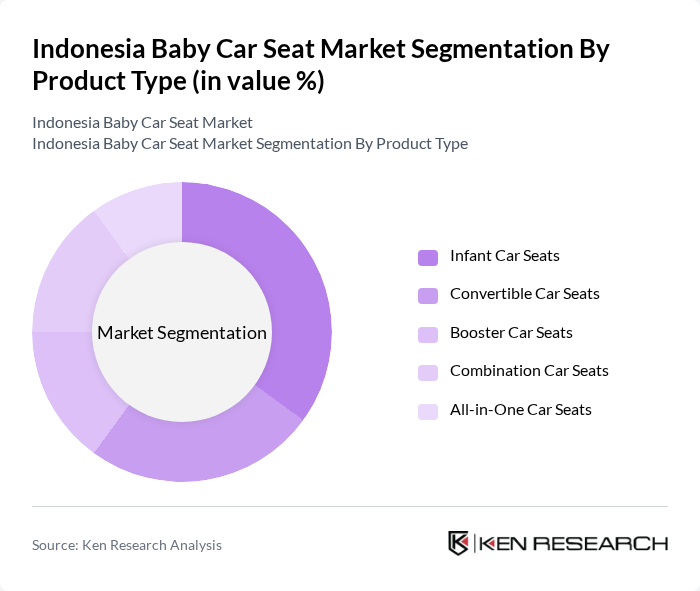
Indonesia Baby Car Seat Market segmentation by Product Type.

By Installation Type:The installation type segmentation includes Rear-Facing, Forward-Facing, and Rear- and Forward-Facing car seats. The Rear-Facing segment is currently the most popular due to its safety benefits for infants and toddlers. Parents are increasingly aware of the importance of keeping their children in rear-facing seats for as long as possible, which has led to a significant market preference for this installation type. This trend is supported by safety recommendations from pediatricians and safety organizations.
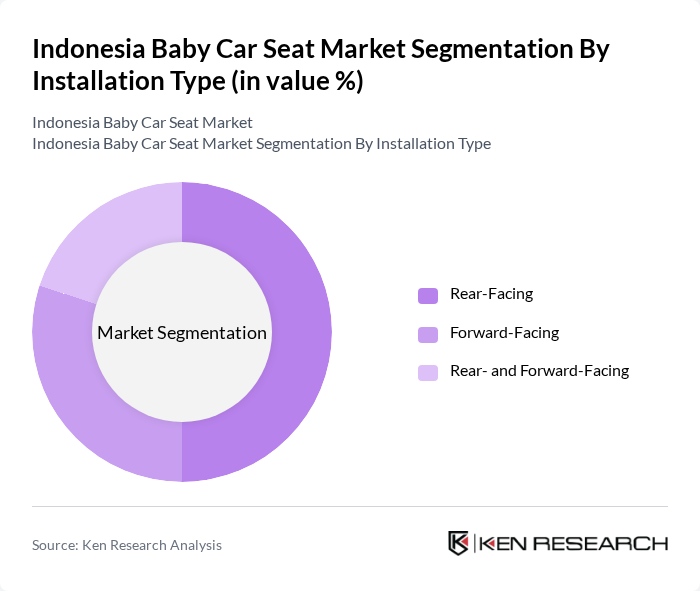
Indonesia Baby Car Seat Market segmentation by Installation Type.

Indonesia Baby Car Seat Market Competitive Landscape

The Indonesia Baby Car Seat Market is characterized by a dynamic mix of regional and international players. Leading participants such as Graco, Chicco, Britax, Maxi-Cosi, Joie, Clek, Evenflo, Baby Jogger, Safety 1st, Peg Perego, Combi, Nuna, Recaro, Diono, Baby Trend contribute to innovation, geographic expansion, and service delivery in this space.

Graco

1942

Westminster, California, USA

Chicco

1958

Como, Italy

Britax

1938

Fort Mill, South Carolina, USA

Maxi-Cosi

1984

Amsterdam, Netherlands

Joie

1992

Newport, Isle of Wight, UK

Company

Establishment Year

Headquarters

Revenue (USD Million)

YoY Revenue Growth (%)

Market Share (%)

EBITDA Margin (%)

CAGR (5-Year, %)

R&D Investment (% of Revenue)

Indonesia Baby Car Seat Market Industry Analysis

Growth Drivers

  • Increasing Awareness of Child Safety:The Indonesian government reported a 30% increase in public campaigns promoting child safety in vehicles from the previous year. This heightened awareness has led to a significant rise in demand for baby car seats, with sales reaching approximately 1.3 million units in the future. As parents become more informed about the risks associated with unrestrained children in vehicles, the market for baby car seats is expected to continue expanding, driven by a commitment to child safety.
  • Government Regulations Mandating Car Seat Usage:In the future, Indonesia is set to implement stricter regulations requiring the use of baby car seats for children under the age of 12. This policy is projected to affect over 11 million families, significantly increasing the market size. The government aims to reduce road traffic injuries among children, which accounted for 24% of all traffic-related fatalities in the previous year, thereby driving demand for compliant products in the baby car seat sector.
  • Rising Disposable Income Among Families:According to the World Bank, Indonesia's GDP per capita is expected to rise to $4,700 in the future, reflecting a 5% increase from the previous year. This economic growth is leading to higher disposable incomes, allowing families to invest more in child safety products. As a result, the baby car seat market is anticipated to benefit from increased purchasing power, with more families prioritizing safety and quality in their vehicle accessories.

Market Challenges

  • High Cost of Quality Baby Car Seats:The average price of a quality baby car seat in Indonesia ranges from IDR 1,600,000 to IDR 3,200,000 (approximately $105 to $210). This price point can be prohibitive for many families, especially in lower-income brackets, where 40% of the population lives on less than $3.50 a day. Consequently, the high cost of quality products poses a significant barrier to market penetration and widespread adoption.
  • Limited Availability in Rural Areas:Approximately 60% of Indonesia's population resides in rural areas, where access to baby car seats is limited. Many rural regions lack retail outlets that stock these products, leading to a significant gap in availability. This challenge is compounded by the fact that only 22% of rural families own vehicles, making it difficult to promote the necessity of baby car seats in these communities, thereby hindering market growth.

Indonesia Baby Car Seat Market Future Outlook

The future of the baby car seat market in Indonesia appears promising, driven by increasing regulatory support and consumer awareness. As urbanization continues, with over 55% of the population expected to live in urban areas in future, the demand for safe transportation solutions will rise. Additionally, the trend towards e-commerce is likely to enhance product accessibility, allowing families in both urban and rural areas to purchase baby car seats more conveniently, thus fostering market growth.

Market Opportunities

  • Expansion of E-Commerce Platforms:The rise of e-commerce in Indonesia, with online sales projected to reach $60 billion in future, presents a significant opportunity for baby car seat manufacturers. By leveraging online platforms, companies can reach a broader audience, particularly in underserved rural areas, enhancing product availability and driving sales growth.
  • Collaborations with Hospitals and Pediatricians:Establishing partnerships with healthcare providers can enhance consumer trust and education regarding baby car seat safety. With over 2,200 hospitals in Indonesia, targeted campaigns can effectively promote the importance of car seat usage, potentially increasing sales by 18% as families seek expert recommendations for child safety products.

Scope of the Report

SegmentSub-Segments
By Product Type

Infant Car Seats

Convertible Car Seats

Booster Car Seats

Combination Car Seats

All-in-One Car Seats

By Installation Type

Rear-Facing

Forward-Facing

Rear- and Forward-Facing

By Distribution Channel

Online

Offline

Hypermarkets/Supermarkets

Specialty Stores

Key Target Audience

Investors and Venture Capitalist Firms

Government and Regulatory Bodies (e.g., Kementerian Perhubungan, Badan Standardisasi Nasional)

Manufacturers and Producers

Distributors and Retailers

Child Safety Advocacy Groups

Automobile Manufacturers

Logistics and Supply Chain Companies

Insurance Companies

Players Mentioned in the Report:

Graco

Chicco

Britax

Maxi-Cosi

Joie

Clek

Evenflo

Baby Jogger

Safety 1st

Peg Perego

Combi

Nuna

Recaro

Diono

Baby Trend

Table of Contents

Market Assessment Phase

1. Executive Summary and Approach


2. Indonesia Baby Car Seat Market Overview

2.1 Key Insights and Strategic Recommendations

2.2 Indonesia Baby Car Seat Market Overview

2.3 Definition and Scope

2.4 Evolution of Market Ecosystem

2.5 Timeline of Key Regulatory Milestones

2.6 Value Chain & Stakeholder Mapping

2.7 Business Cycle Analysis

2.8 Policy & Incentive Landscape


3. Indonesia Baby Car Seat Market Analysis

3.1 Growth Drivers

3.1.1 Increasing awareness of child safety
3.1.2 Government regulations mandating car seat usage
3.1.3 Rising disposable income among families
3.1.4 Growth in urbanization and vehicle ownership

3.2 Market Challenges

3.2.1 High cost of quality baby car seats
3.2.2 Limited availability in rural areas
3.2.3 Lack of consumer education on proper usage
3.2.4 Competition from unregulated products

3.3 Market Opportunities

3.3.1 Expansion of e-commerce platforms
3.3.2 Collaborations with hospitals and pediatricians
3.3.3 Development of innovative and affordable products
3.3.4 Increasing demand for eco-friendly materials

3.4 Market Trends

3.4.1 Shift towards smart baby car seats
3.4.2 Growing preference for multi-functional products
3.4.3 Rise in online shopping for baby products
3.4.4 Increased focus on product safety standards

3.5 Government Regulation

3.5.1 Mandatory safety standards for baby car seats
3.5.2 Incentives for manufacturers producing local products
3.5.3 Regulations on import of foreign car seats
3.5.4 Campaigns promoting child safety in vehicles

4. SWOT Analysis


5. Stakeholder Analysis


6. Porter's Five Forces Analysis


7. Indonesia Baby Car Seat Market Market Size, 2019-2024

7.1 By Value

7.2 By Volume

7.3 By Average Selling Price


8. Indonesia Baby Car Seat Market Segmentation

8.1 By Product Type

8.1.1 Infant Car Seats
8.1.2 Convertible Car Seats
8.1.3 Booster Car Seats
8.1.4 Combination Car Seats
8.1.5 All-in-One Car Seats

8.2 By Installation Type

8.2.1 Rear-Facing
8.2.2 Forward-Facing
8.2.3 Rear- and Forward-Facing

8.3 By Distribution Channel

8.3.1 Online
8.3.2 Offline
8.3.3 Hypermarkets/Supermarkets
8.3.4 Specialty Stores

9. Indonesia Baby Car Seat Market Competitive Analysis

9.1 Market Share of Key Players

9.2 Cross Comparison of Key Players

9.2.1 Company Name
9.2.2 Revenue (USD Million)
9.2.3 YoY Revenue Growth (%)
9.2.4 Market Share (%)
9.2.5 EBITDA Margin (%)
9.2.6 CAGR (5-Year, %)
9.2.7 R&D Investment (% of Revenue)
9.2.8 Distribution Network Coverage (Countries)
9.2.9 Brand Value Score (1-100)
9.2.10 Net Promoter Score (NPS)

9.3 SWOT Analysis of Top Players

9.4 Pricing Analysis

9.5 Detailed Profile of Major Companies

9.5.1 Graco
9.5.2 Chicco
9.5.3 Britax
9.5.4 Maxi-Cosi
9.5.5 Joie
9.5.6 Clek
9.5.7 Evenflo
9.5.8 Baby Jogger
9.5.9 Safety 1st
9.5.10 Peg Perego
9.5.11 Combi
9.5.12 Nuna
9.5.13 Recaro
9.5.14 Diono
9.5.15 Baby Trend

10. Indonesia Baby Car Seat Market End-User Analysis

10.1 Procurement Behavior of Key Ministries

10.1.1 Government procurement policies
10.1.2 Budget allocation for child safety initiatives
10.1.3 Collaboration with NGOs for awareness programs
10.1.4 Evaluation criteria for suppliers

10.2 Corporate Spend on Infrastructure & Energy

10.2.1 Investment in child safety infrastructure
10.2.2 Funding for educational campaigns
10.2.3 Partnerships with private sector
10.2.4 Allocation for research and development

10.3 Pain Point Analysis by End-User Category

10.3.1 Parents' concerns about safety
10.3.2 Accessibility of quality products
10.3.3 Affordability of premium options
10.3.4 Knowledge gaps in product usage

10.4 User Readiness for Adoption

10.4.1 Awareness of safety regulations
10.4.2 Willingness to invest in safety
10.4.3 Availability of information and resources
10.4.4 Influence of peer recommendations

10.5 Post-Deployment ROI and Use Case Expansion

10.5.1 Measurement of safety outcomes
10.5.2 Feedback mechanisms for product improvement
10.5.3 Opportunities for upselling additional products
10.5.4 Expansion into related product categories

11. Indonesia Baby Car Seat Market Future Size, 2025-2030

11.1 By Value

11.2 By Volume

11.3 By Average Selling Price


Go-To-Market Strategy Phase

1. Whitespace Analysis + Business Model Canvas

1.1 Market gaps and opportunities


2. Marketing and Positioning Recommendations

2.1 Branding strategies and Product USPs


3. Distribution Plan

3.1 Urban retail vs rural NGO tie-ups


4. Channel & Pricing Gaps

4.1 Underserved routes and Pricing bands


5. Unmet Demand & Latent Needs

5.1 Category gaps and Consumer segments


6. Customer Relationship

6.1 Loyalty programs and After-sales service


7. Value Proposition

7.1 Sustainability and Integrated supply chains


8. Key Activities

8.1 Regulatory compliance, Branding, Distribution setup


9. Entry Strategy Evaluation

9.1 Domestic Market Entry Strategy

9.1.1 Product mix and Pricing band

9.2 Export Entry Strategy

9.2.1 Target countries and Compliance roadmap

10. Entry Mode Assessment

10.1 JV, Greenfield, M&A, Distributor Model


11. Capital and Timeline Estimation

11.1 Capital requirements and Timelines


12. Control vs Risk Trade-Off

12.1 Ownership vs Partnerships


13. Profitability Outlook

13.1 Breakeven analysis and Long-term sustainability


14. Potential Partner List

14.1 Distributors, JVs, Acquisition targets


15. Execution Roadmap

15.1 Phased Plan for Market Entry

15.1.1 Market Setup ? Market Entry ? Growth Acceleration ? Scale & Stabilize

15.2 Key Activities and Milestones

15.2.1 Milestones for each phase

Research Methodology

ApproachModellingSample

Phase 1: Approach1

Desk Research

  • Analysis of government reports on child safety regulations and standards for baby car seats in Indonesia
  • Review of market reports from industry associations and trade publications related to baby products
  • Examination of demographic data and trends from the Indonesian Bureau of Statistics to understand target market size

Primary Research

  • Interviews with manufacturers and distributors of baby car seats to gather insights on production and sales trends
  • Surveys with parents and caregivers to assess purchasing behavior and preferences regarding baby car seats
  • Focus group discussions with child safety experts and pediatricians to understand safety concerns and recommendations

Validation & Triangulation

  • Cross-validation of findings through comparison with international market trends and standards
  • Triangulation of data from consumer surveys, expert interviews, and industry reports
  • Sanity check through feedback from a panel of industry experts and stakeholders

Phase 2: Market Size Estimation1

Top-down Assessment

  • Estimation of the total addressable market based on the number of registered vehicles and child population statistics
  • Segmentation of the market by urban vs. rural distribution and income levels to identify potential customer bases
  • Incorporation of government initiatives promoting child safety and car seat usage into market projections

Bottom-up Modeling

  • Collection of sales data from key retailers and e-commerce platforms selling baby car seats
  • Estimation of average selling prices and volume sold across different product categories
  • Analysis of consumer spending patterns on baby products to derive market size estimates

Forecasting & Scenario Analysis

  • Multi-factor regression analysis incorporating economic indicators, birth rates, and vehicle ownership trends
  • Scenario modeling based on potential changes in regulations and consumer awareness campaigns
  • Development of baseline, optimistic, and pessimistic forecasts for market growth through 2030

Phase 3: CATI Sample Composition1

Scope Item/SegmentSample SizeTarget Respondent Profiles
Retail Sales of Baby Car Seats150Store Managers, Sales Representatives
Consumer Insights on Baby Car Seat Usage120Parents, Caregivers
Expert Opinions on Child Safety Regulations50Child Safety Advocates, Pediatricians
Distribution Channel Feedback100Distributors, Wholesalers
Market Trends and Innovations75Product Development Managers, Industry Analysts

Frequently Asked Questions

What is the current value of the Indonesia Baby Car Seat Market?

The Indonesia Baby Car Seat Market is valued at approximately USD 140 million, reflecting a significant increase driven by heightened awareness of child safety regulations and rising disposable incomes among families.

What factors are driving the growth of the baby car seat market in Indonesia?

Which cities in Indonesia have the highest demand for baby car seats?

What are the regulations regarding child car seat usage in Indonesia?

Other Adjacent Reports

Egypt Automotive Safety Equipment Market

Egypt Child Safety Products Market

Vietnam baby stroller market size, share, growth drivers, trends, opportunities & forecast 2025–2030

Kuwait Infant Carrier Market

UAE Car Seat Cover Market

Qatar Vehicle Accessories Market

Brazil Road Safety Devices Market

Belgium Baby Gear Market

Germany Parenting Products Market

Mexico Family Vehicle Market

Why Buy From Us?

Refine Robust Result (RRR) Framework

What makes us stand out is that our consultants follow Robust, Refine and Result (RRR) methodology. Robust for clear definitions, approaches and sanity checking, Refine for differentiating respondents' facts and opinions, and Result for presenting data with story.

Our Reach Is Unmatched

We have set a benchmark in the industry by offering our clients with syndicated and customized market research reports featuring coverage of entire market as well as meticulous research and analyst insights.

Shifting the Research Paradigm

While we don't replace traditional research, we flip the method upside down. Our dual approach of Top Bottom & Bottom Top ensures quality deliverable by not just verifying company fundamentals but also looking at the sector and macroeconomic factors.

More Insights-Better Decisions

With one step in the future, our research team constantly tries to show you the bigger picture. We help with some of the tough questions you may encounter along the way: How is the industry positioned? Best marketing channel? KPI's of competitors? By aligning every element, we help maximize success.

Transparency and Trust

Our report gives you instant access to the answers and sources that other companies might choose to hide. We elaborate each steps of research methodology we have used and showcase you the sample size to earn your trust.

Round the Clock Support

If you need any support, we are here! We pride ourselves on universe strength, data quality, and quick, friendly, and professional service.

Why Clients Choose Us?

400000+
Reports in repository
150+
Consulting projects a year
100+
Analysts
8000+
Client Queries in 2022








