About the Report
Base Year 2024Indonesia Emergency Contraceptive Pills Market Overview
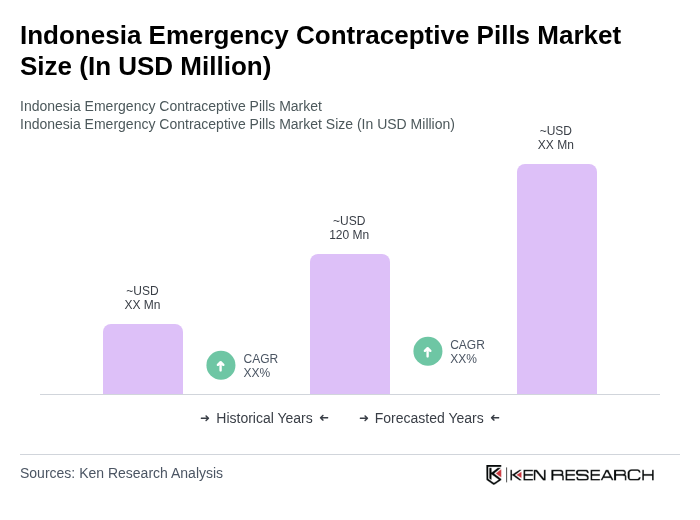
- The Indonesia Emergency Contraceptive Pills market is valued at USD 120 million, based on a five-year historical analysis, in the context of a global emergency contraceptive pills market that is in the low-to-mid billion?dollar range. This growth is primarily driven by increasing awareness of reproductive health, rising demand for family planning solutions, and the growing acceptance of emergency contraceptive methods among women, supported by broader improvements in contraceptive prevalence in Indonesia. The market has seen a steady rise in usage due to educational campaigns and improved access to healthcare services, along with expanding use of e?pharmacies and digital health platforms for discreet purchase of emergency contraception across Asia?Pacific.
- Key cities such as Jakarta, Surabaya, and Bandung dominate the market due to their high population density and urbanization, which is consistent with national patterns where modern contraceptive use is higher in urban areas. These cities have better healthcare infrastructure and access to pharmacies, including growing online and retail pharmacy networks, which facilitates the availability of emergency contraceptive pills. Additionally, the presence of educational institutions contributes to a higher awareness and acceptance of contraceptive methods among the youth, aligning with global evidence that higher education levels correlate with increased contraceptive uptake.
- Emergency contraceptive pills in Indonesia are regulated as prescription medicines and are not mandated to be available fully over?the?counter without a prescription; their distribution and use fall under national pharmaceutical and health regulations, including the Health Law and implementing rules issued by the Ministry of Health and the National Agency of Drug and Food Control (BPOM), which set marketing authorization, dispensing, and pharmacy practice standards for hormonal contraceptives.
Indonesia Emergency Contraceptive Pills Market Segmentation
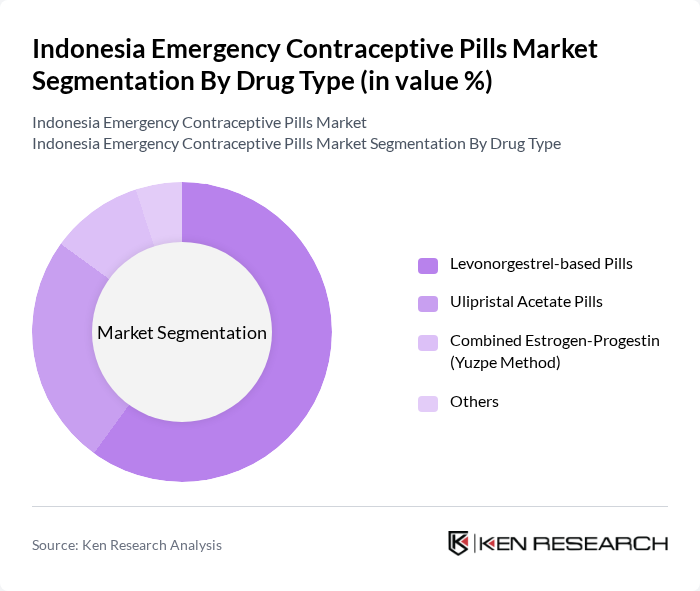
By Drug Type:The market is segmented into Levonorgestrel-based Pills, Ulipristal Acetate Pills, Combined Estrogen-Progestin (Yuzpe Method), and Others. At the global and Asia?Pacific level, Levonorgestrel-based pills account for the majority of emergency contraceptive pill use due to their widespread availability, inclusion in public and NGO programs, and established efficacy. They are preferred by consumers for their ease of use and quick action, making them the go-to choice for emergency contraception, and they are the main dedicated product type registered in many Southeast Asian markets, including Indonesia. Ulipristal acetate is gaining traction globally but remains less widely available than Levonorgestrel in Asia?Pacific, and its presence in Indonesia is more limited and largely concentrated in urban private and specialist channels.
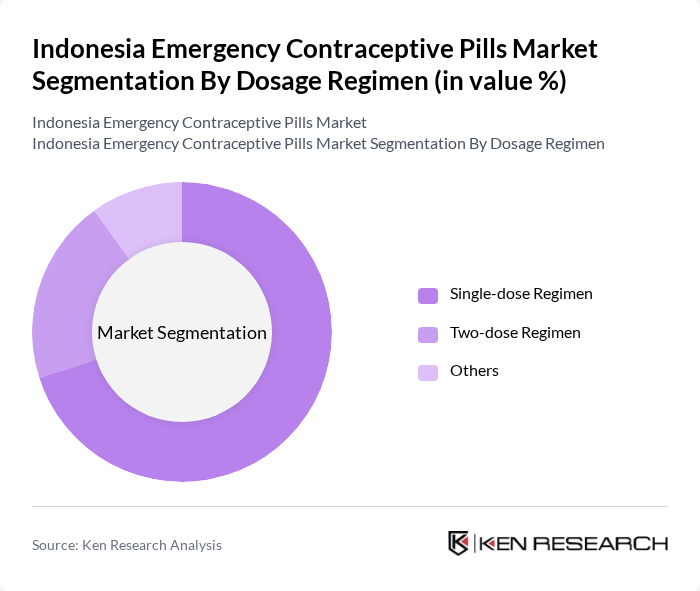
By Dosage Regimen:The market is categorized into Single-dose Regimen, Two-dose Regimen, and Others. The Single-dose Regimen, typically based on Levonorgestrel 1.5 mg taken once, is the most widely used globally due to its convenience and strong evidence of effectiveness. This allows women to take the pill without the need for a second dose, which supports adherence and suits the urgency often associated with emergency contraception, where immediate action is required. Two-dose regimens and Yuzpe?method combinations are used less frequently and are more common in settings where legacy protocols or supply constraints persist.
Indonesia Emergency Contraceptive Pills Market Competitive Landscape
The Indonesia Emergency Contraceptive Pills Market is characterized by a dynamic mix of regional and international players. Leading participants such as PT Kimia Farma Tbk, PT Indofarma Tbk, PT Bayer Indonesia, PT Merck Tbk, PT Sanofi Indonesia, PT Darya-Varia Laboratoria Tbk, PT Novartis Indonesia, PT GlaxoSmithKline Indonesia, PT Abbott Indonesia, PT Pfizer Indonesia, PT Sandoz Indonesia, PT Johnson & Johnson Indonesia, PT AstraZeneca Indonesia, PT Takeda Indonesia, PT Viatris Indonesia contribute to innovation, geographic expansion, and service delivery in this space.
Indonesia Emergency Contraceptive Pills Market Industry Analysis
Growth Drivers
- Increasing Awareness of Reproductive Health:The Indonesian government has reported a 37% increase in reproductive health education initiatives, significantly enhancing public knowledge about contraceptive options. This rise in awareness is crucial, as approximately 37 million women of reproductive age in Indonesia are now more informed about emergency contraceptive pills (ECPs). The World Health Organization (WHO) emphasizes that education directly correlates with increased contraceptive use, indicating a positive trend for ECP adoption in the country.
- Rising Demand for Family Planning Solutions:In future, Indonesia's family planning program has reached over 10 million couples, reflecting a growing demand for effective contraceptive methods. The National Population and Family Planning Board (BKKBN) reported that approximately 60% of married women aged 15-49 use some form of contraception, indicating strong engagement with family planning services rather than a specific share “actively seeking” solutions. This trend is expected to drive the market for emergency contraceptive pills, as more individuals recognize the importance of planning and controlling reproductive health.
- Government Initiatives Promoting Contraceptive Access:The Indonesian government allocated IDR 1.5 trillion (approximately USD 100 million) to enhance access to contraceptives, including emergency contraceptive pills. This funding supports various programs aimed at increasing availability in underserved areas. The Ministry of Health's initiatives have led to a 25% increase in contraceptive distribution points nationwide, facilitating easier access for women, particularly in rural regions where traditional barriers exist.
Market Challenges
- Cultural Stigma Surrounding Contraceptive Use:Despite increasing awareness, cultural stigma remains a significant barrier to contraceptive use in Indonesia. A survey by the Indonesian Institute of Statistics indicated that 40% of women feel societal pressure against using contraceptives, particularly emergency options. This stigma can deter women from seeking necessary reproductive health services, limiting the market's growth potential and perpetuating misconceptions about contraceptive methods.
- Limited Access in Rural Areas:Approximately 44% of Indonesia's population resides in rural areas, where access to emergency contraceptive pills is severely restricted. The Ministry of Health reported that only 30% of rural health facilities stock ECPs, creating a significant gap in availability. This limited access poses a challenge for women in these regions, hindering their ability to make informed choices about their reproductive health and impacting overall market growth.
Indonesia Emergency Contraceptive Pills Market Future Outlook
The future of the Indonesia emergency contraceptive pills market appears promising, driven by ongoing government support and increasing public awareness. As telemedicine services expand, more women will gain access to reproductive health consultations, facilitating informed decisions regarding contraceptive use. Additionally, partnerships with NGOs will enhance outreach efforts, particularly in rural areas, ensuring that education and access to emergency contraceptives improve. These trends indicate a potential for significant market growth in future, addressing both demand and accessibility challenges.
Market Opportunities
- Expansion of Telemedicine Services:The rise of telemedicine in Indonesia presents a unique opportunity for the emergency contraceptive pills market. With over 100 million internet users nationwide, including tens of millions in non-urban areas, telehealth platforms can provide essential reproductive health consultations, increasing access to ECPs. This digital shift can significantly enhance awareness and usage, particularly among younger demographics seeking discreet and convenient healthcare solutions.
- Partnerships with NGOs for Outreach Programs:Collaborating with non-governmental organizations can amplify outreach efforts, particularly in underserved communities. By leveraging existing networks, NGOs can facilitate educational campaigns about emergency contraceptive pills, addressing cultural stigmas and improving access. Such partnerships can lead to increased acceptance and utilization of ECPs, ultimately driving market growth and enhancing reproductive health outcomes across Indonesia.
Scope of the Report
| Segment | Sub-Segments |
|---|---|
| By Drug Type | Levonorgestrel-based Pills Ulipristal Acetate Pills Combined Estrogen-Progestin (Yuzpe Method) Others |
| By Dosage Regimen | Single-dose Regimen Two-dose Regimen Others |
| By Distribution Channel | Hospital Pharmacies Retail Pharmacies & Drug Stores Online Pharmacies & E-commerce Platforms Public Health Facilities & NGO Channels |
| By Region | Java Sumatra Bali and Nusa Tenggara Kalimantan Sulawesi Others |
| By Age Group | 24 Years 34 Years 44 Years Others |
| By Prescription Status | Prescription-based (Rx) Over-the-Counter (OTC) Others |
| By Socioeconomic Status | Low Income Middle Income High Income Others |
Key Target Audience
Investors and Venture Capitalist Firms
Government and Regulatory Bodies (e.g., National Agency of Drug and Food Control, Ministry of Health)
Manufacturers and Producers
Distributors and Retailers
Pharmaceutical Wholesalers
Healthcare Providers and Clinics
Non-Governmental Organizations (NGOs) focused on reproductive health
Insurance Companies and Health Plans
Players Mentioned in the Report:
PT Kimia Farma Tbk
PT Indofarma Tbk
PT Bayer Indonesia
PT Merck Tbk
PT Sanofi Indonesia
PT Darya-Varia Laboratoria Tbk
PT Novartis Indonesia
PT GlaxoSmithKline Indonesia
PT Abbott Indonesia
PT Pfizer Indonesia
PT Sandoz Indonesia
PT Johnson & Johnson Indonesia
PT AstraZeneca Indonesia
PT Takeda Indonesia
PT Viatris Indonesia
Table of Contents
Market Assessment Phase
1. Executive Summary and Approach
2. Indonesia Emergency Contraceptive Pills Market Overview
2.1 Key Insights and Strategic Recommendations
2.2 Indonesia Emergency Contraceptive Pills Market Overview
2.3 Definition and Scope
2.4 Evolution of Market Ecosystem
2.5 Timeline of Key Regulatory Milestones
2.6 Value Chain & Stakeholder Mapping
2.7 Business Cycle Analysis
2.8 Policy & Incentive Landscape
3. Indonesia Emergency Contraceptive Pills Market Analysis
3.1 Growth Drivers
3.1.1 Increasing awareness of reproductive health
3.1.2 Rising demand for family planning solutions
3.1.3 Government initiatives promoting contraceptive access
3.1.4 Growth in online pharmacies and e-commerce platforms
3.2 Market Challenges
3.2.1 Cultural stigma surrounding contraceptive use
3.2.2 Limited access in rural areas
3.2.3 Regulatory hurdles and compliance issues
3.2.4 Competition from alternative contraceptive methods
3.3 Market Opportunities
3.3.1 Expansion of telemedicine services
3.3.2 Partnerships with NGOs for outreach programs
3.3.3 Development of new product formulations
3.3.4 Increasing investment in women's health initiatives
3.4 Market Trends
3.4.1 Shift towards over-the-counter availability
3.4.2 Rise in digital health solutions
3.4.3 Growing focus on personalized healthcare
3.4.4 Increased collaboration between public and private sectors
3.5 Government Regulation
3.5.1 Policies promoting contraceptive education
3.5.2 Regulations on advertising and marketing of contraceptives
3.5.3 Guidelines for distribution and sales of emergency contraceptives
3.5.4 Compliance requirements for pharmaceutical companies
4. SWOT Analysis
5. Stakeholder Analysis
6. Porter's Five Forces Analysis
7. Indonesia Emergency Contraceptive Pills Market Market Size, 2019-2024
7.1 By Value
7.2 By Volume
7.3 By Average Selling Price
8. Indonesia Emergency Contraceptive Pills Market Segmentation
8.1 By Drug Type
8.1.1 Levonorgestrel-based Pills
8.1.2 Ulipristal Acetate Pills
8.1.3 Combined Estrogen-Progestin (Yuzpe Method)
8.1.4 Others
8.2 By Dosage Regimen
8.2.1 Single-dose Regimen
8.2.2 Two-dose Regimen
8.2.3 Others
8.3 By Distribution Channel
8.3.1 Hospital Pharmacies
8.3.2 Retail Pharmacies & Drug Stores
8.3.3 Online Pharmacies & E-commerce Platforms
8.3.4 Public Health Facilities & NGO Channels
8.4 By Region
8.4.1 Java
8.4.2 Sumatra
8.4.3 Bali and Nusa Tenggara
8.4.4 Kalimantan
8.4.5 Sulawesi
8.4.6 Others
8.5 By Age Group
8.5.1 15-24 Years
8.5.2 25-34 Years
8.5.3 35-44 Years
8.5.4 Others
8.6 By Prescription Status
8.6.1 Prescription-based (Rx)
8.6.2 Over-the-Counter (OTC)
8.6.3 Others
8.7 By Socioeconomic Status
8.7.1 Low Income
8.7.2 Middle Income
8.7.3 High Income
8.7.4 Others
9. Indonesia Emergency Contraceptive Pills Market Competitive Analysis
9.1 Market Share of Key Players
9.2 Cross Comparison of Key Players
9.2.1 Company Name
9.2.2 Group Size (Large, Medium, or Small as per industry convention)
9.2.3 Indonesia Revenue from Emergency Contraceptive Pills
9.2.4 3-year Revenue CAGR in Indonesia
9.2.5 Emergency Contraceptive Pills Market Share in Indonesia
9.2.6 Average Realized Price per Dose
9.2.7 Portfolio Breadth (Number of SKUs / Formulations)
9.2.8 Distribution Reach (Cities / Outlets Covered)
9.2.9 Share of Sales from Digital / Online Channels
9.2.10 Indonesia EBITDA Margin for Emergency Contraceptive Pills
9.3 SWOT Analysis of Top Players
9.4 Pricing Analysis
9.5 Detailed Profile of Major Companies
9.5.1 PT Kimia Farma Tbk
9.5.2 PT Indofarma Tbk
9.5.3 PT Bayer Indonesia
9.5.4 PT Merck Tbk
9.5.5 PT Sanofi Indonesia
9.5.6 PT Darya-Varia Laboratoria Tbk
9.5.7 PT Novartis Indonesia
9.5.8 PT GlaxoSmithKline Indonesia
9.5.9 PT Abbott Indonesia
9.5.10 PT Pfizer Indonesia
9.5.11 PT Sandoz Indonesia
9.5.12 PT Johnson & Johnson Indonesia
9.5.13 PT AstraZeneca Indonesia
9.5.14 PT Takeda Indonesia
9.5.15 PT Viatris Indonesia
10. Indonesia Emergency Contraceptive Pills Market End-User Analysis
10.1 Procurement Behavior of Key Ministries
10.1.1 Ministry of Health
10.1.2 Ministry of Education
10.1.3 Ministry of Women's Empowerment and Child Protection
10.1.4 Others
10.2 Corporate Spend on Infrastructure & Energy
10.2.1 Healthcare Infrastructure Investments
10.2.2 Pharmaceutical Supply Chain Investments
10.2.3 Research and Development Expenditures
10.2.4 Others
10.3 Pain Point Analysis by End-User Category
10.3.1 Accessibility Issues
10.3.2 Affordability Concerns
10.3.3 Awareness Gaps
10.3.4 Others
10.4 User Readiness for Adoption
10.4.1 Attitudes towards Emergency Contraceptives
10.4.2 Knowledge of Availability
10.4.3 Willingness to Pay
10.4.4 Others
10.5 Post-Deployment ROI and Use Case Expansion
10.5.1 Effectiveness of Emergency Contraceptives
10.5.2 User Feedback and Satisfaction
10.5.3 Potential for Product Line Expansion
10.5.4 Others
11. Indonesia Emergency Contraceptive Pills Market Future Size, 2025-2030
11.1 By Value
11.2 By Volume
11.3 By Average Selling Price
Go-To-Market Strategy Phase
1. Whitespace Analysis + Business Model Canvas
1.1 Market Gaps Identification
1.2 Value Proposition Development
1.3 Revenue Streams Analysis
1.4 Cost Structure Evaluation
1.5 Key Partnerships Exploration
1.6 Customer Segmentation
1.7 Channels and Customer Relationships
2. Marketing and Positioning Recommendations
2.1 Branding Strategies
2.2 Product USPs
3. Distribution Plan
3.1 Urban Retail vs Rural NGO Tie-ups
4. Channel & Pricing Gaps
4.1 Underserved Routes
4.2 Pricing Bands
5. Unmet Demand & Latent Needs
5.1 Category Gaps
5.2 Consumer Segments
6. Customer Relationship
6.1 Loyalty Programs
6.2 After-sales Service
7. Value Proposition
7.1 Sustainability
7.2 Integrated Supply Chains
8. Key Activities
8.1 Regulatory Compliance
8.2 Branding
8.3 Distribution Setup
9. Entry Strategy Evaluation
9.1 Domestic Market Entry Strategy
9.1.1 Product Mix
9.1.2 Pricing Band
9.1.3 Packaging
9.2 Export Entry Strategy
9.2.1 Target Countries
9.2.2 Compliance Roadmap
10. Entry Mode Assessment
10.1 JV
10.2 Greenfield
10.3 M&A
10.4 Distributor Model
11. Capital and Timeline Estimation
11.1 Capital Requirements
11.2 Timelines
12. Control vs Risk Trade-Off
12.1 Ownership vs Partnerships
13. Profitability Outlook
13.1 Breakeven Analysis
13.2 Long-term Sustainability
14. Potential Partner List
14.1 Distributors
14.2 JVs
14.3 Acquisition Targets
15. Execution Roadmap
15.1 Phased Plan for Market Entry
15.1.1 Market Setup
15.1.2 Market Entry
15.1.3 Growth Acceleration
15.1.4 Scale & Stabilize
15.2 Key Activities and Milestones
15.2.1 Milestone Planning
15.2.2 Activity Scheduling
Research Methodology
Phase 1: Approach1
Desk Research
- Analysis of existing market reports and publications on emergency contraceptive pills in Indonesia
- Review of demographic and health statistics from the Indonesian Ministry of Health
- Examination of regulatory frameworks and guidelines from the National Agency of Drug and Food Control (BPOM)
Primary Research
- Interviews with healthcare professionals, including gynecologists and pharmacists
- Surveys conducted with women of reproductive age to understand awareness and usage patterns
- Focus group discussions with community health workers to gather insights on accessibility and education
Validation & Triangulation
- Cross-validation of findings through multiple data sources, including health surveys and sales data
- Triangulation of qualitative insights from interviews with quantitative data from surveys
- Sanity checks through expert panel reviews comprising public health officials and market analysts
Phase 2: Market Size Estimation1
Top-down Assessment
- Estimation of total market size based on national health expenditure and contraceptive prevalence rates
- Segmentation of the market by urban vs. rural distribution and age demographics
- Incorporation of government initiatives promoting family planning and reproductive health
Bottom-up Modeling
- Collection of sales data from pharmacies and healthcare providers across major cities
- Estimation of average price points for emergency contraceptive pills in the market
- Volume estimates based on prescription rates and over-the-counter sales trends
Forecasting & Scenario Analysis
- Multi-factor regression analysis considering socio-economic factors and public health campaigns
- Scenario modeling based on potential changes in regulations and consumer behavior trends
- Development of baseline, optimistic, and pessimistic market projections through 2030
Phase 3: CATI Sample Composition1
| Scope Item/Segment | Sample Size | Target Respondent Profiles |
|---|---|---|
| Healthcare Professionals | 90 | Gynecologists, Family Planning Counselors |
| Pharmacy Retailers | 70 | Pharmacy Owners, Pharmacists |
| Women of Reproductive Age | 120 | Women aged 15-49, Urban and Rural Residents |
| Community Health Workers | 60 | Health Educators, Outreach Workers |
| Public Health Officials | 40 | Policy Makers, Program Managers |
Frequently Asked Questions
What is the current value of the Indonesia Emergency Contraceptive Pills market?
The Indonesia Emergency Contraceptive Pills market is valued at approximately USD 120 million, reflecting a steady growth driven by increased awareness of reproductive health and family planning solutions among women in the country.
What factors are driving the growth of the Emergency Contraceptive Pills market in Indonesia?
Which cities in Indonesia dominate the Emergency Contraceptive Pills market?
How are Emergency Contraceptive Pills regulated in Indonesia?
Other Regional/Country Reports
Other Adjacent Reports
Qatar Contraceptives Market
Indonesia Oral Contraceptives Market
Belgium Hormonal Contraceptives Market
Indonesia Reproductive Health Market
South Korea Family Planning Market
Mexico Womens Health Market
Brazil Sexual Wellness Market
South Africa Telemedicine Market
South Africa Pharmaceutical Distribution Market
Indonesia Over-the-Counter Pharmaceuticals Market
Why Buy From Us?

What makes us stand out is that our consultants follow Robust, Refine and Result (RRR) methodology. Robust for clear definitions, approaches and sanity checking, Refine for differentiating respondents' facts and opinions, and Result for presenting data with story.

We have set a benchmark in the industry by offering our clients with syndicated and customized market research reports featuring coverage of entire market as well as meticulous research and analyst insights.

While we don't replace traditional research, we flip the method upside down. Our dual approach of Top Bottom & Bottom Top ensures quality deliverable by not just verifying company fundamentals but also looking at the sector and macroeconomic factors.

With one step in the future, our research team constantly tries to show you the bigger picture. We help with some of the tough questions you may encounter along the way: How is the industry positioned? Best marketing channel? KPI's of competitors? By aligning every element, we help maximize success.

Our report gives you instant access to the answers and sources that other companies might choose to hide. We elaborate each steps of research methodology we have used and showcase you the sample size to earn your trust.

If you need any support, we are here! We pride ourselves on universe strength, data quality, and quick, friendly, and professional service.