Indonesia Executive Education in Oil & Gas Market

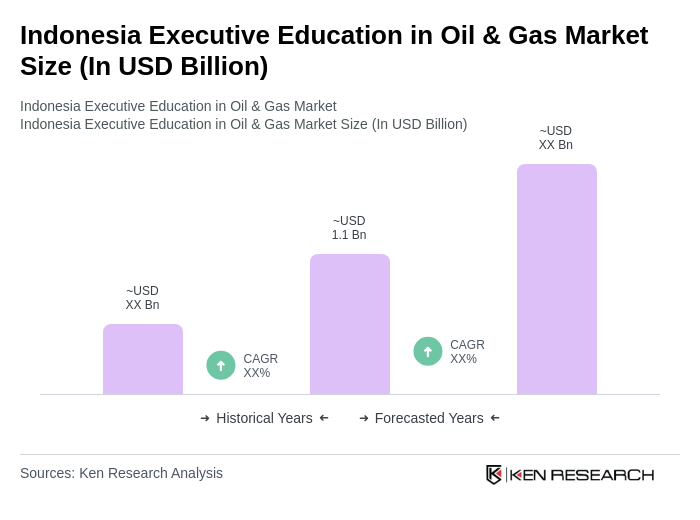
The Indonesia Executive Education in Oil & Gas Market, valued at USD 1.1 billion, is growing due to workforce development needs and digital learning expansion.

Region:Asia

Author(s):Rebecca

Product Code:KRAB1726

Pages:99

Published On:October 2025
About the Report

Base Year 2024

Indonesia Executive Education in Oil & Gas Market Overview

  • The Indonesia Executive Education in Oil & Gas Market is valued at USD 1.1 billion, based on a five-year historical analysis. This market size reflects the robust growth in corporate training and executive education, driven by rising demand for skilled professionals in the oil and gas sector, government initiatives to strengthen local expertise, and increased investments in workforce development and technology adaptation. Key growth drivers include the expansion of digital learning platforms, a young workforce, and ongoing efforts to align training with global operational standards.
  • Key cities dominating this market include Jakarta, Surabaya, and Balikpapan. Jakarta remains the central hub for economic activity and executive education, hosting leading institutions and training centers. Surabaya and Balikpapan are strategically important due to their proximity to major oil and gas fields and operational sites, making them vital for sector-specific professional development.
  • The regulatory framework for oil and gas workforce training in Indonesia is governed by the "Minister of Energy and Mineral Resources Regulation No. 31/2018 on Implementation of Competency Certification and Training in Oil and Gas," issued by the Ministry of Energy and Mineral Resources. This binding regulation mandates that all oil and gas companies must invest in certified employee training, with compliance requirements covering technical, safety, and operational competencies. The regulation sets minimum standards for training providers and requires periodic certification renewal to ensure workforce skills remain aligned with industry advancements.
Indonesia Executive Education in Oil & Gas Market Size

Indonesia Executive Education in Oil & Gas Market Segmentation

By Type:The market is segmented into Leadership Development Programs, Technical Skills Training (Upstream, Midstream, Downstream), Health, Safety, and Environment (HSE) Training, Management and Strategy Courses (Oil & Gas Focused), Executive Coaching & Mentoring, Digital Transformation & Technology Training (e.g., Data Analytics, Automation), Regulatory & Compliance Training, and Others. Technical Skills Training is the leading segment, reflecting the industry's need for specialized operational knowledge and compliance with evolving technological standards.
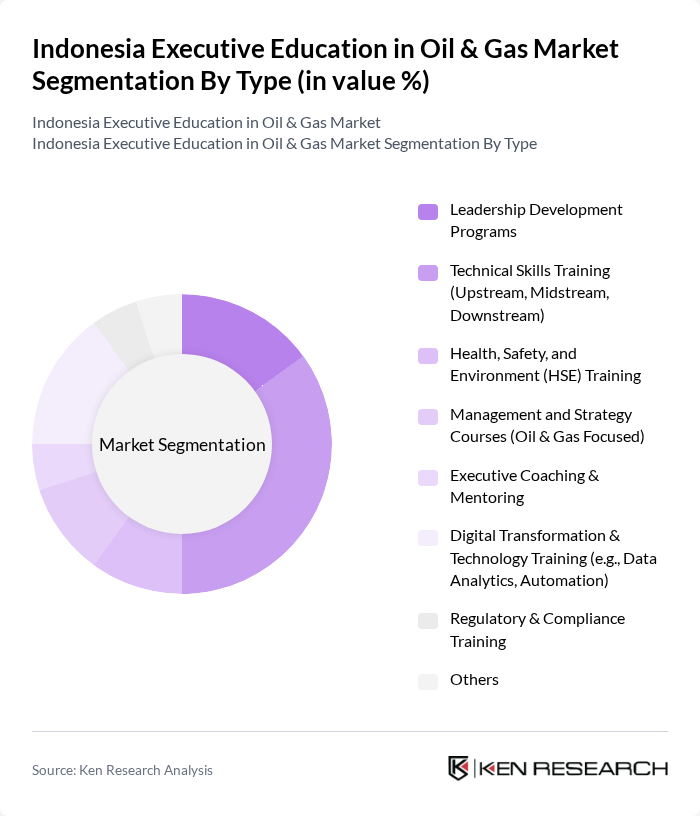
Indonesia Executive Education in Oil & Gas Market segmentation by Type.

By End-User:The end-user segmentation includes National Oil Companies (NOCs), International Oil Companies (IOCs), Oilfield Services Providers, Government Agencies & Regulators, Educational Institutions, Consulting & Engineering Firms, and Others. National Oil Companies are the primary end-users, driven by their mandate to enhance workforce capabilities and comply with national competency certification requirements.
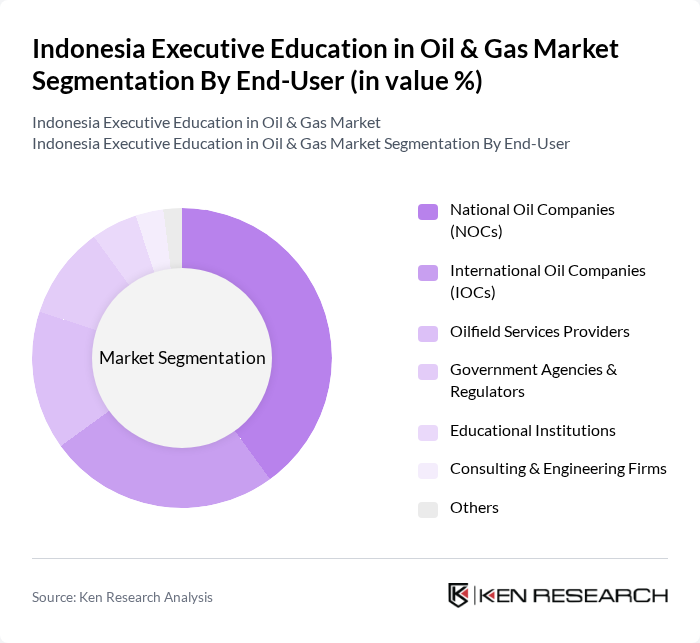
Indonesia Executive Education in Oil & Gas Market segmentation by End-User.

Indonesia Executive Education in Oil & Gas Market Competitive Landscape

The Indonesia Executive Education in Oil & Gas Market is characterized by a dynamic mix of regional and international players. Leading participants such as Universitas Gadjah Mada (UGM) – Center for Oil & Gas Training, Institut Teknologi Bandung (ITB) – School of Business and Management, Oil & Gas Executive Programs, Pertamina University (Universitas Pertamina), Universitas Indonesia (UI) – Executive Education in Energy Management, PPM School of Management – Energy & Oil/Gas Executive Programs, Lembaga Pendidikan dan Pelatihan Migas (LPP Migas), Oil & Gas Training Center (OGTC) Indonesia, Indonesian Petroleum Association (IPA) – Training & Certification Division, Energy Institute Indonesia, Jakarta School of Energy & Sustainability, Universitas Trisakti – Faculty of Earth Technology and Energy, Universitas Pembangunan Nasional "Veteran" Jakarta (UPNVJ), Universitas Kristen Satya Wacana – Oil & Gas Management Programs, Universitas Diponegoro – Center for Energy Studies, Universitas Brawijaya – Oil & Gas Executive Training contribute to innovation, geographic expansion, and service delivery in this space.

Universitas Gadjah Mada (UGM)

1949

Yogyakarta, Indonesia

Institut Teknologi Bandung (ITB)

1959

Bandung, Indonesia

Pertamina University

2016

Jakarta, Indonesia

Universitas Indonesia (UI)

1950

Depok, Indonesia

PPM School of Management

1967

Jakarta, Indonesia

Company

Establishment Year

Headquarters

Number of Oil & Gas-Focused Executive Programs Offered

Annual Enrollment in Oil & Gas Executive Programs

Revenue from Oil & Gas Executive Education (USD)

Client Portfolio Diversity (NOCs, IOCs, Service Companies, etc.)

Course Completion Rate (%)

Post-Training Placement/Promotion Rate (%)

Indonesia Executive Education in Oil & Gas Market Industry Analysis

Growth Drivers

  • Increasing Demand for Skilled Professionals:The Indonesian oil and gas sector is projected to require an additional 50,000 skilled professionals in the future, driven by the expansion of exploration activities. The World Bank estimates that the sector contributes approximately $32 billion to the national GDP, highlighting the urgent need for a workforce equipped with advanced skills. This demand is further fueled by the government's commitment to enhancing local talent through targeted educational programs, ensuring a sustainable workforce for the industry.
  • Government Investment in Oil and Gas Infrastructure:In the future, the Indonesian government plans to allocate $12 billion towards oil and gas infrastructure development, including training facilities. This investment aims to bolster local capabilities and improve operational efficiency. The Ministry of Energy and Mineral Resources has emphasized the importance of education in achieving energy independence, which is expected to create a robust demand for executive education programs tailored to the oil and gas sector's needs.
  • Technological Advancements in Oil Extraction and Management:The adoption of advanced technologies, such as AI and IoT, in oil extraction is projected to increase operational efficiency by 25% in the future. This shift necessitates a workforce skilled in these technologies, driving demand for specialized executive education. Industry reports indicate that companies investing in technology-driven training programs see a 20% increase in productivity, underscoring the critical role of education in adapting to technological changes in the sector.

Market Challenges

  • Regulatory Compliance Complexities:Navigating Indonesia's regulatory landscape poses significant challenges for educational institutions. The government has implemented over 250 regulations affecting the oil and gas sector, complicating compliance for training providers. This complexity can deter potential partnerships and investments in executive education programs, as institutions must allocate substantial resources to ensure adherence to these regulations, which can exceed $1.2 million annually for larger organizations.
  • Competition from International Education Providers:The presence of international education providers in Indonesia has intensified competition, with over 35 foreign institutions offering oil and gas executive programs. These institutions often have established reputations and resources, making it challenging for local providers to attract students. The average tuition for international programs can reach $22,000, which may limit access for local professionals, further complicating the competitive landscape for domestic education providers.

Indonesia Executive Education in Oil & Gas Market Future Outlook

The future of executive education in Indonesia's oil and gas sector appears promising, driven by increasing investments in infrastructure and a growing emphasis on technological advancements. As the industry evolves, educational institutions are likely to adapt their curricula to meet the changing demands of the workforce. Additionally, the rising focus on sustainability practices will encourage the development of specialized programs, ensuring that professionals are equipped to address environmental challenges while maintaining operational efficiency in the sector.

Market Opportunities

  • Expansion of Online Learning Platforms:The shift towards online learning is expected to create opportunities for executive education providers. With an estimated 75% of professionals in the oil and gas sector preferring flexible learning options, institutions can leverage digital platforms to reach a broader audience. This trend is projected to increase enrollment in executive programs by 35% in the future, enhancing accessibility and affordability for local professionals.
  • Partnerships with Industry Leaders:Collaborating with industry leaders presents a significant opportunity for educational institutions. By forming partnerships, institutions can develop customized training programs that align with industry needs. Such collaborations can enhance the relevance of educational offerings, potentially increasing student enrollment by 30% and improving job placement rates for graduates, thereby strengthening the overall workforce in the oil and gas sector.

Scope of the Report

SegmentSub-Segments
By Type

Leadership Development Programs

Technical Skills Training (Upstream, Midstream, Downstream)

Health, Safety, and Environment (HSE) Training

Management and Strategy Courses (Oil & Gas Focused)

Executive Coaching & Mentoring

Digital Transformation & Technology Training (e.g., Data Analytics, Automation)

Regulatory & Compliance Training

Others

By End-User

National Oil Companies (NOCs)

International Oil Companies (IOCs)

Oilfield Services Providers

Government Agencies & Regulators

Educational Institutions

Consulting & Engineering Firms

Others

By Program Duration

Short-term Courses (1-3 months)

Medium-term Courses (3-6 months)

Long-term Courses (6 months - 1 year)

Others

By Delivery Mode

In-person Training

Online Training

Hybrid Training

On-the-job/Field-based Training

Others

By Certification Type

Professional Certifications (e.g., IWCF, NEBOSH, API)

Academic Degrees

Industry Recognized Certifications

Company-specific Certifications

Others

By Geographic Focus

Java-Bali

Sumatra

Kalimantan

Sulawesi

Eastern Indonesia (Papua, Maluku, etc.)

Others

By Price Range

Low-cost Programs

Mid-range Programs

Premium Programs

Others

Key Target Audience

Investors and Venture Capitalist Firms

Government and Regulatory Bodies (e.g., Ministry of Energy and Mineral Resources, SKK Migas)

Oil and Gas Exploration and Production Companies

Energy Sector Policy Makers

Industry Trade Associations

Oil and Gas Service Providers

Environmental Regulatory Agencies

International Oil Companies (IOCs)

Players Mentioned in the Report:

Universitas Gadjah Mada (UGM) Center for Oil & Gas Training

Institut Teknologi Bandung (ITB) School of Business and Management, Oil & Gas Executive Programs

Pertamina University (Universitas Pertamina)

Universitas Indonesia (UI) Executive Education in Energy Management

PPM School of Management Energy & Oil/Gas Executive Programs

Lembaga Pendidikan dan Pelatihan Migas (LPP Migas)

Oil & Gas Training Center (OGTC) Indonesia

Indonesian Petroleum Association (IPA) Training & Certification Division

Energy Institute Indonesia

Jakarta School of Energy & Sustainability

Universitas Trisakti Faculty of Earth Technology and Energy

Universitas Pembangunan Nasional "Veteran" Jakarta (UPNVJ)

Universitas Kristen Satya Wacana Oil & Gas Management Programs

Universitas Diponegoro Center for Energy Studies

Universitas Brawijaya Oil & Gas Executive Training

Table of Contents

Market Assessment Phase

1. Executive Summary and Approach


2. Indonesia Executive Education in Oil & Gas Market Overview

2.1 Key Insights and Strategic Recommendations

2.2 Indonesia Executive Education in Oil & Gas Market Overview

2.3 Definition and Scope

2.4 Evolution of Market Ecosystem

2.5 Timeline of Key Regulatory Milestones

2.6 Value Chain & Stakeholder Mapping

2.7 Business Cycle Analysis

2.8 Policy & Incentive Landscape


3. Indonesia Executive Education in Oil & Gas Market Analysis

3.1 Growth Drivers

3.1.1 Increasing demand for skilled professionals
3.1.2 Government investment in oil and gas infrastructure
3.1.3 Rise in global oil prices
3.1.4 Technological advancements in oil extraction and management

3.2 Market Challenges

3.2.1 Regulatory compliance complexities
3.2.2 Competition from international education providers
3.2.3 Economic fluctuations affecting funding
3.2.4 Limited awareness of executive education benefits

3.3 Market Opportunities

3.3.1 Expansion of online learning platforms
3.3.2 Partnerships with industry leaders
3.3.3 Development of customized training programs
3.3.4 Growing interest in sustainability practices

3.4 Market Trends

3.4.1 Shift towards digital learning solutions
3.4.2 Increased focus on leadership and management skills
3.4.3 Emphasis on practical, hands-on training
3.4.4 Rise of short-term executive programs

3.5 Government Regulation

3.5.1 Licensing requirements for educational institutions
3.5.2 Standards for curriculum development
3.5.3 Funding incentives for local training programs
3.5.4 Compliance with international education standards

4. SWOT Analysis


5. Stakeholder Analysis


6. Porter's Five Forces Analysis


7. Indonesia Executive Education in Oil & Gas Market Market Size, 2019-2024

7.1 By Value

7.2 By Volume

7.3 By Average Selling Price


8. Indonesia Executive Education in Oil & Gas Market Segmentation

8.1 By Type

8.1.1 Leadership Development Programs
8.1.2 Technical Skills Training (Upstream, Midstream, Downstream)
8.1.3 Health, Safety, and Environment (HSE) Training
8.1.4 Management and Strategy Courses (Oil & Gas Focused)
8.1.5 Executive Coaching & Mentoring
8.1.6 Digital Transformation & Technology Training (e.g., Data Analytics, Automation)
8.1.7 Regulatory & Compliance Training
8.1.8 Others

8.2 By End-User

8.2.1 National Oil Companies (NOCs)
8.2.2 International Oil Companies (IOCs)
8.2.3 Oilfield Services Providers
8.2.4 Government Agencies & Regulators
8.2.5 Educational Institutions
8.2.6 Consulting & Engineering Firms
8.2.7 Others

8.3 By Program Duration

8.3.1 Short-term Courses (1-3 months)
8.3.2 Medium-term Courses (3-6 months)
8.3.3 Long-term Courses (6 months - 1 year)
8.3.4 Others

8.4 By Delivery Mode

8.4.1 In-person Training
8.4.2 Online Training
8.4.3 Hybrid Training
8.4.4 On-the-job/Field-based Training
8.4.5 Others

8.5 By Certification Type

8.5.1 Professional Certifications (e.g., IWCF, NEBOSH, API)
8.5.2 Academic Degrees
8.5.3 Industry Recognized Certifications
8.5.4 Company-specific Certifications
8.5.5 Others

8.6 By Geographic Focus

8.6.1 Java-Bali
8.6.2 Sumatra
8.6.3 Kalimantan
8.6.4 Sulawesi
8.6.5 Eastern Indonesia (Papua, Maluku, etc.)
8.6.6 Others

8.7 By Price Range

8.7.1 Low-cost Programs
8.7.2 Mid-range Programs
8.7.3 Premium Programs
8.7.4 Others

9. Indonesia Executive Education in Oil & Gas Market Competitive Analysis

9.1 Market Share of Key Players

9.2 Cross Comparison of Key Players

9.2.1 Company Name
9.2.2 Number of Oil & Gas-Focused Executive Programs Offered
9.2.3 Annual Enrollment in Oil & Gas Executive Programs
9.2.4 Revenue from Oil & Gas Executive Education (USD)
9.2.5 Client Portfolio Diversity (NOCs, IOCs, Service Companies, etc.)
9.2.6 Course Completion Rate (%)
9.2.7 Post-Training Placement/Promotion Rate (%)
9.2.8 Industry Partnerships & Accreditations
9.2.9 Customer Satisfaction Score (NPS or Equivalent)
9.2.10 Digital Delivery Capability (Online/Hybrid % of Portfolio)
9.2.11 Training Effectiveness Rating (Post-Training Assessment)

9.3 SWOT Analysis of Top Players

9.4 Pricing Analysis

9.5 Detailed Profile of Major Companies

9.5.1 Universitas Gadjah Mada (UGM) – Center for Oil & Gas Training
9.5.2 Institut Teknologi Bandung (ITB) – School of Business and Management, Oil & Gas Executive Programs
9.5.3 Pertamina University (Universitas Pertamina)
9.5.4 Universitas Indonesia (UI) – Executive Education in Energy Management
9.5.5 PPM School of Management – Energy & Oil/Gas Executive Programs
9.5.6 Lembaga Pendidikan dan Pelatihan Migas (LPP Migas)
9.5.7 Oil & Gas Training Center (OGTC) Indonesia
9.5.8 Indonesian Petroleum Association (IPA) – Training & Certification Division
9.5.9 Energy Institute Indonesia
9.5.10 Jakarta School of Energy & Sustainability
9.5.11 Universitas Trisakti – Faculty of Earth Technology and Energy
9.5.12 Universitas Pembangunan Nasional "Veteran" Jakarta (UPNVJ)
9.5.13 Universitas Kristen Satya Wacana – Oil & Gas Management Programs
9.5.14 Universitas Diponegoro – Center for Energy Studies
9.5.15 Universitas Brawijaya – Oil & Gas Executive Training

10. Indonesia Executive Education in Oil & Gas Market End-User Analysis

10.1 Procurement Behavior of Key Ministries

10.1.1 Ministry of Energy and Mineral Resources
10.1.2 Ministry of Finance
10.1.3 Ministry of Education and Culture
10.1.4 Others

10.2 Corporate Spend on Infrastructure & Energy

10.2.1 Investment in Training Programs
10.2.2 Budget Allocation for Skill Development
10.2.3 Expenditure on Safety Training
10.2.4 Others

10.3 Pain Point Analysis by End-User Category

10.3.1 Skill Gaps in the Workforce
10.3.2 High Turnover Rates
10.3.3 Compliance with Safety Regulations
10.3.4 Others

10.4 User Readiness for Adoption

10.4.1 Awareness of Executive Education Benefits
10.4.2 Willingness to Invest in Training
10.4.3 Availability of Resources for Training
10.4.4 Others

10.5 Post-Deployment ROI and Use Case Expansion

10.5.1 Measurement of Training Effectiveness
10.5.2 Long-term Impact on Performance
10.5.3 Opportunities for Further Training
10.5.4 Others

11. Indonesia Executive Education in Oil & Gas Market Future Size, 2025-2030

11.1 By Value

11.2 By Volume

11.3 By Average Selling Price


Go-To-Market Strategy Phase

1. Whitespace Analysis + Business Model Canvas

1.1 Market Gaps Identification

1.2 Value Proposition Development

1.3 Revenue Streams Analysis

1.4 Cost Structure Evaluation

1.5 Key Partnerships Exploration

1.6 Customer Segmentation

1.7 Channels of Distribution


2. Marketing and Positioning Recommendations

2.1 Branding Strategies

2.2 Product USPs

2.3 Target Audience Identification

2.4 Communication Strategy

2.5 Digital Marketing Approaches

2.6 Event Marketing Opportunities

2.7 Partnership Marketing


3. Distribution Plan

3.1 Urban Retail Strategies

3.2 Rural NGO Tie-ups

3.3 Online Distribution Channels

3.4 Direct Sales Approaches

3.5 Partnerships with Educational Institutions

3.6 International Distribution Opportunities


4. Channel & Pricing Gaps

4.1 Underserved Routes

4.2 Pricing Bands Analysis

4.3 Competitor Pricing Comparison

4.4 Customer Willingness to Pay

4.5 Value-based Pricing Strategies

4.6 Discounting Strategies


5. Unmet Demand & Latent Needs

5.1 Category Gaps Identification

5.2 Consumer Segments Analysis

5.3 Emerging Trends Exploration

5.4 Feedback Mechanisms

5.5 Future Needs Assessment

5.6 Innovation Opportunities


6. Customer Relationship

6.1 Loyalty Programs

6.2 After-sales Service

6.3 Customer Feedback Systems

6.4 Community Engagement Initiatives

6.5 Customer Education Programs

6.6 Relationship Management Tools


7. Value Proposition

7.1 Sustainability Initiatives

7.2 Integrated Supply Chains

7.3 Unique Selling Points

7.4 Customer-Centric Approaches

7.5 Competitive Advantages

7.6 Long-term Value Creation


8. Key Activities

8.1 Regulatory Compliance

8.2 Branding Efforts

8.3 Distribution Setup

8.4 Training and Development

8.5 Marketing Campaigns

8.6 Partnership Development


9. Entry Strategy Evaluation

9.1 Domestic Market Entry Strategy

9.1.1 Product Mix Considerations
9.1.2 Pricing Band Analysis
9.1.3 Packaging Strategies

9.2 Export Entry Strategy

9.2.1 Target Countries Identification
9.2.2 Compliance Roadmap Development

10. Entry Mode Assessment

10.1 Joint Ventures

10.2 Greenfield Investments

10.3 Mergers & Acquisitions

10.4 Distributor Model Evaluation


11. Capital and Timeline Estimation

11.1 Capital Requirements Analysis

11.2 Timelines for Market Entry


12. Control vs Risk Trade-Off

12.1 Ownership Considerations

12.2 Partnership Dynamics


13. Profitability Outlook

13.1 Breakeven Analysis

13.2 Long-term Sustainability Strategies


14. Potential Partner List

14.1 Distributors

14.2 Joint Ventures

14.3 Acquisition Targets


15. Execution Roadmap

15.1 Phased Plan for Market Entry

15.1.1 Market Setup
15.1.2 Market Entry
15.1.3 Growth Acceleration
15.1.4 Scale & Stabilize

15.2 Key Activities and Milestones

15.2.1 Milestone Planning
15.2.2 Activity Scheduling

Research Methodology

ApproachModellingSample

Phase 1: Approach1

Desk Research

  • Analysis of government reports on the oil and gas sector in Indonesia
  • Review of industry publications and market analysis reports from reputable sources
  • Examination of academic journals focusing on energy economics and oil & gas education

Primary Research

  • Interviews with executives from leading oil and gas companies operating in Indonesia
  • Surveys targeting professionals enrolled in executive education programs
  • Focus groups with industry experts and educators in oil and gas management

Validation & Triangulation

  • Cross-validation of findings through multiple data sources including trade associations
  • Triangulation of qualitative insights from interviews with quantitative data from surveys
  • Sanity checks conducted through expert panel discussions and feedback sessions

Phase 2: Market Size Estimation1

Top-down Assessment

  • Estimation of market size based on national oil and gas revenue statistics
  • Segmentation of the market by educational program types and participant demographics
  • Incorporation of government initiatives promoting oil and gas education and training

Bottom-up Modeling

  • Collection of enrollment data from major executive education institutions in Indonesia
  • Analysis of program pricing and revenue generation from oil and gas courses
  • Volume estimates based on historical enrollment trends and projected growth rates

Forecasting & Scenario Analysis

  • Multi-factor regression analysis incorporating oil price fluctuations and economic growth
  • Scenario modeling based on regulatory changes and industry demand for skilled professionals
  • Development of baseline, optimistic, and pessimistic forecasts through 2030

Phase 3: CATI Sample Composition1

Scope Item/SegmentSample SizeTarget Respondent Profiles
Oil & Gas Executive Education Programs60Program Directors, Curriculum Developers
Industry Professionals in Oil & Gas50Mid-level Managers, Technical Experts
Government Officials in Energy Sector40Policy Makers, Regulatory Authorities
Academic Institutions Offering Oil & Gas Courses45Deans, Faculty Members
Participants of Past Executive Programs55Alumni, Current Students

Frequently Asked Questions

What is the current value of the Indonesia Executive Education in Oil & Gas Market?

The Indonesia Executive Education in Oil & Gas Market is valued at approximately USD 1.1 billion, reflecting significant growth driven by the demand for skilled professionals and government initiatives aimed at enhancing local expertise in the sector.

Which cities are key players in the Indonesia Executive Education in Oil & Gas Market?

What are the main types of training offered in the Indonesia Executive Education in Oil & Gas Market?

Who are the primary end-users of executive education in the oil and gas sector in Indonesia?

Other Regional/Country Reports

UK Executive Education in Oil & Gas MarketCanada Executive Education in Oil & Gas MarketNigeria Executive Education in Oil & Gas Market

Malaysia Executive Education in Oil & Gas Market

KSA Executive Education in Oil & Gas Market

APAC Executive Education in Oil & Gas Market

Other Adjacent Reports

Kuwait Oil and Gas Training Market

KSA Energy Sector Professional Development Market

Indonesia Leadership Development in Energy Market

Indonesia Technical Skills Training in Oil and Gas Market

Brazil Health Safety and Environment Training Market

Mexico Digital Transformation in Energy Market

KSA Regulatory Compliance Training Market

Qatar Petroleum Engineering Education Market

Philippines Sustainable Energy Education Market

UAE Workforce Development in Energy Market

Why Buy From Us?

Refine Robust Result (RRR) Framework

What makes us stand out is that our consultants follow Robust, Refine and Result (RRR) methodology. Robust for clear definitions, approaches and sanity checking, Refine for differentiating respondents' facts and opinions, and Result for presenting data with story.

Our Reach Is Unmatched

We have set a benchmark in the industry by offering our clients with syndicated and customized market research reports featuring coverage of entire market as well as meticulous research and analyst insights.

Shifting the Research Paradigm

While we don't replace traditional research, we flip the method upside down. Our dual approach of Top Bottom & Bottom Top ensures quality deliverable by not just verifying company fundamentals but also looking at the sector and macroeconomic factors.

More Insights-Better Decisions

With one step in the future, our research team constantly tries to show you the bigger picture. We help with some of the tough questions you may encounter along the way: How is the industry positioned? Best marketing channel? KPI's of competitors? By aligning every element, we help maximize success.

Transparency and Trust

Our report gives you instant access to the answers and sources that other companies might choose to hide. We elaborate each steps of research methodology we have used and showcase you the sample size to earn your trust.

Round the Clock Support

If you need any support, we are here! We pride ourselves on universe strength, data quality, and quick, friendly, and professional service.

Why Clients Choose Us?

400000+
Reports in repository
150+
Consulting projects a year
100+
Analysts
8000+
Client Queries in 2022








