UK Executive Education in Oil & Gas Market

UK Executive Education in Oil & Gas Market, valued at USD 590 million, focuses on leadership, technical skills, and sustainability training amid energy transition.

Region:Europe

Author(s):Rebecca

Product Code:KRAB1750

Pages:94

Published On:October 2025

About the Report

Base Year 2024

UK Executive Education in Oil & Gas Market Overview

  • The UK Executive Education in Oil & Gas Market is valued at USD 590 million, based on a five-year historical analysis. This market is propelled by the rising demand for skilled professionals in the oil and gas sector, driven by the industry's digital transformation, energy transition policies, and sustainability initiatives. The sector increasingly requires specialized training programs that address both technical and managerial competencies, enabling companies to remain competitive amid evolving regulatory and operational landscapes. The push for net-zero carbon emissions and the adoption of advanced technologies further accelerate the need for executive education tailored to the oil and gas industry .
  • Key centers for executive education in this market include London, Aberdeen, and Manchester. London’s global financial status and concentration of top universities attract international participants, while Aberdeen’s proximity to North Sea operations and its reputation as the oil capital of Europe create a robust ecosystem for industry-focused education. Manchester’s expanding energy research capabilities and university partnerships further strengthen its role in supporting executive education for the oil and gas sector .
  • The Energy Act 2023, issued by the UK Parliament, mandates that oil and gas companies invest in workforce training programs emphasizing sustainability and digital skills. This regulation requires companies to demonstrate compliance through annual reporting and to meet minimum standards for employee training related to energy transition and digital innovation. The Act’s operational scope covers all licensed operators, with thresholds for mandatory training spend and certification, ensuring the workforce is prepared for the shift toward greener energy solutions .
UK Executive Education in Oil & Gas Market Size

UK Executive Education in Oil & Gas Market Segmentation

By Type:The market is segmented into a diverse range of educational programs, including Leadership Development Programs, Technical Skills Training, Safety and Compliance Training, Management and Strategy Courses, Digital Transformation Workshops, Executive Coaching, Energy Transition & Sustainability Training, Project Management in Oil & Gas, Finance & Risk Management for Oil & Gas Executives, and Others. These sub-segments address the sector’s evolving needs, focusing on upskilling professionals in areas such as advanced operations, regulatory compliance, digitalization, and sustainable practices. The increasing integration of digital transformation workshops and sustainability training reflects the industry’s adaptation to new technologies and environmental standards .
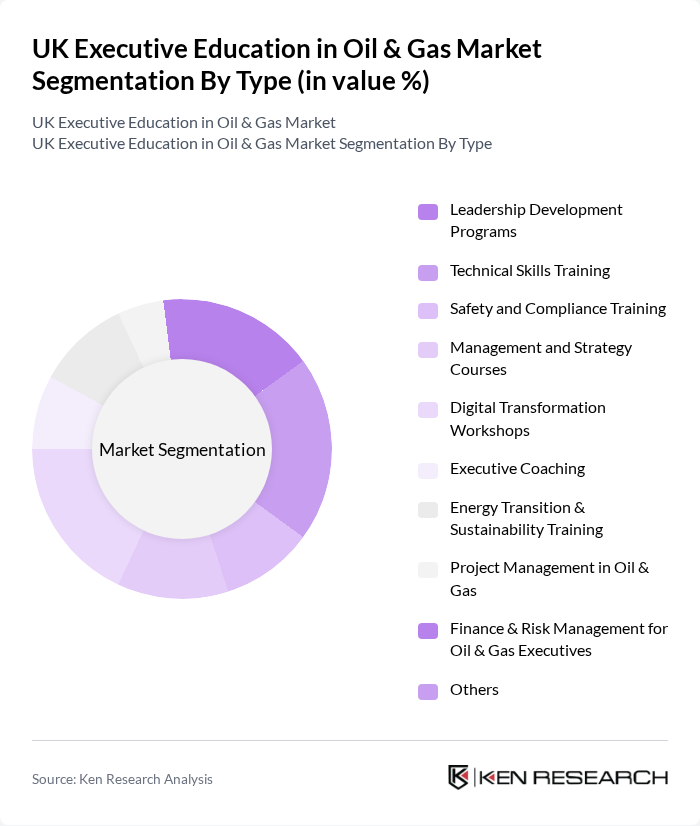
UK Executive Education in Oil & Gas Market segmentation by Type.

By End-User:The end-users of executive education in the oil and gas market include Oil and Gas Companies, Service Providers, Government Agencies, Educational Institutions, Industry Associations, and Others. Oil and gas companies represent the largest consumer segment, driven by the need to upskill their workforce in response to regulatory changes, digitalization, and sustainability goals. Service providers and industry associations also play a significant role, supporting the sector’s transition through specialized training and certification programs. Educational institutions and government agencies contribute to workforce development and policy compliance .
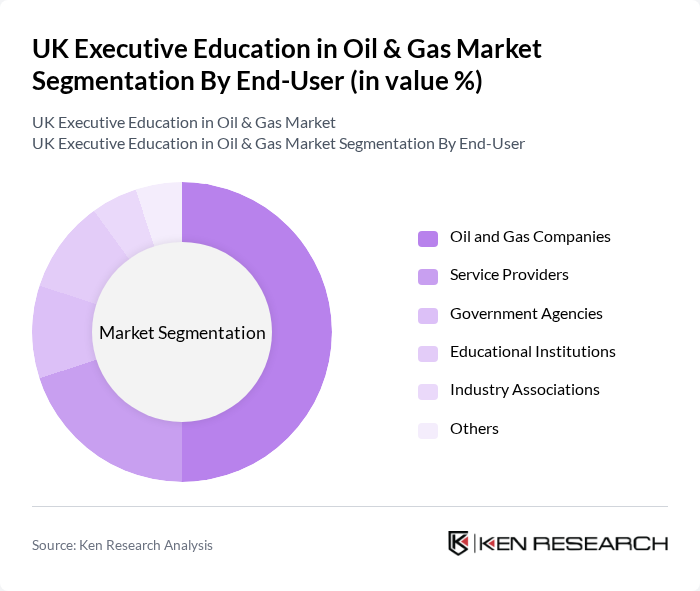
UK Executive Education in Oil & Gas Market segmentation by End-User.

UK Executive Education in Oil & Gas Market Competitive Landscape

The UK Executive Education in Oil & Gas Market is characterized by a dynamic mix of regional and international players. Leading participants such as University of Aberdeen, Imperial College London, University of Edinburgh, University of Strathclyde, The Oil & Gas Academy, Energy Institute, Robert Gordon University, Oxford Management Centre, Hult Ashridge Executive Education, Cranfield University, University of Dundee, University of Glasgow, University of Nottingham, University of Southampton, University of Birmingham, PetroKnowledge, London Business School, Manchester Business School, Leeds University Business School, MSBM (Metropolitan School of Business and Management) contribute to innovation, geographic expansion, and service delivery in this space.

University of Aberdeen

1495

Aberdeen, UK

Imperial College London

1907

London, UK

University of Edinburgh

1582

Edinburgh, UK

University of Strathclyde

1796

Glasgow, UK

The Oil & Gas Academy

2005

London, UK

Company

Establishment Year

Headquarters

Group Size (Large, Medium, or Small as per industry convention)

Revenue Growth Rate (from executive education oil & gas segment)

Number of Oil & Gas Executives Trained Annually

Customer Retention Rate (corporate repeat business)

Market Penetration Rate (UK oil & gas sector)

Pricing Strategy (average course fee, tiered pricing)

UK Executive Education in Oil & Gas Market Industry Analysis

Growth Drivers

  • Increasing Demand for Skilled Professionals:The UK oil and gas sector is projected to require an additional 20,000 skilled professionals in future, driven by the need for expertise in emerging technologies and sustainability practices. The industry is investing approximately £1.6 billion annually in workforce development, highlighting the urgency for executive education programs that can equip professionals with the necessary skills to meet these demands. This growing need is a significant driver for the executive education market.
  • Technological Advancements in the Oil and Gas Sector:The integration of advanced technologies, such as AI and IoT, is transforming the oil and gas industry, with an estimated £3.2 billion allocated for technology upgrades in future. This shift necessitates specialized training programs to ensure that professionals are adept at utilizing these technologies effectively. As companies seek to enhance operational efficiency, the demand for targeted executive education in these areas is expected to rise significantly.
  • Regulatory Changes Promoting Sustainability:The UK government has set ambitious emission reduction targets, aiming for a 68% decrease in future. This regulatory environment is pushing oil and gas companies to adopt sustainable practices, creating a demand for training in environmental management and compliance. With over £600 million earmarked for sustainability initiatives in future, executive education programs focusing on these areas are becoming increasingly vital for industry professionals to navigate the evolving landscape.

Market Challenges

  • Economic Fluctuations Affecting Investment:The oil and gas sector is highly sensitive to economic conditions, with investment levels fluctuating significantly. In future, the sector is expected to face a potential 15% decline in capital expenditure due to global economic uncertainties. This volatility can hinder the growth of executive education programs, as companies may prioritize immediate operational needs over long-term training investments, impacting the overall market.
  • Competition from Alternative Energy Sectors:The rise of renewable energy sources is creating competitive pressure on the oil and gas industry. In future, investments in renewable energy are projected to reach £12 billion, diverting funds from traditional oil and gas training programs. This shift poses a challenge for executive education providers, as they must adapt their offerings to remain relevant in a rapidly changing energy landscape, potentially limiting market growth.

UK Executive Education in Oil & Gas Market Future Outlook

The future of executive education in the UK oil and gas market appears promising, driven by the increasing need for skilled professionals and the integration of advanced technologies. As companies adapt to regulatory changes and sustainability demands, training programs will evolve to include more digital and hybrid learning options. Additionally, partnerships with industry leaders will enhance the relevance of educational offerings, ensuring that professionals are equipped to meet the challenges of a dynamic energy landscape while fostering innovation and growth.

Market Opportunities

  • Growth in Digital Learning Platforms:The shift towards online education is creating opportunities for executive education providers to expand their reach. With an estimated 40% increase in online course enrollments expected in future, companies can leverage digital platforms to offer flexible, accessible training solutions tailored to the oil and gas sector's needs, enhancing workforce development.
  • Partnerships with Industry Leaders:Collaborating with established industry players can enhance the credibility and effectiveness of training programs. In future, strategic partnerships are anticipated to increase by 30%, allowing educational institutions to align their curricula with industry standards and emerging trends, ultimately improving the quality of education and job readiness for graduates.

Scope of the Report

SegmentSub-Segments
By Type

Leadership Development Programs

Technical Skills Training

Safety and Compliance Training

Management and Strategy Courses

Digital Transformation Workshops

Executive Coaching

Energy Transition & Sustainability Training

Project Management in Oil & Gas

Finance & Risk Management for Oil & Gas Executives

Others

By End-User

Oil and Gas Companies

Service Providers

Government Agencies

Educational Institutions

Industry Associations

Others

By Delivery Mode

In-Person Training

Online Learning

Hybrid Programs

On-the-Job Training

Executive Retreats & Immersive Simulations

Others

By Duration

Short Courses (1-2 days)

Medium Courses (1-4 weeks)

Long Courses (1-6 months)

Modular/Part-Time Programs

Others

By Certification Type

Professional Certifications

Academic Degrees

Industry Recognized Credentials

CPD (Continuing Professional Development) Accreditation

Others

By Geographic Focus

Domestic UK Market

European Market

Global Market

Others

By Price Range

Low-Cost Programs

Mid-Range Programs

Premium Programs

Custom Corporate Solutions

Others

Key Target Audience

Investors and Venture Capitalist Firms

Government and Regulatory Bodies (e.g., Department for Business, Energy & Industrial Strategy)

Oil and Gas Exploration and Production Companies

Energy Policy Makers

Environmental Agencies (e.g., Environment Agency)

Trade Associations (e.g., Oil & Gas UK)

Supply Chain and Logistics Companies

Insurance and Risk Management Firms

Players Mentioned in the Report:

University of Aberdeen

Imperial College London

University of Edinburgh

University of Strathclyde

The Oil & Gas Academy

Energy Institute

Robert Gordon University

Oxford Management Centre

Hult Ashridge Executive Education

Cranfield University

University of Dundee

University of Glasgow

University of Nottingham

University of Southampton

University of Birmingham

PetroKnowledge

London Business School

Manchester Business School

Leeds University Business School

MSBM (Metropolitan School of Business and Management)

Table of Contents

Market Assessment Phase

1. Executive Summary and Approach


2. UK Executive Education in Oil & Gas Market Overview

2.1 Key Insights and Strategic Recommendations

2.2 UK Executive Education in Oil & Gas Market Overview

2.3 Definition and Scope

2.4 Evolution of Market Ecosystem

2.5 Timeline of Key Regulatory Milestones

2.6 Value Chain & Stakeholder Mapping

2.7 Business Cycle Analysis

2.8 Policy & Incentive Landscape


3. UK Executive Education in Oil & Gas Market Analysis

3.1 Growth Drivers

3.1.1 Increasing demand for skilled professionals
3.1.2 Technological advancements in the oil and gas sector
3.1.3 Regulatory changes promoting sustainability
3.1.4 Global market expansion opportunities

3.2 Market Challenges

3.2.1 Economic fluctuations affecting investment
3.2.2 Competition from alternative energy sectors
3.2.3 Skills gap in emerging technologies
3.2.4 Regulatory compliance complexities

3.3 Market Opportunities

3.3.1 Growth in digital learning platforms
3.3.2 Partnerships with industry leaders
3.3.3 Customization of training programs
3.3.4 Expansion into international markets

3.4 Market Trends

3.4.1 Shift towards online and hybrid learning models
3.4.2 Increased focus on sustainability and ESG training
3.4.3 Demand for short-term executive programs
3.4.4 Integration of AI and data analytics in training

3.5 Government Regulation

3.5.1 Emission reduction targets
3.5.2 Training and certification requirements
3.5.3 Funding for skills development programs
3.5.4 Compliance with international standards

4. SWOT Analysis


5. Stakeholder Analysis


6. Porter's Five Forces Analysis


7. UK Executive Education in Oil & Gas Market Market Size, 2019-2024

7.1 By Value

7.2 By Volume

7.3 By Average Selling Price


8. UK Executive Education in Oil & Gas Market Segmentation

8.1 By Type

8.1.1 Leadership Development Programs
8.1.2 Technical Skills Training
8.1.3 Safety and Compliance Training
8.1.4 Management and Strategy Courses
8.1.5 Digital Transformation Workshops
8.1.6 Executive Coaching
8.1.7 Energy Transition & Sustainability Training
8.1.8 Project Management in Oil & Gas
8.1.9 Finance & Risk Management for Oil & Gas Executives
8.1.10 Others

8.2 By End-User

8.2.1 Oil and Gas Companies
8.2.2 Service Providers
8.2.3 Government Agencies
8.2.4 Educational Institutions
8.2.5 Industry Associations
8.2.6 Others

8.3 By Delivery Mode

8.3.1 In-Person Training
8.3.2 Online Learning
8.3.3 Hybrid Programs
8.3.4 On-the-Job Training
8.3.5 Executive Retreats & Immersive Simulations
8.3.6 Others

8.4 By Duration

8.4.1 Short Courses (1-2 days)
8.4.2 Medium Courses (1-4 weeks)
8.4.3 Long Courses (1-6 months)
8.4.4 Modular/Part-Time Programs
8.4.5 Others

8.5 By Certification Type

8.5.1 Professional Certifications
8.5.2 Academic Degrees
8.5.3 Industry Recognized Credentials
8.5.4 CPD (Continuing Professional Development) Accreditation
8.5.5 Others

8.6 By Geographic Focus

8.6.1 Domestic UK Market
8.6.2 European Market
8.6.3 Global Market
8.6.4 Others

8.7 By Price Range

8.7.1 Low-Cost Programs
8.7.2 Mid-Range Programs
8.7.3 Premium Programs
8.7.4 Custom Corporate Solutions
8.7.5 Others

9. UK Executive Education in Oil & Gas Market Competitive Analysis

9.1 Market Share of Key Players(Micro, Small, Medium, Large Enterprises)

9.2 Cross Comparison of Key Players

9.2.1 Company Name
9.2.2 Group Size (Large, Medium, or Small as per industry convention)
9.2.3 Revenue Growth Rate (from executive education oil & gas segment)
9.2.4 Number of Oil & Gas Executives Trained Annually
9.2.5 Customer Retention Rate (corporate repeat business)
9.2.6 Market Penetration Rate (UK oil & gas sector)
9.2.7 Pricing Strategy (average course fee, tiered pricing)
9.2.8 Course Completion Rate
9.2.9 Customer Satisfaction Score (post-program survey)
9.2.10 Brand Recognition Index (industry awards, rankings)
9.2.11 Training Effectiveness Score (measured by post-training performance improvement)
9.2.12 Industry Partnerships (number and quality of oil & gas corporate collaborations)
9.2.13 Accreditation Status (industry, academic, CPD)

9.3 SWOT Analysis of Top Players

9.4 Pricing Analysis(By Class and Payload)

9.5 Detailed Profile of Major Companies

9.5.1 University of Aberdeen
9.5.2 Imperial College London
9.5.3 University of Edinburgh
9.5.4 University of Strathclyde
9.5.5 The Oil & Gas Academy
9.5.6 Energy Institute
9.5.7 Robert Gordon University
9.5.8 Oxford Management Centre
9.5.9 Hult Ashridge Executive Education
9.5.10 Cranfield University
9.5.11 University of Dundee
9.5.12 University of Glasgow
9.5.13 University of Nottingham
9.5.14 University of Southampton
9.5.15 University of Birmingham
9.5.16 PetroKnowledge
9.5.17 London Business School
9.5.18 Manchester Business School
9.5.19 Leeds University Business School
9.5.20 MSBM (Metropolitan School of Business and Management)

10. UK Executive Education in Oil & Gas Market End-User Analysis

10.1 Procurement Behavior of Key Ministries

10.1.1 Government procurement policies
10.1.2 Budget allocation for training
10.1.3 Collaboration with educational institutions

10.2 Corporate Spend on Infrastructure & Energy

10.2.1 Investment in workforce development
10.2.2 Budget trends in oil and gas sector
10.2.3 Spending on executive education programs

10.3 Pain Point Analysis by End-User Category

10.3.1 Skills shortages in the industry
10.3.2 Need for upskilling in new technologies
10.3.3 Compliance with regulatory standards

10.4 User Readiness for Adoption

10.4.1 Attitude towards online learning
10.4.2 Willingness to invest in training
10.4.3 Perceived value of executive education

10.5 Post-Deployment ROI and Use Case Expansion

10.5.1 Measurement of training effectiveness
10.5.2 Long-term benefits of executive education
10.5.3 Opportunities for further training

11. UK Executive Education in Oil & Gas Market Future Size, 2025-2030

11.1 By Value

11.2 By Volume

11.3 By Average Selling Price


Go-To-Market Strategy Phase

1. Whitespace Analysis + Business Model Canvas

1.1


2. Marketing and Positioning Recommendations(Branding strategies, Product USPs)

2.1


3. Distribution Plan(Urban retail vs rural NGO tie-ups)

3.1


4. Channel & Pricing Gaps(Underserved routes, Pricing bands)

4.1


5. Unmet Demand & Latent Needs(Category gaps, Consumer segments)

5.1


6. Customer Relationship(Loyalty programs, After-sales service)

6.1


7. Value Proposition(Sustainability, Integrated supply chains)

7.1


8. Key Activities(Regulatory compliance, Branding, Distribution setup)

8.1


9. Entry Strategy Evaluation

9.1 Domestic Market Entry Strategy(Product mix, Pricing band, Packaging)

9.1.1

9.2 Export Entry Strategy(Target countries, Compliance roadmap)

9.2.1

10. Entry Mode Assessment(JV, Greenfield, M&A, Distributor Model)

10.1


11. Capital and Timeline Estimation (Capital requirements, Timelines)

11.1


12. Control vs Risk Trade-Off (Ownership vs Partnerships)

12.1


13. Profitability Outlook (Breakeven analysis, Long-term sustainability)

13.1


14. Potential Partner List (Distributors, JVs, Acquisition targets)

14.1


15. Execution Roadmap

15.1 Phased Plan for Market Entry (Market Setup ? Market Entry ? Growth Acceleration ? Scale & Stabilize)

15.1.1

15.2 Key Activities and Milestones

15.2.1

Research Methodology

ApproachModellingSample

Phase 1: Approach1

Desk Research

  • Analysis of industry reports from the UK Oil & Gas Authority and relevant trade associations
  • Review of academic publications and white papers on executive education trends in the oil and gas sector
  • Examination of government policy documents and strategic frameworks impacting the oil and gas education landscape

Primary Research

  • Interviews with senior executives from oil and gas companies regarding their training and development needs
  • Surveys targeting HR managers in the oil and gas sector to assess current educational offerings
  • Focus groups with industry professionals to gather insights on preferred learning formats and content

Validation & Triangulation

  • Cross-validation of findings through comparison with industry benchmarks and historical data
  • Triangulation of insights from primary interviews with secondary data sources
  • Sanity checks conducted through expert panel reviews comprising industry veterans and academic leaders

Phase 2: Market Size Estimation1

Top-down Assessment

  • Estimation of the total addressable market based on national oil and gas sector expenditure on training
  • Segmentation of the market by type of education (e.g., executive programs, workshops, online courses)
  • Incorporation of trends in digital learning and remote training solutions in the oil and gas industry

Bottom-up Modeling

  • Collection of enrollment data from leading executive education providers in the oil and gas sector
  • Analysis of pricing models for various educational offerings to determine revenue potential
  • Estimation of market share based on participant demographics and program popularity

Forecasting & Scenario Analysis

  • Development of growth projections based on historical enrollment trends and industry forecasts
  • Scenario analysis considering factors such as technological advancements and regulatory changes
  • Creation of multiple forecasts (baseline, optimistic, and pessimistic) through 2030

Phase 3: CATI Sample Composition1

Scope Item/SegmentSample SizeTarget Respondent Profiles
Executive Education Needs Assessment120HR Directors, Training Managers
Program Effectiveness Feedback90Participants of Recent Executive Programs
Industry Trends in Learning60Industry Analysts, Academic Experts
Digital Learning Preferences50Oil & Gas Professionals, Learning & Development Specialists
Future Skills Requirements70Senior Executives, Strategy Planners

Frequently Asked Questions

What is the current value of the UK Executive Education in Oil & Gas Market?

The UK Executive Education in Oil & Gas Market is valued at approximately USD 590 million, reflecting the industry's growing demand for skilled professionals amid digital transformation and sustainability initiatives.

What are the key centers for executive education in the UK oil and gas sector?

What types of training programs are offered in the UK Executive Education in Oil & Gas Market?

How does the Energy Act 2023 impact workforce training in the oil and gas industry?

Other Regional/Country Reports

Canada Executive Education in Oil & Gas MarketIndonesia Executive Education in Oil & Gas MarketNigeria Executive Education in Oil & Gas Market

Malaysia Executive Education in Oil & Gas Market

KSA Executive Education in Oil & Gas Market

APAC Executive Education in Oil & Gas Market

Other Adjacent Reports

Vietnam Executive Education in Energy Market

Thailand Oil and Gas Training Programs Market

South Korea Sustainability Training in Energy Market

Singapore Digital Transformation Education Market

Belgium Leadership Development in Oil and Gas Market

Mexico Technical Skills Training in Energy Market

Belgium Energy Transition Education Market

Vietnam Project Management in Oil and Gas Market

Egypt Finance and Risk Management Training Market

South Africa Safety and Compliance Training Market

Why Buy From Us?

Refine Robust Result (RRR) Framework

What makes us stand out is that our consultants follow Robust, Refine and Result (RRR) methodology. Robust for clear definitions, approaches and sanity checking, Refine for differentiating respondents' facts and opinions, and Result for presenting data with story.

Our Reach Is Unmatched

We have set a benchmark in the industry by offering our clients with syndicated and customized market research reports featuring coverage of entire market as well as meticulous research and analyst insights.

Shifting the Research Paradigm

While we don't replace traditional research, we flip the method upside down. Our dual approach of Top Bottom & Bottom Top ensures quality deliverable by not just verifying company fundamentals but also looking at the sector and macroeconomic factors.

More Insights-Better Decisions

With one step in the future, our research team constantly tries to show you the bigger picture. We help with some of the tough questions you may encounter along the way: How is the industry positioned? Best marketing channel? KPI's of competitors? By aligning every element, we help maximize success.

Transparency and Trust

Our report gives you instant access to the answers and sources that other companies might choose to hide. We elaborate each steps of research methodology we have used and showcase you the sample size to earn your trust.

Round the Clock Support

If you need any support, we are here! We pride ourselves on universe strength, data quality, and quick, friendly, and professional service.

Why Clients Choose Us?

400000+
Reports in repository
150+
Consulting projects a year
100+
Analysts
8000+
Client Queries in 2022








