About the Report
Base Year 2024Listen to the audio summary
Indonesia Medical Cannabis Market Overview
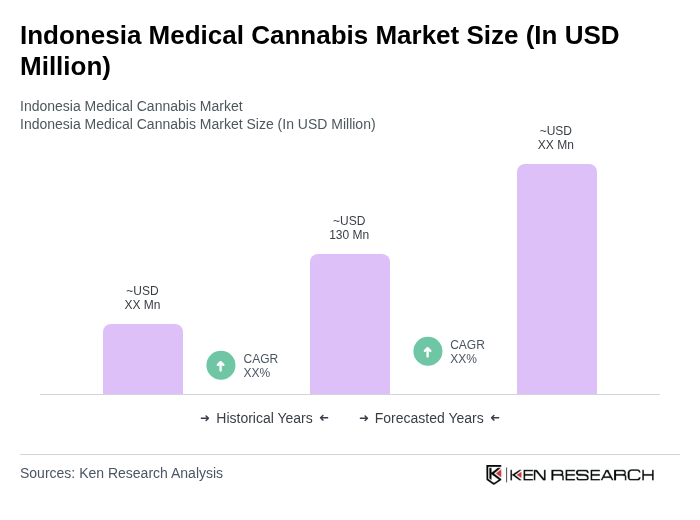
- The Indonesia Medical Cannabis Market is valued at USD 130 million, based on recent analysis. Growth is propelled by increasing recognition of therapeutic potential for conditions such as neurological disorders and pain management and by rising interest among patient groups, particularly families of cerebral palsy sufferers advocating for alternatives. Additional momentum stems from a broader loosening of regional research restrictions and patient-driven awareness of cannabis-derived treatments.
- Key players in this market include PT. Medco Energi Internasional Tbk, PT. Indofarma Tbk, PT. Kimia Farma Tbk, PT. Sido Muncul, PT. Harsen Laboratories, PT. Bio Farma, PT. Deltomed Laboratories, PT. Phapros Tbk, PT. Kalbe Farma Tbk, PT. Novell Pharmaceutical Laboratories, PT. Surya Dermato Medica, PT. Medifarma, PT. Anugerah Pharmindo Lestari, PT. Sari Husada, PT. Murni Solusindo. These companies play a significant role in driving growth and maintaining high standards in cannabis product development and distribution.
- A significant recent development is the National Narcotics Agency’s commitment to conduct medical cannabis research in collaboration with the Ministry of Health and the National Research and Innovation Agency, utilizing one of Southeast Asia’s best-equipped forensic laboratories to generate evidence for policy decision-making. This initiative may lay the groundwork for future regulatory shifts amid evolving domestic discourse.
Indonesia Medical Cannabis Market Segmentation
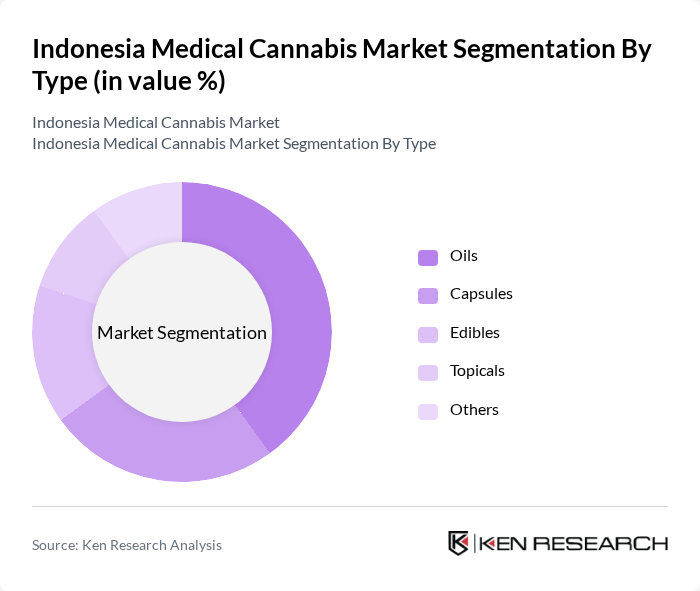
By Type:The market is segmented into various types of medical cannabis products, including oils, capsules, edibles, topicals, and others. Among these, oils are currently the most dominant segment due to their versatility and ease of use, particularly for patients seeking alternative treatments for chronic pain and neurological disorders. The growing acceptance of cannabis oils in therapeutic settings has led to increased consumer demand, making it a preferred choice for both patients and healthcare providers.
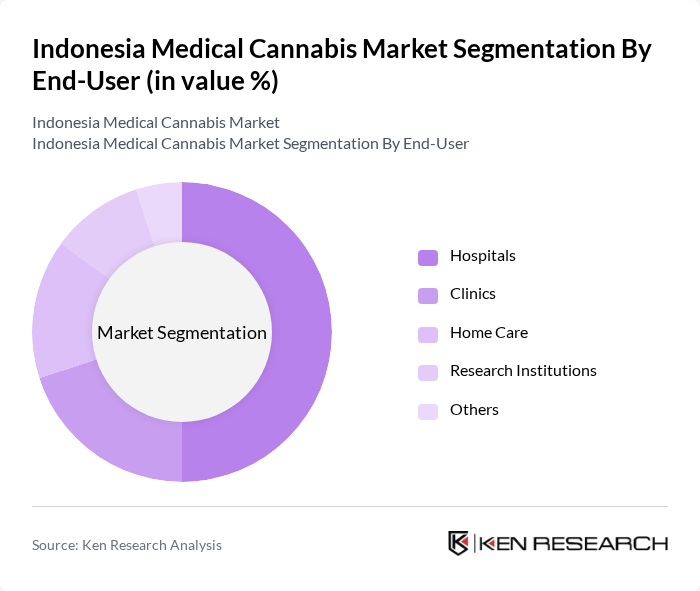
By End-User:The end-user segmentation includes hospitals, clinics, home care, research institutions, and others. Hospitals are the leading end-user segment, primarily due to their capacity to provide comprehensive medical care and the increasing integration of medical cannabis into treatment protocols for various conditions. The growing recognition of cannabis as a viable treatment option in clinical settings has further solidified hospitals' position as the primary consumers of medical cannabis products.
Indonesia Medical Cannabis Market Competitive Landscape
The Indonesia Medical Cannabis Market is characterized by a dynamic mix of regional and international players. Leading participants such as PT. Medco Energi Internasional Tbk, PT. Indofarma Tbk, PT. Kimia Farma Tbk, PT. Sido Muncul, PT. Harsen Laboratories, PT. Bio Farma, PT. Deltomed Laboratories, PT. Phapros Tbk, PT. Kalbe Farma Tbk, PT. Novell Pharmaceutical Laboratories, PT. Surya Dermato Medica, PT. Medifarma, PT. Anugerah Pharmindo Lestari, PT. Sari Husada, PT. Murni Solusindo contribute to innovation, geographic expansion, and service delivery in this space.
Indonesia Medical Cannabis Market Industry Analysis
Growth Drivers
- Rising GDP per Capita:Indonesia's GDP per capita reached IDR 78.62 million (approximately USD 5,000) in future. This increase in per capita income enhances the affordability of medical treatments, including emerging healthcare offerings like medical cannabis. As disposable incomes rise, patients are more likely to seek alternative therapies, driving demand for cannabis-based products. This economic growth supports the potential for a more robust healthcare market, particularly in innovative treatment options.
- Nominal GDP Expansion:The nominal GDP of Indonesia was IDR 22,139.0 trillion (around USD 1,400 billion) in future. This significant economic expansion allows for greater investment in healthcare sectors, including medical cannabis. As the economy grows, there is an increased potential for funding research and development in cannabis-based therapies, which can lead to innovative treatment solutions for various medical conditions. This growth creates a favorable environment for the medical cannabis market to flourish.
- Budget Efficiency and Fiscal Space:Indonesia's government achieved fiscal savings of IDR 306 trillion (approximately USD 19 billion) in the future budget through efficiency measures. This increased fiscal buffer can support healthcare innovation, including potential pilot programs for medical cannabis. With more resources available, the government may explore regulatory changes that could facilitate the development of a legal framework for medical cannabis, thus enhancing market opportunities.
Market Challenges
- Shrinking Middle Class:The middle class in Indonesia has declined to 47.9 million people as of March future, down from 60 million in 2018. This reduction in the middle-income population limits the demand for premium medical treatments, including cannabis-based therapies. As disposable incomes shrink, fewer individuals may be able to afford alternative treatments, which poses a significant challenge to the growth of the medical cannabis market in Indonesia.
- Regulatory Prohibition:Currently, there is no formal legal framework or pilot licensing for medical cannabis in Indonesia. The absence of regulation is a major barrier, as research and investment cannot proceed without legal clarity. This regulatory uncertainty stifles innovation and prevents potential market players from entering the sector, thereby hindering the development of medical cannabis applications and limiting patient access to alternative treatments.
Indonesia Medical Cannabis Market Future Outlook
The future of the medical cannabis market in Indonesia appears cautiously optimistic, driven by potential policy reforms and increasing healthcare pressures. While the current prohibition remains a significant barrier, the government's fiscal flexibility and focus on healthcare innovation may lead to pilot programs in the future. Additionally, the digital transformation in healthcare could facilitate remote prescribing and monitoring for cannabis treatments, paving the way for a more integrated approach to patient care and alternative therapies.
Market Opportunities
- Untapped Medical Cannabis Segment:The absence of a legal market indicates a completely untapped potential for medical cannabis in Indonesia. Should regulations evolve, the logistics and value chain—from cultivation to distribution—could rapidly develop, creating significant economic opportunities and improving patient access to alternative treatments.
- Export Potential via Cultivation:Indonesia's large agricultural capacity presents an opportunity for future cannabis cultivation if legalization occurs. The potential for exporting cannabis products could enhance the economy and position Indonesia as a key player in the regional cannabis market, provided that regulatory frameworks are established to support such initiatives.
Scope of the Report
| Segment | Sub-Segments |
|---|---|
| By Type | Oils Capsules Edibles Topicals Others |
| By End-User | Hospitals Clinics Home Care Research Institutions Others |
| By Patient Demographics | Age Groups Gender Medical Conditions Others |
| By Distribution Channel | Online Pharmacies Retail Pharmacies Direct Sales Others |
| By Formulation | Sativa Indica Hybrid Others |
| By Geographic Distribution | Urban Areas Rural Areas Others |
| By Research and Development Focus | Clinical Trials Product Innovation Market Studies Others |
Key Target Audience
Investors and Venture Capitalist Firms
Government and Regulatory Bodies (e.g., Badan Narkotika Nasional, Kementerian Kesehatan)
Manufacturers and Producers
Distributors and Retailers
Pharmaceutical Companies
Healthcare Providers and Practitioners
Industry Associations
Financial Institutions
Players Mentioned in the Report:
PT. Medco Energi Internasional Tbk
PT. Indofarma Tbk
PT. Kimia Farma Tbk
PT. Sido Muncul
PT. Harsen Laboratories
PT. Bio Farma
PT. Deltomed Laboratories
PT. Phapros Tbk
PT. Kalbe Farma Tbk
PT. Novell Pharmaceutical Laboratories
PT. Surya Dermato Medica
PT. Medifarma
PT. Anugerah Pharmindo Lestari
PT. Sari Husada
PT. Murni Solusindo
Table of Contents
Market Assessment Phase
1. Executive Summary and Approach
2. Indonesia Medical Cannabis Market Overview
2.1 Key Insights and Strategic Recommendations
2.2 Indonesia Medical Cannabis Market Overview
2.3 Definition and Scope
2.4 Evolution of Market Ecosystem
2.5 Timeline of Key Regulatory Milestones
2.6 Value Chain & Stakeholder Mapping
2.7 Business Cycle Analysis
2.8 Policy & Incentive Landscape
3. Indonesia Medical Cannabis Market Analysis
3.1 Growth Drivers
3.1.1 Increasing Acceptance of Medical Cannabis
3.1.2 Rising Demand for Alternative Treatments
3.1.3 Government Initiatives for Medical Research
3.1.4 Expanding Patient Base with Chronic Conditions
3.2 Market Challenges
3.2.1 Regulatory Uncertainty
3.2.2 Stigma Associated with Cannabis Use
3.2.3 Limited Research and Development
3.2.4 High Entry Barriers for New Players
3.3 Market Opportunities
3.3.1 Development of Cannabis-based Pharmaceuticals
3.3.2 Export Potential to Neighboring Countries
3.3.3 Investment in Cannabis Research Facilities
3.3.4 Collaboration with Healthcare Providers
3.4 Market Trends
3.4.1 Increasing Focus on Patient-Centric Products
3.4.2 Growth of E-commerce for Medical Cannabis
3.4.3 Rise of Personalized Medicine
3.4.4 Integration of Technology in Cannabis Cultivation
3.5 Government Regulation
3.5.1 Licensing Requirements for Producers
3.5.2 Restrictions on Advertising and Promotion
3.5.3 Quality Control Standards for Products
3.5.4 Taxation Policies on Cannabis Sales
4. SWOT Analysis
5. Stakeholder Analysis
6. Porter's Five Forces Analysis
7. Indonesia Medical Cannabis Market Market Size, 2019-2024
7.1 By Value
7.2 By Volume
7.3 By Average Selling Price
8. Indonesia Medical Cannabis Market Segmentation
8.1 By Type
8.1.1 Oils
8.1.2 Capsules
8.1.3 Edibles
8.1.4 Topicals
8.1.5 Others
8.2 By End-User
8.2.1 Hospitals
8.2.2 Clinics
8.2.3 Home Care
8.2.4 Research Institutions
8.2.5 Others
8.3 By Patient Demographics
8.3.1 Age Groups
8.3.2 Gender
8.3.3 Medical Conditions
8.3.4 Others
8.4 By Distribution Channel
8.4.1 Online Pharmacies
8.4.2 Retail Pharmacies
8.4.3 Direct Sales
8.4.4 Others
8.5 By Formulation
8.5.1 Sativa
8.5.2 Indica
8.5.3 Hybrid
8.5.4 Others
8.6 By Geographic Distribution
8.6.1 Urban Areas
8.6.2 Rural Areas
8.6.3 Others
8.7 By Research and Development Focus
8.7.1 Clinical Trials
8.7.2 Product Innovation
8.7.3 Market Studies
8.7.4 Others
9. Indonesia Medical Cannabis Market Competitive Analysis
9.1 Market Share of Key Players
9.2 Cross Comparison of Key Players
9.2.1 Company Name
9.2.2 Group Size (Large, Medium, or Small as per industry convention)
9.2.3 Revenue Growth Rate
9.2.4 Market Penetration Rate
9.2.5 Customer Retention Rate
9.2.6 Product Diversification Index
9.2.7 Pricing Strategy
9.2.8 Distribution Efficiency
9.2.9 Brand Recognition Score
9.2.10 Regulatory Compliance Rate
9.3 SWOT Analysis of Top Players
9.4 Pricing Analysis
9.5 Detailed Profile of Major Companies
9.5.1 PT. Medco Energi Internasional Tbk
9.5.2 PT. Indofarma Tbk
9.5.3 PT. Kimia Farma Tbk
9.5.4 PT. Sido Muncul
9.5.5 PT. Harsen Laboratories
9.5.6 PT. Bio Farma
9.5.7 PT. Deltomed Laboratories
9.5.8 PT. Phapros Tbk
9.5.9 PT. Kalbe Farma Tbk
9.5.10 PT. Novell Pharmaceutical Laboratories
9.5.11 PT. Surya Dermato Medica
9.5.12 PT. Medifarma
9.5.13 PT. Anugerah Pharmindo Lestari
9.5.14 PT. Sari Husada
9.5.15 PT. Murni Solusindo
10. Indonesia Medical Cannabis Market End-User Analysis
10.1 Procurement Behavior of Key Ministries
10.1.1 Ministry of Health
10.1.2 Ministry of Agriculture
10.1.3 Ministry of Research and Technology
10.1.4 Others
10.2 Corporate Spend on Infrastructure & Energy
10.2.1 Healthcare Facilities
10.2.2 Research Institutions
10.2.3 Pharmaceutical Companies
10.2.4 Others
10.3 Pain Point Analysis by End-User Category
10.3.1 Patients
10.3.2 Healthcare Providers
10.3.3 Researchers
10.3.4 Others
10.4 User Readiness for Adoption
10.4.1 Awareness Levels
10.4.2 Accessibility of Products
10.4.3 Training and Education
10.4.4 Others
10.5 Post-Deployment ROI and Use Case Expansion
10.5.1 Cost Savings
10.5.2 Improved Patient Outcomes
10.5.3 Market Expansion Opportunities
10.5.4 Others
11. Indonesia Medical Cannabis Market Future Size, 2025-2030
11.1 By Value
11.2 By Volume
11.3 By Average Selling Price
Go-To-Market Strategy Phase
1. Whitespace Analysis + Business Model Canvas
1.1 Market Gaps Identification
1.2 Business Model Development
2. Marketing and Positioning Recommendations
2.1 Branding Strategies
2.2 Product USPs
3. Distribution Plan
3.1 Urban Retail vs Rural NGO Tie-ups
4. Channel & Pricing Gaps
4.1 Underserved Routes
4.2 Pricing Bands
5. Unmet Demand & Latent Needs
5.1 Category Gaps
5.2 Consumer Segments
6. Customer Relationship
6.1 Loyalty Programs
6.2 After-sales Service
7. Value Proposition
7.1 Sustainability
7.2 Integrated Supply Chains
8. Key Activities
8.1 Regulatory Compliance
8.2 Branding
8.3 Distribution Setup
9. Entry Strategy Evaluation
9.1 Domestic Market Entry Strategy
9.1.1 Product Mix
9.1.2 Pricing Band
9.1.3 Packaging
9.2 Export Entry Strategy
9.2.1 Target Countries
9.2.2 Compliance Roadmap
10. Entry Mode Assessment
10.1 JV
10.2 Greenfield
10.3 M&A
10.4 Distributor Model
11. Capital and Timeline Estimation
11.1 Capital Requirements
11.2 Timelines
12. Control vs Risk Trade-Off
12.1 Ownership vs Partnerships
13. Profitability Outlook
13.1 Breakeven Analysis
13.2 Long-term Sustainability
14. Potential Partner List
14.1 Distributors
14.2 JVs
14.3 Acquisition Targets
15. Execution Roadmap
15.1 Phased Plan for Market Entry
15.1.1 Market Setup
15.1.2 Market Entry
15.1.3 Growth Acceleration
15.1.4 Scale & Stabilize
15.2 Key Activities and Milestones
15.2.1 Milestone Tracking
15.2.2 Activity Scheduling
Research Methodology
Phase 1: Approach1
Desk Research
- Analysis of existing literature on medical cannabis regulations in Indonesia
- Review of market reports from health organizations and government publications
- Examination of demographic and health statistics from the Indonesian Ministry of Health
Primary Research
- Interviews with healthcare professionals specializing in cannabis-based treatments
- Surveys with patients and caregivers regarding their experiences and perceptions
- Discussions with policymakers and regulatory bodies involved in cannabis legislation
Validation & Triangulation
- Cross-validation of findings through multiple expert interviews
- Triangulation of data from patient surveys and healthcare provider insights
- Sanity checks through feedback from industry stakeholders and academic experts
Phase 2: Market Size Estimation1
Top-down Assessment
- Estimation of market size based on national healthcare expenditure and cannabis adoption rates
- Segmentation of the market by therapeutic applications and patient demographics
- Incorporation of projected growth rates based on global medical cannabis trends
Bottom-up Modeling
- Collection of data on the number of licensed medical cannabis dispensaries and their sales volumes
- Estimation of average spending per patient on medical cannabis products
- Analysis of production costs and pricing strategies of local cannabis cultivators
Forecasting & Scenario Analysis
- Multi-factor regression analysis incorporating factors such as public acceptance and regulatory changes
- Scenario modeling based on potential shifts in legislation and market entry of new products
- Development of baseline, optimistic, and pessimistic market forecasts through 2030
Phase 3: CATI Sample Composition1
| Scope Item/Segment | Sample Size | Target Respondent Profiles |
|---|---|---|
| Healthcare Professionals | 100 | Doctors, Pharmacists, Medical Researchers |
| Patients Using Medical Cannabis | 150 | Chronic Pain Patients, Cancer Patients, Epilepsy Patients |
| Regulatory Bodies | 50 | Government Officials, Policy Advisors, Legal Experts |
| Industry Stakeholders | 80 | Cultivators, Dispensary Owners, Investors |
| Public Health Advocates | 70 | Health Educators, NGO Representatives, Community Leaders |
Frequently Asked Questions
What is the current value of the Indonesia Medical Cannabis Market?
The Indonesia Medical Cannabis Market is valued at approximately USD 130 million. This valuation reflects the growing recognition of cannabis's therapeutic potential, particularly for neurological disorders and pain management, alongside increasing patient advocacy for alternative treatments.
Who are the key players in the Indonesia Medical Cannabis Market?
What are the main types of medical cannabis products available in Indonesia?
What are the primary end-users of medical cannabis in Indonesia?
Other Regional/Country Reports
Malaysia Medical Cannabis Market
APAC Medical Cannabis Market
Other Adjacent Reports
Brazil Healthcare Services Market
Saudi Arabia biotechnology market Size, Share, Growth Drivers, Trends, Opportunities & Forecast 2025–2030Kuwait Nutraceuticals Market Size, Share & Forecast, By Product Type, Application & Distribution Channel, 2026–2032Bahrain Pain Management Market
Belgium Neurological Disorders Treatment Market
Qatar Healthcare Research Market
Oman Alternative Medicine Market
KSA herbal medicine market report size, share, growth drivers, trends, opportunities & forecast 2025–2030Asia Pacific Clinical Trials Market Size, Share & Forecast, By Phase, Study Design & Therapeutic Area, 2025-2032Why Buy From Us?

What makes us stand out is that our consultants follow Robust, Refine and Result (RRR) methodology. Robust for clear definitions, approaches and sanity checking, Refine for differentiating respondents' facts and opinions, and Result for presenting data with story.

We have set a benchmark in the industry by offering our clients with syndicated and customized market research reports featuring coverage of entire market as well as meticulous research and analyst insights.

While we don't replace traditional research, we flip the method upside down. Our dual approach of Top Bottom & Bottom Top ensures quality deliverable by not just verifying company fundamentals but also looking at the sector and macroeconomic factors.

With one step in the future, our research team constantly tries to show you the bigger picture. We help with some of the tough questions you may encounter along the way: How is the industry positioned? Best marketing channel? KPI's of competitors? By aligning every element, we help maximize success.

Our report gives you instant access to the answers and sources that other companies might choose to hide. We elaborate each steps of research methodology we have used and showcase you the sample size to earn your trust.

If you need any support, we are here! We pride ourselves on universe strength, data quality, and quick, friendly, and professional service.