Indonesia Palm Methyl Ester Derivative Market Size, Share, Growth Drivers, Trends, Opportunities & Forecast 2025–2030

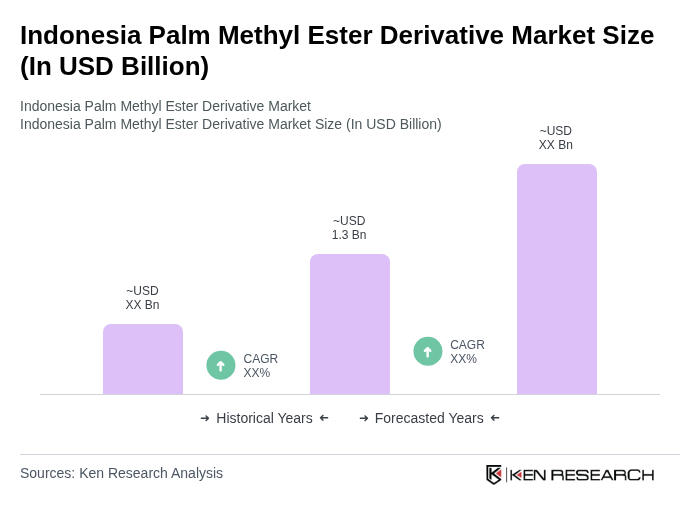
Indonesia Palm Methyl Ester Derivative Market, valued at USD 1.3 Bn, grows due to renewable energy push, eco-friendly alternatives in biodiesel, and government sustainability policies.

Region:Asia

Author(s):Shubham

Product Code:KRAD6615

Pages:92

Published On:December 2025
About the Report

Base Year 2024

Indonesia Palm Methyl Ester Derivative Market Overview

  • The Indonesia Palm Methyl Ester Derivative Market is valued at USD 1.3 billion, based on a five-year historical analysis and its share within the global palm methyl ester derivatives market, which is reported in the low?to?mid USD 1.5–2.3 billion range for recent years. This growth is primarily driven by the increasing demand for sustainable and eco-friendly alternatives in various industries, particularly in biodiesel production and personal care products, where palm?based methyl esters are used as feedstock for FAME biodiesel, surfactants, solvents, and emollients. The market is also supported by the government's push for renewable energy sources through high biodiesel blending mandates (such as Indonesia’s B35 program) and the growing awareness of environmental sustainability among consumers.
  • Key regions dominating the market include Sumatra and Java, which are the primary production areas for palm oil in Indonesia. The concentration of palm oil plantations, mills, and downstream refining and oleochemical facilities in provinces such as Riau, North Sumatra, South Sumatra, and parts of Kalimantan and Java enables efficient supply chain management and distribution for palm methyl ester derivatives. Additionally, the presence of major industry players with large biodiesel and oleochemical complexes in these areas, including integrated palm oil groups operating in Sumatra and Java, contributes to their dominance in the market.
  • In 2023, the Indonesian government advanced its sustainability and renewable energy agenda through instruments such as the Indonesian Sustainable Palm Oil (ISPO) certification system, as strengthened by the Presidential Regulation on the Indonesian Sustainable Palm Oil System issued by the Government of Indonesia in 2020, which mandates sustainability criteria for palm oil growers and processors, and the Ministry of Energy and Mineral Resources regulations governing mandatory biodiesel blending (e.g., B30–B35) that require the use of sustainably sourced palm?based FAME in the fuel mix. These regulations aim to enhance the environmental performance of palm oil production and promote the use of certified sustainable palm oil and its derivatives, including palm methyl esters, in applications such as biodiesel, surfactants, and food-related oleochemicals.
Indonesia Palm Methyl Ester Derivative Market Size

Indonesia Palm Methyl Ester Derivative Market Segmentation

By Product Type:The product type segmentation includes various palm methyl ester derivatives, each serving distinct applications across industries. The subsegments are Palm Methyl Caprylate (C8), Palm Methyl Laurate (C12), Palm Methyl Myristate (C14), Palm Methyl Palmitate (C16), Palm Methyl Stearate (C18), Palm Methyl Oleate (C18:1), Palm Methyl Linoleate (C18:2), and Others. These C8–C18 methyl esters are widely used as intermediates for fatty alcohols, surfactants, plasticizers, solvents, lubricants, and biodiesel components. Among these, Palm Methyl Oleate (C18:1) is currently leading the market due to its extensive use in biodiesel production, metalworking fluids, and as a lubricant additive and solvent in industrial and personal care formulations. The increasing demand for biodiesel as a renewable energy source, supported by Indonesia’s high blend mandates and global moves toward lower?carbon fuels, is driving the growth of this subsegment.
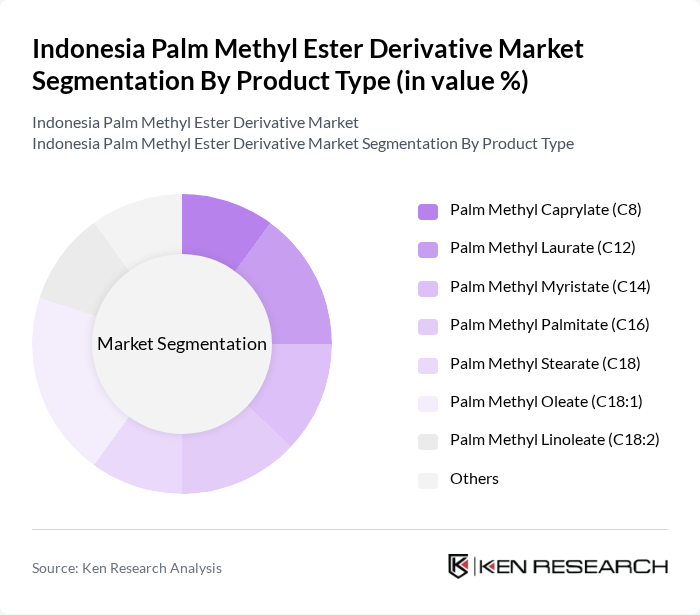
Indonesia Palm Methyl Ester Derivative Market segmentation by Product Type.

By Source:This segmentation focuses on the raw materials used to produce palm methyl esters, which include Crude Palm Oil (CPO), Palm Kernel Oil (PKO), and Others. Crude Palm Oil (CPO) is the dominant source due to its abundant availability and cost-effectiveness in the production of palm methyl esters, as Indonesia is the world’s largest producer of crude palm oil and channels significant volumes into biodiesel and oleochemical value chains. Palm Kernel Oil (PKO) is used more intensively for shorter-chain methyl esters (C8–C12) feeding surfactants and detergents, while CPO is the main feedstock for longer?chain biodiesel?grade esters. The increasing cultivation and replanting of oil palm in Indonesia, together with yield improvements, ensure a steady supply of CPO, which is essential for meeting the growing demand in biodiesel, home and personal care, and industrial applications.
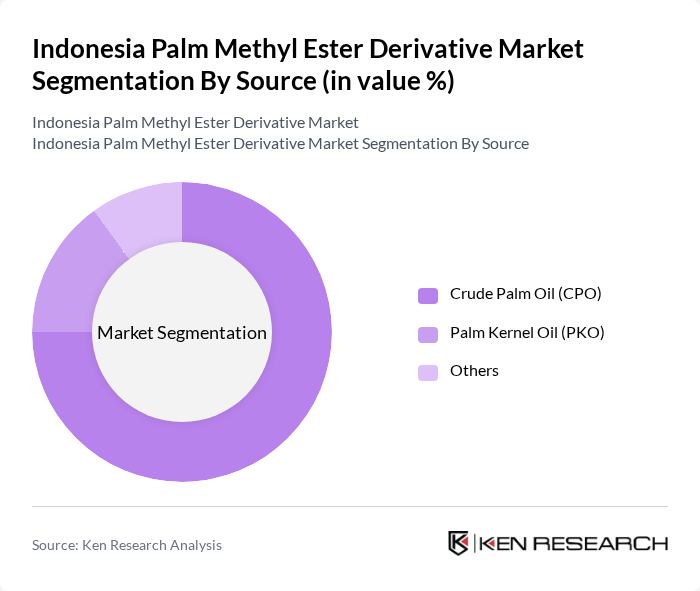
Indonesia Palm Methyl Ester Derivative Market segmentation by Source.

Indonesia Palm Methyl Ester Derivative Market Competitive Landscape

The Indonesia Palm Methyl Ester Derivative Market is characterized by a dynamic mix of regional and international players. Leading participants such as PT Musim Mas, Wilmar International Limited (Indonesia Operations), PT SMART Tbk (Sinar Mas Agribusiness and Food), PT Eterindo Wahanatama Tbk, PT Pertamina (Persero) – Biofuel & Green Refinery Business, PT Cemerlang Energi Perkasa, PT Wilmar Nabati Indonesia, PT Tunas Baru Lampung Tbk, PT Sumi Asih Oleochemicals Industry, PT Ecogreen Oleochemicals, PT Bakrie Bio Energy, PT Indo Biofuels Energy, PT Multi Nabati Sulawesi, PT Katingan Indah Utama, PT Wilmar Bioenergi Indonesia contribute to innovation, geographic expansion, and service delivery in this space, supported by investments in biodiesel capacity, RSPO/ISCC?certified supply chains, and higher?value specialty methyl ester derivatives for surfactants, lubricants, and personal care markets.

PT Musim Mas

1972

Medan, Indonesia

Wilmar International Limited (Indonesia Operations)

1991

Jakarta, Indonesia

PT SMART Tbk

1962

Jakarta, Indonesia

PT Eterindo Wahanatama Tbk

1992

Jakarta, Indonesia

PT Pertamina (Persero)

1957

Jakarta, Indonesia

Company

Establishment Year

Headquarters

Installed Palm Methyl Ester Capacity (kTPA)

Capacity Utilization Rate (%)

Share of RSPO / ISCC Certified Feedstock (%)

Revenue from Palm Methyl Ester Derivatives (USD million)

Revenue CAGR from Palm Methyl Ester Derivatives (%)

Product Mix (Fuel vs. Specialty Derivatives Ratio)

Indonesia Palm Methyl Ester Derivative Market Industry Analysis

Growth Drivers

  • Increasing Demand for Renewable Energy:The global shift towards renewable energy sources is significantly impacting Indonesia's palm methyl ester derivative market. In future, Indonesia's renewable energy consumption is projected to reach 13 million tons of oil equivalent, driven by government policies promoting biofuels. This demand is further supported by the International Energy Agency's forecast that biofuels will account for 27% of total energy consumption in the transportation sector, enhancing the market's growth potential.
  • Government Support and Incentives:The Indonesian government has implemented various incentives to boost the biofuel sector, including tax exemptions and subsidies. In future, the government allocated approximately IDR 6 trillion (around USD 400 million) for biofuel development initiatives. This financial support aims to increase the production of palm methyl ester derivatives, aligning with the national target of achieving a 23% renewable energy mix in future, thus fostering market growth.
  • Rising Environmental Awareness:Growing environmental concerns among consumers and industries are driving the demand for sustainable products. In future, it is estimated that 65% of Indonesian consumers prefer eco-friendly products, leading to increased adoption of palm methyl ester derivatives. This trend is supported by the World Bank's report indicating that environmental awareness is linked to a 15% increase in biofuel consumption, further propelling the market's expansion in Indonesia.

Market Challenges

  • Fluctuating Raw Material Prices:The palm oil market is characterized by price volatility, which poses a significant challenge for the palm methyl ester derivative industry. In future, the average price of crude palm oil is expected to fluctuate between IDR 11,000 to IDR 13,000 per kilogram, impacting production costs. This instability can hinder investment and profitability, making it difficult for producers to maintain competitive pricing in the market.
  • Regulatory Compliance Issues:Navigating the complex regulatory landscape is a major challenge for the palm methyl ester derivative market. In future, compliance with the Indonesian National Standard (SNI) for biofuels will require significant investment in quality control and certification processes. The costs associated with meeting these regulations can reach up to IDR 1.2 billion (approximately USD 80,000) per facility, creating barriers for smaller producers and affecting overall market competitiveness.

Indonesia Palm Methyl Ester Derivative Market Future Outlook

The future of the Indonesia palm methyl ester derivative market appears promising, driven by increasing global demand for sustainable energy solutions and supportive government policies. As the country aims to enhance its renewable energy mix, investments in production technologies and infrastructure are expected to rise. Additionally, the growing trend towards sustainable practices among consumers will likely lead to further innovations in product applications, positioning Indonesia as a key player in the biofuel sector in the coming years.

Market Opportunities

  • Expansion into International Markets:There is a significant opportunity for Indonesian producers to expand into international markets, particularly in Europe and North America, where demand for biofuels is increasing. In future, the European Union is expected to import over 1.2 million tons of palm methyl ester, providing a lucrative avenue for Indonesian exporters to capitalize on this growing demand.
  • Development of New Applications:The potential for developing new applications for palm methyl ester derivatives, such as in the cosmetics and pharmaceutical industries, presents a valuable opportunity. In future, the global market for bio-based chemicals is projected to reach USD 25 billion, indicating a growing interest in sustainable alternatives that Indonesian manufacturers can leverage for diversification and growth.

Scope of the Report

SegmentSub-Segments
By Product Type

Palm Methyl Caprylate (C8)

Palm Methyl Laurate (C12)

Palm Methyl Myristate (C14)

Palm Methyl Palmitate (C16)

Palm Methyl Stearate (C18)

Palm Methyl Oleate (C18:1)

Palm Methyl Linoleate (C18:2)

Others

By Source

Crude Palm Oil (CPO)

Palm Kernel Oil (PKO)

Others

By Application

Soaps & Detergents

Personal Care & Cosmetics

Biodiesel & Fuel Additives

Lubricants & Metalworking Fluids

Solvents & Co-solvents

Food & Beverages Additives

Other Industrial Applications

By End-User

Soaps & Detergent Manufacturers

Personal Care & Cosmetic Product Manufacturers

Biodiesel Producers

Industrial & Automotive Manufacturers

Chemical Distributors & Traders

Others

By Distribution Channel

Direct Sales / Off?take Contracts

Local Distributors & Traders

International Traders

Online / Digital Sales Platforms

Others

By Sustainability Certification

RSPO Certified

ISCC Certified

Non?certified / Conventional

Others

By Region

Sumatra

Java

Kalimantan

Sulawesi

Others

Key Target Audience

Investors and Venture Capitalist Firms

Government and Regulatory Bodies (e.g., Ministry of Agriculture, Ministry of Environment and Forestry)

Manufacturers and Producers of Palm Methyl Ester Derivatives

Distributors and Retailers of Biofuels

Oil Palm Plantation Owners

Industry Associations (e.g., Indonesian Palm Oil Association)

Financial Institutions and Banks

Logistics and Supply Chain Companies

Players Mentioned in the Report:

PT Musim Mas

Wilmar International Limited (Indonesia Operations)

PT SMART Tbk (Sinar Mas Agribusiness and Food)

PT Eterindo Wahanatama Tbk

PT Pertamina (Persero) Biofuel & Green Refinery Business

PT Cemerlang Energi Perkasa

PT Wilmar Nabati Indonesia

PT Tunas Baru Lampung Tbk

PT Sumi Asih Oleochemicals Industry

PT Ecogreen Oleochemicals

PT Bakrie Bio Energy

PT Indo Biofuels Energy

PT Multi Nabati Sulawesi

PT Katingan Indah Utama

PT Wilmar Bioenergi Indonesia

Table of Contents

Market Assessment Phase

1. Executive Summary and Approach


2. Indonesia Palm Methyl Ester Derivative Market Overview

2.1 Key Insights and Strategic Recommendations

2.2 Indonesia Palm Methyl Ester Derivative Market Overview

2.3 Definition and Scope

2.4 Evolution of Market Ecosystem

2.5 Timeline of Key Regulatory Milestones

2.6 Value Chain & Stakeholder Mapping

2.7 Business Cycle Analysis

2.8 Policy & Incentive Landscape


3. Indonesia Palm Methyl Ester Derivative Market Analysis

3.1 Growth Drivers

3.1.1 Increasing Demand for Renewable Energy
3.1.2 Government Support and Incentives
3.1.3 Rising Environmental Awareness
3.1.4 Technological Advancements in Production

3.2 Market Challenges

3.2.1 Fluctuating Raw Material Prices
3.2.2 Regulatory Compliance Issues
3.2.3 Competition from Alternative Fuels
3.2.4 Infrastructure Limitations

3.3 Market Opportunities

3.3.1 Expansion into International Markets
3.3.2 Development of New Applications
3.3.3 Strategic Partnerships and Collaborations
3.3.4 Investment in R&D for Product Innovation

3.4 Market Trends

3.4.1 Shift Towards Sustainable Practices
3.4.2 Increasing Use of Biofuels in Transportation
3.4.3 Growth of the Circular Economy
3.4.4 Digital Transformation in Supply Chain Management

3.5 Government Regulation

3.5.1 Biofuel Mandates and Standards
3.5.2 Environmental Protection Regulations
3.5.3 Tax Incentives for Biofuel Production
3.5.4 Import Tariffs on Alternative Fuels

4. SWOT Analysis


5. Stakeholder Analysis


6. Porter's Five Forces Analysis


7. Indonesia Palm Methyl Ester Derivative Market Market Size, 2019-2024

7.1 By Value

7.2 By Volume

7.3 By Average Selling Price


8. Indonesia Palm Methyl Ester Derivative Market Segmentation

8.1 By Product Type

8.1.1 Palm Methyl Caprylate (C8)
8.1.2 Palm Methyl Laurate (C12)
8.1.3 Palm Methyl Myristate (C14)
8.1.4 Palm Methyl Palmitate (C16)
8.1.5 Palm Methyl Stearate (C18)
8.1.6 Palm Methyl Oleate (C18:1)
8.1.7 Palm Methyl Linoleate (C18:2)
8.1.8 Others

8.2 By Source

8.2.1 Crude Palm Oil (CPO)
8.2.2 Palm Kernel Oil (PKO)
8.2.3 Others

8.3 By Application

8.3.1 Soaps & Detergents
8.3.2 Personal Care & Cosmetics
8.3.3 Biodiesel & Fuel Additives
8.3.4 Lubricants & Metalworking Fluids
8.3.5 Solvents & Co-solvents
8.3.6 Food & Beverages Additives
8.3.7 Other Industrial Applications

8.4 By End-User

8.4.1 Soaps & Detergent Manufacturers
8.4.2 Personal Care & Cosmetic Product Manufacturers
8.4.3 Biodiesel Producers
8.4.4 Industrial & Automotive Manufacturers
8.4.5 Chemical Distributors & Traders
8.4.6 Others

8.5 By Distribution Channel

8.5.1 Direct Sales / Off?take Contracts
8.5.2 Local Distributors & Traders
8.5.3 International Traders
8.5.4 Online / Digital Sales Platforms
8.5.5 Others

8.6 By Sustainability Certification

8.6.1 RSPO Certified
8.6.2 ISCC Certified
8.6.3 Non?certified / Conventional
8.6.4 Others

8.7 By Region

8.7.1 Sumatra
8.7.2 Java
8.7.3 Kalimantan
8.7.4 Sulawesi
8.7.5 Others

9. Indonesia Palm Methyl Ester Derivative Market Competitive Analysis

9.1 Market Share of Key Players

9.2 Cross Comparison of Key Players

9.2.1 Company Name
9.2.2 Installed Palm Methyl Ester Capacity (kTPA)
9.2.3 Capacity Utilization Rate (%)
9.2.4 Share of RSPO / ISCC Certified Feedstock (%)
9.2.5 Revenue from Palm Methyl Ester Derivatives (USD million)
9.2.6 Revenue CAGR from Palm Methyl Ester Derivatives (%)
9.2.7 Product Mix (Fuel vs. Specialty Derivatives Ratio)
9.2.8 Domestic vs Export Sales Share (%)
9.2.9 Average Realization / Selling Price (USD per tonne)
9.2.10 EBITDA Margin from Palm Methyl Ester Business (%)
9.2.11 R&D / Sustainability Spend as % of Segment Revenue
9.2.12 B30/B35/B40 Off?take Exposure (Share of Sales to Biofuel Mandate)

9.3 SWOT Analysis of Top Players

9.4 Pricing Analysis

9.5 Detailed Profile of Major Companies

9.5.1 PT Musim Mas
9.5.2 Wilmar International Limited (Indonesia Operations)
9.5.3 PT SMART Tbk (Sinar Mas Agribusiness and Food)
9.5.4 PT Eterindo Wahanatama Tbk
9.5.5 PT Pertamina (Persero) – Biofuel & Green Refinery Business
9.5.6 PT Cemerlang Energi Perkasa
9.5.7 PT Wilmar Nabati Indonesia
9.5.8 PT Tunas Baru Lampung Tbk
9.5.9 PT Sumi Asih Oleochemicals Industry
9.5.10 PT Ecogreen Oleochemicals
9.5.11 PT Bakrie Bio Energy
9.5.12 PT Indo Biofuels Energy
9.5.13 PT Multi Nabati Sulawesi
9.5.14 PT Katingan Indah Utama
9.5.15 PT Wilmar Bioenergi Indonesia

10. Indonesia Palm Methyl Ester Derivative Market End-User Analysis

10.1 Procurement Behavior of Key Ministries

10.1.1 Ministry of Energy and Mineral Resources
10.1.2 Ministry of Agriculture
10.1.3 Ministry of Environment and Forestry
10.1.4 Others

10.2 Corporate Spend on Infrastructure & Energy

10.2.1 Investment in Renewable Energy Projects
10.2.2 Budget Allocation for Biofuel Initiatives
10.2.3 Corporate Sustainability Programs
10.2.4 Others

10.3 Pain Point Analysis by End-User Category

10.3.1 Cost of Production
10.3.2 Supply Chain Disruptions
10.3.3 Regulatory Compliance Challenges
10.3.4 Others

10.4 User Readiness for Adoption

10.4.1 Awareness of Benefits
10.4.2 Availability of Infrastructure
10.4.3 Financial Incentives
10.4.4 Others

10.5 Post-Deployment ROI and Use Case Expansion

10.5.1 Measurement of Energy Savings
10.5.2 Expansion into New Markets
10.5.3 Long-term Sustainability Benefits
10.5.4 Others

11. Indonesia Palm Methyl Ester Derivative Market Future Size, 2025-2030

11.1 By Value

11.2 By Volume

11.3 By Average Selling Price


Go-To-Market Strategy Phase

1. Whitespace Analysis + Business Model Canvas

1.1 Market Gaps Identification

1.2 Business Model Development


2. Marketing and Positioning Recommendations

2.1 Branding Strategies

2.2 Product USPs


3. Distribution Plan

3.1 Urban Retail Strategies

3.2 Rural NGO Tie-ups


4. Channel & Pricing Gaps

4.1 Underserved Routes

4.2 Pricing Bands


5. Unmet Demand & Latent Needs

5.1 Category Gaps

5.2 Consumer Segments


6. Customer Relationship

6.1 Loyalty Programs

6.2 After-sales Service


7. Value Proposition

7.1 Sustainability Initiatives

7.2 Integrated Supply Chains


8. Key Activities

8.1 Regulatory Compliance

8.2 Branding Efforts

8.3 Distribution Setup


9. Entry Strategy Evaluation

9.1 Domestic Market Entry Strategy

9.1.1 Product Mix
9.1.2 Pricing Band
9.1.3 Packaging

9.2 Export Entry Strategy

9.2.1 Target Countries
9.2.2 Compliance Roadmap

10. Entry Mode Assessment

10.1 Joint Ventures

10.2 Greenfield Investments

10.3 Mergers & Acquisitions

10.4 Distributor Model


11. Capital and Timeline Estimation

11.1 Capital Requirements

11.2 Timelines


12. Control vs Risk Trade-Off

12.1 Ownership vs Partnerships


13. Profitability Outlook

13.1 Breakeven Analysis

13.2 Long-term Sustainability


14. Potential Partner List

14.1 Distributors

14.2 Joint Ventures

14.3 Acquisition Targets


15. Execution Roadmap

15.1 Phased Plan for Market Entry

15.1.1 Market Setup
15.1.2 Market Entry
15.1.3 Growth Acceleration
15.1.4 Scale & Stabilize

15.2 Key Activities and Milestones

15.2.1 Milestone Planning
15.2.2 Activity Tracking

Research Methodology

ApproachModellingSample

Phase 1: Approach1

Desk Research

  • Analysis of industry reports from the Indonesian Palm Oil Association and relevant government publications
  • Review of academic journals and articles focusing on palm methyl ester derivatives and their applications
  • Examination of market trends and forecasts from trade publications and market research databases

Primary Research

  • Interviews with key stakeholders in the palm oil supply chain, including producers and distributors
  • Surveys targeting end-users in sectors such as biodiesel, cosmetics, and food processing
  • Field visits to production facilities to gather insights on operational practices and product usage

Validation & Triangulation

  • Cross-verification of data from multiple sources, including trade statistics and expert opinions
  • Triangulation of findings from primary interviews with secondary data insights
  • Sanity checks through expert panel discussions to ensure data reliability and accuracy

Phase 2: Market Size Estimation1

Top-down Assessment

  • Estimation of the total market size based on national palm oil production statistics and export data
  • Segmentation of the market by application areas such as biodiesel, surfactants, and lubricants
  • Incorporation of government policies promoting renewable energy and sustainable practices

Bottom-up Modeling

  • Collection of production volume data from leading manufacturers of palm methyl ester derivatives
  • Cost analysis based on raw material prices, production processes, and distribution expenses
  • Estimation of market share for each segment based on firm-level sales data

Forecasting & Scenario Analysis

  • Utilization of time-series analysis to project future market growth based on historical data
  • Scenario modeling considering factors such as regulatory changes and shifts in consumer preferences
  • Development of multiple growth scenarios (baseline, optimistic, and pessimistic) through 2030

Phase 3: CATI Sample Composition1

Scope Item/SegmentSample SizeTarget Respondent Profiles
Biodiesel Producers45Production Managers, R&D Directors
Cosmetics Manufacturers40Product Development Managers, Procurement Officers
Food Processing Companies35Quality Assurance Managers, Supply Chain Directors
Industrial Lubricants Sector30Operations Managers, Technical Sales Representatives
Research Institutions25Research Scientists, Policy Analysts

Frequently Asked Questions

What is the current value of the Indonesia Palm Methyl Ester Derivative Market?

The Indonesia Palm Methyl Ester Derivative Market is valued at approximately USD 1.3 billion, reflecting its significant role within the global market, which ranges from USD 1.5 to 2.3 billion in recent years.

What factors are driving the growth of the Indonesia Palm Methyl Ester Derivative Market?

Which regions in Indonesia are the primary production areas for palm oil?

What are the main applications of palm methyl ester derivatives?

Other Regional/Country Reports

Malaysia Palm Methyl Ester Derivative Market

KSA Palm Methyl Ester Derivative Market

APAC Palm Methyl Ester Derivative Market

SEA Palm Methyl Ester Derivative Market

Vietnam Palm Methyl Ester Derivative Market

Thailand Palm Methyl Ester Derivative Market

Why Buy From Us?

Refine Robust Result (RRR) Framework

What makes us stand out is that our consultants follow Robust, Refine and Result (RRR) methodology. Robust for clear definitions, approaches and sanity checking, Refine for differentiating respondents' facts and opinions, and Result for presenting data with story.

Our Reach Is Unmatched

We have set a benchmark in the industry by offering our clients with syndicated and customized market research reports featuring coverage of entire market as well as meticulous research and analyst insights.

Shifting the Research Paradigm

While we don't replace traditional research, we flip the method upside down. Our dual approach of Top Bottom & Bottom Top ensures quality deliverable by not just verifying company fundamentals but also looking at the sector and macroeconomic factors.

More Insights-Better Decisions

With one step in the future, our research team constantly tries to show you the bigger picture. We help with some of the tough questions you may encounter along the way: How is the industry positioned? Best marketing channel? KPI's of competitors? By aligning every element, we help maximize success.

Transparency and Trust

Our report gives you instant access to the answers and sources that other companies might choose to hide. We elaborate each steps of research methodology we have used and showcase you the sample size to earn your trust.

Round the Clock Support

If you need any support, we are here! We pride ourselves on universe strength, data quality, and quick, friendly, and professional service.

Why Clients Choose Us?

400000+
Reports in repository
150+
Consulting projects a year
100+
Analysts
8000+
Client Queries in 2022








