Indonesia sterilization monitoring market report Size, Share, Growth Drivers, Trends, Opportunities & Forecast 2025–2030

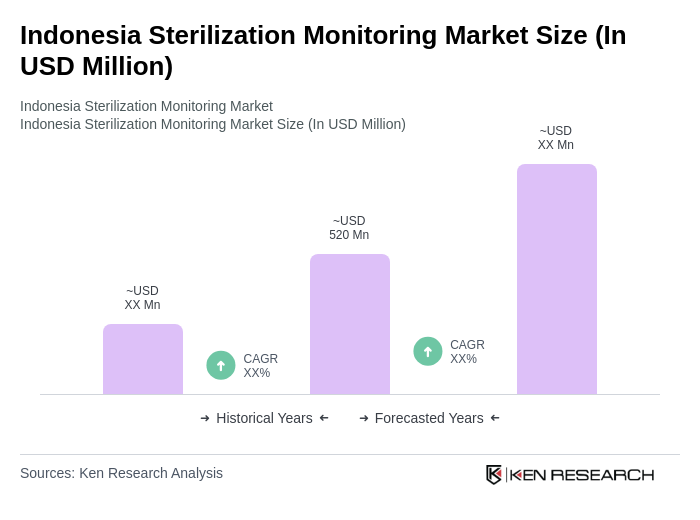
The Indonesia Sterilization Monitoring Market, valued at USD 520 million, grows due to rising healthcare standards, technological advancements, and government regulations on infection control.

Region:Asia

Author(s):Rebecca

Product Code:KRAC2623

Pages:86

Published On:October 2025
About the Report

Base Year 2024

Indonesia Sterilization Monitoring Market Overview

  • The Indonesia Sterilization Monitoring Market is valued at USD 520 million, based on a five-year historical analysis. This growth is primarily driven by the increasing demand for sterilization in healthcare facilities, rising awareness regarding infection control and patient safety, and the adoption of advanced sterilization monitoring technologies. The market is experiencing strong momentum due to technological advancements such as rapid-readout biological indicators, digital data logging systems, and automation, which are essential for ensuring compliance with evolving health regulations and zero-tolerance contamination policies. The integration of smart, connected devices and real-time validation systems is further accelerating market expansion as healthcare providers seek robust solutions for traceability and process documentation .
  • Key cities such as Jakarta, Surabaya, and Bandung dominate the market due to their high concentration of healthcare facilities, including hospitals and clinics. Urbanization and population density in these areas contribute to the increased demand for sterilization monitoring solutions, as healthcare providers strive to maintain high standards of hygiene and safety. The expansion of ambulatory surgery centers and outpatient facilities in these urban hubs is further driving the need for reliable and efficient sterilization monitoring systems .
  • The Indonesian government enforces sterilization protocols for healthcare facilities under the “Peraturan Menteri Kesehatan Republik Indonesia Nomor 27 Tahun 2017 tentang Pedoman Pencegahan dan Pengendalian Infeksi di Fasilitas Pelayanan Kesehatan” (Regulation of the Minister of Health of the Republic of Indonesia Number 27 of 2017 concerning Guidelines for Infection Prevention and Control in Healthcare Facilities), issued by the Ministry of Health. This regulation mandates validated sterilization monitoring systems, regular documentation, and compliance audits to enhance patient safety and reduce the risk of healthcare-associated infections, thereby driving demand for monitoring products and services nationwide .
Indonesia Sterilization Monitoring Market Size

Indonesia Sterilization Monitoring Market Segmentation

By Type:The sterilization monitoring market is segmented into Chemical Indicators, Biological Indicators, Physical Indicators, Integrating Indicators, Monitoring Systems, Accessories, and Others. Chemical indicators are widely used for routine process checks, while biological indicators are preferred for critical process validation due to their ability to confirm the destruction of microbial spores. Physical indicators, such as temperature and pressure monitoring devices, are essential for continuous process control. Integrating indicators and advanced monitoring systems are gaining traction for their ability to provide comprehensive validation and traceability, especially in high-throughput hospital and laboratory environments. Accessories include supporting products such as indicator tapes and test packs, which complement the main monitoring solutions .
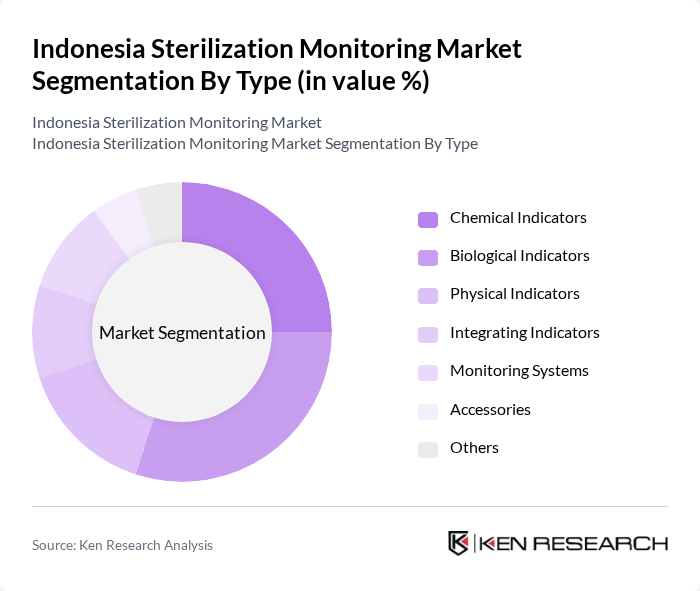
Indonesia Sterilization Monitoring Market segmentation by Type.

The Biological Indicators subsegment is currently dominating the market due to their critical role in validating sterilization processes. These indicators provide reliable evidence that sterilization has been achieved, which is essential for compliance with health regulations. The increasing focus on patient safety and infection control in healthcare facilities has led to a higher adoption rate of biological indicators, making them a preferred choice among healthcare providers. Rapid-readout biological indicators and automated loggers are further enhancing efficiency and traceability in sterilization validation .

By End-User:The market is segmented by end-users, including Hospitals, Clinics, Laboratories, Pharmaceutical Companies, Research Institutions, Food Processing Facilities, and Others. Hospitals require comprehensive sterilization monitoring due to the high volume of surgical procedures and stringent infection control standards. Clinics and laboratories rely on monitoring solutions for routine instrument reprocessing and sample integrity. Pharmaceutical companies and research institutions utilize advanced monitoring systems for regulatory compliance and product safety. Food processing facilities adopt sterilization monitoring to ensure product safety and meet food hygiene standards .
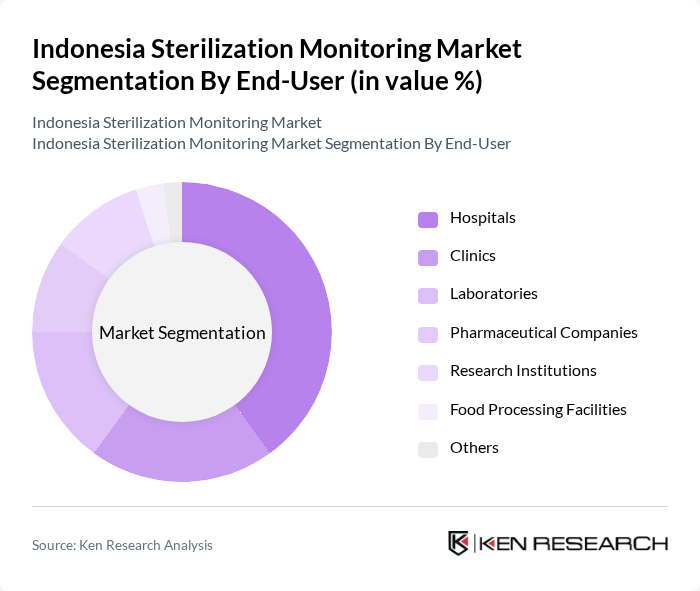
Indonesia Sterilization Monitoring Market segmentation by End-User.

Hospitals are the leading end-user segment, accounting for a significant portion of the market. This dominance is attributed to the high volume of surgical procedures and the stringent sterilization requirements in hospital settings. The increasing number of hospitals and the growing emphasis on infection control measures further drive the demand for sterilization monitoring solutions in this sector. The expansion of ambulatory surgery centers and outpatient facilities is also contributing to the rising adoption of advanced monitoring systems .

Indonesia Sterilization Monitoring Market Competitive Landscape

The Indonesia Sterilization Monitoring Market is characterized by a dynamic mix of regional and international players. Leading participants such as 3M Company, Getinge AB, STERIS Corporation, Belimed AG, Cantel Medical Corporation, Ecolab Inc., Halyard Health, Inc., Advanced Sterilization Products (ASP, a Fortive company), Mesa Laboratories, Inc., Becton, Dickinson and Company (BD), Thermo Fisher Scientific Inc., Hu-Friedy Mfg. Co., LLC, Aesculap, Inc. (B. Braun Group), Cardinal Health, Inc., PT Enseval Medika Prima (Indonesia), PT Rajawali Nusindo (Indonesia), PT Kimia Farma Tbk (Indonesia) contribute to innovation, geographic expansion, and service delivery in this space.

3M Company

1902

Maplewood, Minnesota, USA

Getinge AB

1904

Getinge, Sweden

STERIS Corporation

1985

Dublin, Ohio, USA

Belimed AG

1968

Zurich, Switzerland

Cantel Medical Corporation

1963

Little Falls, New Jersey, USA

Company

Establishment Year

Headquarters

Group Size (Large, Medium, or Small as per industry convention)

Revenue Growth Rate (Indonesia Sterilization Monitoring Segment)

Market Share in Indonesia

Number of Healthcare Facility Installations

Product Portfolio Breadth (Indicators, Systems, Services)

Regulatory Compliance Score (MOH, BPOM, ISO)

Indonesia Sterilization Monitoring Market Industry Analysis

Growth Drivers

  • Increasing Healthcare Standards:The Indonesian government has committed to enhancing healthcare standards, with a budget allocation of IDR 178.7 trillion (approximately USD 12 billion) for health services in future. This investment aims to improve hospital infrastructure and sterilization practices, ensuring compliance with international health regulations. As healthcare facilities upgrade their systems, the demand for sterilization monitoring products is expected to rise significantly, fostering a safer environment for patients and healthcare workers alike.
  • Rising Awareness of Infection Control:The COVID-19 pandemic has heightened awareness regarding infection control in Indonesia, leading to a 40% increase in demand for sterilization monitoring solutions in healthcare settings. Hospitals are now prioritizing infection prevention measures, resulting in a surge in the adoption of advanced sterilization technologies. This shift is supported by educational campaigns from health authorities, emphasizing the importance of effective sterilization in reducing healthcare-associated infections and improving patient outcomes.
  • Technological Advancements in Sterilization Methods:The Indonesian sterilization monitoring market is witnessing rapid technological advancements, with investments in innovative sterilization equipment projected to reach IDR 5 trillion (approximately USD 350 million) in future. These advancements include automated systems and IoT integration, which enhance monitoring accuracy and efficiency. As healthcare facilities adopt these technologies, the overall effectiveness of sterilization processes improves, driving further demand for sophisticated monitoring solutions in the market.

Market Challenges

  • High Costs of Advanced Sterilization Equipment:The initial investment required for advanced sterilization equipment in Indonesia can be prohibitive, with costs ranging from IDR 500 million to IDR 2 billion (approximately USD 35,000 to USD 140,000). Many healthcare facilities, particularly in rural areas, struggle to allocate sufficient budgets for these technologies. This financial barrier limits the widespread adoption of effective sterilization monitoring solutions, hindering overall market growth and compliance with health standards.
  • Lack of Trained Personnel:A significant challenge in the Indonesian sterilization monitoring market is the shortage of trained personnel capable of operating advanced sterilization equipment. According to the Ministry of Health, only 30% of healthcare workers have received adequate training in sterilization practices. This skills gap leads to improper use of sterilization technologies, increasing the risk of infection and undermining the effectiveness of monitoring systems. Addressing this issue is crucial for improving market performance and patient safety.

Indonesia Sterilization Monitoring Market Future Outlook

The future of the Indonesian sterilization monitoring market appears promising, driven by ongoing investments in healthcare infrastructure and a growing emphasis on infection control. As hospitals and clinics increasingly adopt automated and IoT-enabled sterilization solutions, the market is expected to evolve rapidly. Additionally, government initiatives aimed at enhancing healthcare quality will likely spur further advancements in sterilization technologies, ensuring compliance with international standards and improving patient safety across the nation.

Market Opportunities

  • Expansion of Healthcare Facilities:The Indonesian government plans to establish 1,000 new healthcare facilities in future, creating significant opportunities for sterilization monitoring product suppliers. This expansion will necessitate the implementation of effective sterilization practices, driving demand for advanced monitoring solutions to ensure compliance with health regulations and enhance patient safety.
  • Collaborations with International Firms:Collaborations between local Indonesian companies and international firms specializing in sterilization technologies can enhance market growth. Such partnerships can facilitate knowledge transfer, improve product offerings, and increase access to advanced sterilization monitoring solutions, ultimately benefiting healthcare providers and patients across Indonesia.

Scope of the Report

SegmentSub-Segments
By Type

Chemical Indicators

Biological Indicators

Physical Indicators

Integrating Indicators

Monitoring Systems

Accessories

Others

By End-User

Hospitals

Clinics

Laboratories

Pharmaceutical Companies

Research Institutions

Food Processing Facilities

Others

By Application

Surgical Procedures

Laboratory Testing

Pharmaceutical Manufacturing

Medical Device Sterilization

Food Safety Monitoring

Others

By Distribution Channel

Direct Sales

Distributors

Online Sales

Retail Outlets

Others

By Region

Java

Sumatra

Bali

Kalimantan

Sulawesi

Papua

Others

By Price Range

Low

Medium

High

By Technology

Manual Monitoring

Automated Monitoring

Digital Monitoring

Rapid Readout Systems

Others

Key Target Audience

Investors and Venture Capitalist Firms

Government and Regulatory Bodies (e.g., Ministry of Health, National Agency of Drug and Food Control)

Manufacturers and Producers

Distributors and Retailers

Healthcare Providers and Hospitals

Medical Device Regulatory Authorities

Industry Associations and Trade Organizations

Financial Institutions and Banks

Players Mentioned in the Report:

3M Company

Getinge AB

STERIS Corporation

Belimed AG

Cantel Medical Corporation

Ecolab Inc.

Halyard Health, Inc.

Advanced Sterilization Products (ASP, a Fortive company)

Mesa Laboratories, Inc.

Becton, Dickinson and Company (BD)

Thermo Fisher Scientific Inc.

Hu-Friedy Mfg. Co., LLC

Aesculap, Inc. (B. Braun Group)

Cardinal Health, Inc.

PT Enseval Medika Prima (Indonesia)

PT Rajawali Nusindo (Indonesia)

PT Kimia Farma Tbk (Indonesia)

Table of Contents

Market Assessment Phase

1. Executive Summary and Approach


2. Indonesia Sterilization Monitoring Market Overview

2.1 Key Insights and Strategic Recommendations

2.2 Indonesia Sterilization Monitoring Market Overview

2.3 Definition and Scope

2.4 Evolution of Market Ecosystem

2.5 Timeline of Key Regulatory Milestones

2.6 Value Chain & Stakeholder Mapping

2.7 Business Cycle Analysis

2.8 Policy & Incentive Landscape


3. Indonesia Sterilization Monitoring Market Analysis

3.1 Growth Drivers

3.1.1 Increasing healthcare standards
3.1.2 Rising awareness of infection control
3.1.3 Government initiatives for healthcare improvement
3.1.4 Technological advancements in sterilization methods

3.2 Market Challenges

3.2.1 High costs of advanced sterilization equipment
3.2.2 Lack of trained personnel
3.2.3 Regulatory compliance complexities
3.2.4 Limited access in rural areas

3.3 Market Opportunities

3.3.1 Expansion of healthcare facilities
3.3.2 Growth in the pharmaceutical sector
3.3.3 Increasing demand for sterilization monitoring products
3.3.4 Collaborations with international firms

3.4 Market Trends

3.4.1 Shift towards automated sterilization monitoring
3.4.2 Integration of IoT in sterilization processes
3.4.3 Focus on sustainable and eco-friendly solutions
3.4.4 Rising demand for real-time monitoring systems

3.5 Government Regulation

3.5.1 Standards for sterilization practices
3.5.2 Compliance requirements for healthcare facilities
3.5.3 Guidelines for sterilization monitoring products
3.5.4 Incentives for adopting advanced technologies

4. SWOT Analysis


5. Stakeholder Analysis


6. Porter's Five Forces Analysis


7. Indonesia Sterilization Monitoring Market Market Size, 2019-2024

7.1 By Value

7.2 By Volume

7.3 By Average Selling Price


8. Indonesia Sterilization Monitoring Market Segmentation

8.1 By Type

8.1.1 Chemical Indicators
8.1.2 Biological Indicators
8.1.3 Physical Indicators
8.1.4 Integrating Indicators
8.1.5 Monitoring Systems
8.1.6 Accessories
8.1.7 Others

8.2 By End-User

8.2.1 Hospitals
8.2.2 Clinics
8.2.3 Laboratories
8.2.4 Pharmaceutical Companies
8.2.5 Research Institutions
8.2.6 Food Processing Facilities
8.2.7 Others

8.3 By Application

8.3.1 Surgical Procedures
8.3.2 Laboratory Testing
8.3.3 Pharmaceutical Manufacturing
8.3.4 Medical Device Sterilization
8.3.5 Food Safety Monitoring
8.3.6 Others

8.4 By Distribution Channel

8.4.1 Direct Sales
8.4.2 Distributors
8.4.3 Online Sales
8.4.4 Retail Outlets
8.4.5 Others

8.5 By Region

8.5.1 Java
8.5.2 Sumatra
8.5.3 Bali
8.5.4 Kalimantan
8.5.5 Sulawesi
8.5.6 Papua
8.5.7 Others

8.6 By Price Range

8.6.1 Low
8.6.2 Medium
8.6.3 High

8.7 By Technology

8.7.1 Manual Monitoring
8.7.2 Automated Monitoring
8.7.3 Digital Monitoring
8.7.4 Rapid Readout Systems
8.7.5 Others

9. Indonesia Sterilization Monitoring Market Competitive Analysis

9.1 Market Share of Key Players

9.2 KPIs for Cross Comparison of Key Players

9.2.1 Company Name
9.2.2 Group Size (Large, Medium, or Small as per industry convention)
9.2.3 Revenue Growth Rate (Indonesia Sterilization Monitoring Segment)
9.2.4 Market Share in Indonesia
9.2.5 Number of Healthcare Facility Installations
9.2.6 Product Portfolio Breadth (Indicators, Systems, Services)
9.2.7 Regulatory Compliance Score (MOH, BPOM, ISO)
9.2.8 Distribution Network Coverage (Regions/Channels)
9.2.9 Local Manufacturing/Import Ratio
9.2.10 After-Sales Service Quality Index
9.2.11 Innovation Rate (New Product Launches, Patents)
9.2.12 Brand Recognition Score (Indonesia Healthcare Market)

9.3 SWOT Analysis of Top Players

9.4 Pricing Analysis

9.5 Detailed Profile of Major Companies

9.5.1 3M Company
9.5.2 Getinge AB
9.5.3 STERIS Corporation
9.5.4 Belimed AG
9.5.5 Cantel Medical Corporation
9.5.6 Ecolab Inc.
9.5.7 Halyard Health, Inc.
9.5.8 Advanced Sterilization Products (ASP, a Fortive company)
9.5.9 Mesa Laboratories, Inc.
9.5.10 Becton, Dickinson and Company (BD)
9.5.11 Thermo Fisher Scientific Inc.
9.5.12 Hu-Friedy Mfg. Co., LLC
9.5.13 Aesculap, Inc. (B. Braun Group)
9.5.14 Cardinal Health, Inc.
9.5.15 PT Enseval Medika Prima (Indonesia)
9.5.16 PT Rajawali Nusindo (Indonesia)
9.5.17 PT Kimia Farma Tbk (Indonesia)

10. Indonesia Sterilization Monitoring Market End-User Analysis

10.1 Procurement Behavior of Key Ministries

10.1.1 Budget Allocation Trends
10.1.2 Procurement Processes
10.1.3 Preferred Suppliers

10.2 Corporate Spend on Infrastructure & Energy

10.2.1 Investment in Sterilization Technologies
10.2.2 Budgeting for Compliance
10.2.3 Spending on Training and Development

10.3 Pain Point Analysis by End-User Category

10.3.1 Equipment Reliability Issues
10.3.2 Training Gaps
10.3.3 Compliance Challenges

10.4 User Readiness for Adoption

10.4.1 Awareness Levels
10.4.2 Training Needs
10.4.3 Technology Acceptance

10.5 Post-Deployment ROI and Use Case Expansion

10.5.1 Measurement of Effectiveness
10.5.2 Expansion Opportunities
10.5.3 Long-term Benefits

11. Indonesia Sterilization Monitoring Market Future Size, 2025-2030

11.1 By Value

11.2 By Volume

11.3 By Average Selling Price


Go-To-Market Strategy Phase

1. Whitespace Analysis + Business Model Canvas

1.1 Market Gaps Identification

1.2 Value Proposition Development

1.3 Revenue Streams

1.4 Key Resources

1.5 Key Activities

1.6 Key Partnerships

1.7 Customer Segments


2. Marketing and Positioning Recommendations

2.1 Branding Strategies

2.2 Product USPs


3. Distribution Plan

3.1 Urban Retail Strategies

3.2 Rural NGO Tie-ups


4. Channel & Pricing Gaps

4.1 Underserved Routes

4.2 Pricing Bands


5. Unmet Demand & Latent Needs

5.1 Category Gaps

5.2 Consumer Segments


6. Customer Relationship

6.1 Loyalty Programs

6.2 After-sales Service


7. Value Proposition

7.1 Sustainability

7.2 Integrated Supply Chains


8. Key Activities

8.1 Regulatory Compliance

8.2 Branding

8.3 Distribution Setup


9. Entry Strategy Evaluation

9.1 Domestic Market Entry Strategy

9.1.1 Product Mix
9.1.2 Pricing Band
9.1.3 Packaging

9.2 Export Entry Strategy

9.2.1 Target Countries
9.2.2 Compliance Roadmap

10. Entry Mode Assessment

10.1 Joint Ventures

10.2 Greenfield Investments

10.3 Mergers & Acquisitions

10.4 Distributor Model


11. Capital and Timeline Estimation

11.1 Capital Requirements

11.2 Timelines


12. Control vs Risk Trade-Off

12.1 Ownership vs Partnerships


13. Profitability Outlook

13.1 Breakeven Analysis

13.2 Long-term Sustainability


14. Potential Partner List

14.1 Distributors

14.2 Joint Ventures

14.3 Acquisition Targets


15. Execution Roadmap

15.1 Phased Plan for Market Entry

15.1.1 Market Setup
15.1.2 Market Entry
15.1.3 Growth Acceleration
15.1.4 Scale & Stabilize

15.2 Key Activities and Milestones

15.2.1 Milestone Planning
15.2.2 Activity Tracking

Research Methodology

ApproachModellingSample

Phase 1: Approach1

Desk Research

  • Analysis of government health reports and sterilization guidelines from the Indonesian Ministry of Health
  • Review of industry publications and market reports on sterilization technologies and practices
  • Examination of demographic data and healthcare infrastructure statistics relevant to sterilization needs

Primary Research

  • Interviews with hospital administrators and sterilization unit managers to understand operational challenges
  • Surveys with medical device manufacturers to gauge market trends and product offerings
  • Focus groups with healthcare professionals to gather insights on sterilization practices and preferences

Validation & Triangulation

  • Cross-validation of findings through multiple data sources, including industry reports and expert opinions
  • Triangulation of market data with sales figures from leading sterilization equipment suppliers
  • Sanity checks conducted through expert panel discussions to ensure data reliability

Phase 2: Market Size Estimation1

Top-down Assessment

  • Estimation of total healthcare expenditure in Indonesia as a basis for sterilization market size
  • Segmentation of the market by sterilization methods (e.g., steam, ethylene oxide, hydrogen peroxide) and end-user facilities
  • Incorporation of government health initiatives aimed at improving sterilization standards in healthcare facilities

Bottom-up Modeling

  • Collection of data on sterilization equipment sales from major suppliers in the Indonesian market
  • Estimation of operational costs associated with sterilization processes in hospitals and clinics
  • Volume and frequency analysis of sterilization procedures performed across various healthcare settings

Forecasting & Scenario Analysis

  • Multi-factor regression analysis considering population growth, healthcare access, and infection rates
  • Scenario modeling based on potential regulatory changes and advancements in sterilization technology
  • Development of baseline, optimistic, and pessimistic market projections through 2030

Phase 3: CATI Sample Composition1

Scope Item/SegmentSample SizeTarget Respondent Profiles
Hospital Sterilization Units100Sterilization Managers, Infection Control Officers
Private Clinics and Healthcare Facilities70Clinic Owners, Medical Directors
Medical Device Manufacturers50Product Managers, Sales Executives
Regulatory Bodies and Health Authorities40Policy Makers, Health Inspectors
Research Institutions and Universities40Healthcare Researchers, Academic Professors

Frequently Asked Questions

What is the current value of the Indonesia Sterilization Monitoring Market?

The Indonesia Sterilization Monitoring Market is valued at approximately USD 520 million, reflecting a significant growth driven by increasing demand for sterilization in healthcare facilities and advancements in monitoring technologies.

What factors are driving the growth of the sterilization monitoring market in Indonesia?

Which cities in Indonesia are leading in the sterilization monitoring market?

What types of sterilization monitoring products are available in the Indonesian market?

Other Regional/Country Reports

GCC Sterilization Monitoring MarketVietnam sterilization monitoring market report Size, Share, Growth Drivers, Trends, Opportunities & Forecast 2025–2030

Malaysia Sterilization Monitoring Market

KSA Sterilization Monitoring Market

APAC Sterilization Monitoring Market

SEA Sterilization Monitoring Market

Why Buy From Us?

Refine Robust Result (RRR) Framework

What makes us stand out is that our consultants follow Robust, Refine and Result (RRR) methodology. Robust for clear definitions, approaches and sanity checking, Refine for differentiating respondents' facts and opinions, and Result for presenting data with story.

Our Reach Is Unmatched

We have set a benchmark in the industry by offering our clients with syndicated and customized market research reports featuring coverage of entire market as well as meticulous research and analyst insights.

Shifting the Research Paradigm

While we don't replace traditional research, we flip the method upside down. Our dual approach of Top Bottom & Bottom Top ensures quality deliverable by not just verifying company fundamentals but also looking at the sector and macroeconomic factors.

More Insights-Better Decisions

With one step in the future, our research team constantly tries to show you the bigger picture. We help with some of the tough questions you may encounter along the way: How is the industry positioned? Best marketing channel? KPI's of competitors? By aligning every element, we help maximize success.

Transparency and Trust

Our report gives you instant access to the answers and sources that other companies might choose to hide. We elaborate each steps of research methodology we have used and showcase you the sample size to earn your trust.

Round the Clock Support

If you need any support, we are here! We pride ourselves on universe strength, data quality, and quick, friendly, and professional service.

Why Clients Choose Us?

400000+
Reports in repository
150+
Consulting projects a year
100+
Analysts
8000+
Client Queries in 2022








