About the Report
Base Year 2024Listen to the audio summary
Indonesia Veterinary Antibiotics Market Overview
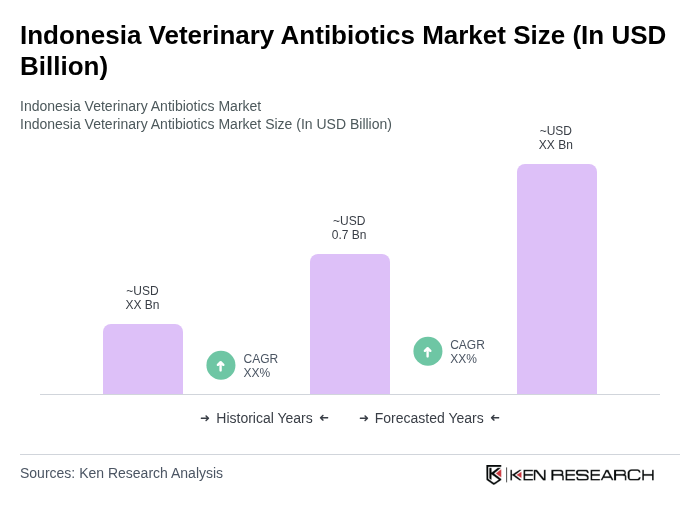
- The Indonesia Veterinary Antibiotics Market is valued at USD 0.7 billion, based on a five-year historical analysis of regional and country?level animal antibiotics and broader animal health data for Asia Pacific. This growth is primarily driven by the increasing demand for animal protein, rising livestock and poultry populations, and the need for effective disease management in commercial farming systems. The market is also influenced by stronger awareness of animal health and welfare among farmers and consumers, supported by government and industry programs promoting prudent antimicrobial use and biosecurity to safeguard food safety.
- Key regions dominating the market include Java, Sumatra, and Kalimantan. Java, being the most populous island, has a high concentration of commercial broiler, layer, and ruminant farms, which drives the demand for veterinary antibiotics and other animal health products. Sumatra and Kalimantan also contribute significantly due to extensive plantation-based livestock integration and rapidly developing aquaculture clusters for fish and shrimp, making them vital areas for market growth.
- In 2023, the Indonesian government implemented a regulation mandating the responsible use of antibiotics in livestock. This regulation aims to combat antibiotic resistance and ensure the safety of animal products. It requires farmers to adhere to guidelines for antibiotic usage, including prescription requirements and monitoring of antibiotic residues in food products, thereby promoting sustainable practices in the veterinary sector; a key example is Regulation of the Minister of Agriculture of the Republic of Indonesia Number 14/Permentan/PK.350/5/2017 on the Classification of Veterinary Drugs, which establishes prescription-only status for many antibiotics, sets maximum residue limits in food?producing animals, and defines obligations for veterinarians, feed mills, and farms on storage, recording, and supervision of antimicrobial use.
Indonesia Veterinary Antibiotics Market Segmentation
By Drug Class:The market is segmented into various drug classes, including Tetracyclines, Penicillins, Macrolides, Sulfonamides, Aminoglycosides, Fluoroquinolones, and Others, which broadly aligns with global veterinary antibiotics classifications. Each of these classes serves specific therapeutic needs in veterinary medicine, with differing usage intensity across poultry, swine, ruminants, and aquaculture depending on disease profile, resistance concerns, and stewardship policies.
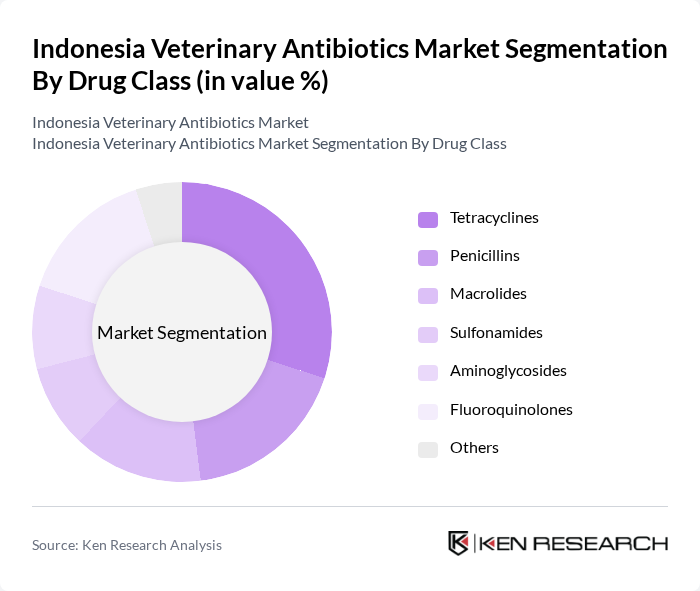
The Tetracyclines segment is currently dominating the market due to its broad-spectrum efficacy against a wide range of bacterial infections in livestock and poultry and its relatively favorable cost profile for mass medication. This class of antibiotics is widely used for therapeutic indications such as respiratory and enteric diseases and, under stricter stewardship frameworks, is increasingly administered under veterinary prescription and targeted metaphylaxis rather than routine growth promotion. The increasing prevalence of bacterial infections in intensive poultry and ruminant systems, combined with higher awareness of timely treatment to reduce mortality and productivity losses, continues to drive demand for Tetracyclines, solidifying its position as the leading drug class in the market.
By Animal Type:The market is segmented by animal type, including Cattle, Swine, Poultry, Aquaculture (Fish & Shrimp), Companion Animals (Dogs, Cats, Others), and Others. Each segment reflects the specific needs and consumption patterns of veterinary antibiotics across different animal categories, mirroring the broader split between food?producing animals and companion animals used in international market analyses.
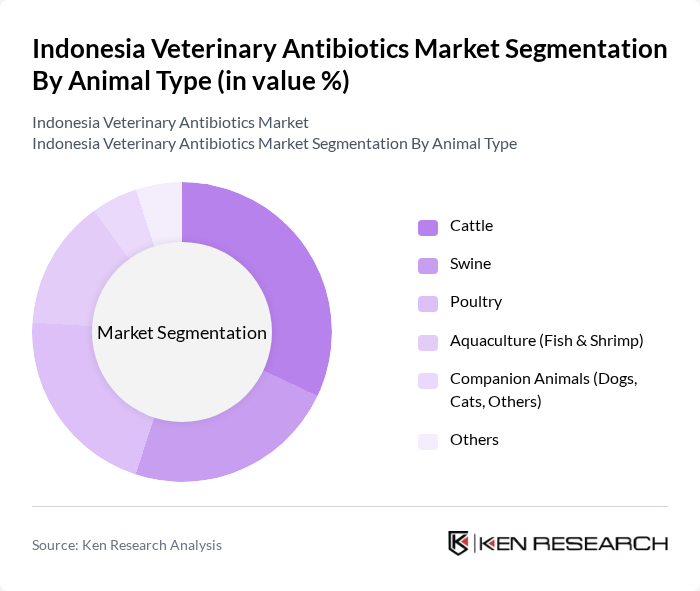
The Cattle segment leads the market due to the high and rising demand for beef and dairy products in Indonesia, supported by national programs to improve local beef self?sufficiency and dairy productivity. The increasing cattle population in feedlot and smallholder systems and the need for effective control of respiratory, mastitis, and reproductive infections are driving the consumption of veterinary antibiotics in this segment, consistent with global findings that cattle account for the largest share of animal antibiotics use by value. Additionally, the growing trend of more intensive and semi?intensive farming practices among cattle producers, alongside herd health programs recommended by veterinarians and integrators, is further propelling the demand for antibiotics, making it the most significant animal type in the market.
Indonesia Veterinary Antibiotics Market Competitive Landscape
The Indonesia Veterinary Antibiotics Market is characterized by a dynamic mix of regional and international players. Leading participants such as PT Medion Farma Jaya, PT Vaksindo Satwa Nusantara, PT Indofarma Tbk, PT Kimia Farma Tbk, PT Sanbe Farma, PT Sido Muncul Tbk, PT Bintang Toedjoe, PT Novartis Indonesia, PT Bayer Indonesia, PT Zoetis Animal Health Indonesia, PT Merck Sharp & Dohme Pharma Tbk, PT Elanco Animal Health Indonesia, PT Interchemie Werken De Adelaar Indonesia, PT Biotis Agrindo, PT Biogenesis Bagó contribute to innovation, geographic expansion, and service delivery in this space.
Indonesia Veterinary Antibiotics Market Industry Analysis
Growth Drivers
- Increasing Livestock Production:Indonesia's livestock sector is projected to produce approximately 1.5 million tons of beef and 2.3 million tons of poultry in future, driven by rising domestic demand. The country's population, expected to reach 277 million, necessitates increased meat production. This growth in livestock production directly correlates with the demand for veterinary antibiotics, as farmers seek to maintain animal health and productivity, ensuring a stable supply of meat to meet consumer needs.
- Rising Awareness of Animal Health:The Indonesian government has initiated various campaigns to promote animal health awareness, resulting in a significant increase in veterinary consultations. In future, it is estimated that over 62% of livestock owners will seek veterinary services regularly, up from 45% in 2020. This heightened awareness leads to increased usage of veterinary antibiotics, as farmers recognize the importance of disease prevention and treatment in maintaining healthy livestock and enhancing productivity.
- Government Initiatives for Veterinary Care:The Indonesian government allocated approximately IDR 1.3 trillion (around USD 85 million) in future for veterinary health programs, including antibiotic distribution and education. These initiatives aim to improve animal health standards and reduce disease outbreaks. As a result, the demand for veterinary antibiotics is expected to rise, as farmers will have better access to necessary medications and knowledge on responsible usage, ultimately supporting livestock productivity and health.
Market Challenges
- Antimicrobial Resistance Concerns:The rise of antimicrobial resistance (AMR) poses a significant challenge in Indonesia, with an estimated 52% of antibiotics used in livestock contributing to this issue. The World Health Organization (WHO) has identified Indonesia as a high-risk country for AMR, which could lead to stricter regulations on antibiotic usage. This situation may hinder the availability of essential veterinary antibiotics, impacting livestock health and productivity in the long term.
- Regulatory Compliance Issues:The veterinary antibiotics market in Indonesia faces challenges related to regulatory compliance, with over 32% of veterinary products on the market lacking proper registration. The Ministry of Agriculture has implemented stricter regulations, requiring all veterinary antibiotics to be registered in future. This compliance burden may limit the availability of certain products, affecting farmers' access to necessary treatments and potentially leading to increased livestock health issues.
Indonesia Veterinary Antibiotics Market Future Outlook
The future of the Indonesian veterinary antibiotics market appears promising, driven by increasing livestock production and government support for animal health initiatives. As awareness of responsible antibiotic use grows, the market is likely to see a shift towards preventive healthcare practices. Additionally, advancements in veterinary medicine and technology will enhance treatment options, ensuring better health outcomes for livestock. The focus on sustainable practices will also shape the market, as consumers increasingly demand antibiotic-free meat products.
Market Opportunities
- Expansion of Veterinary Services:The Indonesian veterinary services sector is expected to expand significantly, with an estimated 22% increase in veterinary clinics in future. This growth will provide farmers with better access to veterinary care and antibiotics, ultimately improving livestock health and productivity. Enhanced veterinary services will also facilitate education on responsible antibiotic use, addressing concerns related to antimicrobial resistance.
- Development of New Antibiotic Formulations:There is a growing opportunity for the development of innovative antibiotic formulations tailored to local livestock needs. With an estimated investment of IDR 550 billion (approximately USD 36 million) in research and development in future, pharmaceutical companies can create effective solutions that address specific health challenges in Indonesian livestock, enhancing overall animal welfare and productivity.
Scope of the Report
| Segment | Sub-Segments |
|---|---|
| By Drug Class | Tetracyclines Penicillins Macrolides Sulfonamides Aminoglycosides Fluoroquinolones Others |
| By Animal Type | Cattle Swine Poultry Aquaculture (Fish & Shrimp) Companion Animals (Dogs, Cats, Others) Others |
| By Application | Therapeutic Prophylactic / Metaphylactic Growth Promotion Others |
| By Route of Administration | Oral Injectable (Parenteral) Topical In-feed / In-water Others |
| By End-User | Commercial Animal Farms Veterinary Hospitals & Clinics Government & Institutional Buyers Others |
| By Distribution Channel | Prescription-Based Over-the-Counter (OTC) Online / E-commerce Others |
| By Region | Java Sumatra Kalimantan Sulawesi Others |
Key Target Audience
Investors and Venture Capitalist Firms
Government and Regulatory Bodies (e.g., Ministry of Agriculture, National Food Security Agency)
Veterinary Pharmaceutical Manufacturers
Animal Health Product Distributors
Livestock Producers and Farmers' Cooperatives
Veterinary Clinics and Animal Hospitals
Industry Associations (e.g., Indonesian Veterinary Medical Association)
Financial Institutions and Banks
Players Mentioned in the Report:
PT Medion Farma Jaya
PT Vaksindo Satwa Nusantara
PT Indofarma Tbk
PT Kimia Farma Tbk
PT Sanbe Farma
PT Sido Muncul Tbk
PT Bintang Toedjoe
PT Novartis Indonesia
PT Bayer Indonesia
PT Zoetis Animal Health Indonesia
PT Merck Sharp & Dohme Pharma Tbk
PT Elanco Animal Health Indonesia
PT Interchemie Werken De Adelaar Indonesia
PT Biotis Agrindo
PT Biogenesis Bago
Table of Contents
Market Assessment Phase
1. Executive Summary and Approach
2. Indonesia Veterinary Antibiotics Market Overview
2.1 Key Insights and Strategic Recommendations
2.2 Indonesia Veterinary Antibiotics Market Overview
2.3 Definition and Scope
2.4 Evolution of Market Ecosystem
2.5 Timeline of Key Regulatory Milestones
2.6 Value Chain & Stakeholder Mapping
2.7 Business Cycle Analysis
2.8 Policy & Incentive Landscape
3. Indonesia Veterinary Antibiotics Market Analysis
3.1 Growth Drivers
3.1.1 Increasing livestock production
3.1.2 Rising awareness of animal health
3.1.3 Government initiatives for veterinary care
3.1.4 Growth in aquaculture
3.2 Market Challenges
3.2.1 Antimicrobial resistance concerns
3.2.2 Regulatory compliance issues
3.2.3 High cost of veterinary services
3.2.4 Limited access to quality antibiotics
3.3 Market Opportunities
3.3.1 Expansion of veterinary services
3.3.2 Development of new antibiotic formulations
3.3.3 Increasing demand for organic livestock products
3.3.4 Technological advancements in veterinary medicine
3.4 Market Trends
3.4.1 Shift towards preventive healthcare
3.4.2 Growth of e-commerce in veterinary products
3.4.3 Rising consumer preference for antibiotic-free meat
3.4.4 Increased investment in veterinary research
3.5 Government Regulation
3.5.1 Stricter regulations on antibiotic use
3.5.2 Implementation of veterinary drug monitoring systems
3.5.3 Guidelines for responsible antibiotic use
3.5.4 Support for veterinary education and training
4. SWOT Analysis
5. Stakeholder Analysis
6. Porter's Five Forces Analysis
7. Indonesia Veterinary Antibiotics Market Market Size, 2019-2024
7.1 By Value
7.2 By Volume
7.3 By Average Selling Price
8. Indonesia Veterinary Antibiotics Market Segmentation
8.1 By Drug Class
8.1.1 Tetracyclines
8.1.2 Penicillins
8.1.3 Macrolides
8.1.4 Sulfonamides
8.1.5 Aminoglycosides
8.1.6 Fluoroquinolones
8.1.7 Others
8.2 By Animal Type
8.2.1 Cattle
8.2.2 Swine
8.2.3 Poultry
8.2.4 Aquaculture (Fish & Shrimp)
8.2.5 Companion Animals (Dogs, Cats, Others)
8.2.6 Others
8.3 By Application
8.3.1 Therapeutic
8.3.2 Prophylactic / Metaphylactic
8.3.3 Growth Promotion
8.3.4 Others
8.4 By Route of Administration
8.4.1 Oral
8.4.2 Injectable (Parenteral)
8.4.3 Topical
8.4.4 In-feed / In-water
8.4.5 Others
8.5 By End-User
8.5.1 Commercial Animal Farms
8.5.2 Veterinary Hospitals & Clinics
8.5.3 Government & Institutional Buyers
8.5.4 Others
8.6 By Distribution Channel
8.6.1 Prescription-Based
8.6.2 Over-the-Counter (OTC)
8.6.3 Online / E-commerce
8.6.4 Others
8.7 By Region
8.7.1 Java
8.7.2 Sumatra
8.7.3 Kalimantan
8.7.4 Sulawesi
8.7.5 Others
9. Indonesia Veterinary Antibiotics Market Competitive Analysis
9.1 Market Share of Key Players
9.2 Cross Comparison of Key Players
9.2.1 Company Name
9.2.2 Group Size (Large, Medium, or Small as per industry convention)
9.2.3 Indonesia Veterinary Antibiotics Revenue (USD, latest year)
9.2.4 3-Year Revenue CAGR (%) – Indonesia Veterinary Antibiotics
9.2.5 EBITDA Margin (%) – Indonesia Operations
9.2.6 Market Share (%) – Indonesia Veterinary Antibiotics
9.2.7 R&D Intensity (% of Revenue)
9.2.8 Capex Intensity (% of Revenue)
9.2.9 Average Realization per Unit (IDR / dose or pack)
9.2.10 Distribution Reach (Number of Provinces / Active Channel Partners)
9.2.11 Customer Concentration (Top 5 Customers’ Share %)
9.2.12 Regulatory Compliance Track Record (Number of Warnings / Recalls in last 5 years)
9.3 SWOT Analysis of Top Players
9.4 Pricing Analysis
9.5 Detailed Profile of Major Companies
9.5.1 PT Medion Farma Jaya
9.5.2 PT Vaksindo Satwa Nusantara
9.5.3 PT Indofarma Tbk
9.5.4 PT Kimia Farma Tbk
9.5.5 PT Sanbe Farma
9.5.6 PT Sido Muncul Tbk
9.5.7 PT Bintang Toedjoe
9.5.8 PT Novartis Indonesia
9.5.9 PT Bayer Indonesia
9.5.10 PT Zoetis Animal Health Indonesia
9.5.11 PT Merck Sharp & Dohme Pharma Tbk
9.5.12 PT Elanco Animal Health Indonesia
9.5.13 PT Interchemie Werken De Adelaar Indonesia
9.5.14 PT Biotis Agrindo
9.5.15 PT Biogenesis Bagó
10. Indonesia Veterinary Antibiotics Market End-User Analysis
10.1 Procurement Behavior of Key Ministries
10.1.1 Ministry of Agriculture
10.1.2 Ministry of Health
10.1.3 Ministry of Fisheries and Marine Affairs
10.1.4 Ministry of Trade
10.2 Corporate Spend on Infrastructure & Energy
10.2.1 Investment in veterinary infrastructure
10.2.2 Funding for research and development
10.3 Pain Point Analysis by End-User Category
10.3.1 Livestock producers
10.3.2 Poultry farmers
10.3.3 Aquaculture operators
10.3.4 Veterinary clinics
10.4 User Readiness for Adoption
10.4.1 Awareness of antibiotic resistance
10.4.2 Training and education needs
10.5 Post-Deployment ROI and Use Case Expansion
10.5.1 Cost savings from improved animal health
10.5.2 Expansion into new markets
11. Indonesia Veterinary Antibiotics Market Future Size, 2025-2030
11.1 By Value
11.2 By Volume
11.3 By Average Selling Price
Go-To-Market Strategy Phase
1. Whitespace Analysis + Business Model Canvas
1.1 Market Gaps Identification
1.2 Business Model Development
2. Marketing and Positioning Recommendations
2.1 Branding Strategies
2.2 Product USPs
3. Distribution Plan
3.1 Urban Retail vs Rural NGO Tie-ups
4. Channel & Pricing Gaps
4.1 Underserved Routes
4.2 Pricing Bands
5. Unmet Demand & Latent Needs
5.1 Category Gaps
5.2 Consumer Segments
6. Customer Relationship
6.1 Loyalty Programs
6.2 After-sales Service
7. Value Proposition
7.1 Sustainability
7.2 Integrated Supply Chains
8. Key Activities
8.1 Regulatory Compliance
8.2 Branding
8.3 Distribution Setup
9. Entry Strategy Evaluation
9.1 Domestic Market Entry Strategy
9.1.1 Product Mix
9.1.2 Pricing Band
9.1.3 Packaging
9.2 Export Entry Strategy
9.2.1 Target Countries
9.2.2 Compliance Roadmap
10. Entry Mode Assessment
10.1 JV
10.2 Greenfield
10.3 M&A
10.4 Distributor Model
11. Capital and Timeline Estimation
11.1 Capital Requirements
11.2 Timelines
12. Control vs Risk Trade-Off
12.1 Ownership vs Partnerships
13. Profitability Outlook
13.1 Breakeven Analysis
13.2 Long-term Sustainability
14. Potential Partner List
14.1 Distributors
14.2 JVs
14.3 Acquisition Targets
15. Execution Roadmap
15.1 Phased Plan for Market Entry
15.1.1 Market Setup
15.1.2 Market Entry
15.1.3 Growth Acceleration
15.1.4 Scale & Stabilize
15.2 Key Activities and Milestones
15.2.1 Milestone Planning
Research Methodology
Phase 1: Approach1
Desk Research
- Analysis of industry reports from veterinary associations and agricultural departments in Indonesia
- Review of published market studies and white papers on antibiotic usage in livestock
- Examination of regulatory frameworks and guidelines from the Indonesian Ministry of Agriculture
Primary Research
- Interviews with veterinarians and livestock farmers to understand antibiotic usage patterns
- Surveys with distributors and suppliers of veterinary antibiotics to gauge market dynamics
- Focus group discussions with industry experts and stakeholders in animal health
Validation & Triangulation
- Cross-validation of findings through multiple data sources including government reports and industry insights
- Triangulation of data from primary interviews and secondary research to ensure consistency
- Sanity checks conducted through expert panel reviews to validate assumptions and findings
Phase 2: Market Size Estimation1
Top-down Assessment
- Estimation of total market size based on national livestock population and antibiotic consumption rates
- Segmentation of the market by type of livestock (e.g., poultry, cattle, aquaculture)
- Incorporation of trends in antibiotic resistance and regulatory impacts on market size
Bottom-up Modeling
- Collection of sales data from major veterinary antibiotic manufacturers and distributors
- Estimation of average pricing and volume sold across different antibiotic categories
- Analysis of growth rates based on historical sales data and projected livestock growth
Forecasting & Scenario Analysis
- Development of forecasting models based on historical trends and future market drivers
- Scenario analysis considering potential regulatory changes and shifts in consumer behavior
- Creation of baseline, optimistic, and pessimistic forecasts through 2030
Phase 3: CATI Sample Composition1
| Scope Item/Segment | Sample Size | Target Respondent Profiles |
|---|---|---|
| Poultry Antibiotic Usage | 150 | Poultry Farmers, Veterinary Technicians |
| Cattle Antibiotic Distribution | 100 | Cattle Ranchers, Livestock Feed Suppliers |
| Aquaculture Antibiotic Practices | 80 | Aquaculture Farmers, Fishery Managers |
| Veterinary Clinics and Hospitals | 70 | Veterinarians, Clinic Managers |
| Regulatory Compliance Insights | 60 | Regulatory Officials, Policy Makers |
Frequently Asked Questions
What is the current value of the Indonesia Veterinary Antibiotics Market?
The Indonesia Veterinary Antibiotics Market is valued at approximately USD 0.7 billion, driven by increasing demand for animal protein, rising livestock populations, and effective disease management in commercial farming systems.
What factors are driving growth in the Indonesia Veterinary Antibiotics Market?
Which regions in Indonesia dominate the Veterinary Antibiotics Market?
What regulations has the Indonesian government implemented regarding antibiotic use in livestock?
Other Regional/Country Reports
Malaysia Veterinary Antibiotics Market
KSA Veterinary Antibiotics Market
APAC Veterinary Antibiotics Market
SEA Veterinary Antibiotics Market
Vietnam Veterinary Antibiotics Market
Other Adjacent Reports
Mexico Livestock Feed Market
South Korea Poultry Health Market
Bahrain Aquaculture Health Market
Indonesia Veterinary Diagnostics Market Size, Share & Forecast, By Product Type, Animal Type & End User, 2025–2032Malaysia Animal Nutrition Market
GCC veterinary services market report size, share, growth drivers, trends, opportunities & forecast 2025–2030Why Buy From Us?

What makes us stand out is that our consultants follow Robust, Refine and Result (RRR) methodology. Robust for clear definitions, approaches and sanity checking, Refine for differentiating respondents' facts and opinions, and Result for presenting data with story.

We have set a benchmark in the industry by offering our clients with syndicated and customized market research reports featuring coverage of entire market as well as meticulous research and analyst insights.

While we don't replace traditional research, we flip the method upside down. Our dual approach of Top Bottom & Bottom Top ensures quality deliverable by not just verifying company fundamentals but also looking at the sector and macroeconomic factors.

With one step in the future, our research team constantly tries to show you the bigger picture. We help with some of the tough questions you may encounter along the way: How is the industry positioned? Best marketing channel? KPI's of competitors? By aligning every element, we help maximize success.

Our report gives you instant access to the answers and sources that other companies might choose to hide. We elaborate each steps of research methodology we have used and showcase you the sample size to earn your trust.

If you need any support, we are here! We pride ourselves on universe strength, data quality, and quick, friendly, and professional service.